TESTING LISTENING
Testing for Language Teachers
Chapter 12
by Arthur Hughes
Claudia Cavada presents:
INDEX
I. Problems in constructing listening tests.
II. Specifications.
III. Setting the tasks.
IV. Scoring the listening test.
V. Making easier listening assessment.
VI. The importance of listening skills.
VII. References.
I. PROBLEM IN CONSTRUCTING
LISTENING TESTS
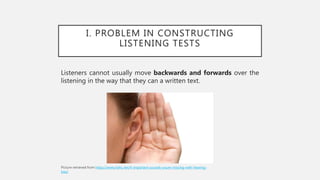
Listeners cannot usually move backwards and forwards over the
listening in the way that they can a written text.
https://www.hahc.net/4-important-sounds-youre-missing-with-hearing-
loss/
II. SPECIFICATIONS
We need the specifications in order to inform the listeners about
the test that they will carry out.
The specifications are the description of
what the candidates should be able to
do.
https://www.urbanears.com/ue_gb_en/plattan
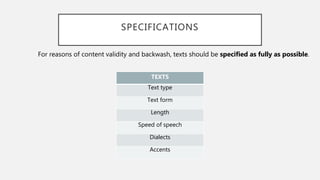
SPECIFICATIONS
TEXTS
Text type
Text form
Length
Speed of speech
Dialects
Accents
For reasons of content validity and backwash, texts should be specified as fully as possible.
III. SETTING THE TASKS
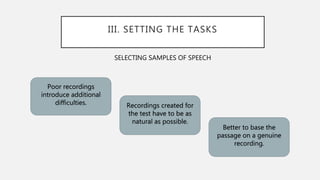
Poor recordings
introduce additional
difficulties. Recordings created for
the test have to be as
natural as possible.
Better to base the
passage on a genuine
recording.
SELECTING SAMPLES OF SPEECH
SETTING THE TASKS
WRITING ITEMS
FOR EXTENDED
LISTENING:
Keep items sufficiently
far apart in the passage.
Candidates should be
warned by KEY WORDS
both in the passage and
item.
Sufficient time at the
start to familiarize
themselves with the
items.
https://ru.pngtree.com/freepng/hand-holding-a-pencil_2413892.html
SETTING THE TASKS
POSSIBLE TECHNIQUES
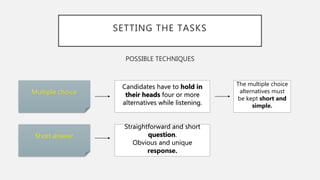
Multiple choice
Short answer
The multiple choice
alternatives must
be kept short and
simple.
Candidates have to hold in
their heads four or more
alternatives while listening.
Straightforward and short
question.
Obvious and unique
response.
SETTING THE TASKS
POSSIBLE TECHNIQUES
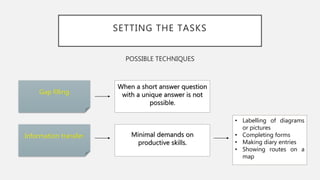
Gap filling
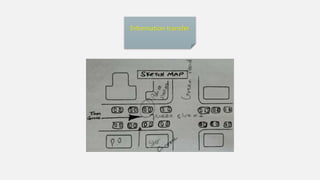
Information transfer
• Labelling of diagrams
or pictures
• Completing forms
• Making diary entries
• Showing routes on a
map
When a short answer question
with a unique answer is not
possible.
Minimal demands on
productive skills.
Information transfer
SETTING THE TASKS
POSSIBLE TECHNIQUES
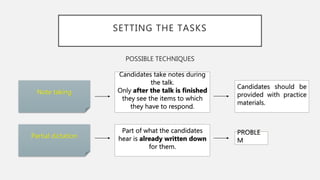
Note taking
Partial dictation
PROBLE
M
Candidates take notes during
the talk.
Only after the talk is finished
they see the items to which
they have to respond.
Part of what the candidates
hear is already written down
for them.
Candidates should be
provided with practice
materials.
SETTING THE TASKS
POSSIBLE TECHNIQUES
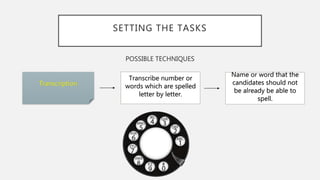
Transcription
Transcribe number or
words which are spelled
letter by letter.
Name or word that the
candidates should not
be already be able to
spell.
IV. SCORING THE LISTENING TEST
Do the testers have to deduct points for
grammar or spelling mistakes in listening
tests?
Listening is a receptive skill.
http://teachinglearnerswithmultipleneeds.blogspot.com/2012/11/the-yesno-series-part-
one.html
V. MAKING EASIER LISTENING
ASSESSMENT
• Base assessment on learning objectives and listening tasks of
the unit / course.
• Specifications as complete as possible.
• Minimize anxiety
• Ensure all the test takers can hear/see the audio/video and that
there are not distracting noises.
• Decide beforehand how questions will be marked and inform
the test takers about it.
• Ensure the number of possible answers to open-ended
questions is limited so that marking is easy and fair to all test
VI. THE IMPORTANCE OF LISTENING
SKILLS
• Listening is often seen the most
difficult skill to test.
• It is very important since we
cannot have any communication
without understating.
https://recast.ai/blog/understanding-word-understand-language/
VII. REFERENCES
• British Council. (n.d.) Assessing Listening. Retrieved from
https://www.britishcouncil.org/exam/aptis/research/projects/assessment
-literacy/listening
• Hughes, A. (2002). Testing listening. In Testing for Language
Teachers (Cambridge Language Teaching Library, pp. 160-171).
Cambridge: Cambridge University Press.
doi:10.1017/CBO9780511732980.013
• Karavas, K. (n.d.) Testing Listening Comprehension [PowerPoint slides].
Retrieved from
https://eclass.uoa.gr/modules/document/file.php/ENL264/testing%20list
ening%20final.ppt
PPT_Testing Listening_Claudia Cavada

PPT_Testing Listening_Claudia Cavada

  • 1.
    TESTING LISTENING Testing forLanguage Teachers Chapter 12 by Arthur Hughes Claudia Cavada presents:
  • 2.
    INDEX I. Problems inconstructing listening tests. II. Specifications. III. Setting the tasks. IV. Scoring the listening test. V. Making easier listening assessment. VI. The importance of listening skills. VII. References.
  • 3.
    I. PROBLEM INCONSTRUCTING LISTENING TESTS Listeners cannot usually move backwards and forwards over the listening in the way that they can a written text. https://www.hahc.net/4-important-sounds-youre-missing-with-hearing- loss/
  • 4.
    II. SPECIFICATIONS We needthe specifications in order to inform the listeners about the test that they will carry out. The specifications are the description of what the candidates should be able to do. https://www.urbanears.com/ue_gb_en/plattan
  • 5.
    SPECIFICATIONS TEXTS Text type Text form Length Speedof speech Dialects Accents For reasons of content validity and backwash, texts should be specified as fully as possible.
  • 6.
    III. SETTING THETASKS Poor recordings introduce additional difficulties. Recordings created for the test have to be as natural as possible. Better to base the passage on a genuine recording. SELECTING SAMPLES OF SPEECH
  • 7.
    SETTING THE TASKS WRITINGITEMS FOR EXTENDED LISTENING: Keep items sufficiently far apart in the passage. Candidates should be warned by KEY WORDS both in the passage and item. Sufficient time at the start to familiarize themselves with the items. https://ru.pngtree.com/freepng/hand-holding-a-pencil_2413892.html
  • 8.
    SETTING THE TASKS POSSIBLETECHNIQUES Multiple choice Short answer The multiple choice alternatives must be kept short and simple. Candidates have to hold in their heads four or more alternatives while listening. Straightforward and short question. Obvious and unique response.
  • 9.
    SETTING THE TASKS POSSIBLETECHNIQUES Gap filling Information transfer • Labelling of diagrams or pictures • Completing forms • Making diary entries • Showing routes on a map When a short answer question with a unique answer is not possible. Minimal demands on productive skills.
  • 10.
  • 11.
    SETTING THE TASKS POSSIBLETECHNIQUES Note taking Partial dictation PROBLE M Candidates take notes during the talk. Only after the talk is finished they see the items to which they have to respond. Part of what the candidates hear is already written down for them. Candidates should be provided with practice materials.
  • 12.
    SETTING THE TASKS POSSIBLETECHNIQUES Transcription Transcribe number or words which are spelled letter by letter. Name or word that the candidates should not be already be able to spell.
  • 13.
    IV. SCORING THELISTENING TEST Do the testers have to deduct points for grammar or spelling mistakes in listening tests? Listening is a receptive skill. http://teachinglearnerswithmultipleneeds.blogspot.com/2012/11/the-yesno-series-part- one.html
  • 14.
    V. MAKING EASIERLISTENING ASSESSMENT • Base assessment on learning objectives and listening tasks of the unit / course. • Specifications as complete as possible. • Minimize anxiety • Ensure all the test takers can hear/see the audio/video and that there are not distracting noises. • Decide beforehand how questions will be marked and inform the test takers about it. • Ensure the number of possible answers to open-ended questions is limited so that marking is easy and fair to all test
  • 15.
    VI. THE IMPORTANCEOF LISTENING SKILLS • Listening is often seen the most difficult skill to test. • It is very important since we cannot have any communication without understating. https://recast.ai/blog/understanding-word-understand-language/
  • 16.
    VII. REFERENCES • BritishCouncil. (n.d.) Assessing Listening. Retrieved from https://www.britishcouncil.org/exam/aptis/research/projects/assessment -literacy/listening • Hughes, A. (2002). Testing listening. In Testing for Language Teachers (Cambridge Language Teaching Library, pp. 160-171). Cambridge: Cambridge University Press. doi:10.1017/CBO9780511732980.013 • Karavas, K. (n.d.) Testing Listening Comprehension [PowerPoint slides]. Retrieved from https://eclass.uoa.gr/modules/document/file.php/ENL264/testing%20list ening%20final.ppt