Needs analysis for
curriculum design
Ana Bocanegra-Valle
PhD in Applied Linguistics
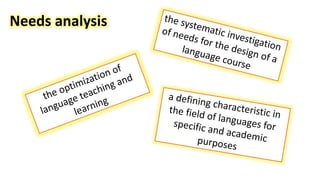
Needs analysis
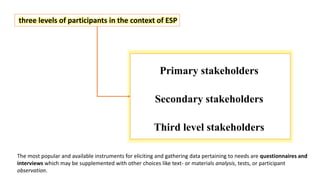
three levels of participants in the context of ESP
Primary stakeholders
Secondary stakeholders
Third level stakeholders
The most popular and available instruments for eliciting and gathering data pertaining to needs are questionnaires and
interviews which may be supplemented with other choices like text- or materials analysis, tests, or participant
observation.
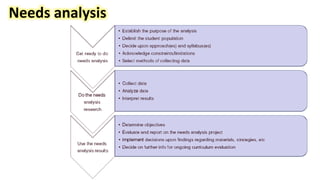
Needs analysis
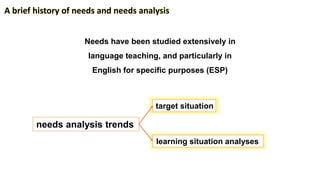
Needs have been studied extensively in
language teaching, and particularly in
English for specific purposes (ESP)
A brief history of needs and needs analysis
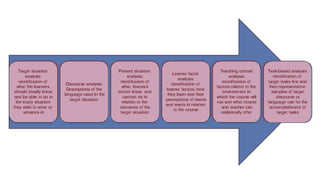
target situation
learning situation analyses
needs analysis trends
 An efficient needs analysis should involve different stakeholders
 Needs are neither universal nor everlasting
 An efficient needs analysis should be systematic and based on a
triangulation of research methods, data gathering techniques and sources
 Needs analysis is fundamental to curriculum renewal, course and syllabus
design, materials development and methodology updating
 Needs analysis favors the integration of EAP with disciplinary programs
critical issues
An efficient needs analysis should involve different stakehold
Data should be gathered from different stakeholder groups
diverse participant sources will provide a more
complete picture of the whole set of needs
different parties may be concerned with different needs
students alone may not be a reliable source of information
because they are not fully familiar with the teaching context.
needs are “jointly constructed between teachers and learners
Needs are neither universal nor everlasting
Needs vary across educational contexts,
disciplines and student groups
the far-reaching expectations of today’s
globalized society contribute to the
identification of “glocal needs”
a needs analysis cannot be generalizable
An efficient needs analysis should be systematic and based on a
triangulation of research methods, data gathering techniques and sources
Need analysis through non empirical ways such as questionnaire
are considered slipshod techniques that should be avoided.
The use of multiple sources, multiple methods and multiple rounds
of data collection are important to build consensus and to support
the reliability and validity of the needs analysis.
Instead needs analyses should be conducted
with a “mixed-methodology approach"
Needs analysis is fundamental to curriculum renewal, course and
syllabus design, materials development and methodology updating
• EAP courses should not only be skills-based but promote the development of subject-specific
vocabulary and be customized with the core subject in mind.
• EAP courses should foster learner-centered approaches, self-direction and greater autonomy.
• EAP courses should link learning targets to the disciplines and professions, particularly
regarding oral communication and task attainment.
• EAP courses should be more focused on genres and disciplinary discourse rather than
linguistic features.
• EAP courses should be re-evaluated and renewed on the basis of proper needs analyses, and
changes regarding learning objectives, teaching method, materials, etc. should be applied
accordingly.
• EAP courses should supply support services for discourse discipline-specific tasks and for
internationalized classrooms
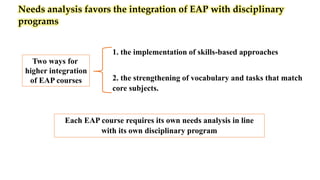
Needs analysis favors the integration of EAP with disciplinary
programs
1. the implementation of skills-based approaches
2. the strengthening of vocabulary and tasks that match
core subjects.
Each EAP course requires its own needs analysis in line
with its own disciplinary program
Two ways for
higher integration
of EAP courses
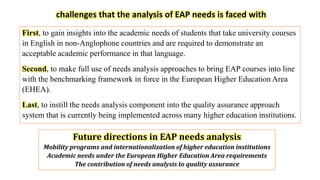
First, to gain insights into the academic needs of students that take university courses
in English in non-Anglophone countries and are required to demonstrate an
acceptable academic performance in that language.
Second, to make full use of needs analysis approaches to bring EAP courses into line
with the benchmarking framework in force in the European Higher Education Area
(EHEA).
Last, to instill the needs analysis component into the quality assurance approach
system that is currently being implemented across many higher education institutions.
challenges that the analysis of EAP needs is faced with
Future directions in EAP needs analysis
Mobility programs and internationalization of higher education institutions
Academic needs under the European Higher Education Area requirements
The contribution of needs analysis to quality assurance
Mobility programs and internationalization of higher education
institutions
the greater mobility of students and teachers
across countries
In this new context special needs arise, new
challenges are created and problems that already
exist are made “more acute and more explicit”.
EAP class groups are more heterogeneous than ever
Academic needs under the European Higher Education Area
requirements
Needs analysis plays a fundamental role in methodological principle of
the Council of Europe’s educational model.
CEFR (Common European Framework of References for Languages) is a
guideline used to describe achievements of learners of foreign
languages across Europe and, increasingly, in other countries.
knowledge of the needs, drives, motivations and interests of individual
learners in their social context will make informed decisions for setting the
aims and objectives of language learning and teaching, and it is rich in
references to the needs of both learners and society
The contribution of needs analysis to quality assurance
EAQUALS (Evaluation and Accreditation of Quality in Language Services) is the
leading professional association for language education throughout the world.
it shows particular concern about the identification of learners’ needs, and notes
the diagnosis and revision of course participants’ needs as one of the main focus
points in the inspection process.
Quality means “client satisfaction”
“need to take greater account of client needs”
A quality assurance approach supervises whether, to what extent, teaching
materials etc. have been developed in relation to learning objectives, and whether,
and to what extent, these learning objectives have been attained and, therefore,
whether, and to what extent, students’ needs have been covered.
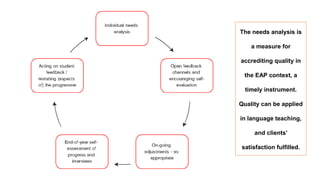
The needs analysis is
a measure for
accrediting quality in
the EAP context, a
timely instrument.
Quality can be applied
in language teaching,
and clients’
satisfaction fulfilled.
Thank you
for yourattention

Needs analysis for curriculum design

  • 1.
    Needs analysis for curriculumdesign Ana Bocanegra-Valle PhD in Applied Linguistics
  • 2.
  • 3.
    three levels ofparticipants in the context of ESP Primary stakeholders Secondary stakeholders Third level stakeholders The most popular and available instruments for eliciting and gathering data pertaining to needs are questionnaires and interviews which may be supplemented with other choices like text- or materials analysis, tests, or participant observation.
  • 4.
  • 5.
    Needs have beenstudied extensively in language teaching, and particularly in English for specific purposes (ESP) A brief history of needs and needs analysis target situation learning situation analyses needs analysis trends
  • 7.
     An efficientneeds analysis should involve different stakeholders  Needs are neither universal nor everlasting  An efficient needs analysis should be systematic and based on a triangulation of research methods, data gathering techniques and sources  Needs analysis is fundamental to curriculum renewal, course and syllabus design, materials development and methodology updating  Needs analysis favors the integration of EAP with disciplinary programs critical issues
  • 8.
    An efficient needsanalysis should involve different stakehold Data should be gathered from different stakeholder groups diverse participant sources will provide a more complete picture of the whole set of needs different parties may be concerned with different needs students alone may not be a reliable source of information because they are not fully familiar with the teaching context. needs are “jointly constructed between teachers and learners
  • 9.
    Needs are neitheruniversal nor everlasting Needs vary across educational contexts, disciplines and student groups the far-reaching expectations of today’s globalized society contribute to the identification of “glocal needs” a needs analysis cannot be generalizable
  • 10.
    An efficient needsanalysis should be systematic and based on a triangulation of research methods, data gathering techniques and sources Need analysis through non empirical ways such as questionnaire are considered slipshod techniques that should be avoided. The use of multiple sources, multiple methods and multiple rounds of data collection are important to build consensus and to support the reliability and validity of the needs analysis. Instead needs analyses should be conducted with a “mixed-methodology approach"
  • 11.
    Needs analysis isfundamental to curriculum renewal, course and syllabus design, materials development and methodology updating • EAP courses should not only be skills-based but promote the development of subject-specific vocabulary and be customized with the core subject in mind. • EAP courses should foster learner-centered approaches, self-direction and greater autonomy. • EAP courses should link learning targets to the disciplines and professions, particularly regarding oral communication and task attainment. • EAP courses should be more focused on genres and disciplinary discourse rather than linguistic features. • EAP courses should be re-evaluated and renewed on the basis of proper needs analyses, and changes regarding learning objectives, teaching method, materials, etc. should be applied accordingly. • EAP courses should supply support services for discourse discipline-specific tasks and for internationalized classrooms
  • 12.
    Needs analysis favorsthe integration of EAP with disciplinary programs 1. the implementation of skills-based approaches 2. the strengthening of vocabulary and tasks that match core subjects. Each EAP course requires its own needs analysis in line with its own disciplinary program Two ways for higher integration of EAP courses
  • 13.
    First, to gaininsights into the academic needs of students that take university courses in English in non-Anglophone countries and are required to demonstrate an acceptable academic performance in that language. Second, to make full use of needs analysis approaches to bring EAP courses into line with the benchmarking framework in force in the European Higher Education Area (EHEA). Last, to instill the needs analysis component into the quality assurance approach system that is currently being implemented across many higher education institutions. challenges that the analysis of EAP needs is faced with Future directions in EAP needs analysis Mobility programs and internationalization of higher education institutions Academic needs under the European Higher Education Area requirements The contribution of needs analysis to quality assurance
  • 14.
    Mobility programs andinternationalization of higher education institutions the greater mobility of students and teachers across countries In this new context special needs arise, new challenges are created and problems that already exist are made “more acute and more explicit”. EAP class groups are more heterogeneous than ever
  • 15.
    Academic needs underthe European Higher Education Area requirements Needs analysis plays a fundamental role in methodological principle of the Council of Europe’s educational model. CEFR (Common European Framework of References for Languages) is a guideline used to describe achievements of learners of foreign languages across Europe and, increasingly, in other countries. knowledge of the needs, drives, motivations and interests of individual learners in their social context will make informed decisions for setting the aims and objectives of language learning and teaching, and it is rich in references to the needs of both learners and society
  • 16.
    The contribution ofneeds analysis to quality assurance EAQUALS (Evaluation and Accreditation of Quality in Language Services) is the leading professional association for language education throughout the world. it shows particular concern about the identification of learners’ needs, and notes the diagnosis and revision of course participants’ needs as one of the main focus points in the inspection process. Quality means “client satisfaction” “need to take greater account of client needs” A quality assurance approach supervises whether, to what extent, teaching materials etc. have been developed in relation to learning objectives, and whether, and to what extent, these learning objectives have been attained and, therefore, whether, and to what extent, students’ needs have been covered.
  • 17.
    The needs analysisis a measure for accrediting quality in the EAP context, a timely instrument. Quality can be applied in language teaching, and clients’ satisfaction fulfilled.
  • 18.