Assessing Receptive Skills
(Reading & Listening)
 Teacher Trainees:
Hasna Bouhmad
Lahcen Biznoukad
 Trainer:
Ayad Charaa
Departm
ent of
English
Outline
Introduction:Definition
Historical Background
Models of reading
Assessing Grammar and
vocabulary
Types of reading
Assessment Tasks
Assessing Reading Assessing Listening
Introduction: Definition
Models of
Listening:Micro and
macro skills
Types of listening
Types of Listening
Assessment Tasks
Language teachers understand that reading is an
essential skill and employ numerous strategies to help
learners become better readers. However, as a
receptive skill, the process of reading cannot be
directly observed, nor is there a “ product” from
reading that can be objectively assessed as there is in
writing and speaking. Therefore the assessment of
reading focuses on a variety of subskills that contribute
to the total process of making meaning from printed
material.
Introduction
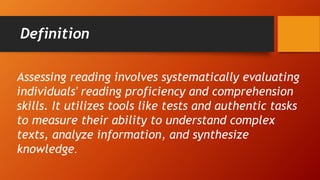
Definition
Assessing reading involves systematically evaluating
individuals' reading proficiency and comprehension
skills. It utilizes tools like tests and authentic tasks
to measure their ability to understand complex
texts, analyze information, and synthesize
knowledge.
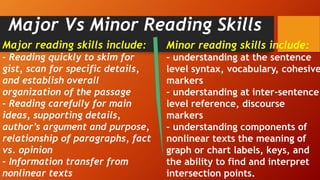
Major Vs Minor Reading Skills
Major reading skills include:
– Reading quickly to skim for
gist, scan for specific details,
and establish overall
organization of the passage
– Reading carefully for main
ideas, supporting details,
author’s argument and purpose,
relationship of paragraphs, fact
vs. opinion
– Information transfer from
nonlinear texts
Minor reading skills include:
– understanding at the sentence
level syntax, vocabulary, cohesive
markers
– understanding at inter-sentence
level reference, discourse
markers
– understanding components of
nonlinear texts the meaning of
graph or chart labels, keys, and
the ability to find and interpret
intersection points.
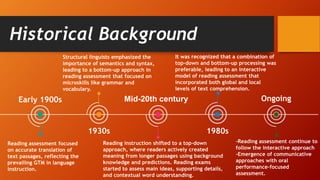
Historical Background
Early 1900s
Reading assessment focused
on accurate translation of
text passages, reflecting the
prevailing GTM in language
instruction.
1930s
Structural linguists emphasized the
importance of semantics and syntax,
leading to a bottom-up approach in
reading assessment that focused on
microskills like grammar and
vocabulary.
Mid-20th century
Reading instruction shifted to a top-down
approach, where readers actively created
meaning from longer passages using background
knowledge and predictions. Reading exams
started to assess main ideas, supporting details,
and contextual word understanding.
1980s
It was recognized that a combination of
top-down and bottom-up processing was
preferable, leading to an interactive
model of reading assessment that
incorporated both global and local
levels of text comprehension.
Ongoing
-Reading assessment continue to
follow the interactive approach
-Emergence of communicative
approaches with oral
performance-focused
assessment.
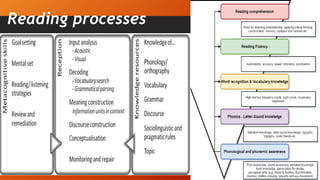
Reading processes
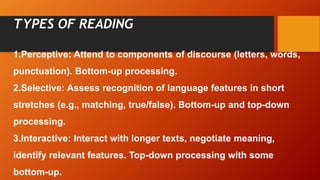
TYPES OF READING
1.Perceptive: Attend to components of discourse (letters, words,
punctuation). Bottom-up processing.
2.Selective: Assess recognition of language features in short
stretches (e.g., matching, true/false). Bottom-up and top-down
processing.
3.Interactive: Interact with longer texts, negotiate meaning,
identify relevant features. Top-down processing with some
bottom-up.
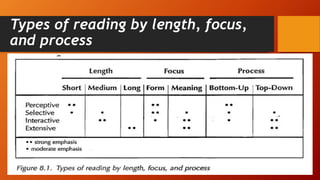
Types of reading by length, focus,
and process
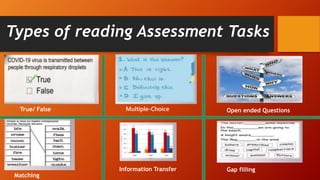
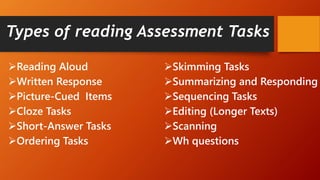
Types of reading Assessment Tasks
Information Transfer Gap filling
Open ended Questions
Multiple-Choice
True/ False
Matching
Reading Aloud
Written Response
Picture-Cued Items
Cloze Tasks
Short-Answer Tasks
Ordering Tasks
Skimming Tasks
Summarizing and Responding
Sequencing Tasks
Editing (Longer Texts)
Scanning
Wh questions
Types of reading Assessment Tasks
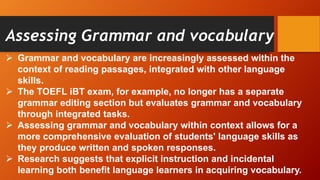
Assessing Grammar and vocabulary
 Grammar and vocabulary are increasingly assessed within the
context of reading passages, integrated with other language
skills.
 The TOEFL iBT exam, for example, no longer has a separate
grammar editing section but evaluates grammar and vocabulary
through integrated tasks.
 Assessing grammar and vocabulary within context allows for a
more comprehensive evaluation of students' language skills as
they produce written and spoken responses.
 Research suggests that explicit instruction and incidental
learning both benefit language learners in acquiring vocabulary.
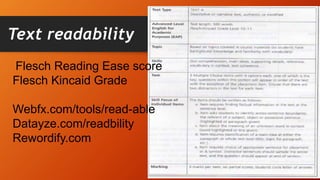
Text readability
Flesch Reading Ease score
Flesch Kincaid Grade
Webfx.com/tools/read-able
Datayze.com/readbility
Rewordify.com
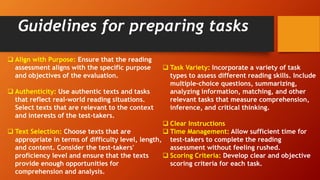
Guidelines for preparing tasks
 Align with Purpose: Ensure that the reading
assessment aligns with the specific purpose
and objectives of the evaluation.
 Authenticity: Use authentic texts and tasks
that reflect real-world reading situations.
Select texts that are relevant to the context
and interests of the test-takers.
 Text Selection: Choose texts that are
appropriate in terms of difficulty level, length,
and content. Consider the test-takers'
proficiency level and ensure that the texts
provide enough opportunities for
comprehension and analysis.
 Task Variety: Incorporate a variety of task
types to assess different reading skills. Include
multiple-choice questions, summarizing,
analyzing information, matching, and other
relevant tasks that measure comprehension,
inference, and critical thinking.
 Clear Instructions
 Time Management: Allow sufficient time for
test-takers to complete the reading
assessment without feeling rushed.
 Scoring Criteria: Develop clear and objective
scoring criteria for each task.
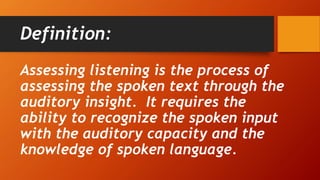
Definition:
Assessing listening is the process of
assessing the spoken text through the
auditory insight. It requires the
ability to recognize the spoken input
with the auditory capacity and the
knowledge of spoken language.
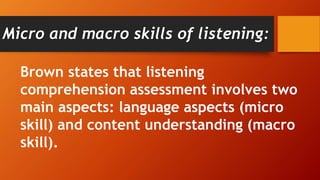
Brown states that listening
comprehension assessment involves two
main aspects: language aspects (micro
skill) and content understanding (macro
skill).
Micro and macro skills of listening:
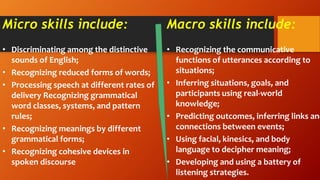
Micro skills include:
• Discriminating among the distinctive
sounds of English;
• Recognizing reduced forms of words;
• Processing speech at different rates of
delivery Recognizing grammatical
word classes, systems, and pattern
rules;
• Recognizing meanings by different
grammatical forms;
• Recognizing cohesive devices in
spoken discourse
Macro skills include:
• Recognizing the communicative
functions of utterances according to
situations;
• Inferring situations, goals, and
participants using real-world
knowledge;
• Predicting outcomes, inferring links and
connections between events;
• Using facial, kinesics, and body
language to decipher meaning;
• Developing and using a battery of
listening strategies.
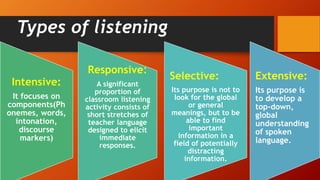
Types of listening
Intensive:
It focuses on
components(Ph
onemes, words,
intonation,
discourse
markers)
Responsive:
A significant
proportion of
classroom listening
activity consists of
short stretches of
teacher language
designed to elicit
immediate
responses.
Selective:
Its purpose is not to
look for the global
or general
meanings, but to be
able to find
important
information in a
field of potentially
distracting
information.
Extensive:
Its purpose is
to develop a
top-down,
global
understanding
of spoken
language.
Types of Listening Assessment Tasks
1.Comprehension Listening
It involves comprehending the speaker’s message based on
different features such as vocabulary, language skills,
perception.
2.Intensive Listening Tasks:
- Intensive listening assessments test the student’s ability to
recognize phonemes, morphemes, words and different
derivatives thereof, as well as discourse markers and intonation.
- This form of listening assessment assesses students’ ability to
correctly identify different phonemes and morphemes commonly
found in the English language.
Types of Listening Assessment Tasks
3.Responsive listening tasks:
Responsive listening is another task used in listening
assessments. It can be assessed in more than one
manner. It allows the students to actively participate and
produce the language through speaking or writing in
response to spoken stimulus.
Types of Listening Assessment Tasks
4- Selective Listening Tasks
It is when a student listens to a piece of information and must
discern specific information.
There are several activities for this task, such as:
• Listening cloze (students fill in the blanks);
• Chart completion (students feel in a grid);
• Sentence repetition (students repeat stimulus sentence).
Types of Listening Assessment Tasks
5- Extensive listening tasks
Extensive listening tasks focus on macro-skills of listening,
such as inferring situations, goals, and participants based
on real-world knowledge, distinguishing between implied
and literal meanings, and using a variety of listening
strategies such as detecting keywords and using context
to guess the meaning of a word.
Types of Listening Assessment Tasks
There are several activities for this task, such as:
Dictation
Dialogue
Lecture (students take notes, summarize, and list main points);
Interpretive tasks (students hear a poem – interpret meaning);
Stories, narrative (students retell a story).
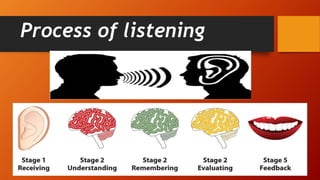
Process of listening
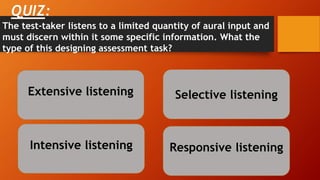
QUIZ:
Extensive listening
Intensive listening Responsive listening
Selective listening
The test-taker listens to a limited quantity of aural input and
must discern within it some specific information. What the
type of this designing assessment task?
QUIZ:
What techniques are needed by selective listening?
Dictation, authentic
listening tasks, and
communicative stimulus-
response
Listening cloze,
information transfer, and
sentence repetition
Recognizing phonological
and paraphrase
recognition
Note taking, editing,
interpretive tasks, and
retelling
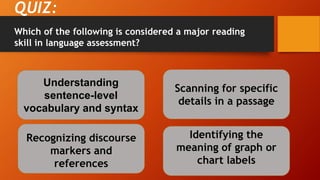
Understanding
sentence-level
vocabulary and syntax
Recognizing discourse
markers and
references
Identifying the
meaning of graph or
chart labels
Scanning for specific
details in a passage
QUIZ:
Which of the following is considered a major reading
skill in language assessment?
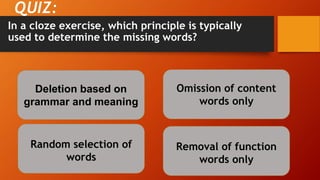
In a cloze exercise, which principle is typically
used to determine the missing words?
QUIZ:
Deletion based on
grammar and meaning
Random selection of
words
Removal of function
words only
Omission of content
words only
References:
• MacMillan, Fabiana M. "8. Assessing reading." Handbook of second language
assessment. De Gruyter Mouton, 2016. 113-130.
• Coombe, Christine Anne, Keith S. Folse, and Nancy J. Hubley. A practical guide to
assessing English language learners. University of Michigan Press, 2007.
• Spinelli, Cathleen G. Classroom Assessment for Students in Special and General
Education, 3/e. Pearson Education India, 2010.
• Alderson, Charles J., and J. Charles Alderson. Assessing reading. Cambridge
University Press, 2000.
• Hubley, Nancy J. "Reading Assessment." The TESOL Encyclopedia of English
Language Teaching (2018): 1-7.
• https://tenrycolle.com/skills/lisening/assessment-of-listening-skill/
• https://englishpost.org/how-to-assess-listening/
• https://www.coursesidekick.com/communications/study-guides/atd-fscj-
publicspeaking/types-of-listening

Assessing receptive skills.pptx

  • 1.
    Assessing Receptive Skills (Reading& Listening)  Teacher Trainees: Hasna Bouhmad Lahcen Biznoukad  Trainer: Ayad Charaa Departm ent of English
  • 2.
    Outline Introduction:Definition Historical Background Models ofreading Assessing Grammar and vocabulary Types of reading Assessment Tasks Assessing Reading Assessing Listening Introduction: Definition Models of Listening:Micro and macro skills Types of listening Types of Listening Assessment Tasks
  • 3.
    Language teachers understandthat reading is an essential skill and employ numerous strategies to help learners become better readers. However, as a receptive skill, the process of reading cannot be directly observed, nor is there a “ product” from reading that can be objectively assessed as there is in writing and speaking. Therefore the assessment of reading focuses on a variety of subskills that contribute to the total process of making meaning from printed material. Introduction
  • 4.
    Definition Assessing reading involvessystematically evaluating individuals' reading proficiency and comprehension skills. It utilizes tools like tests and authentic tasks to measure their ability to understand complex texts, analyze information, and synthesize knowledge.
  • 5.
    Major Vs MinorReading Skills Major reading skills include: – Reading quickly to skim for gist, scan for specific details, and establish overall organization of the passage – Reading carefully for main ideas, supporting details, author’s argument and purpose, relationship of paragraphs, fact vs. opinion – Information transfer from nonlinear texts Minor reading skills include: – understanding at the sentence level syntax, vocabulary, cohesive markers – understanding at inter-sentence level reference, discourse markers – understanding components of nonlinear texts the meaning of graph or chart labels, keys, and the ability to find and interpret intersection points.
  • 6.
    Historical Background Early 1900s Readingassessment focused on accurate translation of text passages, reflecting the prevailing GTM in language instruction. 1930s Structural linguists emphasized the importance of semantics and syntax, leading to a bottom-up approach in reading assessment that focused on microskills like grammar and vocabulary. Mid-20th century Reading instruction shifted to a top-down approach, where readers actively created meaning from longer passages using background knowledge and predictions. Reading exams started to assess main ideas, supporting details, and contextual word understanding. 1980s It was recognized that a combination of top-down and bottom-up processing was preferable, leading to an interactive model of reading assessment that incorporated both global and local levels of text comprehension. Ongoing -Reading assessment continue to follow the interactive approach -Emergence of communicative approaches with oral performance-focused assessment.
  • 7.
  • 8.
    TYPES OF READING 1.Perceptive:Attend to components of discourse (letters, words, punctuation). Bottom-up processing. 2.Selective: Assess recognition of language features in short stretches (e.g., matching, true/false). Bottom-up and top-down processing. 3.Interactive: Interact with longer texts, negotiate meaning, identify relevant features. Top-down processing with some bottom-up.
  • 9.
    Types of readingby length, focus, and process
  • 10.
    Types of readingAssessment Tasks Information Transfer Gap filling Open ended Questions Multiple-Choice True/ False Matching
  • 11.
    Reading Aloud Written Response Picture-CuedItems Cloze Tasks Short-Answer Tasks Ordering Tasks Skimming Tasks Summarizing and Responding Sequencing Tasks Editing (Longer Texts) Scanning Wh questions Types of reading Assessment Tasks
  • 12.
    Assessing Grammar andvocabulary  Grammar and vocabulary are increasingly assessed within the context of reading passages, integrated with other language skills.  The TOEFL iBT exam, for example, no longer has a separate grammar editing section but evaluates grammar and vocabulary through integrated tasks.  Assessing grammar and vocabulary within context allows for a more comprehensive evaluation of students' language skills as they produce written and spoken responses.  Research suggests that explicit instruction and incidental learning both benefit language learners in acquiring vocabulary.
  • 13.
    Text readability Flesch ReadingEase score Flesch Kincaid Grade Webfx.com/tools/read-able Datayze.com/readbility Rewordify.com
  • 14.
    Guidelines for preparingtasks  Align with Purpose: Ensure that the reading assessment aligns with the specific purpose and objectives of the evaluation.  Authenticity: Use authentic texts and tasks that reflect real-world reading situations. Select texts that are relevant to the context and interests of the test-takers.  Text Selection: Choose texts that are appropriate in terms of difficulty level, length, and content. Consider the test-takers' proficiency level and ensure that the texts provide enough opportunities for comprehension and analysis.  Task Variety: Incorporate a variety of task types to assess different reading skills. Include multiple-choice questions, summarizing, analyzing information, matching, and other relevant tasks that measure comprehension, inference, and critical thinking.  Clear Instructions  Time Management: Allow sufficient time for test-takers to complete the reading assessment without feeling rushed.  Scoring Criteria: Develop clear and objective scoring criteria for each task.
  • 15.
    Definition: Assessing listening isthe process of assessing the spoken text through the auditory insight. It requires the ability to recognize the spoken input with the auditory capacity and the knowledge of spoken language.
  • 16.
    Brown states thatlistening comprehension assessment involves two main aspects: language aspects (micro skill) and content understanding (macro skill). Micro and macro skills of listening:
  • 17.
    Micro skills include: •Discriminating among the distinctive sounds of English; • Recognizing reduced forms of words; • Processing speech at different rates of delivery Recognizing grammatical word classes, systems, and pattern rules; • Recognizing meanings by different grammatical forms; • Recognizing cohesive devices in spoken discourse Macro skills include: • Recognizing the communicative functions of utterances according to situations; • Inferring situations, goals, and participants using real-world knowledge; • Predicting outcomes, inferring links and connections between events; • Using facial, kinesics, and body language to decipher meaning; • Developing and using a battery of listening strategies.
  • 18.
    Types of listening Intensive: Itfocuses on components(Ph onemes, words, intonation, discourse markers) Responsive: A significant proportion of classroom listening activity consists of short stretches of teacher language designed to elicit immediate responses. Selective: Its purpose is not to look for the global or general meanings, but to be able to find important information in a field of potentially distracting information. Extensive: Its purpose is to develop a top-down, global understanding of spoken language.
  • 19.
    Types of ListeningAssessment Tasks 1.Comprehension Listening It involves comprehending the speaker’s message based on different features such as vocabulary, language skills, perception.
  • 20.
    2.Intensive Listening Tasks: -Intensive listening assessments test the student’s ability to recognize phonemes, morphemes, words and different derivatives thereof, as well as discourse markers and intonation. - This form of listening assessment assesses students’ ability to correctly identify different phonemes and morphemes commonly found in the English language. Types of Listening Assessment Tasks
  • 21.
    3.Responsive listening tasks: Responsivelistening is another task used in listening assessments. It can be assessed in more than one manner. It allows the students to actively participate and produce the language through speaking or writing in response to spoken stimulus. Types of Listening Assessment Tasks
  • 22.
    4- Selective ListeningTasks It is when a student listens to a piece of information and must discern specific information. There are several activities for this task, such as: • Listening cloze (students fill in the blanks); • Chart completion (students feel in a grid); • Sentence repetition (students repeat stimulus sentence). Types of Listening Assessment Tasks
  • 23.
    5- Extensive listeningtasks Extensive listening tasks focus on macro-skills of listening, such as inferring situations, goals, and participants based on real-world knowledge, distinguishing between implied and literal meanings, and using a variety of listening strategies such as detecting keywords and using context to guess the meaning of a word. Types of Listening Assessment Tasks
  • 24.
    Types of ListeningAssessment Tasks There are several activities for this task, such as: Dictation Dialogue Lecture (students take notes, summarize, and list main points); Interpretive tasks (students hear a poem – interpret meaning); Stories, narrative (students retell a story).
  • 25.
  • 26.
    QUIZ: Extensive listening Intensive listeningResponsive listening Selective listening The test-taker listens to a limited quantity of aural input and must discern within it some specific information. What the type of this designing assessment task?
  • 27.
    QUIZ: What techniques areneeded by selective listening? Dictation, authentic listening tasks, and communicative stimulus- response Listening cloze, information transfer, and sentence repetition Recognizing phonological and paraphrase recognition Note taking, editing, interpretive tasks, and retelling
  • 28.
    Understanding sentence-level vocabulary and syntax Recognizingdiscourse markers and references Identifying the meaning of graph or chart labels Scanning for specific details in a passage QUIZ: Which of the following is considered a major reading skill in language assessment?
  • 29.
    In a clozeexercise, which principle is typically used to determine the missing words? QUIZ: Deletion based on grammar and meaning Random selection of words Removal of function words only Omission of content words only
  • 30.
    References: • MacMillan, FabianaM. "8. Assessing reading." Handbook of second language assessment. De Gruyter Mouton, 2016. 113-130. • Coombe, Christine Anne, Keith S. Folse, and Nancy J. Hubley. A practical guide to assessing English language learners. University of Michigan Press, 2007. • Spinelli, Cathleen G. Classroom Assessment for Students in Special and General Education, 3/e. Pearson Education India, 2010. • Alderson, Charles J., and J. Charles Alderson. Assessing reading. Cambridge University Press, 2000. • Hubley, Nancy J. "Reading Assessment." The TESOL Encyclopedia of English Language Teaching (2018): 1-7. • https://tenrycolle.com/skills/lisening/assessment-of-listening-skill/ • https://englishpost.org/how-to-assess-listening/ • https://www.coursesidekick.com/communications/study-guides/atd-fscj- publicspeaking/types-of-listening