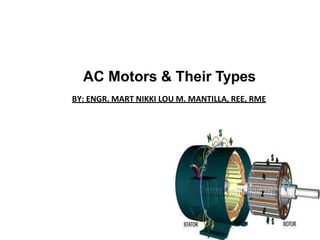
AC Motors & Their Types
BY: ENGR. MART NIKKI LOU M. MANTILLA, REE, RME
Topic Introduction
 What is an Electric
Motor?
 Electromechanical device that converts electrical
energy to mechanical energy.
 Mechanical energy used to e.g.
 Rotate pump impeller, fan, blower
 Drive compressors
 Lift materials
 Motors in industry: 70% of electrical load.
Principle of how motors work
Structural Design
 An electric motor is all about magnets and
magnetism: A motor uses magnets to create motion.
 A motor is consist of two magnets.
Classification of Motors
Electric Motors
Alternating Current (AC)
Motors
Direct Current (DC)
Motors
Synchronous Induction
Three-Phase
Single-Phase
Self Excited
Separately
Excited
Series Shunt
Compound
AC Motors
Alternating Current (AC)
Motors
Synchronous Induction
Three-Phase
Single-Phase
AC Motors
 Electrical current reverses direction
 Two parts: stator and rotor
 Stator: stationary electrical component
 Rotor: rotates the motor shaft
Two types
• Synchronous motor
• Induction motor
stator
rotor
Induction motors
Induction motors can be classified into two
main groups:
single-phase induction motors
three-phase induction motors
Single-phase induction motors:
These only have one stator winding, operate with a
single-phase power supply...
Three –phase induction motors:
The use three sets of stator coils the rotating
magnetic field drags the rotor around with it.
Induction motors
•Induction motors are the most common motors used for
various equipments in industry.
Components
Rotor
• Squirrel cage
• Wound rotor
Stator
Single Induction motor
•Single phase motors are very widely used in
home, offices, workshops etc. as power
delivered to most of the houses and offices is
single phase. In addition to this, single phase
motors are reliable, cheap in cost, simple in
construction and easy to repair.
3 phase Induction Motor
• Stator
As its name indicate stator is a stationary part of induction motor. A
three phase supply is given to the stator of induction motor.
• Rotor
The rotor is a rotating part of induction motor. The rotor is connected to
the mechanical load through the shaft. The rotor of the three phase
induction motor are further classified as
• Squirrel cage rotor
• Slip ring rotor or wound rotor or phase wound rotor
Squirrel Cage Induction Motor
• Advantages of squirrel cage induction rotor
1. Its construction is very simple and rugged
2. as there are no brushes and slip ring, these
motors requires less maintenance.
• Applications:
Squirrel cage induction motor is used in lathes, drilling
machine, fan, blower printing machines etc
Slip Ring Induction Motor
• Slip ring or wound three phase induction motor : In this
type of three phase induction motor the rotor is wound
for the same number of poles as that of stator but it has
less number of slots and has less turns per phase of a
heavier conductor.The rotor also carries star or delta
winding similar to that of stator winding. The rotor
consists of numbers of slots and rotor winding are
placed inside these slots.
• Advantages of slip ring induction motor
1. It has high starting torque and low starting
current.
2. Possibility of adding additional resistance to
control speed
• Applications:
Slip ring induction motor are used where high
starting torque is required i.e in hoists, cranes,
elevator etc
Synchronous motor
 As the name suggests
Synchronous motors are
capable of running at
constant speed irrespective
of the load acting on them.
 Synchronous motors have
got higher efficiency than
its counterparts. Its
efficiency ranges from 90 –
92%.
AC Synchronous motor
Stator: It carries three phase winding and is fed from 3-phase
supply.
Rotor: It carries permanent magnet poles that rotate exactly
with same speed as that of the stator magnetic field, hence
the name synchronous motor.
It is not self starting.
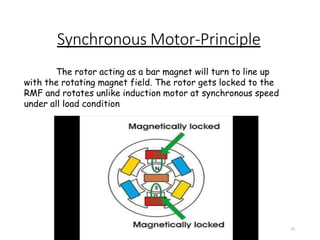
Synchronous Motor-Principle
22
The rotor acting as a bar magnet will turn to line up
with the rotating magnet field. The rotor gets locked to the
RMF and rotates unlike induction motor at synchronous speed
under all load condition
Synchronous Speed
Speed at which RMF rotates or Synchronous speed can easily
be derived as follows,
speed of synchronous motor can be very
accurately controlled. This is the reason why
they are suitable for high precision
applications.
Why Synchronous motors are not self starting ?
North Pole of the Rotor will obviously
get attracted by South Pole of RMF,
and will start to move in the same
direction. But since the rotor has got
some inertia, this starting speed will
be very low. So it will give repulsive
force. This will make the rotor move
backward. As a net effect the rotor
won’t be able to start.
Making Synchronous Motor Self Start
• To make synchronous motor self start, a squirrel cage
arrangement is cleverly fitted through pole tips. They are
also called as damper windings.
At the starting rotor field coils are not energized.
So with revolving magnetic field, electricity is
induced in squirrel cage bars and rotor starts
rotating just like an induction motor starts.
Out of Synchronism
•Synchronous motors will produce constant speed
irrespective of motor load only if the load is within
the capability of motor. If external torque load is
more than torque produced by the motor, it will slip
out of synchronism and will come to rest. Low supply
voltage and excitation voltage are other reasons of
going out of synchronism
Application of Synchronous
Motor
•Synchronous motor having no load connected to its shaft is used for
power factor improvement. it is used in power system in situations
where static capacitors are expensive.
•Synchronous motor finds application where operating speed is less
(around 500 rpm) and high power is required. For power requirement
from 35 kW to 2500KW, the size, weight and cost of the
corresponding induction motor is very high. Hence these motors are
preferably used. Ex- Reciprocating pump, compressor, rolling mills etc
THANK YOU….

TOPIC 4.1- A.C. Motors.pptx

  • 1.
    AC Motors &Their Types BY: ENGR. MART NIKKI LOU M. MANTILLA, REE, RME
  • 2.
    Topic Introduction  Whatis an Electric Motor?  Electromechanical device that converts electrical energy to mechanical energy.  Mechanical energy used to e.g.  Rotate pump impeller, fan, blower  Drive compressors  Lift materials  Motors in industry: 70% of electrical load.
  • 3.
    Principle of howmotors work
  • 4.
    Structural Design  Anelectric motor is all about magnets and magnetism: A motor uses magnets to create motion.  A motor is consist of two magnets.
  • 5.
    Classification of Motors ElectricMotors Alternating Current (AC) Motors Direct Current (DC) Motors Synchronous Induction Three-Phase Single-Phase Self Excited Separately Excited Series Shunt Compound
  • 6.
    AC Motors Alternating Current(AC) Motors Synchronous Induction Three-Phase Single-Phase
  • 7.
    AC Motors  Electricalcurrent reverses direction  Two parts: stator and rotor  Stator: stationary electrical component  Rotor: rotates the motor shaft Two types • Synchronous motor • Induction motor stator rotor
  • 8.
    Induction motors Induction motorscan be classified into two main groups: single-phase induction motors three-phase induction motors Single-phase induction motors: These only have one stator winding, operate with a single-phase power supply... Three –phase induction motors: The use three sets of stator coils the rotating magnetic field drags the rotor around with it.
  • 9.
    Induction motors •Induction motorsare the most common motors used for various equipments in industry. Components Rotor • Squirrel cage • Wound rotor Stator
  • 10.
    Single Induction motor •Singlephase motors are very widely used in home, offices, workshops etc. as power delivered to most of the houses and offices is single phase. In addition to this, single phase motors are reliable, cheap in cost, simple in construction and easy to repair.
  • 15.
    3 phase InductionMotor • Stator As its name indicate stator is a stationary part of induction motor. A three phase supply is given to the stator of induction motor. • Rotor The rotor is a rotating part of induction motor. The rotor is connected to the mechanical load through the shaft. The rotor of the three phase induction motor are further classified as • Squirrel cage rotor • Slip ring rotor or wound rotor or phase wound rotor
  • 16.
  • 17.
    • Advantages ofsquirrel cage induction rotor 1. Its construction is very simple and rugged 2. as there are no brushes and slip ring, these motors requires less maintenance. • Applications: Squirrel cage induction motor is used in lathes, drilling machine, fan, blower printing machines etc
  • 18.
    Slip Ring InductionMotor • Slip ring or wound three phase induction motor : In this type of three phase induction motor the rotor is wound for the same number of poles as that of stator but it has less number of slots and has less turns per phase of a heavier conductor.The rotor also carries star or delta winding similar to that of stator winding. The rotor consists of numbers of slots and rotor winding are placed inside these slots.
  • 19.
    • Advantages ofslip ring induction motor 1. It has high starting torque and low starting current. 2. Possibility of adding additional resistance to control speed • Applications: Slip ring induction motor are used where high starting torque is required i.e in hoists, cranes, elevator etc
  • 20.
    Synchronous motor  Asthe name suggests Synchronous motors are capable of running at constant speed irrespective of the load acting on them.  Synchronous motors have got higher efficiency than its counterparts. Its efficiency ranges from 90 – 92%.
  • 21.
    AC Synchronous motor Stator:It carries three phase winding and is fed from 3-phase supply. Rotor: It carries permanent magnet poles that rotate exactly with same speed as that of the stator magnetic field, hence the name synchronous motor. It is not self starting.
  • 22.
    Synchronous Motor-Principle 22 The rotoracting as a bar magnet will turn to line up with the rotating magnet field. The rotor gets locked to the RMF and rotates unlike induction motor at synchronous speed under all load condition
  • 23.
    Synchronous Speed Speed atwhich RMF rotates or Synchronous speed can easily be derived as follows, speed of synchronous motor can be very accurately controlled. This is the reason why they are suitable for high precision applications.
  • 24.
    Why Synchronous motorsare not self starting ? North Pole of the Rotor will obviously get attracted by South Pole of RMF, and will start to move in the same direction. But since the rotor has got some inertia, this starting speed will be very low. So it will give repulsive force. This will make the rotor move backward. As a net effect the rotor won’t be able to start.
  • 25.
    Making Synchronous MotorSelf Start • To make synchronous motor self start, a squirrel cage arrangement is cleverly fitted through pole tips. They are also called as damper windings. At the starting rotor field coils are not energized. So with revolving magnetic field, electricity is induced in squirrel cage bars and rotor starts rotating just like an induction motor starts.
  • 26.
    Out of Synchronism •Synchronousmotors will produce constant speed irrespective of motor load only if the load is within the capability of motor. If external torque load is more than torque produced by the motor, it will slip out of synchronism and will come to rest. Low supply voltage and excitation voltage are other reasons of going out of synchronism
  • 27.
    Application of Synchronous Motor •Synchronousmotor having no load connected to its shaft is used for power factor improvement. it is used in power system in situations where static capacitors are expensive. •Synchronous motor finds application where operating speed is less (around 500 rpm) and high power is required. For power requirement from 35 kW to 2500KW, the size, weight and cost of the corresponding induction motor is very high. Hence these motors are preferably used. Ex- Reciprocating pump, compressor, rolling mills etc
  • 28.