Protection of transformers
CONTENT
 Faults in transformer
 Protective Schemes of Transformers
 Buchholz Relay
 Earth-Fault or Leakage Protection
 Differential systems: (or circulating current system or
Merz-price circulating current)
BY: ENGR. MART NIKKI LOU M. MANTILLA, REE, RME
Protectionof Transformer
Protection of transformers
•Transformers are static devices, totally enclosed and generally oil
immersed. Therefore, chances of faults occurring on them are very
rare.
•The consequences of even a rare fault may be very serious unless
the transformer is quickly disconnected from the system.
Common transformer faults
(i) Open circuits
(ii) Over heating
(iii)Winding short-circuits e.g. earth-fault, phase to phase faults
and inter-turn faults.
Protectionof Transformer
•An open circuit faults in one phase of a 3-phase transformer may
cause undesirable heating. In practice relay protection is not
provided against open circuits because this condition is relatively
harmless.
•Over heating of the transformer is usually caused by sustained
overloads or short-circuits and very occasionally by the failure of
the cooling system.
•Winding short circuits also called as internal faults on the
transformer arise from corrosion of winding insulation due to
overheating or mechanical injury.
Protectionof Transformer
Protectionsystems for transformers
(i)Buchholz devices: Providing protection against all kinds of
incipient faults i.e. slow-developing fault such as insulation failure
of windings, core heating, fall of oil level due to leaky joins etc.
(ii) Earth-fault relays: Providing protection earth fault only
(iii)Over current relays: Providing protection mainly against
phase-phase faults and over loading
(iv) Differential systems: (or circulating current system)
Providing protection against both earth and phase faults.
Protectionof Transformer
The complete protection of transformer usually requires
the combination of these systems.
Choice of a particular combination of systems may depend
upon several factors such as
(a) size of the transformer (b) type of cooling (c) location of
transformer in the network (d) nature of load supplied
(e) importance of service for which transformer is required. In the
following sections, above systems
of protection will be discussed in detail.
Protectionof Transformer
Buchholz Relay
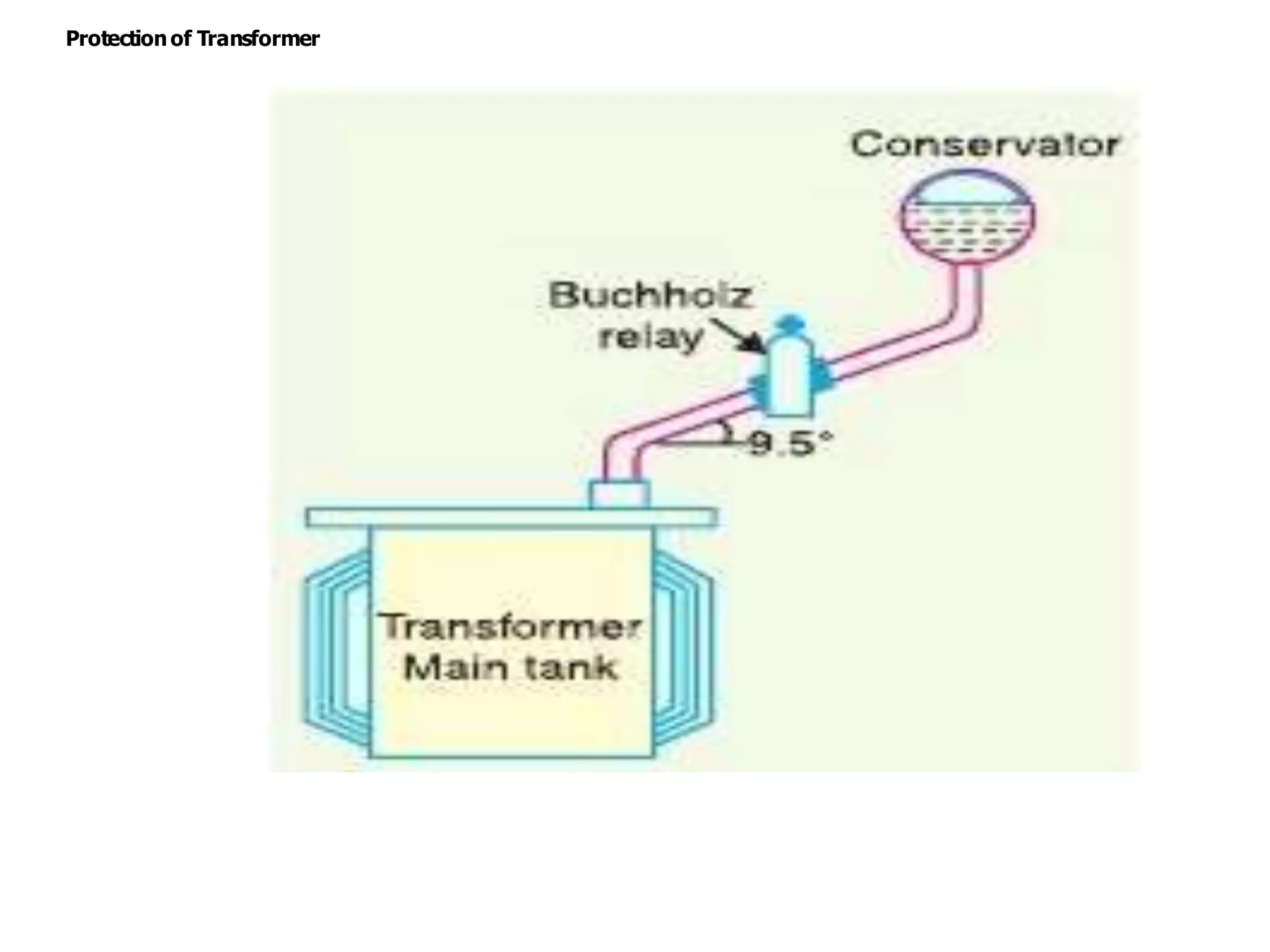
• Buchholz relay is a gas-actuated relay installed in oil
immersed transformers for protection against all kinds of faults.
• Buchholz, it is used to give an alarm in case of incipient (i.e.
slow-developing) faults in the transformer and to disconnect the
transformer from the supply in the event of severe internal faults.
• It is a universal practice to use Buchholz relays on all such oil
immersed transformers having ratings in excess of 750 kVA
Construction
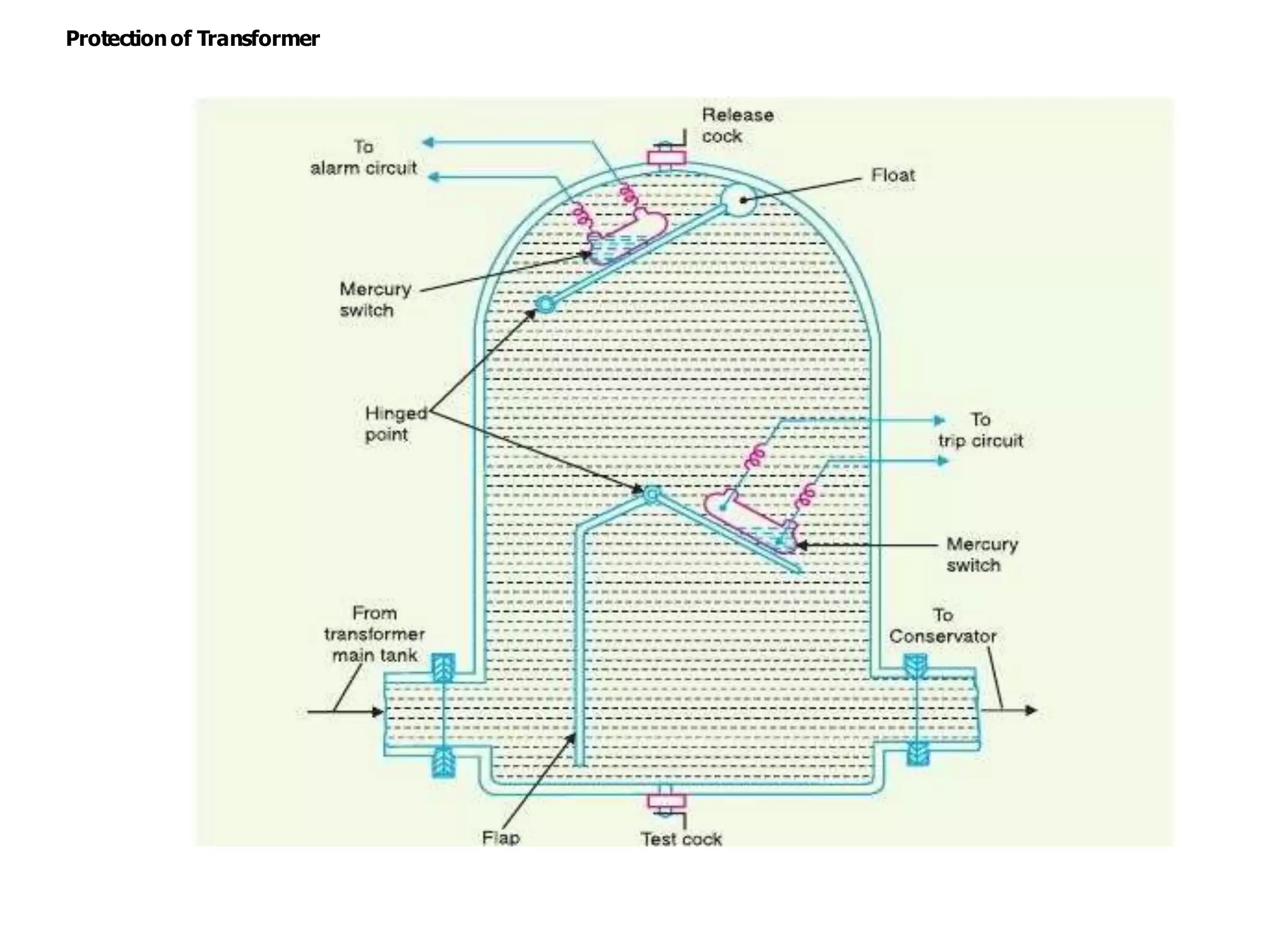
• The device has two elements. The upper element consists of a
mercury type switch attached to a float
• The lower element contains a mercury switch mounted on a
hinged type flap located in the direct path
• of the flow of oil from the transformer to the conservator.
Protectionof Transformer
• The upper element closes an alarm circuit during incipient faults
whereas the lower element is arranged to trip the circuit breaker
in case of severe internal faults.
Operation
• In case of incipient faults within the transformer, the heat due to
fault causes the decomposition of some transformer oil in the
main tank. The products of decomposition contain more than 70%
of hydrogen gas.
• The hydrogen gas being light tries to go into the conservator and
in the process gets entrapped in the upper part of relay chamber.
• If a serious fault occurs in the transformer, an enormous amount
of gas is generated in the main tank.
• The oil in the main tank rushes towards the conservator via the
Buchholz relay and in doing so tilts the flap to close the contacts
of mercury switch.
Protectionof Transformer
Advantages
(i) It is the simplest form of transformer protection.
(ii)It detects the incipient faults at a stage much earlier than is
possible with other forms of protection.
Disadvantages
(i) It can only be used with oil immersed transformers equipped
with conservator tanks.
(ii)The device can detect only faults below oil level in the
transformer. Therefore, separate protection is needed for
connecting cables.
Protectionof Transformer
Earth-Fault or Leakage Protection
• An earth-fault usually involves a partial breakdown of winding
insulation to earth.
• The resulting leakage current is considerably less than the short-
circuit current.
• The earth-fault may continue for a long time and cause
considerable damage before it ultimately develops into a short-
circuit and removed from the system.
• Under these circumstances, it is profitable to employ earth-fault
relays in order to ensure the disconnection of earth-fault or leak
in the early stage.
Protectionof Transformer
Core-balance leakage protection
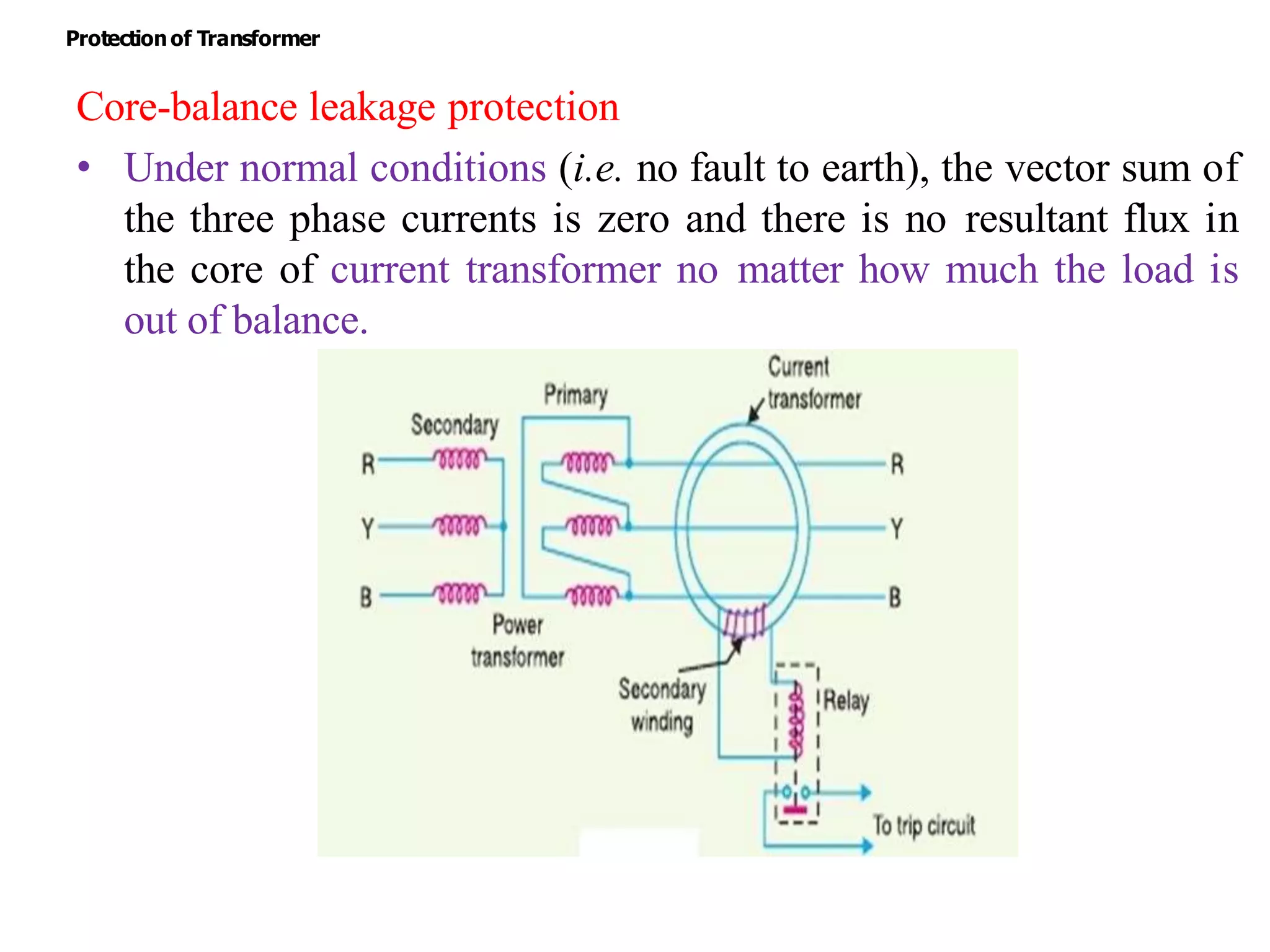
• Under normal conditions (i.e. no fault to earth), the vector sum of
the three phase currents is zero and there is no resultant flux in
the core of current transformer no matter how much the load is
out of balance.
Protectionof Transformer
• Consequently, no current flows through the relay and it
remains inoperative.
• However, on the occurrence of an earth-fault, the vector sum
of three phase currents is no longer zero. The resultant
current sets up flux in the core of the C.T. which induces
e.m.f. in the secondary winding.
• This energizes the relay to trip the circuit breaker and
disconnect the faulty transformer from the system.
Protectionof Transformer
Combined Leakage and Overload Protection
• The core-balance protection described above suffers from the
drawback that it cannot provide protection against overloads.
• If a fault or leakage occurs between phases, the core-balance
relay will not operate.
• It is a usual practice to provide combined leakage and overload
protection for transformers.
• The earth relay has low current setting and operates under earth
or leakage faults only.
• The overload relays have high current setting and are arranged
to operate against faults between the phases.
Protectionof Transformer
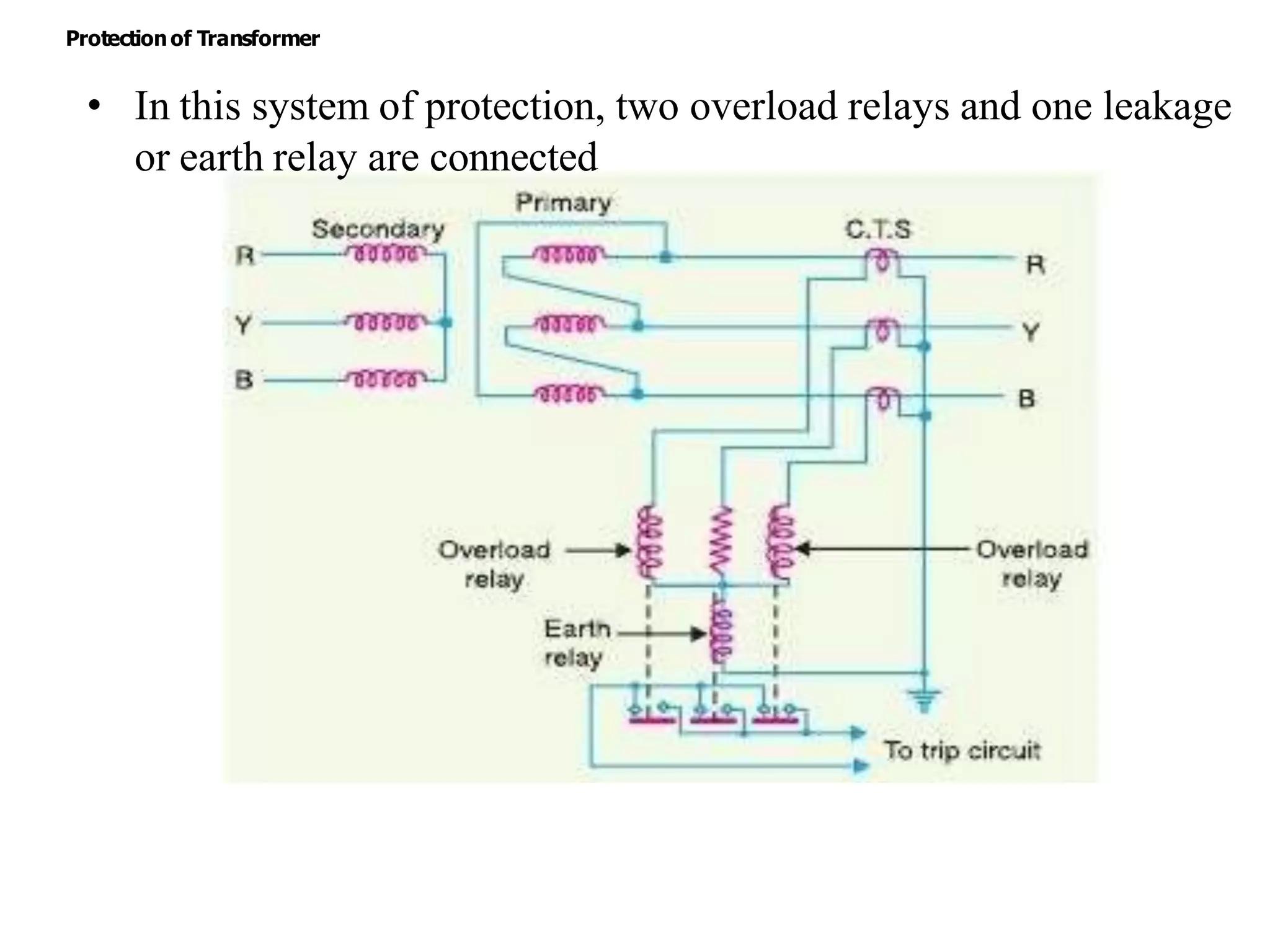
• In this system of protection, two overload relays and one leakage
or earth relay are connected
• The two overload relays are sufficient to protect against phase-to-
phase faults. The trip contacts of overload relays and earth fault
relay are connected in parallel.
• Therefore, with the energizing of either overload relay or earth
relay, the circuit breaker will be tripped.
Protectionof Transformer
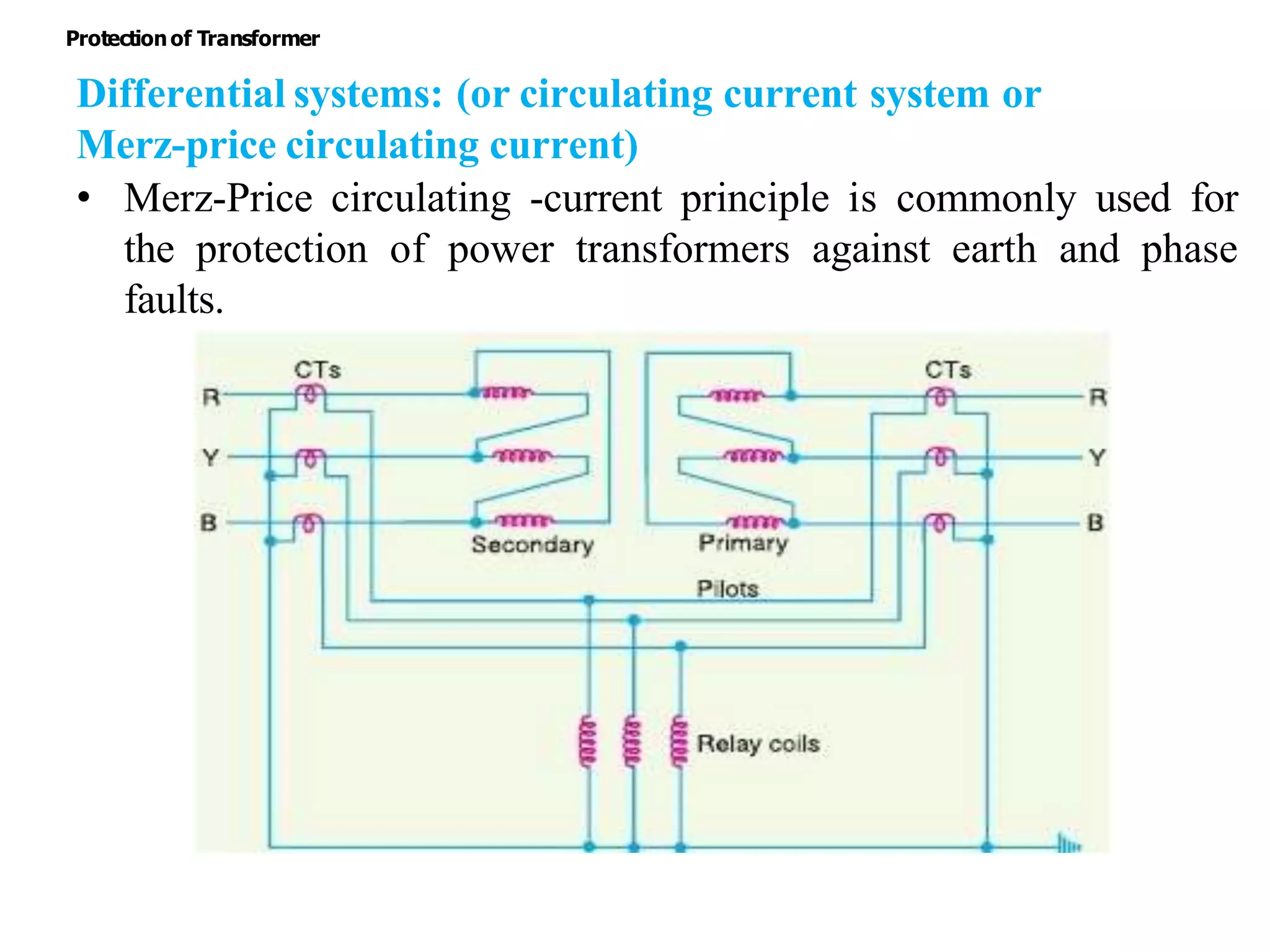
Differential systems: (or circulating current system or
Merz-price circulating current)
• Merz-Price circulating -current principle is commonly used for
the protection of power transformers against earth and phase
faults.
Protectionof Transformer
Operation
• Note that CTs on the two sides of the transformer are connected
in star.
• This compensates for the phase difference between the power
transformer primary and secondary. The CTs on the two sides
are connected by pilot wires and one relay is used for each pair
of CTs.
• During normal operating conditions, the secondaries of CTs
carry identical currents. Therefore, the currents entering and
leaving the pilot wires at both ends are the same and no current
flows through the relays.
Protectionof Transformer
• If a ground or phase-to-phase fault occurs, the currents in the
secondaries of CTs will no longer be the same and the
differential current flowing through the relay circuit will clear
the breaker on both sides of the transformer.
• The-protected zone is limited to the region between CTs on
the high-voltage side and the CTs on the low-voltage side of
the power transformer.
Protectionof Transformer
Reference:
• V.K.MEHTA,ROHIT MEHTA, “Principles of Power
System”, S.Chand,2018.
• B.Rabindranath and N.Chander, ‘Power System Protection
and Switchgear’, New Age International (P) Ltd., First
Edition 2011.
Protectionof Transformer
THANK YOU….

TOPIC 6- Transformer Protection.pptx

  • 1.
    Protection of transformers CONTENT Faults in transformer  Protective Schemes of Transformers  Buchholz Relay  Earth-Fault or Leakage Protection  Differential systems: (or circulating current system or Merz-price circulating current) BY: ENGR. MART NIKKI LOU M. MANTILLA, REE, RME Protectionof Transformer
  • 2.
    Protection of transformers •Transformersare static devices, totally enclosed and generally oil immersed. Therefore, chances of faults occurring on them are very rare. •The consequences of even a rare fault may be very serious unless the transformer is quickly disconnected from the system. Common transformer faults (i) Open circuits (ii) Over heating (iii)Winding short-circuits e.g. earth-fault, phase to phase faults and inter-turn faults. Protectionof Transformer
  • 3.
    •An open circuitfaults in one phase of a 3-phase transformer may cause undesirable heating. In practice relay protection is not provided against open circuits because this condition is relatively harmless. •Over heating of the transformer is usually caused by sustained overloads or short-circuits and very occasionally by the failure of the cooling system. •Winding short circuits also called as internal faults on the transformer arise from corrosion of winding insulation due to overheating or mechanical injury. Protectionof Transformer
  • 4.
    Protectionsystems for transformers (i)Buchholzdevices: Providing protection against all kinds of incipient faults i.e. slow-developing fault such as insulation failure of windings, core heating, fall of oil level due to leaky joins etc. (ii) Earth-fault relays: Providing protection earth fault only (iii)Over current relays: Providing protection mainly against phase-phase faults and over loading (iv) Differential systems: (or circulating current system) Providing protection against both earth and phase faults. Protectionof Transformer
  • 5.
    The complete protectionof transformer usually requires the combination of these systems. Choice of a particular combination of systems may depend upon several factors such as (a) size of the transformer (b) type of cooling (c) location of transformer in the network (d) nature of load supplied (e) importance of service for which transformer is required. In the following sections, above systems of protection will be discussed in detail. Protectionof Transformer
  • 6.
    Buchholz Relay • Buchholzrelay is a gas-actuated relay installed in oil immersed transformers for protection against all kinds of faults. • Buchholz, it is used to give an alarm in case of incipient (i.e. slow-developing) faults in the transformer and to disconnect the transformer from the supply in the event of severe internal faults. • It is a universal practice to use Buchholz relays on all such oil immersed transformers having ratings in excess of 750 kVA Construction • The device has two elements. The upper element consists of a mercury type switch attached to a float • The lower element contains a mercury switch mounted on a hinged type flap located in the direct path • of the flow of oil from the transformer to the conservator. Protectionof Transformer
  • 7.
    • The upperelement closes an alarm circuit during incipient faults whereas the lower element is arranged to trip the circuit breaker in case of severe internal faults. Operation • In case of incipient faults within the transformer, the heat due to fault causes the decomposition of some transformer oil in the main tank. The products of decomposition contain more than 70% of hydrogen gas. • The hydrogen gas being light tries to go into the conservator and in the process gets entrapped in the upper part of relay chamber. • If a serious fault occurs in the transformer, an enormous amount of gas is generated in the main tank. • The oil in the main tank rushes towards the conservator via the Buchholz relay and in doing so tilts the flap to close the contacts of mercury switch. Protectionof Transformer
  • 8.
    Advantages (i) It isthe simplest form of transformer protection. (ii)It detects the incipient faults at a stage much earlier than is possible with other forms of protection. Disadvantages (i) It can only be used with oil immersed transformers equipped with conservator tanks. (ii)The device can detect only faults below oil level in the transformer. Therefore, separate protection is needed for connecting cables. Protectionof Transformer
  • 9.
  • 10.
  • 11.
    Earth-Fault or LeakageProtection • An earth-fault usually involves a partial breakdown of winding insulation to earth. • The resulting leakage current is considerably less than the short- circuit current. • The earth-fault may continue for a long time and cause considerable damage before it ultimately develops into a short- circuit and removed from the system. • Under these circumstances, it is profitable to employ earth-fault relays in order to ensure the disconnection of earth-fault or leak in the early stage. Protectionof Transformer
  • 12.
    Core-balance leakage protection •Under normal conditions (i.e. no fault to earth), the vector sum of the three phase currents is zero and there is no resultant flux in the core of current transformer no matter how much the load is out of balance. Protectionof Transformer
  • 13.
    • Consequently, nocurrent flows through the relay and it remains inoperative. • However, on the occurrence of an earth-fault, the vector sum of three phase currents is no longer zero. The resultant current sets up flux in the core of the C.T. which induces e.m.f. in the secondary winding. • This energizes the relay to trip the circuit breaker and disconnect the faulty transformer from the system. Protectionof Transformer
  • 14.
    Combined Leakage andOverload Protection • The core-balance protection described above suffers from the drawback that it cannot provide protection against overloads. • If a fault or leakage occurs between phases, the core-balance relay will not operate. • It is a usual practice to provide combined leakage and overload protection for transformers. • The earth relay has low current setting and operates under earth or leakage faults only. • The overload relays have high current setting and are arranged to operate against faults between the phases. Protectionof Transformer
  • 15.
    Protectionof Transformer • Inthis system of protection, two overload relays and one leakage or earth relay are connected
  • 16.
    • The twooverload relays are sufficient to protect against phase-to- phase faults. The trip contacts of overload relays and earth fault relay are connected in parallel. • Therefore, with the energizing of either overload relay or earth relay, the circuit breaker will be tripped. Protectionof Transformer
  • 17.
    Differential systems: (orcirculating current system or Merz-price circulating current) • Merz-Price circulating -current principle is commonly used for the protection of power transformers against earth and phase faults. Protectionof Transformer
  • 18.
    Operation • Note thatCTs on the two sides of the transformer are connected in star. • This compensates for the phase difference between the power transformer primary and secondary. The CTs on the two sides are connected by pilot wires and one relay is used for each pair of CTs. • During normal operating conditions, the secondaries of CTs carry identical currents. Therefore, the currents entering and leaving the pilot wires at both ends are the same and no current flows through the relays. Protectionof Transformer
  • 19.
    • If aground or phase-to-phase fault occurs, the currents in the secondaries of CTs will no longer be the same and the differential current flowing through the relay circuit will clear the breaker on both sides of the transformer. • The-protected zone is limited to the region between CTs on the high-voltage side and the CTs on the low-voltage side of the power transformer. Protectionof Transformer
  • 20.
    Reference: • V.K.MEHTA,ROHIT MEHTA,“Principles of Power System”, S.Chand,2018. • B.Rabindranath and N.Chander, ‘Power System Protection and Switchgear’, New Age International (P) Ltd., First Edition 2011. Protectionof Transformer
  • 21.