Methods of
Philosophical
Reasoning:
Fallacies
DANILO F. MARIBAO
FACULTY
Paliparan 3 Senior High School
Paliparan III, Dasmarinas City, Cavite
REVIEW
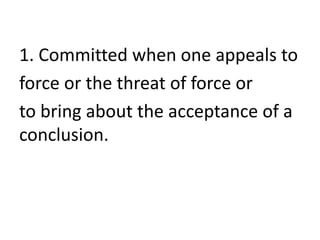
1. Committed when one appeals to
force or the threat of force or
to bring about the acceptance of a
conclusion.
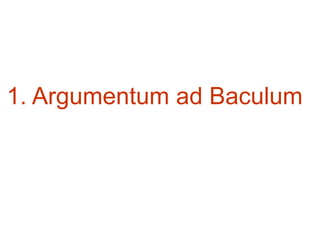
1. Argumentum ad Baculum
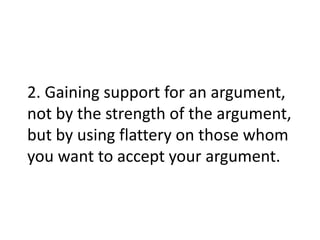
2. Gaining support for an argument,
not by the strength of the argument,
but by using flattery on those whom
you want to accept your argument.
2. Appeal to Vanity
• 3. Argument against the Person
attacking the character or
circumstances of an individual
3. Argumentum ad Hominem
4. rather than trying to disprove a remark
about someone's character or circumstances,
one accuses the other of having the same
character or circumstances.
4. Tu Quoque
5.Apparently refuting an opponent
while actually disproving something not
asserted
5. Ignoratio Elenchi
6. An irrelevant topic is introduced
in an argument to divert the
attention of listeners from the
original issue
6. Red Herring
7. supposing that a conclusion must
be valid because the person making
the argument is wealthy
7. Argumentum ad
Crumenam
8. Using authority as evidence but the
authority is not really an authority on facts
relevant to the argument
8. Argementum ad Verecundiam
9. Also known as “argument from
ignorance” or “argument from lack of
imagination”.
9. Argument ad Ignorantiam
10. Also known as the Fallacy of
Insufficient Statistics, Fallacy of
Insufficient Sample, Hasty
Induction.
10. Fallacy of Hasty Generalization
ACTIVITY
Formulate an example of the
following fallacy:
1. Argumentum ad Baculum
2. Argumentum ad Misericordiam
3. Argumentum ad Homenim
ABSTRACTION
Fallacy of Presumption
The fallacies of presumption also fail to
provide adequate reason for believing the
truth of their conclusions. In these
instances, however, the erroneous
reasoning results from an implicit
supposition of some further proposition
whose truth is uncertain or implausible.
Again, we'll consider each of them in turn,
seeking always to identify the unwarranted
assumption upon which it is based.
Fallacies of Presumption
Petitio Pricipii
(Begging the Questions /
Circular reasoning / Circular
argument)
Begging the Questions
• Begging the Question is a fallacy in which
the premises include the claim that the
conclusion is true or (directly or indirectly)
assume that the conclusion is true. This sort of
"reasoning" typically has the following form.
1. Premises in which the truth of
the conclusion is claimed or the truth of the
conclusion is assumed (either directly or
indirectly).
2. Claim C (the conclusion) is true.
Example:
i. Since I'm not lying, it follows that I'm telling
the truth.
ii. We know that God exists, since the Bible says
God exists. What the Bible says must be true,
since God wrote it and God never lies.
Proof:
Show that in order to believe that the
premises are true we must already agree that
the conclusion is true.
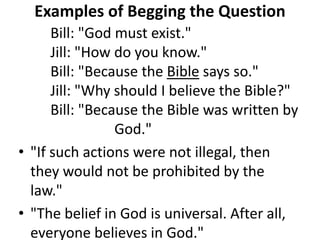
Examples of Begging the Question
Bill: "God must exist."
Jill: "How do you know."
Bill: "Because the Bible says so."
Jill: "Why should I believe the Bible?"
Bill: "Because the Bible was written by
God."
• "If such actions were not illegal, then
they would not be prohibited by the
law."
• "The belief in God is universal. After all,
everyone believes in God."
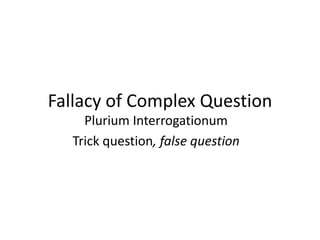
Fallacy of Complex Question
Plurium Interrogationum
Trick question, false question
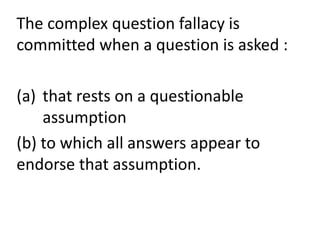
The complex question fallacy is
committed when a question is asked :
(a) that rests on a questionable
assumption
(b) to which all answers appear to
endorse that assumption.
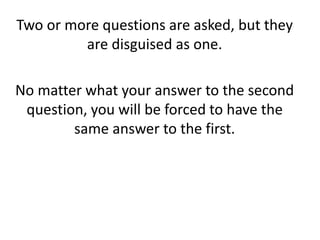
Two or more questions are asked, but they
are disguised as one.
No matter what your answer to the second
question, you will be forced to have the
same answer to the first.
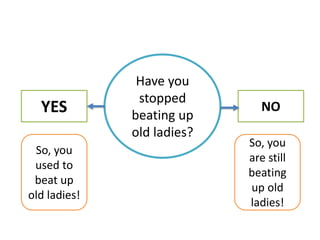
Have you
stopped
beating up
old ladies?
YES NO
So, you
used to
beat up
old ladies!
So, you
are still
beating
up old
ladies!
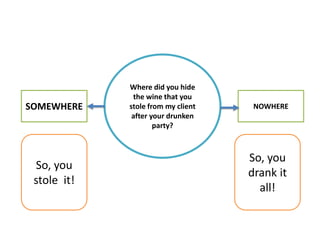
Where did you hide
the wine that you
stole from my client
after your drunken
party?
SOMEWHERE NOWHERE
So, you
stole it!
So, you
drank it
all!
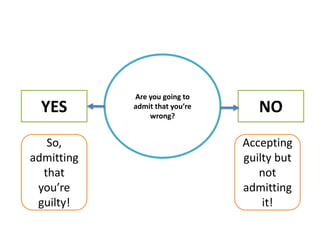
Are you going to
admit that you’re
wrong?
YES NO
So,
admitting
that
you’re
guilty!
Accepting
guilty but
not
admitting
it!
Black or White Fallacy
Fallacy of False Dichotomy
Or
“False Dilemma”
• Only two alternative states are presented,
when in fact more possibilities exist.
• A spectrum of possible choices exists between
two extremes.
Examples:
“Either you’re with God, or against Him.”
“I thought you were a good person, but you
weren’t at church today.”
• Exception:
–There may be cases when the number of options
really is limited.
Ex.: “If an ice cream man just has chocolate and
vanilla left, it would be a waste of time insisting
he has mint chocolate chip.”
–It is also not a fallacy if other options exist, but
you are not offering other options as a possibility.
Ex.: Mom: “Billy, it’s time for bed.”
Billy: “Can I stay up and watch a movie?”
Mom: “You can either go to bed or stay up for
another 30 minutes and read.”
Non-sequitur Fallacy
•Non sequiturs
 Latin phrase that means “it doesn’t follow”
 literary devices which include the statements,
sayings and conclusions that do not follow the
fundamental principles of logic and reason.
Non-sequitur
 irrelevant reason, invalid inference, non-
support, argument by scenario, a form of false
premise , a form of questionable premise.
 There is a divide between the premise and the
conclusion, which results in something called
a fallacy.
 “...giant logical jump that is totally
unreasonable!!!”
Example #1:
 People generally like to walk on the
beach. Beaches have sand. Therefore,
having sand floors in homes would be a
great idea!
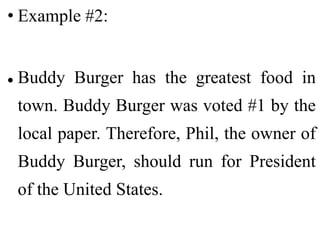
• Example #2:
 Buddy Burger has the greatest food in
town. Buddy Burger was voted #1 by the
local paper. Therefore, Phil, the owner of
Buddy Burger, should run for President
of the United States.
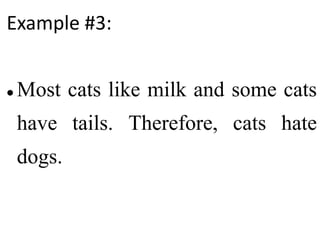
Example #3:
 Most cats like milk and some cats
have tails. Therefore, cats hate
dogs.
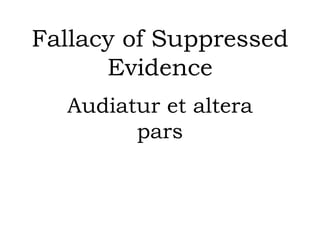
Fallacy of Suppressed
Evidence
Audiatur et altera
pars
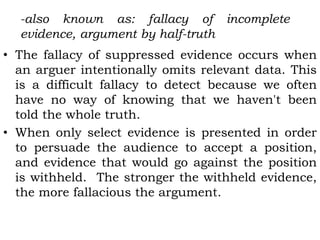
-also known as: fallacy of incomplete
evidence, argument by half-truth
• The fallacy of suppressed evidence occurs when
an arguer intentionally omits relevant data. This
is a difficult fallacy to detect because we often
have no way of knowing that we haven't been
told the whole truth.
• When only select evidence is presented in order
to persuade the audience to accept a position,
and evidence that would go against the position
is withheld. The stronger the withheld evidence,
the more fallacious the argument.
Examples:
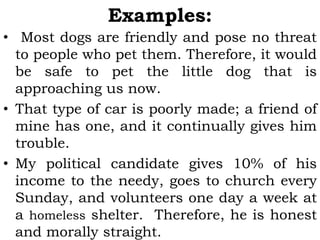
• Most dogs are friendly and pose no threat
to people who pet them. Therefore, it would
be safe to pet the little dog that is
approaching us now.
• That type of car is poorly made; a friend of
mine has one, and it continually gives him
trouble.
• My political candidate gives 10% of his
income to the needy, goes to church every
Sunday, and volunteers one day a week at
a homeless shelter. Therefore, he is honest
and morally straight.
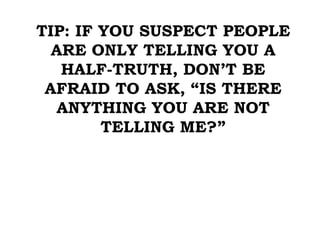
TIP: IF YOU SUSPECT PEOPLE
ARE ONLY TELLING YOU A
HALF-TRUTH, DON’T BE
AFRAID TO ASK, “IS THERE
ANYTHING YOU ARE NOT
TELLING ME?”
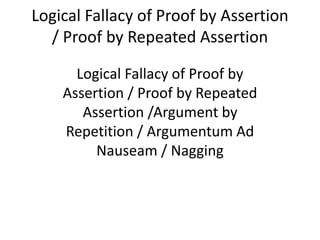
Logical Fallacy of Proof by Assertion
/ Proof by Repeated Assertion
Logical Fallacy of Proof by
Assertion / Proof by Repeated
Assertion /Argument by
Repetition / Argumentum Ad
Nauseam / Nagging
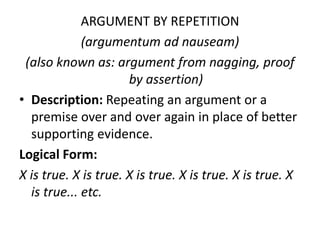
ARGUMENT BY REPETITION
(argumentum ad nauseam)
(also known as: argument from nagging, proof
by assertion)
• Description: Repeating an argument or a
premise over and over again in place of better
supporting evidence.
Logical Form:
X is true. X is true. X is true. X is true. X is true. X
is true... etc.
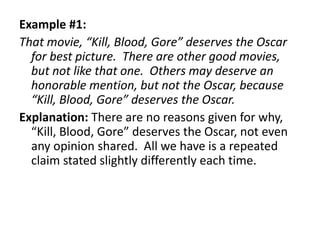
Example #1:
That movie, “Kill, Blood, Gore” deserves the Oscar
for best picture. There are other good movies,
but not like that one. Others may deserve an
honorable mention, but not the Oscar, because
“Kill, Blood, Gore” deserves the Oscar.
Explanation: There are no reasons given for why,
“Kill, Blood, Gore” deserves the Oscar, not even
any opinion shared. All we have is a repeated
claim stated slightly differently each time.
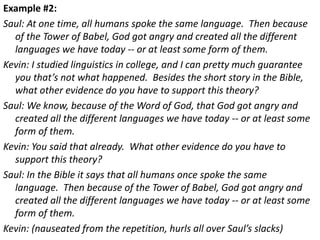
Example #2:
Saul: At one time, all humans spoke the same language. Then because
of the Tower of Babel, God got angry and created all the different
languages we have today -- or at least some form of them.
Kevin: I studied linguistics in college, and I can pretty much guarantee
you that’s not what happened. Besides the short story in the Bible,
what other evidence do you have to support this theory?
Saul: We know, because of the Word of God, that God got angry and
created all the different languages we have today -- or at least some
form of them.
Kevin: You said that already. What other evidence do you have to
support this theory?
Saul: In the Bible it says that all humans once spoke the same
language. Then because of the Tower of Babel, God got angry and
created all the different languages we have today -- or at least some
form of them.
Kevin: (nauseated from the repetition, hurls all over Saul’s slacks)
Fallacies of Ambiguity
Introduction to Informal Fallacies
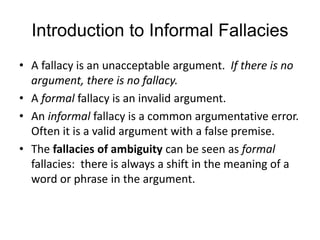
• A fallacy is an unacceptable argument. If there is no
argument, there is no fallacy.
• A formal fallacy is an invalid argument.
• An informal fallacy is a common argumentative error.
Often it is a valid argument with a false premise.
• The fallacies of ambiguity can be seen as formal
fallacies: there is always a shift in the meaning of a
word or phrase in the argument.
Fallacies of Ambiguity
Arise from the occurrence of some form of ambiguity in
either the premises or the conclusion ( or both ). When the
conclusion of an argument depends on a shift in meaning
of an ambiguous word or phrase or on the wrong
interpretation of an ambiguous statement, the argument
commits a fallacy of ambiguity
 These fallacies occur when one word in an argument may
be taken to have two or more distinct meanings.
 Fallacies of Ambiguity are of three types:
• Equivocation ("to call by the same name")
is classified as an informal logical fallacy.
It is the misleading use of a term with more
than one meaning or sense (by glossing
over which meaning is intended at a
particular time). It generally occurs
with polysemic words (words with multiple
meanings).
Equivocation
Equivocation
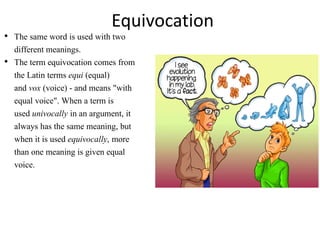
• The same word is used with two
different meanings.
• The term equivocation comes from
the Latin terms equi (equal)
and vox (voice) - and means "with
equal voice". When a term is
used univocally in an argument, it
always has the same meaning, but
when it is used equivocally, more
than one meaning is given equal
voice.
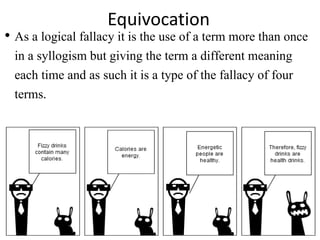
• As a logical fallacy it is the use of a term more than once
in a syllogism but giving the term a different meaning
each time and as such it is a type of the fallacy of four
terms.
Equivocation
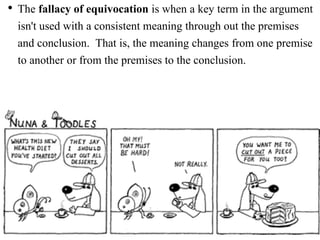
• The fallacy of equivocation is when a key term in the argument
isn't used with a consistent meaning through out the premises
and conclusion. That is, the meaning changes from one premise
to another or from the premises to the conclusion.
Explanation:
A single term is used with two or more meanings in
the same argument. The basic form of this fallacy is:
a. Premise1: [statement using term X in sense 1]
b.Premise2: [statement using term X in sense 2] AND/OR
c. Conclusion: [statement using term X in sense 2]
Examples
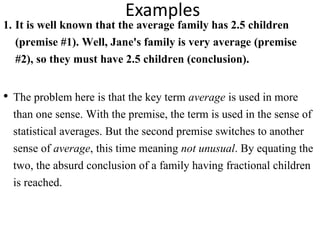
1. It is well known that the average family has 2.5 children
(premise #1). Well, Jane's family is very average (premise
#2), so they must have 2.5 children (conclusion).
• The problem here is that the key term average is used in more
than one sense. With the premise, the term is used in the sense of
statistical averages. But the second premise switches to another
sense of average, this time meaning not unusual. By equating the
two, the absurd conclusion of a family having fractional children
is reached.
Examples
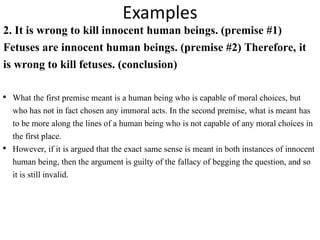
2. It is wrong to kill innocent human beings. (premise #1)
Fetuses are innocent human beings. (premise #2) Therefore, it
is wrong to kill fetuses. (conclusion)
• What the first premise meant is a human being who is capable of moral choices, but
who has not in fact chosen any immoral acts. In the second premise, what is meant has
to be more along the lines of a human being who is not capable of any moral choices in
the first place.
• However, if it is argued that the exact same sense is meant in both instances of innocent
human being, then the argument is guilty of the fallacy of begging the question, and so
it is still invalid.
Examples
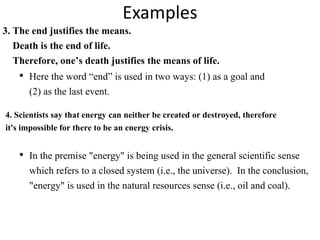
3. The end justifies the means.
Death is the end of life.
Therefore, one’s death justifies the means of life.
• Here the word “end” is used in two ways: (1) as a goal and
(2) as the last event.
• In the premise "energy" is being used in the general scientific sense
which refers to a closed system (i.e., the universe). In the conclusion,
"energy" is used in the natural resources sense (i.e., oil and coal).
4. Scientists say that energy can neither be created or destroyed, therefore
it's impossible for there to be an energy crisis.
Examples
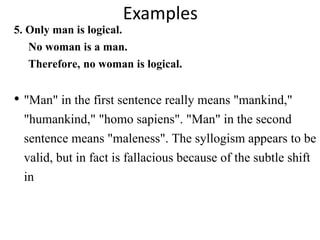
5. Only man is logical.
No woman is a man.
Therefore, no woman is logical.
• "Man" in the first sentence really means "mankind,"
"humankind," "homo sapiens". "Man" in the second
sentence means "maleness". The syllogism appears to be
valid, but in fact is fallacious because of the subtle shift
in
Additional Examples
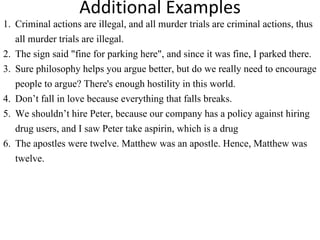
1. Criminal actions are illegal, and all murder trials are criminal actions, thus
all murder trials are illegal.
2. The sign said "fine for parking here", and since it was fine, I parked there.
3. Sure philosophy helps you argue better, but do we really need to encourage
people to argue? There's enough hostility in this world.
4. Don’t fall in love because everything that falls breaks.
5. We shouldn’t hire Peter, because our company has a policy against hiring
drug users, and I saw Peter take aspirin, which is a drug
6. The apostles were twelve. Matthew was an apostle. Hence, Matthew was
twelve.
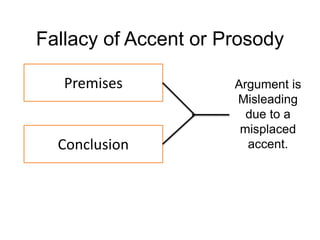
Fallacy of Accent or Prosody
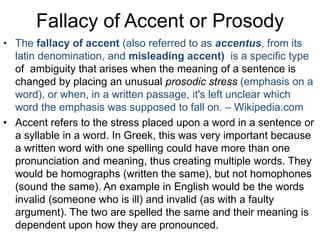
• The fallacy of accent (also referred to as accentus, from its
latin denomination, and misleading accent) is a specific type
of ambiguity that arises when the meaning of a sentence is
changed by placing an unusual prosodic stress (emphasis on a
word), or when, in a written passage, it's left unclear which
word the emphasis was supposed to fall on. – Wikipedia.com
• Accent refers to the stress placed upon a word in a sentence or
a syllable in a word. In Greek, this was very important because
a written word with one spelling could have more than one
pronunciation and meaning, thus creating multiple words. They
would be homographs (written the same), but not homophones
(sound the same). An example in English would be the words
invalid (someone who is ill) and invalid (as with a faulty
argument). The two are spelled the same and their meaning is
dependent upon how they are pronounced.
Fallacy of Accent or Prosody
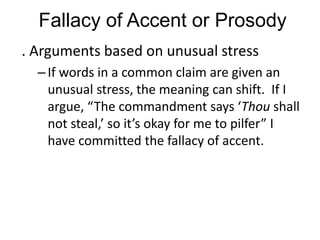
. Arguments based on unusual stress
–If words in a common claim are given an
unusual stress, the meaning can shift. If I
argue, “The commandment says ‘Thou shall
not steal,’ so it’s okay for me to pilfer” I
have committed the fallacy of accent.
Premises
Conclusion
Argument is
Misleading
due to a
misplaced
accent.
Fallacy of Accent or Prosody
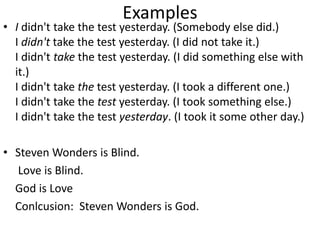
Examples
• I didn't take the test yesterday. (Somebody else did.)
I didn't take the test yesterday. (I did not take it.)
I didn't take the test yesterday. (I did something else with
it.)
I didn't take the test yesterday. (I took a different one.)
I didn't take the test yesterday. (I took something else.)
I didn't take the test yesterday. (I took it some other day.)
• Steven Wonders is Blind.
Love is Blind.
God is Love
Conlcusion: Steven Wonders is God.
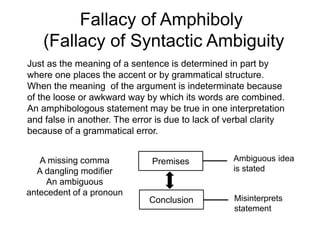
Fallacy of Amphiboly
(Fallacy of Syntactic Ambiguity
Just as the meaning of a sentence is determined in part by
where one places the accent or by grammatical structure.
When the meaning of the argument is indeterminate because
of the loose or awkward way by which its words are combined.
An amphibologous statement may be true in one interpretation
and false in another. The error is due to lack of verbal clarity
because of a grammatical error.
Premises
Conclusion
Ambiguous idea
is stated
Misinterprets
statement
A missing comma
A dangling modifier
An ambiguous
antecedent of a pronoun
Fallacies of
Grammatical
Analogy
73
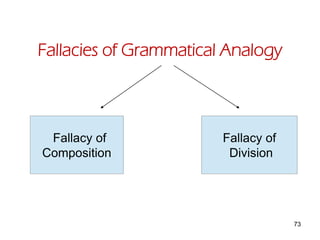
Fallacies of Grammatical Analogy
Fallacy of
Composition
Fallacy of
Division
74
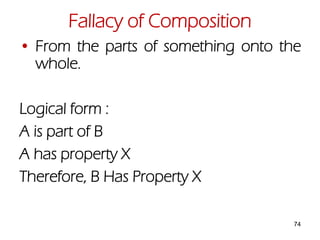
• From the parts of something onto the
whole.
Logical form :
A is part of B
A has property X
Therefore, B Has Property X
Fallacy of Composition
75
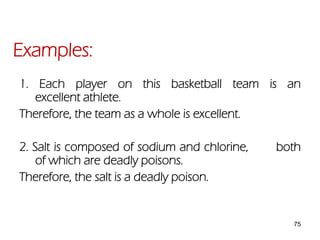
1. Each player on this basketball team is an
excellent athlete.
Therefore, the team as a whole is excellent.
2. Salt is composed of sodium and chlorine, both
of which are deadly poisons.
Therefore, the salt is a deadly poison.
Examples:
76
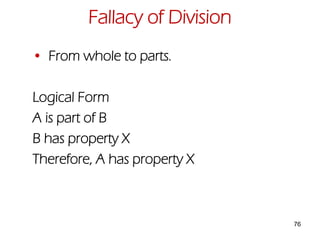
• From whole to parts.
Logical Form
A is part of B
B has property X
Therefore, A has property X
Fallacy of Division
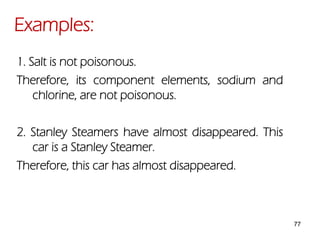
77
1. Salt is not poisonous.
Therefore, its component elements, sodium and
chlorine, are not poisonous.
2. Stanley Steamers have almost disappeared. This
car is a Stanley Steamer.
Therefore, this car has almost disappeared.
Examples:
APPLICATION
Formulate five arguments that
connect to different fallacies.
Assignment
Formulate five arguments that
usually used in daily arguments
with friends and relatives.

Topic 3. methods of philosophical reasoning session2

  • 1.
    Methods of Philosophical Reasoning: Fallacies DANILO F.MARIBAO FACULTY Paliparan 3 Senior High School Paliparan III, Dasmarinas City, Cavite
  • 2.
  • 3.
    1. Committed whenone appeals to force or the threat of force or to bring about the acceptance of a conclusion.
  • 4.
  • 5.
    2. Gaining supportfor an argument, not by the strength of the argument, but by using flattery on those whom you want to accept your argument.
  • 6.
  • 7.
    • 3. Argumentagainst the Person attacking the character or circumstances of an individual
  • 8.
  • 9.
    4. rather thantrying to disprove a remark about someone's character or circumstances, one accuses the other of having the same character or circumstances.
  • 10.
  • 11.
    5.Apparently refuting anopponent while actually disproving something not asserted
  • 12.
  • 13.
    6. An irrelevanttopic is introduced in an argument to divert the attention of listeners from the original issue
  • 14.
  • 15.
    7. supposing thata conclusion must be valid because the person making the argument is wealthy
  • 16.
  • 17.
    8. Using authorityas evidence but the authority is not really an authority on facts relevant to the argument
  • 18.
    8. Argementum adVerecundiam
  • 19.
    9. Also knownas “argument from ignorance” or “argument from lack of imagination”.
  • 20.
    9. Argument adIgnorantiam
  • 21.
    10. Also knownas the Fallacy of Insufficient Statistics, Fallacy of Insufficient Sample, Hasty Induction.
  • 22.
    10. Fallacy ofHasty Generalization
  • 23.
    ACTIVITY Formulate an exampleof the following fallacy: 1. Argumentum ad Baculum 2. Argumentum ad Misericordiam 3. Argumentum ad Homenim
  • 25.
  • 26.
    Fallacy of Presumption Thefallacies of presumption also fail to provide adequate reason for believing the truth of their conclusions. In these instances, however, the erroneous reasoning results from an implicit supposition of some further proposition whose truth is uncertain or implausible. Again, we'll consider each of them in turn, seeking always to identify the unwarranted assumption upon which it is based.
  • 27.
    Fallacies of Presumption PetitioPricipii (Begging the Questions / Circular reasoning / Circular argument)
  • 28.
    Begging the Questions •Begging the Question is a fallacy in which the premises include the claim that the conclusion is true or (directly or indirectly) assume that the conclusion is true. This sort of "reasoning" typically has the following form. 1. Premises in which the truth of the conclusion is claimed or the truth of the conclusion is assumed (either directly or indirectly). 2. Claim C (the conclusion) is true.
  • 29.
    Example: i. Since I'mnot lying, it follows that I'm telling the truth. ii. We know that God exists, since the Bible says God exists. What the Bible says must be true, since God wrote it and God never lies. Proof: Show that in order to believe that the premises are true we must already agree that the conclusion is true.
  • 30.
    Examples of Beggingthe Question Bill: "God must exist." Jill: "How do you know." Bill: "Because the Bible says so." Jill: "Why should I believe the Bible?" Bill: "Because the Bible was written by God." • "If such actions were not illegal, then they would not be prohibited by the law." • "The belief in God is universal. After all, everyone believes in God."
  • 31.
    Fallacy of ComplexQuestion Plurium Interrogationum Trick question, false question
  • 32.
    The complex questionfallacy is committed when a question is asked : (a) that rests on a questionable assumption (b) to which all answers appear to endorse that assumption.
  • 33.
    Two or morequestions are asked, but they are disguised as one. No matter what your answer to the second question, you will be forced to have the same answer to the first.
  • 34.
    Have you stopped beating up oldladies? YES NO So, you used to beat up old ladies! So, you are still beating up old ladies!
  • 35.
    Where did youhide the wine that you stole from my client after your drunken party? SOMEWHERE NOWHERE So, you stole it! So, you drank it all!
  • 36.
    Are you goingto admit that you’re wrong? YES NO So, admitting that you’re guilty! Accepting guilty but not admitting it!
  • 37.
    Black or WhiteFallacy Fallacy of False Dichotomy Or “False Dilemma”
  • 38.
    • Only twoalternative states are presented, when in fact more possibilities exist. • A spectrum of possible choices exists between two extremes. Examples: “Either you’re with God, or against Him.” “I thought you were a good person, but you weren’t at church today.”
  • 39.
    • Exception: –There maybe cases when the number of options really is limited. Ex.: “If an ice cream man just has chocolate and vanilla left, it would be a waste of time insisting he has mint chocolate chip.” –It is also not a fallacy if other options exist, but you are not offering other options as a possibility. Ex.: Mom: “Billy, it’s time for bed.” Billy: “Can I stay up and watch a movie?” Mom: “You can either go to bed or stay up for another 30 minutes and read.”
  • 40.
    Non-sequitur Fallacy •Non sequiturs Latin phrase that means “it doesn’t follow”  literary devices which include the statements, sayings and conclusions that do not follow the fundamental principles of logic and reason.
  • 41.
    Non-sequitur  irrelevant reason,invalid inference, non- support, argument by scenario, a form of false premise , a form of questionable premise.  There is a divide between the premise and the conclusion, which results in something called a fallacy.  “...giant logical jump that is totally unreasonable!!!”
  • 42.
    Example #1:  Peoplegenerally like to walk on the beach. Beaches have sand. Therefore, having sand floors in homes would be a great idea!
  • 43.
    • Example #2: Buddy Burger has the greatest food in town. Buddy Burger was voted #1 by the local paper. Therefore, Phil, the owner of Buddy Burger, should run for President of the United States.
  • 44.
    Example #3:  Mostcats like milk and some cats have tails. Therefore, cats hate dogs.
  • 45.
  • 46.
    -also known as:fallacy of incomplete evidence, argument by half-truth • The fallacy of suppressed evidence occurs when an arguer intentionally omits relevant data. This is a difficult fallacy to detect because we often have no way of knowing that we haven't been told the whole truth. • When only select evidence is presented in order to persuade the audience to accept a position, and evidence that would go against the position is withheld. The stronger the withheld evidence, the more fallacious the argument.
  • 47.
    Examples: • Most dogsare friendly and pose no threat to people who pet them. Therefore, it would be safe to pet the little dog that is approaching us now. • That type of car is poorly made; a friend of mine has one, and it continually gives him trouble. • My political candidate gives 10% of his income to the needy, goes to church every Sunday, and volunteers one day a week at a homeless shelter. Therefore, he is honest and morally straight.
  • 48.
    TIP: IF YOUSUSPECT PEOPLE ARE ONLY TELLING YOU A HALF-TRUTH, DON’T BE AFRAID TO ASK, “IS THERE ANYTHING YOU ARE NOT TELLING ME?”
  • 49.
    Logical Fallacy ofProof by Assertion / Proof by Repeated Assertion Logical Fallacy of Proof by Assertion / Proof by Repeated Assertion /Argument by Repetition / Argumentum Ad Nauseam / Nagging
  • 50.
    ARGUMENT BY REPETITION (argumentumad nauseam) (also known as: argument from nagging, proof by assertion) • Description: Repeating an argument or a premise over and over again in place of better supporting evidence. Logical Form: X is true. X is true. X is true. X is true. X is true. X is true... etc.
  • 51.
    Example #1: That movie,“Kill, Blood, Gore” deserves the Oscar for best picture. There are other good movies, but not like that one. Others may deserve an honorable mention, but not the Oscar, because “Kill, Blood, Gore” deserves the Oscar. Explanation: There are no reasons given for why, “Kill, Blood, Gore” deserves the Oscar, not even any opinion shared. All we have is a repeated claim stated slightly differently each time.
  • 52.
    Example #2: Saul: Atone time, all humans spoke the same language. Then because of the Tower of Babel, God got angry and created all the different languages we have today -- or at least some form of them. Kevin: I studied linguistics in college, and I can pretty much guarantee you that’s not what happened. Besides the short story in the Bible, what other evidence do you have to support this theory? Saul: We know, because of the Word of God, that God got angry and created all the different languages we have today -- or at least some form of them. Kevin: You said that already. What other evidence do you have to support this theory? Saul: In the Bible it says that all humans once spoke the same language. Then because of the Tower of Babel, God got angry and created all the different languages we have today -- or at least some form of them. Kevin: (nauseated from the repetition, hurls all over Saul’s slacks)
  • 53.
  • 54.
    Introduction to InformalFallacies • A fallacy is an unacceptable argument. If there is no argument, there is no fallacy. • A formal fallacy is an invalid argument. • An informal fallacy is a common argumentative error. Often it is a valid argument with a false premise. • The fallacies of ambiguity can be seen as formal fallacies: there is always a shift in the meaning of a word or phrase in the argument.
  • 55.
    Fallacies of Ambiguity Arisefrom the occurrence of some form of ambiguity in either the premises or the conclusion ( or both ). When the conclusion of an argument depends on a shift in meaning of an ambiguous word or phrase or on the wrong interpretation of an ambiguous statement, the argument commits a fallacy of ambiguity  These fallacies occur when one word in an argument may be taken to have two or more distinct meanings.  Fallacies of Ambiguity are of three types:
  • 56.
    • Equivocation ("tocall by the same name") is classified as an informal logical fallacy. It is the misleading use of a term with more than one meaning or sense (by glossing over which meaning is intended at a particular time). It generally occurs with polysemic words (words with multiple meanings). Equivocation
  • 57.
    Equivocation • The sameword is used with two different meanings. • The term equivocation comes from the Latin terms equi (equal) and vox (voice) - and means "with equal voice". When a term is used univocally in an argument, it always has the same meaning, but when it is used equivocally, more than one meaning is given equal voice.
  • 58.
    • As alogical fallacy it is the use of a term more than once in a syllogism but giving the term a different meaning each time and as such it is a type of the fallacy of four terms. Equivocation
  • 59.
    • The fallacyof equivocation is when a key term in the argument isn't used with a consistent meaning through out the premises and conclusion. That is, the meaning changes from one premise to another or from the premises to the conclusion.
  • 60.
    Explanation: A single termis used with two or more meanings in the same argument. The basic form of this fallacy is: a. Premise1: [statement using term X in sense 1] b.Premise2: [statement using term X in sense 2] AND/OR c. Conclusion: [statement using term X in sense 2]
  • 61.
    Examples 1. It iswell known that the average family has 2.5 children (premise #1). Well, Jane's family is very average (premise #2), so they must have 2.5 children (conclusion). • The problem here is that the key term average is used in more than one sense. With the premise, the term is used in the sense of statistical averages. But the second premise switches to another sense of average, this time meaning not unusual. By equating the two, the absurd conclusion of a family having fractional children is reached.
  • 62.
    Examples 2. It iswrong to kill innocent human beings. (premise #1) Fetuses are innocent human beings. (premise #2) Therefore, it is wrong to kill fetuses. (conclusion) • What the first premise meant is a human being who is capable of moral choices, but who has not in fact chosen any immoral acts. In the second premise, what is meant has to be more along the lines of a human being who is not capable of any moral choices in the first place. • However, if it is argued that the exact same sense is meant in both instances of innocent human being, then the argument is guilty of the fallacy of begging the question, and so it is still invalid.
  • 63.
    Examples 3. The endjustifies the means. Death is the end of life. Therefore, one’s death justifies the means of life. • Here the word “end” is used in two ways: (1) as a goal and (2) as the last event. • In the premise "energy" is being used in the general scientific sense which refers to a closed system (i.e., the universe). In the conclusion, "energy" is used in the natural resources sense (i.e., oil and coal). 4. Scientists say that energy can neither be created or destroyed, therefore it's impossible for there to be an energy crisis.
  • 64.
    Examples 5. Only manis logical. No woman is a man. Therefore, no woman is logical. • "Man" in the first sentence really means "mankind," "humankind," "homo sapiens". "Man" in the second sentence means "maleness". The syllogism appears to be valid, but in fact is fallacious because of the subtle shift in
  • 65.
    Additional Examples 1. Criminalactions are illegal, and all murder trials are criminal actions, thus all murder trials are illegal. 2. The sign said "fine for parking here", and since it was fine, I parked there. 3. Sure philosophy helps you argue better, but do we really need to encourage people to argue? There's enough hostility in this world. 4. Don’t fall in love because everything that falls breaks. 5. We shouldn’t hire Peter, because our company has a policy against hiring drug users, and I saw Peter take aspirin, which is a drug 6. The apostles were twelve. Matthew was an apostle. Hence, Matthew was twelve.
  • 66.
    Fallacy of Accentor Prosody • The fallacy of accent (also referred to as accentus, from its latin denomination, and misleading accent) is a specific type of ambiguity that arises when the meaning of a sentence is changed by placing an unusual prosodic stress (emphasis on a word), or when, in a written passage, it's left unclear which word the emphasis was supposed to fall on. – Wikipedia.com • Accent refers to the stress placed upon a word in a sentence or a syllable in a word. In Greek, this was very important because a written word with one spelling could have more than one pronunciation and meaning, thus creating multiple words. They would be homographs (written the same), but not homophones (sound the same). An example in English would be the words invalid (someone who is ill) and invalid (as with a faulty argument). The two are spelled the same and their meaning is dependent upon how they are pronounced.
  • 67.
    Fallacy of Accentor Prosody . Arguments based on unusual stress –If words in a common claim are given an unusual stress, the meaning can shift. If I argue, “The commandment says ‘Thou shall not steal,’ so it’s okay for me to pilfer” I have committed the fallacy of accent.
  • 68.
    Premises Conclusion Argument is Misleading due toa misplaced accent. Fallacy of Accent or Prosody
  • 69.
    Examples • I didn'ttake the test yesterday. (Somebody else did.) I didn't take the test yesterday. (I did not take it.) I didn't take the test yesterday. (I did something else with it.) I didn't take the test yesterday. (I took a different one.) I didn't take the test yesterday. (I took something else.) I didn't take the test yesterday. (I took it some other day.) • Steven Wonders is Blind. Love is Blind. God is Love Conlcusion: Steven Wonders is God.
  • 71.
    Fallacy of Amphiboly (Fallacyof Syntactic Ambiguity Just as the meaning of a sentence is determined in part by where one places the accent or by grammatical structure. When the meaning of the argument is indeterminate because of the loose or awkward way by which its words are combined. An amphibologous statement may be true in one interpretation and false in another. The error is due to lack of verbal clarity because of a grammatical error. Premises Conclusion Ambiguous idea is stated Misinterprets statement A missing comma A dangling modifier An ambiguous antecedent of a pronoun
  • 72.
  • 73.
    73 Fallacies of GrammaticalAnalogy Fallacy of Composition Fallacy of Division
  • 74.
    74 • From theparts of something onto the whole. Logical form : A is part of B A has property X Therefore, B Has Property X Fallacy of Composition
  • 75.
    75 1. Each playeron this basketball team is an excellent athlete. Therefore, the team as a whole is excellent. 2. Salt is composed of sodium and chlorine, both of which are deadly poisons. Therefore, the salt is a deadly poison. Examples:
  • 76.
    76 • From wholeto parts. Logical Form A is part of B B has property X Therefore, A has property X Fallacy of Division
  • 77.
    77 1. Salt isnot poisonous. Therefore, its component elements, sodium and chlorine, are not poisonous. 2. Stanley Steamers have almost disappeared. This car is a Stanley Steamer. Therefore, this car has almost disappeared. Examples:
  • 78.
    APPLICATION Formulate five argumentsthat connect to different fallacies.
  • 79.
    Assignment Formulate five argumentsthat usually used in daily arguments with friends and relatives.