Logical Fallacies
What is a logical fallacy?
• Arguments which may appear logical (particularly to
audiences who are not listening/reading carefully),
but do not stand up when closely examined.
• They tend to make sweeping generalizations or go off
topic from the issue at hand.
• They weaken your argument.
What’s wrong with this argument?
What’s the fallacy?
• A. Loaded Question
• B. Non Sequitur
• C. Hasty Generalization
• D. Post Hoc (False Cause)
Hasty Generalization
• Drawing a conclusion or making an assumption about
a group based on a sample size that is too small.
• How might this weaken your overall argument?
What’s wrong with this argument? 2
“I’m a single father raising
a 15-year-old, severely
autistic non-verbal
teenage daughter. When
she was 15 months old,
she received a round of
vaccines that included the
MMR and the DTaP. She
developed a high fever,
and when the fever broke,
she lost everything.”
What’s the fallacy? 2
• A. Red Herring
• B. False Dilemma/Dichotomy
• C. Slippery Slope
• D. Post Hoc (False Cause)
Post Hoc Ergo Propter Hoc (False Cause)
• This father makes a false assumption about the cause of
his daughter’s autism. Just because her autism developed
after the vaccine does not mean the vaccine caused it.
• Multiple studies have shown that autism is NOT caused by
vaccines. The doctor that claimed it admitted he lied and
has been disbarred from the medical community.
• False cause is a logical fallacy in which one assumes that
one thing (A) causes another (B) because A came before
B.
• Correlation does NOT equal causation.
• Visit Spurious Correlations for some funny correlations.
What’s wrong with this argument? 3
• Don’t get rid of cable…
• Click on the link above to view the video. Then return
to answers the questions.
What’s the fallacy? 3
• A. Slippery Slope
• B. Red Herring
• C. Non Sequitur
• D. Post Hoc (False Cause)
Slippery Slope
• The writer states that a chain reaction will take place
if a first step is taken, but there is no logical evidence
that this reaction will occur.
• This is a fallacy called slippery slope.
What’s wrong with this argument? 4
• Prop 8
• Click on the link above to view the video. Then return
to answers the questions.
What’s the fallacy? 4
• A. False Analogy
• B. False Dilemma/Dichotomy
• C. Ad Hominem
• D. Bandwagon
Weak/False Analogy
• This is a fallacy in which two things that are NOT alike
are treated alike.
• In other words, a pair of shoes IS NOT like a pair of
people.
• Your audience will reject your argument if they do not
accept the comparison.
What’s wrong with this argument? 5
• Direct TV hates puppies
• Click on the link above to view the video. Then return
to answers the questions.
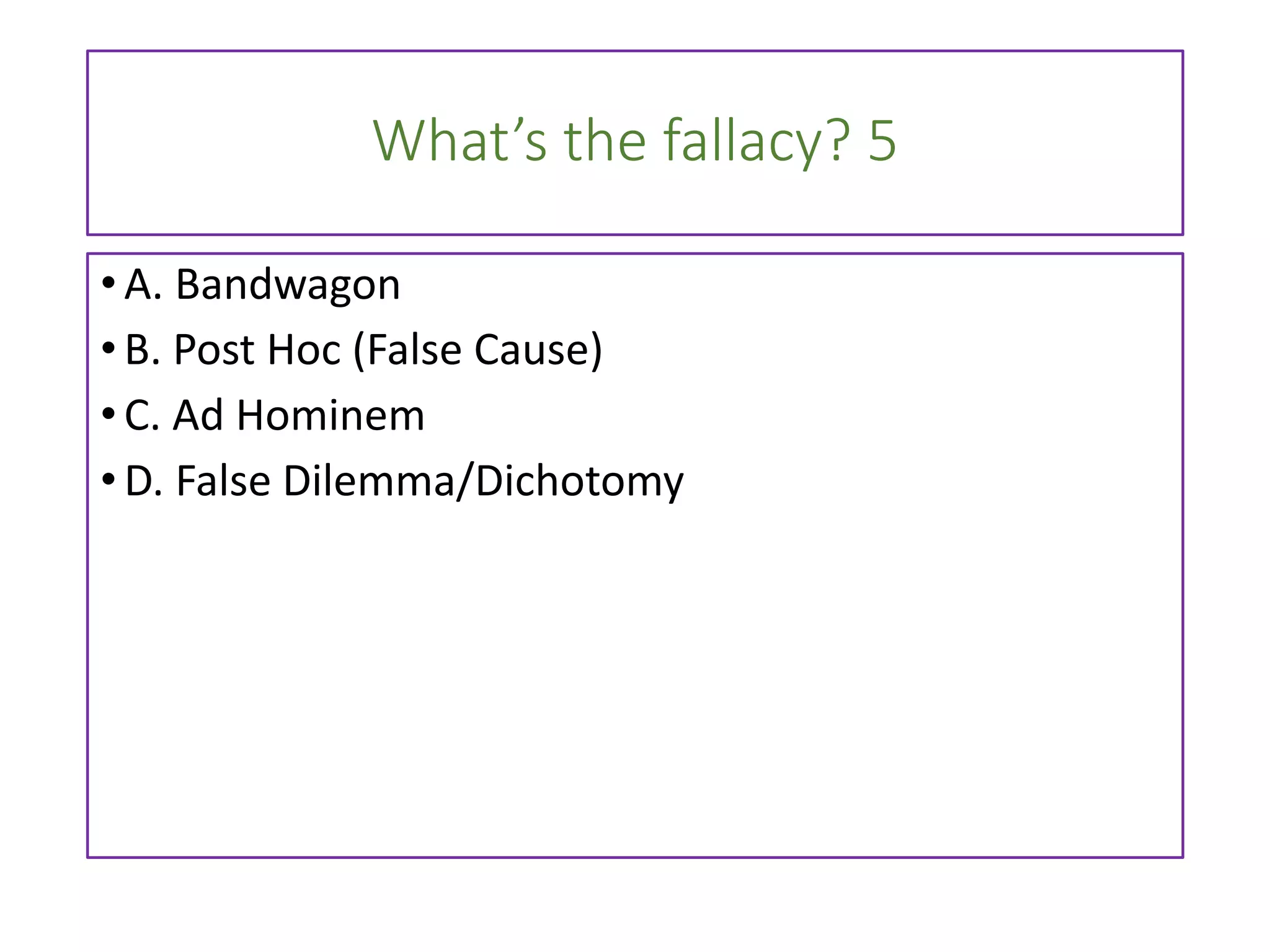
What’s the fallacy? 5
• A. Bandwagon
• B. Post Hoc (False Cause)
• C. Ad Hominem
• D. False Dilemma/Dichotomy
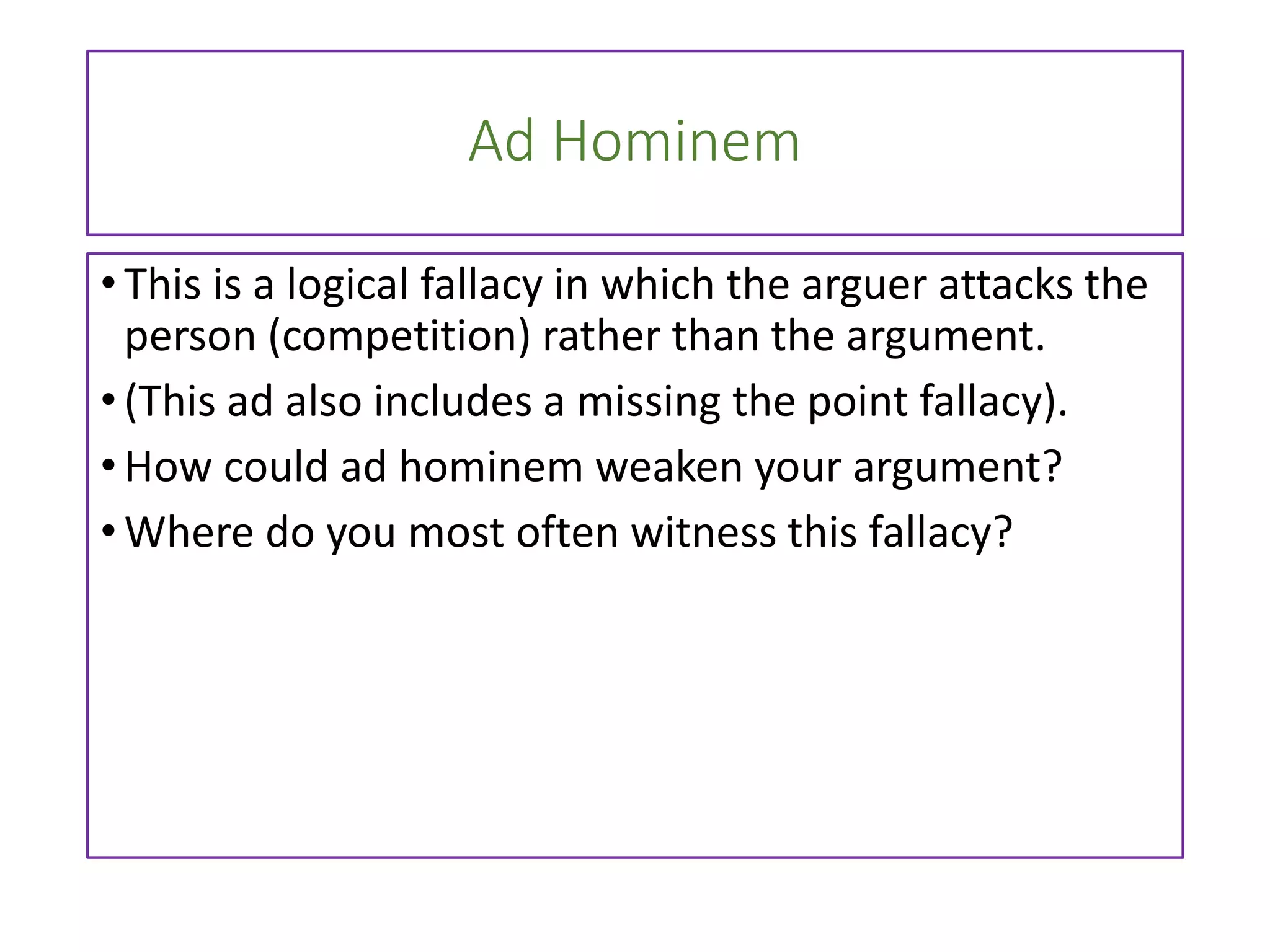
Ad Hominem
• This is a logical fallacy in which the arguer attacks the
person (competition) rather than the argument.
• (This ad also includes a missing the point fallacy).
• How could ad hominem weaken your argument?
• Where do you most often witness this fallacy?
What’s wrong with this argument? 6
“How do we know that we have here in the
Bible a right criterion of truth? We know
because of the Bible's claims for itself. All
through the Scripture are found frequent
expressions such as ‘Thus says the Lord,’ ‘The
Lord said,’ and ‘God spoke.’ Such statements
occur no less than 1,904 times in the 39 books
of the Old Testament.”
• Gilbert W. Kirby, "Is the Bible True?" Decision, Vol. 1, Jan. 1974, p. 4.
Cited by S. Morris Engel in Analyzing Informal Fallacies, Prentice-Hall,
1980, p. 55.
What’s the fallacy? 6
• A. Bandwagon
• B. Begging the Question
• C. Straw Man
• D. Emotional Fallacy
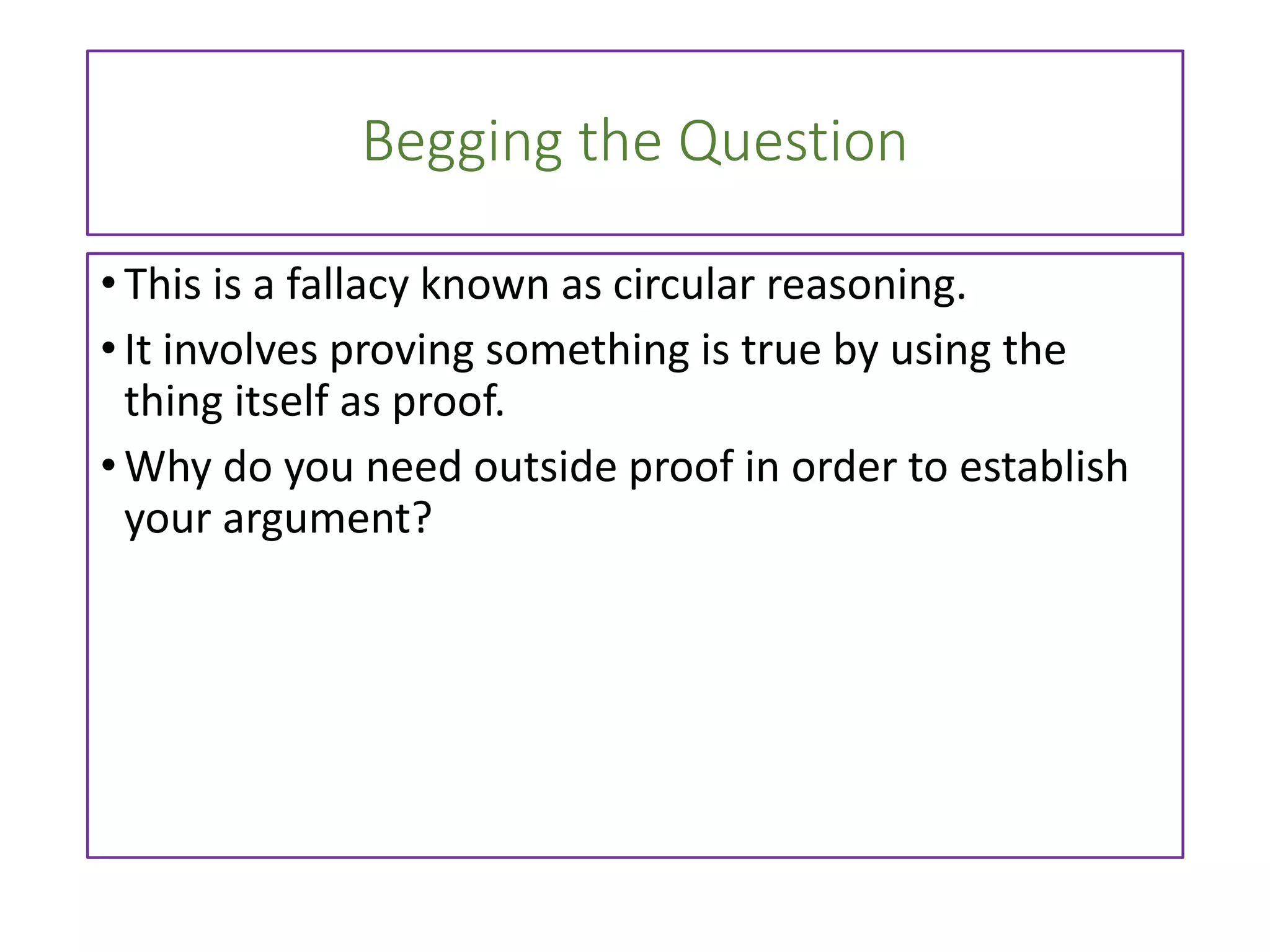
Begging the Question
• This is a fallacy known as circular reasoning.
• It involves proving something is true by using the
thing itself as proof.
• Why do you need outside proof in order to establish
your argument?
What’s wrong with this argument? 7
What’s the fallacy? 7
• A. Bandwagon
• B. Begging the Question
• C. Straw Man
• D. Guilt by Association
Bandwagon
• This fallacy convinces you to accept the argument
because everyone else does.
• We see this all the time when someone argues things
on websites for the legalization of marijuana.
What’s wrong with this argument? 8
• She’s a witch!
• Click on the link above to view the video. Then return
to answers the questions.
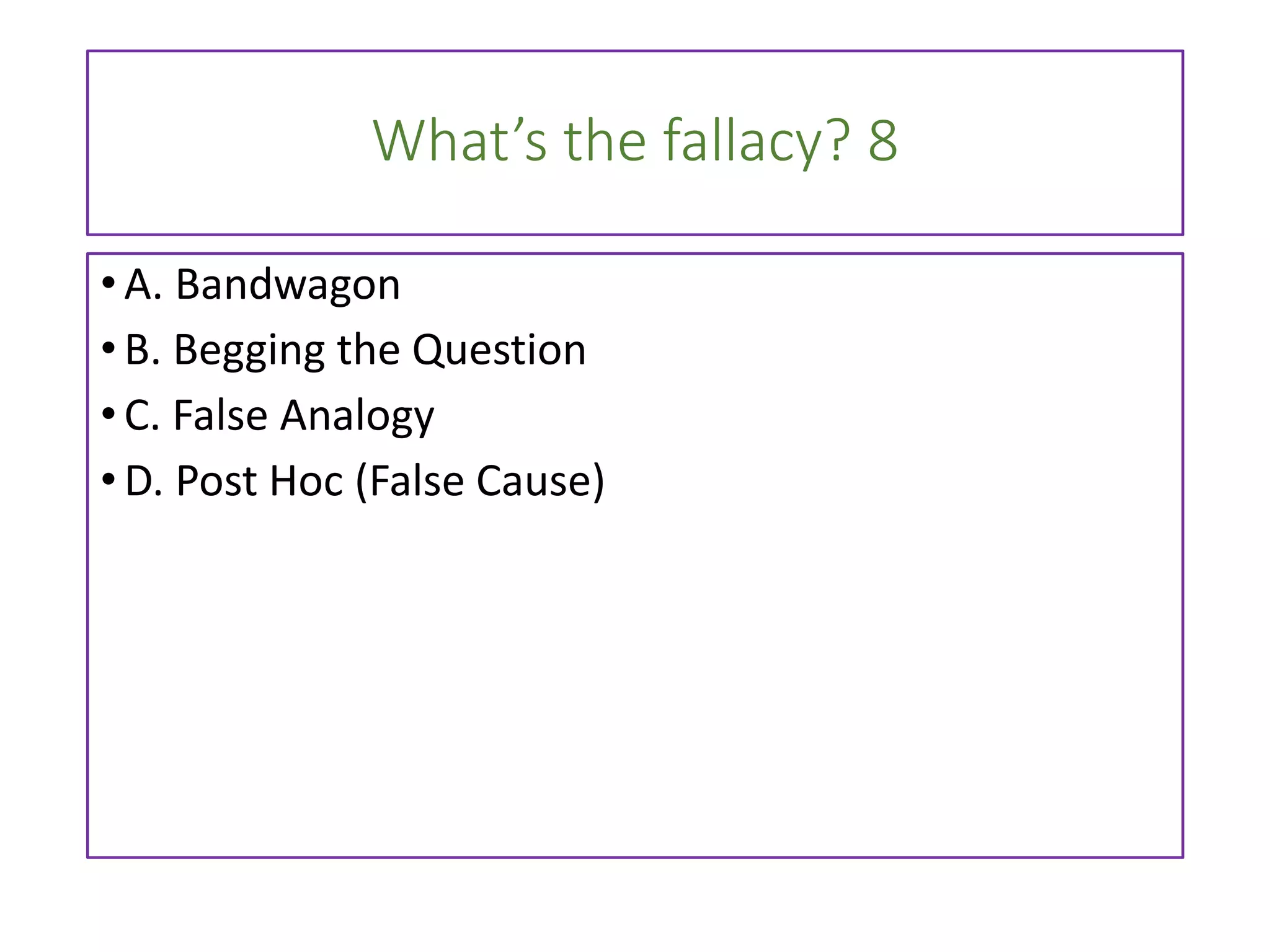
What’s the fallacy? 8
• A. Bandwagon
• B. Begging the Question
• C. False Analogy
• D. Post Hoc (False Cause)
ALL of Them!
• The conclusion reached by the author is not actually
supported by the premises.
• Really this example is just a hot mess of illogical
arguments and a fun example of how NOT to argue!
Other Logical Fallacies
• Appeal to authority
• Loaded Question
• Appeal to ignorance
• Straw man
• Red herring
• False dichotomy/dilemma
Reflection
• How will understanding logical fallacies help you
critically evaluate arguments?
• How will understanding logical fallacies help you write
your argument essay?
• How will understanding logical fallacies help you in
your future courses or beyond?
Final Responses
• Answer the following questions using the sentence
threads provided about your understanding of logical
fallacies. You may need more than one sentence.
• I used to think…
• Now I think…

Logical Fallacies

  • 1.
  • 2.
    What is alogical fallacy? • Arguments which may appear logical (particularly to audiences who are not listening/reading carefully), but do not stand up when closely examined. • They tend to make sweeping generalizations or go off topic from the issue at hand. • They weaken your argument.
  • 3.
    What’s wrong withthis argument?
  • 4.
    What’s the fallacy? •A. Loaded Question • B. Non Sequitur • C. Hasty Generalization • D. Post Hoc (False Cause)
  • 5.
    Hasty Generalization • Drawinga conclusion or making an assumption about a group based on a sample size that is too small. • How might this weaken your overall argument?
  • 6.
    What’s wrong withthis argument? 2 “I’m a single father raising a 15-year-old, severely autistic non-verbal teenage daughter. When she was 15 months old, she received a round of vaccines that included the MMR and the DTaP. She developed a high fever, and when the fever broke, she lost everything.”
  • 7.
    What’s the fallacy?2 • A. Red Herring • B. False Dilemma/Dichotomy • C. Slippery Slope • D. Post Hoc (False Cause)
  • 8.
    Post Hoc ErgoPropter Hoc (False Cause) • This father makes a false assumption about the cause of his daughter’s autism. Just because her autism developed after the vaccine does not mean the vaccine caused it. • Multiple studies have shown that autism is NOT caused by vaccines. The doctor that claimed it admitted he lied and has been disbarred from the medical community. • False cause is a logical fallacy in which one assumes that one thing (A) causes another (B) because A came before B. • Correlation does NOT equal causation. • Visit Spurious Correlations for some funny correlations.
  • 9.
    What’s wrong withthis argument? 3 • Don’t get rid of cable… • Click on the link above to view the video. Then return to answers the questions.
  • 10.
    What’s the fallacy?3 • A. Slippery Slope • B. Red Herring • C. Non Sequitur • D. Post Hoc (False Cause)
  • 11.
    Slippery Slope • Thewriter states that a chain reaction will take place if a first step is taken, but there is no logical evidence that this reaction will occur. • This is a fallacy called slippery slope.
  • 12.
    What’s wrong withthis argument? 4 • Prop 8 • Click on the link above to view the video. Then return to answers the questions.
  • 13.
    What’s the fallacy?4 • A. False Analogy • B. False Dilemma/Dichotomy • C. Ad Hominem • D. Bandwagon
  • 14.
    Weak/False Analogy • Thisis a fallacy in which two things that are NOT alike are treated alike. • In other words, a pair of shoes IS NOT like a pair of people. • Your audience will reject your argument if they do not accept the comparison.
  • 15.
    What’s wrong withthis argument? 5 • Direct TV hates puppies • Click on the link above to view the video. Then return to answers the questions.
  • 16.
    What’s the fallacy?5 • A. Bandwagon • B. Post Hoc (False Cause) • C. Ad Hominem • D. False Dilemma/Dichotomy
  • 17.
    Ad Hominem • Thisis a logical fallacy in which the arguer attacks the person (competition) rather than the argument. • (This ad also includes a missing the point fallacy). • How could ad hominem weaken your argument? • Where do you most often witness this fallacy?
  • 18.
    What’s wrong withthis argument? 6 “How do we know that we have here in the Bible a right criterion of truth? We know because of the Bible's claims for itself. All through the Scripture are found frequent expressions such as ‘Thus says the Lord,’ ‘The Lord said,’ and ‘God spoke.’ Such statements occur no less than 1,904 times in the 39 books of the Old Testament.” • Gilbert W. Kirby, "Is the Bible True?" Decision, Vol. 1, Jan. 1974, p. 4. Cited by S. Morris Engel in Analyzing Informal Fallacies, Prentice-Hall, 1980, p. 55.
  • 19.
    What’s the fallacy?6 • A. Bandwagon • B. Begging the Question • C. Straw Man • D. Emotional Fallacy
  • 20.
    Begging the Question •This is a fallacy known as circular reasoning. • It involves proving something is true by using the thing itself as proof. • Why do you need outside proof in order to establish your argument?
  • 21.
    What’s wrong withthis argument? 7
  • 22.
    What’s the fallacy?7 • A. Bandwagon • B. Begging the Question • C. Straw Man • D. Guilt by Association
  • 23.
    Bandwagon • This fallacyconvinces you to accept the argument because everyone else does. • We see this all the time when someone argues things on websites for the legalization of marijuana.
  • 24.
    What’s wrong withthis argument? 8 • She’s a witch! • Click on the link above to view the video. Then return to answers the questions.
  • 25.
    What’s the fallacy?8 • A. Bandwagon • B. Begging the Question • C. False Analogy • D. Post Hoc (False Cause)
  • 26.
    ALL of Them! •The conclusion reached by the author is not actually supported by the premises. • Really this example is just a hot mess of illogical arguments and a fun example of how NOT to argue!
  • 27.
    Other Logical Fallacies •Appeal to authority • Loaded Question • Appeal to ignorance • Straw man • Red herring • False dichotomy/dilemma
  • 28.
    Reflection • How willunderstanding logical fallacies help you critically evaluate arguments? • How will understanding logical fallacies help you write your argument essay? • How will understanding logical fallacies help you in your future courses or beyond?
  • 29.
    Final Responses • Answerthe following questions using the sentence threads provided about your understanding of logical fallacies. You may need more than one sentence. • I used to think… • Now I think…

Editor's Notes

  • #19 http://www.fallacyfiles.org/examples.html