DETERMINING
TRUTH
DANILO F. MARIBAO
PALIPARAN III SENIOR HIGH SCHOOL
DASMARINAS CITY, CAVITE
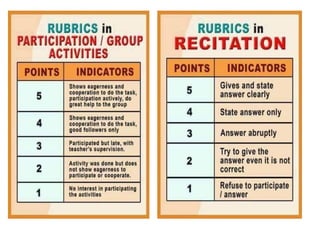
1. Group the class into 5 groups
2. Each group must appoint for a
leader and secretary.
3. Once you hear “what is your
score” the group must announce
their score.
4. The first group who announce
their score will get an additional
points.
5. Highest score gets 10pts- 8 pts- 6
REVIEW
1. Skeptical attitude in
looking an ideas, events
or things.
Systematic doubt
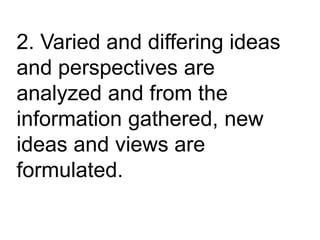
2. Varied and differing ideas
and perspectives are
analyzed and from the
information gathered, new
ideas and views are
formulated.
Dialectic
3. Analyzing a topic by
formulating a series of
questions designed to
analyze its various aspects,
and examine and clarify a
person’s view on it.
Socratic Method
4. Refers to
assumptions which
are taken for granted
in a philosophical
discussion.
Axioms
5. It is a problem
solving device used in
analyzing possible
explanations regarding
a phenomenon.
Occam’s razor
DETERMINING
TRUTH
ACTIVITY
LET’S PONDER
Asia is the largest continent in the world.
God made the world in seven days.
Man has the right to life, liberty, and the pursuit of
happiness.
China’s continued presence in the Spratlys is a violation
of international law.
A person must always consider the interests of his
family before his own happiness.
Citizens have the right to take up arms and overthrow an
oppressive government.
The President has done very little to upload
democracy and look after the interests of the Filipino people.
The sun is the center of the solar system
Put a check in the box of the statement that is true.
ANALYSIS
1. Were you able to judge easily the
truthfulness of the statements? Why?
2. Which of the statements are obviously
true?
3. Which of these statements may be true
for others but not true in the judgment?
4. Which of these statements do you
personally believe to be true but may be
disputed by other people?
ABSTRACTION
How do we use
Philosophy to figure out
what is true?
In today’s society, we are often
bombarded with a lot of information.
Most of these are helpful, but there are
some that seem to mislead us or even
utterly false.
These kind of information often have a
negative impact in our lives.
People have been mislead by claims of
“miracle drugs” which were eventually
proven to have a no significant effects
on health.
Selling some
herbal beauty
soap ❤ at budget
price . Pm me if
intrested. ❤
How do we know that
what they are telling is
true
TRUTH lies at the heart of any
inquiry.
Knowledge must be truthful to gain
validity and acceptance. But the
concept of truth remains a
controversial and much-discussed
topic among philosophers.
What is true, or even a
definition of truth, is tricky
concept in Philosophy.
Philosophers agree that
there is no absolute measure
of truth.
Concept of truth:
- Rooted in an ancient Greek
philosophy’s concept of
knowledge as “justified, true
belief”.
- This concept states that
something is true because you
believe it is be true, and there is
justification for such belief.
CORRESPONDENCE THEORY
states that something is true if it
corresponds to reality or the actual
state of affairs.
- This theory assumes a direct
relationship between an idea and
reality and that can be taken as
“fact”.
Example:
“A mammal is an animal which is warm-
blooded, has hair, and feed its young
with milk” is considered to be true.
“a dog barks” is also true
“ pigs can fly” however, is false since
in reality pigs do not have the capability
to fly.
Is this true?
manananggal
Ng lakas”
COHERENCE THEORY propose that
something is true if it makes sense
when placed in a certain situation or
context.
Unclean for
Muslims
makes sense in the context of
Islamic faith.
RELATIVISM is a philosophical
concept which contends that there are
no absolute truths.
Abortion is
acceptable
practice for
Catholics.
CONSTRUCTIVIST THEORY holds
that knowledge is shaped by social
forces and influenced by culture and
history.
This is reflected
by laws and
traditions.
CONSENSUS THEORY views
knowledge as based on argument, and
that something is true if almost
everyone agrees that is true.
Pluto’s classification
into a “dwarf planet”
PRAGMATIC THEORY holds the view
that something is true if we can put it
into practice or is useful in real life. It
also believes that ideas should be
continually treated to confirm their
validity.
A related theory, verification, considers
that ideas must be verified using the
senses of experience.
OTHER THINGS
SHOULD WE CONSIDER
IN DETERMINING THE
TRUTH
Determining the truth of any statement
Ideas and claims are often presented in
the form of ARGUMENTS
These kinds of arguments are called
FALLACIES
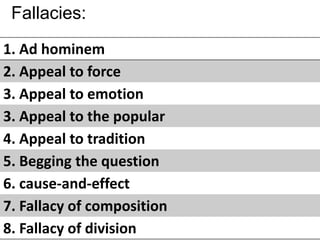
1. Ad hominem
2. Appeal to force
3. Appeal to emotion
3. Appeal to the popular
4. Appeal to tradition
5. Begging the question
6. cause-and-effect
7. Fallacy of composition
8. Fallacy of division
Fallacies:
You make
me happy
in a way,
no one else
can
One should also know the difference
between fact and opinion.
Facts are generally established truths,
easily verified, and do not easily
change from one situation to another.
Opinions on the other hand, are aware
of bias or personal views of the person
presenting it.
Kabahan ka na.
😂 #Transformer
Biases are not necessarily errors in
reasoning, but refer to tendencies or
influences which affect the views of
people.
1. Correspondence bias or attribution effect
2. Confirmation bias
3. Framing
4. Hindsight
5. Conflict of interest
6. Cultural bias
Biases:
CORRESPONDENCE BIAS OR ATTRIBUTION EFFECT
Tendency to judge a person’s personality
by his or her actions, without regard for
external factors on influence.
Ex:
These soldiers who fought in the war are
all bloodthirsty murderer.
CONFIRMATION BIAS
Tendency to look for and readily accept
information which fits with one’s own
beliefs or views and to reject ideas or views
that go against it.
Ex:
How can I accept his view that there is no
God? I am a Christian!
FRAMING
Focusing on a certain aspect of a problem while
ignoring other aspects.
Ex: Preliminary evidences have still not
pointed out the actual cause of the plane
crash, but investigators are currently focusing
on the possibility of pilot error.
HINDSIGHT
The tendency to see past events as
predictable, or to ascribe a pattern to
historical; events.
Ex: Magellan’s assault on Mactan Island
was a foolhardy venture, made by an
overconfident, careless man who
underestimated the valor of the native
Filipinos.
CONFLICT OF INTEREST
A person or group is connected to or has a
vested interest in the issue being
discussed.
Ex:
As the daughter of the accused, I believe I
have the right to express my opinion on the
issue of his alleged corrupt practices.
CULTURAL BIAS
Analyzing an event or issue based on
one’s cultural standards.
Ex:
I do not agree with this Western practice of
placing aged parents in retirement homes.
We Filipinos take care of ur family
members.
THEORY Something is
true if…
We can determine
truth if…
THINK
Compare the various theories on knowledge by
completing the table.
APPLICATION
1. What are some of your personal
biases?
2. How do these biases affect the
way you deal with other people’s
views and opinions?
ASSESSMENT
1. Lies at the heart of any
inquiry.
2. states that something is true if it
corresponds to reality or the actual
state of affairs
3. Propose that something is true if
it makes sense when placed in a
certain situation or context.
4. It is a philosophical concept
which contends that there are no
absolute truths.
5. Holds that knowledge is shaped by
social forces and influenced by culture
and history.
1. TRUTH
2. Correspondence theory
3. Coherence Theory
4. Relativism
5. Constructivist Theory
ANSWERS:
Topic 5. determining truth

Topic 5. determining truth

  • 1.
    DETERMINING TRUTH DANILO F. MARIBAO PALIPARANIII SENIOR HIGH SCHOOL DASMARINAS CITY, CAVITE
  • 2.
    1. Group theclass into 5 groups 2. Each group must appoint for a leader and secretary. 3. Once you hear “what is your score” the group must announce their score. 4. The first group who announce their score will get an additional points. 5. Highest score gets 10pts- 8 pts- 6
  • 4.
  • 5.
    1. Skeptical attitudein looking an ideas, events or things.
  • 6.
  • 7.
    2. Varied anddiffering ideas and perspectives are analyzed and from the information gathered, new ideas and views are formulated.
  • 8.
  • 9.
    3. Analyzing atopic by formulating a series of questions designed to analyze its various aspects, and examine and clarify a person’s view on it.
  • 10.
  • 11.
    4. Refers to assumptionswhich are taken for granted in a philosophical discussion.
  • 12.
  • 13.
    5. It isa problem solving device used in analyzing possible explanations regarding a phenomenon.
  • 14.
  • 15.
  • 16.
  • 17.
    Asia is thelargest continent in the world. God made the world in seven days. Man has the right to life, liberty, and the pursuit of happiness. China’s continued presence in the Spratlys is a violation of international law. A person must always consider the interests of his family before his own happiness. Citizens have the right to take up arms and overthrow an oppressive government. The President has done very little to upload democracy and look after the interests of the Filipino people. The sun is the center of the solar system Put a check in the box of the statement that is true.
  • 18.
    ANALYSIS 1. Were youable to judge easily the truthfulness of the statements? Why? 2. Which of the statements are obviously true? 3. Which of these statements may be true for others but not true in the judgment? 4. Which of these statements do you personally believe to be true but may be disputed by other people?
  • 19.
    ABSTRACTION How do weuse Philosophy to figure out what is true?
  • 20.
    In today’s society,we are often bombarded with a lot of information. Most of these are helpful, but there are some that seem to mislead us or even utterly false.
  • 22.
    These kind ofinformation often have a negative impact in our lives. People have been mislead by claims of “miracle drugs” which were eventually proven to have a no significant effects on health.
  • 23.
    Selling some herbal beauty soap❤ at budget price . Pm me if intrested. ❤
  • 24.
    How do weknow that what they are telling is true
  • 25.
    TRUTH lies atthe heart of any inquiry. Knowledge must be truthful to gain validity and acceptance. But the concept of truth remains a controversial and much-discussed topic among philosophers.
  • 26.
    What is true,or even a definition of truth, is tricky concept in Philosophy. Philosophers agree that there is no absolute measure of truth.
  • 27.
    Concept of truth: -Rooted in an ancient Greek philosophy’s concept of knowledge as “justified, true belief”. - This concept states that something is true because you believe it is be true, and there is justification for such belief.
  • 28.
    CORRESPONDENCE THEORY states thatsomething is true if it corresponds to reality or the actual state of affairs. - This theory assumes a direct relationship between an idea and reality and that can be taken as “fact”.
  • 29.
    Example: “A mammal isan animal which is warm- blooded, has hair, and feed its young with milk” is considered to be true. “a dog barks” is also true “ pigs can fly” however, is false since in reality pigs do not have the capability to fly.
  • 30.
  • 31.
  • 32.
    COHERENCE THEORY proposethat something is true if it makes sense when placed in a certain situation or context. Unclean for Muslims
  • 33.
    makes sense inthe context of Islamic faith.
  • 34.
    RELATIVISM is aphilosophical concept which contends that there are no absolute truths. Abortion is acceptable practice for Catholics.
  • 35.
    CONSTRUCTIVIST THEORY holds thatknowledge is shaped by social forces and influenced by culture and history. This is reflected by laws and traditions.
  • 36.
    CONSENSUS THEORY views knowledgeas based on argument, and that something is true if almost everyone agrees that is true. Pluto’s classification into a “dwarf planet”
  • 37.
    PRAGMATIC THEORY holdsthe view that something is true if we can put it into practice or is useful in real life. It also believes that ideas should be continually treated to confirm their validity. A related theory, verification, considers that ideas must be verified using the senses of experience.
  • 38.
    OTHER THINGS SHOULD WECONSIDER IN DETERMINING THE TRUTH
  • 39.
    Determining the truthof any statement Ideas and claims are often presented in the form of ARGUMENTS These kinds of arguments are called FALLACIES
  • 40.
    1. Ad hominem 2.Appeal to force 3. Appeal to emotion 3. Appeal to the popular 4. Appeal to tradition 5. Begging the question 6. cause-and-effect 7. Fallacy of composition 8. Fallacy of division Fallacies:
  • 41.
    You make me happy ina way, no one else can
  • 42.
    One should alsoknow the difference between fact and opinion. Facts are generally established truths, easily verified, and do not easily change from one situation to another. Opinions on the other hand, are aware of bias or personal views of the person presenting it.
  • 43.
    Kabahan ka na. 😂#Transformer
  • 44.
    Biases are notnecessarily errors in reasoning, but refer to tendencies or influences which affect the views of people.
  • 45.
    1. Correspondence biasor attribution effect 2. Confirmation bias 3. Framing 4. Hindsight 5. Conflict of interest 6. Cultural bias Biases:
  • 46.
    CORRESPONDENCE BIAS ORATTRIBUTION EFFECT Tendency to judge a person’s personality by his or her actions, without regard for external factors on influence. Ex: These soldiers who fought in the war are all bloodthirsty murderer.
  • 47.
    CONFIRMATION BIAS Tendency tolook for and readily accept information which fits with one’s own beliefs or views and to reject ideas or views that go against it. Ex: How can I accept his view that there is no God? I am a Christian!
  • 48.
    FRAMING Focusing on acertain aspect of a problem while ignoring other aspects. Ex: Preliminary evidences have still not pointed out the actual cause of the plane crash, but investigators are currently focusing on the possibility of pilot error.
  • 49.
    HINDSIGHT The tendency tosee past events as predictable, or to ascribe a pattern to historical; events. Ex: Magellan’s assault on Mactan Island was a foolhardy venture, made by an overconfident, careless man who underestimated the valor of the native Filipinos.
  • 50.
    CONFLICT OF INTEREST Aperson or group is connected to or has a vested interest in the issue being discussed. Ex: As the daughter of the accused, I believe I have the right to express my opinion on the issue of his alleged corrupt practices.
  • 51.
    CULTURAL BIAS Analyzing anevent or issue based on one’s cultural standards. Ex: I do not agree with this Western practice of placing aged parents in retirement homes. We Filipinos take care of ur family members.
  • 52.
    THEORY Something is trueif… We can determine truth if… THINK Compare the various theories on knowledge by completing the table. APPLICATION
  • 53.
    1. What aresome of your personal biases? 2. How do these biases affect the way you deal with other people’s views and opinions?
  • 54.
  • 55.
    1. Lies atthe heart of any inquiry.
  • 56.
    2. states thatsomething is true if it corresponds to reality or the actual state of affairs
  • 57.
    3. Propose thatsomething is true if it makes sense when placed in a certain situation or context.
  • 58.
    4. It isa philosophical concept which contends that there are no absolute truths.
  • 59.
    5. Holds thatknowledge is shaped by social forces and influenced by culture and history.
  • 60.
    1. TRUTH 2. Correspondencetheory 3. Coherence Theory 4. Relativism 5. Constructivist Theory ANSWERS: