CHOICES
Lesson 12
Freedom of the Human Person
(Part 2- Ethics)
Mr. Edward B. Noda Jr.
Choices: Freedomcomeswithgreat
responsibilities
 It is an absolute understanding that all actions have
consequences. Freedom involves choice.
 Chance and choosing are incommensurable. If a
person has the capacity to choose, then that person
can be held responsible over the consequences of his/
her actions.
 Freedom is the power to be what you want to be
and the ability to decide and create your self.
 Many of the characteristics that define our
personality are often a product of our choices.
Freedom gives you the ability to strive to achieve
goal.
 Freedom is rooted in the human person’s self determination
and the exercise of intellect and free will.
 A person’s actions determine what kind of person he/ she
becomes.
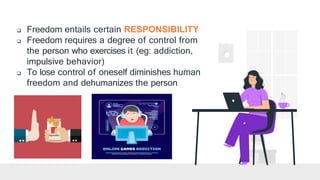
 Freedom entails certain RESPONSIBILITY
 Freedom requires a degree of control from
the person who exercises it (eg: addiction,
impulsive behavior)
 To lose control of oneself diminishes human
freedom and dehumanizes the person
What makesus
free?
How does
freedom shape
our experiences?
2 Elementsthat definefreedom:
1.Voluntariness- refers to the ability of a person to
act out of his/ her own free will and self
determination.
 Decisions are made out of his/ her own free will
 Also means that a person may act even if he/ she
is not required or called to take action.
 Voluntary acts are free acts which can be
assigned a corresponding moral value.
 Whenever we decide to take action, this results in
a certain consequence.
2 Elementsthat definefreedom:
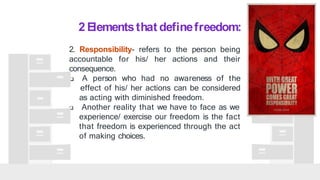
2. Responsibility- refers to the person being
accountable for his/ her actions and their
consequence.
 A person who had no awareness of the
effect of his/ her actions can be considered
as acting with diminished freedom.
 Another reality that we have to face as we
experience/ exercise our freedom is the fact
that freedom is experienced through the act
of making choices.
TheNatureof theChoicesWe Make
Understanding the importance of being prudent in
making choices, you will realize that any deliberate
act of choosing involves evaluating the alternatives.
weighing the reasons
 The concept of explained that
when you are choosing, the act involves not only
weighing the reasons but giving weight to reasons.
 After you have chosen each alternative, you will
realize that some considerations carry more weight
than the others. That is why you choose one
alternative and disregard the other.
TheAct of MakingaChoice
 Ethics is a branch of philosophy that deals with the systematic
questioning and critical examination of the underlying
principles of morality.
 A moral agent is a person who has the ability to discern right
from wrong and to be held accountable for his or her own
actions. Moral agents have a moral responsibility not to cause
unjustified harm.
moral decision
 A is a choice made based on a person's ethics,
manners, character, and what they believe is proper behavior.
These decisions tend to affect not only our own well-being, but
the well-being of others.
Ethics
.Intellectual Choice – This is a choice which is deliberately selected
based on a moral standpoint.
normative
 They are answers about what we ought to do from a
moral system that we uphold and its moral principles.
normative
 These answers would take into
consideration the behavior which the society will accept.
For example, when you are to decide in a moral issue, you can try to
give intellectual choice as a normative answer. Here you are simply
assuming because you are not, as it were, facing that actual moral
situation described in the dilemma.
In this case, the answers that you are inclined to give are
prescriptive in this imaginary and hypothetical situation.
Intellectual Choicevs. Practical Choice
Practical Choice – a choice which is borne out of psychological and
emotional considerations.
 Practical choices are made when confronted with the actual
situation, and usually affected by psychological aspect of the person
embroiled in the moral situation or dilemma.
For instance, psychological and emotional stress and lack of time to
deliberate during an actual moral situation may affect a person’s
moral decision in that situation. A person may be so engulfed by
emotions that he may sometimes fail to make the right choice.
Likewise, stress could make a person’s practical choice inconsistent
with his intellectual choice.
Intellectual Choicevs. Practical Choice
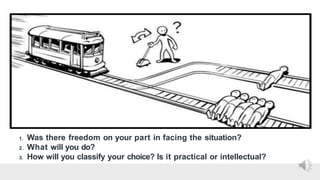
1. Was there freedom on your part in facing the situation?
2. What will you do?
3. How will you classify your choice? Is it practical or intellectual?
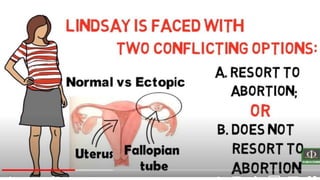
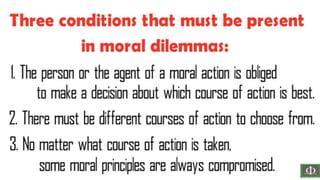
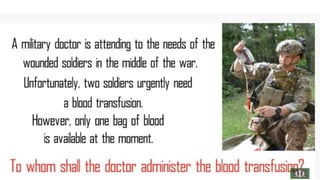
Moral Dilemma
 Dilemma- a situation where a person is forced to choose
between two or more conflicting options, neither of which is
acceptable.
 When dilemmas involve human actions which have moral
implications, they are called ethical or moral dilemmas.
 Moral dilemmas are situations where persons, who are called
“moral agents” in ethics, are forced to choose between two or
more conflicting options, neither of which resolves the
situation in a morally acceptable manner.
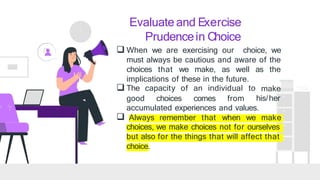
Evaluate and Exercise
Prudencein Choice
 When we are exercising our choice, we
must always be cautious and aware of the
choices that we make, as well as the
implications of these in the future.
make
 The capacity of an individual to
good choices comes from his/her
accumulated experiences and values.
 Always remember that when we make
choices, we make choices not for ourselves
but also for the things that will affect that
choice.
Choices: Consequences and Sacrifices
 We must take into consideration the necessary
sacrifices that we must take for us to grow.
 There are times that when we decide, we take risks,
may it be a sacrifice or consequence, and the
tendency of humans to take such daunting tasks
comes from his experiences and values.
 In totality, the situation and progress of a person
in a situation falls on the result, that is our goal
depends solely the weighted consequences we must
bear and the sacrifices we must endure.
How canI exercise
my freedomin a
responsible and
beneficial
manner?
 Human freedom, though essential is NOT ABSOLUTE
 Human freedom should be exercised with control and a
recognition of reasonable limits.
 Limiting personal freedom requires sacrifice to certain self-
interests and accept certain realities that are beyond control.
 Our sense of right and wrong guides us on recognizing and
deciding on the limitations to our freedom.
 Freedom should also be exercised with regard
for knowledge and truth.
 It is necessary to cultivate the intellectual virtue
of PRUDENCE in making sound choice.
 In exercising our freedom, we should also
recognize and uphold not only our individual
freedom but also the freedom of others
 Freedom should be exercised with due regard for
the welfare of other persons.
The“
Gi ven” and the“ Chosen”
These “give pre determin things do
not negate
ns”
ou
or
r freedom but g
ed
ive us the
opportunities to exercise our freedom
when we determine ourselves.
Use our freedom in a good way so that
we may become better people and better
versions of ourselves.
Recap
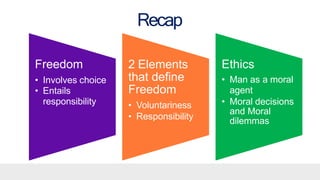
Freedom
• Involves choice
• Entails
responsibility
2 Elements
that define
Freedom
• Voluntariness
• Responsibility
Ethics
• Man as a moral
agent
• Moral decisions
and Moral
dilemmas

Lesson 12- Choices - Hand-outs.pptx

  • 1.
    CHOICES Lesson 12 Freedom ofthe Human Person (Part 2- Ethics) Mr. Edward B. Noda Jr.
  • 2.
    Choices: Freedomcomeswithgreat responsibilities  Itis an absolute understanding that all actions have consequences. Freedom involves choice.  Chance and choosing are incommensurable. If a person has the capacity to choose, then that person can be held responsible over the consequences of his/ her actions.
  • 3.
     Freedom isthe power to be what you want to be and the ability to decide and create your self.  Many of the characteristics that define our personality are often a product of our choices. Freedom gives you the ability to strive to achieve goal.
  • 4.
     Freedom isrooted in the human person’s self determination and the exercise of intellect and free will.  A person’s actions determine what kind of person he/ she becomes.
  • 5.
     Freedom entailscertain RESPONSIBILITY  Freedom requires a degree of control from the person who exercises it (eg: addiction, impulsive behavior)  To lose control of oneself diminishes human freedom and dehumanizes the person
  • 6.
  • 7.
    2 Elementsthat definefreedom: 1.Voluntariness-refers to the ability of a person to act out of his/ her own free will and self determination.  Decisions are made out of his/ her own free will  Also means that a person may act even if he/ she is not required or called to take action.  Voluntary acts are free acts which can be assigned a corresponding moral value.  Whenever we decide to take action, this results in a certain consequence.
  • 8.
    2 Elementsthat definefreedom: 2.Responsibility- refers to the person being accountable for his/ her actions and their consequence.  A person who had no awareness of the effect of his/ her actions can be considered as acting with diminished freedom.  Another reality that we have to face as we experience/ exercise our freedom is the fact that freedom is experienced through the act of making choices.
  • 9.
    TheNatureof theChoicesWe Make Understandingthe importance of being prudent in making choices, you will realize that any deliberate act of choosing involves evaluating the alternatives. weighing the reasons  The concept of explained that when you are choosing, the act involves not only weighing the reasons but giving weight to reasons.  After you have chosen each alternative, you will realize that some considerations carry more weight than the others. That is why you choose one alternative and disregard the other. TheAct of MakingaChoice
  • 10.
     Ethics isa branch of philosophy that deals with the systematic questioning and critical examination of the underlying principles of morality.  A moral agent is a person who has the ability to discern right from wrong and to be held accountable for his or her own actions. Moral agents have a moral responsibility not to cause unjustified harm. moral decision  A is a choice made based on a person's ethics, manners, character, and what they believe is proper behavior. These decisions tend to affect not only our own well-being, but the well-being of others. Ethics
  • 11.
    .Intellectual Choice –This is a choice which is deliberately selected based on a moral standpoint. normative  They are answers about what we ought to do from a moral system that we uphold and its moral principles. normative  These answers would take into consideration the behavior which the society will accept. For example, when you are to decide in a moral issue, you can try to give intellectual choice as a normative answer. Here you are simply assuming because you are not, as it were, facing that actual moral situation described in the dilemma. In this case, the answers that you are inclined to give are prescriptive in this imaginary and hypothetical situation. Intellectual Choicevs. Practical Choice
  • 12.
    Practical Choice –a choice which is borne out of psychological and emotional considerations.  Practical choices are made when confronted with the actual situation, and usually affected by psychological aspect of the person embroiled in the moral situation or dilemma. For instance, psychological and emotional stress and lack of time to deliberate during an actual moral situation may affect a person’s moral decision in that situation. A person may be so engulfed by emotions that he may sometimes fail to make the right choice. Likewise, stress could make a person’s practical choice inconsistent with his intellectual choice. Intellectual Choicevs. Practical Choice
  • 13.
    1. Was therefreedom on your part in facing the situation? 2. What will you do? 3. How will you classify your choice? Is it practical or intellectual?
  • 14.
    Moral Dilemma  Dilemma-a situation where a person is forced to choose between two or more conflicting options, neither of which is acceptable.  When dilemmas involve human actions which have moral implications, they are called ethical or moral dilemmas.  Moral dilemmas are situations where persons, who are called “moral agents” in ethics, are forced to choose between two or more conflicting options, neither of which resolves the situation in a morally acceptable manner.
  • 19.
    Evaluate and Exercise PrudenceinChoice  When we are exercising our choice, we must always be cautious and aware of the choices that we make, as well as the implications of these in the future. make  The capacity of an individual to good choices comes from his/her accumulated experiences and values.  Always remember that when we make choices, we make choices not for ourselves but also for the things that will affect that choice.
  • 20.
    Choices: Consequences andSacrifices  We must take into consideration the necessary sacrifices that we must take for us to grow.  There are times that when we decide, we take risks, may it be a sacrifice or consequence, and the tendency of humans to take such daunting tasks comes from his experiences and values.  In totality, the situation and progress of a person in a situation falls on the result, that is our goal depends solely the weighted consequences we must bear and the sacrifices we must endure.
  • 21.
    How canI exercise myfreedomin a responsible and beneficial manner?
  • 22.
     Human freedom,though essential is NOT ABSOLUTE  Human freedom should be exercised with control and a recognition of reasonable limits.  Limiting personal freedom requires sacrifice to certain self- interests and accept certain realities that are beyond control.  Our sense of right and wrong guides us on recognizing and deciding on the limitations to our freedom.
  • 23.
     Freedom shouldalso be exercised with regard for knowledge and truth.  It is necessary to cultivate the intellectual virtue of PRUDENCE in making sound choice.  In exercising our freedom, we should also recognize and uphold not only our individual freedom but also the freedom of others  Freedom should be exercised with due regard for the welfare of other persons.
  • 24.
    The“ Gi ven” andthe“ Chosen” These “give pre determin things do not negate ns” ou or r freedom but g ed ive us the opportunities to exercise our freedom when we determine ourselves. Use our freedom in a good way so that we may become better people and better versions of ourselves.
  • 25.
    Recap Freedom • Involves choice •Entails responsibility 2 Elements that define Freedom • Voluntariness • Responsibility Ethics • Man as a moral agent • Moral decisions and Moral dilemmas