239
7Informal Fallacies
Enterline Design Services LLC/iStock/Thinkstock
Learning Objectives
After reading this chapter, you should be able to:
1. Describe the various fallacies of support, their origins, and
circumstances in which specific
arguments may not be fallacious.
2. Describe the various fallacies of relevance, their origins, and
circumstances in which
specific arguments may not be fallacious.
3. Describe the various fallacies of clarity, their origins, and
circumstances in which specific
arguments may not be fallacious.
har85668_07_c07_239-278.indd 239 4/9/15 11:30 AM
© 2015 Bridgepoint Education, Inc. All rights reserved. Not for
resale or redistribution.
We can conceive of logic as providing us with the best tools for
seeking truth. If our goal is to
seek truth, then we must be clear that the task is not limited to
the formation of true beliefs
based on a solid logical foundation, for the task also involves
learning to avoid forming false
beliefs. Therefore, just as it is important to learn to employ
good reasoning, it is also impor-
tant to learn to avoid bad reasoning.
Toward this end, this chapter will focus on fallacies. Fallacies
are errors in reasoning; more
specifically, they are common patterns of reasoning with a high
likelihood of leading to false
conclusions. Logical fallacies often seem like good reasoning
because they resemble perfectly
legitimate argument forms. For example, the following is a
perfectly valid argument:
If you live in Paris, then you live in France.
You live in Paris.
Therefore, you live in France.
Assuming that both of the premises are true, it logically follows
that the conclusion must be
true. The following argument is very similar:
If you live in Paris, then you live in France.
You live in France.
Therefore, you live in Paris.
This second argument, however, is invalid; there are plenty of
other places to live in France.
This is a common formal fallacy known as affirming the
consequent. Chapter 4 discussed how
this fallacy was based on an incorrect logical form. This chapter
will focus on informal falla-
cies, fallacies whose errors are not so much a matter of form but
of content. The rest of this
chapter will cover some of the most common and important
fallacies, with definitions and
examples. Learning about fallacies can be a lot of fun, but be
warned: Once you begin noticing
fallacies, you may start to see them everywhere.
Before we start, it is worth noting a few things. First, there are
many, many fallacies. This
chapter will consider only a sampling of some of the most well-
known fallacies. Second, there
is a lot of overlap between fallacies. Reasonable people can
interpret the same errors as dif-
ferent fallacies. Focus on trying to understand both
interpretations rather than on insisting
that only one can be right. Third, different philosophers often
have different terminology for
the same fallacies and make different distinctions among them.
Therefore, you may find that
others use different terminology for the fallacies that we will
learn about in this chapter. Not
to worry—it is the ideas here that are most important: Our goal
is to learn to identify and
avoid mistakes in reasoning, regardless of specific terminology.
Finally, there are many ways to divide the fallacies into
categories. This chapter will refer to
fallacies of support, fallacies of clarity, and fallacies of
relevance. Avoiding fallacies may be dif-
ficult at first, but ultimately, as we learn to reason more fairly
and carefully, we will find that
avoiding fallacious reasoning helps us develop habits of mental
fairness, trustworthiness, and
openness, enhancing our ability to discern truth from error.
har85668_07_c07_239-278.indd 240 4/9/15 11:30 AM
© 2015 Bridgepoint Education, Inc. All rights reserved. Not for
resale or redistribution.
Section 7.1 Fallacies of Support
7.1 Fallacies of Support
When reasoning, it is essential to reach conclusions
based on adequate evidence; otherwise, our views
are unsubstantiated. The better the evidence, the
more credible our claims are, and the more likely
they are to be true. Fallacies can lead us to accept
conclusions that are not adequately supported and
may be false. Let us learn some of the most common
ways this can happen.
Begging the Question
One of the most common fallacies is called
begging the question, also known as petitio princi-
pii. This fallacy occurs when someone gives reason-
ing that assumes a major point at issue; it assumes
a particular answer to the question with which we
are concerned. In other words, the premises of the
argument claim something that someone probably
would not agree with if he or she did not already
accept the conclusion. Take a look at the following
argument:
Abortion is wrong because a fetus has a right to live.
There is nothing wrong with this argument as an expression of a
person’s belief. The ques-
tion is whether it will persuade anyone who does not already
agree with the conclusion. The
premise of this argument assumes the major point at issue. If
fetuses have a right to live,
then it would follow almost automatically that abortion is
wrong. However, those who do not
accept the conclusion probably do not accept this premise
(perhaps they do not feel that the
developing embryo is developed enough to have human rights
yet). It is therefore unlikely
that they will be persuaded by the argument. To improve the
argument, it would be necessary
to give good reasons why a fetus has a right to life, reasons that
would be persuasive to people
on the other side of the argument.
For more clarity about this problem, take a look at these similar
arguments:
Capital punishment is wrong because all humans have a right to
live.
Eating meat is wrong because animals have a right to live.
These arguments are nearly identical, yet they reach different
conclusions about what types
of killing are wrong because of different assumptions about who
has the right to live. Each,
however, is just as unlikely to persuade people with a different
view. In order to be persua-
sive, it is best to give an argument that does not rest on
controversial views that are merely
assumed to be true. It is not always easy to create non-question-
begging arguments, but such
is the challenge for those who would like to have a strong
chance of persuading those with
differing views.
Ingram Publishing/Thinkstock
With fallacious reasoning, the
premises only appear to support the
conclusion. When you look closely at a
fallacious argument, you can see how
the premises fail to offer support.
har85668_07_c07_239-278.indd 241 4/9/15 11:30 AM
© 2015 Bridgepoint Education, Inc. All rights reserved. Not for
resale or redistribution.
Section 7.1 Fallacies of Support
Here are examples on both sides of a different question:
Joe: I know that God exists because it says so in the Bible.
Doug: God doesn’t exist because nothing supernatural is real.
Do you think that either argument will persuade someone on the
other side? Someone who
does not believe in God probably does not accept the Bible to
be completely true, so this rea-
soning will not make the person change his or her mind. The
other argument does the same
thing by simply ruling out the possibility that anything could
exist other than physical matter.
Someone who believes in God will probably not accept this
premise.
Both arguments, on the other hand, will probably sound very
good to someone who shares
the speaker’s point of view, but they will not sound persuasive
at all to those who do not.
Committing the fallacy of begging the question can be
compared to “preaching to the choir”
because the only people who will accept the premise are those
who already agree with the
conclusion.
Circular Reasoning
An extreme form of begging the question is called circular
reasoning. In circular reasoning,
a premise is identical, or virtually identical, to the conclusion.
Here is an example:
Mike: Capital punishment is wrong.
Sally: Why is it wrong?
Mike: Because it is!
Mike’s reasoning here seems to be, “Capital punishment is
wrong. Therefore, capital punish-
ment is wrong.” The premise and conclusion are the same. The
reasoning is technically logi-
cally valid because there is no way for the premise to be true
and the conclusion false—since
they are the same—but this argument will never persuade
anyone, because no one will accept
the premise without already agreeing with the conclusion.
As mentioned, circular reasoning can be considered an extreme
form of begging the question.
For another example, suppose the conversation between Joe and
Doug went a little further.
Suppose each questioned the other about how they knew that the
premise was true:
Joe: I know that the Bible is true because it says so right here in
the Bible, in
2 Timothy 3:16.
Doug: I know that there is nothing supernatural because
everything has a
purely natural explanation.
Here both seem to reason in a circular manner: Joe says that the
Bible is true because it says
so, which assumes that it is true. On the other side, to say that
everything has a purely natural
har85668_07_c07_239-278.indd 242 4/9/15 11:30 AM
© 2015 Bridgepoint Education, Inc. All rights reserved. Not for
resale or redistribution.
Section 7.1 Fallacies of Support
explanation is the same thing as to say that there is nothing
supernatural, so the premise is
synonymous with the conclusion. If either party hopes to
persuade the other to accept his
position, then he should offer premises that the other is likely to
find persuasive, not simply
another version of the conclusion.
Hasty Generalizations and Biased Samples
Chapter 5 demonstrated that we can reason from a premise
about a sample population to a
conclusion about a larger population that includes the sample.
Here is a simple example:
Every crow I have ever seen has been black.
Therefore, all crows are black.
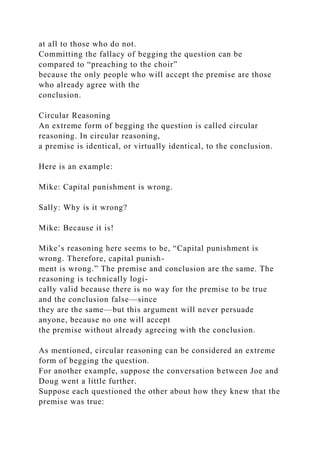
This is known as making an
inductive generalization; you
are making a generalization
about all crows based on the
crows you have seen. However,
if you have seen only a small
number of crows, then this
inductive argument is weak
because the sample of crows
was not large enough. A hasty
generalization is an induc-
tive generalization in which
the sample size is too small.
The person has generalized
too quickly, without adequate
support.
Notice that stereotypes are often based on hasty generalizations.
For example, sometimes
people see a person of a different demographic driving poorly
and, based on only one exam-
ple, draw a conclusion about the whole demographic. As
Chapter 8 will discuss, such general-
izations can act as obstacles to critical thinking and have led to
many erroneous and hurtful
views (see also
http://www.sciencedaily.com/releases/2010/08/100810122210.ht
m for a
discussion of the long-term effects of stereotyping).
Moral of the Story: Begging the Question and Circular
Reasoning
To demonstrate the truth of a conclusion, it is not enough to
simply assume that it is true; we
should give evidence that has a reasonable chance of being
persuasive to people on the other
side of the argument. The way to avoid begging the question
and circular reasoning is to think
for a minute about whether someone with a different point of
view is likely to accept the prem-
ises you offer. If not, strive to modify your argument so that it
has premises that are more likely
to be accepted by parties on the other side of the debate.
Concept by Christopher Foster | Illustration by Steve Zmina
Some inductive arguments make generalizations about
certain groups, but in a hasty generalization, the sample size
is inadequate.
har85668_07_c07_239-278.indd 243 4/9/15 11:30 AM
© 2015 Bridgepoint Education, Inc. All rights reserved. Not for
resale or redistribution.
http://www.sciencedaily.com/releases/2010/08/100810122210.ht
m
Section 7.1 Fallacies of Support
Not all inductive generalizations are bad, however. A common
form of inductive generaliza-
tion is a poll. When someone takes a poll, he or she samples a
group to draw a conclusion
about a larger group. Here would be an example:
We sampled 1,000 people, and 70% said they will vote for
candidate A.
Therefore, candidate A will win.
Here, the sample size is relatively large, so it may supply strong
evidence for the conclusion.
Recall Chapter 5’s discussion of assessing the strength of
statistical arguments that use sam-
ples. That chapter discussed how an inductive generalization
could be affected if a sample
population is not truly random. For example, what if all of the
people polled were in the same
county? The results of the poll might then be skewed toward
one candidate or other based on
who lives in that county. If, in a generalization, the sample
population is not truly representa-
tive of the whole population, then the argument uses a biased
sample (recall the Chapter 5
discussion of Gallup’s polling techniques and see this chapter’s
A Closer Look: Biased Samples
in History for a historical example of how even well-intentioned
polling can go wrong).
Slanted polling questions represent just one method of creating
deliberately biased samples;
another method is called cherry picking. Cherry picking
involves a deliberate selection of
data to support only one side of an issue. If there is evidence on
both sides of a controversial
question and you focus only on evidence supporting one side,
then you are manipulating the
data by ignoring the evidence that does not support the
conclusion you desire.
For example, suppose an infomercial gives many examples of
people who used a certain
product and had amazing results and therefore suggests that you
will probably get great
results, too. Even if those people are telling the truth, it is very
possible that many more
people did not have good results. The advertisers will, of
course, only put the people in the
commercial that had the best results. This can be seen as cherry
picking, because the viewer
of the commercial does not get to see all of the people who felt
that the product was a waste
of money.
A Closer Look: Biased Samples in History
In 1936 the largest poll ever taken (10 million questionnaires)
showed that Alf Landon would
soundly defeat Franklin D. Roosevelt in the presidential
election. The results were quite the
opposite, however. What went wrong? The answer, it turns out,
was that the names and
addresses that were used to send out the questionnaires were
taken from lists of automo-
bile owners, phone subscribers, and country club memberships
(DeTurk, n.d.). Therefore, the
polls tended to be sent to wealthier people, who were more
likely to vote for Landon.
Typically, finding a representative sample means selecting a
sample randomly from within the
whole population. However, as this example shows, it is
sometimes difficult to make certain
that there is no source of bias within one’s sampling method. In
fact, it is really difficult to get
inductive generalizations just right. We must have a sufficiently
large sample, and it must be
truly representative of the whole population. We should be
careful to look at a large sample of
data that accurately represents the population in general. There
is a complex science of poll-
ing and analyzing the data to predict things like election results.
A more in-depth discussion
of this topic can be found in Chapter 5.
har85668_07_c07_239-278.indd 244 4/9/15 11:30 AM
© 2015 Bridgepoint Education, Inc. All rights reserved. Not for
resale or redistribution.
Section 7.1 Fallacies of Support
Appeal to Ignorance and Shifting the Burden of Proof
Sometimes we lack adequate evidence that a claim is true or
false; in such situations it would
seem wise to be cautious and search for further evidence.
Sometimes, however, people take
the lack of proof on one side to constitute a proof of the other
side. This type of reasoning is
known as the appeal to ignorance; it consists of arguing either
that a claim is true because
it has not been proved to be false or that a claim is false
because it has not been proved to
be true.
Here is a common example on both sides of another issue:
UFO investigator: “You can’t prove that space aliens haven’t
visited Earth, so
they probably have.”
Skeptic: “We haven’t yet verified the existence of space aliens,
so they must
not exist.”
Both the believer and the skeptic in these examples mistakenly
take a failure to prove one
side to constitute a demonstration of the truth of the other side.
It is sometimes said that the
absence of evidence is not evidence of absence. However, there
are some exceptions in which
such inferences are justified. Take a look at the following
example:
John: There are no elephants in this room.
Cindy: How do you know?
John: Because I do not see any.
In this case the argument may be legitimate. If there were an
elephant in the room, one would
probably notice. Another example might be in a medical test in
which the presence of an anti-
body would trigger a certain reaction in the lab. The absence of
that reaction is then taken to
demonstrate that the antibody is not present. For such reasoning
to work, we need to have
good reason to believe that if the antibody were present, then
the reaction would be observed.
However, for that type of reasoning to work in the case of space
aliens, the believer would
have to demonstrate that if there were none, then we would be
able to prove that. Likewise,
the skeptic’s argument would require that if there were space
aliens, then we would have
been able to verify it. Such a statement is likely to be true for
the case of an elephant, but it
is not likely to be the case for space aliens, so the appeal to
ignorance in those examples is
fallacious.
The appeal to ignorance fallacy is closely related to the fallacy
of shifting the burden of
proof, in which those who have the responsibility of
demonstrating the truth of their claims
(the so-called burden of proof ) simply point out the failure of
the other side to prove the
opposing position. People who do this have not met the burden
of proof but have merely
acted as though the other side has the burden instead. Here are
two examples of an appeal to
ignorance that seem to shift the burden of proof:
Power company: “This new style of nuclear power plant has not
been proved
to be unsafe; therefore, its construction should be approved.” (It
would seem
har85668_07_c07_239-278.indd 245 4/9/15 11:30 AM
© 2015 Bridgepoint Education, Inc. All rights reserved. Not for
resale or redistribution.
Section 7.1 Fallacies of Support
that, when it comes to high degrees of risk, the burden of proof
would be on
the power plant’s side to show that the proposed plants are
safe.)
Prosecuting attorney: “The defense has failed to demonstrate
that their cli-
ent was not at the scene of the crime. Therefore, we must put
this criminal
in jail.” (This prosecutor seems to assume that it is the duty of
the defense to
demonstrate the innocence of its client, when it is actually the
prosecution’s
responsibility to show that the accused is guilty beyond
reasonable doubt.)
It is not always easy to determine who has the burden of proof.
However, here are some rea-
sonable questions to ask when it comes to making such a
determination:
• Which side is trying to change the status quo? One person
trying to get another
person to change views will usually have the burden of proof;
otherwise, the other
person will not be persuaded to change.
• Which side’s position involves greater risk? A company that
designs parachutes or
power plants, for example, would be expected to demonstrate
the safety of the
design.
• Is there a rule that determines the burden of proof in this
context? For example, the
American legal system requires that, in criminal cases, the
prosecution prove its case
“beyond reasonable doubt.” Debates often put the burden of
proof on the affirmative
position.
Generally speaking, we should arrive at conclusions based on
good evidence for that conclu-
sion, not based on an absence of evidence to the contrary. An
exception to this rule is the
case of negative tests: cases in which if the claim P is true, then
result Q would very likely be
observed. In these cases, if the result Q is not observed, then we
may infer that P is unlikely to
be true. In general, when one side has the burden of proof, it
should be met; simply shifting
the burden to the other side is a sneaky and fallacious move.
Appeal to Inadequate Authority
An appeal to authority is the reasoning that a claim is true
because an authority figure said
so. Some people are inclined to think that all appeals to
authority are fallacious; however, that
is not the case. Appeals to authority can be quite legitimate if
the person cited actually is an
authority on the matter. However, if the person cited is not in
fact an authority on the subject
at hand, then it is an appeal to inadequate authority.
To see why appeals to authority in general are necessary, try to
imagine how you would do
in college if you did not listen to your teachers, textbooks, or
any other sources of informa-
tion. In order to learn, it is essential that we listen to
appropriate authorities. However, many
sources are unreliable, misleading, or even downright deceptive.
It is therefore necessary to
learn to distinguish reliable sources of authority from unreliable
sources. How do we know
which is which? Here are some good questions to ask when
considering whether to trust a
given source or authority:
• Is this the kind of topic that can be settled by an appeal to
authority?
• Is there much agreement among authorities about this issue?
• Is this person or source an actual authority on the subject
matter in question?
har85668_07_c07_239-278.indd 246 4/9/15 11:30 AM
© 2015 Bridgepoint Education, Inc. All rights reserved. Not for
resale or redistribution.
Section 7.1 Fallacies of Support
• Can this authority be trusted to be honest in this context?
• Am I understanding or interpreting this authority correctly?
If the answer to all of these is “yes,” then it may be a legitimate
appeal to authority; if the
answer to any of them is “no,” then it may be fallacious. Here
are some examples of how
appeals to authority can fail at each of these questions:
Is this the kind of topic that can be settled by an appeal to
authority?
Student: “Capitalism is wrong; Karl Marx said so.” (The
morality of capitalism
may not be an issue that authority alone can resolve. We should
look at rea-
sons on both sides to determine where the best arguments are.)
Is there much agreement among authorities about this issue?
Student: “Abortion is wrong. My philosophy teacher said so.”
(Philosophers do
carefully consider arguments about abortion, but there is no
consensus among
them about this topic; there are good philosophers on both sides
of the issue.
Furthermore, this might not be the type of question that can be
settled by an
appeal to authority. One should listen to the best arguments on
each side of
such issues rather than simply trying to appeal to an authority.)
Is this person or source an actual
authority on the subject matter in
question?
Voter: “Global warming is
real. My congressperson
said so.” (A politician may
not be an actual authority
on the matter, since politi-
cians often choose posi-
tions based on likely voting
behavior and who donates
to their campaigns. A cli-
matologist is more likely
to be a more reliable and
informed source in this
field.)
Can this authority be trusted to be
honest in this context?
Juror: “I know that the accused is innocent because he said he
didn’t do it.” (A
person or entity who has a stake in a matter is called an
interested party. A
defendant is definitely an interested party. It would be better to
have a wit-
ness who is a neutral party.)
Concept by Christopher Foster | Illustration by Steve Zmina
If the guitar player were stating his position on the best
guitar to purchase, we might be inclined to follow his
advice, as he would be a legitimate authority. However, in
this case he is an inadequate authority.
har85668_07_c07_239-278.indd 247 4/9/15 11:31 AM
© 2015 Bridgepoint Education, Inc. All rights reserved. Not for
resale or redistribution.
Section 7.1 Fallacies of Support
Am I understanding or interpreting this authority correctly?
Christian: “War is always wrong because the Bible states, ‘Thou
shalt not kill.’”
(This one is a matter of interpretation. What does this scripture
really mean?
In this sort of case, the interpretation of the source is the most
important
issue.)
Finally, here is an example of a legitimate appeal to authority:
“Martin Van Buren was a Democrat; it says so in the
encyclopedia.” (It is hard
to think of why an encyclopedia—other than possibly an openly
editable
resource such as Wikipedia—would lie or be wrong about an
easily verifiable
fact.)
It may still be hard to be certain about many issues even after
listening to authorities. In such
cases the best approach is to listen to and carefully evaluate the
reasoning of many experts in
the field, to determine to what degree there is consensus, and to
listen to the best arguments
for each position. If we do so, we are less prone to being misled
by our own biases and the
biases of interested parties.
False Dilemma
An argument presents a false dilemma, sometimes called a false
dichotomy, when it makes it
sound as though there were only two options when in fact there
are more than just those two
options. People are often prone to thinking of things in black-
and-white terms, but this type
of thinking can oversimplify complex matters. Here are two
simple examples:
Wife to husband: “Now that we’ve agreed to get a dog, should it
be a poodle or
a Chihuahua?” (Perhaps the husband would rather get a Great
Dane.)
Online survey: “Are you a Republican or a Democrat?” (This
ignores many
other options like Libertarian, Green, Independent, and so on. If
you are in
one of those other parties, how should you answer?)
Such examples actually appear to be manipulative, which is why
this can be such a problem-
atic fallacy. Take a look at the following examples:
Partygoer: “What is it going to be? Are you going to go drink
with us, or are
you going to be a loser?” (This seems to imply that there are no
other options,
like not drinking and still being cool.)
Activist: “You can either come to our protest or you can
continue to support
the abuse we are protesting.” (This assumes that if you are not
protesting,
you do not support the cause and in fact support the other side.
Perhaps you
believe there are better ways to change the system.)
Though the fallacy is called a dilemma, implying two options,
the same thing can happen
with more than two options—for example, if someone implies
that there are only five options
when there are in fact other options as well.
har85668_07_c07_239-278.indd 248 4/9/15 11:31 AM
© 2015 Bridgepoint Education, Inc. All rights reserved. Not for
resale or redistribution.
Section 7.1 Fallacies of Support
False Cause
The assumption that because two things are related, one of them
is the cause of the other
is called the fallacy of false cause. It is traditionally called post
hoc ergo propter hoc (often
simply post hoc), which is Latin for “it came after it therefore it
was caused by it.” Clearly, not
everything that happens after something else was caused by it.
Take this example:
John is playing the basketball shooting game of H-O-R-S-E and
tries a very
difficult shot. Right before the shot someone coughs, and the
ball goes in. The
next time John is going to shoot, he asks that person to cough.
(John seems to
be assuming that the cough played some causal role in the ball
going in. That
seems unlikely.)
Here is a slightly more subtle example:
John is taller than Sally, and John won the election, so it must
have been
because he was taller. (In this case, he was taller first and then
won the elec-
tion, so the speaker assumes that is the reason. It is conceivable
that his height
was a factor, but that does not follow merely because he won;
we would need
more evidence to infer that was the reason.)
Large-scale correlations might be more complex, but they can
commit the same fallacy. Sup-
pose that two things, A and B, correlate highly with each other,
as in this example:
The number of police cars in a city correlates highly with the
amount of crime
in a city. Therefore, police cars cause crime.
It does not necessarily follow that A, the number of police cars,
causes B, crime. Another
possibility is that B causes A; the amount of crime causes the
higher number of police cars.
Another option is that a third thing is causing both A and B; in
this case the city’s popula-
tion might be causing both. It is also possible that in some cases
the correlation has no
causal basis.
Practice Problems 7.1
Identify the fallacy in each statement or exchange.
1. Politician: “We either decide to keep the handgun laws in the
city limits and main-
tain peace, or we revoke the laws and let the city become a
modern day Wild West.”
a. begging the question
b. circular reasoning
c. hasty generalization
d. false dilemma
e. no fallacy
2. PTA Parent: “Should school kids say the Pledge of
Allegiance before class? Certainly,
why shouldn’t they?”
a. appeal to ignorance
b. appeal to inadequate authority
(continued)
har85668_07_c07_239-278.indd 249 4/9/15 11:31 AM
© 2015 Bridgepoint Education, Inc. All rights reserved. Not for
resale or redistribution.
Section 7.1 Fallacies of Support
c. false dilemma
d. shifting the burden of proof
e. no fallacy
3. “Both times I went to the movies at Northpark Mall the
people watching the movies
were extremely disruptive. That movie theater is horrible.”
a. false cause
b. hasty generalization
c. begging the question
d. circular reasoning
e. no fallacy
4. “After I had been in a coma for 10 days following my
accident, the swelling in my
brain went down right after the priest put holy water on my
forehead. The water
healed me.”
a. begging the question
b. hasty generalization
c. cherry picking
d. false cause
e. no fallacy
5. Tom: “Early humans had a simple form of music played on
instruments made from
animal bones and skins.”
Boris: “How do you know that?”
Tom: “Well, no one has proved that they didn’t.”
a. biased sample
b. appeal to inadequate authority
c. appeal to ignorance
d. false dilemma
e. no fallacy
6. “My father always only bought Ford cars. He said they were
the best cars ever. So I
only buy Fords.”
a. circular reasoning
b. biased sample
c. false cause
d. appeal to inadequate authority
e. no fallacy
7. “Ice cream is bad because it’s unhealthy.”
a. hasty generalization
b. false cause
c. begging the question
d. false dilemma
e. no fallacy
8. “Michael Jordan wears Hanes, so they must be the best.”
a. biased sample
b. begging the question
c. appeal to inadequate authority
d. shifting the burden of proof
e. no fallacy
Practice Problems 7.1 (continued)
(continued)
har85668_07_c07_239-278.indd 250 4/9/15 11:31 AM
© 2015 Bridgepoint Education, Inc. All rights reserved. Not for
resale or redistribution.
Section 7.2 Fallacies of Relevance
7.2 Fallacies of Relevance
We have seen examples in which the premises are unfounded or
do not provide adequate sup-
port for the conclusion. In extreme cases the premises are barely
even relevant to the truth
of the conclusion, yet somehow people draw those inferences
anyway. This section will take
a look at some examples of common inferences based on
premises that are barely relevant to
the truth of the conclusion.
Red Herring and Non Sequitur
A red herring fallacy is a deliberate attempt to distract the
listener from the question at hand.
It has been suggested that the phrase’s origins stem from the
practice of testing hunting dogs’
skills by dragging a rotting fish across their path, thus
attempting to divert the dogs from the
track of the animal they are supposed to find. The best dogs
could remain on the correct path
despite the temptation to follow the stronger scent of the dead
fish (deLaplante, 2009). When
it comes to reasoning, someone who uses a red herring is
attempting to steer the listener
away from the path that leads to the truth of the conclusion.
Here are two examples:
Political campaigner: “This candidate is far better than the
others. The flag tie
he is wearing represents the greatest country on Earth. Let me
tell you about
the great country he represents. . . .” (The campaigner seems to
be trying to
get the voter to associate love for America with that particular
candidate, but
presumably all of the candidates love their country. In this case
patriotism is
9. Father: “Republicans only care about making more money
and paying lower taxes.
That is what they really care about.”
Son: “Why is that?”
Father: “Because they want to keep more of their money and not
have to support
others through payment.”
a. circular reasoning
b. appeal to pity
c. false cause
d. appeal to ridicule
e. no fallacy
10. Student: “A recent study found that people who have braces
and other work to
straighten their teeth are more confident and better looking,
according to members
of the American Association of Dental Health.”
a. ad hominem
b. biased sample
c. burden of proof
d. false dilemma
e. no fallacy
Practice Problems 7.1 (continued)
har85668_07_c07_239-278.indd 251 4/9/15 11:31 AM
© 2015 Bridgepoint Education, Inc. All rights reserved. Not for
resale or redistribution.
Section 7.2 Fallacies of Relevance
the red herring; the real issue we should be addressing is which
candidate’s
policies would be better for the country.)
Debater in an argument about animal rights: “How can you say
that animals
have rights? There are humans suffering all around the world.
For exam-
ple, there are human beings starving in Africa; don’t you care
about them?”
(There may indeed be terrible issues with human suffering, but
the existence
of human suffering does not address the question of whether
animals have
rights as well. This line of thinking appears to distract from the
question
at hand).
An extreme case in which someone argues in an irrelevant
manner is called a non sequitur,
meaning that the conclusion does not follow from the premises.
Football player: “I didn’t come to practice because I was
worried about the
game this week; that other team is too good!” (Logically, the
talent of the other
team would seem to give the player all the more reason to go to
practice.)
One student to another: “I wouldn’t take that class. I took it and
had a terrible
time. Don’t you remember: That semester, my dog died, and I
had a car acci-
dent. It was terrible.” (These events are irrelevant to the quality
of the class, so
this inference is unwarranted.)
Whereas a red herring seems to take the conversation to a new
topic in an effort to distract
people from the real question, a non sequitur may stay on topic
but simply make a terrible
inference—one in which the conclusion is entirely unjustified
by the premises given.
Appeal to Emotion
The appeal to emotion is a fallacy in which someone argues for
a point based on emotion
rather than on reason. As noted in Chapter 1, people make
decisions based on emotion all the
time, yet emotion is unreliable as a guide. Many philosophers
throughout history thought that
emotion was a major distraction from living a life guided by
reason. The ancient Greek phi-
losopher Plato, for example, compared emotion and other
desires to a beast that tries to lead
mankind in several different directions at once (Plato, 360
BCE). The solution to this problem,
Plato reasons, is to allow reason, not emotion, to be in charge of
our thinking and decision
making. Consider the following examples of overreliance on
emotion:
Impulsive husband: “Honey, let’s buy this luxury car. Think of
how awesome
it would be to drive it around. Plus, it would really impress my
ex-coworkers.”
(This might feel like the fun choice at the time, but what about
when they can-
not afford it in a few years?)
Columnist: “Capital punishment should be legal. If someone
broke into your
house and killed your family, wouldn’t you want him dead?”
(You perhaps
would want him dead, but that alone does not settle the issue.
There are many
other issues worth considering, including the issue of innocent
people acci-
dentally getting on death row, racism in the system, and so on.)
har85668_07_c07_239-278.indd 252 4/9/15 11:31 AM
© 2015 Bridgepoint Education, Inc. All rights reserved. Not for
resale or redistribution.
Section 7.2 Fallacies of Relevance
This is not to say that emotion is never relevant to a decision.
The fun of driving a car is one
factor (among many) in one’s choice of a car, and the emotions
of the victim’s family are one
consideration (out of many) in whether capital punishment
should be allowed. However, we
must not allow that emotion to override rational consideration
of the best evidence for and
against a decision.
One specific type of appeal to emotion tries to get someone to
change his or her position only
because of the sad state of an individual affected. This is known
as the appeal to pity.
Student: “Professor, you need to change my grade; otherwise, I
will lose my
scholarship.” (The professor might feel bad, but to base grades
on that would
be unjust to other students.)
Salesman: “You should buy this car from me because if I don’t
get this commis-
sion, I will lose my job!” (Whether or not this car is a good
purchase is not
settled by which salesperson needs the commission most. This
salesman
appears to play on the buyer’s sense of guilt.)
As with other types of appeal to emotion, there
are cases in which a decision based on pity is
not fallacious. For example, a speaker may
speak truthfully about terrible conditions of
children in the aftermath of a natural disaster
or about the plight of homeless animals. This
may cause listeners to pity the children or ani-
mals, but if this is pity for those who are actu-
ally suffering, then it may provide a legitimate
motive to help. The fallacious use of the appeal
to pity occurs when the pity is not (or should
not be) relevant to the decision at hand or is
used manipulatively.
Another specific type of appeal to emotion
is the appeal to fear. The appeal to fear is a
fallacy that tries to get someone to agree to
something out of fear when it is contrary to a
rational assessment of the evidence.
Mom: “You shouldn’t swim in the
ocean; there could be sharks.” (The
odds of being bitten by a shark are
much smaller than the odds of being
struck by lightning [International Wildlife Museum, n.d.].
However, the fear of
sharks tends to produce a strong aversion.)
Dad: “Don’t go to that country; there is a lot of crime there.”
(Here you should
ask: How high is the crime rate? Where am I going within that
country? Is it
much more dangerous than my own country? How important is
it to go there?
Can I act so that I am safe there?)
Dave Carpenter/Cartoonstock
With an appeal to pity, it is important to
recognize when the appeal is fallacious
versus genuine. Telling possible consumers
you will cry if they do not purchase your
product is most likely a fallacious appeal
to pity.
har85668_07_c07_239-278.indd 253 4/9/15 11:31 AM
© 2015 Bridgepoint Education, Inc. All rights reserved. Not for
resale or redistribution.
Section 7.2 Fallacies of Relevance
Political ad: “If we elect that candidate, then the economy will
collapse.” (Gen-
erally, all candidates claim that their policies will be better for
the economy.
This statement seems to use fear in order to change votes.)
This is not to say that fear cannot be rational. If, in fact, many
dangerous sharks have been
seen recently in a given area, then it might be wise to go
somewhere else. However, a fallacy
is committed if the fears are exaggerated—as they often are—or
if one allows the emotion of
fear to make the decision rather than a careful assessment of the
evidence.
The appeal to fear has been used throughout history. Many
wars, for example, have been pro-
moted by playing on people’s fears of an outside group or of the
imagined consequences of
nonaction.
Politician: “We have to go to war with that country; otherwise
its influence
will destroy our civilization.” (There may or may not be good
rational argu-
ments for the war, but getting citizens to support it out of
exaggerated fears is
to commit the appeal to fear fallacy.)
Sometimes, a person using the appeal to fear personally
threatens the listener if she or he
does not agree. This fallacy is known as the appeal to force. The
threat can be direct:
Boss: “If you don’t agree with me, then you are fired.”
Or the threat can be implied:
Mob boss: “I’d sure like to see you come around to our way of
seeing things. It
was a real shame what happened to the last guy who disagreed
with us.”
Either way, the listener is being coerced into believing
something rather than rationally per-
suaded that it is true. A statement of consequences, however,
may not constitute an appeal to
force fallacy, as in the following example:
Boss: “If you don’t finish that report by Friday, then you will
be fired.” (This
example may be harsh, but it might not be fallacious because
the boss is not
asking you to accept something as true just to avoid
consequences, even if it
is contrary to evidence. This boss just gives you the information
that you need
to get this thing done in time in order to keep your job.)
It may be less clear if the consequences are imposed by a large
or nebulous group:
Campaign manager: “If you don’t come around to the party line
on this issue,
then you will not make it through the primary.” (This gives the
candidate a
strong incentive to accept his or her party’s position on the
issue; however,
is the manager threatening force or just stating the facts? It
could that the
implied force comes from the voters themselves.)
It is sometimes hard to maintain integrity in life when there are
so many forces giving us all
kinds of incentives to conform to popular or lucrative positions.
Understanding this fallacy
can be an important step in recognizing when those influences
are being applied.
har85668_07_c07_239-278.indd 254 4/9/15 11:31 AM
© 2015 Bridgepoint Education, Inc. All rights reserved. Not for
resale or redistribution.
Section 7.2 Fallacies of Relevance
When it comes to appeals to emotions in general, it is good to
be aware of our emotions, but
we should not allow them to be in charge of our decision
making. We should carefully and
rationally consider the evidence in order to make the best
decisions. We should also not let
those competing forces distract us from trusting only the best
and most rational assessment
of the evidence.
Appeal to Popular Opinion
The appeal to popular opinion fallacy, also known as the appeal
to popularity fallacy, band-
wagon fallacy, or mob appeal fallacy, occurs when one accepts
a point of view because that is
what most people think. The reasoning pattern looks like this:
“Almost everyone thinks that X is true. Therefore, X must be
true.”
The error in this reasoning seems obvious: Just because many
people believe something does
not make it true. After all, many people used to believe that the
sun moved around the earth,
that women should not vote, and that slavery was morally
acceptable. While these are all
examples of past erroneous beliefs, the appeal to popular
opinion fallacy remains more com-
mon than we often realize. People tend to default to the
dominant views of their respective
cultures, and it takes guts to voice a different opinion from what
is normally accepted. Because
people with uncommon views
are often scorned and because
people strongly want to fit in to
their culture, our beliefs tend not
to be as autonomous as one might
imagine.
The philosopher Immanuel Kant
discussed the great struggle to
learn to think for ourselves. He
defined enlightenment as the abil-
ity to use one’s own understand-
ing without oversight from others
(Kant, 1784). However, extricat-
ing ourselves from bandwagon
thinking is harder than one might
think. Consider these examples of
popular opinions that might seem
appealing:
Patriot: “America is the best country in the world; everyone
here knows it.”
(To evaluate this claim objectively, we would need a definition
of best and rel-
evant data about all of the countries in the world.)
Animal eater: “It would be wrong to kill a dog to eat it, but
killing a pig for food
is fine. Why? Because that’s what everyone does.” (Can one
logically justify
this distinction? It seems simply to be based on a majority
opinion in one’s
culture.)
Concept by Christopher Foster | Illustration by Steve Zmina
The appeal to popular opinion fallacy can be harmless,
like when you see a movie because all your friends
said it was great, but other times it can have negative
consequences, such as bullying or discriminating against
others.
har85668_07_c07_239-278.indd 255 4/9/15 11:31 AM
© 2015 Bridgepoint Education, Inc. All rights reserved. Not for
resale or redistribution.
Section 7.2 Fallacies of Relevance
Business manager: “This business practice is the right way to do
it; it is what
everyone is doing.” (This type of thinking can stifle innovation
or even justify
violations of ethics.)
General formula: “Doing thing of type X is perfectly fine; it is
common and
legal.” (You could fill in all kinds of things for X that people
ethically seem to
take for granted without thinking about it. Have you ever
questioned the eth-
ics of what is “normal”?)
It is also interesting to note that the “truths” of one culture are
often different from the “truths”
of another. This may not be because truth is relative but because
people in each culture are
committing the bandwagon fallacy rather than thinking
independently. Do you think that we
hold many false beliefs today just because a majority of people
also believe them? It is pos-
sible that much of the so-called common sense of today could
someday come to be seen as
once popular myths.
It is often wise to listen to the wisdom of others, including
majority opinions. However, just
because the majority of people think and act a certain way does
not mean that it is right or
that it is the only way to do things; we should learn to think
independently and rationally
when deciding what things are right and true and best.
Appeal to Tradition
Closely related to the appeal to popular opinion is the appeal to
tradition, which involves
believing in something or doing something simply because that
is what people have always
believed and done. One can see that this reasoning is fallacious
because people have believed
and done false and terrible things for millennia. It is not always
easy, however, to undo these
thought patterns. For example, people tried to justify slavery for
centuries based partly on the
reasoning that it had always been done and was therefore
“right” and “natural.” Some tradi-
tions may not be quite as harmful. Religious traditions, for
example, are often considered to
be valuable to people’s identity and collective sense of
meaning. In seeking to avoid the fal-
lacy, therefore, it is not always easy to distinguish which things
from history are worth keep-
ing. Here is an example:
“This country got where it is today because generations of stay-
at-home moth-
ers taught their children the importance of love, hard work, and
respect for
their elders. Women should stay at home with their kids.” (Is
this a tradition
that is worth keeping or is it a form of social discrimination?)
The fallacy would be to assume that something is acceptable
simply because it is a tradition.
We should be open to rational evaluation of whether a tradition
is acceptable or whether it is
time to change. For example, in response to proposals of social
change, some will argue:
“If people start changing aspect X of society, then our nation
will be ruined.”
(People have used such reasoning against virtually every form
of positive
social change.)
You may be realizing that sometimes whether a piece of
reasoning is fallacious can be a con-
troversial question. Sometimes traditions are good; however, we
should not assume that
har85668_07_c07_239-278.indd 256 4/9/15 11:31 AM
© 2015 Bridgepoint Education, Inc. All rights reserved. Not for
resale or redistribution.
Section 7.2 Fallacies of Relevance
something is right just because it is a tradition. There would
need to be more evidence that
the change would be bad than evidence that it would be good.
As with appeals to popularity,
it is important to reason carefully and independently about what
is best, despite the biases of
our culture.
Ad Hominem and Poisoning the Well
Ad hominem is Latin for “to the person.” One commits the ad
hominem fallacy when one
rejects or dismisses a person’s reasoning because of who is
saying it. Here are some examples:
“Who cares what Natalie Portman says about science? She’s just
an actress.”
(Despite being an actress, Natalie Portman has relevant
background.)
“Global warming is not real; climate change activists drive cars
and live in
houses with big carbon footprints.” (Whether the advocates are
good personal
exemplars is independent of whether the problem is real or
whether their
arguments are sound.)
“I refuse to listen to the arguments about the merits of home
birth from a
man.” (A man may not personally know the ordeal of childbirth,
but that does
not mean that a man cannot effectively reason about the issue.)
It is not always a fallacy to point out who is making a claim. A
person’s credentials are often
relevant to that person’s credibility as an authority, as we
discussed earlier with the appeal
to authority. However, a person’s personal traits do not refute
that person’s reasoning. The
difference, then, is whether one rejects or ignores that person’s
views or reasoning due to
those traits. To simply assume that someone’s opinion has no
merit based on who said it is to
commit the fallacy; to question whether or not we should trust
someone as an authority may
not be.
This next example commits the ad hominem fallacy:
“I wouldn’t listen to his views about crime in America; he is an
ex-convict.”
(This statement is fallacious because it ignores the person’s
reasoning.
Ex-convicts sometimes know a lot about problems that lead to
crime.)
This example, however, may not commit the fallacy:
“I wouldn’t trust his claims about lung cancer; he works for the
tobacco indus-
try.” (This simply calls into question the credibility of the
person due to a
source of bias.)
One specific type of ad hominem reasons that someone’s claim
is not to be listened to if he or
she does not live up to the truth of that claim. It is called the tu
quoque (Latin for “you too”).
Here is an example:
“Don’t listen to his claims that smoking is bad; he smokes!”
(Even if the person
is a hypocrite, that does not mean his claims are false.)
har85668_07_c07_239-278.indd 257 4/9/15 11:31 AM
© 2015 Bridgepoint Education, Inc. All rights reserved. Not for
resale or redistribution.
Section 7.2 Fallacies of Relevance
Another type of fallacy commits the ad hominem in advance. It
is called poisoning the well:
when someone attempts to discredit a person’s credibility ahead
of time, so that all those who
are listening will automatically reject whatever the person says.
“The next speaker is going to tell you all kinds of things about
giving money
to his charity, but keep in mind that he is just out to line his
pockets with your
money.” (This may unfairly color everyone’s perceptions of
what the speaker
says.)
To ignore arguments because of their source is often lazy
reasoning. A logical thinker neither
rejects nor blindly accepts whatever someone says, but carefully
evaluates the quality of the
reasoning used on both sides. We should evaluate the truth or
falsity of people’s claims on the
merits of the claims themselves and based on the quality of the
reasoning for them.
Practice Problems 7.2
Identify the fallacy in each statement or exchange.
1. Jeff: “I think that it is sacrilegious to tell children that a
bunny drops off eggs on
Easter morning. This totally detracts from the true meaning of
Easter.”
Steve: “C’mon man! Everybody puts out eggs for their kids on
Easter.”
a. false cause
b. begging the question
c. red herring
d. appeal to popular opinion
e. no fallacy
2. Radio announcer: “I’ll tell you what: I am appalled that this
new bill about the econ-
omy is even being looked at by Congress! The bureaucrats in
Washington want us
all to just sit around and forget about the fact that every day we
are getting closer to
losing this great nation. I think you’ll agree with me that we
don’t want our nation to
collapse because a bunch of sissies are worried about people
who don’t care about
our country anyway!”
a. red herring
b. appeal to tradition
c. begging the question
d. false cause
e. no fallacy
3. Spouse: “I know that you get angry a lot. I’m sure that soon
you will hit me or some-
thing. And what are we going to do when we have kids? You
will probably beat them
until they run out of the house, and I will be left childless and
abused!
a. slippery slope
b. begging the question
c. red herring
d. appeal to emotion
e. no fallacy
(continued)
har85668_07_c07_239-278.indd 258 4/9/15 11:31 AM
© 2015 Bridgepoint Education, Inc. All rights reserved. Not for
resale or redistribution.
Section 7.2 Fallacies of Relevance
4. Sloan: “Dude, you play way too many video games.”
John: “Whatever, bro! When Eternal Death Slayer III came out,
you were waiting in
line outside the store for 4 hours to be the first to get it.”
a. ad hominem
b. appeal to popularity
c. false dilemma
d. false cause
e. no fallacy
5. TV preacher: “Just a $50 gift per month is all it takes to live
a life of economic health
and prosperity. God will reward your generous donation with 10
times more bless-
ings in your own life if you donate to our ministry. Call now to
start enjoying more
happiness every day.”
a. appeal to emotion
b. false dilemma
c. appeal to force
d. red herring
e. no fallacy
6. TV preacher: “You know, in the Old Testament, God told
people to give 10% of what-
ever they had as an offering to him. In fact, in one story, God
kills 100,000 Israelites
because they fail to honor his demands. This teaching remains
true to this day. Now
let’s pass around the offering plates.”
a. ad hominem
b. hasty generalization
c. appeal to ignorance
d. appeal to fear
e. no fallacy
7. “July is the month during which more ice cream is sold than
any other time of the
year. July is also the month with the highest crime rate.
Therefore, to curb crime, we
should ban sales of ice cream during July.”
a. slippery slope
b. ad hominem
c. false cause
d. false dilemma
e. no fallacy
8. “Did you see the men land on the moon? Then how can you
be so sure that it
happened?”
a. appeal to ignorance
b. hasty generalization
c. appeal to inadequate authority
d. appeal to force
e. no fallacy
9. “Which are you going to do—help your mother or be a lazy
bum?”
a. false dilemma
b. begging the question
c. red herring
Practice Problems 7.2 (continued)
(continued)
har85668_07_c07_239-278.indd 259 4/9/15 11:31 AM
© 2015 Bridgepoint Education, Inc. All rights reserved. Not for
resale or redistribution.
Section 7.2 Fallacies of Relevance
d. shifting the burden of proof
e. no fallacy
10. “The last two summers saw record heat; therefore, global
warming will soon kill us
all.”
a. hasty generalization
b. appeal to fear
c. false dilemma
d. false cause
e. no fallacy
11. “Why do I think that abortion should be illegal? That
doesn’t matter. What matters is,
why do you think it should be legal?”
a. shifting the burden of proof
b. hasty generalization
c. appeal to popular opinion
d. appeal to force
e. no fallacy
12. “If Brad Pitt’s children go to that elementary school, it must
be the best school in Los
Angeles.”
a. appeal to fear
b. begging the question
c. appeal to inadequate authority
d. appeal to tradition
e. no fallacy
13. Father to son: “Now that we have finished the Thanksgiving
meal, it’s time to go
watch football.”
Son: “Why should we watch football?”
Father: “Because my father and my grandfather before him used
to watch football.”
a. appeal to fear
b. false cause
c. accident
d. appeal to tradition
e. no fallacy
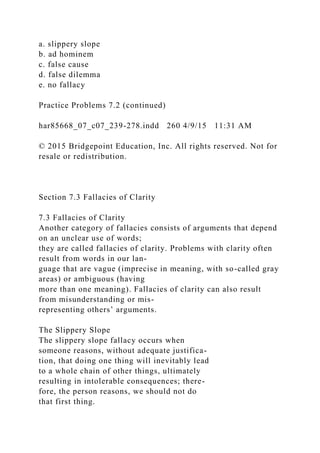
14. “I wouldn’t listen to Bob. After all, he’s just a mechanic.”
a. slippery slope
b. ad hominem
c. false cause
d. false dilemma
e. no fallacy
Practice Problems 7.2 (continued)
har85668_07_c07_239-278.indd 260 4/9/15 11:31 AM
© 2015 Bridgepoint Education, Inc. All rights reserved. Not for
resale or redistribution.
Section 7.3 Fallacies of Clarity
7.3 Fallacies of Clarity
Another category of fallacies consists of arguments that depend
on an unclear use of words;
they are called fallacies of clarity. Problems with clarity often
result from words in our lan-
guage that are vague (imprecise in meaning, with so-called gray
areas) or ambiguous (having
more than one meaning). Fallacies of clarity can also result
from misunderstanding or mis-
representing others’ arguments.
The Slippery Slope
The slippery slope fallacy occurs when
someone reasons, without adequate justifica-
tion, that doing one thing will inevitably lead
to a whole chain of other things, ultimately
resulting in intolerable consequences; there-
fore, the person reasons, we should not do
that first thing.
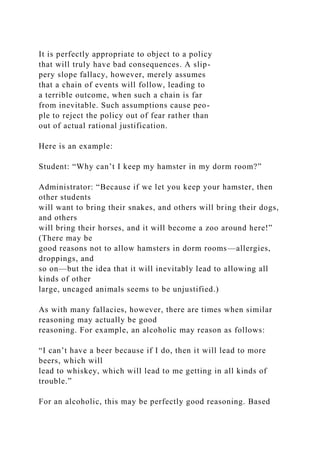
It is perfectly appropriate to object to a policy
that will truly have bad consequences. A slip-
pery slope fallacy, however, merely assumes
that a chain of events will follow, leading to
a terrible outcome, when such a chain is far
from inevitable. Such assumptions cause peo-
ple to reject the policy out of fear rather than
out of actual rational justification.
Here is an example:
Student: “Why can’t I keep my hamster in my dorm room?”
Administrator: “Because if we let you keep your hamster, then
other students
will want to bring their snakes, and others will bring their dogs,
and others
will bring their horses, and it will become a zoo around here!”
(There may be
good reasons not to allow hamsters in dorm rooms—allergies,
droppings, and
so on—but the idea that it will inevitably lead to allowing all
kinds of other
large, uncaged animals seems to be unjustified.)
As with many fallacies, however, there are times when similar
reasoning may actually be good
reasoning. For example, an alcoholic may reason as follows:
“I can’t have a beer because if I do, then it will lead to more
beers, which will
lead to whiskey, which will lead to me getting in all kinds of
trouble.”
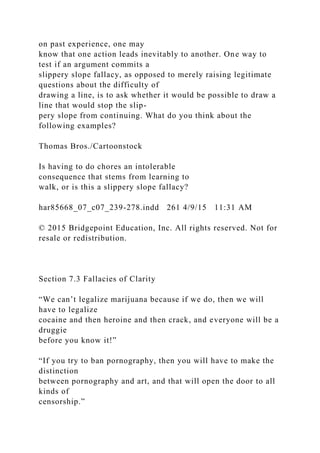
For an alcoholic, this may be perfectly good reasoning. Based
on past experience, one may
know that one action leads inevitably to another. One way to
test if an argument commits a
slippery slope fallacy, as opposed to merely raising legitimate
questions about the difficulty of
drawing a line, is to ask whether it would be possible to draw a
line that would stop the slip-
pery slope from continuing. What do you think about the
following examples?
Thomas Bros./Cartoonstock
Is having to do chores an intolerable
consequence that stems from learning to
walk, or is this a slippery slope fallacy?
har85668_07_c07_239-278.indd 261 4/9/15 11:31 AM
© 2015 Bridgepoint Education, Inc. All rights reserved. Not for
resale or redistribution.
Section 7.3 Fallacies of Clarity
“We can’t legalize marijuana because if we do, then we will
have to legalize
cocaine and then heroine and then crack, and everyone will be a
druggie
before you know it!”
“If you try to ban pornography, then you will have to make the
distinction
between pornography and art, and that will open the door to all
kinds of
censorship.”
Some examples may present genuine questions as to where to
draw a line; others may repre-
sent slippery slope fallacies. The question is whether those
consequences are likely to follow
from the initial change.
As some examples show, the difficulty of drawing precise lines
is sometimes relevant to
important political questions. For example, in the abortion
debate, there is a very important
question about at what point a developing embryo becomes a
human being with rights. Some
say that it should be at conception; some say at birth. The
Supreme Court, in its famous Roe v.
Wade decision (1973), chose the point of viability—the point at
which a fetus could survive
outside the womb; the decision remains controversial today.
True, it is difficult to decide exactly where the line should be
drawn, but the failure to draw
one at all can lead to slippery slope problems. To reason that we
should not make any distinc-
tions because it is hard to draw the line is like reasoning that
there should be no speed limit
because it is difficult to decide exactly when fast driving
becomes unsafe. The trick is to find
good reasons why a line should be drawn in one place rather
than another.
Another example is in the same-sex marriage debate. Some feel
that if same-sex marriage
were to be universally legalized, then all kinds of other types of
objectionable marriage will
become legal as well. Therefore, they argue, we must not
legalize it. This would appear to
commit the slippery slope fallacy, because there are ways that
gay marriage laws could be
written without leading to other objectionable types of
marriages becoming legal.
Equivocations
Equivocation is a fallacy based on ambiguity. An ambiguous
term is a word that means two
different things. For example, fast can mean “going without
food,” or it can mean “rapid.” Some
ambiguities are used for humor, like in the joke, “How many
therapists does it take to change
a lightbulb? Just one, but the lightbulb has to really want to
change!” This, of course, is a pun
on two meanings of change. However, when ambiguity is used
in reasoning, it often creates
an equivocation, in which an ambiguous word is used with one
meaning at one point in an
Moral of the Story: The Slippery Slope
It can be difficult to draw sharp boundaries and create clear
definitions, but we must not allow
this difficulty to prevent us from making the best and most
useful distinctions we can. Policy
decisions, for example, should be judged with careful reasoning,
making the best distinctions
we can, not by the mere application of slippery slope reasoning.
har85668_07_c07_239-278.indd 262 4/9/15 11:31 AM
© 2015 Bridgepoint Education, Inc. All rights reserved. Not for
resale or redistribution.
Section 7.3 Fallacies of Clarity
argument and another meaning in another place in the argument
in a misleading way. Take
the following argument:
Mark plays tennis.
Mark is poor.
Therefore, Mark is a poor tennis player.
If the conclusion meant that Mark is poor and a tennis player
then this would be a logically
valid argument. However, the conclusion actually seems to
mean that he is bad at playing ten-
nis, which does not follow from the fact that he is poor. This
argument seems to switch the
meaning of the word poor in between the premises and the
conclusion. As another example,
consider the following exchange:
Person A: “I broke my leg; I need a doctor!”
Person B: “I am a doctor.”
Person A: “Can you help me with my leg?”
Person B: “I have a PhD in sociology; what do I know about
medicine?”
Can you identify the equivocation? Person B seemed to reason
as follows:
I have a PhD in sociology.
Therefore, I am a doctor.
Although this reasoning is right in some sense, it does not
follow that person B is the type of
doctor that person A needs. The word doctor is being used
ambiguously.
Here is another example:
Officer: Have you been drinking at all tonight?
Driver: Yes.
Officer: Then you are under arrest.
Driver: But I only had a soda!
Clearly, the officer came to a false conclusion because he and
the driver meant different things
by drinking. See A Closer Look: Philosophical Equivocations
for more examples.
It is very important when reasoning (or critiquing reasoning)
that we are consistent and clear
about our meanings when we use words. A subtle switch in
meanings within an argument can
be highly misleading and can mean that arguments that initially
appear to be valid may actu-
ally be invalid once we correctly understand the terms involved.
har85668_07_c07_239-278.indd 263 4/9/15 11:31 AM
© 2015 Bridgepoint Education, Inc. All rights reserved. Not for
resale or redistribution.
Section 7.3 Fallacies of Clarity
The Straw Man
Have you ever heard your views misrepresented? Most of us
have. Whether it is our religion,
our political views, or our recreational preferences, we have
probably heard someone make
our opinions sound worse than they are. If so, then you know
that can be a very frustrating
experience.
The straw man fallacy is an attack on a
person’s position based on a (deliber-
ate or otherwise) misrepresentation of
his or her actual views. The straw man
fallacy is so named because it is like
beating up a scarecrow (a straw man)
rather than defeating a real person (or
the real argument). The straw man fal-
lacy can be pernicious; it is hard for
any debate to progress if the differing
sides are not even fairly represented.
We can hope to refute or improve on
a view only once we have understood
and represented it correctly.
A Closer Look: Philosophical Equivocations
In real life, equivocations are not always so obvious. The
philosopher John Stuart Mill, for
example, attempted to demonstrate his moral theory, known as
utilitarianism, by arguing
that, if the only thing that people desire is pleasure, then
pleasure is the only thing that is
desirable (Mill, 1879). Many philosophers think that Mill is
equivocating between two differ-
ent meanings of desirable. One interpretation means “able to be
desired,” which he uses in the
premise. The other interpretation is “thing that is good or
should be desired,” which he uses in
the conclusion. His argument would therefore be invalid, based
on a subtle shift in meaning.
Another historical example is one of the most famous
philosophical arguments of all time. The
philosopher Saint Anselm long ago presented an argument for
the existence of God based on
the idea that the word God means the greatest conceivable thing
and that a thing must exist to
be greatest (Anselm, n.d.). His argument may be simplified as
follows:
God means the greatest conceivable thing.
A thing that exists is greater than one that does not.
We can conceive of God existing.
Therefore, God must exist.
Though this is still an influential argument for the existence of
God, some think it commits a
subtle equivocation in its application of the word great. The
question is whether it is talking
about the greatness of the concept or the greatness of the thing.
The first premise seems to
take it be about the greatness of the concept. The second
premise, however, seems to depend
on talking about the thing itself (actual existence does not
change the greatness of the con-
cept). If this analysis is right, then the word greatest has
different meanings in the first two
premises, and the argument may commit an equivocation. In
that case the argument that
appears to be valid may in fact be subtly invalid.
Concept by Christopher Foster | Illustration by Steve Zmina
Misrepresenting the views of the other side through
a straw man fallacy can be frustrating and will fail to
advance the issue.
har85668_07_c07_239-278.indd 264 4/9/15 11:31 AM
© 2015 Bridgepoint Education, Inc. All rights reserved. Not for
resale or redistribution.
Section 7.3 Fallacies of Clarity
If you have listened to people arguing about politics, there is a
good chance that you have
heard statements like the following:
Democrat: “Republicans don’t care about poor people.”
Republican: “Democrats want the government to control
everything.”
These characterizations do not accurately represent the aims of
either side. One way to tell
whether this is a fair representation is to determine whether
someone with that view would
agree with the characterization of their view. People may
sometimes think that if they make
the other side sound dumb, their own views will sound smart
and convincing by compari-
son. However, this approach is likely to backfire. If our
audience is wise enough to know that
the other party’s position is more sophisticated than was
expressed, then it actually sounds
unfair, or even dishonest, to misrepresent their views.
It is much harder to refute a statement that reflects the
complexity of someone’s actual views.
Can you imagine if politically partisan people spoke in a fairer
manner?
Democrat: “Republicans believe that an unrestrained free
market incentivizes
innovation and efficiency, thereby improving the economy.”
Republican: “Democrats believe that in a country with as much
wealth as ours,
it would be immoral to allow the poorest among us to go
without life’s basic
needs, including food, shelter, and health care.”
That would be a much more honest world; it would also be more
intellectually responsible,
but it would not be as easy to make other people sound dumb.
Here are more—possibly
familiar—examples of straw man fallacies, used by those on
opposing sides of a given issue:
Environmentalist: “Corporations and politicians want to destroy
the earth.
Therefore, we should pass this law to stop them.” (Perhaps the
corporations
and politicians believe that corporate practices are not as
destructive as some
imply or that the progress of industry is necessary for the
country’s growth.)
Developer: “Environmentalists don’t believe in growth and want
to destroy
the economy. Therefore, you should not oppose this power
plant.” (Perhaps
environmentalists believe that the economy can thrive while
shifting to more
eco-friendly sources.)
Young Earth creationist: “Evolutionists think that monkeys
turned into peo-
ple! Monkeys don’t turn into people, so their theory should be
rejected.”
(Proponents of evolution would state that there was a common
ancestor mil-
lions of years ago. Genetic changes occurred very gradually
between thou-
sands and thousands of generations, leading to eventual species
differences.)
Atheist: “Christians don’t believe in science. They think that
Adam and Eve
rode around on dinosaurs! Therefore, you should not take their
views seri-
ously.” (Many Christians find their religion to be compatible
with science or
have nonliteral interpretations of biblical creation.)
har85668_07_c07_239-278.indd 265 4/9/15 11:31 AM
© 2015 Bridgepoint Education, Inc. All rights reserved. Not for
resale or redistribution.
Section 7.3 Fallacies of Clarity
Closely related to the straw man fallacy is the appeal to
ridicule, in which one simply seeks
to make fun of another person’s view rather than actually refute
it. Here is an example:
“Vegans are idiots who live only on salad. Hooray for bacon!”
(Actually, vegans
are frequently intelligent people who object to the confinement
of animals for
food.)
“People with those political opinions are Nazis!” (Comparisons
to Nazis in
politics are generally clichéd, exaggerated, and disrespectful to
the actual vic-
tims of the Holocaust. See Chapter 8 for a discussion of the
fallacy reductio ad
Hitlerum.)
In an academic or any other context, it is essential that we learn
not to commit the straw man
fallacy. If you are arguing against a point of view, it is
necessary first to demonstrate that you
have accurately understood it. Only then have you demonstrated
that you are qualified to
discuss its truthfulness. Furthermore, the attempt to ridicule
other’s views is rationally coun-
terproductive; it does not advance the discussion and seeks only
to mock other people. (See
Everyday Logic: Love and Logic for how you can avoid the
straw man fallacy and the appeal to
ridicule.)
When we seek to defend our own views, the intellectually
responsible thing to do is to under-
stand opposing viewpoints as fully as possible and to represent
them fairly before we give the
reasons for our own disagreement. The same applies in
philosophy and other academic top-
ics. If someone want to pontificate about a topic without having
understood what has already
been done in that field, then that person simply sounds naive.
To be intellectually responsible,
we have to make sure to correctly understand what has been
done in the field before we begin
to formulate our own contribution to the field.
Everyday Logic: Love and Logic
When it comes to real-life disagreements, people can become
very upset—even aggressive.
This is an understandable reaction, particularly if the
disagreement concerns positions we
think are wrong or perspectives that challenge our worldview.
However, this kind of emo-
tional reaction can lead to judgments about what the other side
may believe—judgments that
are not based on a full and sophisticated understanding of what
is actually believed and why.
This pattern can be the genesis of much of the hostility we see
surrounding controversial top-
ics. It can also lead to common fallacies such as the straw man
and appeal to ridicule, which
are two of the most pernicious and hurtful fallacies of them all.
Logic can help provide a remedy to these types of problems.
Logic in its fullest sense is not just
about creating arguments to prove our positions right—and
certainly not just about proving
others wrong. It is about learning to discover truth while
avoiding error, which is a goal all
participants can share. Therefore, there need not be any losers
in this quest.
(continued)
har85668_07_c07_239-278.indd 266 4/9/15 11:31 AM
© 2015 Bridgepoint Education, Inc. All rights reserved. Not for
resale or redistribution.
Section 7.3 Fallacies of Clarity
If we stop short of a full appreciation of others’ perspectives,
then we are blocked from a
full understanding of the topic at hand. One of the most
important marks of a sophisticated
thinker is the appreciation of the best reasoning on all sides of
each issue.
We must therefore resist the common temptation to think of
people with opposing positions
as “stupid” or “evil.” Those kinds of judgments are generally
unfair and unkind. Instead we
should seek to expand our own points of view and remove any
animosity. Here are some
places to begin:
• We can read what smart people have written to represent their
own views about the
topic, including reading top scholarly articles explaining
different points of view.
• We can really listen with intelligence, openness, and empathy
to people who feel certain
ways about the topic without seeking to refute or minimize
them.
• We can seek to put ourselves “in their shoes” with sensitivity
and compassion.
• We can speak in ways that reflect civility and mutual
understanding.
It will take time and openness, but eventually it is possible to
appreciate more fully a much
wider variety of perspectives on life’s questions.
Furthermore, once we learn to fairly represent opposing points
of view, we may not find those
views to be as crazy as we once thought. Even the groups that
we initially think of as the
strangest actually have good reasons for their beliefs. We may
or may not come to agree, but
only in learning to appreciate why these groups have such
beliefs can we truly say that we
understand their views. The process and effort to do so can
make us more civil, more mature,
more sophisticated, more intelligent, and more kind.
Everyday Logic: Love and Logic (continued)
Fallacy of Accident
The fallacy of accident consists of applying a general rule to
cases in which it is not prop-
erly applied. Often, a general rule is true in most cases, but
people who commit this fallacy
talk as though it were always true and apply it to cases that
could easily be considered to be
exceptions.
Some may find the name of this fallacy confusing. It is called
the fallacy of accident because
someone committing this fallacy confuses the “essential”
meaning of a statement with its
nonessential, or “accidental,” meaning. It is sometimes
alternately called dicto simpliciter,
meaning “unqualified generalization” (Fallacy Files, n.d.). Here
are some examples:
“Of course ostriches must be able to fly. They are birds, and
birds fly.” (There
clearly are exceptions to that general rule, and ostriches are
among them.)
“If you skip class, then you should get detention. Therefore,
because you
skipped class in order to save someone from a burning building,
you should
get detention.” (This may be an extreme case, but it shows how
a misapplica-
tion of a general rule can go astray.)
har85668_07_c07_239-278.indd 267 4/9/15 11:31 AM
© 2015 Bridgepoint Education, Inc. All rights reserved. Not for
resale or redistribution.
Section 7.3 Fallacies of Clarity
“Jean Valjean should go to prison because he broke the law.”
(This example,
from the novel Les Miserables, involves a man serving many
years in prison for
stealing bread to feed his starving family. In this case the law
against stealing
perhaps should not be applied as harshly when there are such
extenuating
circumstances.)
The last example raises the issue of sentencing. One area in
which the fallacy of accident can
occur in real life is with extreme sentencing for some crimes. In
such cases, though an action
may meet the technical definition of a type of crime under the
law, it may be far from the type
of case that legislators had in mind when the sentencing
guidelines were created. This is one
reason that some argue for the elimination of mandatory
minimum sentencing.
Another example in which the fallacy of accident can occur is in
the debate surrounding
euthanasia, the practice of intentionally ending a person’s life
to relieve her or him of long-
term suffering from a terminal illness. Here is an argument
against it:
It is wrong to intentionally kill an innocent human being.
Committing euthanasia is intentionally killing an innocent
human being.
Therefore, euthanasia is wrong.
The moral premise here is generally true; however, when we
think of the rule “It is wrong to
intentionally kill an innocent human being,” what one may have
in mind is a person willfully
killing a person without justification. In the case of euthanasia,
we have a person willingly
terminating his or her own life with a strong type of
justification. Whatever one’s feelings
about euthanasia, the issue is not settled by simply applying the
general rule that it is wrong
to kill a human being. To use that rule seems to oversimplify
the issue in a way that misses the
subtleties of this specific case. An argument that properly
addresses the issue will appeal to a
moral principle that makes sense when applied to the specific
issues that pertain to the case
of euthanasia itself.
It is difficult to make general rules that do not have exceptions.
Therefore, when specific trou-
bling cases come up, we should not simply assume the rule is
perfect but rather consider the
merits of each case in light of the overall purpose for which we
have the rule.
Fallacies of Composition and Division
Two closely related fallacies come from confusing the whole
with its parts. The fallacy of
composition occurs when one reasons that a whole group must
have a certain property
because its parts do. Here is an example:
Because the citizens of that country are rich; it follows that the
country is
rich. (This may not be the case at all; what if the government
has outspent its
revenue?)
You should be able to see why this one reaches an incorrect
conclusion:
har85668_07_c07_239-278.indd 268 4/9/15 11:31 AM
© 2015 Bridgepoint Education, Inc. All rights reserved. Not for
resale or redistribution.
Section 7.3 Fallacies of Clarity
“If I stand up at a baseball game then I will be able to see
better. Therefore,
if everyone stands up at the baseball game, then everyone will
be able to see
better.”
This statement seems to make the same mistake as the baseball
example:
If the government would just give everyone more money, then
everyone would
be wealthier. (Actually, giving away money to all would
probably reduce the
value of the nation’s currency.)
A similar fallacy, known as the fallacy of division, does the
opposite. Namely, it makes con-
clusions about members of a population because of
characteristics of the whole. Examples
might include the following:
That country is wealthy; therefore, its citizens must be wealthy.
(This one
may not follow at all; the citizens could be much poorer than
the country as a
whole.)
That team is the best; the players on the team must be the best
in the league.
(Although the ability of the team has a lot to do with the skills
of the players,
there are also reasons, including coaching and teamwork, why a
team might
outperform the average talent of its roster.)
These types of fallacies can lead to stereotyping as well, in
which people arrive at erroneous
conclusions about a group because of (often fallacious)
generalizations about its members.
Conversely, people often make assumptions about individuals
because of (often fallacious)
views about the whole group. We should be careful when
reasoning about populations, lest
we commit such harmful fallacies.
Practice Problems 7.3
Identify the fallacy in each statement or exchange.
1. “Jim says that it is bad to invest in bonds right now. What
does he know; he’s just a
janitor!”
a. appeal to force
b. ad hominem
c. appeal to popular opinion
d. equivocation
e. no fallacy
2. Student #1: “Animals are on the earth for humans to eat.”
Student #2: “How do you know that?”
Student #1: “Because they provide nourishment for us.”
a. biased sample
b. inadequate authority
c. equivocation
(continued)
har85668_07_c07_239-278.indd 269 4/9/15 11:31 AM
© 2015 Bridgepoint Education, Inc. All rights reserved. Not for
resale or redistribution.
Section 7.3 Fallacies of Clarity
d. begging the question
e. no fallacy
3. Politician: “The best way to create equity in society is to tax
the rich more and redis-
tribute wealth to those who have less.”
Moderator: “And how do you plan on implementing these tax
changes in Congress?”
Politician: “If we don’t figure out how to do this, then more and
more children will
feel the pain of hunger at night.”
a. appeal to tradition
b. poisoning the well
c. red herring
d. false dilemma
e. no fallacy
4. “If we legalize gay marriage, the whole world will decay
morally.”
a. appeal to emotion
b. appeal to ignorance
c. slippery slope
d. false cause
e. no fallacy
5. “You know communism was going to fail! After all, Karl
Marx was an alcoholic!”
a. slippery slope
b. ad hominem
c. false cause
d. false dilemma
e. no fallacy
6. “You think that Stanford is better only because you went
there.”
a. appeal to popularity
b. appeal to ignorance
c. hasty generalization
d. ad hominem
e. no fallacy
7. “Look at this picture of an aborted fetus. How can you
support abortion?!!”
a. false cause
b. appeal to emotion
c. appeal to popular opinion
d. appeal to force
e. no fallacy
8. “Everyone likes Friends, so it must be a good show.”
a. non sequitur
b. ad hominem
c. appeal to popular opinion
d. appeal to inadequate authority
e. no fallacy
(continued)
Practice Problems 7.3 (continued)
har85668_07_c07_239-278.indd 270 4/9/15 11:31 AM
© 2015 Bridgepoint Education, Inc. All rights reserved. Not for
resale or redistribution.
Section 7.3 Fallacies of Clarity
9. “I strongly oppose the opposition’s view that we shouldn’t
care about our children’s
education.”
a. straw man
b. begging the question
c. red herring
d. appeal to tradition
e. no fallacy
10. “You have the right to make money, so making money is
right.”
a. appeal to emotion
b. appeal to ignorance
c. slippery slope
d. equivocation
e. no fallacy
11. “Houses in the United States with storm cellars are more
often hit by tornadoes, so
you shouldn’t get a storm cellar.”
a. false cause
b. equivocation
c. appeal to ignorance
d. appeal to ridicule
e. no fallacy
12. “I am opposed to abortion because Jim is pro-choice, and
he’s an idiot!”
a. ad hominem
b. poisoning the well
c. shifting the burden of proof
d. false dilemma
e. no fallacy
13. “If I give this homeless person a dollar then I’ll have to give
the next guy a dollar and
so forth. . . . I’ll end up broke!”
a. ad hominem
b. slippery slope
c. shifting the burden of proof
d. false dilemma
e. no fallacy
14. “You oppose her policies only because you lost the election
to her.”
a. appeal to popular opinion
b. appeal to ignorance
c. hasty generalization
d. ad hominem
e. no fallacy
15. “I am pro-choice because I don’t think that women should
have no rights in our
society.”
a. appeal to force
b. ad hominem
c. straw man
Practice Problems 7.3 (continued)
(continued)
har85668_07_c07_239-278.indd 271 4/9/15 11:31 AM
© 2015 Bridgepoint Education, Inc. All rights reserved. Not for
resale or redistribution.
Section 7.3 Fallacies of Clarity
d. appeal to ridicule
e. no fallacy
16. “We should have prescription drug care. Would you want
your grandma to suffer?”
a. appeal to emotion
b. hasty generalization
c. red herring
d. appeal to popular opinion
e. no fallacy
17. “There is no solid scientific evidence for the existence of
spirits, so they don’t exist.”
a. appeal to inadequate authority
b. appeal to force
c. biased sample
d. appeal to ignorance
e. no fallacy
18. “Most Americans support this policy, so it must be right.”
a. appeal to popularity
b. slippery slope
c. shifting the burden of proof
d. false dilemma
e. no fallacy
19. “I don’t think that we should bomb innocent people in order
to steal their oil.”
a. false cause
b. hasty generalization
c. straw man
d. appeal to popular opinion
e. no fallacy
20. “Timothy was 10 minutes late to the meeting this morning. I
can tell he’s going to be
a horrible employee.”
a. shifting the burden of proof
b. hasty generalization
c. appeal to pity
d. appeal to force
e. no fallacy
21. “If I cheat on a curved test, I’ll get a better grade, so if we
all cheat on the test, we will
all get better grades.”
a. slippery slope
b. ad hominem
c. post hoc
d. fallacy of composition
e. no fallacy
22. “I promised myself I would never lie again. That is why I
have to tell this drunk angry
man that the child who just escaped his basement is hiding
behind the bush in my
yard.”
a. burden of proof
b. fallacy of accident
Practice Problems 7.3 (continued)
(continued)
har85668_07_c07_239-278.indd 272 4/9/15 11:31 AM
© 2015 Bridgepoint Education, Inc. All rights reserved. Not for
resale or redistribution.
Summary and Resources
Chapter Summary
There are many fallacies beyond those covered in this chapter.
However, learning this sam-
ple of important and common logical fallacies will help sharpen
one’s critical thinking skills
so that one is less likely to become the victim (knowingly or
otherwise) of logical tricks.
However, when learning about fallacies it is also important to
stay positive and to use the
knowledge for good: to promote high-quality reasoning
delivered in a sincere and respectful
manner (for some ideas on how to stay positive, see Everyday
Logic: Staying Positive in the
Face of Fallacies).
c. red herring
d. appeal to tradition
e. no fallacy
23. Doctor: “It is ethically acceptable to test newly developed
medications on homeless
people who need money.”
Nurse: “But doesn’t that exploit these people based on their
need?”
Doctor: “Prove to me that it is not acceptable.”
a. appeal to force
b. appeal to inadequate authority
c. straw man
d. shifting the burden of proof
e. no fallacy
24. “What? You believe that peace is actually possible in the
Middle East? Ha! That’s the
craziest thing I have ever heard.”
a. appeal to ridicule
b. appeal to tradition
c. poisoning the well
d. appeal to popular opinion
e. no fallacy
25. “It’s not acceptable to harm another person. Since jail harms
the freedoms of a per-
son, we should release serial killers and rapists.”
a. begging the question
b. false cause
c. equivocation
d. fallacy of accident
e. no fallacy
Practice Problems 7.3 (continued)
har85668_07_c07_239-278.indd 273 4/9/15 11:31 AM
© 2015 Bridgepoint Education, Inc. All rights reserved. Not for
resale or redistribution.
Summary and Resources
It is a mark of a mature thinker to consider multiple points of
view and come to conclusions
only after thorough consideration of the best evidence and best
reasoning available. We
should never fall for these types of traps (often set by a lack of
effort in carefully thinking
through the evidence). Learning the fallacies helps one think
critically and avoid erroneous
reasoning—and can help us avoid falling for fallacies in the
future.
Everyday Logic: Staying Positive in the Face of Fallacies
Learning about the fallacies should come with a warning: Once
you learn to identify the falla-
cies, you may start to notice them everywhere. People commit
them on TV, in newspapers, in
books, and in face-to-face conversations all the time. Noticing
the prevalence of these fallacies
can be fascinating and eye-opening; however, it can also be
dangerous. One of the risks of notic-
ing fallacies is cynicism, in which one becomes overly skeptical
of anything and everything.
Becoming discouraged about the power of reason can even lead
some to misology, the hatred of
logic itself. Socrates himself warned about misology, stating
that “no greater misfortune could
happen to anyone than that of developing a dislike for
argument” (Plato, 1961, p. 71). Some
people hear so many fallacies that they begin to wonder if
reason itself is ever to be trusted.
We need not come to that conclusion. One of the main reasons
that we learn about fallacies is
to learn not to commit them and to reason sincerely, honestly,
and carefully. The chief purpose
of the Moral of the Story feature boxes in this chapter is to
focus on the positive message that
we can learn from each fallacy, rather than just focusing on
people’s mistakes. By reasoning
with great care, we can constantly improve our abilities to
develop trustworthy patterns of
reasoning that can lead to the discovery of all kinds of truths of
which we may never have pre-
viously been aware. In so doing, we can be more honest,
intelligent, civil, and deep.
A second danger in noticing fallacies is becoming what Kevin
deLaplante (2014), philosopher
of science and founder of the Critical Thinking Academy, calls
a “fallacy bully.” Some people
learn about fallacies and then become exceptionally eager to
point them out. However, point-
ing out someone’s fallacies is a bit like pointing out his or her
grammatical mistakes; it can be
considered annoying or rude.
American writer Max Shulman’s short story “Love Is a
Fallacy,” in which the main character’s
attempt to educate his love interest about fallacies backfires, is
one humorous illustration of
a fallacy bully in action. (Numerous dramatic adaptations of
Shulman’s story are available on
YouTube, including one produced by George Argento, which
takes place on a college campus:
https://www.youtube.com/watch?v=7_81fz6kUJI.) One ought to
be quite judicious about
when it is appropriate to point out other people’s fallacies.
Another problem is that fallacy bullies often overreach. It is
important to remember that
almost all of the argument forms defined in this chapter have
legitimate uses. As noted, appeals
to authority, slippery slope reasoning, and even ad hominem
arguments can have legitimate
applications as well as fallacious ones. Knowing when, whether,
and to what degree a certain
argument may fail to adequately demonstrate the truth of its
conclusion requires a kind of
wisdom over and above recognizing the general form of the
argument.
We should make sure to have that kind of wisdom and even
kindness in our hearts as we seek
to understand and critique people’s reasoning. The result will be
that we can share reasoning
in ways that are positive, respectful, civil, and productive.
Remember, logic is not a competi-
tion; our goal should not be to defeat others in debate. If our
goal is not so much to be right
but to find truth, then we can see others, even those with whom
we may disagree, as being on
the same team.
har85668_07_c07_239-278.indd 274 4/9/15 11:31 AM
© 2015 Bridgepoint Education, Inc. All rights reserved. Not for
resale or redistribution.
https://www.youtube.com/watch?v=7_81fz6kUJI
Summary and Resources
ad hominem The fallacy of rejecting or dis-
missing a person’s reasoning on the basis of
some irrelevant fact about him or her.
appeal to emotion A fallacy in which some-
one argues for a point based on emotion
rather than on reason.
appeal to fear One specific type of appeal
to emotion that tries to get someone to agree
with something out of fear rather than a
rational assessment of the evidence.
appeal to force One specific type of appeal
to emotion that tries to get people to accept
a conclusion by threatening them with nega-
tive consequences specifically for not accept-
ing the conclusion.
appeal to ignorance The argument either
that a claim must be false because it has not
been demonstrated to be true or that a claim
must be true because it has not been proved
to be false.
Critical Thinking Questions
1. Think of a time that someone used an ad hominem argument
against you or you
used an ad hominem argument against someone else. What was
the topic you were
discussing, and what would have been a better way to present
the argument or
disagree?
2. Now that you have studied the fallacies, think about how
these fallacies are used
in the media and advertisements. What are some examples of
the use of fallacies in
these areas, and how do they function to influence people?
3. Understanding the informal fallacies is a great way to protect
oneself against manip-
ulation. How do you plan on honing your skills in fallacy
identification as you move
forward in your career and social life?
4. Often it is easier to use fallacies than it is to present well-
reasoned positions to
support your ideas and claims. Is there ever a time in which it is
acceptable to
use fallacious reasoning to get people to do what you want?
Why is this ethically
permissible?
Web Resources
https://owl.english.purdue.edu/owl/resource/659/03
Purdue’s Online Writing Lab (OWL) provides a list of fallacies,
with slightly different termi-
nology than ours (which is common), but it gives nice and clear
definitions of fallacies with
examples.
http://www.nizkor.org/features/fallacies
The Nizkor Project, which is dedicated to education about the
Holocaust, also provides a
thorough list of fallacies with definitions, examples, and
explanations.
http://www.csun.edu/~dgw61315/fallacies.html
California State University Northridge’s debate team explains a
number of fallacies and
includes their Latin names.
Key Terms
har85668_07_c07_239-278.indd 275 4/9/15 11:31 AM
© 2015 Bridgepoint Education, Inc. All rights reserved. Not for
resale or redistribution.
https://owl.english.purdue.edu/owl/resource/659/03
http://www.nizkor.org/features/fallacies
http://www.csun.edu/~dgw61315/fallacies.html
Summary and Resources
appeal to inadequate authority A fallacy
that reasons that something is true because
someone said so, even though that person
is, for one reason or another, not a reliable
source on that topic.
appeal to pity One specific type of appeal
to emotion that tries to get someone to
change his or her position only because of
the unfortunate situation of an individual
affected.
appeal to popular opinion A fallacy in
which one—knowingly or not—accepts
a point of view because that is what most
other people think; also known as appeal
to popularity, bandwagon fallacy, or mob
appeal.
appeal to ridicule A fallacy that seeks to
make fun of another person’s view rather
than actually refute it.
appeal to tradition A fallacy that argues
for a conclusion based on the claim that it is
what people have always done or believed.
begging the question A fallacy in which
one gives an argument that assumes a major
point at issue; also known as petitio principii.
biased sample A sample that is not repre-
sentative of the whole population, perhaps
due to some tendency within the method of
sampling to favor some results over others.
cherry picking An inductive generalization
that emphasizes evidence for a claim while
ignoring the evidence against the claim, or
vice versa.
circular reasoning A fallacy in which the
premise is the same as, or is synonymous
with, the conclusion.
equivocation A fallacy that switches the
meaning of a key term so that the argument
seems valid when it actually is not.
fallacies Common patterns of reasoning
that have a high likelihood of leading to false
conclusions.
fallacy of accident A fallacy that applies a
general rule in cases in which the rule is not
properly applied.
fallacy of composition A fallacy that infers
that a whole group has a certain property
because each member of it does.
fallacy of division A fallacy that infers that
the members of a group must have a certain
property because the whole group does.
false cause A fallacy that assumes some-
thing was caused by another thing just
because it came after it; also known as post
hoc ergo propter hoc.
false dilemma A fallacy that makes it
sound as though there are only a certain
number of options when in fact there are
more than just those options; also known as
false dichotomy.
hasty generalization An inductive general-
ization in which the sample size is too small
to adequately support the conclusion.
non sequitur A fallacy in which the prem-
ises have little bearing on the truth of the
conclusion.
poisoning the well A fallacy in which
someone attempts to discredit someone’s
credibility ahead of time, so that all those
who listen to that person will automatically
reject whatever he or she says.
red herring A fallacy in which a deliberate
distraction is used in an attempt to veer the
listener away from the real question at hand.
har85668_07_c07_239-278.indd 276 4/9/15 11:31 AM
© 2015 Bridgepoint Education, Inc. All rights reserved. Not for
resale or redistribution.
Summary and Resources
Answers to Practice Problems
Practice Problems 7.1
shifting the burden of proof A fallacy in
which the reasoner has the burden to dem-
onstrate the truth of his or her own side, but
instead of meeting that burden simply points
out the failure of the other side to prove its
own position.
slippery slope A fallacy that argues that we
should not do something because if we do,
then it will lead to a series of events that will
end in a terrible conclusion, when this chain
of events is not likely at all.
straw man A fallacy in which one attempts
to refute a very weak or inaccurate version
of the other side’s position.
tu quoque A version of the ad hominem fal-
lacy that argues that someone’s claim is not
to be listened to if he or she does not live up
to the truth of that claim.
1. d
2. d
3. b
4. d
5. c
6. d
7. c
8. c
9. a
10. b
Practice Problems 7.2
1. d
2. a
3. a
4. a
5. a
6. d
7. c
8. a
9. a
10. a
11. a
12. c
13. d
14. b
Practice Problems 7.3
1. b
2. d
3. c
4. c
5. b
6. d
7. b
8. c
9. a
10. d
11. a
12. a
13. b
14. d
15. c
16. a
17. d
18. a
19. c
20. b
21. d
22. b
23. d
24. a
25. d
har85668_07_c07_239-278.indd 277 4/9/15 11:31 AM
© 2015 Bridgepoint Education, Inc. All rights reserved. Not for
resale or redistribution.
har85668_07_c07_239-278.indd 278 4/9/15 11:31 AM
© 2015 Bridgepoint Education, Inc. All rights reserved. Not for
resale or redistribution.
Part A-Read All references and attachments (chapter7) below
prior to starting assignment. Search through common media
sources looking for examples of fallacies. Some common places
to find fallacies include advertisements, opinion pieces in news
media, and arguments about politics, religion, and other
controversial issues. You may also notice fallacies in your daily
life. Present three distinct informal logical fallacies you have
discovered in these types of sources or in your life. Make sure
to identify the specific fallacy committed by each example.
Explain how the fallacies were used and the context in which
they occurred. Finally, explain how the person should have
presented the argument in order to avoid committing this logical
error.MINIMUM WORD COUNT 400
References:
https://youtu.be/EJp4bZhhYfw
https://youtu.be/OAXKc-rvMa8
https://youtu.be/qSWCi_-qIME
https://youtu.be/krYpiQ6evD4
https://youtu.be/v5vzCmURh7o
https://youtu.be/cGZkCPo7tC0
PART B- Reflect on the fallacies that you read in our text and
find the one that you feel that you commit the most. Think
about how frequently you have committed the fallacy and what
kinds of things tend to lead to you committing it. Write: Present
an example of an argument (or arguments) that you have made
that commits that particular fallacy. Present the reasoning
in standard form. Evaluate your argument(s) by indicating the
name of the fallacy that you committed and explaining why this
argument is fallacious. What might you do to avoid committing
that type of fallacy in the future? How might learning to avoid
this fallacy benefit your life? MINIMUM WORD COUNT 400

2397Informal FallaciesEnterline Design Services LLCiS.docx

  • 1.
    239 7Informal Fallacies Enterline DesignServices LLC/iStock/Thinkstock Learning Objectives After reading this chapter, you should be able to: 1. Describe the various fallacies of support, their origins, and circumstances in which specific arguments may not be fallacious. 2. Describe the various fallacies of relevance, their origins, and circumstances in which specific arguments may not be fallacious. 3. Describe the various fallacies of clarity, their origins, and circumstances in which specific arguments may not be fallacious. har85668_07_c07_239-278.indd 239 4/9/15 11:30 AM © 2015 Bridgepoint Education, Inc. All rights reserved. Not for resale or redistribution. We can conceive of logic as providing us with the best tools for seeking truth. If our goal is to seek truth, then we must be clear that the task is not limited to
  • 2.
    the formation oftrue beliefs based on a solid logical foundation, for the task also involves learning to avoid forming false beliefs. Therefore, just as it is important to learn to employ good reasoning, it is also impor- tant to learn to avoid bad reasoning. Toward this end, this chapter will focus on fallacies. Fallacies are errors in reasoning; more specifically, they are common patterns of reasoning with a high likelihood of leading to false conclusions. Logical fallacies often seem like good reasoning because they resemble perfectly legitimate argument forms. For example, the following is a perfectly valid argument: If you live in Paris, then you live in France. You live in Paris. Therefore, you live in France. Assuming that both of the premises are true, it logically follows that the conclusion must be true. The following argument is very similar: If you live in Paris, then you live in France. You live in France. Therefore, you live in Paris. This second argument, however, is invalid; there are plenty of other places to live in France. This is a common formal fallacy known as affirming the consequent. Chapter 4 discussed how this fallacy was based on an incorrect logical form. This chapter will focus on informal falla- cies, fallacies whose errors are not so much a matter of form but of content. The rest of this
  • 3.
    chapter will coversome of the most common and important fallacies, with definitions and examples. Learning about fallacies can be a lot of fun, but be warned: Once you begin noticing fallacies, you may start to see them everywhere. Before we start, it is worth noting a few things. First, there are many, many fallacies. This chapter will consider only a sampling of some of the most well- known fallacies. Second, there is a lot of overlap between fallacies. Reasonable people can interpret the same errors as dif- ferent fallacies. Focus on trying to understand both interpretations rather than on insisting that only one can be right. Third, different philosophers often have different terminology for the same fallacies and make different distinctions among them. Therefore, you may find that others use different terminology for the fallacies that we will learn about in this chapter. Not to worry—it is the ideas here that are most important: Our goal is to learn to identify and avoid mistakes in reasoning, regardless of specific terminology. Finally, there are many ways to divide the fallacies into categories. This chapter will refer to fallacies of support, fallacies of clarity, and fallacies of relevance. Avoiding fallacies may be dif- ficult at first, but ultimately, as we learn to reason more fairly and carefully, we will find that avoiding fallacious reasoning helps us develop habits of mental fairness, trustworthiness, and openness, enhancing our ability to discern truth from error. har85668_07_c07_239-278.indd 240 4/9/15 11:30 AM
  • 4.
    © 2015 BridgepointEducation, Inc. All rights reserved. Not for resale or redistribution. Section 7.1 Fallacies of Support 7.1 Fallacies of Support When reasoning, it is essential to reach conclusions based on adequate evidence; otherwise, our views are unsubstantiated. The better the evidence, the more credible our claims are, and the more likely they are to be true. Fallacies can lead us to accept conclusions that are not adequately supported and may be false. Let us learn some of the most common ways this can happen. Begging the Question One of the most common fallacies is called begging the question, also known as petitio princi- pii. This fallacy occurs when someone gives reason- ing that assumes a major point at issue; it assumes a particular answer to the question with which we are concerned. In other words, the premises of the argument claim something that someone probably would not agree with if he or she did not already accept the conclusion. Take a look at the following argument: Abortion is wrong because a fetus has a right to live. There is nothing wrong with this argument as an expression of a person’s belief. The ques- tion is whether it will persuade anyone who does not already agree with the conclusion. The premise of this argument assumes the major point at issue. If
  • 5.
    fetuses have aright to live, then it would follow almost automatically that abortion is wrong. However, those who do not accept the conclusion probably do not accept this premise (perhaps they do not feel that the developing embryo is developed enough to have human rights yet). It is therefore unlikely that they will be persuaded by the argument. To improve the argument, it would be necessary to give good reasons why a fetus has a right to life, reasons that would be persuasive to people on the other side of the argument. For more clarity about this problem, take a look at these similar arguments: Capital punishment is wrong because all humans have a right to live. Eating meat is wrong because animals have a right to live. These arguments are nearly identical, yet they reach different conclusions about what types of killing are wrong because of different assumptions about who has the right to live. Each, however, is just as unlikely to persuade people with a different view. In order to be persua- sive, it is best to give an argument that does not rest on controversial views that are merely assumed to be true. It is not always easy to create non-question- begging arguments, but such is the challenge for those who would like to have a strong chance of persuading those with differing views. Ingram Publishing/Thinkstock
  • 6.
    With fallacious reasoning,the premises only appear to support the conclusion. When you look closely at a fallacious argument, you can see how the premises fail to offer support. har85668_07_c07_239-278.indd 241 4/9/15 11:30 AM © 2015 Bridgepoint Education, Inc. All rights reserved. Not for resale or redistribution. Section 7.1 Fallacies of Support Here are examples on both sides of a different question: Joe: I know that God exists because it says so in the Bible. Doug: God doesn’t exist because nothing supernatural is real. Do you think that either argument will persuade someone on the other side? Someone who does not believe in God probably does not accept the Bible to be completely true, so this rea- soning will not make the person change his or her mind. The other argument does the same thing by simply ruling out the possibility that anything could exist other than physical matter. Someone who believes in God will probably not accept this premise. Both arguments, on the other hand, will probably sound very good to someone who shares the speaker’s point of view, but they will not sound persuasive
  • 7.
    at all tothose who do not. Committing the fallacy of begging the question can be compared to “preaching to the choir” because the only people who will accept the premise are those who already agree with the conclusion. Circular Reasoning An extreme form of begging the question is called circular reasoning. In circular reasoning, a premise is identical, or virtually identical, to the conclusion. Here is an example: Mike: Capital punishment is wrong. Sally: Why is it wrong? Mike: Because it is! Mike’s reasoning here seems to be, “Capital punishment is wrong. Therefore, capital punish- ment is wrong.” The premise and conclusion are the same. The reasoning is technically logi- cally valid because there is no way for the premise to be true and the conclusion false—since they are the same—but this argument will never persuade anyone, because no one will accept the premise without already agreeing with the conclusion. As mentioned, circular reasoning can be considered an extreme form of begging the question. For another example, suppose the conversation between Joe and Doug went a little further. Suppose each questioned the other about how they knew that the premise was true:
  • 8.
    Joe: I knowthat the Bible is true because it says so right here in the Bible, in 2 Timothy 3:16. Doug: I know that there is nothing supernatural because everything has a purely natural explanation. Here both seem to reason in a circular manner: Joe says that the Bible is true because it says so, which assumes that it is true. On the other side, to say that everything has a purely natural har85668_07_c07_239-278.indd 242 4/9/15 11:30 AM © 2015 Bridgepoint Education, Inc. All rights reserved. Not for resale or redistribution. Section 7.1 Fallacies of Support explanation is the same thing as to say that there is nothing supernatural, so the premise is synonymous with the conclusion. If either party hopes to persuade the other to accept his position, then he should offer premises that the other is likely to find persuasive, not simply another version of the conclusion. Hasty Generalizations and Biased Samples Chapter 5 demonstrated that we can reason from a premise about a sample population to a conclusion about a larger population that includes the sample. Here is a simple example:
  • 9.
    Every crow Ihave ever seen has been black. Therefore, all crows are black. This is known as making an inductive generalization; you are making a generalization about all crows based on the crows you have seen. However, if you have seen only a small number of crows, then this inductive argument is weak because the sample of crows was not large enough. A hasty generalization is an induc- tive generalization in which the sample size is too small. The person has generalized too quickly, without adequate support. Notice that stereotypes are often based on hasty generalizations. For example, sometimes people see a person of a different demographic driving poorly and, based on only one exam- ple, draw a conclusion about the whole demographic. As Chapter 8 will discuss, such general- izations can act as obstacles to critical thinking and have led to many erroneous and hurtful views (see also http://www.sciencedaily.com/releases/2010/08/100810122210.ht m for a discussion of the long-term effects of stereotyping). Moral of the Story: Begging the Question and Circular Reasoning
  • 10.
    To demonstrate thetruth of a conclusion, it is not enough to simply assume that it is true; we should give evidence that has a reasonable chance of being persuasive to people on the other side of the argument. The way to avoid begging the question and circular reasoning is to think for a minute about whether someone with a different point of view is likely to accept the prem- ises you offer. If not, strive to modify your argument so that it has premises that are more likely to be accepted by parties on the other side of the debate. Concept by Christopher Foster | Illustration by Steve Zmina Some inductive arguments make generalizations about certain groups, but in a hasty generalization, the sample size is inadequate. har85668_07_c07_239-278.indd 243 4/9/15 11:30 AM © 2015 Bridgepoint Education, Inc. All rights reserved. Not for resale or redistribution. http://www.sciencedaily.com/releases/2010/08/100810122210.ht m Section 7.1 Fallacies of Support Not all inductive generalizations are bad, however. A common form of inductive generaliza- tion is a poll. When someone takes a poll, he or she samples a group to draw a conclusion about a larger group. Here would be an example: We sampled 1,000 people, and 70% said they will vote for
  • 11.
    candidate A. Therefore, candidateA will win. Here, the sample size is relatively large, so it may supply strong evidence for the conclusion. Recall Chapter 5’s discussion of assessing the strength of statistical arguments that use sam- ples. That chapter discussed how an inductive generalization could be affected if a sample population is not truly random. For example, what if all of the people polled were in the same county? The results of the poll might then be skewed toward one candidate or other based on who lives in that county. If, in a generalization, the sample population is not truly representa- tive of the whole population, then the argument uses a biased sample (recall the Chapter 5 discussion of Gallup’s polling techniques and see this chapter’s A Closer Look: Biased Samples in History for a historical example of how even well-intentioned polling can go wrong). Slanted polling questions represent just one method of creating deliberately biased samples; another method is called cherry picking. Cherry picking involves a deliberate selection of data to support only one side of an issue. If there is evidence on both sides of a controversial question and you focus only on evidence supporting one side, then you are manipulating the data by ignoring the evidence that does not support the conclusion you desire. For example, suppose an infomercial gives many examples of people who used a certain product and had amazing results and therefore suggests that you
  • 12.
    will probably getgreat results, too. Even if those people are telling the truth, it is very possible that many more people did not have good results. The advertisers will, of course, only put the people in the commercial that had the best results. This can be seen as cherry picking, because the viewer of the commercial does not get to see all of the people who felt that the product was a waste of money. A Closer Look: Biased Samples in History In 1936 the largest poll ever taken (10 million questionnaires) showed that Alf Landon would soundly defeat Franklin D. Roosevelt in the presidential election. The results were quite the opposite, however. What went wrong? The answer, it turns out, was that the names and addresses that were used to send out the questionnaires were taken from lists of automo- bile owners, phone subscribers, and country club memberships (DeTurk, n.d.). Therefore, the polls tended to be sent to wealthier people, who were more likely to vote for Landon. Typically, finding a representative sample means selecting a sample randomly from within the whole population. However, as this example shows, it is sometimes difficult to make certain that there is no source of bias within one’s sampling method. In fact, it is really difficult to get inductive generalizations just right. We must have a sufficiently large sample, and it must be truly representative of the whole population. We should be careful to look at a large sample of data that accurately represents the population in general. There
  • 13.
    is a complexscience of poll- ing and analyzing the data to predict things like election results. A more in-depth discussion of this topic can be found in Chapter 5. har85668_07_c07_239-278.indd 244 4/9/15 11:30 AM © 2015 Bridgepoint Education, Inc. All rights reserved. Not for resale or redistribution. Section 7.1 Fallacies of Support Appeal to Ignorance and Shifting the Burden of Proof Sometimes we lack adequate evidence that a claim is true or false; in such situations it would seem wise to be cautious and search for further evidence. Sometimes, however, people take the lack of proof on one side to constitute a proof of the other side. This type of reasoning is known as the appeal to ignorance; it consists of arguing either that a claim is true because it has not been proved to be false or that a claim is false because it has not been proved to be true. Here is a common example on both sides of another issue: UFO investigator: “You can’t prove that space aliens haven’t visited Earth, so they probably have.” Skeptic: “We haven’t yet verified the existence of space aliens, so they must not exist.”
  • 14.
    Both the believerand the skeptic in these examples mistakenly take a failure to prove one side to constitute a demonstration of the truth of the other side. It is sometimes said that the absence of evidence is not evidence of absence. However, there are some exceptions in which such inferences are justified. Take a look at the following example: John: There are no elephants in this room. Cindy: How do you know? John: Because I do not see any. In this case the argument may be legitimate. If there were an elephant in the room, one would probably notice. Another example might be in a medical test in which the presence of an anti- body would trigger a certain reaction in the lab. The absence of that reaction is then taken to demonstrate that the antibody is not present. For such reasoning to work, we need to have good reason to believe that if the antibody were present, then the reaction would be observed. However, for that type of reasoning to work in the case of space aliens, the believer would have to demonstrate that if there were none, then we would be able to prove that. Likewise, the skeptic’s argument would require that if there were space aliens, then we would have been able to verify it. Such a statement is likely to be true for the case of an elephant, but it is not likely to be the case for space aliens, so the appeal to
  • 15.
    ignorance in thoseexamples is fallacious. The appeal to ignorance fallacy is closely related to the fallacy of shifting the burden of proof, in which those who have the responsibility of demonstrating the truth of their claims (the so-called burden of proof ) simply point out the failure of the other side to prove the opposing position. People who do this have not met the burden of proof but have merely acted as though the other side has the burden instead. Here are two examples of an appeal to ignorance that seem to shift the burden of proof: Power company: “This new style of nuclear power plant has not been proved to be unsafe; therefore, its construction should be approved.” (It would seem har85668_07_c07_239-278.indd 245 4/9/15 11:30 AM © 2015 Bridgepoint Education, Inc. All rights reserved. Not for resale or redistribution. Section 7.1 Fallacies of Support that, when it comes to high degrees of risk, the burden of proof would be on the power plant’s side to show that the proposed plants are safe.) Prosecuting attorney: “The defense has failed to demonstrate that their cli-
  • 16.
    ent was notat the scene of the crime. Therefore, we must put this criminal in jail.” (This prosecutor seems to assume that it is the duty of the defense to demonstrate the innocence of its client, when it is actually the prosecution’s responsibility to show that the accused is guilty beyond reasonable doubt.) It is not always easy to determine who has the burden of proof. However, here are some rea- sonable questions to ask when it comes to making such a determination: • Which side is trying to change the status quo? One person trying to get another person to change views will usually have the burden of proof; otherwise, the other person will not be persuaded to change. • Which side’s position involves greater risk? A company that designs parachutes or power plants, for example, would be expected to demonstrate the safety of the design. • Is there a rule that determines the burden of proof in this context? For example, the American legal system requires that, in criminal cases, the prosecution prove its case “beyond reasonable doubt.” Debates often put the burden of proof on the affirmative position. Generally speaking, we should arrive at conclusions based on good evidence for that conclu-
  • 17.
    sion, not basedon an absence of evidence to the contrary. An exception to this rule is the case of negative tests: cases in which if the claim P is true, then result Q would very likely be observed. In these cases, if the result Q is not observed, then we may infer that P is unlikely to be true. In general, when one side has the burden of proof, it should be met; simply shifting the burden to the other side is a sneaky and fallacious move. Appeal to Inadequate Authority An appeal to authority is the reasoning that a claim is true because an authority figure said so. Some people are inclined to think that all appeals to authority are fallacious; however, that is not the case. Appeals to authority can be quite legitimate if the person cited actually is an authority on the matter. However, if the person cited is not in fact an authority on the subject at hand, then it is an appeal to inadequate authority. To see why appeals to authority in general are necessary, try to imagine how you would do in college if you did not listen to your teachers, textbooks, or any other sources of informa- tion. In order to learn, it is essential that we listen to appropriate authorities. However, many sources are unreliable, misleading, or even downright deceptive. It is therefore necessary to learn to distinguish reliable sources of authority from unreliable sources. How do we know which is which? Here are some good questions to ask when considering whether to trust a given source or authority: • Is this the kind of topic that can be settled by an appeal to
  • 18.
    authority? • Is theremuch agreement among authorities about this issue? • Is this person or source an actual authority on the subject matter in question? har85668_07_c07_239-278.indd 246 4/9/15 11:30 AM © 2015 Bridgepoint Education, Inc. All rights reserved. Not for resale or redistribution. Section 7.1 Fallacies of Support • Can this authority be trusted to be honest in this context? • Am I understanding or interpreting this authority correctly? If the answer to all of these is “yes,” then it may be a legitimate appeal to authority; if the answer to any of them is “no,” then it may be fallacious. Here are some examples of how appeals to authority can fail at each of these questions: Is this the kind of topic that can be settled by an appeal to authority? Student: “Capitalism is wrong; Karl Marx said so.” (The morality of capitalism may not be an issue that authority alone can resolve. We should look at rea- sons on both sides to determine where the best arguments are.) Is there much agreement among authorities about this issue? Student: “Abortion is wrong. My philosophy teacher said so.” (Philosophers do
  • 19.
    carefully consider argumentsabout abortion, but there is no consensus among them about this topic; there are good philosophers on both sides of the issue. Furthermore, this might not be the type of question that can be settled by an appeal to authority. One should listen to the best arguments on each side of such issues rather than simply trying to appeal to an authority.) Is this person or source an actual authority on the subject matter in question? Voter: “Global warming is real. My congressperson said so.” (A politician may not be an actual authority on the matter, since politi- cians often choose posi- tions based on likely voting behavior and who donates to their campaigns. A cli- matologist is more likely to be a more reliable and informed source in this field.) Can this authority be trusted to be honest in this context? Juror: “I know that the accused is innocent because he said he didn’t do it.” (A person or entity who has a stake in a matter is called an interested party. A defendant is definitely an interested party. It would be better to
  • 20.
    have a wit- nesswho is a neutral party.) Concept by Christopher Foster | Illustration by Steve Zmina If the guitar player were stating his position on the best guitar to purchase, we might be inclined to follow his advice, as he would be a legitimate authority. However, in this case he is an inadequate authority. har85668_07_c07_239-278.indd 247 4/9/15 11:31 AM © 2015 Bridgepoint Education, Inc. All rights reserved. Not for resale or redistribution. Section 7.1 Fallacies of Support Am I understanding or interpreting this authority correctly? Christian: “War is always wrong because the Bible states, ‘Thou shalt not kill.’” (This one is a matter of interpretation. What does this scripture really mean? In this sort of case, the interpretation of the source is the most important issue.) Finally, here is an example of a legitimate appeal to authority: “Martin Van Buren was a Democrat; it says so in the encyclopedia.” (It is hard to think of why an encyclopedia—other than possibly an openly editable resource such as Wikipedia—would lie or be wrong about an
  • 21.
    easily verifiable fact.) It maystill be hard to be certain about many issues even after listening to authorities. In such cases the best approach is to listen to and carefully evaluate the reasoning of many experts in the field, to determine to what degree there is consensus, and to listen to the best arguments for each position. If we do so, we are less prone to being misled by our own biases and the biases of interested parties. False Dilemma An argument presents a false dilemma, sometimes called a false dichotomy, when it makes it sound as though there were only two options when in fact there are more than just those two options. People are often prone to thinking of things in black- and-white terms, but this type of thinking can oversimplify complex matters. Here are two simple examples: Wife to husband: “Now that we’ve agreed to get a dog, should it be a poodle or a Chihuahua?” (Perhaps the husband would rather get a Great Dane.) Online survey: “Are you a Republican or a Democrat?” (This ignores many other options like Libertarian, Green, Independent, and so on. If you are in one of those other parties, how should you answer?) Such examples actually appear to be manipulative, which is why this can be such a problem-
  • 22.
    atic fallacy. Takea look at the following examples: Partygoer: “What is it going to be? Are you going to go drink with us, or are you going to be a loser?” (This seems to imply that there are no other options, like not drinking and still being cool.) Activist: “You can either come to our protest or you can continue to support the abuse we are protesting.” (This assumes that if you are not protesting, you do not support the cause and in fact support the other side. Perhaps you believe there are better ways to change the system.) Though the fallacy is called a dilemma, implying two options, the same thing can happen with more than two options—for example, if someone implies that there are only five options when there are in fact other options as well. har85668_07_c07_239-278.indd 248 4/9/15 11:31 AM © 2015 Bridgepoint Education, Inc. All rights reserved. Not for resale or redistribution. Section 7.1 Fallacies of Support False Cause The assumption that because two things are related, one of them is the cause of the other is called the fallacy of false cause. It is traditionally called post hoc ergo propter hoc (often
  • 23.
    simply post hoc),which is Latin for “it came after it therefore it was caused by it.” Clearly, not everything that happens after something else was caused by it. Take this example: John is playing the basketball shooting game of H-O-R-S-E and tries a very difficult shot. Right before the shot someone coughs, and the ball goes in. The next time John is going to shoot, he asks that person to cough. (John seems to be assuming that the cough played some causal role in the ball going in. That seems unlikely.) Here is a slightly more subtle example: John is taller than Sally, and John won the election, so it must have been because he was taller. (In this case, he was taller first and then won the elec- tion, so the speaker assumes that is the reason. It is conceivable that his height was a factor, but that does not follow merely because he won; we would need more evidence to infer that was the reason.) Large-scale correlations might be more complex, but they can commit the same fallacy. Sup- pose that two things, A and B, correlate highly with each other, as in this example: The number of police cars in a city correlates highly with the amount of crime in a city. Therefore, police cars cause crime.
  • 24.
    It does notnecessarily follow that A, the number of police cars, causes B, crime. Another possibility is that B causes A; the amount of crime causes the higher number of police cars. Another option is that a third thing is causing both A and B; in this case the city’s popula- tion might be causing both. It is also possible that in some cases the correlation has no causal basis. Practice Problems 7.1 Identify the fallacy in each statement or exchange. 1. Politician: “We either decide to keep the handgun laws in the city limits and main- tain peace, or we revoke the laws and let the city become a modern day Wild West.” a. begging the question b. circular reasoning c. hasty generalization d. false dilemma e. no fallacy 2. PTA Parent: “Should school kids say the Pledge of Allegiance before class? Certainly, why shouldn’t they?” a. appeal to ignorance b. appeal to inadequate authority (continued) har85668_07_c07_239-278.indd 249 4/9/15 11:31 AM © 2015 Bridgepoint Education, Inc. All rights reserved. Not for resale or redistribution.
  • 25.
    Section 7.1 Fallaciesof Support c. false dilemma d. shifting the burden of proof e. no fallacy 3. “Both times I went to the movies at Northpark Mall the people watching the movies were extremely disruptive. That movie theater is horrible.” a. false cause b. hasty generalization c. begging the question d. circular reasoning e. no fallacy 4. “After I had been in a coma for 10 days following my accident, the swelling in my brain went down right after the priest put holy water on my forehead. The water healed me.” a. begging the question b. hasty generalization c. cherry picking d. false cause e. no fallacy 5. Tom: “Early humans had a simple form of music played on instruments made from animal bones and skins.” Boris: “How do you know that?” Tom: “Well, no one has proved that they didn’t.” a. biased sample b. appeal to inadequate authority
  • 26.
    c. appeal toignorance d. false dilemma e. no fallacy 6. “My father always only bought Ford cars. He said they were the best cars ever. So I only buy Fords.” a. circular reasoning b. biased sample c. false cause d. appeal to inadequate authority e. no fallacy 7. “Ice cream is bad because it’s unhealthy.” a. hasty generalization b. false cause c. begging the question d. false dilemma e. no fallacy 8. “Michael Jordan wears Hanes, so they must be the best.” a. biased sample b. begging the question c. appeal to inadequate authority d. shifting the burden of proof e. no fallacy Practice Problems 7.1 (continued) (continued) har85668_07_c07_239-278.indd 250 4/9/15 11:31 AM © 2015 Bridgepoint Education, Inc. All rights reserved. Not for resale or redistribution.
  • 27.
    Section 7.2 Fallaciesof Relevance 7.2 Fallacies of Relevance We have seen examples in which the premises are unfounded or do not provide adequate sup- port for the conclusion. In extreme cases the premises are barely even relevant to the truth of the conclusion, yet somehow people draw those inferences anyway. This section will take a look at some examples of common inferences based on premises that are barely relevant to the truth of the conclusion. Red Herring and Non Sequitur A red herring fallacy is a deliberate attempt to distract the listener from the question at hand. It has been suggested that the phrase’s origins stem from the practice of testing hunting dogs’ skills by dragging a rotting fish across their path, thus attempting to divert the dogs from the track of the animal they are supposed to find. The best dogs could remain on the correct path despite the temptation to follow the stronger scent of the dead fish (deLaplante, 2009). When it comes to reasoning, someone who uses a red herring is attempting to steer the listener away from the path that leads to the truth of the conclusion. Here are two examples: Political campaigner: “This candidate is far better than the others. The flag tie he is wearing represents the greatest country on Earth. Let me tell you about
  • 28.
    the great countryhe represents. . . .” (The campaigner seems to be trying to get the voter to associate love for America with that particular candidate, but presumably all of the candidates love their country. In this case patriotism is 9. Father: “Republicans only care about making more money and paying lower taxes. That is what they really care about.” Son: “Why is that?” Father: “Because they want to keep more of their money and not have to support others through payment.” a. circular reasoning b. appeal to pity c. false cause d. appeal to ridicule e. no fallacy 10. Student: “A recent study found that people who have braces and other work to straighten their teeth are more confident and better looking, according to members of the American Association of Dental Health.” a. ad hominem b. biased sample c. burden of proof d. false dilemma e. no fallacy Practice Problems 7.1 (continued) har85668_07_c07_239-278.indd 251 4/9/15 11:31 AM © 2015 Bridgepoint Education, Inc. All rights reserved. Not for
  • 29.
    resale or redistribution. Section7.2 Fallacies of Relevance the red herring; the real issue we should be addressing is which candidate’s policies would be better for the country.) Debater in an argument about animal rights: “How can you say that animals have rights? There are humans suffering all around the world. For exam- ple, there are human beings starving in Africa; don’t you care about them?” (There may indeed be terrible issues with human suffering, but the existence of human suffering does not address the question of whether animals have rights as well. This line of thinking appears to distract from the question at hand). An extreme case in which someone argues in an irrelevant manner is called a non sequitur, meaning that the conclusion does not follow from the premises. Football player: “I didn’t come to practice because I was worried about the game this week; that other team is too good!” (Logically, the talent of the other team would seem to give the player all the more reason to go to practice.) One student to another: “I wouldn’t take that class. I took it and
  • 30.
    had a terrible time.Don’t you remember: That semester, my dog died, and I had a car acci- dent. It was terrible.” (These events are irrelevant to the quality of the class, so this inference is unwarranted.) Whereas a red herring seems to take the conversation to a new topic in an effort to distract people from the real question, a non sequitur may stay on topic but simply make a terrible inference—one in which the conclusion is entirely unjustified by the premises given. Appeal to Emotion The appeal to emotion is a fallacy in which someone argues for a point based on emotion rather than on reason. As noted in Chapter 1, people make decisions based on emotion all the time, yet emotion is unreliable as a guide. Many philosophers throughout history thought that emotion was a major distraction from living a life guided by reason. The ancient Greek phi- losopher Plato, for example, compared emotion and other desires to a beast that tries to lead mankind in several different directions at once (Plato, 360 BCE). The solution to this problem, Plato reasons, is to allow reason, not emotion, to be in charge of our thinking and decision making. Consider the following examples of overreliance on emotion: Impulsive husband: “Honey, let’s buy this luxury car. Think of how awesome it would be to drive it around. Plus, it would really impress my ex-coworkers.”
  • 31.
    (This might feellike the fun choice at the time, but what about when they can- not afford it in a few years?) Columnist: “Capital punishment should be legal. If someone broke into your house and killed your family, wouldn’t you want him dead?” (You perhaps would want him dead, but that alone does not settle the issue. There are many other issues worth considering, including the issue of innocent people acci- dentally getting on death row, racism in the system, and so on.) har85668_07_c07_239-278.indd 252 4/9/15 11:31 AM © 2015 Bridgepoint Education, Inc. All rights reserved. Not for resale or redistribution. Section 7.2 Fallacies of Relevance This is not to say that emotion is never relevant to a decision. The fun of driving a car is one factor (among many) in one’s choice of a car, and the emotions of the victim’s family are one consideration (out of many) in whether capital punishment should be allowed. However, we must not allow that emotion to override rational consideration of the best evidence for and against a decision. One specific type of appeal to emotion tries to get someone to change his or her position only because of the sad state of an individual affected. This is known
  • 32.
    as the appealto pity. Student: “Professor, you need to change my grade; otherwise, I will lose my scholarship.” (The professor might feel bad, but to base grades on that would be unjust to other students.) Salesman: “You should buy this car from me because if I don’t get this commis- sion, I will lose my job!” (Whether or not this car is a good purchase is not settled by which salesperson needs the commission most. This salesman appears to play on the buyer’s sense of guilt.) As with other types of appeal to emotion, there are cases in which a decision based on pity is not fallacious. For example, a speaker may speak truthfully about terrible conditions of children in the aftermath of a natural disaster or about the plight of homeless animals. This may cause listeners to pity the children or ani- mals, but if this is pity for those who are actu- ally suffering, then it may provide a legitimate motive to help. The fallacious use of the appeal to pity occurs when the pity is not (or should not be) relevant to the decision at hand or is used manipulatively. Another specific type of appeal to emotion is the appeal to fear. The appeal to fear is a fallacy that tries to get someone to agree to something out of fear when it is contrary to a rational assessment of the evidence.
  • 33.
    Mom: “You shouldn’tswim in the ocean; there could be sharks.” (The odds of being bitten by a shark are much smaller than the odds of being struck by lightning [International Wildlife Museum, n.d.]. However, the fear of sharks tends to produce a strong aversion.) Dad: “Don’t go to that country; there is a lot of crime there.” (Here you should ask: How high is the crime rate? Where am I going within that country? Is it much more dangerous than my own country? How important is it to go there? Can I act so that I am safe there?) Dave Carpenter/Cartoonstock With an appeal to pity, it is important to recognize when the appeal is fallacious versus genuine. Telling possible consumers you will cry if they do not purchase your product is most likely a fallacious appeal to pity. har85668_07_c07_239-278.indd 253 4/9/15 11:31 AM © 2015 Bridgepoint Education, Inc. All rights reserved. Not for resale or redistribution. Section 7.2 Fallacies of Relevance Political ad: “If we elect that candidate, then the economy will collapse.” (Gen-
  • 34.
    erally, all candidatesclaim that their policies will be better for the economy. This statement seems to use fear in order to change votes.) This is not to say that fear cannot be rational. If, in fact, many dangerous sharks have been seen recently in a given area, then it might be wise to go somewhere else. However, a fallacy is committed if the fears are exaggerated—as they often are—or if one allows the emotion of fear to make the decision rather than a careful assessment of the evidence. The appeal to fear has been used throughout history. Many wars, for example, have been pro- moted by playing on people’s fears of an outside group or of the imagined consequences of nonaction. Politician: “We have to go to war with that country; otherwise its influence will destroy our civilization.” (There may or may not be good rational argu- ments for the war, but getting citizens to support it out of exaggerated fears is to commit the appeal to fear fallacy.) Sometimes, a person using the appeal to fear personally threatens the listener if she or he does not agree. This fallacy is known as the appeal to force. The threat can be direct: Boss: “If you don’t agree with me, then you are fired.” Or the threat can be implied:
  • 35.
    Mob boss: “I’dsure like to see you come around to our way of seeing things. It was a real shame what happened to the last guy who disagreed with us.” Either way, the listener is being coerced into believing something rather than rationally per- suaded that it is true. A statement of consequences, however, may not constitute an appeal to force fallacy, as in the following example: Boss: “If you don’t finish that report by Friday, then you will be fired.” (This example may be harsh, but it might not be fallacious because the boss is not asking you to accept something as true just to avoid consequences, even if it is contrary to evidence. This boss just gives you the information that you need to get this thing done in time in order to keep your job.) It may be less clear if the consequences are imposed by a large or nebulous group: Campaign manager: “If you don’t come around to the party line on this issue, then you will not make it through the primary.” (This gives the candidate a strong incentive to accept his or her party’s position on the issue; however, is the manager threatening force or just stating the facts? It could that the implied force comes from the voters themselves.) It is sometimes hard to maintain integrity in life when there are so many forces giving us all
  • 36.
    kinds of incentivesto conform to popular or lucrative positions. Understanding this fallacy can be an important step in recognizing when those influences are being applied. har85668_07_c07_239-278.indd 254 4/9/15 11:31 AM © 2015 Bridgepoint Education, Inc. All rights reserved. Not for resale or redistribution. Section 7.2 Fallacies of Relevance When it comes to appeals to emotions in general, it is good to be aware of our emotions, but we should not allow them to be in charge of our decision making. We should carefully and rationally consider the evidence in order to make the best decisions. We should also not let those competing forces distract us from trusting only the best and most rational assessment of the evidence. Appeal to Popular Opinion The appeal to popular opinion fallacy, also known as the appeal to popularity fallacy, band- wagon fallacy, or mob appeal fallacy, occurs when one accepts a point of view because that is what most people think. The reasoning pattern looks like this: “Almost everyone thinks that X is true. Therefore, X must be true.” The error in this reasoning seems obvious: Just because many people believe something does
  • 37.
    not make ittrue. After all, many people used to believe that the sun moved around the earth, that women should not vote, and that slavery was morally acceptable. While these are all examples of past erroneous beliefs, the appeal to popular opinion fallacy remains more com- mon than we often realize. People tend to default to the dominant views of their respective cultures, and it takes guts to voice a different opinion from what is normally accepted. Because people with uncommon views are often scorned and because people strongly want to fit in to their culture, our beliefs tend not to be as autonomous as one might imagine. The philosopher Immanuel Kant discussed the great struggle to learn to think for ourselves. He defined enlightenment as the abil- ity to use one’s own understand- ing without oversight from others (Kant, 1784). However, extricat- ing ourselves from bandwagon thinking is harder than one might think. Consider these examples of popular opinions that might seem appealing: Patriot: “America is the best country in the world; everyone here knows it.” (To evaluate this claim objectively, we would need a definition of best and rel- evant data about all of the countries in the world.)
  • 38.
    Animal eater: “Itwould be wrong to kill a dog to eat it, but killing a pig for food is fine. Why? Because that’s what everyone does.” (Can one logically justify this distinction? It seems simply to be based on a majority opinion in one’s culture.) Concept by Christopher Foster | Illustration by Steve Zmina The appeal to popular opinion fallacy can be harmless, like when you see a movie because all your friends said it was great, but other times it can have negative consequences, such as bullying or discriminating against others. har85668_07_c07_239-278.indd 255 4/9/15 11:31 AM © 2015 Bridgepoint Education, Inc. All rights reserved. Not for resale or redistribution. Section 7.2 Fallacies of Relevance Business manager: “This business practice is the right way to do it; it is what everyone is doing.” (This type of thinking can stifle innovation or even justify violations of ethics.) General formula: “Doing thing of type X is perfectly fine; it is common and legal.” (You could fill in all kinds of things for X that people ethically seem to
  • 39.
    take for grantedwithout thinking about it. Have you ever questioned the eth- ics of what is “normal”?) It is also interesting to note that the “truths” of one culture are often different from the “truths” of another. This may not be because truth is relative but because people in each culture are committing the bandwagon fallacy rather than thinking independently. Do you think that we hold many false beliefs today just because a majority of people also believe them? It is pos- sible that much of the so-called common sense of today could someday come to be seen as once popular myths. It is often wise to listen to the wisdom of others, including majority opinions. However, just because the majority of people think and act a certain way does not mean that it is right or that it is the only way to do things; we should learn to think independently and rationally when deciding what things are right and true and best. Appeal to Tradition Closely related to the appeal to popular opinion is the appeal to tradition, which involves believing in something or doing something simply because that is what people have always believed and done. One can see that this reasoning is fallacious because people have believed and done false and terrible things for millennia. It is not always easy, however, to undo these thought patterns. For example, people tried to justify slavery for centuries based partly on the reasoning that it had always been done and was therefore
  • 40.
    “right” and “natural.”Some tradi- tions may not be quite as harmful. Religious traditions, for example, are often considered to be valuable to people’s identity and collective sense of meaning. In seeking to avoid the fal- lacy, therefore, it is not always easy to distinguish which things from history are worth keep- ing. Here is an example: “This country got where it is today because generations of stay- at-home moth- ers taught their children the importance of love, hard work, and respect for their elders. Women should stay at home with their kids.” (Is this a tradition that is worth keeping or is it a form of social discrimination?) The fallacy would be to assume that something is acceptable simply because it is a tradition. We should be open to rational evaluation of whether a tradition is acceptable or whether it is time to change. For example, in response to proposals of social change, some will argue: “If people start changing aspect X of society, then our nation will be ruined.” (People have used such reasoning against virtually every form of positive social change.) You may be realizing that sometimes whether a piece of reasoning is fallacious can be a con- troversial question. Sometimes traditions are good; however, we should not assume that har85668_07_c07_239-278.indd 256 4/9/15 11:31 AM
  • 41.
    © 2015 BridgepointEducation, Inc. All rights reserved. Not for resale or redistribution. Section 7.2 Fallacies of Relevance something is right just because it is a tradition. There would need to be more evidence that the change would be bad than evidence that it would be good. As with appeals to popularity, it is important to reason carefully and independently about what is best, despite the biases of our culture. Ad Hominem and Poisoning the Well Ad hominem is Latin for “to the person.” One commits the ad hominem fallacy when one rejects or dismisses a person’s reasoning because of who is saying it. Here are some examples: “Who cares what Natalie Portman says about science? She’s just an actress.” (Despite being an actress, Natalie Portman has relevant background.) “Global warming is not real; climate change activists drive cars and live in houses with big carbon footprints.” (Whether the advocates are good personal exemplars is independent of whether the problem is real or whether their arguments are sound.) “I refuse to listen to the arguments about the merits of home
  • 42.
    birth from a man.”(A man may not personally know the ordeal of childbirth, but that does not mean that a man cannot effectively reason about the issue.) It is not always a fallacy to point out who is making a claim. A person’s credentials are often relevant to that person’s credibility as an authority, as we discussed earlier with the appeal to authority. However, a person’s personal traits do not refute that person’s reasoning. The difference, then, is whether one rejects or ignores that person’s views or reasoning due to those traits. To simply assume that someone’s opinion has no merit based on who said it is to commit the fallacy; to question whether or not we should trust someone as an authority may not be. This next example commits the ad hominem fallacy: “I wouldn’t listen to his views about crime in America; he is an ex-convict.” (This statement is fallacious because it ignores the person’s reasoning. Ex-convicts sometimes know a lot about problems that lead to crime.) This example, however, may not commit the fallacy: “I wouldn’t trust his claims about lung cancer; he works for the tobacco indus- try.” (This simply calls into question the credibility of the person due to a source of bias.)
  • 43.
    One specific typeof ad hominem reasons that someone’s claim is not to be listened to if he or she does not live up to the truth of that claim. It is called the tu quoque (Latin for “you too”). Here is an example: “Don’t listen to his claims that smoking is bad; he smokes!” (Even if the person is a hypocrite, that does not mean his claims are false.) har85668_07_c07_239-278.indd 257 4/9/15 11:31 AM © 2015 Bridgepoint Education, Inc. All rights reserved. Not for resale or redistribution. Section 7.2 Fallacies of Relevance Another type of fallacy commits the ad hominem in advance. It is called poisoning the well: when someone attempts to discredit a person’s credibility ahead of time, so that all those who are listening will automatically reject whatever the person says. “The next speaker is going to tell you all kinds of things about giving money to his charity, but keep in mind that he is just out to line his pockets with your money.” (This may unfairly color everyone’s perceptions of what the speaker says.) To ignore arguments because of their source is often lazy reasoning. A logical thinker neither rejects nor blindly accepts whatever someone says, but carefully
  • 44.
    evaluates the qualityof the reasoning used on both sides. We should evaluate the truth or falsity of people’s claims on the merits of the claims themselves and based on the quality of the reasoning for them. Practice Problems 7.2 Identify the fallacy in each statement or exchange. 1. Jeff: “I think that it is sacrilegious to tell children that a bunny drops off eggs on Easter morning. This totally detracts from the true meaning of Easter.” Steve: “C’mon man! Everybody puts out eggs for their kids on Easter.” a. false cause b. begging the question c. red herring d. appeal to popular opinion e. no fallacy 2. Radio announcer: “I’ll tell you what: I am appalled that this new bill about the econ- omy is even being looked at by Congress! The bureaucrats in Washington want us all to just sit around and forget about the fact that every day we are getting closer to losing this great nation. I think you’ll agree with me that we don’t want our nation to collapse because a bunch of sissies are worried about people who don’t care about our country anyway!” a. red herring b. appeal to tradition c. begging the question
  • 45.
    d. false cause e.no fallacy 3. Spouse: “I know that you get angry a lot. I’m sure that soon you will hit me or some- thing. And what are we going to do when we have kids? You will probably beat them until they run out of the house, and I will be left childless and abused! a. slippery slope b. begging the question c. red herring d. appeal to emotion e. no fallacy (continued) har85668_07_c07_239-278.indd 258 4/9/15 11:31 AM © 2015 Bridgepoint Education, Inc. All rights reserved. Not for resale or redistribution. Section 7.2 Fallacies of Relevance 4. Sloan: “Dude, you play way too many video games.” John: “Whatever, bro! When Eternal Death Slayer III came out, you were waiting in line outside the store for 4 hours to be the first to get it.” a. ad hominem b. appeal to popularity c. false dilemma d. false cause e. no fallacy
  • 46.
    5. TV preacher:“Just a $50 gift per month is all it takes to live a life of economic health and prosperity. God will reward your generous donation with 10 times more bless- ings in your own life if you donate to our ministry. Call now to start enjoying more happiness every day.” a. appeal to emotion b. false dilemma c. appeal to force d. red herring e. no fallacy 6. TV preacher: “You know, in the Old Testament, God told people to give 10% of what- ever they had as an offering to him. In fact, in one story, God kills 100,000 Israelites because they fail to honor his demands. This teaching remains true to this day. Now let’s pass around the offering plates.” a. ad hominem b. hasty generalization c. appeal to ignorance d. appeal to fear e. no fallacy 7. “July is the month during which more ice cream is sold than any other time of the year. July is also the month with the highest crime rate. Therefore, to curb crime, we should ban sales of ice cream during July.” a. slippery slope b. ad hominem c. false cause d. false dilemma e. no fallacy
  • 47.
    8. “Did yousee the men land on the moon? Then how can you be so sure that it happened?” a. appeal to ignorance b. hasty generalization c. appeal to inadequate authority d. appeal to force e. no fallacy 9. “Which are you going to do—help your mother or be a lazy bum?” a. false dilemma b. begging the question c. red herring Practice Problems 7.2 (continued) (continued) har85668_07_c07_239-278.indd 259 4/9/15 11:31 AM © 2015 Bridgepoint Education, Inc. All rights reserved. Not for resale or redistribution. Section 7.2 Fallacies of Relevance d. shifting the burden of proof e. no fallacy 10. “The last two summers saw record heat; therefore, global warming will soon kill us all.” a. hasty generalization
  • 48.
    b. appeal tofear c. false dilemma d. false cause e. no fallacy 11. “Why do I think that abortion should be illegal? That doesn’t matter. What matters is, why do you think it should be legal?” a. shifting the burden of proof b. hasty generalization c. appeal to popular opinion d. appeal to force e. no fallacy 12. “If Brad Pitt’s children go to that elementary school, it must be the best school in Los Angeles.” a. appeal to fear b. begging the question c. appeal to inadequate authority d. appeal to tradition e. no fallacy 13. Father to son: “Now that we have finished the Thanksgiving meal, it’s time to go watch football.” Son: “Why should we watch football?” Father: “Because my father and my grandfather before him used to watch football.” a. appeal to fear b. false cause c. accident d. appeal to tradition e. no fallacy 14. “I wouldn’t listen to Bob. After all, he’s just a mechanic.”
  • 49.
    a. slippery slope b.ad hominem c. false cause d. false dilemma e. no fallacy Practice Problems 7.2 (continued) har85668_07_c07_239-278.indd 260 4/9/15 11:31 AM © 2015 Bridgepoint Education, Inc. All rights reserved. Not for resale or redistribution. Section 7.3 Fallacies of Clarity 7.3 Fallacies of Clarity Another category of fallacies consists of arguments that depend on an unclear use of words; they are called fallacies of clarity. Problems with clarity often result from words in our lan- guage that are vague (imprecise in meaning, with so-called gray areas) or ambiguous (having more than one meaning). Fallacies of clarity can also result from misunderstanding or mis- representing others’ arguments. The Slippery Slope The slippery slope fallacy occurs when someone reasons, without adequate justifica- tion, that doing one thing will inevitably lead to a whole chain of other things, ultimately resulting in intolerable consequences; there- fore, the person reasons, we should not do that first thing.
  • 50.
    It is perfectlyappropriate to object to a policy that will truly have bad consequences. A slip- pery slope fallacy, however, merely assumes that a chain of events will follow, leading to a terrible outcome, when such a chain is far from inevitable. Such assumptions cause peo- ple to reject the policy out of fear rather than out of actual rational justification. Here is an example: Student: “Why can’t I keep my hamster in my dorm room?” Administrator: “Because if we let you keep your hamster, then other students will want to bring their snakes, and others will bring their dogs, and others will bring their horses, and it will become a zoo around here!” (There may be good reasons not to allow hamsters in dorm rooms—allergies, droppings, and so on—but the idea that it will inevitably lead to allowing all kinds of other large, uncaged animals seems to be unjustified.) As with many fallacies, however, there are times when similar reasoning may actually be good reasoning. For example, an alcoholic may reason as follows: “I can’t have a beer because if I do, then it will lead to more beers, which will lead to whiskey, which will lead to me getting in all kinds of trouble.” For an alcoholic, this may be perfectly good reasoning. Based
  • 51.
    on past experience,one may know that one action leads inevitably to another. One way to test if an argument commits a slippery slope fallacy, as opposed to merely raising legitimate questions about the difficulty of drawing a line, is to ask whether it would be possible to draw a line that would stop the slip- pery slope from continuing. What do you think about the following examples? Thomas Bros./Cartoonstock Is having to do chores an intolerable consequence that stems from learning to walk, or is this a slippery slope fallacy? har85668_07_c07_239-278.indd 261 4/9/15 11:31 AM © 2015 Bridgepoint Education, Inc. All rights reserved. Not for resale or redistribution. Section 7.3 Fallacies of Clarity “We can’t legalize marijuana because if we do, then we will have to legalize cocaine and then heroine and then crack, and everyone will be a druggie before you know it!” “If you try to ban pornography, then you will have to make the distinction between pornography and art, and that will open the door to all kinds of censorship.”
  • 52.
    Some examples maypresent genuine questions as to where to draw a line; others may repre- sent slippery slope fallacies. The question is whether those consequences are likely to follow from the initial change. As some examples show, the difficulty of drawing precise lines is sometimes relevant to important political questions. For example, in the abortion debate, there is a very important question about at what point a developing embryo becomes a human being with rights. Some say that it should be at conception; some say at birth. The Supreme Court, in its famous Roe v. Wade decision (1973), chose the point of viability—the point at which a fetus could survive outside the womb; the decision remains controversial today. True, it is difficult to decide exactly where the line should be drawn, but the failure to draw one at all can lead to slippery slope problems. To reason that we should not make any distinc- tions because it is hard to draw the line is like reasoning that there should be no speed limit because it is difficult to decide exactly when fast driving becomes unsafe. The trick is to find good reasons why a line should be drawn in one place rather than another. Another example is in the same-sex marriage debate. Some feel that if same-sex marriage were to be universally legalized, then all kinds of other types of objectionable marriage will become legal as well. Therefore, they argue, we must not legalize it. This would appear to
  • 53.
    commit the slipperyslope fallacy, because there are ways that gay marriage laws could be written without leading to other objectionable types of marriages becoming legal. Equivocations Equivocation is a fallacy based on ambiguity. An ambiguous term is a word that means two different things. For example, fast can mean “going without food,” or it can mean “rapid.” Some ambiguities are used for humor, like in the joke, “How many therapists does it take to change a lightbulb? Just one, but the lightbulb has to really want to change!” This, of course, is a pun on two meanings of change. However, when ambiguity is used in reasoning, it often creates an equivocation, in which an ambiguous word is used with one meaning at one point in an Moral of the Story: The Slippery Slope It can be difficult to draw sharp boundaries and create clear definitions, but we must not allow this difficulty to prevent us from making the best and most useful distinctions we can. Policy decisions, for example, should be judged with careful reasoning, making the best distinctions we can, not by the mere application of slippery slope reasoning. har85668_07_c07_239-278.indd 262 4/9/15 11:31 AM © 2015 Bridgepoint Education, Inc. All rights reserved. Not for resale or redistribution. Section 7.3 Fallacies of Clarity
  • 54.
    argument and anothermeaning in another place in the argument in a misleading way. Take the following argument: Mark plays tennis. Mark is poor. Therefore, Mark is a poor tennis player. If the conclusion meant that Mark is poor and a tennis player then this would be a logically valid argument. However, the conclusion actually seems to mean that he is bad at playing ten- nis, which does not follow from the fact that he is poor. This argument seems to switch the meaning of the word poor in between the premises and the conclusion. As another example, consider the following exchange: Person A: “I broke my leg; I need a doctor!” Person B: “I am a doctor.” Person A: “Can you help me with my leg?” Person B: “I have a PhD in sociology; what do I know about medicine?” Can you identify the equivocation? Person B seemed to reason as follows: I have a PhD in sociology. Therefore, I am a doctor. Although this reasoning is right in some sense, it does not follow that person B is the type of
  • 55.
    doctor that personA needs. The word doctor is being used ambiguously. Here is another example: Officer: Have you been drinking at all tonight? Driver: Yes. Officer: Then you are under arrest. Driver: But I only had a soda! Clearly, the officer came to a false conclusion because he and the driver meant different things by drinking. See A Closer Look: Philosophical Equivocations for more examples. It is very important when reasoning (or critiquing reasoning) that we are consistent and clear about our meanings when we use words. A subtle switch in meanings within an argument can be highly misleading and can mean that arguments that initially appear to be valid may actu- ally be invalid once we correctly understand the terms involved. har85668_07_c07_239-278.indd 263 4/9/15 11:31 AM © 2015 Bridgepoint Education, Inc. All rights reserved. Not for resale or redistribution. Section 7.3 Fallacies of Clarity The Straw Man
  • 56.
    Have you everheard your views misrepresented? Most of us have. Whether it is our religion, our political views, or our recreational preferences, we have probably heard someone make our opinions sound worse than they are. If so, then you know that can be a very frustrating experience. The straw man fallacy is an attack on a person’s position based on a (deliber- ate or otherwise) misrepresentation of his or her actual views. The straw man fallacy is so named because it is like beating up a scarecrow (a straw man) rather than defeating a real person (or the real argument). The straw man fal- lacy can be pernicious; it is hard for any debate to progress if the differing sides are not even fairly represented. We can hope to refute or improve on a view only once we have understood and represented it correctly. A Closer Look: Philosophical Equivocations In real life, equivocations are not always so obvious. The philosopher John Stuart Mill, for example, attempted to demonstrate his moral theory, known as utilitarianism, by arguing that, if the only thing that people desire is pleasure, then pleasure is the only thing that is desirable (Mill, 1879). Many philosophers think that Mill is equivocating between two differ- ent meanings of desirable. One interpretation means “able to be desired,” which he uses in the premise. The other interpretation is “thing that is good or should be desired,” which he uses in
  • 57.
    the conclusion. Hisargument would therefore be invalid, based on a subtle shift in meaning. Another historical example is one of the most famous philosophical arguments of all time. The philosopher Saint Anselm long ago presented an argument for the existence of God based on the idea that the word God means the greatest conceivable thing and that a thing must exist to be greatest (Anselm, n.d.). His argument may be simplified as follows: God means the greatest conceivable thing. A thing that exists is greater than one that does not. We can conceive of God existing. Therefore, God must exist. Though this is still an influential argument for the existence of God, some think it commits a subtle equivocation in its application of the word great. The question is whether it is talking about the greatness of the concept or the greatness of the thing. The first premise seems to take it be about the greatness of the concept. The second premise, however, seems to depend on talking about the thing itself (actual existence does not change the greatness of the con- cept). If this analysis is right, then the word greatest has different meanings in the first two premises, and the argument may commit an equivocation. In that case the argument that appears to be valid may in fact be subtly invalid. Concept by Christopher Foster | Illustration by Steve Zmina Misrepresenting the views of the other side through
  • 58.
    a straw manfallacy can be frustrating and will fail to advance the issue. har85668_07_c07_239-278.indd 264 4/9/15 11:31 AM © 2015 Bridgepoint Education, Inc. All rights reserved. Not for resale or redistribution. Section 7.3 Fallacies of Clarity If you have listened to people arguing about politics, there is a good chance that you have heard statements like the following: Democrat: “Republicans don’t care about poor people.” Republican: “Democrats want the government to control everything.” These characterizations do not accurately represent the aims of either side. One way to tell whether this is a fair representation is to determine whether someone with that view would agree with the characterization of their view. People may sometimes think that if they make the other side sound dumb, their own views will sound smart and convincing by compari- son. However, this approach is likely to backfire. If our audience is wise enough to know that the other party’s position is more sophisticated than was expressed, then it actually sounds unfair, or even dishonest, to misrepresent their views. It is much harder to refute a statement that reflects the
  • 59.
    complexity of someone’sactual views. Can you imagine if politically partisan people spoke in a fairer manner? Democrat: “Republicans believe that an unrestrained free market incentivizes innovation and efficiency, thereby improving the economy.” Republican: “Democrats believe that in a country with as much wealth as ours, it would be immoral to allow the poorest among us to go without life’s basic needs, including food, shelter, and health care.” That would be a much more honest world; it would also be more intellectually responsible, but it would not be as easy to make other people sound dumb. Here are more—possibly familiar—examples of straw man fallacies, used by those on opposing sides of a given issue: Environmentalist: “Corporations and politicians want to destroy the earth. Therefore, we should pass this law to stop them.” (Perhaps the corporations and politicians believe that corporate practices are not as destructive as some imply or that the progress of industry is necessary for the country’s growth.) Developer: “Environmentalists don’t believe in growth and want to destroy the economy. Therefore, you should not oppose this power plant.” (Perhaps environmentalists believe that the economy can thrive while shifting to more
  • 60.
    eco-friendly sources.) Young Earthcreationist: “Evolutionists think that monkeys turned into peo- ple! Monkeys don’t turn into people, so their theory should be rejected.” (Proponents of evolution would state that there was a common ancestor mil- lions of years ago. Genetic changes occurred very gradually between thou- sands and thousands of generations, leading to eventual species differences.) Atheist: “Christians don’t believe in science. They think that Adam and Eve rode around on dinosaurs! Therefore, you should not take their views seri- ously.” (Many Christians find their religion to be compatible with science or have nonliteral interpretations of biblical creation.) har85668_07_c07_239-278.indd 265 4/9/15 11:31 AM © 2015 Bridgepoint Education, Inc. All rights reserved. Not for resale or redistribution. Section 7.3 Fallacies of Clarity Closely related to the straw man fallacy is the appeal to ridicule, in which one simply seeks to make fun of another person’s view rather than actually refute it. Here is an example: “Vegans are idiots who live only on salad. Hooray for bacon!”
  • 61.
    (Actually, vegans are frequentlyintelligent people who object to the confinement of animals for food.) “People with those political opinions are Nazis!” (Comparisons to Nazis in politics are generally clichéd, exaggerated, and disrespectful to the actual vic- tims of the Holocaust. See Chapter 8 for a discussion of the fallacy reductio ad Hitlerum.) In an academic or any other context, it is essential that we learn not to commit the straw man fallacy. If you are arguing against a point of view, it is necessary first to demonstrate that you have accurately understood it. Only then have you demonstrated that you are qualified to discuss its truthfulness. Furthermore, the attempt to ridicule other’s views is rationally coun- terproductive; it does not advance the discussion and seeks only to mock other people. (See Everyday Logic: Love and Logic for how you can avoid the straw man fallacy and the appeal to ridicule.) When we seek to defend our own views, the intellectually responsible thing to do is to under- stand opposing viewpoints as fully as possible and to represent them fairly before we give the reasons for our own disagreement. The same applies in philosophy and other academic top- ics. If someone want to pontificate about a topic without having understood what has already been done in that field, then that person simply sounds naive.
  • 62.
    To be intellectuallyresponsible, we have to make sure to correctly understand what has been done in the field before we begin to formulate our own contribution to the field. Everyday Logic: Love and Logic When it comes to real-life disagreements, people can become very upset—even aggressive. This is an understandable reaction, particularly if the disagreement concerns positions we think are wrong or perspectives that challenge our worldview. However, this kind of emo- tional reaction can lead to judgments about what the other side may believe—judgments that are not based on a full and sophisticated understanding of what is actually believed and why. This pattern can be the genesis of much of the hostility we see surrounding controversial top- ics. It can also lead to common fallacies such as the straw man and appeal to ridicule, which are two of the most pernicious and hurtful fallacies of them all. Logic can help provide a remedy to these types of problems. Logic in its fullest sense is not just about creating arguments to prove our positions right—and certainly not just about proving others wrong. It is about learning to discover truth while avoiding error, which is a goal all participants can share. Therefore, there need not be any losers in this quest. (continued) har85668_07_c07_239-278.indd 266 4/9/15 11:31 AM
  • 63.
    © 2015 BridgepointEducation, Inc. All rights reserved. Not for resale or redistribution. Section 7.3 Fallacies of Clarity If we stop short of a full appreciation of others’ perspectives, then we are blocked from a full understanding of the topic at hand. One of the most important marks of a sophisticated thinker is the appreciation of the best reasoning on all sides of each issue. We must therefore resist the common temptation to think of people with opposing positions as “stupid” or “evil.” Those kinds of judgments are generally unfair and unkind. Instead we should seek to expand our own points of view and remove any animosity. Here are some places to begin: • We can read what smart people have written to represent their own views about the topic, including reading top scholarly articles explaining different points of view. • We can really listen with intelligence, openness, and empathy to people who feel certain ways about the topic without seeking to refute or minimize them. • We can seek to put ourselves “in their shoes” with sensitivity and compassion. • We can speak in ways that reflect civility and mutual understanding.
  • 64.
    It will taketime and openness, but eventually it is possible to appreciate more fully a much wider variety of perspectives on life’s questions. Furthermore, once we learn to fairly represent opposing points of view, we may not find those views to be as crazy as we once thought. Even the groups that we initially think of as the strangest actually have good reasons for their beliefs. We may or may not come to agree, but only in learning to appreciate why these groups have such beliefs can we truly say that we understand their views. The process and effort to do so can make us more civil, more mature, more sophisticated, more intelligent, and more kind. Everyday Logic: Love and Logic (continued) Fallacy of Accident The fallacy of accident consists of applying a general rule to cases in which it is not prop- erly applied. Often, a general rule is true in most cases, but people who commit this fallacy talk as though it were always true and apply it to cases that could easily be considered to be exceptions. Some may find the name of this fallacy confusing. It is called the fallacy of accident because someone committing this fallacy confuses the “essential” meaning of a statement with its nonessential, or “accidental,” meaning. It is sometimes alternately called dicto simpliciter, meaning “unqualified generalization” (Fallacy Files, n.d.). Here are some examples:
  • 65.
    “Of course ostrichesmust be able to fly. They are birds, and birds fly.” (There clearly are exceptions to that general rule, and ostriches are among them.) “If you skip class, then you should get detention. Therefore, because you skipped class in order to save someone from a burning building, you should get detention.” (This may be an extreme case, but it shows how a misapplica- tion of a general rule can go astray.) har85668_07_c07_239-278.indd 267 4/9/15 11:31 AM © 2015 Bridgepoint Education, Inc. All rights reserved. Not for resale or redistribution. Section 7.3 Fallacies of Clarity “Jean Valjean should go to prison because he broke the law.” (This example, from the novel Les Miserables, involves a man serving many years in prison for stealing bread to feed his starving family. In this case the law against stealing perhaps should not be applied as harshly when there are such extenuating circumstances.) The last example raises the issue of sentencing. One area in which the fallacy of accident can occur in real life is with extreme sentencing for some crimes. In
  • 66.
    such cases, thoughan action may meet the technical definition of a type of crime under the law, it may be far from the type of case that legislators had in mind when the sentencing guidelines were created. This is one reason that some argue for the elimination of mandatory minimum sentencing. Another example in which the fallacy of accident can occur is in the debate surrounding euthanasia, the practice of intentionally ending a person’s life to relieve her or him of long- term suffering from a terminal illness. Here is an argument against it: It is wrong to intentionally kill an innocent human being. Committing euthanasia is intentionally killing an innocent human being. Therefore, euthanasia is wrong. The moral premise here is generally true; however, when we think of the rule “It is wrong to intentionally kill an innocent human being,” what one may have in mind is a person willfully killing a person without justification. In the case of euthanasia, we have a person willingly terminating his or her own life with a strong type of justification. Whatever one’s feelings about euthanasia, the issue is not settled by simply applying the general rule that it is wrong to kill a human being. To use that rule seems to oversimplify the issue in a way that misses the subtleties of this specific case. An argument that properly addresses the issue will appeal to a moral principle that makes sense when applied to the specific issues that pertain to the case
  • 67.
    of euthanasia itself. Itis difficult to make general rules that do not have exceptions. Therefore, when specific trou- bling cases come up, we should not simply assume the rule is perfect but rather consider the merits of each case in light of the overall purpose for which we have the rule. Fallacies of Composition and Division Two closely related fallacies come from confusing the whole with its parts. The fallacy of composition occurs when one reasons that a whole group must have a certain property because its parts do. Here is an example: Because the citizens of that country are rich; it follows that the country is rich. (This may not be the case at all; what if the government has outspent its revenue?) You should be able to see why this one reaches an incorrect conclusion: har85668_07_c07_239-278.indd 268 4/9/15 11:31 AM © 2015 Bridgepoint Education, Inc. All rights reserved. Not for resale or redistribution. Section 7.3 Fallacies of Clarity “If I stand up at a baseball game then I will be able to see better. Therefore,
  • 68.
    if everyone standsup at the baseball game, then everyone will be able to see better.” This statement seems to make the same mistake as the baseball example: If the government would just give everyone more money, then everyone would be wealthier. (Actually, giving away money to all would probably reduce the value of the nation’s currency.) A similar fallacy, known as the fallacy of division, does the opposite. Namely, it makes con- clusions about members of a population because of characteristics of the whole. Examples might include the following: That country is wealthy; therefore, its citizens must be wealthy. (This one may not follow at all; the citizens could be much poorer than the country as a whole.) That team is the best; the players on the team must be the best in the league. (Although the ability of the team has a lot to do with the skills of the players, there are also reasons, including coaching and teamwork, why a team might outperform the average talent of its roster.) These types of fallacies can lead to stereotyping as well, in which people arrive at erroneous conclusions about a group because of (often fallacious)
  • 69.
    generalizations about itsmembers. Conversely, people often make assumptions about individuals because of (often fallacious) views about the whole group. We should be careful when reasoning about populations, lest we commit such harmful fallacies. Practice Problems 7.3 Identify the fallacy in each statement or exchange. 1. “Jim says that it is bad to invest in bonds right now. What does he know; he’s just a janitor!” a. appeal to force b. ad hominem c. appeal to popular opinion d. equivocation e. no fallacy 2. Student #1: “Animals are on the earth for humans to eat.” Student #2: “How do you know that?” Student #1: “Because they provide nourishment for us.” a. biased sample b. inadequate authority c. equivocation (continued) har85668_07_c07_239-278.indd 269 4/9/15 11:31 AM © 2015 Bridgepoint Education, Inc. All rights reserved. Not for resale or redistribution.
  • 70.
    Section 7.3 Fallaciesof Clarity d. begging the question e. no fallacy 3. Politician: “The best way to create equity in society is to tax the rich more and redis- tribute wealth to those who have less.” Moderator: “And how do you plan on implementing these tax changes in Congress?” Politician: “If we don’t figure out how to do this, then more and more children will feel the pain of hunger at night.” a. appeal to tradition b. poisoning the well c. red herring d. false dilemma e. no fallacy 4. “If we legalize gay marriage, the whole world will decay morally.” a. appeal to emotion b. appeal to ignorance c. slippery slope d. false cause e. no fallacy 5. “You know communism was going to fail! After all, Karl Marx was an alcoholic!” a. slippery slope b. ad hominem c. false cause d. false dilemma e. no fallacy 6. “You think that Stanford is better only because you went
  • 71.
    there.” a. appeal topopularity b. appeal to ignorance c. hasty generalization d. ad hominem e. no fallacy 7. “Look at this picture of an aborted fetus. How can you support abortion?!!” a. false cause b. appeal to emotion c. appeal to popular opinion d. appeal to force e. no fallacy 8. “Everyone likes Friends, so it must be a good show.” a. non sequitur b. ad hominem c. appeal to popular opinion d. appeal to inadequate authority e. no fallacy (continued) Practice Problems 7.3 (continued) har85668_07_c07_239-278.indd 270 4/9/15 11:31 AM © 2015 Bridgepoint Education, Inc. All rights reserved. Not for resale or redistribution. Section 7.3 Fallacies of Clarity 9. “I strongly oppose the opposition’s view that we shouldn’t
  • 72.
    care about ourchildren’s education.” a. straw man b. begging the question c. red herring d. appeal to tradition e. no fallacy 10. “You have the right to make money, so making money is right.” a. appeal to emotion b. appeal to ignorance c. slippery slope d. equivocation e. no fallacy 11. “Houses in the United States with storm cellars are more often hit by tornadoes, so you shouldn’t get a storm cellar.” a. false cause b. equivocation c. appeal to ignorance d. appeal to ridicule e. no fallacy 12. “I am opposed to abortion because Jim is pro-choice, and he’s an idiot!” a. ad hominem b. poisoning the well c. shifting the burden of proof d. false dilemma e. no fallacy 13. “If I give this homeless person a dollar then I’ll have to give the next guy a dollar and so forth. . . . I’ll end up broke!”
  • 73.
    a. ad hominem b.slippery slope c. shifting the burden of proof d. false dilemma e. no fallacy 14. “You oppose her policies only because you lost the election to her.” a. appeal to popular opinion b. appeal to ignorance c. hasty generalization d. ad hominem e. no fallacy 15. “I am pro-choice because I don’t think that women should have no rights in our society.” a. appeal to force b. ad hominem c. straw man Practice Problems 7.3 (continued) (continued) har85668_07_c07_239-278.indd 271 4/9/15 11:31 AM © 2015 Bridgepoint Education, Inc. All rights reserved. Not for resale or redistribution. Section 7.3 Fallacies of Clarity d. appeal to ridicule e. no fallacy
  • 74.
    16. “We shouldhave prescription drug care. Would you want your grandma to suffer?” a. appeal to emotion b. hasty generalization c. red herring d. appeal to popular opinion e. no fallacy 17. “There is no solid scientific evidence for the existence of spirits, so they don’t exist.” a. appeal to inadequate authority b. appeal to force c. biased sample d. appeal to ignorance e. no fallacy 18. “Most Americans support this policy, so it must be right.” a. appeal to popularity b. slippery slope c. shifting the burden of proof d. false dilemma e. no fallacy 19. “I don’t think that we should bomb innocent people in order to steal their oil.” a. false cause b. hasty generalization c. straw man d. appeal to popular opinion e. no fallacy 20. “Timothy was 10 minutes late to the meeting this morning. I can tell he’s going to be a horrible employee.” a. shifting the burden of proof
  • 75.
    b. hasty generalization c.appeal to pity d. appeal to force e. no fallacy 21. “If I cheat on a curved test, I’ll get a better grade, so if we all cheat on the test, we will all get better grades.” a. slippery slope b. ad hominem c. post hoc d. fallacy of composition e. no fallacy 22. “I promised myself I would never lie again. That is why I have to tell this drunk angry man that the child who just escaped his basement is hiding behind the bush in my yard.” a. burden of proof b. fallacy of accident Practice Problems 7.3 (continued) (continued) har85668_07_c07_239-278.indd 272 4/9/15 11:31 AM © 2015 Bridgepoint Education, Inc. All rights reserved. Not for resale or redistribution. Summary and Resources Summary and Resources
  • 76.
    Chapter Summary There aremany fallacies beyond those covered in this chapter. However, learning this sam- ple of important and common logical fallacies will help sharpen one’s critical thinking skills so that one is less likely to become the victim (knowingly or otherwise) of logical tricks. However, when learning about fallacies it is also important to stay positive and to use the knowledge for good: to promote high-quality reasoning delivered in a sincere and respectful manner (for some ideas on how to stay positive, see Everyday Logic: Staying Positive in the Face of Fallacies). c. red herring d. appeal to tradition e. no fallacy 23. Doctor: “It is ethically acceptable to test newly developed medications on homeless people who need money.” Nurse: “But doesn’t that exploit these people based on their need?” Doctor: “Prove to me that it is not acceptable.” a. appeal to force b. appeal to inadequate authority c. straw man d. shifting the burden of proof e. no fallacy 24. “What? You believe that peace is actually possible in the Middle East? Ha! That’s the craziest thing I have ever heard.” a. appeal to ridicule
  • 77.
    b. appeal totradition c. poisoning the well d. appeal to popular opinion e. no fallacy 25. “It’s not acceptable to harm another person. Since jail harms the freedoms of a per- son, we should release serial killers and rapists.” a. begging the question b. false cause c. equivocation d. fallacy of accident e. no fallacy Practice Problems 7.3 (continued) har85668_07_c07_239-278.indd 273 4/9/15 11:31 AM © 2015 Bridgepoint Education, Inc. All rights reserved. Not for resale or redistribution. Summary and Resources It is a mark of a mature thinker to consider multiple points of view and come to conclusions only after thorough consideration of the best evidence and best reasoning available. We should never fall for these types of traps (often set by a lack of effort in carefully thinking through the evidence). Learning the fallacies helps one think critically and avoid erroneous reasoning—and can help us avoid falling for fallacies in the future.
  • 78.
    Everyday Logic: StayingPositive in the Face of Fallacies Learning about the fallacies should come with a warning: Once you learn to identify the falla- cies, you may start to notice them everywhere. People commit them on TV, in newspapers, in books, and in face-to-face conversations all the time. Noticing the prevalence of these fallacies can be fascinating and eye-opening; however, it can also be dangerous. One of the risks of notic- ing fallacies is cynicism, in which one becomes overly skeptical of anything and everything. Becoming discouraged about the power of reason can even lead some to misology, the hatred of logic itself. Socrates himself warned about misology, stating that “no greater misfortune could happen to anyone than that of developing a dislike for argument” (Plato, 1961, p. 71). Some people hear so many fallacies that they begin to wonder if reason itself is ever to be trusted. We need not come to that conclusion. One of the main reasons that we learn about fallacies is to learn not to commit them and to reason sincerely, honestly, and carefully. The chief purpose of the Moral of the Story feature boxes in this chapter is to focus on the positive message that we can learn from each fallacy, rather than just focusing on people’s mistakes. By reasoning with great care, we can constantly improve our abilities to develop trustworthy patterns of reasoning that can lead to the discovery of all kinds of truths of which we may never have pre- viously been aware. In so doing, we can be more honest, intelligent, civil, and deep.
  • 79.
    A second dangerin noticing fallacies is becoming what Kevin deLaplante (2014), philosopher of science and founder of the Critical Thinking Academy, calls a “fallacy bully.” Some people learn about fallacies and then become exceptionally eager to point them out. However, point- ing out someone’s fallacies is a bit like pointing out his or her grammatical mistakes; it can be considered annoying or rude. American writer Max Shulman’s short story “Love Is a Fallacy,” in which the main character’s attempt to educate his love interest about fallacies backfires, is one humorous illustration of a fallacy bully in action. (Numerous dramatic adaptations of Shulman’s story are available on YouTube, including one produced by George Argento, which takes place on a college campus: https://www.youtube.com/watch?v=7_81fz6kUJI.) One ought to be quite judicious about when it is appropriate to point out other people’s fallacies. Another problem is that fallacy bullies often overreach. It is important to remember that almost all of the argument forms defined in this chapter have legitimate uses. As noted, appeals to authority, slippery slope reasoning, and even ad hominem arguments can have legitimate applications as well as fallacious ones. Knowing when, whether, and to what degree a certain argument may fail to adequately demonstrate the truth of its conclusion requires a kind of wisdom over and above recognizing the general form of the argument. We should make sure to have that kind of wisdom and even
  • 80.
    kindness in ourhearts as we seek to understand and critique people’s reasoning. The result will be that we can share reasoning in ways that are positive, respectful, civil, and productive. Remember, logic is not a competi- tion; our goal should not be to defeat others in debate. If our goal is not so much to be right but to find truth, then we can see others, even those with whom we may disagree, as being on the same team. har85668_07_c07_239-278.indd 274 4/9/15 11:31 AM © 2015 Bridgepoint Education, Inc. All rights reserved. Not for resale or redistribution. https://www.youtube.com/watch?v=7_81fz6kUJI Summary and Resources ad hominem The fallacy of rejecting or dis- missing a person’s reasoning on the basis of some irrelevant fact about him or her. appeal to emotion A fallacy in which some- one argues for a point based on emotion rather than on reason. appeal to fear One specific type of appeal to emotion that tries to get someone to agree with something out of fear rather than a rational assessment of the evidence. appeal to force One specific type of appeal to emotion that tries to get people to accept
  • 81.
    a conclusion bythreatening them with nega- tive consequences specifically for not accept- ing the conclusion. appeal to ignorance The argument either that a claim must be false because it has not been demonstrated to be true or that a claim must be true because it has not been proved to be false. Critical Thinking Questions 1. Think of a time that someone used an ad hominem argument against you or you used an ad hominem argument against someone else. What was the topic you were discussing, and what would have been a better way to present the argument or disagree? 2. Now that you have studied the fallacies, think about how these fallacies are used in the media and advertisements. What are some examples of the use of fallacies in these areas, and how do they function to influence people? 3. Understanding the informal fallacies is a great way to protect oneself against manip- ulation. How do you plan on honing your skills in fallacy identification as you move forward in your career and social life? 4. Often it is easier to use fallacies than it is to present well- reasoned positions to support your ideas and claims. Is there ever a time in which it is acceptable to
  • 82.
    use fallacious reasoningto get people to do what you want? Why is this ethically permissible? Web Resources https://owl.english.purdue.edu/owl/resource/659/03 Purdue’s Online Writing Lab (OWL) provides a list of fallacies, with slightly different termi- nology than ours (which is common), but it gives nice and clear definitions of fallacies with examples. http://www.nizkor.org/features/fallacies The Nizkor Project, which is dedicated to education about the Holocaust, also provides a thorough list of fallacies with definitions, examples, and explanations. http://www.csun.edu/~dgw61315/fallacies.html California State University Northridge’s debate team explains a number of fallacies and includes their Latin names. Key Terms har85668_07_c07_239-278.indd 275 4/9/15 11:31 AM © 2015 Bridgepoint Education, Inc. All rights reserved. Not for resale or redistribution. https://owl.english.purdue.edu/owl/resource/659/03 http://www.nizkor.org/features/fallacies http://www.csun.edu/~dgw61315/fallacies.html Summary and Resources
  • 83.
    appeal to inadequateauthority A fallacy that reasons that something is true because someone said so, even though that person is, for one reason or another, not a reliable source on that topic. appeal to pity One specific type of appeal to emotion that tries to get someone to change his or her position only because of the unfortunate situation of an individual affected. appeal to popular opinion A fallacy in which one—knowingly or not—accepts a point of view because that is what most other people think; also known as appeal to popularity, bandwagon fallacy, or mob appeal. appeal to ridicule A fallacy that seeks to make fun of another person’s view rather than actually refute it. appeal to tradition A fallacy that argues for a conclusion based on the claim that it is what people have always done or believed. begging the question A fallacy in which one gives an argument that assumes a major point at issue; also known as petitio principii. biased sample A sample that is not repre- sentative of the whole population, perhaps due to some tendency within the method of sampling to favor some results over others.
  • 84.
    cherry picking Aninductive generalization that emphasizes evidence for a claim while ignoring the evidence against the claim, or vice versa. circular reasoning A fallacy in which the premise is the same as, or is synonymous with, the conclusion. equivocation A fallacy that switches the meaning of a key term so that the argument seems valid when it actually is not. fallacies Common patterns of reasoning that have a high likelihood of leading to false conclusions. fallacy of accident A fallacy that applies a general rule in cases in which the rule is not properly applied. fallacy of composition A fallacy that infers that a whole group has a certain property because each member of it does. fallacy of division A fallacy that infers that the members of a group must have a certain property because the whole group does. false cause A fallacy that assumes some- thing was caused by another thing just because it came after it; also known as post hoc ergo propter hoc. false dilemma A fallacy that makes it
  • 85.
    sound as thoughthere are only a certain number of options when in fact there are more than just those options; also known as false dichotomy. hasty generalization An inductive general- ization in which the sample size is too small to adequately support the conclusion. non sequitur A fallacy in which the prem- ises have little bearing on the truth of the conclusion. poisoning the well A fallacy in which someone attempts to discredit someone’s credibility ahead of time, so that all those who listen to that person will automatically reject whatever he or she says. red herring A fallacy in which a deliberate distraction is used in an attempt to veer the listener away from the real question at hand. har85668_07_c07_239-278.indd 276 4/9/15 11:31 AM © 2015 Bridgepoint Education, Inc. All rights reserved. Not for resale or redistribution. Summary and Resources Answers to Practice Problems Practice Problems 7.1 shifting the burden of proof A fallacy in
  • 86.
    which the reasonerhas the burden to dem- onstrate the truth of his or her own side, but instead of meeting that burden simply points out the failure of the other side to prove its own position. slippery slope A fallacy that argues that we should not do something because if we do, then it will lead to a series of events that will end in a terrible conclusion, when this chain of events is not likely at all. straw man A fallacy in which one attempts to refute a very weak or inaccurate version of the other side’s position. tu quoque A version of the ad hominem fal- lacy that argues that someone’s claim is not to be listened to if he or she does not live up to the truth of that claim. 1. d 2. d 3. b 4. d 5. c 6. d 7. c 8. c 9. a 10. b Practice Problems 7.2 1. d 2. a
  • 87.
    3. a 4. a 5.a 6. d 7. c 8. a 9. a 10. a 11. a 12. c 13. d 14. b Practice Problems 7.3 1. b 2. d 3. c 4. c 5. b 6. d 7. b 8. c 9. a 10. d 11. a 12. a 13. b 14. d 15. c 16. a 17. d
  • 88.
    18. a 19. c 20.b 21. d 22. b 23. d 24. a 25. d har85668_07_c07_239-278.indd 277 4/9/15 11:31 AM © 2015 Bridgepoint Education, Inc. All rights reserved. Not for resale or redistribution. har85668_07_c07_239-278.indd 278 4/9/15 11:31 AM © 2015 Bridgepoint Education, Inc. All rights reserved. Not for resale or redistribution. Part A-Read All references and attachments (chapter7) below prior to starting assignment. Search through common media sources looking for examples of fallacies. Some common places to find fallacies include advertisements, opinion pieces in news media, and arguments about politics, religion, and other controversial issues. You may also notice fallacies in your daily life. Present three distinct informal logical fallacies you have discovered in these types of sources or in your life. Make sure to identify the specific fallacy committed by each example. Explain how the fallacies were used and the context in which they occurred. Finally, explain how the person should have presented the argument in order to avoid committing this logical error.MINIMUM WORD COUNT 400
  • 89.
    References: https://youtu.be/EJp4bZhhYfw https://youtu.be/OAXKc-rvMa8 https://youtu.be/qSWCi_-qIME https://youtu.be/krYpiQ6evD4 https://youtu.be/v5vzCmURh7o https://youtu.be/cGZkCPo7tC0 PART B- Reflecton the fallacies that you read in our text and find the one that you feel that you commit the most. Think about how frequently you have committed the fallacy and what kinds of things tend to lead to you committing it. Write: Present an example of an argument (or arguments) that you have made that commits that particular fallacy. Present the reasoning in standard form. Evaluate your argument(s) by indicating the name of the fallacy that you committed and explaining why this argument is fallacious. What might you do to avoid committing that type of fallacy in the future? How might learning to avoid this fallacy benefit your life? MINIMUM WORD COUNT 400