Nutritional Status of Children

     Measures, Estimates and
         Explanations
Malnutrition Indicators
• Malnutrition indicators: Differ with respect
  to the stage in one’s life cycle.


                 Nutritional Status of Children   2
Intra-uterine Undernutrition: Low
          Birth Weight (LBW)
• Cause: Maternal malnutrition:
• Effect:
   Malnutrition during intra-uterine life.
   Retards the growth and development of the foetus
    during pregnancy.
    The foetus is born with birth weight lower than
    normal.
   The cut-off value for birth weight is 2.5 kg(WHO).
    Babies born with birth weight <2.5 kg are LBW
    babies.
                     Nutritional Status of Children      3
Childhood Malnutrition

• Severe consequences if it occurs early in life.
  – Adverse        impact      on  subsequent
    growth,           morbidity,     cognitive
    development, educational attainment and
    productivity in adulthood.


                   Nutritional Status of Children   4
Nutrition status: Children U5
• Anthropometric Indicators:
    Height-for-age (HFA),
    Weight-for-age (WFA),
    Weight-for-height (WFH), and
    MUAC-for-age.
   Most sensitive indicators of food security, vulnerability
     and overall socio-economic development of a country.
   Stunting, Wasting and Underweight.
   Z-score classification.


                        Nutritional Status of Children          5
Malnutrition Indicators
 Measure the clinical phenomena of malnutrition.
 Standard cutoff points are used internationally to define
  under nutrition in children 6-59 months.
 The cutoff points for nutrition indicators are derived
  from the WHO child growth standard population
  (WHO standards) or NCHS reference population
  (NCHS population).


                    Nutritional Status of Children        6
Stunting (low height-for-age)

• Cause: Chronic under nutrition retards growth of
  a child by height.
• Stunting: child is shorter for its age.
• Information requirement: Estimates of height and
  age.


                      Nutritional Status of Children   7
Stunting (low height-for-age)
• Low HFA identifies past or chronic under nutrition
  (stunting)
• Stunting indicates reduced linear growth
    Cannot measure short-term changes in malnutrition
    For children <2 yrs of age, the term is length-for-
     age/LA
    For children > 2 yrs age, the index is referred to as
     height-for-age/HA


                       Nutritional Status of Children        8
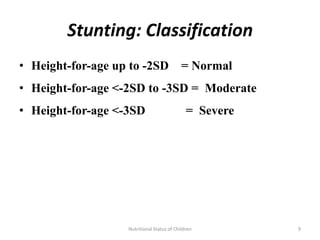
Stunting: Classification
• Height-for-age up to -2SD                 = Normal
• Height-for-age <-2SD to -3SD = Moderate
• Height-for-age <-3SD                        = Severe


                   Nutritional Status of Children        9
Wasting (low weight–for-height)

• Cause: Acute, short-run malnutrition
  Affects only body weight.
   “Wasting” of the body, i.e. loss of body mass
   compared to the body size.
   Indicator: Weight-for-height.


                   Nutritional Status of Children   10
Wasting (low weight–for-height)
Weight for-height:
     Low WFH identifies current or acute under
       nutrition (wasting)
     Useful when exact age is difficult to
       determine
     • - Weight for-length (< 2 yrs) or weight for-
       height (in > 2 yrs)
     - Appropriate for examining short-term effects


                    Nutritional Status of Children    11
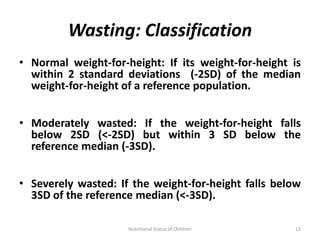
Wasting: Classification
• Normal weight-for-height: If its weight-for-height is
  within 2 standard deviations (-2SD) of the median
  weight-for-height of a reference population.


• Moderately wasted: If the weight-for-height falls
  below 2SD (<-2SD) but within 3 SD below the
  reference median (-3SD).


• Severely wasted: If the weight-for-height falls below
  3SD of the reference median (<-3SD).

                     Nutritional Status of Children   12
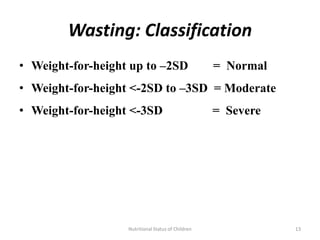
Wasting: Classification
• Weight-for-height up to –2SD                      = Normal
• Weight-for-height <-2SD to –3SD = Moderate
• Weight-for-height <-3SD                           = Severe


                   Nutritional Status of Children              13
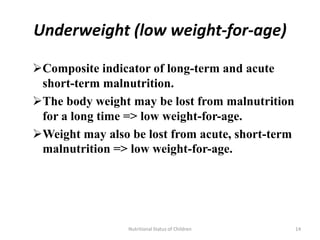
Underweight (low weight-for-age)

Composite indicator of long-term and acute
 short-term malnutrition.
The body weight may be lost from malnutrition
 for a long time => low weight-for-age.
Weight may also be lost from acute, short-term
 malnutrition => low weight-for-age.


                 Nutritional Status of Children   14
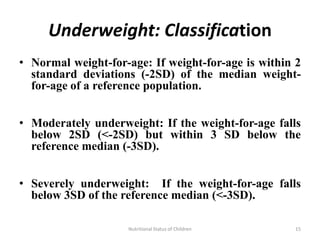
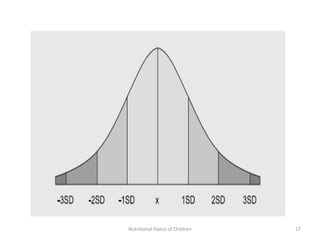
Underweight: Classification
• Normal weight-for-age: If weight-for-age is within 2
  standard deviations (-2SD) of the median weight-
  for-age of a reference population.


• Moderately underweight: If the weight-for-age falls
  below 2SD (<-2SD) but within 3 SD below the
  reference median (-3SD).


• Severely underweight: If the weight-for-age falls
  below 3SD of the reference median (<-3SD).

                    Nutritional Status of Children   15
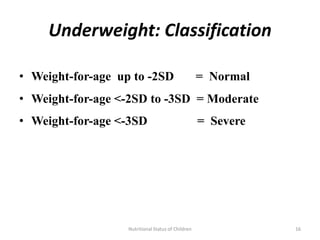
Underweight: Classification

• Weight-for-age up to -2SD                         = Normal
• Weight-for-age <-2SD to -3SD = Moderate
• Weight-for-age <-3SD                              = Severe


                   Nutritional Status of Children              16
Nutritional Status of Children   17
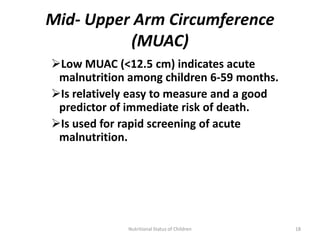
Mid- Upper Arm Circumference
          (MUAC)
Low MUAC (<12.5 cm) indicates acute
 malnutrition among children 6-59 months.
Is relatively easy to measure and a good
 predictor of immediate risk of death.
Is used for rapid screening of acute
 malnutrition.


             Nutritional Status of Children   18
Nutritional Status of Children   19
Nutritional Status of Children   20
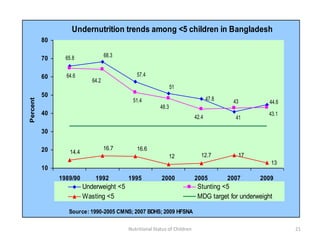
Undernutrition trends among <5 children in Bangladesh
          80

                 65.8              68.3
          70

          60     64.6                         57.4
                            64.2
                                                                51
          50
                                            51.4                                  47.8
Percent


                                                                                          43         44.6
                                                         48.3
          40                                                                                        43.1
                                                                           42.4            41

          30

          20                       16.7       16.6
                  14.4
                                                                12            12.7          17
                                                                                                     13
          10
               1989/90       1992         1995           2000              2005          2007    2009
                         Underweight <5                                     Stunting <5
                         Wasting <5                                         MDG target for underweight

                  Source: 1990-2005 CMNS; 2007 BDHS; 2009 HFSNA

                                          Nutritional Status of Children                                    21
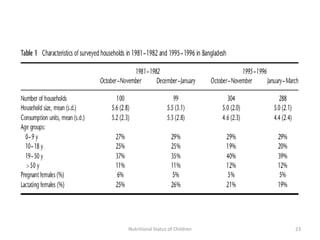
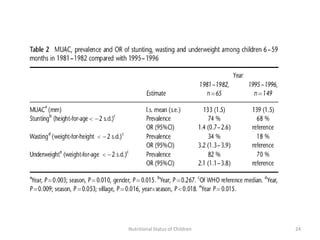
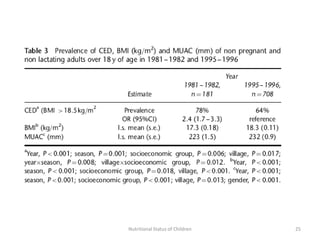
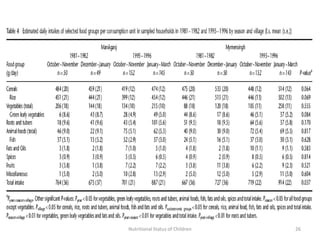
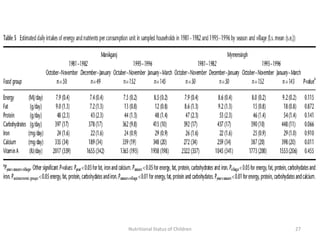
Food consumption, energy and nutrient
  intake and nutritional status in rural
 Bangladesh: Changes from 1981 – 1982
              to 1995 – 96


               Source: Hels et al. (2003)   22
Nutritional Status of Children   23
Nutritional Status of Children   24
Nutritional Status of Children   25
Nutritional Status of Children   26
Nutritional Status of Children   27
Thank You

Topic 20 anthro meaurement230312

  • 1.
    Nutritional Status ofChildren Measures, Estimates and Explanations
  • 2.
    Malnutrition Indicators • Malnutritionindicators: Differ with respect to the stage in one’s life cycle. Nutritional Status of Children 2
  • 3.
    Intra-uterine Undernutrition: Low Birth Weight (LBW) • Cause: Maternal malnutrition: • Effect: Malnutrition during intra-uterine life. Retards the growth and development of the foetus during pregnancy.  The foetus is born with birth weight lower than normal. The cut-off value for birth weight is 2.5 kg(WHO).  Babies born with birth weight <2.5 kg are LBW babies. Nutritional Status of Children 3
  • 4.
    Childhood Malnutrition • Severeconsequences if it occurs early in life. – Adverse impact on subsequent growth, morbidity, cognitive development, educational attainment and productivity in adulthood. Nutritional Status of Children 4
  • 5.
    Nutrition status: ChildrenU5 • Anthropometric Indicators:  Height-for-age (HFA),  Weight-for-age (WFA),  Weight-for-height (WFH), and  MUAC-for-age.  Most sensitive indicators of food security, vulnerability and overall socio-economic development of a country.  Stunting, Wasting and Underweight.  Z-score classification. Nutritional Status of Children 5
  • 6.
    Malnutrition Indicators  Measurethe clinical phenomena of malnutrition.  Standard cutoff points are used internationally to define under nutrition in children 6-59 months.  The cutoff points for nutrition indicators are derived from the WHO child growth standard population (WHO standards) or NCHS reference population (NCHS population). Nutritional Status of Children 6
  • 7.
    Stunting (low height-for-age) •Cause: Chronic under nutrition retards growth of a child by height. • Stunting: child is shorter for its age. • Information requirement: Estimates of height and age. Nutritional Status of Children 7
  • 8.
    Stunting (low height-for-age) •Low HFA identifies past or chronic under nutrition (stunting) • Stunting indicates reduced linear growth  Cannot measure short-term changes in malnutrition  For children <2 yrs of age, the term is length-for- age/LA  For children > 2 yrs age, the index is referred to as height-for-age/HA Nutritional Status of Children 8
  • 9.
    Stunting: Classification • Height-for-ageup to -2SD = Normal • Height-for-age <-2SD to -3SD = Moderate • Height-for-age <-3SD = Severe Nutritional Status of Children 9
  • 10.
    Wasting (low weight–for-height) •Cause: Acute, short-run malnutrition Affects only body weight.  “Wasting” of the body, i.e. loss of body mass compared to the body size.  Indicator: Weight-for-height. Nutritional Status of Children 10
  • 11.
    Wasting (low weight–for-height) Weightfor-height: Low WFH identifies current or acute under nutrition (wasting) Useful when exact age is difficult to determine • - Weight for-length (< 2 yrs) or weight for- height (in > 2 yrs) - Appropriate for examining short-term effects Nutritional Status of Children 11
  • 12.
    Wasting: Classification • Normalweight-for-height: If its weight-for-height is within 2 standard deviations (-2SD) of the median weight-for-height of a reference population. • Moderately wasted: If the weight-for-height falls below 2SD (<-2SD) but within 3 SD below the reference median (-3SD). • Severely wasted: If the weight-for-height falls below 3SD of the reference median (<-3SD). Nutritional Status of Children 12
  • 13.
    Wasting: Classification • Weight-for-heightup to –2SD = Normal • Weight-for-height <-2SD to –3SD = Moderate • Weight-for-height <-3SD = Severe Nutritional Status of Children 13
  • 14.
    Underweight (low weight-for-age) Compositeindicator of long-term and acute short-term malnutrition. The body weight may be lost from malnutrition for a long time => low weight-for-age. Weight may also be lost from acute, short-term malnutrition => low weight-for-age. Nutritional Status of Children 14
  • 15.
    Underweight: Classification • Normalweight-for-age: If weight-for-age is within 2 standard deviations (-2SD) of the median weight- for-age of a reference population. • Moderately underweight: If the weight-for-age falls below 2SD (<-2SD) but within 3 SD below the reference median (-3SD). • Severely underweight: If the weight-for-age falls below 3SD of the reference median (<-3SD). Nutritional Status of Children 15
  • 16.
    Underweight: Classification • Weight-for-ageup to -2SD = Normal • Weight-for-age <-2SD to -3SD = Moderate • Weight-for-age <-3SD = Severe Nutritional Status of Children 16
  • 17.
  • 18.
    Mid- Upper ArmCircumference (MUAC) Low MUAC (<12.5 cm) indicates acute malnutrition among children 6-59 months. Is relatively easy to measure and a good predictor of immediate risk of death. Is used for rapid screening of acute malnutrition. Nutritional Status of Children 18
  • 19.
  • 20.
  • 21.
    Undernutrition trends among<5 children in Bangladesh 80 65.8 68.3 70 60 64.6 57.4 64.2 51 50 51.4 47.8 Percent 43 44.6 48.3 40 43.1 42.4 41 30 20 16.7 16.6 14.4 12 12.7 17 13 10 1989/90 1992 1995 2000 2005 2007 2009 Underweight <5 Stunting <5 Wasting <5 MDG target for underweight Source: 1990-2005 CMNS; 2007 BDHS; 2009 HFSNA Nutritional Status of Children 21
  • 22.
    Food consumption, energyand nutrient intake and nutritional status in rural Bangladesh: Changes from 1981 – 1982 to 1995 – 96 Source: Hels et al. (2003) 22
  • 23.
  • 24.
  • 25.
  • 26.
  • 27.
  • 28.