NUTRITIONAL ASSESSMENT


    Maria Carmela L. Domocmat, RN, MSN
Purposes
• Provides insight into the client’s
  overall physical health
• Helps identify risk factors for
  obesity and to promote health
• Help identify nutritional deficits
• Hydration s an important indicator
  of the client’s general health
  status


          Maria Carmela L. Domocmat, RN, MSN
SUBJECTIVE DATA


      Maria Carmela L. Domocmat, RN, MSN
General nutritional
    status interview
• Dietary habits
• Average daily intake of food
  and fluids
• types and quantities consume
• where and when food is eaten
• any conditions or diseases that
  affect intake or absorption

         Maria Carmela L. Domocmat, RN, MSN
• use various nutritional
  assessment tools
 o Checklist for nutritional
   screening
 o Nutrition Screening Checklist


         Maria Carmela L. Domocmat, RN, MSN
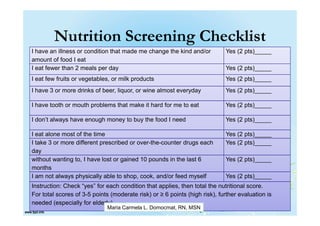
Nutrition Screening Checklist
I have an illness or condition that made me change the kind and/or          Yes (2 pts)_____
amount of food I eat
I eat fewer than 2 meals per day                                            Yes (2 pts)_____
I eat few fruits or vegetables, or milk products                            Yes (2 pts)_____
I have 3 or more drinks of beer, liquor, or wine almost everyday            Yes (2 pts)_____

I have tooth or mouth problems that make it hard for me to eat              Yes (2 pts)_____

I don’t always have enough money to buy the food I need                     Yes (2 pts)_____

I eat alone most of the time                                                Yes (2 pts)_____
I take 3 or more different prescribed or over-the-counter drugs each        Yes (2 pts)_____
day
without wanting to, I have lost or gained 10 pounds in the last 6           Yes (2 pts)_____
months
I am not always physically able to shop, cook, and/or feed myself           Yes (2 pts)_____
Instruction: Check “yes” for each condition that applies, then total the nutritional score.
For total scores of 3-5 points (moderate risk) or ≥ 6 points (high risk), further evaluation is
needed (especially for elderly)
                             Maria Carmela L. Domocmat, RN, MSN
OBJECTIVE DATA


      Maria Carmela L. Domocmat, RN, MSN
1.Anthropometric measurements
2.Body composition measurements


         Maria Carmela L. Domocmat, RN, MSN
Anthropometric
       measurements
• Height, weight, BMI
• Helps to evaluate the client’s
  physical growth, development,
  and nutritional status


         Maria Carmela L. Domocmat, RN, MSN
Height
o Normal findings:
   within range for age, ethnic and
   genetic heritage


          Maria Carmela L. Domocmat, RN, MSN
Height
o Abnormal findings:
   extreme shortness is seen
   achondroplastic dwarfism and
   Turner’s syndrome
   extreme tallness – gigantism
   (excessive secretion of GH) and
   Marfan’s syndrome


          Maria Carmela L. Domocmat, RN, MSN
Weight
o determine ideal body weight
  (IBW) and percentage of IBW


         Maria Carmela L. Domocmat, RN, MSN
Weight
o Method for determining desired
  weight.
   Females assume 100 pounds for the
   first 5 feet (60 inches) and add 5
   pounds for each inch over 60.


          Maria Carmela L. Domocmat, RN, MSN
Weight
o Method for determining desired
  weight.
   Males assume 106 pounds for the
   first 5 feet (60 inches) and add 6
   pounds for each inch over 60.


          Maria Carmela L. Domocmat, RN, MSN
o calculate &age of IBW:
• actual weight x 100 = %IBW
         IBW


        Maria Carmela L. Domocmat, RN, MSN
o Normal findings:
   body weight is within 10% of ideal
   range


          Maria Carmela L. Domocmat, RN, MSN
o Abnormal findings:
   current weight that is 10-20%
   below IBW – indicates a lean
   client and possibly mild
   malnutrition
   • if 20-30% - indicates moderate
     malnutrition
   • more than 30% - severe malnutrition


          Maria Carmela L. Domocmat, RN, MSN
o Abnormal findings:
   weight exceeding 10% of IBW range-
   considered overweight
   20% - obesity


          Maria Carmela L. Domocmat, RN, MSN
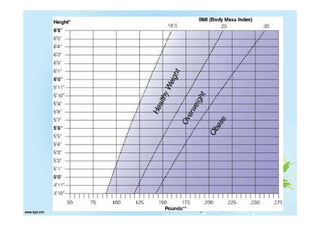
BMI


      Maria Carmela L. Domocmat, RN, MSN
BMI
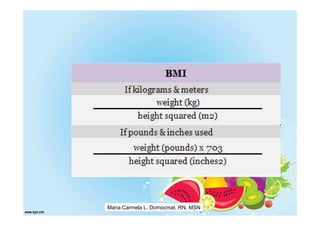
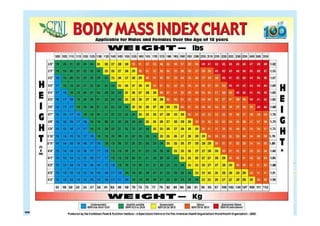
o Calculated based on ht and wt
  regardless of gender
o A practical measure for
  estimating total body fat
o Calculated as wt in kg and
  divided by the square in ht in
  meters
o Simple, quick, inexpensive
         Maria Carmela L. Domocmat, RN, MSN
o But not diagnostic of client’s
  health status
   Does not differentiate bet fat or
   muscle tissue


          Maria Carmela L. Domocmat, RN, MSN
Inaccurately high or low findings
can result for individuals who are
particularly muscular or elderly
who tend to lose muscle mass
Inaccurate if client is retaining
fluid (e.g., edema, ascites,
pregnant)


       Maria Carmela L. Domocmat, RN, MSN
• May not accurately reflect body fat
  in adults, who are shorter than 5
  feet


          Maria Carmela L. Domocmat, RN, MSN
• Further assessments using
  measurements that determine body fat
  composition shld be performed – to
  determine health status and assoc
  risk factors


          Maria Carmela L. Domocmat, RN, MSN
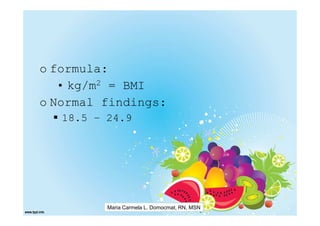
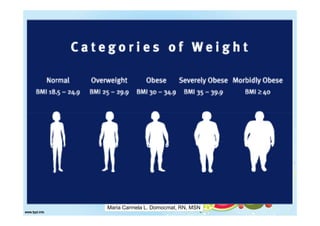
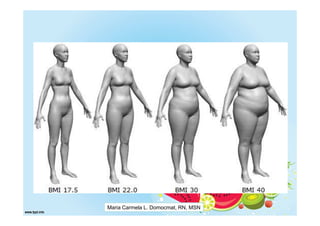
o formula:
   • kg/m2 = BMI
o Normal findings:
   18.5 – 24.9


          Maria Carmela L. Domocmat, RN, MSN
Maria Carmela L. Domocmat, RN, MSN
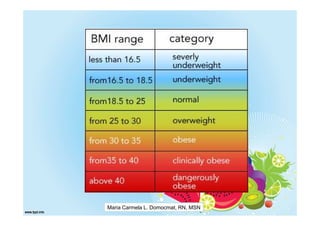
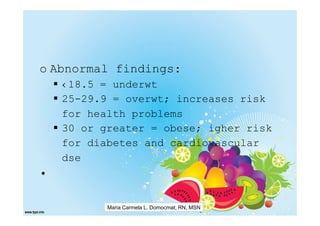
o Abnormal findings:
    ‹18.5 = underwt
    25-29.9 = overwt; increases risk
    for health problems
    30 or greater = obese; igher risk
    for diabetes and cardiovascular
    dse
•

           Maria Carmela L. Domocmat, RN, MSN
BODY COMPOSITION
MEASUREMENTS

      Maria Carmela L. Domocmat, RN, MSN
Body composition
       measurements
o Useful in determining location
  of body fat


         Maria Carmela L. Domocmat, RN, MSN
Maria Carmela L. Domocmat, RN, MSN
Fat Distribution


Maria Carmela L. Domocmat, RN, MSN
Fat Distribution
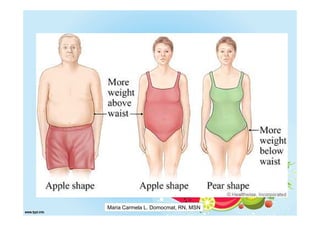
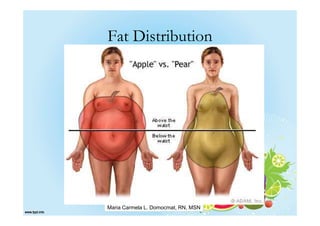
• Pear-shaped body has a lower risk for disease
  than does apple-shaped body.
• this is measured by Waist-to-hip ratio
  measurement


              Maria Carmela L. Domocmat, RN, MSN
Body composition
       measurements
o Waist circumference
   Most common measurement used to
   determine extent of abd visceral
   fat in relation to body fat


          Maria Carmela L. Domocmat, RN, MSN
Waist circumference

Visceral fat
• excess fat within the abd cavity
• assoc with higher health risks than
  subq fat
• may be an independent predictor of
  health risks even when BMI is not
  markedly increased


       Maria Carmela L. Domocmat, RN, MSN
Waist circumference

Normal findings:
• F: less than 35 inches
• M: less than 40 inches


        Maria Carmela L. Domocmat, RN, MSN
Waist circumference

Abnormal findings:
• Increased measurement may indicate
  increased risk for disorders such
  as DM, HTN, Hyperlipidemia,
  cardiovascular dse


        Maria Carmela L. Domocmat, RN, MSN
Waist circumference

• May not be accurate in adults
  who are shorter than 5 feet


         Maria Carmela L. Domocmat, RN, MSN
Body composition
       measurements
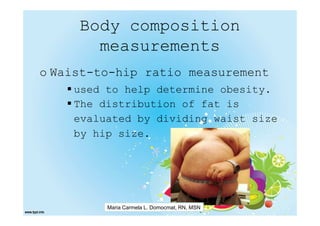
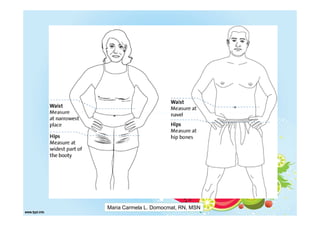
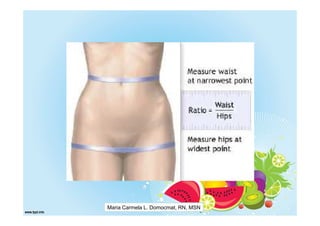
o Waist-to-hip ratio measurement
    used to help determine obesity.
    The distribution of fat is
    evaluated by dividing waist size
    by hip size.


         Maria Carmela L. Domocmat, RN, MSN
Maria Carmela L. Domocmat, RN, MSN
Waist-to-hip ratio
     measurement
Ex:
• 30-inch waist and 40-inch hips
  would have a ratio of .75
• 41-inch waist and 39-inch hips
  would have a ratio of 1.05.


        Maria Carmela L. Domocmat, RN, MSN
Waist-to-hip ratio
     measurement
Normal findings:
• Male: ratio ‹1.0
• Female: ratio of ‹0.8


        Maria Carmela L. Domocmat, RN, MSN
Waist-to-hip ratio
        measurement
Abnormal findings:
•   Male: ratio ›1.0
•   Female: ratio ›0.8
•   increased risk of diseases
•   The higher the ratio, the higher
    the risk of heart disease and
    other obesity-related disorders.


           Maria Carmela L. Domocmat, RN, MSN
Body composition
       measurements
o Mid-arm circumference
 o Helps to assess skeletal muscle
   mass


          Maria Carmela L. Domocmat, RN, MSN
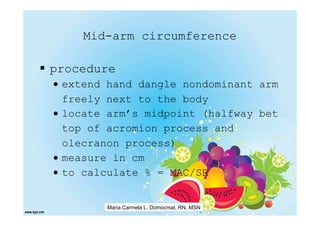
Mid-arm circumference

procedure
• extend hand dangle nondominant arm
  freely next to the body
• locate arm’s midpoint (halfway bet
  top of acromion process and
  olecranon process)
• measure in cm
• to calculate % = MAC/SR


        Maria Carmela L. Domocmat, RN, MSN
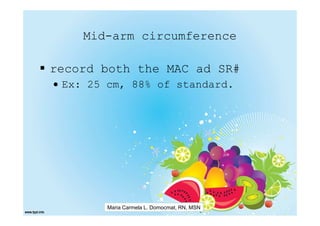
Mid-arm circumference

record both the MAC ad SR#
• Ex: 25 cm, 88% of standard.


        Maria Carmela L. Domocmat, RN, MSN
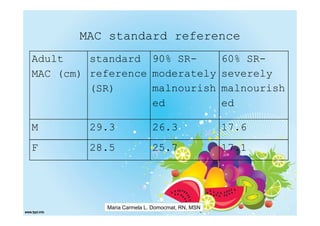
MAC standard reference
Adult    standard 90% SR-                       60% SR-
MAC (cm) reference moderately                   severely
         (SR)      malnourish                   malnourish
                   ed                           ed

M        29.3              26.3                 17.6
F        28.5              25.7                 17.1


           Maria Carmela L. Domocmat, RN, MSN
Body composition
       measurements
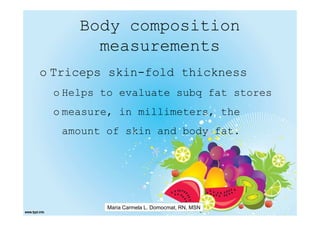
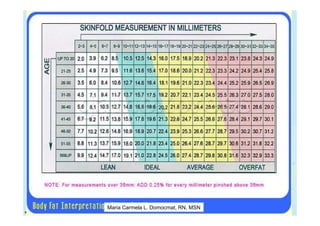
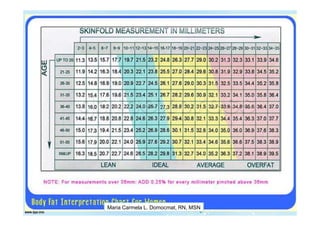
o Triceps skin-fold thickness
 o Helps to evaluate subq fat stores
 o measure, in millimeters, the
   amount of skin and body fat.


          Maria Carmela L. Domocmat, RN, MSN
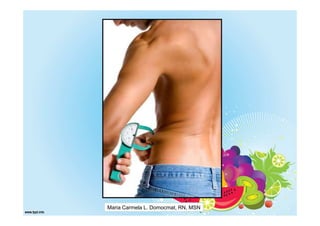
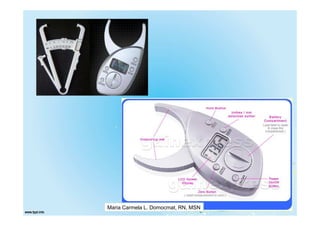
Skinfold calipers
• areas: arm; suprailiac region of
  abd; or subscapular area


          Maria Carmela L. Domocmat, RN, MSN
Skinfold calipers
• Male: measure at mid-chest,
  abdominal (1 inch to the side
  of the belly button), & top of
  mid-thigh
• Female: measure at the mid-
  triceps, suprailiac (outside
  abdominal, about 2 inches
  forward of your love handles),
  & mid-thigh if you're a woman.
         Maria Carmela L. Domocmat, RN, MSN
Maria Carmela L. Domocmat, RN, MSN
Triceps skin-fold
       thickness
Arm = grasp skinfold and subq
fat bet thumb and forefinger,
midway bet acromion process and
tip of elbow
pull skin away from muscle
apply calipers
repeat 3 times record in mm

       Maria Carmela L. Domocmat, RN, MSN
Maria Carmela L. Domocmat, RN, MSN
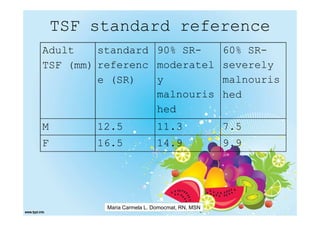
TSF standard reference
Adult    standard 90% SR-                      60% SR-
TSF (mm) referenc moderatel                    severely
         e (SR)   y                            malnouris
                  malnouris                    hed
                  hed
M       12.5                11.3               7.5
F       16.5                14.9               9.9


          Maria Carmela L. Domocmat, RN, MSN
Maria Carmela L. Domocmat, RN, MSN
Triceps skin-fold
        thickness
• Abnormal finding: greater than
  120% = obesity


         Maria Carmela L. Domocmat, RN, MSN
Body composition
       measurements
o Mid-arm muscle circumference
 o Evaluate muscle reserve stores
 o Fla: MAMC = MAC (cm) – [0.314 x
   TSF (mm)]


          Maria Carmela L. Domocmat, RN, MSN
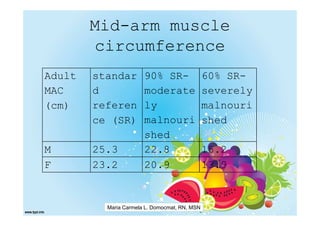
Mid-arm muscle
        circumference
Adult   standar        90% SR-                 60% SR-
MAC     d              moderate                severely
(cm)    referen        ly                      malnouri
        ce (SR)        malnouri                shed
                       shed
M       25.3           22.8                    15.2
F       23.2           20.9                    13.9


          Maria Carmela L. Domocmat, RN, MSN
Mid-arm muscle
     circumference
to calculate % = 20.29/23.2 =
87%
record MAC and TSF and SR #
• ex: MAMC = 25 - [0.314 x 15] =
  20.29; 87% of standard


        Maria Carmela L. Domocmat, RN, MSN
• Note: when evaluating anthropometric
  data, base conclusions on a data
  cluster, not on individual findings


          Maria Carmela L. Domocmat, RN, MSN
HYDRATION


      Maria Carmela L. Domocmat, RN, MSN
Hydration

o Measure I &O
o Weight clients
o Check skin turgor
o Check for pitting edema
o Observe skin for moisture
o Assess venous filing
o Observe neck veins

         Maria Carmela L. Domocmat, RN, MSN
Hydration
o Inspect tongue’s condition
  gently palpate eyeball
o Observe eye position and
  surrounding coloration
o Auscultate lung sounds
o Take BP on different positions


         Maria Carmela L. Domocmat, RN, MSN

nutritional assessment

  • 1.
    NUTRITIONAL ASSESSMENT Maria Carmela L. Domocmat, RN, MSN
  • 2.
    Purposes • Provides insightinto the client’s overall physical health • Helps identify risk factors for obesity and to promote health • Help identify nutritional deficits • Hydration s an important indicator of the client’s general health status Maria Carmela L. Domocmat, RN, MSN
  • 3.
    SUBJECTIVE DATA Maria Carmela L. Domocmat, RN, MSN
  • 4.
    General nutritional status interview • Dietary habits • Average daily intake of food and fluids • types and quantities consume • where and when food is eaten • any conditions or diseases that affect intake or absorption Maria Carmela L. Domocmat, RN, MSN
  • 5.
    • use variousnutritional assessment tools o Checklist for nutritional screening o Nutrition Screening Checklist Maria Carmela L. Domocmat, RN, MSN
  • 6.
    Nutrition Screening Checklist Ihave an illness or condition that made me change the kind and/or Yes (2 pts)_____ amount of food I eat I eat fewer than 2 meals per day Yes (2 pts)_____ I eat few fruits or vegetables, or milk products Yes (2 pts)_____ I have 3 or more drinks of beer, liquor, or wine almost everyday Yes (2 pts)_____ I have tooth or mouth problems that make it hard for me to eat Yes (2 pts)_____ I don’t always have enough money to buy the food I need Yes (2 pts)_____ I eat alone most of the time Yes (2 pts)_____ I take 3 or more different prescribed or over-the-counter drugs each Yes (2 pts)_____ day without wanting to, I have lost or gained 10 pounds in the last 6 Yes (2 pts)_____ months I am not always physically able to shop, cook, and/or feed myself Yes (2 pts)_____ Instruction: Check “yes” for each condition that applies, then total the nutritional score. For total scores of 3-5 points (moderate risk) or ≥ 6 points (high risk), further evaluation is needed (especially for elderly) Maria Carmela L. Domocmat, RN, MSN
  • 7.
    OBJECTIVE DATA Maria Carmela L. Domocmat, RN, MSN
  • 8.
    1.Anthropometric measurements 2.Body compositionmeasurements Maria Carmela L. Domocmat, RN, MSN
  • 9.
    Anthropometric measurements • Height, weight, BMI • Helps to evaluate the client’s physical growth, development, and nutritional status Maria Carmela L. Domocmat, RN, MSN
  • 10.
    Height o Normal findings: within range for age, ethnic and genetic heritage Maria Carmela L. Domocmat, RN, MSN
  • 11.
    Height o Abnormal findings: extreme shortness is seen achondroplastic dwarfism and Turner’s syndrome extreme tallness – gigantism (excessive secretion of GH) and Marfan’s syndrome Maria Carmela L. Domocmat, RN, MSN
  • 12.
    Weight o determine idealbody weight (IBW) and percentage of IBW Maria Carmela L. Domocmat, RN, MSN
  • 13.
    Weight o Method fordetermining desired weight. Females assume 100 pounds for the first 5 feet (60 inches) and add 5 pounds for each inch over 60. Maria Carmela L. Domocmat, RN, MSN
  • 14.
    Weight o Method fordetermining desired weight. Males assume 106 pounds for the first 5 feet (60 inches) and add 6 pounds for each inch over 60. Maria Carmela L. Domocmat, RN, MSN
  • 15.
    o calculate &ageof IBW: • actual weight x 100 = %IBW IBW Maria Carmela L. Domocmat, RN, MSN
  • 16.
    o Normal findings: body weight is within 10% of ideal range Maria Carmela L. Domocmat, RN, MSN
  • 17.
    o Abnormal findings: current weight that is 10-20% below IBW – indicates a lean client and possibly mild malnutrition • if 20-30% - indicates moderate malnutrition • more than 30% - severe malnutrition Maria Carmela L. Domocmat, RN, MSN
  • 18.
    o Abnormal findings: weight exceeding 10% of IBW range- considered overweight 20% - obesity Maria Carmela L. Domocmat, RN, MSN
  • 19.
    BMI Maria Carmela L. Domocmat, RN, MSN
  • 20.
    BMI o Calculated basedon ht and wt regardless of gender o A practical measure for estimating total body fat o Calculated as wt in kg and divided by the square in ht in meters o Simple, quick, inexpensive Maria Carmela L. Domocmat, RN, MSN
  • 21.
    o But notdiagnostic of client’s health status Does not differentiate bet fat or muscle tissue Maria Carmela L. Domocmat, RN, MSN
  • 22.
    Inaccurately high orlow findings can result for individuals who are particularly muscular or elderly who tend to lose muscle mass Inaccurate if client is retaining fluid (e.g., edema, ascites, pregnant) Maria Carmela L. Domocmat, RN, MSN
  • 23.
    • May notaccurately reflect body fat in adults, who are shorter than 5 feet Maria Carmela L. Domocmat, RN, MSN
  • 24.
    • Further assessmentsusing measurements that determine body fat composition shld be performed – to determine health status and assoc risk factors Maria Carmela L. Domocmat, RN, MSN
  • 25.
    o formula: • kg/m2 = BMI o Normal findings: 18.5 – 24.9 Maria Carmela L. Domocmat, RN, MSN
  • 26.
    Maria Carmela L.Domocmat, RN, MSN
  • 27.
    Maria Carmela L.Domocmat, RN, MSN
  • 28.
    Maria Carmela L.Domocmat, RN, MSN
  • 29.
    Maria Carmela L.Domocmat, RN, MSN
  • 30.
    Maria Carmela L.Domocmat, RN, MSN
  • 31.
    Maria Carmela L.Domocmat, RN, MSN
  • 32.
    o Abnormal findings: ‹18.5 = underwt 25-29.9 = overwt; increases risk for health problems 30 or greater = obese; igher risk for diabetes and cardiovascular dse • Maria Carmela L. Domocmat, RN, MSN
  • 33.
    BODY COMPOSITION MEASUREMENTS Maria Carmela L. Domocmat, RN, MSN
  • 34.
    Body composition measurements o Useful in determining location of body fat Maria Carmela L. Domocmat, RN, MSN
  • 35.
    Maria Carmela L.Domocmat, RN, MSN
  • 36.
    Fat Distribution Maria CarmelaL. Domocmat, RN, MSN
  • 37.
    Fat Distribution • Pear-shapedbody has a lower risk for disease than does apple-shaped body. • this is measured by Waist-to-hip ratio measurement Maria Carmela L. Domocmat, RN, MSN
  • 38.
    Body composition measurements o Waist circumference Most common measurement used to determine extent of abd visceral fat in relation to body fat Maria Carmela L. Domocmat, RN, MSN
  • 39.
    Waist circumference Visceral fat •excess fat within the abd cavity • assoc with higher health risks than subq fat • may be an independent predictor of health risks even when BMI is not markedly increased Maria Carmela L. Domocmat, RN, MSN
  • 40.
    Waist circumference Normal findings: •F: less than 35 inches • M: less than 40 inches Maria Carmela L. Domocmat, RN, MSN
  • 41.
    Waist circumference Abnormal findings: •Increased measurement may indicate increased risk for disorders such as DM, HTN, Hyperlipidemia, cardiovascular dse Maria Carmela L. Domocmat, RN, MSN
  • 42.
    Waist circumference • Maynot be accurate in adults who are shorter than 5 feet Maria Carmela L. Domocmat, RN, MSN
  • 43.
    Body composition measurements o Waist-to-hip ratio measurement used to help determine obesity. The distribution of fat is evaluated by dividing waist size by hip size. Maria Carmela L. Domocmat, RN, MSN
  • 44.
    Maria Carmela L.Domocmat, RN, MSN
  • 45.
    Maria Carmela L.Domocmat, RN, MSN
  • 46.
    Waist-to-hip ratio measurement Ex: • 30-inch waist and 40-inch hips would have a ratio of .75 • 41-inch waist and 39-inch hips would have a ratio of 1.05. Maria Carmela L. Domocmat, RN, MSN
  • 47.
    Waist-to-hip ratio measurement Normal findings: • Male: ratio ‹1.0 • Female: ratio of ‹0.8 Maria Carmela L. Domocmat, RN, MSN
  • 48.
    Waist-to-hip ratio measurement Abnormal findings: • Male: ratio ›1.0 • Female: ratio ›0.8 • increased risk of diseases • The higher the ratio, the higher the risk of heart disease and other obesity-related disorders. Maria Carmela L. Domocmat, RN, MSN
  • 49.
    Body composition measurements o Mid-arm circumference o Helps to assess skeletal muscle mass Maria Carmela L. Domocmat, RN, MSN
  • 50.
    Mid-arm circumference procedure • extendhand dangle nondominant arm freely next to the body • locate arm’s midpoint (halfway bet top of acromion process and olecranon process) • measure in cm • to calculate % = MAC/SR Maria Carmela L. Domocmat, RN, MSN
  • 51.
    Mid-arm circumference record boththe MAC ad SR# • Ex: 25 cm, 88% of standard. Maria Carmela L. Domocmat, RN, MSN
  • 52.
    MAC standard reference Adult standard 90% SR- 60% SR- MAC (cm) reference moderately severely (SR) malnourish malnourish ed ed M 29.3 26.3 17.6 F 28.5 25.7 17.1 Maria Carmela L. Domocmat, RN, MSN
  • 53.
    Body composition measurements o Triceps skin-fold thickness o Helps to evaluate subq fat stores o measure, in millimeters, the amount of skin and body fat. Maria Carmela L. Domocmat, RN, MSN
  • 54.
    Skinfold calipers • areas:arm; suprailiac region of abd; or subscapular area Maria Carmela L. Domocmat, RN, MSN
  • 55.
    Skinfold calipers • Male:measure at mid-chest, abdominal (1 inch to the side of the belly button), & top of mid-thigh • Female: measure at the mid- triceps, suprailiac (outside abdominal, about 2 inches forward of your love handles), & mid-thigh if you're a woman. Maria Carmela L. Domocmat, RN, MSN
  • 56.
    Maria Carmela L.Domocmat, RN, MSN
  • 57.
    Triceps skin-fold thickness Arm = grasp skinfold and subq fat bet thumb and forefinger, midway bet acromion process and tip of elbow pull skin away from muscle apply calipers repeat 3 times record in mm Maria Carmela L. Domocmat, RN, MSN
  • 58.
    Maria Carmela L.Domocmat, RN, MSN
  • 59.
    TSF standard reference Adult standard 90% SR- 60% SR- TSF (mm) referenc moderatel severely e (SR) y malnouris malnouris hed hed M 12.5 11.3 7.5 F 16.5 14.9 9.9 Maria Carmela L. Domocmat, RN, MSN
  • 60.
    Maria Carmela L.Domocmat, RN, MSN
  • 61.
    Maria Carmela L.Domocmat, RN, MSN
  • 62.
    Triceps skin-fold thickness • Abnormal finding: greater than 120% = obesity Maria Carmela L. Domocmat, RN, MSN
  • 63.
    Body composition measurements o Mid-arm muscle circumference o Evaluate muscle reserve stores o Fla: MAMC = MAC (cm) – [0.314 x TSF (mm)] Maria Carmela L. Domocmat, RN, MSN
  • 64.
    Mid-arm muscle circumference Adult standar 90% SR- 60% SR- MAC d moderate severely (cm) referen ly malnouri ce (SR) malnouri shed shed M 25.3 22.8 15.2 F 23.2 20.9 13.9 Maria Carmela L. Domocmat, RN, MSN
  • 65.
    Mid-arm muscle circumference to calculate % = 20.29/23.2 = 87% record MAC and TSF and SR # • ex: MAMC = 25 - [0.314 x 15] = 20.29; 87% of standard Maria Carmela L. Domocmat, RN, MSN
  • 66.
    • Note: whenevaluating anthropometric data, base conclusions on a data cluster, not on individual findings Maria Carmela L. Domocmat, RN, MSN
  • 67.
    HYDRATION Maria Carmela L. Domocmat, RN, MSN
  • 68.
    Hydration o Measure I&O o Weight clients o Check skin turgor o Check for pitting edema o Observe skin for moisture o Assess venous filing o Observe neck veins Maria Carmela L. Domocmat, RN, MSN
  • 69.
    Hydration o Inspect tongue’scondition gently palpate eyeball o Observe eye position and surrounding coloration o Auscultate lung sounds o Take BP on different positions Maria Carmela L. Domocmat, RN, MSN