Author(s): Julie Lumeng, M.D., 2009

License: Unless otherwise noted, this material is made available under the
terms of the Creative Commons Attribution – Share Alike 3.0 License:
http://creativecommons.org/licenses/by-sa/3.0/
We have reviewed this material in accordance with U.S. Copyright Law and have tried to maximize your
ability to use, share, and adapt it. The citation key on the following slide provides information about how you
may share and adapt this material.

Copyright holders of content included in this material should contact open.michigan@umich.edu with any
questions, corrections, or clarification regarding the use of content.

For more information about how to cite these materials visit http://open.umich.edu/education/about/terms-of-use.

Any medical information in this material is intended to inform and educate and is not a tool for self-diagnosis
or a replacement for medical evaluation, advice, diagnosis or treatment by a healthcare professional. Please
speak to your physician if you have questions about your medical condition.

Viewer discretion is advised: Some medical content is graphic and may not be suitable for all viewers.
Citation Key
                          for more information see: http://open.umich.edu/wiki/CitationPolicy


Use + Share + Adapt
  { Content the copyright holder, author, or law permits you to use, share and adapt. }
               Public Domain – Government: Works that are produced by the U.S. Government. (17 USC § 105)
               Public Domain – Expired: Works that are no longer protected due to an expired copyright term.
               Public Domain – Self Dedicated: Works that a copyright holder has dedicated to the public domain.

               Creative Commons – Zero Waiver

               Creative Commons – Attribution License
               Creative Commons – Attribution Share Alike License
               Creative Commons – Attribution Noncommercial License
               Creative Commons – Attribution Noncommercial Share Alike License
               GNU – Free Documentation License

Make Your Own Assessment
  { Content Open.Michigan believes can be used, shared, and adapted because it is ineligible for copyright. }
               Public Domain – Ineligible: Works that are ineligible for copyright protection in the U.S. (17 USC § 102(b)) *laws in
               your jurisdiction may differ
   { Content Open.Michigan has used under a Fair Use determination. }
               Fair Use: Use of works that is determined to be Fair consistent with the U.S. Copyright Act. (17 USC § 107) *laws in
               your jurisdiction may differ
               Our determination DOES NOT mean that all uses of this 3rd-party content are Fair Uses and we DO NOT guarantee
               that your use of the content is Fair.
               To use this content you should do your own independent analysis to determine whether or not your use will be Fair.
Growth & Development:
              School Age

                     Julie Lumeng, MD
              Assistant Professor of Pediatrics


Spring 2010
Learning Objectives
For ages 2 to 12 years:
  Physical Growth
     –  Normal
     –  Patterns and characteristics of abnormal
    Nutrition
    Physical Activity
    Development
     –  Normal
     –  Patterns and characteristics of abnormal
Physical Growth
Normal Growth:
         Weight and Height
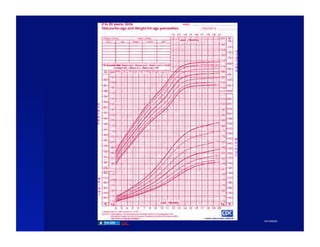
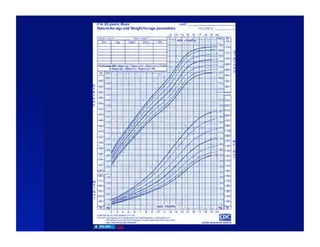
    Separate growth charts for:
      –  Girls and boys
      –  Birth to 36 months
      –  2 to 20 years
      –  Publicly available via CDC website
    Specialized growth charts for children with
     chromosomal abnormalities that alter
     growth potential (e.g. Turner’s syndrome,
     Down syndrome)
OK135S053
CDC
CDC
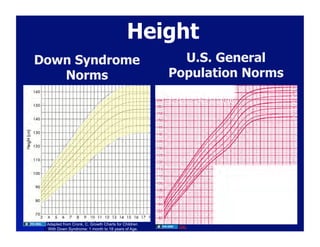
Height
Down Syndrome                                          U.S. General
   Norms                                             Population Norms


 Adapted from Cronk, C. Growth Charts for Children
                                                      CDC
 With Down Syndrome: 1 month to 18 years of Age.
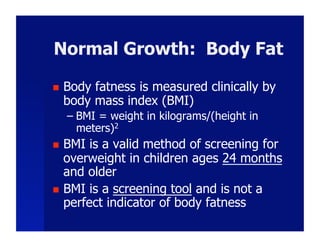
Normal Growth: Body Fat

    Body fatness is measured clinically by
     body mass index (BMI)
     –  BMI = weight in kilograms/(height in
        meters)2
  BMI is a valid method of screening for
   overweight in children ages 24 months
   and older
  BMI is a screening tool and is not a
   perfect indicator of body fatness
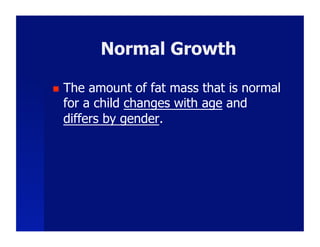
Normal Growth

    The amount of fat mass that is normal
     for a child changes with age and
     differs by gender.
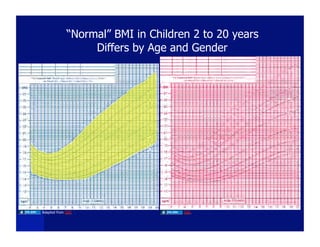
“Normal” BMI in Children 2 to 20 years
                  Differs by Age and Gender


Adapted from CDC                    CDC
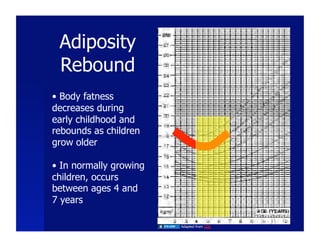
Adiposity
 Rebound
•  Body fatness
decreases during
early childhood and
rebounds as children
grow older

•  In normally growing
children, occurs
between ages 4 and
7 years

                         Adapted from CDC
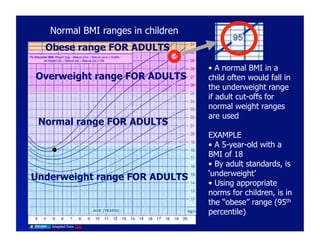
Normal BMI ranges in children
  Obese range FOR ADULTS

                                   •  A normal BMI in a
Overweight range FOR ADULTS        child often would fall in
                                   the underweight range
                                   if adult cut-offs for
                                   normal weight ranges
                                   are used
 Normal range FOR ADULTS
                                   EXAMPLE
                                   •  A 5-year-old with a
                                   BMI of 18
                                   •  By adult standards, is
Underweight range FOR ADULTS       ‘underweight’
                                   •  Using appropriate
                                   norms for children, is in
                                   the “obese” range (95th
                                   percentile)
   Adapted from CDC
Abnormal Growth

 Types of abnormal growth during
school age:
     –  Weight
          Obesity
                 and Overweight
          Underweight

     –  Height
Abnormal Growth: Obesity

    Terminology
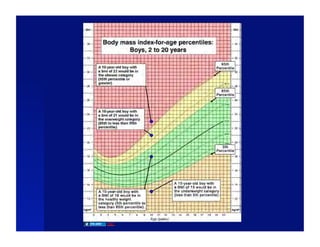
     –  “Obese” is a BMI > 95th percentile for age
        and sex
     –  “Overweight” is a BMI > 85th but < 95th
        percentile for age and sex
     –  “Underweight” is a BMI < 5th percentile
        for age and sex
CDC
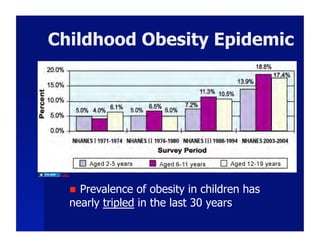
Childhood Obesity Epidemic


 CDC


        Prevalence of obesity in children has
       nearly tripled in the last 30 years
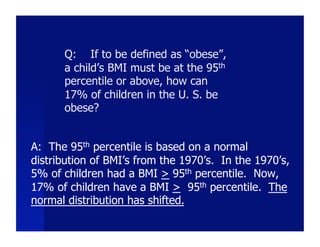
Q: If to be defined as “obese”,
      a child’s BMI must be at the 95th
      percentile or above, how can
      17% of children in the U. S. be
      obese?


A: The 95th percentile is based on a normal
distribution of BMI’s from the 1970’s. In the 1970’s,
5% of children had a BMI > 95th percentile. Now,
17% of children have a BMI > 95th percentile. The
normal distribution has shifted.
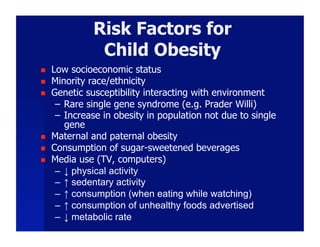
Risk Factors for
                Child Obesity
    Low socioeconomic status
    Minority race/ethnicity
    Genetic susceptibility interacting with environment
      –  Rare single gene syndrome (e.g. Prader Willi)
      –  Increase in obesity in population not due to single
         gene
    Maternal and paternal obesity
    Consumption of sugar-sweetened beverages
    Media use (TV, computers)
      –  ↓ physical activity
      –  ↑ sedentary activity
      –  ↑ consumption (when eating while watching)
      –  ↑ consumption of unhealthy foods advertised
      –  ↓ metabolic rate
Abnormal Growth:
        Underweight
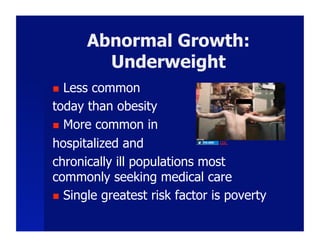
  Less common
today than obesity
  More common in

hospitalized and                CDC


chronically ill populations most
commonly seeking medical care
  Single greatest risk factor is poverty
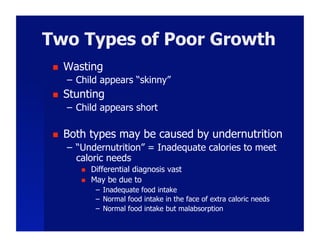
Two Types of Poor Growth
     Wasting
      –  Child appears “skinny”
     Stunting
      –  Child appears short

     Both types may be caused by undernutrition
      –  “Undernutrition” = Inadequate calories to meet
         caloric needs
             Differential diagnosis vast
             May be due to
               –  Inadequate food intake
               –  Normal food intake in the face of extra caloric needs
               –  Normal food intake but malabsorption
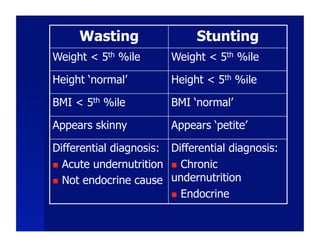
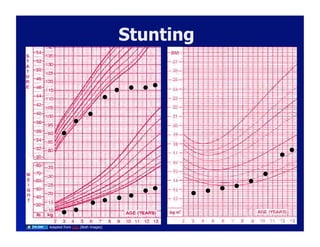
Wasting                  Stunting
Weight < 5th %ile       Weight < 5th %ile

Height ‘normal’         Height < 5th %ile

BMI < 5th %ile          BMI ‘normal’

Appears skinny          Appears ‘petite’

Differential diagnosis: Differential diagnosis:
  Acute undernutrition   Chronic

  Not endocrine cause undernutrition
                          Endocrine
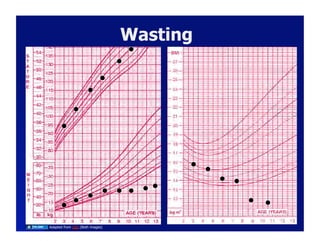
Wasting


Adapted from CDC (Both images)
Stunting


Adapted from CDC (Both images)
Nutrition
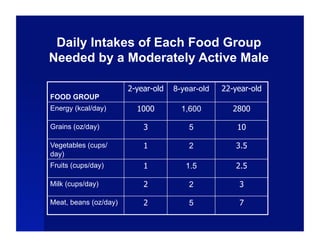
Daily Intakes of Each Food Group
Needed by a Moderately Active Male

                       2-year-old   8-year-old   22-year-old
FOOD GROUP
Energy (kcal/day)        1000         1,600         2800

Grains (oz/day)            3            5            10

Vegetables (cups/          1            2           3.5
day)
Fruits (cups/day)          1           1.5          2.5

Milk (cups/day)            2            2            3

Meat, beans (oz/day)       2            5            7
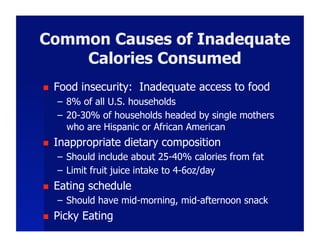
Common Causes of Inadequate
    Calories Consumed
    Food insecurity: Inadequate access to food
     –  8% of all U.S. households
     –  20-30% of households headed by single mothers
        who are Hispanic or African American
    Inappropriate dietary composition
     –  Should include about 25-40% calories from fat
     –  Limit fruit juice intake to 4-6oz/day
    Eating schedule
     –  Should have mid-morning, mid-afternoon snack
    Picky Eating
Common Causes of Excessive
   Calories Consumed

  Calorically dense food
  Liquid calories (sugar-sweetened
   beverages)
  Restaurant eating

  Portion sizes

  Excessive (often unsupervised) snacking
Physical Activity
    Physical activity in childhood predicts physical
     activity in adulthood
    Physical activity levels typically decline into
     adolescence
    Children are less active today than several
     decades ago
    Physical inactivity associated with increased
     risk of obesity even in children
    More barriers reported in low income groups
    Of 9- to 13-year-old children
     –  23% no free time physical activity
     –  62% no organized non-school physical activity
Physical Activity
Recommendations for Children

     Goal is to establish physical activity patterns
      in childhood that will persist
     Focus on promoting free-time (as opposed
      to organized) physical activity
     At least 60 minutes per day of moderate to
      vigorous physical activity
     Should be enjoyable
     Parents should model
     Parents should provide opportunities and
      praise
Development
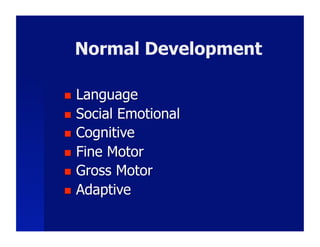
Normal Development
Normal Development:
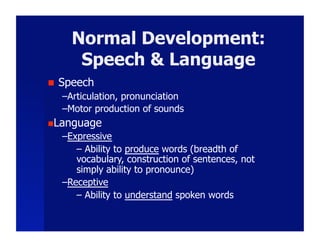
        Speech & Language
    Speech
     – Articulation, pronunciation
     – Motor production of sounds
 Language
     – Expressive
         –  Ability to produce words (breadth of
         vocabulary, construction of sentences, not
         simply ability to pronounce)
     – Receptive
         –  Ability to understand spoken words
Normal Development:
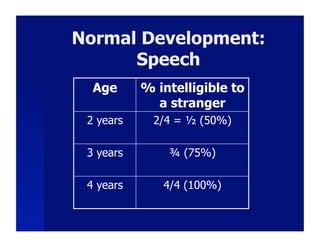
      Speech
  Age      % intelligible to
             a stranger
 2 years     2/4 = ½ (50%)

 3 years       ¾ (75%)

 4 years      4/4 (100%)
Normal Development:
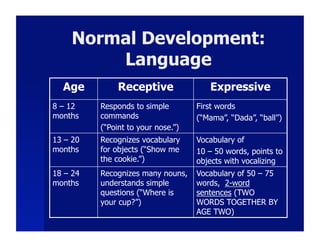
        Language
  Age          Receptive               Expressive
8 – 12    Responds to simple        First words
months    commands                  (“Mama”, “Dada”, “ball”)
          (“Point to your nose.”)
13 – 20   Recognizes vocabulary     Vocabulary of
months    for objects (“Show me     10 – 50 words, points to
          the cookie.”)             objects with vocalizing
18 – 24   Recognizes many nouns,    Vocabulary of 50 – 75
months    understands simple        words, 2-word
          questions (“Where is      sentences (TWO
          your cup?”)               WORDS TOGETHER BY
                                    AGE TWO)
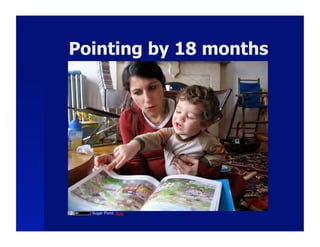
Pointing by 18 months


  Sugar Pond, flickr
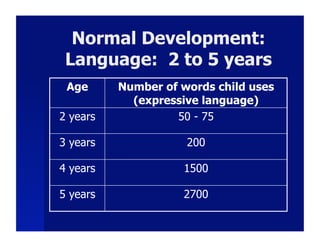
Normal Development:
 Language: 2 to 5 years
 Age      Number of words child uses
            (expressive language)
2 years            50 - 75

3 years              200

4 years             1500

5 years             2700
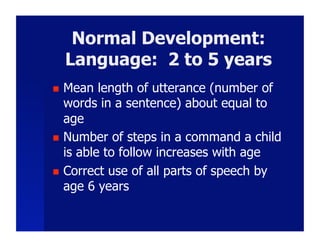
Normal Development:
     Language: 2 to 5 years
  Mean length of utterance (number of
   words in a sentence) about equal to
   age
  Number of steps in a command a child
   is able to follow increases with age
  Correct use of all parts of speech by
   age 6 years
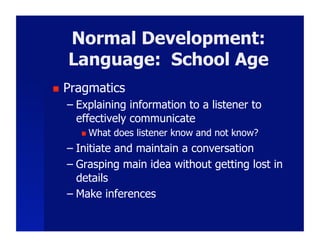
Normal Development:
     Language: School Age
    Pragmatics
     –  Explaining information to a listener to
        effectively communicate
          What   does listener know and not know?
     –  Initiate and maintain a conversation
     –  Grasping main idea without getting lost in
        details
     –  Make inferences
Normal Development:
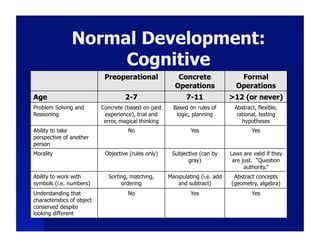
                     Cognitive
                             Preoperational               Concrete                 Formal
                                                         Operations               Operations
Age                                  2-7                      7-11              >12 (or never)
Problem Solving and         Concrete (based on past      Based on rules of        Abstract, flexible,
Reasoning                    experience), trial and       logic, planning          rational, testing
                             error, magical thinking                                 hypotheses
Ability to take                       No                        Yes                      Yes
perspective of another
person
Morality                     Objective (rules only)     Subjective (can by      Laws are valid if they
                                                              gray)              are just. “Question
                                                                                      authority.”
Ability to work with          Sorting, matching,       Manipulating (i.e. add    Abstract concepts
symbols (i.e. numbers)             ordering               and subtract)         (geometry, algebra)
Understanding that                    No                        Yes                      Yes
characteristics of object
conserved despite
looking different
Example of Pre-Operational
Reasoning: Lack of Understanding
        of Conservation


                        Calvin and Hobbes
                            comic strip
                             removed


   Please see: http://lobo.sbc.edu/Images%20for%20webpage/Toast_permanence.jpg
Example of Pre-Operational
Reasoning: Lack of Understanding
        of Conservation


                  Conservation of
                   liquid cartoon
                      removed


        Please see: http://lobo.sbc.edu/ChildDump2.html
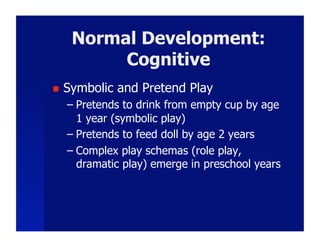
Normal Development:
           Cognitive
    Symbolic and Pretend Play
     –  Pretends to drink from empty cup by age
        1 year (symbolic play)
     –  Pretends to feed doll by age 2 years
     –  Complex play schemas (role play,
        dramatic play) emerge in preschool years
Normal Development:
          Cognitive
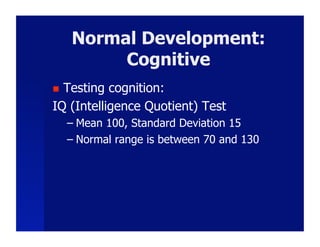
 Testing cognition:
IQ (Intelligence Quotient) Test
     –  Mean 100, Standard Deviation 15
     –  Normal range is between 70 and 130
Normal Development:
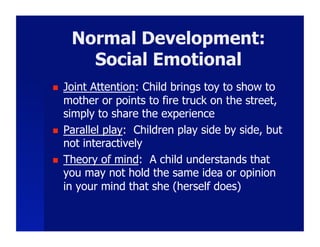
        Social Emotional
    Joint Attention: Child brings toy to show to
     mother or points to fire truck on the street,
     simply to share the experience
    Parallel play: Children play side by side, but
     not interactively
    Theory of mind: A child understands that
     you may not hold the same idea or opinion
     in your mind that she (herself does)
Normal Development:
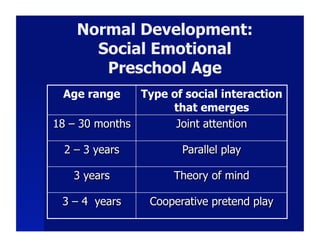
    Social Emotional
     Preschool Age
Age range   Type of social interaction
                 that emerges
Normal Development:
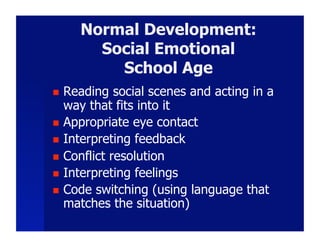
       Social Emotional
         School Age
  Reading social scenes and acting in a
   way that fits into it
  Appropriate eye contact
  Interpreting feedback
  Conflict resolution
  Interpreting feelings
  Code switching (using language that
   matches the situation)
Normal Development:
     Social Emotional
From ages to 2 to 12 years, increasing
   ability to:
  Sustain attention

  Regulate emotion

  Avoid acting immediately on impulse
Speech and Language
             Delay
    5 – 10 % of children
    When parents are worried, they are correct
     75% of the time
    Differential Diagnosis
     –  Hearing loss
     –  Global Developmental Delay
     –  Psychosocial Deprivation
     –  Autism
     –  Selective mutism
Atypical Speech and
          Language
  Echolalia: Repeating back to the
   speaker what he or she said
  Jargoning: Meaningless words and
   phrases strung together, sometimes as
   “fillers”; abnormal beyond about age
   2 years
Abnormal Cognitive
           Development:
         Mental Retardation
    Definition
     –  IQ < 70 with impaired adaptive functioning
    Prevalence is 2-3%
    Cause
     –  Mild (IQ 55 – 70)
          Cause identifiable in less than half
          Genetic syndromes
          Intrauterine exposures
          Perinatal insults

     –  Moderate/Severe/Profound (IQ < 55)
          Cause identifiable in ¾
          Most causes genetic
Autism
    Prevalence
     –  3 to 6 out of every 1000 children
     –  Increasing
     –  More common in boys
    Cause
     –  Unknown, though VERY active area of research
     –  Interaction of genes and environment
     –  NOT parenting
    Treatment
     –  No cure
     –  No medical treatment, interventions are intense
        behavioral approaches
Diagnostic Criteria
     for Autism
1.  Impaired social interaction
2.  Impaired communication
3.  Restricted repetitive and
  stereotyped patterns of behavior
Features of Autism
    Impairments in           Presence of
     –  Eye contact            –  Echolalia
     –  Peer                   –  Jargoning
        relationships          –  Lining things up
     –  Joint attention        –  Restricted interests
     –  Theory of mind         –  “Spinning”
     –  Pretend play           –  Interest in parts of toys (e.g.
     –  Pragmatic                 wheels of car)
        Language               –  Self-stimulating behavior
     –  Pointing                  (e.g. rocking, head banging)
                               –  Oversensitivity to sensory
                                  stimuli
ADHD
    Prevalence
     –  3 to 5% of all children
     –  More common in boys
    Cause
     –  Does not arise purely from parenting or social
        factors
     –  Multi-factorial
     –  Not definitively known
    Treatment
     –  Medication and behavioral
     –  Medication alone is more effective than behavioral
        alone
Diagnostic Criteria for
            ADHD

  Inattention
  Hyperactivity/Impulsivity

  Must cause impairment

  Must occur in 2 or more settings
Additional Source Information
                 for more information see: http://open.umich.edu/wiki/CitationPolicy

Slide 7: Center for Disease Control and Prevention, http://www.cdc.gov/
Slide 8: Center for Disease Control and Prevention, http://www.cdc.gov/
Slide 9: Adapted from Cronk, C. Growth Charts for Children With Down Syndrome: 1 month to 18 years of Age. Pediatrics, Jan 1988; 81:
    102-110; Center for Disease Control and Prevention, http://www.cdc.gov/
Slide 12: Adapted from Center for Disease Control and Prevention, http://www.cdc.gov/; Center for Disease Control and Prevention,
    http://www.cdc.gov
Slide 13: Adapted from Center for Disease Control and Prevention, http://www.cdc.gov/
Slide 14: Adapted from Center for Disease Control and Prevention, http://www.cdc.gov/
Slide 17: Center for Disease Control and Prevention, http://www.cdc.gov/
Slide 18: Center for Disease Control and Prevention, http://www.cdc.gov/
Slide 21: Center for Disease Control and Prevention, http://www.cdc.gov/
Slide 24: Adapted from Center for Disease Control and Prevention, http://www.cdc.gov/
Slide 25: Adapted from Center for Disease Control and Prevention, http://www.cdc.gov/
Slide 38: Sugar Pond, flickr, http://www.flickr.com/photos/sugarpond/2256622336/, CC:BY http://creativecommons.org/licenses/by/2.0/deed.en

05.11.09(c): School Age Development

  • 1.
    Author(s): Julie Lumeng,M.D., 2009 License: Unless otherwise noted, this material is made available under the terms of the Creative Commons Attribution – Share Alike 3.0 License: http://creativecommons.org/licenses/by-sa/3.0/ We have reviewed this material in accordance with U.S. Copyright Law and have tried to maximize your ability to use, share, and adapt it. The citation key on the following slide provides information about how you may share and adapt this material. Copyright holders of content included in this material should contact open.michigan@umich.edu with any questions, corrections, or clarification regarding the use of content. For more information about how to cite these materials visit http://open.umich.edu/education/about/terms-of-use. Any medical information in this material is intended to inform and educate and is not a tool for self-diagnosis or a replacement for medical evaluation, advice, diagnosis or treatment by a healthcare professional. Please speak to your physician if you have questions about your medical condition. Viewer discretion is advised: Some medical content is graphic and may not be suitable for all viewers.
  • 2.
    Citation Key for more information see: http://open.umich.edu/wiki/CitationPolicy Use + Share + Adapt { Content the copyright holder, author, or law permits you to use, share and adapt. } Public Domain – Government: Works that are produced by the U.S. Government. (17 USC § 105) Public Domain – Expired: Works that are no longer protected due to an expired copyright term. Public Domain – Self Dedicated: Works that a copyright holder has dedicated to the public domain. Creative Commons – Zero Waiver Creative Commons – Attribution License Creative Commons – Attribution Share Alike License Creative Commons – Attribution Noncommercial License Creative Commons – Attribution Noncommercial Share Alike License GNU – Free Documentation License Make Your Own Assessment { Content Open.Michigan believes can be used, shared, and adapted because it is ineligible for copyright. } Public Domain – Ineligible: Works that are ineligible for copyright protection in the U.S. (17 USC § 102(b)) *laws in your jurisdiction may differ { Content Open.Michigan has used under a Fair Use determination. } Fair Use: Use of works that is determined to be Fair consistent with the U.S. Copyright Act. (17 USC § 107) *laws in your jurisdiction may differ Our determination DOES NOT mean that all uses of this 3rd-party content are Fair Uses and we DO NOT guarantee that your use of the content is Fair. To use this content you should do your own independent analysis to determine whether or not your use will be Fair.
  • 3.
    Growth & Development: School Age Julie Lumeng, MD Assistant Professor of Pediatrics Spring 2010
  • 4.
    Learning Objectives For ages2 to 12 years:   Physical Growth –  Normal –  Patterns and characteristics of abnormal   Nutrition   Physical Activity   Development –  Normal –  Patterns and characteristics of abnormal
  • 5.
  • 6.
    Normal Growth: Weight and Height   Separate growth charts for: –  Girls and boys –  Birth to 36 months –  2 to 20 years –  Publicly available via CDC website   Specialized growth charts for children with chromosomal abnormalities that alter growth potential (e.g. Turner’s syndrome, Down syndrome)
  • 7.
  • 8.
  • 9.
    Height Down Syndrome U.S. General Norms Population Norms Adapted from Cronk, C. Growth Charts for Children CDC With Down Syndrome: 1 month to 18 years of Age.
  • 10.
    Normal Growth: BodyFat   Body fatness is measured clinically by body mass index (BMI) –  BMI = weight in kilograms/(height in meters)2   BMI is a valid method of screening for overweight in children ages 24 months and older   BMI is a screening tool and is not a perfect indicator of body fatness
  • 11.
    Normal Growth   The amount of fat mass that is normal for a child changes with age and differs by gender.
  • 12.
    “Normal” BMI inChildren 2 to 20 years Differs by Age and Gender Adapted from CDC CDC
  • 13.
    Adiposity Rebound •  Bodyfatness decreases during early childhood and rebounds as children grow older •  In normally growing children, occurs between ages 4 and 7 years Adapted from CDC
  • 14.
    Normal BMI rangesin children Obese range FOR ADULTS •  A normal BMI in a Overweight range FOR ADULTS child often would fall in the underweight range if adult cut-offs for normal weight ranges are used Normal range FOR ADULTS EXAMPLE •  A 5-year-old with a BMI of 18 •  By adult standards, is Underweight range FOR ADULTS ‘underweight’ •  Using appropriate norms for children, is in the “obese” range (95th percentile) Adapted from CDC
  • 15.
    Abnormal Growth  Types ofabnormal growth during school age: –  Weight   Obesity and Overweight   Underweight –  Height
  • 16.
    Abnormal Growth: Obesity   Terminology –  “Obese” is a BMI > 95th percentile for age and sex –  “Overweight” is a BMI > 85th but < 95th percentile for age and sex –  “Underweight” is a BMI < 5th percentile for age and sex
  • 17.
  • 18.
    Childhood Obesity Epidemic CDC  Prevalence of obesity in children has nearly tripled in the last 30 years
  • 19.
    Q: If tobe defined as “obese”, a child’s BMI must be at the 95th percentile or above, how can 17% of children in the U. S. be obese? A: The 95th percentile is based on a normal distribution of BMI’s from the 1970’s. In the 1970’s, 5% of children had a BMI > 95th percentile. Now, 17% of children have a BMI > 95th percentile. The normal distribution has shifted.
  • 20.
    Risk Factors for Child Obesity   Low socioeconomic status   Minority race/ethnicity   Genetic susceptibility interacting with environment –  Rare single gene syndrome (e.g. Prader Willi) –  Increase in obesity in population not due to single gene   Maternal and paternal obesity   Consumption of sugar-sweetened beverages   Media use (TV, computers) –  ↓ physical activity –  ↑ sedentary activity –  ↑ consumption (when eating while watching) –  ↑ consumption of unhealthy foods advertised –  ↓ metabolic rate
  • 21.
    Abnormal Growth: Underweight   Less common today than obesity   More common in hospitalized and CDC chronically ill populations most commonly seeking medical care   Single greatest risk factor is poverty
  • 22.
    Two Types ofPoor Growth   Wasting –  Child appears “skinny”   Stunting –  Child appears short   Both types may be caused by undernutrition –  “Undernutrition” = Inadequate calories to meet caloric needs   Differential diagnosis vast   May be due to –  Inadequate food intake –  Normal food intake in the face of extra caloric needs –  Normal food intake but malabsorption
  • 23.
    Wasting Stunting Weight < 5th %ile Weight < 5th %ile Height ‘normal’ Height < 5th %ile BMI < 5th %ile BMI ‘normal’ Appears skinny Appears ‘petite’ Differential diagnosis: Differential diagnosis:   Acute undernutrition   Chronic   Not endocrine cause undernutrition   Endocrine
  • 24.
  • 25.
  • 26.
  • 27.
    Daily Intakes ofEach Food Group Needed by a Moderately Active Male 2-year-old 8-year-old 22-year-old FOOD GROUP Energy (kcal/day) 1000 1,600 2800 Grains (oz/day) 3 5 10 Vegetables (cups/ 1 2 3.5 day) Fruits (cups/day) 1 1.5 2.5 Milk (cups/day) 2 2 3 Meat, beans (oz/day) 2 5 7
  • 28.
    Common Causes ofInadequate Calories Consumed   Food insecurity: Inadequate access to food –  8% of all U.S. households –  20-30% of households headed by single mothers who are Hispanic or African American   Inappropriate dietary composition –  Should include about 25-40% calories from fat –  Limit fruit juice intake to 4-6oz/day   Eating schedule –  Should have mid-morning, mid-afternoon snack   Picky Eating
  • 29.
    Common Causes ofExcessive Calories Consumed   Calorically dense food   Liquid calories (sugar-sweetened beverages)   Restaurant eating   Portion sizes   Excessive (often unsupervised) snacking
  • 30.
  • 31.
      Physical activity in childhood predicts physical activity in adulthood   Physical activity levels typically decline into adolescence   Children are less active today than several decades ago   Physical inactivity associated with increased risk of obesity even in children   More barriers reported in low income groups   Of 9- to 13-year-old children –  23% no free time physical activity –  62% no organized non-school physical activity
  • 32.
    Physical Activity Recommendations forChildren   Goal is to establish physical activity patterns in childhood that will persist   Focus on promoting free-time (as opposed to organized) physical activity   At least 60 minutes per day of moderate to vigorous physical activity   Should be enjoyable   Parents should model   Parents should provide opportunities and praise
  • 33.
  • 34.
  • 35.
    Normal Development: Speech & Language   Speech – Articulation, pronunciation – Motor production of sounds  Language – Expressive –  Ability to produce words (breadth of vocabulary, construction of sentences, not simply ability to pronounce) – Receptive –  Ability to understand spoken words
  • 36.
    Normal Development: Speech Age % intelligible to a stranger 2 years 2/4 = ½ (50%) 3 years ¾ (75%) 4 years 4/4 (100%)
  • 37.
    Normal Development: Language Age Receptive Expressive 8 – 12 Responds to simple First words months commands (“Mama”, “Dada”, “ball”) (“Point to your nose.”) 13 – 20 Recognizes vocabulary Vocabulary of months for objects (“Show me 10 – 50 words, points to the cookie.”) objects with vocalizing 18 – 24 Recognizes many nouns, Vocabulary of 50 – 75 months understands simple words, 2-word questions (“Where is sentences (TWO your cup?”) WORDS TOGETHER BY AGE TWO)
  • 38.
    Pointing by 18months Sugar Pond, flickr
  • 39.
    Normal Development: Language:2 to 5 years Age Number of words child uses (expressive language) 2 years 50 - 75 3 years 200 4 years 1500 5 years 2700
  • 40.
    Normal Development: Language: 2 to 5 years   Mean length of utterance (number of words in a sentence) about equal to age   Number of steps in a command a child is able to follow increases with age   Correct use of all parts of speech by age 6 years
  • 41.
    Normal Development: Language: School Age   Pragmatics –  Explaining information to a listener to effectively communicate   What does listener know and not know? –  Initiate and maintain a conversation –  Grasping main idea without getting lost in details –  Make inferences
  • 42.
    Normal Development: Cognitive Preoperational Concrete Formal Operations Operations Age 2-7 7-11 >12 (or never) Problem Solving and Concrete (based on past Based on rules of Abstract, flexible, Reasoning experience), trial and logic, planning rational, testing error, magical thinking hypotheses Ability to take No Yes Yes perspective of another person Morality Objective (rules only) Subjective (can by Laws are valid if they gray) are just. “Question authority.” Ability to work with Sorting, matching, Manipulating (i.e. add Abstract concepts symbols (i.e. numbers) ordering and subtract) (geometry, algebra) Understanding that No Yes Yes characteristics of object conserved despite looking different
  • 43.
    Example of Pre-Operational Reasoning:Lack of Understanding of Conservation Calvin and Hobbes comic strip removed Please see: http://lobo.sbc.edu/Images%20for%20webpage/Toast_permanence.jpg
  • 44.
    Example of Pre-Operational Reasoning:Lack of Understanding of Conservation Conservation of liquid cartoon removed Please see: http://lobo.sbc.edu/ChildDump2.html
  • 45.
    Normal Development: Cognitive   Symbolic and Pretend Play –  Pretends to drink from empty cup by age 1 year (symbolic play) –  Pretends to feed doll by age 2 years –  Complex play schemas (role play, dramatic play) emerge in preschool years
  • 46.
    Normal Development: Cognitive  Testing cognition: IQ (Intelligence Quotient) Test –  Mean 100, Standard Deviation 15 –  Normal range is between 70 and 130
  • 47.
    Normal Development: Social Emotional   Joint Attention: Child brings toy to show to mother or points to fire truck on the street, simply to share the experience   Parallel play: Children play side by side, but not interactively   Theory of mind: A child understands that you may not hold the same idea or opinion in your mind that she (herself does)
  • 48.
    Normal Development: Social Emotional Preschool Age Age range Type of social interaction that emerges
  • 49.
    Normal Development: Social Emotional School Age   Reading social scenes and acting in a way that fits into it   Appropriate eye contact   Interpreting feedback   Conflict resolution   Interpreting feelings   Code switching (using language that matches the situation)
  • 50.
    Normal Development: Social Emotional From ages to 2 to 12 years, increasing ability to:   Sustain attention   Regulate emotion   Avoid acting immediately on impulse
  • 51.
    Speech and Language Delay   5 – 10 % of children   When parents are worried, they are correct 75% of the time   Differential Diagnosis –  Hearing loss –  Global Developmental Delay –  Psychosocial Deprivation –  Autism –  Selective mutism
  • 52.
    Atypical Speech and Language   Echolalia: Repeating back to the speaker what he or she said   Jargoning: Meaningless words and phrases strung together, sometimes as “fillers”; abnormal beyond about age 2 years
  • 53.
    Abnormal Cognitive Development: Mental Retardation   Definition –  IQ < 70 with impaired adaptive functioning   Prevalence is 2-3%   Cause –  Mild (IQ 55 – 70)   Cause identifiable in less than half   Genetic syndromes   Intrauterine exposures   Perinatal insults –  Moderate/Severe/Profound (IQ < 55)   Cause identifiable in ¾   Most causes genetic
  • 54.
    Autism   Prevalence –  3 to 6 out of every 1000 children –  Increasing –  More common in boys   Cause –  Unknown, though VERY active area of research –  Interaction of genes and environment –  NOT parenting   Treatment –  No cure –  No medical treatment, interventions are intense behavioral approaches
  • 55.
    Diagnostic Criteria for Autism 1.  Impaired social interaction 2.  Impaired communication 3.  Restricted repetitive and stereotyped patterns of behavior
  • 56.
    Features of Autism   Impairments in   Presence of –  Eye contact –  Echolalia –  Peer –  Jargoning relationships –  Lining things up –  Joint attention –  Restricted interests –  Theory of mind –  “Spinning” –  Pretend play –  Interest in parts of toys (e.g. –  Pragmatic wheels of car) Language –  Self-stimulating behavior –  Pointing (e.g. rocking, head banging) –  Oversensitivity to sensory stimuli
  • 57.
    ADHD   Prevalence –  3 to 5% of all children –  More common in boys   Cause –  Does not arise purely from parenting or social factors –  Multi-factorial –  Not definitively known   Treatment –  Medication and behavioral –  Medication alone is more effective than behavioral alone
  • 58.
    Diagnostic Criteria for ADHD   Inattention   Hyperactivity/Impulsivity   Must cause impairment   Must occur in 2 or more settings
  • 59.
    Additional Source Information for more information see: http://open.umich.edu/wiki/CitationPolicy Slide 7: Center for Disease Control and Prevention, http://www.cdc.gov/ Slide 8: Center for Disease Control and Prevention, http://www.cdc.gov/ Slide 9: Adapted from Cronk, C. Growth Charts for Children With Down Syndrome: 1 month to 18 years of Age. Pediatrics, Jan 1988; 81: 102-110; Center for Disease Control and Prevention, http://www.cdc.gov/ Slide 12: Adapted from Center for Disease Control and Prevention, http://www.cdc.gov/; Center for Disease Control and Prevention, http://www.cdc.gov Slide 13: Adapted from Center for Disease Control and Prevention, http://www.cdc.gov/ Slide 14: Adapted from Center for Disease Control and Prevention, http://www.cdc.gov/ Slide 17: Center for Disease Control and Prevention, http://www.cdc.gov/ Slide 18: Center for Disease Control and Prevention, http://www.cdc.gov/ Slide 21: Center for Disease Control and Prevention, http://www.cdc.gov/ Slide 24: Adapted from Center for Disease Control and Prevention, http://www.cdc.gov/ Slide 25: Adapted from Center for Disease Control and Prevention, http://www.cdc.gov/ Slide 38: Sugar Pond, flickr, http://www.flickr.com/photos/sugarpond/2256622336/, CC:BY http://creativecommons.org/licenses/by/2.0/deed.en