Technology, Gender and Food
     Security Interface:
    Cramer’s V & phi-test


         Source: Babu and Sanyal (2009)   1
Technology, Gender and Food Security
                 Interface
• Gender empowerment: A major policy option considered for
  reducing income deprivation and food insecurity.
• Reasons:
    Women produce more than half the food grown in the
     developing countries.
    Women farmers in sub-Saharan Africa produce more
     than three-quarters of the region’s basic food, manage
     about two-thirds of the marketing and at least one-half
     of the activities for storing food and raising animals.
    In Asia, women account for more than two-thirds of food
     production

                     Technology, Gender and Food Security
                                                            2
                                   Interface
Gender & its Importance
• Reasons:
    They contribute to about 45 per cent of production in
     Latin America and the Caribbean.


• Disadvantage:
    Women are risk-averse and hence, differential gender
     profile with respect to technology adoption or
     commercialization.
    Differential commercialization profile also; women prefer
     to grow food for home consumption; women have
     limited access to land labor, credit & extension services.
                      Technology, Gender and Food Security
                                                              3
                                    Interface
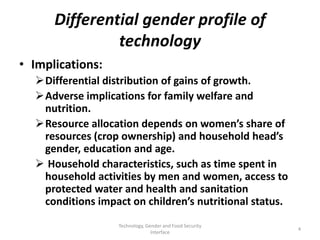
Differential gender profile of
               technology
• Implications:
  Differential distribution of gains of growth.
  Adverse implications for family welfare and
   nutrition.
  Resource allocation depends on women’s share of
   resources (crop ownership) and household head’s
   gender, education and age.
   Household characteristics, such as time spent in
   household activities by men and women, access to
   protected water and health and sanitation
   conditions impact on children’s nutritional status.
                   Technology, Gender and Food Security
                                                          4
                                 Interface
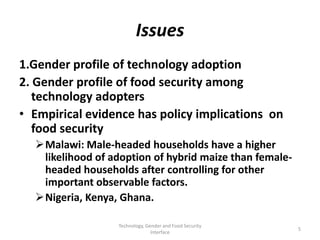
Issues
1.Gender profile of technology adoption
2. Gender profile of food security among
   technology adopters
• Empirical evidence has policy implications on
   food security
  Malawi: Male-headed households have a higher
   likelihood of adoption of hybrid maize than female-
   headed households after controlling for other
   important observable factors.
  Nigeria, Kenya, Ghana.

                  Technology, Gender and Food Security
                                                         5
                                Interface
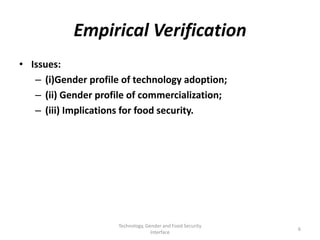
Empirical Verification
• Issues:
   – (i)Gender profile of technology adoption;
   – (ii) Gender profile of commercialization;
   – (iii) Implications for food security.


                      Technology, Gender and Food Security
                                                             6
                                    Interface
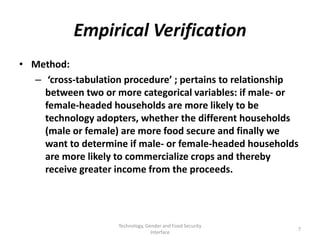
Empirical Verification
• Method:
  – ‘cross-tabulation procedure’ ; pertains to relationship
    between two or more categorical variables: if male- or
    female-headed households are more likely to be
    technology adopters, whether the different households
    (male or female) are more food secure and finally we
    want to determine if male- or female-headed households
    are more likely to commercialize crops and thereby
    receive greater income from the proceeds.


                     Technology, Gender and Food Security
                                                            7
                                   Interface
Empirical Verification
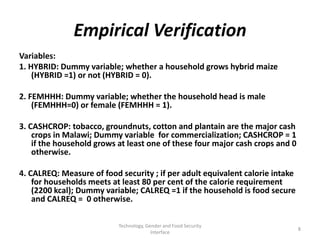
Variables:
1. HYBRID: Dummy variable; whether a household grows hybrid maize
    (HYBRID =1) or not (HYBRID = 0).

2. FEMHHH: Dummy variable; whether the household head is male
    (FEMHHH=0) or female (FEMHHH = 1).

3. CASHCROP: tobacco, groundnuts, cotton and plantain are the major cash
    crops in Malawi; Dummy variable for commercialization; CASHCROP = 1
    if the household grows at least one of these four major cash crops and 0
    otherwise.

4. CALREQ: Measure of food security ; if per adult equivalent calorie intake
    for households meets at least 80 per cent of the calorie requirement
    (2200 kcal); Dummy variable; CALREQ =1 if the household is food secure
    and CALREQ = 0 otherwise.

                           Technology, Gender and Food Security
                                                                               8
                                         Interface
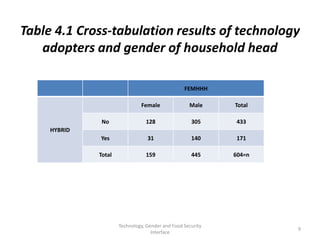
Table 4.1 Cross-tabulation results of technology
   adopters and gender of household head

                                                  FEMHHH

                               Female               Male     Total

               No                128                 305      433
     HYBRID
              Yes                 31                 140      171

              Total              159                 445     604=n


                      Technology, Gender and Food Security
                                                                     9
                                    Interface
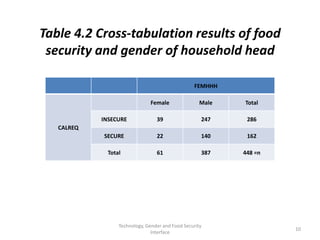
Table 4.2 Cross-tabulation results of food
 security and gender of household head

                                                  FEMHHH

                               Female                Male   Total

            INSECURE              39                 247     286
   CALREQ
            SECURE                22                 140     162

              Total               61                 387    448 =n


                  Technology, Gender and Food Security
                                                                     10
                                Interface
Statistical Test: phi coefficient


          Technology, Gender and Food Security
                                                 11
                        Interface
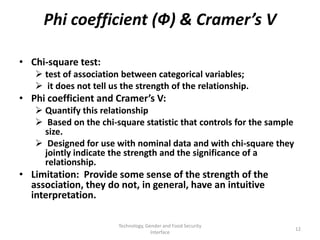
Phi coefficient (Ф) & Cramer’s V

• Chi-square test:
    test of association between categorical variables;
    it does not tell us the strength of the relationship.
• Phi coefficient and Cramer’s V:
    Quantify this relationship
    Based on the chi-square statistic that controls for the sample
     size.
    Designed for use with nominal data and with chi-square they
     jointly indicate the strength and the significance of a
     relationship.
• Limitation: Provide some sense of the strength of the
  association, they do not, in general, have an intuitive
  interpretation.

                        Technology, Gender and Food Security
                                                                      12
                                      Interface
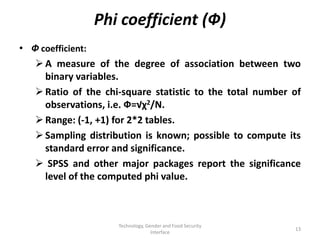
Phi coefficient (Ф)
• Ф coefficient:
    A measure of the degree of association between two
     binary variables.
    Ratio of the chi-square statistic to the total number of
     observations, i.e. Ф=√χ2/N.
    Range: (-1, +1) for 2*2 tables.
    Sampling distribution is known; possible to compute its
     standard error and significance.
    SPSS and other major packages report the significance
     level of the computed phi value.


                     Technology, Gender and Food Security
                                                            13
                                   Interface
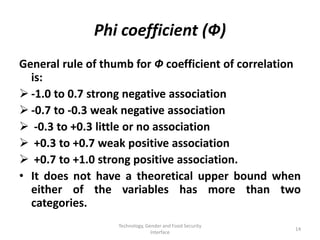
Phi coefficient (Ф)
General rule of thumb for Ф coefficient of correlation
  is:
 -1.0 to 0.7 strong negative association
 -0.7 to -0.3 weak negative association
 -0.3 to +0.3 little or no association
 +0.3 to +0.7 weak positive association
 +0.7 to +1.0 strong positive association.
• It does not have a theoretical upper bound when
  either of the variables has more than two
  categories.
                   Technology, Gender and Food Security
                                                          14
                                 Interface
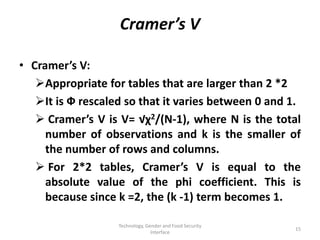
Cramer’s V

• Cramer’s V:
   Appropriate for tables that are larger than 2 *2
   It is Ф rescaled so that it varies between 0 and 1.
    Cramer’s V is V= √χ2/(N-1), where N is the total
     number of observations and k is the smaller of
     the number of rows and columns.
    For 2*2 tables, Cramer’s V is equal to the
     absolute value of the phi coefficient. This is
     because since k =2, the (k -1) term becomes 1.

                   Technology, Gender and Food Security
                                                          15
                                 Interface
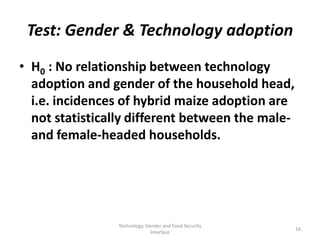
Test: Gender & Technology adoption
• H0 : No relationship between technology
  adoption and gender of the household head,
  i.e. incidences of hybrid maize adoption are
  not statistically different between the male-
  and female-headed households.


                Technology, Gender and Food Security
                                                       16
                              Interface
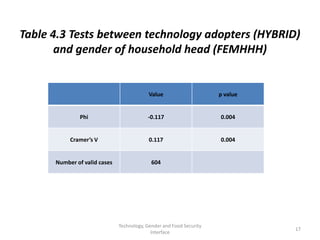
Table 4.3 Tests between technology adopters (HYBRID)
       and gender of household head (FEMHHH)


                                           Value                     p value


              Phi                         -0.117                     0.004


           Cramer’s V                      0.117                     0.004


      Number of valid cases                 604


                              Technology, Gender and Food Security
                                                                               17
                                            Interface
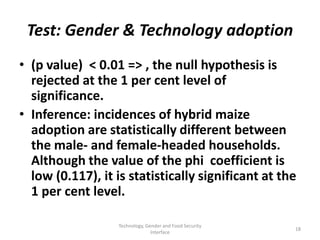
Test: Gender & Technology adoption
• (p value) < 0.01 => , the null hypothesis is
  rejected at the 1 per cent level of
  significance.
• Inference: incidences of hybrid maize
  adoption are statistically different between
  the male- and female-headed households.
  Although the value of the phi coefficient is
  low (0.117), it is statistically significant at the
  1 per cent level.

                   Technology, Gender and Food Security
                                                          18
                                 Interface
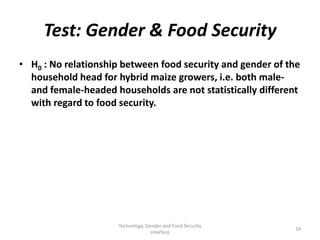
Test: Gender & Food Security
• H0 : No relationship between food security and gender of the
  household head for hybrid maize growers, i.e. both male-
  and female-headed households are not statistically different
  with regard to food security.


                     Technology, Gender and Food Security
                                                            19
                                   Interface
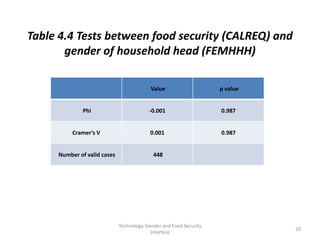
Table 4.4 Tests between food security (CALREQ) and
       gender of household head (FEMHHH)

                                          Value                     p value


              Phi                         -0.001                    0.987


          Cramer’s V                      0.001                     0.987


     Number of valid cases                  448


                             Technology, Gender and Food Security
                                                                              20
                                           Interface
Test: Gender & Food Security
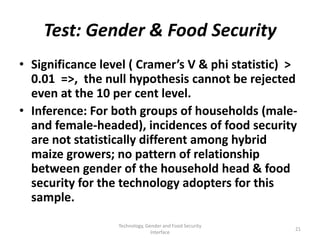
• Significance level ( Cramer’s V & phi statistic) >
  0.01 =>, the null hypothesis cannot be rejected
  even at the 10 per cent level.
• Inference: For both groups of households (male-
  and female-headed), incidences of food security
  are not statistically different among hybrid
  maize growers; no pattern of relationship
  between gender of the household head & food
  security for the technology adopters for this
  sample.
                  Technology, Gender and Food Security
                                                         21
                                Interface
Gender & Commercialization
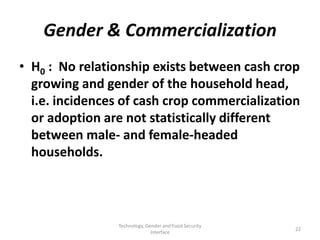
• H0 : No relationship exists between cash crop
  growing and gender of the household head,
  i.e. incidences of cash crop commercialization
  or adoption are not statistically different
  between male- and female-headed
  households.


                Technology, Gender and Food Security
                                                       22
                              Interface
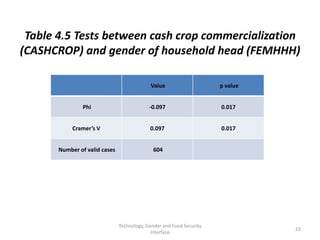
Table 4.5 Tests between cash crop commercialization
(CASHCROP) and gender of household head (FEMHHH)

                                            Value                     p value


                Phi                         -0.097                    0.017


            Cramer’s V                      0.097                     0.017


       Number of valid cases                  604


                               Technology, Gender and Food Security
                                                                                23
                                             Interface
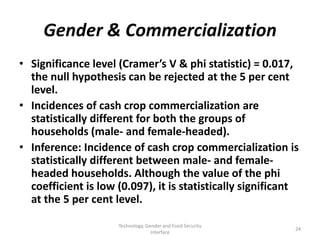
Gender & Commercialization
• Significance level (Cramer’s V & phi statistic) = 0.017,
  the null hypothesis can be rejected at the 5 per cent
  level.
• Incidences of cash crop commercialization are
  statistically different for both the groups of
  households (male- and female-headed).
• Inference: Incidence of cash crop commercialization is
  statistically different between male- and female-
  headed households. Although the value of the phi
  coefficient is low (0.097), it is statistically significant
  at the 5 per cent level.

                     Technology, Gender and Food Security
                                                            24
                                   Interface

Topic 12 gender technology interface

  • 1.
    Technology, Gender andFood Security Interface: Cramer’s V & phi-test Source: Babu and Sanyal (2009) 1
  • 2.
    Technology, Gender andFood Security Interface • Gender empowerment: A major policy option considered for reducing income deprivation and food insecurity. • Reasons:  Women produce more than half the food grown in the developing countries.  Women farmers in sub-Saharan Africa produce more than three-quarters of the region’s basic food, manage about two-thirds of the marketing and at least one-half of the activities for storing food and raising animals.  In Asia, women account for more than two-thirds of food production Technology, Gender and Food Security 2 Interface
  • 3.
    Gender & itsImportance • Reasons:  They contribute to about 45 per cent of production in Latin America and the Caribbean. • Disadvantage:  Women are risk-averse and hence, differential gender profile with respect to technology adoption or commercialization.  Differential commercialization profile also; women prefer to grow food for home consumption; women have limited access to land labor, credit & extension services. Technology, Gender and Food Security 3 Interface
  • 4.
    Differential gender profileof technology • Implications: Differential distribution of gains of growth. Adverse implications for family welfare and nutrition. Resource allocation depends on women’s share of resources (crop ownership) and household head’s gender, education and age.  Household characteristics, such as time spent in household activities by men and women, access to protected water and health and sanitation conditions impact on children’s nutritional status. Technology, Gender and Food Security 4 Interface
  • 5.
    Issues 1.Gender profile oftechnology adoption 2. Gender profile of food security among technology adopters • Empirical evidence has policy implications on food security Malawi: Male-headed households have a higher likelihood of adoption of hybrid maize than female- headed households after controlling for other important observable factors. Nigeria, Kenya, Ghana. Technology, Gender and Food Security 5 Interface
  • 6.
    Empirical Verification • Issues: – (i)Gender profile of technology adoption; – (ii) Gender profile of commercialization; – (iii) Implications for food security. Technology, Gender and Food Security 6 Interface
  • 7.
    Empirical Verification • Method: – ‘cross-tabulation procedure’ ; pertains to relationship between two or more categorical variables: if male- or female-headed households are more likely to be technology adopters, whether the different households (male or female) are more food secure and finally we want to determine if male- or female-headed households are more likely to commercialize crops and thereby receive greater income from the proceeds. Technology, Gender and Food Security 7 Interface
  • 8.
    Empirical Verification Variables: 1. HYBRID:Dummy variable; whether a household grows hybrid maize (HYBRID =1) or not (HYBRID = 0). 2. FEMHHH: Dummy variable; whether the household head is male (FEMHHH=0) or female (FEMHHH = 1). 3. CASHCROP: tobacco, groundnuts, cotton and plantain are the major cash crops in Malawi; Dummy variable for commercialization; CASHCROP = 1 if the household grows at least one of these four major cash crops and 0 otherwise. 4. CALREQ: Measure of food security ; if per adult equivalent calorie intake for households meets at least 80 per cent of the calorie requirement (2200 kcal); Dummy variable; CALREQ =1 if the household is food secure and CALREQ = 0 otherwise. Technology, Gender and Food Security 8 Interface
  • 9.
    Table 4.1 Cross-tabulationresults of technology adopters and gender of household head FEMHHH Female Male Total No 128 305 433 HYBRID Yes 31 140 171 Total 159 445 604=n Technology, Gender and Food Security 9 Interface
  • 10.
    Table 4.2 Cross-tabulationresults of food security and gender of household head FEMHHH Female Male Total INSECURE 39 247 286 CALREQ SECURE 22 140 162 Total 61 387 448 =n Technology, Gender and Food Security 10 Interface
  • 11.
    Statistical Test: phicoefficient Technology, Gender and Food Security 11 Interface
  • 12.
    Phi coefficient (Ф)& Cramer’s V • Chi-square test:  test of association between categorical variables;  it does not tell us the strength of the relationship. • Phi coefficient and Cramer’s V:  Quantify this relationship  Based on the chi-square statistic that controls for the sample size.  Designed for use with nominal data and with chi-square they jointly indicate the strength and the significance of a relationship. • Limitation: Provide some sense of the strength of the association, they do not, in general, have an intuitive interpretation. Technology, Gender and Food Security 12 Interface
  • 13.
    Phi coefficient (Ф) •Ф coefficient:  A measure of the degree of association between two binary variables.  Ratio of the chi-square statistic to the total number of observations, i.e. Ф=√χ2/N.  Range: (-1, +1) for 2*2 tables.  Sampling distribution is known; possible to compute its standard error and significance.  SPSS and other major packages report the significance level of the computed phi value. Technology, Gender and Food Security 13 Interface
  • 14.
    Phi coefficient (Ф) Generalrule of thumb for Ф coefficient of correlation is:  -1.0 to 0.7 strong negative association  -0.7 to -0.3 weak negative association  -0.3 to +0.3 little or no association  +0.3 to +0.7 weak positive association  +0.7 to +1.0 strong positive association. • It does not have a theoretical upper bound when either of the variables has more than two categories. Technology, Gender and Food Security 14 Interface
  • 15.
    Cramer’s V • Cramer’sV: Appropriate for tables that are larger than 2 *2 It is Ф rescaled so that it varies between 0 and 1.  Cramer’s V is V= √χ2/(N-1), where N is the total number of observations and k is the smaller of the number of rows and columns.  For 2*2 tables, Cramer’s V is equal to the absolute value of the phi coefficient. This is because since k =2, the (k -1) term becomes 1. Technology, Gender and Food Security 15 Interface
  • 16.
    Test: Gender &Technology adoption • H0 : No relationship between technology adoption and gender of the household head, i.e. incidences of hybrid maize adoption are not statistically different between the male- and female-headed households. Technology, Gender and Food Security 16 Interface
  • 17.
    Table 4.3 Testsbetween technology adopters (HYBRID) and gender of household head (FEMHHH) Value p value Phi -0.117 0.004 Cramer’s V 0.117 0.004 Number of valid cases 604 Technology, Gender and Food Security 17 Interface
  • 18.
    Test: Gender &Technology adoption • (p value) < 0.01 => , the null hypothesis is rejected at the 1 per cent level of significance. • Inference: incidences of hybrid maize adoption are statistically different between the male- and female-headed households. Although the value of the phi coefficient is low (0.117), it is statistically significant at the 1 per cent level. Technology, Gender and Food Security 18 Interface
  • 19.
    Test: Gender &Food Security • H0 : No relationship between food security and gender of the household head for hybrid maize growers, i.e. both male- and female-headed households are not statistically different with regard to food security. Technology, Gender and Food Security 19 Interface
  • 20.
    Table 4.4 Testsbetween food security (CALREQ) and gender of household head (FEMHHH) Value p value Phi -0.001 0.987 Cramer’s V 0.001 0.987 Number of valid cases 448 Technology, Gender and Food Security 20 Interface
  • 21.
    Test: Gender &Food Security • Significance level ( Cramer’s V & phi statistic) > 0.01 =>, the null hypothesis cannot be rejected even at the 10 per cent level. • Inference: For both groups of households (male- and female-headed), incidences of food security are not statistically different among hybrid maize growers; no pattern of relationship between gender of the household head & food security for the technology adopters for this sample. Technology, Gender and Food Security 21 Interface
  • 22.
    Gender & Commercialization •H0 : No relationship exists between cash crop growing and gender of the household head, i.e. incidences of cash crop commercialization or adoption are not statistically different between male- and female-headed households. Technology, Gender and Food Security 22 Interface
  • 23.
    Table 4.5 Testsbetween cash crop commercialization (CASHCROP) and gender of household head (FEMHHH) Value p value Phi -0.097 0.017 Cramer’s V 0.097 0.017 Number of valid cases 604 Technology, Gender and Food Security 23 Interface
  • 24.
    Gender & Commercialization •Significance level (Cramer’s V & phi statistic) = 0.017, the null hypothesis can be rejected at the 5 per cent level. • Incidences of cash crop commercialization are statistically different for both the groups of households (male- and female-headed). • Inference: Incidence of cash crop commercialization is statistically different between male- and female- headed households. Although the value of the phi coefficient is low (0.097), it is statistically significant at the 5 per cent level. Technology, Gender and Food Security 24 Interface