ANTHROPOMETRY
2
Anthropometry: Introduction 
• Anthropos - "man" 
• Metron "measurement” 
•A branch of anthropology that involves the 
quantitative measurement of the human body. 
3
ANTHROPOMETRY-significance 
• It is used to evaluate both under & over 
nutrition. 
• The measured values reflects the current 
nutritional status & don’t differentiate 
between acute & chronic changes 
• It is the single most portable, universally 
applicable, inexpensive and non-invasive 
technique for assessing the size, 
proportions and composition of the human 
body. 
4
Parameters of anthropometry 
Age dependent factors:- 
a) Weight 
b) Height 
c) Head circumference 
d) Chest circumference 
Age independent factors:- 
a)Mid-arm circumference (1-5 years) 
b) Weight for height 
c) Skinfold thickness 
d) Mid upper arm/height ratio 
5
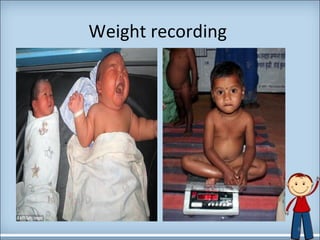
Weight recording 
6
Weight 
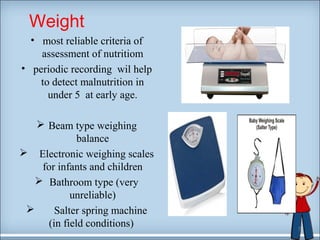
• most reliable criteria of 
assessment of nutritiom 
• periodic recording wil help 
to detect malnutrition in 
under 5 at early age. 
 Beam type weighing 
balance 
 Electronic weighing scales 
for infants and children 
 Bathroom type (very 
unreliable) 
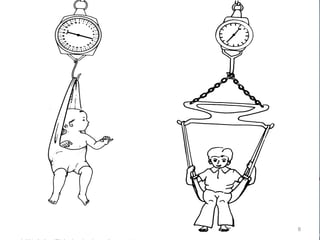
 Salter spring machine 
(in field conditions) 7
8
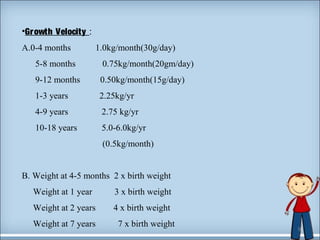
•Growth Velocity : 
A.0-4 months 1.0kg/month(30g/day) 
5-8 months 0.75kg/month(20gm/day) 
9-12 months 0.50kg/month(15g/day) 
1-3 years 2.25kg/yr 
4-9 years 2.75 kg/yr 
10-18 years 5.0-6.0kg/yr 
(0.5kg/month) 
B. Weight at 4-5 months 2 x birth weight 
Weight at 1 year 3 x birth weight 
Weight at 2 years 4 x birth weight 
Weight at 7 years 7 x birth weight 9
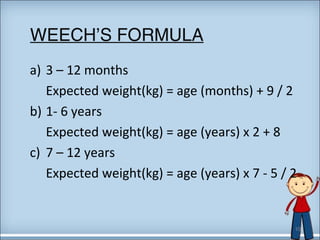
WEECH’S FORMULA 
a) 3 – 12 months 
Expected weight(kg) = age (months) + 9 / 2 
b) 1- 6 years 
Expected weight(kg) = age (years) x 2 + 8 
c) 7 – 12 years 
Expected weight(kg) = age (years) x 7 - 5 / 2 
10
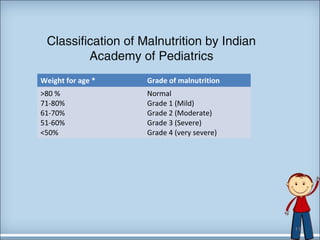
Classification of Malnutrition by Indian 
Academy of Pediatrics 
Weight for age * Grade of malnutrition 
>80 % 
Normal 
71-80% 
Grade 1 (Mild) 
61-70% 
Grade 2 (Moderate) 
51-60% 
Grade 3 (Severe) 
<50% 
Grade 4 (very severe) 
11
12
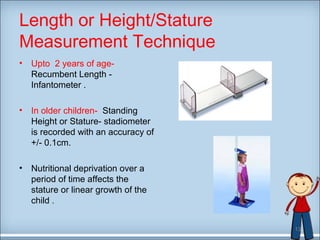
Length or Height/Stature 
Measurement Technique 
• Upto 2 years of age- 
Recumbent Length - 
Infantometer . 
• In older children- Standing 
Height or Stature- stadiometer 
is recorded with an accuracy of 
+/- 0.1cm. 
• Nutritional deprivation over a 
period of time affects the 
stature or linear growth of the 
child . 
13
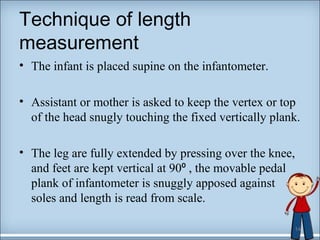
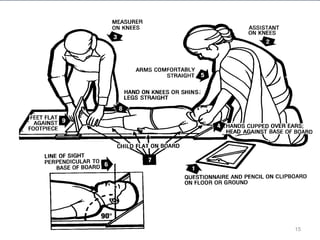
Technique of length 
measurement 
• The infant is placed supine on the infantometer. 
• Assistant or mother is asked to keep the vertex or top 
of the head snugly touching the fixed vertically plank. 
• The leg are fully extended by pressing over the knee, 
and feet are kept vertical at 90⁰ , the movable pedal 
plank of infantometer is snuggly apposed against 
soles and length is read from scale. 
14
15
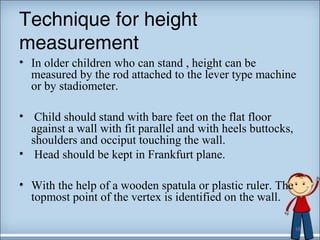
Technique for height 
measurement 
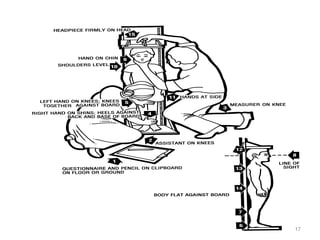
• In older children who can stand , height can be 
measured by the rod attached to the lever type machine 
or by stadiometer. 
• Child should stand with bare feet on the flat floor 
against a wall with fit parallel and with heels buttocks, 
shoulders and occiput touching the wall. 
• Head should be kept in Frankfurt plane. 
• With the help of a wooden spatula or plastic ruler. The 
topmost point of the vertex is identified on the wall. 
16
17
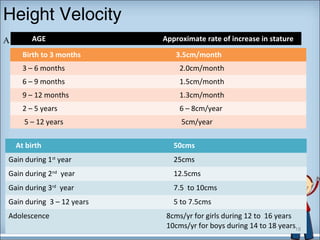
Height Velocity 
A 
AGE Approximate rate of increase in stature 
Birth to 3 months 3.5cm/month 
3 – 6 months 2.0cm/month 
6 – 9 months 1.5cm/month 
9 – 12 months 1.3cm/month 
2 – 5 years 6 – 8cm/year 
5 – 12 years 5cm/year 
At birth 50cms 
Gain during 1st year 25cms 
Gain during 2nd year 12.5cms 
Gain during 3rd year 7.5 to 10cms 
Gain during 3 – 12 years 5 to 7.5cms 
Adolescence 8cms/yr for girls during 12 to 16 years 
10cms/yr for boys during 14 to 18 years 
18
B] Expected height upto 12 yrs 
length or height (in cms) = age in years x 6 +77 ( wheech’s formula ) 
C] ] Prediction of adult height 
• Parental height , Tanner’s formula and Weech’s formula are used. 
19
20
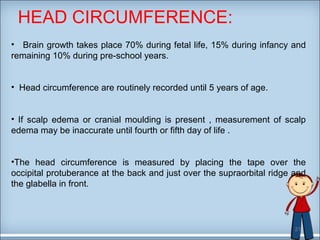
HEAD CIRCUMFERENCE: 
• Brain growth takes place 70% during fetal life, 15% during infancy and 
remaining 10% during pre-school years. 
• Head circumference are routinely recorded until 5 years of age. 
• If scalp edema or cranial moulding is present , measurement of scalp 
edema may be inaccurate until fourth or fifth day of life . 
•The head circumference is measured by placing the tape over the 
occipital protuberance at the back and just over the supraorbital ridge and 
the glabella in front. 
21
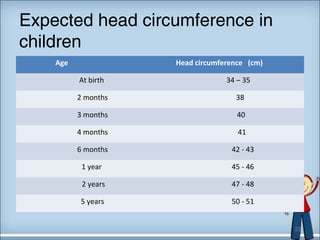
Expected head circumference in 
children 
Age Head circumference (cm) 
At birth 34 – 35 
2 months 38 
3 months 40 
4 months 41 
6 months 42 - 43 
1 year 45 - 46 
2 years 47 - 48 
5 years 50 - 51 
22
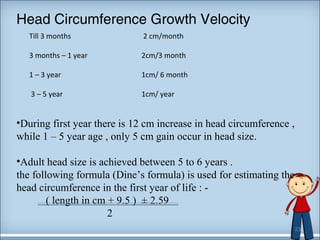
Head Circumference Growth Velocity 
Till 3 months 2 cm/month 
3 months – 1 year 2cm/3 month 
1 – 3 year 1cm/ 6 month 
3 – 5 year 1cm/ year 
•During first year there is 12 cm increase in head circumference , 
while 1 – 5 year age , only 5 cm gain occur in head size. 
•Adult head size is achieved between 5 to 6 years . 
the following formula (Dine’s formula) is used for estimating the 
head circumference in the first year of life : - 
( length in cm + 9.5 ) ± 2.59 
2 
23
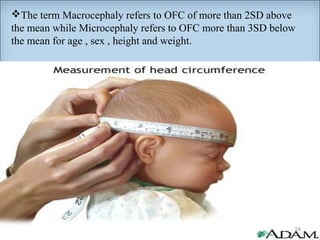
The term Macrocephaly refers to OFC of more than 2SD above 
the mean while Microcephaly refers to OFC more than 3SD below 
the mean for age , sex , height and weight. 
24
Chest circumference 
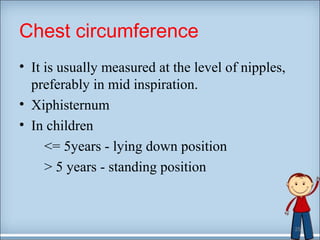
• It is usually measured at the level of nipples, 
preferably in mid inspiration. 
• Xiphisternum 
• In children 
<= 5years - lying down position 
> 5 years - standing position 
25
Relationship between head size 
with Chest Circumference: 
• At birth: head circumference > chest 
circumference by upto 3 cms. 
• At around 9 months to 1 year of age: head 
circumference = chest circumference, 
• but thereafter chest grows more rapidly 
compared to the brain. 
26
• The head circumference is greater than chest 
circumference by more than 3 cms in : 
a) preterms 
b) small-for-date , & 
c) hydrocephalic infants 
• In malnourished children, chest size may be 
significantly smaller than head circumference 
because growth of brain is less affected by 
undernutrition. 
Therefore there will be considerable delay 
before chest circumference overtakes head 
circumference. 
27
AGE INDEPENDENT CRITERIA FOR 
ASSESSMENT OF NUTRITIONAL STATUS 
• Mid-upper arm circumference 
• Thickness of subcutaneous fat 
• Body ratios 
• Weight for height 
• Body mass index 
• Upper segment/ lower segment ratio 
• Arm span 
• Obesity 
28
29
MID-UPPER ARM 
CIRCUMFERENCE 
• During 1-5 Yrs of age it remains reasonably static between 15-17cms 
among healthy children . 
• It is conventionally measured over the left upper arm , at a point marked 
midway between acromion (shoulder) and olecranon (elbow) with arm 
bent at right angle. 
• The child is asked to stand or sit with the arm hanging loose at the side. 
• MUAC is measured with a fiber glass or steel tape. 
• If it is less than 12.5 cm it is suggestive of severe malnutrition. 
• If it is between 12.5 -13.5 cm it is indicative of moderate malnutrition. 
30
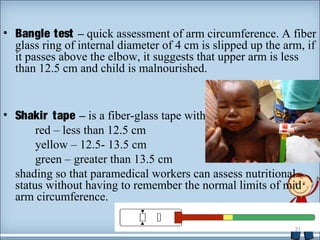
• Bangle test – quick assessment of arm circumference. A fiber 
glass ring of internal diameter of 4 cm is slipped up the arm, if 
it passes above the elbow, it suggests that upper arm is less 
than 12.5 cm and child is malnourished. 
• Shakir tape – is a fiber-glass tape with 
red – less than 12.5 cm 
yellow – 12.5- 13.5 cm 
green – greater than 13.5 cm 
shading so that paramedical workers can assess nutritional 
status without having to remember the normal limits of mid 
arm circumference. 
31
• QUAC stick – Quaker Upper Arm Circumference Stick 
It is developed on the principle that acute starvation severely affects 
mid-arm circumference while height is unaffected. 
• It is a height measuring rod, calibrated in MAC. 
• Values of 80% MAC for Ht. are marked on stick at corresponding ht. 
levels 
• The malnourished child would be taller than the anticipated height 
derived from the mid-arm circumference 
MAC (cm) Ht. (cm) 
16.5 133.0 
13.5 103.5 
12.5 70.0 
32
33
Skinfold thickness 
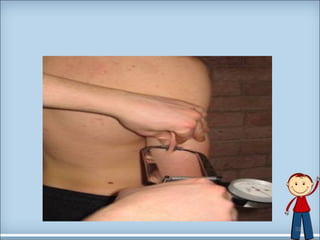
• Measured with Herpenden’s caliper 
• Triceps or subscapular region 
• The skinfold with subcutaneous fat is picked up with 
thumb and index finger, and caliper is applied beyond 
the pinch. 
• Fat thickness 
>10mm - healthy children 1-6 years 
<6mm - is indicative of moderate to 
severe degree of malnutrition 
34
35
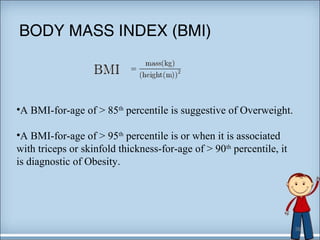
BODY MASS INDEX (BMI) 
•A BMI-for-age of > 85th percentile is suggestive of Overweight. 
•A BMI-for-age of > 95th percentile is or when it is associated 
with triceps or skinfold thickness-for-age of > 90th percentile, it 
is diagnostic of Obesity. 
36
Body ratios 
• Rao & Singh’s weight-height index: 
= [weight (kg) / (height)2 cms ] * 100 
normal index is more than 0.15 
• Kanawati index: (during 3m to 4 years) 
= Mid-arm circumference / Head circumference 
Normal 0.331 
Mild 0.310 – 0.280 
Modreate 0.279 – 0.250 
Severe < 0.250 
37
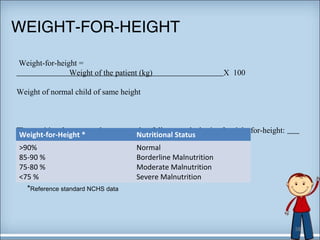
WEIGHT-FOR-HEIGHT 
Weight-for-height = 
Weight of the patient (kg) X 100 
Weight of normal child of same height 
The Weight-nutritional for-Height status * can be expressed Nutritional as follows Status 
on the basis of weight-for-height: 
>90% 
Normal 
85-90 % 
Borderline Malnutrition 
75-80 % 
Moderate Malnutrition 
<75 % 
Severe Malnutrition 
*Reference standard NCHS data 
38
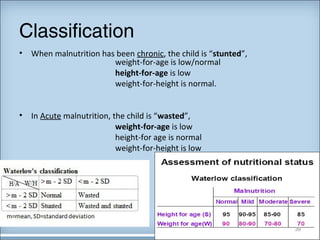
Classification 
• When malnutrition has been chronic, the child is “stunted”, 
weight-for-age is low/normal 
height-for-age is low 
weight-for-height is normal. 
• In Acute malnutrition, the child is “wasted”, 
weight-for-age is low 
height-for age is normal 
weight-for-height is low 
39
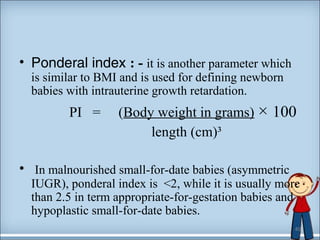
• Ponderal index : - it is another parameter which 
is similar to BMI and is used for defining newborn 
babies with intrauterine growth retardation. 
PI = (Body weight in grams) × 100 
length (cm)³ 
• In malnourished small-for-date babies (asymmetric 
IUGR), ponderal index is <2, while it is usually more 
than 2.5 in term appropriate-for-gestation babies and 
hypoplastic small-for-date babies. 
40
PROPORTIONAL TRUNK AND 
LIMB GROWTH 
•The mid-point of the body in newborn is at umbilicus whereas in an 
adult the mid-point shifts to the symphysis pubis due to greater 
growth of limbs than trunk. 
•The UPPER SEGMENT (vertex to upper edge of symphysis pubis) 
to LOWER SEGMENT (symphysis pubis to heels) ratio at birth is 
1.7 to 1.0 . 
•This gradually becomes 1.0 to 1.1 in healthy adults. 
• In infants upper segment (crown to symphysis pubis) can be 
measured by using infantometer. 
• The lower segment is obtained by subtracting the upper segment 
from total length. 
41
42
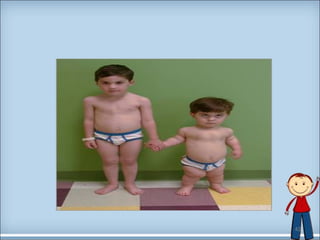
• Infantile upper segment to lower segment ratio 
(trunk abnormally large or limbs abnormally 
small) is seen in : 
1. Achondroplasia 
2. Cretinism 
3. Short limbed dwarfism 
4. Sexual precocity 
5. Bowed legs 
43
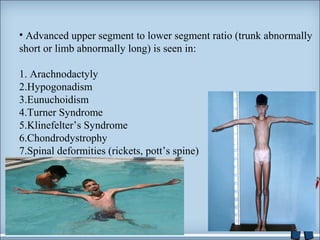
• Advanced upper segment to lower segment ratio (trunk abnormally 
short or limb abnormally long) is seen in: 
1. Arachnodactyly 
2.Hypogonadism 
3.Eunuchoidism 
4.Turner Syndrome 
5.Klinefelter’s Syndrome 
6.Chondrodystrophy 
7.Spinal deformities (rickets, pott’s spine) 
44
45
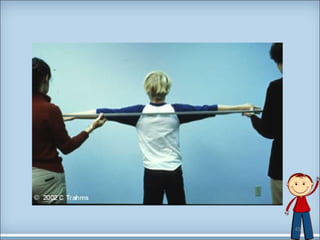
ARM SPAN 
•It is the distance between the tips of middle fingers of both arms outstretched at 
right angles to the body, measured across the back of the child. 
•In under-5 children , arm span is 1 to 2 cm smaller than body length. 
•During 10-12 years of age , arm span = height. 
•In adults arm span is more in adults by 2 cm. 
09/18/14 46
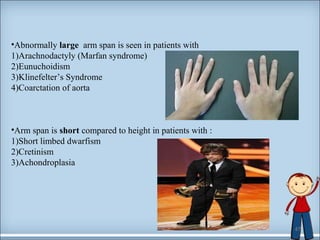
•Abnormally large arm span is seen in patients with 
1)Arachnodactyly (Marfan syndrome) 
2)Eunuchoidism 
3)Klinefelter’s Syndrome 
4)Coarctation of aorta 
•Arm span is short compared to height in patients with : 
1)Short limbed dwarfism 
2)Cretinism 
3)Achondroplasia 
47
ADVANTAGES OF 
ANTHROPOMETRY 
• Less expensive & need minimal training 
• Readings are reproducible. 
• Objective with high specificity & sensitivity 
• Measures many variables of nutritional significance 
(Ht, Wt, MAC, HC, skin fold thickness, waist & hip 
ratio & BMI). 
• Readings are numerical & gradable on standard 
growth charts
Conclusion 
• Advantages of anthropometry 
Simple, safe, cheap, non-invasive, portable 
requires minimal training 
• Limitations of anthropometry 
Cannot identify specific deficiencies, fairly slow to 
respond to recent changes in nutritional status
Limitations of Anthropometry 
Inter-observers errors in measurement 
Limited nutritional diagnosis 
Problems with reference standards, i.e. local 
versus international standards. 
Arbitrary statistical cut-off levels for what 
considered as abnormal values. 
50
Conclusion 
USE OF ANTHROPOEMETRY 
• Identify individuals & populations with normal & 
abnormal 
nutritional status 
• Predict who will benefit from interventions 
• Identify social & economic inequity 
• Evaluate response to interventions.
Thank you 
52

Anthrapometry

  • 1.
  • 2.
  • 3.
    Anthropometry: Introduction •Anthropos - "man" • Metron "measurement” •A branch of anthropology that involves the quantitative measurement of the human body. 3
  • 4.
    ANTHROPOMETRY-significance • Itis used to evaluate both under & over nutrition. • The measured values reflects the current nutritional status & don’t differentiate between acute & chronic changes • It is the single most portable, universally applicable, inexpensive and non-invasive technique for assessing the size, proportions and composition of the human body. 4
  • 5.
    Parameters of anthropometry Age dependent factors:- a) Weight b) Height c) Head circumference d) Chest circumference Age independent factors:- a)Mid-arm circumference (1-5 years) b) Weight for height c) Skinfold thickness d) Mid upper arm/height ratio 5
  • 6.
  • 7.
    Weight • mostreliable criteria of assessment of nutritiom • periodic recording wil help to detect malnutrition in under 5 at early age.  Beam type weighing balance  Electronic weighing scales for infants and children  Bathroom type (very unreliable)  Salter spring machine (in field conditions) 7
  • 8.
  • 9.
    •Growth Velocity : A.0-4 months 1.0kg/month(30g/day) 5-8 months 0.75kg/month(20gm/day) 9-12 months 0.50kg/month(15g/day) 1-3 years 2.25kg/yr 4-9 years 2.75 kg/yr 10-18 years 5.0-6.0kg/yr (0.5kg/month) B. Weight at 4-5 months 2 x birth weight Weight at 1 year 3 x birth weight Weight at 2 years 4 x birth weight Weight at 7 years 7 x birth weight 9
  • 10.
    WEECH’S FORMULA a)3 – 12 months Expected weight(kg) = age (months) + 9 / 2 b) 1- 6 years Expected weight(kg) = age (years) x 2 + 8 c) 7 – 12 years Expected weight(kg) = age (years) x 7 - 5 / 2 10
  • 11.
    Classification of Malnutritionby Indian Academy of Pediatrics Weight for age * Grade of malnutrition >80 % Normal 71-80% Grade 1 (Mild) 61-70% Grade 2 (Moderate) 51-60% Grade 3 (Severe) <50% Grade 4 (very severe) 11
  • 12.
  • 13.
    Length or Height/Stature Measurement Technique • Upto 2 years of age- Recumbent Length - Infantometer . • In older children- Standing Height or Stature- stadiometer is recorded with an accuracy of +/- 0.1cm. • Nutritional deprivation over a period of time affects the stature or linear growth of the child . 13
  • 14.
    Technique of length measurement • The infant is placed supine on the infantometer. • Assistant or mother is asked to keep the vertex or top of the head snugly touching the fixed vertically plank. • The leg are fully extended by pressing over the knee, and feet are kept vertical at 90⁰ , the movable pedal plank of infantometer is snuggly apposed against soles and length is read from scale. 14
  • 15.
  • 16.
    Technique for height measurement • In older children who can stand , height can be measured by the rod attached to the lever type machine or by stadiometer. • Child should stand with bare feet on the flat floor against a wall with fit parallel and with heels buttocks, shoulders and occiput touching the wall. • Head should be kept in Frankfurt plane. • With the help of a wooden spatula or plastic ruler. The topmost point of the vertex is identified on the wall. 16
  • 17.
  • 18.
    Height Velocity A AGE Approximate rate of increase in stature Birth to 3 months 3.5cm/month 3 – 6 months 2.0cm/month 6 – 9 months 1.5cm/month 9 – 12 months 1.3cm/month 2 – 5 years 6 – 8cm/year 5 – 12 years 5cm/year At birth 50cms Gain during 1st year 25cms Gain during 2nd year 12.5cms Gain during 3rd year 7.5 to 10cms Gain during 3 – 12 years 5 to 7.5cms Adolescence 8cms/yr for girls during 12 to 16 years 10cms/yr for boys during 14 to 18 years 18
  • 19.
    B] Expected heightupto 12 yrs length or height (in cms) = age in years x 6 +77 ( wheech’s formula ) C] ] Prediction of adult height • Parental height , Tanner’s formula and Weech’s formula are used. 19
  • 20.
  • 21.
    HEAD CIRCUMFERENCE: •Brain growth takes place 70% during fetal life, 15% during infancy and remaining 10% during pre-school years. • Head circumference are routinely recorded until 5 years of age. • If scalp edema or cranial moulding is present , measurement of scalp edema may be inaccurate until fourth or fifth day of life . •The head circumference is measured by placing the tape over the occipital protuberance at the back and just over the supraorbital ridge and the glabella in front. 21
  • 22.
    Expected head circumferencein children Age Head circumference (cm) At birth 34 – 35 2 months 38 3 months 40 4 months 41 6 months 42 - 43 1 year 45 - 46 2 years 47 - 48 5 years 50 - 51 22
  • 23.
    Head Circumference GrowthVelocity Till 3 months 2 cm/month 3 months – 1 year 2cm/3 month 1 – 3 year 1cm/ 6 month 3 – 5 year 1cm/ year •During first year there is 12 cm increase in head circumference , while 1 – 5 year age , only 5 cm gain occur in head size. •Adult head size is achieved between 5 to 6 years . the following formula (Dine’s formula) is used for estimating the head circumference in the first year of life : - ( length in cm + 9.5 ) ± 2.59 2 23
  • 24.
    The term Macrocephalyrefers to OFC of more than 2SD above the mean while Microcephaly refers to OFC more than 3SD below the mean for age , sex , height and weight. 24
  • 25.
    Chest circumference •It is usually measured at the level of nipples, preferably in mid inspiration. • Xiphisternum • In children <= 5years - lying down position > 5 years - standing position 25
  • 26.
    Relationship between headsize with Chest Circumference: • At birth: head circumference > chest circumference by upto 3 cms. • At around 9 months to 1 year of age: head circumference = chest circumference, • but thereafter chest grows more rapidly compared to the brain. 26
  • 27.
    • The headcircumference is greater than chest circumference by more than 3 cms in : a) preterms b) small-for-date , & c) hydrocephalic infants • In malnourished children, chest size may be significantly smaller than head circumference because growth of brain is less affected by undernutrition. Therefore there will be considerable delay before chest circumference overtakes head circumference. 27
  • 28.
    AGE INDEPENDENT CRITERIAFOR ASSESSMENT OF NUTRITIONAL STATUS • Mid-upper arm circumference • Thickness of subcutaneous fat • Body ratios • Weight for height • Body mass index • Upper segment/ lower segment ratio • Arm span • Obesity 28
  • 29.
  • 30.
    MID-UPPER ARM CIRCUMFERENCE • During 1-5 Yrs of age it remains reasonably static between 15-17cms among healthy children . • It is conventionally measured over the left upper arm , at a point marked midway between acromion (shoulder) and olecranon (elbow) with arm bent at right angle. • The child is asked to stand or sit with the arm hanging loose at the side. • MUAC is measured with a fiber glass or steel tape. • If it is less than 12.5 cm it is suggestive of severe malnutrition. • If it is between 12.5 -13.5 cm it is indicative of moderate malnutrition. 30
  • 31.
    • Bangle test– quick assessment of arm circumference. A fiber glass ring of internal diameter of 4 cm is slipped up the arm, if it passes above the elbow, it suggests that upper arm is less than 12.5 cm and child is malnourished. • Shakir tape – is a fiber-glass tape with red – less than 12.5 cm yellow – 12.5- 13.5 cm green – greater than 13.5 cm shading so that paramedical workers can assess nutritional status without having to remember the normal limits of mid arm circumference. 31
  • 32.
    • QUAC stick– Quaker Upper Arm Circumference Stick It is developed on the principle that acute starvation severely affects mid-arm circumference while height is unaffected. • It is a height measuring rod, calibrated in MAC. • Values of 80% MAC for Ht. are marked on stick at corresponding ht. levels • The malnourished child would be taller than the anticipated height derived from the mid-arm circumference MAC (cm) Ht. (cm) 16.5 133.0 13.5 103.5 12.5 70.0 32
  • 33.
  • 34.
    Skinfold thickness •Measured with Herpenden’s caliper • Triceps or subscapular region • The skinfold with subcutaneous fat is picked up with thumb and index finger, and caliper is applied beyond the pinch. • Fat thickness >10mm - healthy children 1-6 years <6mm - is indicative of moderate to severe degree of malnutrition 34
  • 35.
  • 36.
    BODY MASS INDEX(BMI) •A BMI-for-age of > 85th percentile is suggestive of Overweight. •A BMI-for-age of > 95th percentile is or when it is associated with triceps or skinfold thickness-for-age of > 90th percentile, it is diagnostic of Obesity. 36
  • 37.
    Body ratios •Rao & Singh’s weight-height index: = [weight (kg) / (height)2 cms ] * 100 normal index is more than 0.15 • Kanawati index: (during 3m to 4 years) = Mid-arm circumference / Head circumference Normal 0.331 Mild 0.310 – 0.280 Modreate 0.279 – 0.250 Severe < 0.250 37
  • 38.
    WEIGHT-FOR-HEIGHT Weight-for-height = Weight of the patient (kg) X 100 Weight of normal child of same height The Weight-nutritional for-Height status * can be expressed Nutritional as follows Status on the basis of weight-for-height: >90% Normal 85-90 % Borderline Malnutrition 75-80 % Moderate Malnutrition <75 % Severe Malnutrition *Reference standard NCHS data 38
  • 39.
    Classification • Whenmalnutrition has been chronic, the child is “stunted”, weight-for-age is low/normal height-for-age is low weight-for-height is normal. • In Acute malnutrition, the child is “wasted”, weight-for-age is low height-for age is normal weight-for-height is low 39
  • 40.
    • Ponderal index: - it is another parameter which is similar to BMI and is used for defining newborn babies with intrauterine growth retardation. PI = (Body weight in grams) × 100 length (cm)³ • In malnourished small-for-date babies (asymmetric IUGR), ponderal index is <2, while it is usually more than 2.5 in term appropriate-for-gestation babies and hypoplastic small-for-date babies. 40
  • 41.
    PROPORTIONAL TRUNK AND LIMB GROWTH •The mid-point of the body in newborn is at umbilicus whereas in an adult the mid-point shifts to the symphysis pubis due to greater growth of limbs than trunk. •The UPPER SEGMENT (vertex to upper edge of symphysis pubis) to LOWER SEGMENT (symphysis pubis to heels) ratio at birth is 1.7 to 1.0 . •This gradually becomes 1.0 to 1.1 in healthy adults. • In infants upper segment (crown to symphysis pubis) can be measured by using infantometer. • The lower segment is obtained by subtracting the upper segment from total length. 41
  • 42.
  • 43.
    • Infantile uppersegment to lower segment ratio (trunk abnormally large or limbs abnormally small) is seen in : 1. Achondroplasia 2. Cretinism 3. Short limbed dwarfism 4. Sexual precocity 5. Bowed legs 43
  • 44.
    • Advanced uppersegment to lower segment ratio (trunk abnormally short or limb abnormally long) is seen in: 1. Arachnodactyly 2.Hypogonadism 3.Eunuchoidism 4.Turner Syndrome 5.Klinefelter’s Syndrome 6.Chondrodystrophy 7.Spinal deformities (rickets, pott’s spine) 44
  • 45.
  • 46.
    ARM SPAN •Itis the distance between the tips of middle fingers of both arms outstretched at right angles to the body, measured across the back of the child. •In under-5 children , arm span is 1 to 2 cm smaller than body length. •During 10-12 years of age , arm span = height. •In adults arm span is more in adults by 2 cm. 09/18/14 46
  • 47.
    •Abnormally large armspan is seen in patients with 1)Arachnodactyly (Marfan syndrome) 2)Eunuchoidism 3)Klinefelter’s Syndrome 4)Coarctation of aorta •Arm span is short compared to height in patients with : 1)Short limbed dwarfism 2)Cretinism 3)Achondroplasia 47
  • 48.
    ADVANTAGES OF ANTHROPOMETRY • Less expensive & need minimal training • Readings are reproducible. • Objective with high specificity & sensitivity • Measures many variables of nutritional significance (Ht, Wt, MAC, HC, skin fold thickness, waist & hip ratio & BMI). • Readings are numerical & gradable on standard growth charts
  • 49.
    Conclusion • Advantagesof anthropometry Simple, safe, cheap, non-invasive, portable requires minimal training • Limitations of anthropometry Cannot identify specific deficiencies, fairly slow to respond to recent changes in nutritional status
  • 50.
    Limitations of Anthropometry Inter-observers errors in measurement Limited nutritional diagnosis Problems with reference standards, i.e. local versus international standards. Arbitrary statistical cut-off levels for what considered as abnormal values. 50
  • 51.
    Conclusion USE OFANTHROPOEMETRY • Identify individuals & populations with normal & abnormal nutritional status • Predict who will benefit from interventions • Identify social & economic inequity • Evaluate response to interventions.
  • 52.

Editor's Notes

  • #8 M onitoring the weight is helpful in diagnosing malnutrition at early stage
  • #11 Used to calculate expected weight between the ages of 3 months and 12 years
  • #14 Tragion- an anthropometric point situated in the notch just above the tragus of the ear.