Top School in Noida 
BY: 
SCHOOL.EDHOLE.COM
Comp 122, Spring 2004 
Order Statistics 
school.edhole.com
Order Statistic 
ith order statistic: ith smallest element of a set of n 
elements. 
Minimum: first order statistic. 
Maximum: nth order statistic. 
Median: “half-way point” of the set. 
 Unique, when n is odd – occurs at i = (n+1)/2. 
 Two medians when n is even. 
 Lower median, at i = n/2. 
 Upper median, at i = n/2+1. 
 For consistency, “median” will refer to the lower median. 
school.edhole.com 
Comp 122
Selection Problem 
Selection problem: 
 Input: A set A of n distinct numbers and a number i, with 1£ 
i £ n. 
 Output: the element x Î A that is larger than exactly i – 1 
other elements of A. 
Can be solved in O(n lg n) time. How? 
We will study faster linear-time algorithms. 
 For the special cases when i = 1 and i = n. 
 For the general problem. 
school.edhole.com 
Comp 122
Minimum (Maximum) 
Comp 122 
Minimum (A) 
1. min ¬ A[1] 
2. for i ¬ 2 to length[A] 
3. do if min > A[i] 
4. then min ¬ A[i] 
5. return min 
Minimum (A) 
1. min ¬ A[1] 
2. for i ¬ 2 to length[A] 
3. do if min > A[i] 
4. then min ¬ A[i] 
5. return min 
Maximum can be determined similarly. 
• T(n) = Q(n). 
• No. of comparisons: n – 1. 
• Can we do better? Why not? 
• Minimum(A) has worst-school.edhole.com case optimal # of comparisons.
Problem 
Average for random input: 
Minimum (A) 
1. min ¬ A[1] 
2. for i ¬ 2 to length[A] 
3. do if min > A[i] 
4. then min ¬ A[i] 
5. return min 
How many times 
do we expect line 4 
to be executed? 
 X = RV for # of executions of line 4. 
 Xi = Indicator RV for the event that line 4 is executed on the ith 
iteration. 
 X = Si=2..n Xi 
 E[Xi] = 1/i. How? 
 Hence, E[X] = ln(n) – 1 = Q(lg n). 
Comp 122 
Minimum (A) 
1. min ¬ A[1] 
2. for i ¬ 2 to length[A] 
3. do if min > A[i] 
4. then min ¬ A[i] 
5. return min 
school.edhole.com
Simultaneous Minimum and Maximum 
Some applications need to determine both the 
maximum and minimum of a set of elements. 
 Example: Graphics program trying to fit a set of points onto a 
rectangular display. 
Independent determination of maximum and 
minimum requires 2n – 2 comparisons. 
Can we reduce this number? 
 Yes. 
school.edhole.com 
Comp 122
Simultaneous Minimum and Maximum 
Maintain minimum and maximum elements seen 
so far. 
Process elements in pairs. 
 Compare the smaller to the current minimum and the 
larger to the current maximum. 
 Update current minimum and maximum based on the 
outcomes. 
No. of comparisons per pair = 3. How? 
No. of pairs £ ën/2û. 
 For odd n: initialize min and max to A[1]. Pair the 
remaining elements. So, no. of pairs = ën/2û. 
 For even n: initialize min to the smaller of the first pair 
and max to the larger. So, remaining no. of pairs = (n – 
2)/2 < ën/2û. 
school.edhole.com 
Comp 122
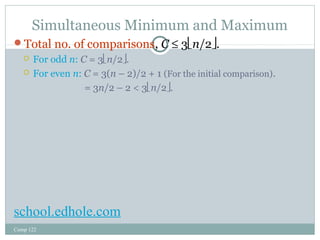
Simultaneous Minimum and Maximum 
Total no. of comparisons, C £ 3ën/2û. 
 For odd n: C = 3ën/2û. 
 For even n: C = 3(n – 2)/2 + 1 (For the initial comparison). 
Comp 122 
= 3n/2 – 2 < 3ën/2û. 
school.edhole.com
General Selection Problem 
Seems more difficult than Minimum or Maximum. 
 Yet, has solutions with same asymptotic complexity as 
Minimum and Maximum. 
We will study 2 algorithms for the general problem. 
 One with expected linear-time complexity. 
 A second, whose worst-case complexity is linear. 
school.edhole.com 
Comp 122
Selection in Expected Linear Time 
Modeled after randomized quicksort. 
Exploits the abilities of Randomized-Partition (RP). 
 RP returns the index k in the sorted order of a randomly 
chosen element (pivot). 
 If the order statistic we are interested in, i, equals k, then we are 
done. 
 Else, reduce the problem size using its other ability. 
 RP rearranges the other elements around the random 
pivot. 
 If i < k, selection can be narrowed down to A[1..k – 1]. 
 Else, select the (i – k)th element from A[k+1..n]. 
(Assuming RP operates on A[1..n]. For A[p..r], change k 
schooaplp.erodphriaotelely..)com 
Comp 122
Randomized Quicksort: review 
Partition 5 
school.edhole.com 
Comp 122 
Quicksort(A, p, r) 
Quicksort(A, p, r) 
if p < r then 
if p < r then 
q := Rnd-Partition(A, p, r); 
Quicksort(A, p, q – 1); 
Quicksort(A, q + 1, r) 
fi 
q := Rnd-Partition(A, p, r); 
Quicksort(A, p, q – 1); 
Quicksort(A, q + 1, r) 
fi 
Rnd-Partition(A, p, r) 
i := Random(p, r); 
A[r] « A[i]; 
x, i := A[r], p – 1; 
for j := p to r – 1 do 
i := Random(p, r); 
A[r] « A[i]; 
x, i := A[r], p – 1; 
for j := p to r – 1 do 
if A[j] £ x then 
if A[j] £ x then 
i := i + 1; 
A[i] « A[j] 
i := i + 1; 
A[i] « A[j] 
fi 
fi 
od; 
A[i + 1] « A[r]; 
return i + 1 
od; 
A[i + 1] « A[r]; 
return i + 1 
5 
A[p..r] 
A[p..q – 1] A[q+1..r] 
£ 5 ³ 5
Randomized-Select 
Randomized-Select(A, p, r, i) // select ith order statistic. 
1. if p = r 
2. then return A[p] 
3. q ¬ Randomized-Partition(A, p, r) 
4. k ¬ q – p + 1 
5. if i = k 
6. then return A[q] 
7. elseif i < k 
8. then return Randomized-Select(A, p, q – 1, i) 
9. else return Randomized-Select(A, q+1, r, i – k) 
Randomized-Select(A, p, r, i) // select ith order statistic. 
1. if p = r 
2. then return A[p] 
3. q ¬ Randomized-Partition(A, p, r) 
4. k ¬ q – p + 1 
5. if i = k 
6. then return A[q] 
7. elseif i < k 
8. then return Randomized-Select(A, p, q – 1, i) 
9. else return Randomized-Select(A, q+1, r, i – k) 
Comp 122
Analysis 
Worst-case Complexity: 
 Q(n2) – As we could get unlucky and always recurse on a 
subarray that is only one element smaller than the previous 
subarray. 
Average-case Complexity: 
 Q(n) – Intuition: Because the pivot is chosen at random, we 
expect that we get rid of half of the list each time we choose a 
random pivot q. 
 Why Q(n) and not Q(n lg n)? 
school.edhole.com 
Comp 122
Average-case Analysis 
Define Indicator RV’s Xk, for 1 £ k £ n. 
 Xk = I{subarray A[p…q] has exactly k elements}. 
 Pr{subarray A[p…q] has exactly k elements} = 1/n for all k = 1..n. 
 Hence, E[Xk] = 1/n. 
Let T(n) be the RV for the time required by 
Randomized-Select (RS) on A[p…q] of n elements. 
Determine an upper bound on E[T(n)]. 
Comp 122 
(9.1) 
school.edhole.com
Average-case Analysis 
A call to RS may 
 Terminate immediately with the correct answer, 
 Recurse on A[p..q – 1], or 
 Recurse on A[q+1..r]. 
To obtain an upper bound, assume that the ith 
smallest element that we want is always in the larger 
subarray. 
RP takes O(n) time on a problem of size n. 
Hence, recurrence for T(n) is: 
 
n 
T n Xk T k n k O n 
( ) ( (max( 1, )) ( )) 
For a given call of RS, Xk =1 for exactly one value of 
k, and Xk = 0 for all other k. 
Comp 122 
å= 
£ × - - + 
k 
1 
school.edhole.com
Average-case Analysis 
å 
T n £ X × T k - n - k + 
O n 
( ) ( (max( 1, )) ( )) 
X T k n k O n 
= × - - + 
(max( 1, )) ( ) 
= 
1 
Taking expectation, we have 
£ é × - - + 
E T n E X T k n k O n 
[ ( )] (max( 1, )) ( ) 
Comp 122 
E X T k n k O n 
= × - - + 
ù 
[ (max( 1, ))] ( ) 
E X E T k n k O n 
= × - - + 
[ ] [ (max( 1, ))] ( ) 
1 [ (max( 1, ))] ( ) 
å 
= 
1 
å 
= 
1 
1 
1 
1 
å 
å 
å 
= 
= 
= 
= × - - + 
úû 
êë 
n 
k 
n 
k 
k 
n 
k 
k 
n 
k 
k 
n 
k 
k 
n 
k 
k 
E T k n k O n 
n 
(by linearity of expectation) 
(by Eq. (C.23)) 
school.edhole.com (by Eq. (9.1))
Average-case Analysis (Contd.) 
Comp 122 
k k n 
1 if / 2 
é ù 
é ù 
- > 
if / 2 
The summation is expanded 
E T n E T n E T n n 
n 
- + - + + - + 
1 ( ( 1)) ( ( 2)) ( ( / 2 )) [ ( )] ( ) 
é ù 
ö 
é ù ÷ ÷ø 
æ 
ç çè 
+ + - 
£ + 
î í ì 
- £ 
- - = 
( ( / 2 )) ( ( 1)) 
max( 1, ) 
E T n E T n 
E T n O n 
n k k n 
k n k 
 
 
• If n is odd, T(n – 1) thru T(én/2ù) occur twice and T(ën/2û) occurs once. 
• If n is even, T(n – 1) thru T(én/2ù) occur twice. 
[ ( )] 2 [ ( )] ( ). 
å- 
£ + 
ë û 
= 
1 
/ 2 
Thus, we have 
n 
k n 
E T k O n 
n 
E T n
Average-case Analysis (Contd.) 
We solve the recurrence by substitution. 
Guess E[T(n)] = O(n). 
[ ( )] 2 
Comp 122 
å 
ck an 
£ + 
ë û 
ë û 
n 
c 
n 
æ 
æ 
- 
1 
å å 
k k an 
1 
n n an 
c 
n 
3 
c n 
1 
3 
= æ + - 
ö n 
çè 
cn c an 
£ + + 
+ ÷ø 
ö 
an 
4 2 
ö çè 
÷ø 
= - æ - - 
+ ÷ ÷ø ö 
ç çè 
£ + - 
+ ÷ ÷ø 
ç çè 
= - 
= 
- 
= 
- 
= 
cn cn c an 
E T n 
n 
k 
n 
k 
n 
k n 
4 2 
3 
2 
2 
4 
2 
4 2 
2 
2 
/ 2 1 
1 
1 
/ 2 
cn cn c an cn 
ö çè 
cn c an 
Þ - - ³ 
n c a c 
Þ - ³ 
( / 4 ) / 2, or 
c 
, if 4 . 
4 
2 
/ 2 
n c 
/ 4 
0 
4 2 
, 
4 2 
c a 
c a 
c a 
> 
- 
= 
- 
³ 
£ ÷ø 
- æ - - 
Thus, if we assume T(n) = O(1) for 
n < 2c/(c – 4a), we have E[T(n)] = 
school.edhole.com O(n).
Selection in Worst-Case Linear Time 
Algorithm Select: 
 Like RandomizedSelect, finds the desired element by 
recursively partitioning the input array. 
 Unlike RandomizedSelect, is deterministic. 
 Uses a variant of the deterministic Partition routine. 
 Partition is told which element to use as the pivot. 
 Achieves linear-time complexity in the worst case by 
 Guaranteeing that the split is always “good” at each Partition. 
 How can a good split be guaranteed? 
school.edhole.com 
Comp 122
Guaranteeing a Good Split 
We will have a good split if we can ensure that the 
pivot is the median element or an element close to the 
median. 
Hence, determining a reasonable pivot is the first 
step. 
school.edhole.com 
Comp 122
Choosing a Pivot 
Median-of-Medians: 
 Divide the n elements into én/5ù groups. 
 ë n/5û groups contain 5 elements each. 1 group contains n mod 5 
< 5 elements. 
 Determine the median of each of the groups. 
Comp 122 
 Sort each group using Insertion Sort. Pick the median from the 
sorted list of group elements. 
 Recursively find the median x of the én/5ù medians. 
Recurrence for running time (of median-of-medians): 
 T(n) = O(n) + T(én/5ù) + …. 
school.edhole.com
Algorithm Select 
Determine the median-of-medians x (using the 
procedure on the previous slide.) 
Partition the input array around x using the variant 
of Partition. 
Let k be the index of x that Partition returns. 
If k = i, then return x. 
Else if i < k, then apply Select recursively to A[1..k–1] 
to find the ith smallest element. 
Else if i > k, then apply Select recursively to 
A[k+1..n] to find the (i – k)th smallest element. 
(Assumption: Select operates on A[1..n]. For subarrays A[p..r], 
sscuhitoaoblly.e cdhhanoglee .kc. o)m 
Comp 122
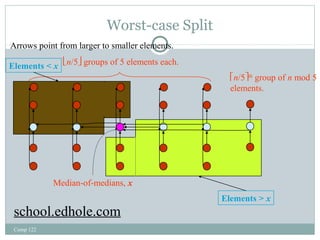
Worst-case Split 
Comp 122 
ën/5û groups of 5 elements each. 
Median-of-medians, x 
én/5ùth group of n mod 5 
elements. 
Arrows point from larger to smaller elements. 
Elements > x 
Elements < x 
school.edhole.com
Worst-case Split 
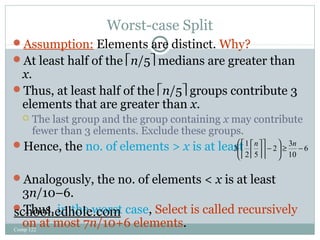
Assumption: Elements are distinct. Why? 
At least half of the én/5ù medians are greater than 
x. 
Thus, at least half of the én/5ù groups contribute 3 
elements that are greater than x. 
 The last group and the group containing x may contribute 
fewer than 3 elements. Exclude these groups. 
Hence, the no. of elements > x is at least 
én n 
úú 
æ - ö çè 
3 é 
1 ù 
2 ÷ø 
³ 3 
- Analogously, the no. of elements < x is at least 
3n/10–6. 
Thus, in the worst case, Select is called recursively 
on at most 7n/10+6 elements. 
Comp 122 
6 
10 
2 5 
ù 
êê 
úú 
êê 
school.edhole.com
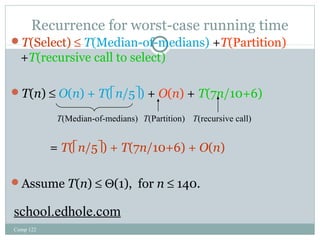
Recurrence for worst-case running time 
T(Select) £ T(Median-of-medians) +T(Partition) 
+T(recursive call to select) 
T(n) £ O(n) + T(én/5ù) + O(n) + T(7n/10+6) 
Comp 122 
T(Median-of-medians) T(Partition) T(recursive call) 
= T(én/5ù) + T(7n/10+6) + O(n) 
Assume T(n) £ Q(1), for n £ 140. 
school.edhole.com
Solving the recurrence 
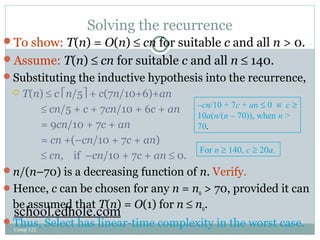
To show: T(n) = O(n) £ cn for suitable c and all n > 0. 
Assume: T(n) £ cn for suitable c and all n £ 140. 
Substituting the inductive hypothesis into the recurrence, 
 T(n) £ c én/5ù + c(7n/10+6)+an 
Comp 122 
£ cn/5 + c + 7cn/10 + 6c + an 
= 9cn/10 + 7c + an 
= cn +(–cn/10 + 7c + an) 
£ cn, if –cn/10 + 7c + an £ 0. 
–cn/10 + 7c + an £ 0 º c ³ 
10a(n/(n – 70)), when n > 
70. 
For n ³ 140, c ³ 20a. 
n/(n–70) is a decreasing function of n. Verify. 
Hence, c can be chosen for any n = n> 70, provided it can 
0 be school.assumed edhole.that com 
T(n) = O(1) for n £ n. 
0Thus, Select has linear-time complexity in the worst case.

Top school in noida

  • 1.
    Top School inNoida BY: SCHOOL.EDHOLE.COM
  • 2.
    Comp 122, Spring2004 Order Statistics school.edhole.com
  • 3.
    Order Statistic ithorder statistic: ith smallest element of a set of n elements. Minimum: first order statistic. Maximum: nth order statistic. Median: “half-way point” of the set.  Unique, when n is odd – occurs at i = (n+1)/2.  Two medians when n is even.  Lower median, at i = n/2.  Upper median, at i = n/2+1.  For consistency, “median” will refer to the lower median. school.edhole.com Comp 122
  • 4.
    Selection Problem Selectionproblem:  Input: A set A of n distinct numbers and a number i, with 1£ i £ n.  Output: the element x Î A that is larger than exactly i – 1 other elements of A. Can be solved in O(n lg n) time. How? We will study faster linear-time algorithms.  For the special cases when i = 1 and i = n.  For the general problem. school.edhole.com Comp 122
  • 5.
    Minimum (Maximum) Comp122 Minimum (A) 1. min ¬ A[1] 2. for i ¬ 2 to length[A] 3. do if min > A[i] 4. then min ¬ A[i] 5. return min Minimum (A) 1. min ¬ A[1] 2. for i ¬ 2 to length[A] 3. do if min > A[i] 4. then min ¬ A[i] 5. return min Maximum can be determined similarly. • T(n) = Q(n). • No. of comparisons: n – 1. • Can we do better? Why not? • Minimum(A) has worst-school.edhole.com case optimal # of comparisons.
  • 6.
    Problem Average forrandom input: Minimum (A) 1. min ¬ A[1] 2. for i ¬ 2 to length[A] 3. do if min > A[i] 4. then min ¬ A[i] 5. return min How many times do we expect line 4 to be executed?  X = RV for # of executions of line 4.  Xi = Indicator RV for the event that line 4 is executed on the ith iteration.  X = Si=2..n Xi  E[Xi] = 1/i. How?  Hence, E[X] = ln(n) – 1 = Q(lg n). Comp 122 Minimum (A) 1. min ¬ A[1] 2. for i ¬ 2 to length[A] 3. do if min > A[i] 4. then min ¬ A[i] 5. return min school.edhole.com
  • 7.
    Simultaneous Minimum andMaximum Some applications need to determine both the maximum and minimum of a set of elements.  Example: Graphics program trying to fit a set of points onto a rectangular display. Independent determination of maximum and minimum requires 2n – 2 comparisons. Can we reduce this number?  Yes. school.edhole.com Comp 122
  • 8.
    Simultaneous Minimum andMaximum Maintain minimum and maximum elements seen so far. Process elements in pairs.  Compare the smaller to the current minimum and the larger to the current maximum.  Update current minimum and maximum based on the outcomes. No. of comparisons per pair = 3. How? No. of pairs £ ën/2û.  For odd n: initialize min and max to A[1]. Pair the remaining elements. So, no. of pairs = ën/2û.  For even n: initialize min to the smaller of the first pair and max to the larger. So, remaining no. of pairs = (n – 2)/2 < ën/2û. school.edhole.com Comp 122
  • 9.
    Simultaneous Minimum andMaximum Total no. of comparisons, C £ 3ën/2û.  For odd n: C = 3ën/2û.  For even n: C = 3(n – 2)/2 + 1 (For the initial comparison). Comp 122 = 3n/2 – 2 < 3ën/2û. school.edhole.com
  • 10.
    General Selection Problem Seems more difficult than Minimum or Maximum.  Yet, has solutions with same asymptotic complexity as Minimum and Maximum. We will study 2 algorithms for the general problem.  One with expected linear-time complexity.  A second, whose worst-case complexity is linear. school.edhole.com Comp 122
  • 11.
    Selection in ExpectedLinear Time Modeled after randomized quicksort. Exploits the abilities of Randomized-Partition (RP).  RP returns the index k in the sorted order of a randomly chosen element (pivot).  If the order statistic we are interested in, i, equals k, then we are done.  Else, reduce the problem size using its other ability.  RP rearranges the other elements around the random pivot.  If i < k, selection can be narrowed down to A[1..k – 1].  Else, select the (i – k)th element from A[k+1..n]. (Assuming RP operates on A[1..n]. For A[p..r], change k schooaplp.erodphriaotelely..)com Comp 122
  • 12.
    Randomized Quicksort: review Partition 5 school.edhole.com Comp 122 Quicksort(A, p, r) Quicksort(A, p, r) if p < r then if p < r then q := Rnd-Partition(A, p, r); Quicksort(A, p, q – 1); Quicksort(A, q + 1, r) fi q := Rnd-Partition(A, p, r); Quicksort(A, p, q – 1); Quicksort(A, q + 1, r) fi Rnd-Partition(A, p, r) Rnd-Partition(A, p, r) i := Random(p, r); A[r] « A[i]; x, i := A[r], p – 1; for j := p to r – 1 do i := Random(p, r); A[r] « A[i]; x, i := A[r], p – 1; for j := p to r – 1 do if A[j] £ x then if A[j] £ x then i := i + 1; A[i] « A[j] i := i + 1; A[i] « A[j] fi fi od; A[i + 1] « A[r]; return i + 1 od; A[i + 1] « A[r]; return i + 1 5 A[p..r] A[p..q – 1] A[q+1..r] £ 5 ³ 5
  • 13.
    Randomized-Select Randomized-Select(A, p,r, i) // select ith order statistic. 1. if p = r 2. then return A[p] 3. q ¬ Randomized-Partition(A, p, r) 4. k ¬ q – p + 1 5. if i = k 6. then return A[q] 7. elseif i < k 8. then return Randomized-Select(A, p, q – 1, i) 9. else return Randomized-Select(A, q+1, r, i – k) Randomized-Select(A, p, r, i) // select ith order statistic. 1. if p = r 2. then return A[p] 3. q ¬ Randomized-Partition(A, p, r) 4. k ¬ q – p + 1 5. if i = k 6. then return A[q] 7. elseif i < k 8. then return Randomized-Select(A, p, q – 1, i) 9. else return Randomized-Select(A, q+1, r, i – k) Comp 122
  • 14.
    Analysis Worst-case Complexity:  Q(n2) – As we could get unlucky and always recurse on a subarray that is only one element smaller than the previous subarray. Average-case Complexity:  Q(n) – Intuition: Because the pivot is chosen at random, we expect that we get rid of half of the list each time we choose a random pivot q.  Why Q(n) and not Q(n lg n)? school.edhole.com Comp 122
  • 15.
    Average-case Analysis DefineIndicator RV’s Xk, for 1 £ k £ n.  Xk = I{subarray A[p…q] has exactly k elements}.  Pr{subarray A[p…q] has exactly k elements} = 1/n for all k = 1..n.  Hence, E[Xk] = 1/n. Let T(n) be the RV for the time required by Randomized-Select (RS) on A[p…q] of n elements. Determine an upper bound on E[T(n)]. Comp 122 (9.1) school.edhole.com
  • 16.
    Average-case Analysis Acall to RS may  Terminate immediately with the correct answer,  Recurse on A[p..q – 1], or  Recurse on A[q+1..r]. To obtain an upper bound, assume that the ith smallest element that we want is always in the larger subarray. RP takes O(n) time on a problem of size n. Hence, recurrence for T(n) is:  n T n Xk T k n k O n ( ) ( (max( 1, )) ( )) For a given call of RS, Xk =1 for exactly one value of k, and Xk = 0 for all other k. Comp 122 å= £ × - - + k 1 school.edhole.com
  • 17.
    Average-case Analysis å T n £ X × T k - n - k + O n ( ) ( (max( 1, )) ( )) X T k n k O n = × - - + (max( 1, )) ( ) = 1 Taking expectation, we have £ é × - - + E T n E X T k n k O n [ ( )] (max( 1, )) ( ) Comp 122 E X T k n k O n = × - - + ù [ (max( 1, ))] ( ) E X E T k n k O n = × - - + [ ] [ (max( 1, ))] ( ) 1 [ (max( 1, ))] ( ) å = 1 å = 1 1 1 1 å å å = = = = × - - + úû êë n k n k k n k k n k k n k k n k k E T k n k O n n (by linearity of expectation) (by Eq. (C.23)) school.edhole.com (by Eq. (9.1))
  • 18.
    Average-case Analysis (Contd.) Comp 122 k k n 1 if / 2 é ù é ù - > if / 2 The summation is expanded E T n E T n E T n n n - + - + + - + 1 ( ( 1)) ( ( 2)) ( ( / 2 )) [ ( )] ( ) é ù ö é ù ÷ ÷ø æ ç çè + + - £ + î í ì - £ - - = ( ( / 2 )) ( ( 1)) max( 1, ) E T n E T n E T n O n n k k n k n k   • If n is odd, T(n – 1) thru T(én/2ù) occur twice and T(ën/2û) occurs once. • If n is even, T(n – 1) thru T(én/2ù) occur twice. [ ( )] 2 [ ( )] ( ). å- £ + ë û = 1 / 2 Thus, we have n k n E T k O n n E T n
  • 19.
    Average-case Analysis (Contd.) We solve the recurrence by substitution. Guess E[T(n)] = O(n). [ ( )] 2 Comp 122 å ck an £ + ë û ë û n c n æ æ - 1 å å k k an 1 n n an c n 3 c n 1 3 = æ + - ö n çè cn c an £ + + + ÷ø ö an 4 2 ö çè ÷ø = - æ - - + ÷ ÷ø ö ç çè £ + - + ÷ ÷ø ç çè = - = - = - = cn cn c an E T n n k n k n k n 4 2 3 2 2 4 2 4 2 2 2 / 2 1 1 1 / 2 cn cn c an cn ö çè cn c an Þ - - ³ n c a c Þ - ³ ( / 4 ) / 2, or c , if 4 . 4 2 / 2 n c / 4 0 4 2 , 4 2 c a c a c a > - = - ³ £ ÷ø - æ - - Thus, if we assume T(n) = O(1) for n < 2c/(c – 4a), we have E[T(n)] = school.edhole.com O(n).
  • 20.
    Selection in Worst-CaseLinear Time Algorithm Select:  Like RandomizedSelect, finds the desired element by recursively partitioning the input array.  Unlike RandomizedSelect, is deterministic.  Uses a variant of the deterministic Partition routine.  Partition is told which element to use as the pivot.  Achieves linear-time complexity in the worst case by  Guaranteeing that the split is always “good” at each Partition.  How can a good split be guaranteed? school.edhole.com Comp 122
  • 21.
    Guaranteeing a GoodSplit We will have a good split if we can ensure that the pivot is the median element or an element close to the median. Hence, determining a reasonable pivot is the first step. school.edhole.com Comp 122
  • 22.
    Choosing a Pivot Median-of-Medians:  Divide the n elements into én/5ù groups.  ë n/5û groups contain 5 elements each. 1 group contains n mod 5 < 5 elements.  Determine the median of each of the groups. Comp 122  Sort each group using Insertion Sort. Pick the median from the sorted list of group elements.  Recursively find the median x of the én/5ù medians. Recurrence for running time (of median-of-medians):  T(n) = O(n) + T(én/5ù) + …. school.edhole.com
  • 23.
    Algorithm Select Determinethe median-of-medians x (using the procedure on the previous slide.) Partition the input array around x using the variant of Partition. Let k be the index of x that Partition returns. If k = i, then return x. Else if i < k, then apply Select recursively to A[1..k–1] to find the ith smallest element. Else if i > k, then apply Select recursively to A[k+1..n] to find the (i – k)th smallest element. (Assumption: Select operates on A[1..n]. For subarrays A[p..r], sscuhitoaoblly.e cdhhanoglee .kc. o)m Comp 122
  • 24.
    Worst-case Split Comp122 ën/5û groups of 5 elements each. Median-of-medians, x én/5ùth group of n mod 5 elements. Arrows point from larger to smaller elements. Elements > x Elements < x school.edhole.com
  • 25.
    Worst-case Split Assumption:Elements are distinct. Why? At least half of the én/5ù medians are greater than x. Thus, at least half of the én/5ù groups contribute 3 elements that are greater than x.  The last group and the group containing x may contribute fewer than 3 elements. Exclude these groups. Hence, the no. of elements > x is at least én n úú æ - ö çè 3 é 1 ù 2 ÷ø ³ 3 - Analogously, the no. of elements < x is at least 3n/10–6. Thus, in the worst case, Select is called recursively on at most 7n/10+6 elements. Comp 122 6 10 2 5 ù êê úú êê school.edhole.com
  • 26.
    Recurrence for worst-caserunning time T(Select) £ T(Median-of-medians) +T(Partition) +T(recursive call to select) T(n) £ O(n) + T(én/5ù) + O(n) + T(7n/10+6) Comp 122 T(Median-of-medians) T(Partition) T(recursive call) = T(én/5ù) + T(7n/10+6) + O(n) Assume T(n) £ Q(1), for n £ 140. school.edhole.com
  • 27.
    Solving the recurrence To show: T(n) = O(n) £ cn for suitable c and all n > 0. Assume: T(n) £ cn for suitable c and all n £ 140. Substituting the inductive hypothesis into the recurrence,  T(n) £ c én/5ù + c(7n/10+6)+an Comp 122 £ cn/5 + c + 7cn/10 + 6c + an = 9cn/10 + 7c + an = cn +(–cn/10 + 7c + an) £ cn, if –cn/10 + 7c + an £ 0. –cn/10 + 7c + an £ 0 º c ³ 10a(n/(n – 70)), when n > 70. For n ³ 140, c ³ 20a. n/(n–70) is a decreasing function of n. Verify. Hence, c can be chosen for any n = n> 70, provided it can 0 be school.assumed edhole.that com T(n) = O(1) for n £ n. 0Thus, Select has linear-time complexity in the worst case.