1
Design and Analysis of Algorithms
CSE 353– Lecture 3
Lecture7
Divide and conquer
© 2004 Goodrich, Tamassia
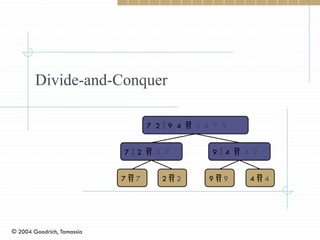
Divide-and-Conquer
7 2  9 4  2 4 7 9
7  2  2 7 9  4  4 9
7  7 2  2 9  9 4  4
3
Divide-and-Conquer
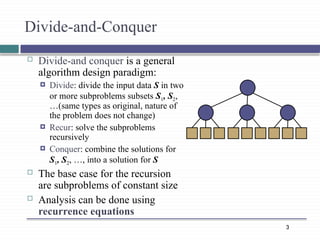
 Divide-and conquer is a general
algorithm design paradigm:
 Divide: divide the input data S in two
or more subproblems subsets S1, S2,
…(same types as original, nature of
the problem does not change)
 Recur: solve the subproblems
recursively
 Conquer: combine the solutions for
S1, S2, …, into a solution for S
 The base case for the recursion
are subproblems of constant size
 Analysis can be done using
recurrence equations
4
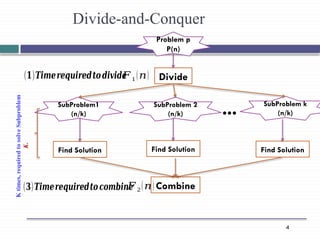
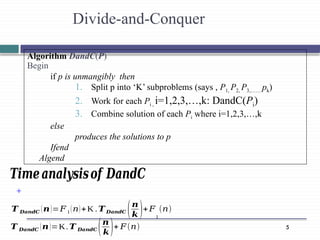
Divide
Problem p
P(n)
SubProblem1
(n/k)
SubProblem 2
(n/k)
SubProblem k
(n/k)
...
Find Solution Find Solution Find Solution
Combine
𝐹1 (𝑛)
𝐹2(𝑛)
(𝟏)𝑻𝒊𝒎𝒆𝒓𝒆𝒒𝒖𝒊𝒓𝒆𝒅𝒕𝒐𝒅𝒊𝒗𝒊𝒅𝒆
(𝟑)𝑻𝒊𝒎𝒆𝒓𝒆𝒒𝒖𝒊𝒓𝒆𝒅𝒕𝒐𝒄𝒐𝒎𝒃𝒊𝒏𝒆
K
times,
required
to
solve
Subproblem
K.
Divide-and-Conquer
5
Divide-and-Conquer
+
𝑻 𝑫𝒂𝒏𝒅𝑪 (𝒏)=𝐹1 (𝑛)+K . 𝑻𝑫𝒂𝒏𝒅𝑪 (𝒏
𝒌 )+𝐹
1
(𝑛)
𝑻 𝑫𝒂𝒏𝒅𝑪 (𝒏)=K.𝑻 𝑫𝒂𝒏𝒅𝑪 (𝒏
𝒌)+ 𝐹(𝑛)
Algorithm DandC(P)
Begin
if p is unmangibly then
1. Split p into ‘K’ subproblems (says , P1, P2, P3,…… pk)
2. Work for each Pi , i=1,2,3,…,k: DandC(Pi)
3. Combine solution of each Pi where i=1,2,3,…,k
else
produces the solutions to p
Ifend
Algend
𝑻𝒊𝒎𝒆𝒂𝒏𝒂𝒍𝒚𝒔𝒊𝒔𝒐𝒇 𝑫𝒂𝒏𝒅𝑪
6
CSE 353– Lecture 3
Finding the max of N elements
7
CSE 353– Lecture 3
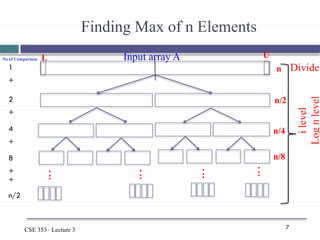
Finding Max of n Elements
Divide
Input array A
i
level
Log
n
level
n
n/2
.
.
.
.
.
.
.
.
.
.
.
.
n/8
n/4
1
+
2
+
4
+
8
+
+
n/2
No of Comparison L U
8
Algorithm Max (A, L, U)
if L = U then
return A[L]
else
mid   (L+U)/2; (Divide)
M1=Max(A, L, mid); (Conquer)
M1=Max(A, mid+1, U); (Conquer)
Return (M1>M2?M1:M2);
endif
 Call Merge-Sort(A,1,n) to sort A[1..n]
 Recursion bottoms out when subsequences have length 1
Merge Sort
9
9
=
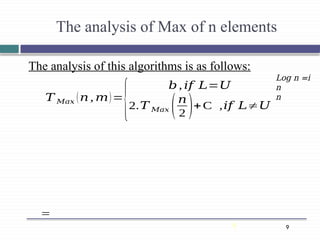
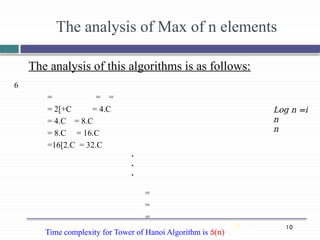
The analysis of this algorithms is as follows:
The analysis of Max of n elements
Log n =i
n
n
𝑇 𝑀𝑎𝑥 (𝑛, 𝑚)=
{
𝑏, 𝑖𝑓 𝐿=𝑈
2.𝑇 𝑀𝑎𝑥 (𝑛
2 )+C ,𝑖𝑓 𝐿≠𝑈
10
10
6
= = =
= 2[+C = 4.C
= 4.C = 8.C
= 8.C = 16.C
=16[2.C = 32.C
=
=
=
Time complexity for Tower of Hanoi Algorithm is (n)
The analysis of this algorithms is as follows:
The analysis of Max of n elements
Log n =i
n
n
.
.
.
11
CSE 353– Lecture 3
Merge Sort
12
CSE 353– Lecture 3
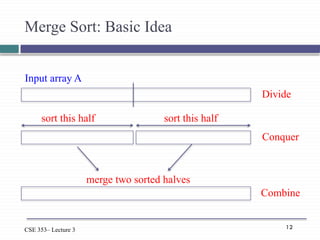
Merge Sort: Basic Idea
Divide
Input array A
Conquer
sort this half sort this half
merge two sorted halves
Combine
13
Algorithm Merge-Sort (A, L, U)
if p = r then return;
else
mid   (L+U)/2; (Divide)
Merge-Sort (A, L, mid); (Conquer)
Merge-Sort (A, mid+1, U); (Conquer)
Merge (A, L, mid, U); (Combine)
endif
 Call Merge-Sort(A,1,n) to sort A[1..n]
 Recursion bottoms out when subsequences have length 1
Merge Sort
14
CSE 353– Lecture 3
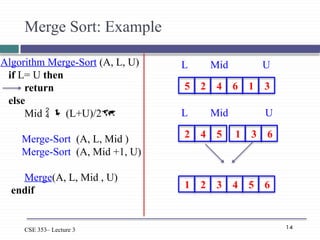
Algorithm Merge-Sort (A, L, U)
if L= U then
return
else
Mid   (L+U)/2
Merge-Sort (A, L, Mid )
Merge-Sort (A, Mid +1, U)
Merge(A, L, Mid , U)
endif
Merge Sort: Example
5 2 4 6 1 3
L U
Mid
2 4 5 1 3 6
L U
Mid
1 2 3 4 5 6
15
CSE 353– Lecture 3
How to merge 2 sorted subarrays?
 HW: Study the pseudo-code in the textbook (Sec. 2.3.1)
 What is the complexity of this step? (n)
2 4 5
1 3 6
A[L..Mid]
A[Mid+1..U]
1 2 3 4 5 6
16
CSE 353– Lecture 3
Algorithm Merge-Sort (A, L, U)
if L = U then
return
else
Mid   (L+U)/2
Merge-Sort (A, L, Mid)
Merge-Sort (A, Mid+1, U)
Merge(A, L, Mid, U)
endif
Merge Sort
Base case: L = U
 Trivially correct
Inductive hypothesis: MERGE-SORT
is correct for any subarray that is a
strict (smaller) subset of A[L, Mid].
General Case: MERGE-SORT is
correct for A[L, U].
From inductive hypothesis and
correctness of Merge.
17
CSE 353– Lecture 3
Algorithm Merge (A, L, Mid,U)
i=L
J=Mid+1
K=L
While(i<=mid and j<=U)
if a[i]<A[j] then
B[k]=A[i]
i=i+1
else
B[k]=A[j]
j=j+1
ifend
k=k+1
whileend
Merge Sort: Correctness
If i<=mid then
For p=I to mid do
B[k]=A[p]
k=k+1
forend
else
For p= j to U do
B[k]=A[p]
k=k+1
forend
ifend
for i=L to U do
A[i]=B[i]
Forend
18
CSE 353– Lecture 3
Algorithm Merge-Sort (A, L, U)
if p = r then
return
else
Mid   (L+U)/2
Merge-Sort (A, L, Mid)
Merge-Sort (A, mid+1, U)
Merge(A, L, Mid, U)
endif
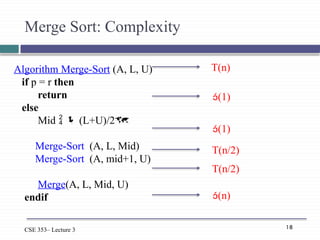
Merge Sort: Complexity
(1)
T(n)
(1)
T(n/2)
T(n/2)
(n)
19
CSE 353– Lecture 3
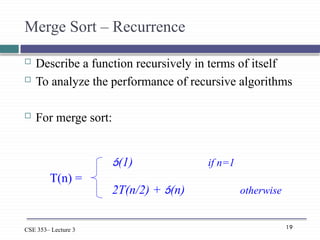
Merge Sort – Recurrence
 Describe a function recursively in terms of itself
 To analyze the performance of recursive algorithms
 For merge sort:
(1) if n=1
2T(n/2) + (n) otherwise
T(n) =
20
CSE 353– Lecture 3
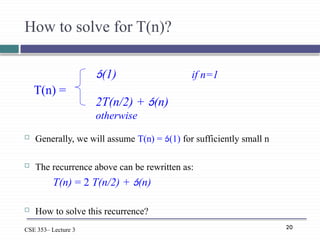
How to solve for T(n)?
 Generally, we will assume T(n) = (1) for sufficiently small n
 The recurrence above can be rewritten as:
T(n) = 2 T(n/2) + (n)
 How to solve this recurrence?
(1) if n=1
2T(n/2) + (n)
otherwise
T(n) =
21
CSE 353– Lecture 3
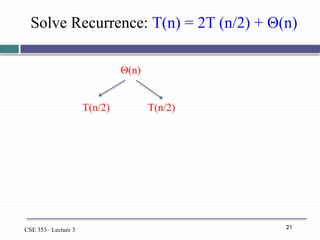
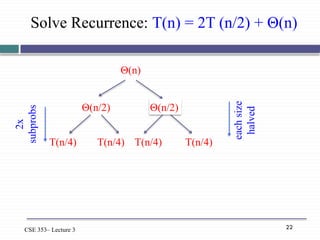
Solve Recurrence: T(n) = 2T (n/2) + Θ(n)
Θ(n)
T(n/2) T(n/2)
22
CSE 353– Lecture 3
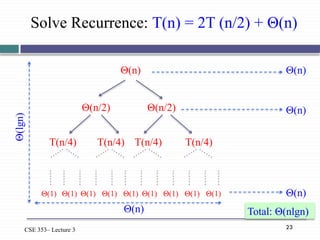
Solve Recurrence: T(n) = 2T (n/2) + Θ(n)
Θ(n)
Θ(n/2)
T(n/4) T(n/4) T(n/4) T(n/4)
T(n/2)
Θ(n/2)
2x
subprobs
each
size
halved
23
CSE 353– Lecture 3
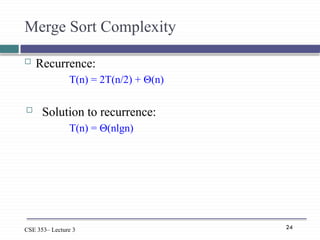
Solve Recurrence: T(n) = 2T (n/2) + Θ(n)
Θ(n)
Θ(n/2) Θ(n/2)
T(n/4) T(n/4) T(n/4) T(n/4)
Θ(1) Θ(1) Θ(1) Θ(1) Θ(1)
Θ(1)
Θ(1) Θ(1) Θ(1)
Θ(n)
Θ(lgn)
Θ(n)
Θ(n)
Θ(n)
Total: Θ(nlgn)
24
CSE 353– Lecture 3
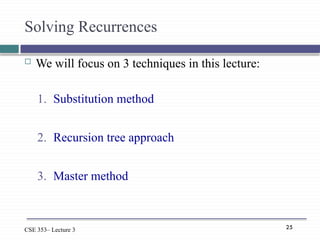
Merge Sort Complexity
 Recurrence:
T(n) = 2T(n/2) + Θ(n)
 Solution to recurrence:
T(n) = Θ(nlgn)
25
CSE 353– Lecture 3
Solving Recurrences
 We will focus on 3 techniques in this lecture:
1. Substitution method
2. Recursion tree approach
3. Master method
26
Recurrence Equation Analysis
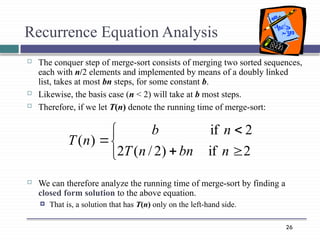
 The conquer step of merge-sort consists of merging two sorted sequences,
each with n/2 elements and implemented by means of a doubly linked
list, takes at most bn steps, for some constant b.
 Likewise, the basis case (n < 2) will take at b most steps.
 Therefore, if we let T(n) denote the running time of merge-sort:
 We can therefore analyze the running time of merge-sort by finding a
closed form solution to the above equation.
 That is, a solution that has T(n) only on the left-hand side.







2
if
)
2
/
(
2
2
if
)
(
n
bn
n
T
n
b
n
T
27
Iterative Substitution
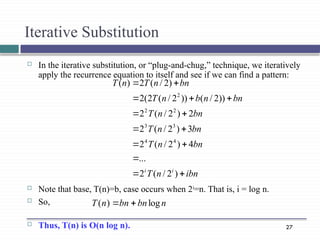
 In the iterative substitution, or “plug-and-chug,” technique, we iteratively
apply the recurrence equation to itself and see if we can find a pattern:
 Note that base, T(n)=b, case occurs when 2i
=n. That is, i = log n.
 So,
 Thus, T(n) is O(n log n).
ibn
n
T
bn
n
T
bn
n
T
bn
n
T
bn
n
b
n
T
bn
n
T
n
T
i
i














)
2
/
(
2
...
4
)
2
/
(
2
3
)
2
/
(
2
2
)
2
/
(
2
))
2
/
(
))
2
/
(
2
(
2
)
2
/
(
2
)
(
4
4
3
3
2
2
2
n
bn
bn
n
T log
)
( 

28
The Recursion Tree
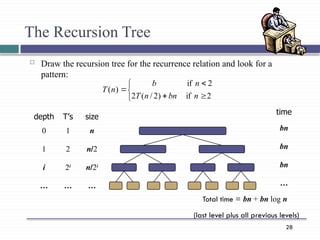
 Draw the recursion tree for the recurrence relation and look for a
pattern:
depth T’s size
0 1 n
1 2 n/2
i 2i
n/2i
… … …







2
if
)
2
/
(
2
2
if
)
(
n
bn
n
T
n
b
n
T
time
bn
bn
bn
…
Total time = bn + bn log n
(last level plus all previous levels)
29
Guess-and-Test Method
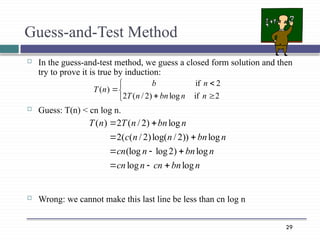
 In the guess-and-test method, we guess a closed form solution and then
try to prove it is true by induction:
 Guess: T(n) < cn log n.
 Wrong: we cannot make this last line be less than cn log n
n
bn
cn
n
cn
n
bn
n
cn
n
bn
n
n
c
n
bn
n
T
n
T
log
log
log
)
2
log
(log
log
))
2
/
log(
)
2
/
(
(
2
log
)
2
/
(
2
)
(

















2
if
log
)
2
/
(
2
2
if
)
(
n
n
bn
n
T
n
b
n
T
30
Guess-and-Test Method, Part 2
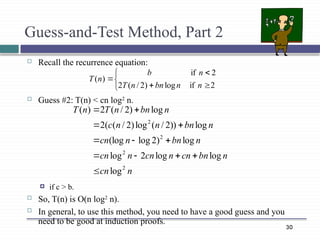
 Recall the recurrence equation:
 Guess #2: T(n) < cn log2
n.
 if c > b.
 So, T(n) is O(n log2
n).
 In general, to use this method, you need to have a good guess and you
need to be good at induction proofs.
n
cn
n
bn
cn
n
cn
n
cn
n
bn
n
cn
n
bn
n
n
c
n
bn
n
T
n
T
2
2
2
2
log
log
log
2
log
log
)
2
log
(log
log
))
2
/
(
log
)
2
/
(
(
2
log
)
2
/
(
2
)
(



















2
if
log
)
2
/
(
2
2
if
)
(
n
n
bn
n
T
n
b
n
T
31
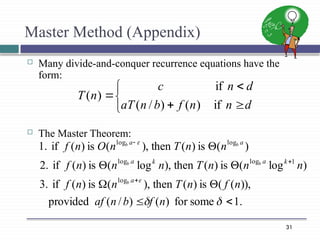
Master Method (Appendix)
 Many divide-and-conquer recurrence equations have the
form:
 The Master Theorem:







d
n
n
f
b
n
aT
d
n
c
n
T
if
)
(
)
/
(
if
)
(
.
1
some
for
)
(
)
/
(
provided
)),
(
(
is
)
(
then
),
(
is
)
(
if
3.
)
log
(
is
)
(
then
),
log
(
is
)
(
if
2.
)
(
is
)
(
then
),
(
is
)
(
if
1.
log
1
log
log
log
log














n
f
b
n
af
n
f
n
T
n
n
f
n
n
n
T
n
n
n
f
n
n
T
n
O
n
f
a
k
a
k
a
a
a
b
b
b
b
b
32
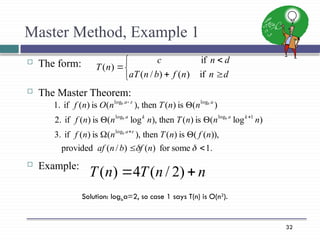
Master Method, Example 1
 The form:
 The Master Theorem:
 Example:







d
n
n
f
b
n
aT
d
n
c
n
T
if
)
(
)
/
(
if
)
(
.
1
some
for
)
(
)
/
(
provided
)),
(
(
is
)
(
then
),
(
is
)
(
if
3.
)
log
(
is
)
(
then
),
log
(
is
)
(
if
2.
)
(
is
)
(
then
),
(
is
)
(
if
1.
log
1
log
log
log
log














n
f
b
n
af
n
f
n
T
n
n
f
n
n
n
T
n
n
n
f
n
n
T
n
O
n
f
a
k
a
k
a
a
a
b
b
b
b
b
n
n
T
n
T 
 )
2
/
(
4
)
(
Solution: logba=2, so case 1 says T(n) is O(n2
).
33
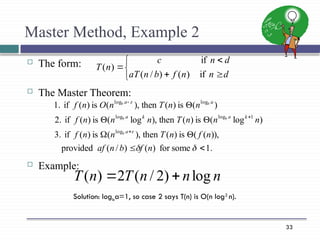
Master Method, Example 2
 The form:
 The Master Theorem:
 Example:







d
n
n
f
b
n
aT
d
n
c
n
T
if
)
(
)
/
(
if
)
(
.
1
some
for
)
(
)
/
(
provided
)),
(
(
is
)
(
then
),
(
is
)
(
if
3.
)
log
(
is
)
(
then
),
log
(
is
)
(
if
2.
)
(
is
)
(
then
),
(
is
)
(
if
1.
log
1
log
log
log
log














n
f
b
n
af
n
f
n
T
n
n
f
n
n
n
T
n
n
n
f
n
n
T
n
O
n
f
a
k
a
k
a
a
a
b
b
b
b
b
n
n
n
T
n
T log
)
2
/
(
2
)
( 

Solution: logba=1, so case 2 says T(n) is O(n log2
n).
34
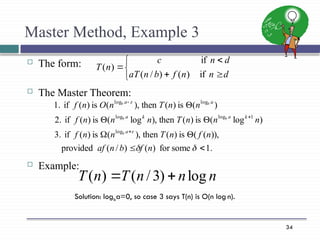
Master Method, Example 3
 The form:
 The Master Theorem:
 Example:







d
n
n
f
b
n
aT
d
n
c
n
T
if
)
(
)
/
(
if
)
(
.
1
some
for
)
(
)
/
(
provided
)),
(
(
is
)
(
then
),
(
is
)
(
if
3.
)
log
(
is
)
(
then
),
log
(
is
)
(
if
2.
)
(
is
)
(
then
),
(
is
)
(
if
1.
log
1
log
log
log
log














n
f
b
n
af
n
f
n
T
n
n
f
n
n
n
T
n
n
n
f
n
n
T
n
O
n
f
a
k
a
k
a
a
a
b
b
b
b
b
n
n
n
T
n
T log
)
3
/
(
)
( 

Solution: logba=0, so case 3 says T(n) is O(n log n).
35
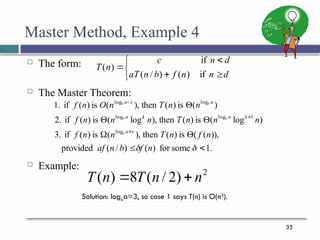
Master Method, Example 4
 The form:
 The Master Theorem:
 Example:







d
n
n
f
b
n
aT
d
n
c
n
T
if
)
(
)
/
(
if
)
(
.
1
some
for
)
(
)
/
(
provided
)),
(
(
is
)
(
then
),
(
is
)
(
if
3.
)
log
(
is
)
(
then
),
log
(
is
)
(
if
2.
)
(
is
)
(
then
),
(
is
)
(
if
1.
log
1
log
log
log
log














n
f
b
n
af
n
f
n
T
n
n
f
n
n
n
T
n
n
n
f
n
n
T
n
O
n
f
a
k
a
k
a
a
a
b
b
b
b
b
2
)
2
/
(
8
)
( n
n
T
n
T 

Solution: logba=3, so case 1 says T(n) is O(n3
).
36
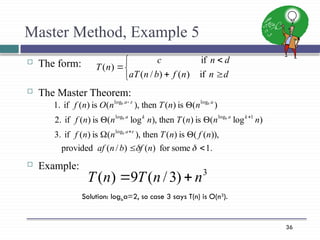
Master Method, Example 5
 The form:
 The Master Theorem:
 Example:







d
n
n
f
b
n
aT
d
n
c
n
T
if
)
(
)
/
(
if
)
(
.
1
some
for
)
(
)
/
(
provided
)),
(
(
is
)
(
then
),
(
is
)
(
if
3.
)
log
(
is
)
(
then
),
log
(
is
)
(
if
2.
)
(
is
)
(
then
),
(
is
)
(
if
1.
log
1
log
log
log
log














n
f
b
n
af
n
f
n
T
n
n
f
n
n
n
T
n
n
n
f
n
n
T
n
O
n
f
a
k
a
k
a
a
a
b
b
b
b
b
3
)
3
/
(
9
)
( n
n
T
n
T 

Solution: logba=2, so case 3 says T(n) is O(n3
).
37
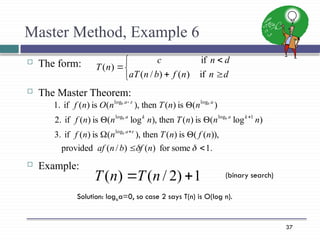
Master Method, Example 6
 The form:
 The Master Theorem:
 Example:







d
n
n
f
b
n
aT
d
n
c
n
T
if
)
(
)
/
(
if
)
(
.
1
some
for
)
(
)
/
(
provided
)),
(
(
is
)
(
then
),
(
is
)
(
if
3.
)
log
(
is
)
(
then
),
log
(
is
)
(
if
2.
)
(
is
)
(
then
),
(
is
)
(
if
1.
log
1
log
log
log
log














n
f
b
n
af
n
f
n
T
n
n
f
n
n
n
T
n
n
n
f
n
n
T
n
O
n
f
a
k
a
k
a
a
a
b
b
b
b
b
1
)
2
/
(
)
( 
 n
T
n
T
Solution: logba=0, so case 2 says T(n) is O(log n).
(binary search)
38
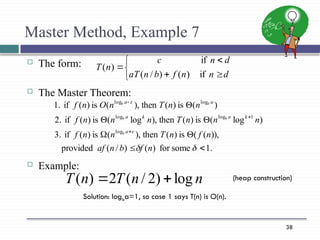
Master Method, Example 7
 The form:
 The Master Theorem:
 Example:







d
n
n
f
b
n
aT
d
n
c
n
T
if
)
(
)
/
(
if
)
(
.
1
some
for
)
(
)
/
(
provided
)),
(
(
is
)
(
then
),
(
is
)
(
if
3.
)
log
(
is
)
(
then
),
log
(
is
)
(
if
2.
)
(
is
)
(
then
),
(
is
)
(
if
1.
log
1
log
log
log
log














n
f
b
n
af
n
f
n
T
n
n
f
n
n
n
T
n
n
n
f
n
n
T
n
O
n
f
a
k
a
k
a
a
a
b
b
b
b
b
n
n
T
n
T log
)
2
/
(
2
)
( 

Solution: logba=1, so case 1 says T(n) is O(n).
(heap construction)
39
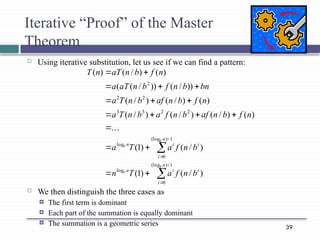
Iterative “Proof” of the Master
Theorem
 Using iterative substitution, let us see if we can find a pattern:
 We then distinguish the three cases as
 The first term is dominant
 Each part of the summation is equally dominant
 The summation is a geometric series























1
)
(log
0
log
1
)
(log
0
log
2
2
3
3
2
2
2
)
/
(
)
1
(
)
/
(
)
1
(
.
.
.
)
(
)
/
(
)
/
(
)
/
(
)
(
)
/
(
)
/
(
))
/
(
))
/
(
(
)
(
)
/
(
)
(
n
i
i
i
a
n
i
i
i
n
b
b
b
b
b
n
f
a
T
n
b
n
f
a
T
a
n
f
b
n
af
b
n
f
a
b
n
T
a
n
f
b
n
af
b
n
T
a
bn
b
n
f
b
n
aT
a
n
f
b
n
aT
n
T
40
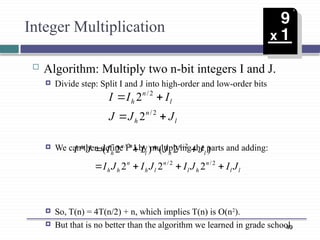
Integer Multiplication
 Algorithm: Multiply two n-bit integers I and J.
 Divide step: Split I and J into high-order and low-order bits
 We can then define I*J by multiplying the parts and adding:
 So, T(n) = 4T(n/2) + n, which implies T(n) is O(n2
).
 But that is no better than the algorithm we learned in grade school.
l
n
h
l
n
h
J
J
J
I
I
I




2
/
2
/
2
2
l
l
n
h
l
n
l
h
n
h
h
l
n
h
l
n
h
J
I
J
I
J
I
J
I
J
J
I
I
J
I







2
/
2
/
2
/
2
/
2
2
2
)
2
(
*
)
2
(
*
41
An Improved Integer Multiplication Algorithm
 Algorithm: Multiply two n-bit integers I and J.
 Divide step: Split I and J into high-order and low-order bits
 Observe that there is a different way to multiply parts:
 So, T(n) = 3T(n/2) + n, which implies T(n) is O(nlog
2
3
), by the Master Theorem.
 Thus, T(n) is O(n1.585
).
l
n
h
l
n
h
J
J
J
I
I
I




2
/
2
/
2
2
l
l
n
h
l
l
h
n
h
h
l
l
n
l
l
h
h
h
l
h
h
l
l
l
h
n
h
h
l
l
n
l
l
h
h
h
l
l
h
n
h
h
J
I
J
I
J
I
J
I
J
I
J
I
J
I
J
I
J
I
J
I
J
I
J
I
J
I
J
I
J
I
J
J
I
I
J
I
J
I



















2
/
2
/
2
/
2
)
(
2
2
]
)
[(
2
2
]
)
)(
[(
2
*
42
CSE 353– Lecture 3
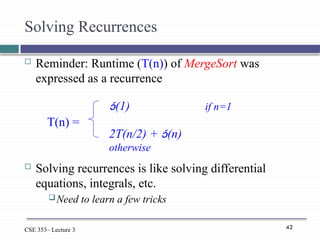
Solving Recurrences
 Reminder: Runtime (T(n)) of MergeSort was
expressed as a recurrence
 Solving recurrences is like solving differential
equations, integrals, etc.
Need to learn a few tricks
(1) if n=1
2T(n/2) + (n)
otherwise
T(n) =
43
CSE 353– Lecture 3
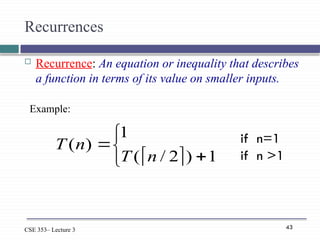
Recurrences
 Recurrence: An equation or inequality that describes
a function in terms of its value on smaller inputs.
 





1
)
2
/
(
1
)
(
n
T
n
T if n=1
if n >1
Example:
44
CSE 353– Lecture 3
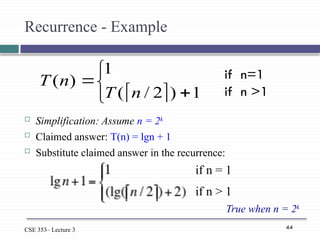
Recurrence - Example
 Simplification: Assume n = 2k
 Claimed answer: T(n) = lgn + 1
 Substitute claimed answer in the recurrence:
 





1
)
2
/
(
1
)
(
n
T
n
T
if n = 1
if n > 1
True when n = 2k
if n=1
if n >1
45
CSE 353– Lecture 3
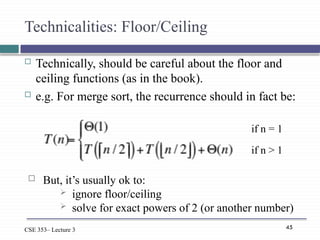
Technicalities: Floor/Ceiling
 Technically, should be careful about the floor and
ceiling functions (as in the book).
 e.g. For merge sort, the recurrence should in fact be:
if n = 1
if n > 1
 But, it’s usually ok to:
 ignore floor/ceiling
 solve for exact powers of 2 (or another number)
46
CSE 353– Lecture 3
Technicalities: Boundary Conditions
 Usually assume: T(n) = Θ(1) for sufficiently small n
 Changes the exact solution, but usually the asymptotic
solution is not affected (e.g. if polynomially bounded)
 For convenience, the boundary conditions generally
implicitly stated in a recurrence
T(n) = 2T(n/2) + Θ(n)
assuming that
T(n) = Θ(1) for sufficiently small n
47
CSE 353– Lecture 3
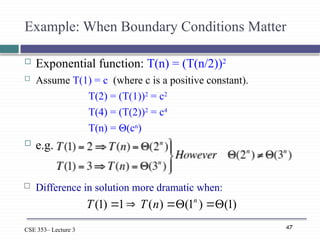
Example: When Boundary Conditions Matter
 Exponential function: T(n) = (T(n/2))2
 Assume T(1) = c (where c is a positive constant).
T(2) = (T(1))2
= c2
T(4) = (T(2))2
= c4
T(n) = Θ(cn
)
 e.g.
)
1
(
)
1
(
)
(
1
)
1
( 




 n
n
T
T
 Difference in solution more dramatic when:
48
CSE 353– Lecture 3
Solving Recurrences
 We will focus on 3 techniques in this lecture:
1. Substitution method
2. Recursion tree approach
3. Master method
49
CSE 353– Lecture 3
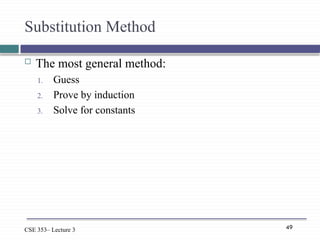
Substitution Method
 The most general method:
1. Guess
2. Prove by induction
3. Solve for constants
50
CSE 353– Lecture 3
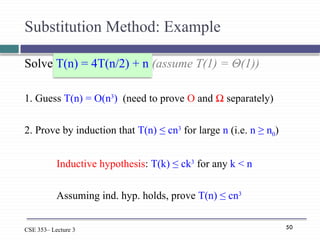
Solve T(n) = 4T(n/2) + n (assume T(1) = Θ(1))
1. Guess T(n) = O(n3
) (need to prove O and Ω separately)
2. Prove by induction that T(n) ≤ cn3
for large n (i.e. n ≥ n0)
Inductive hypothesis: T(k) ≤ ck3
for any k < n
Assuming ind. hyp. holds, prove T(n) ≤ cn3
Substitution Method: Example
51
CSE 353– Lecture 3
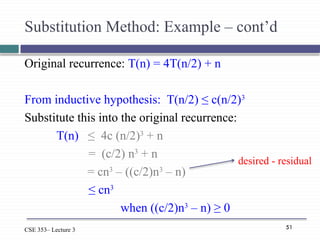
Substitution Method: Example – cont’d
Original recurrence: T(n) = 4T(n/2) + n
From inductive hypothesis: T(n/2) ≤ c(n/2)3
Substitute this into the original recurrence:
T(n) ≤ 4c (n/2)3
+ n
= (c/2) n3
+ n
= cn3
– ((c/2)n3
– n)
≤ cn3
when ((c/2)n3
– n) ≥ 0
desired - residual
52
CSE 353– Lecture 3
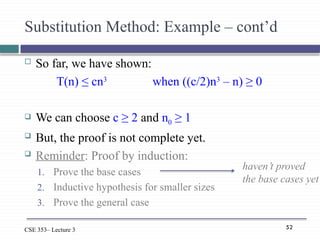
Substitution Method: Example – cont’d
 So far, we have shown:
T(n) ≤ cn3
when ((c/2)n3
– n) ≥ 0
 We can choose c ≥ 2 and n0 ≥ 1
 But, the proof is not complete yet.
 Reminder: Proof by induction:
1. Prove the base cases
2. Inductive hypothesis for smaller sizes
3. Prove the general case
haven’t proved
the base cases yet
53
CSE 353– Lecture 3
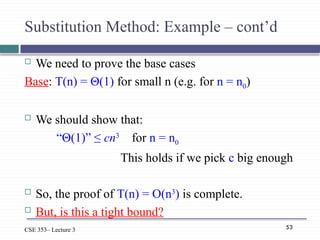
Substitution Method: Example – cont’d
 We need to prove the base cases
Base: T(n) = Θ(1) for small n (e.g. for n = n0)
 We should show that:
“Θ(1)” ≤ cn3
for n = n0
This holds if we pick c big enough
 So, the proof of T(n) = O(n3
) is complete.
 But, is this a tight bound?
54
CSE 353– Lecture 3
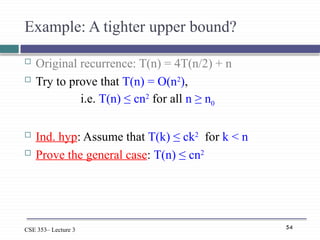
Example: A tighter upper bound?
 Original recurrence: T(n) = 4T(n/2) + n
 Try to prove that T(n) = O(n2
),
i.e. T(n) ≤ cn2
for all n ≥ n0
 Ind. hyp: Assume that T(k) ≤ ck2
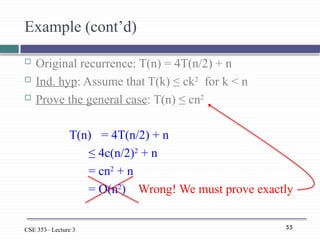
for k < n
 Prove the general case: T(n) ≤ cn2
55
CSE 353– Lecture 3
Example (cont’d)
 Original recurrence: T(n) = 4T(n/2) + n
 Ind. hyp: Assume that T(k) ≤ ck2
for k < n
 Prove the general case: T(n) ≤ cn2
T(n) = 4T(n/2) + n
≤ 4c(n/2)2
+ n
= cn2
+ n
= O(n2
) Wrong! We must prove exactly
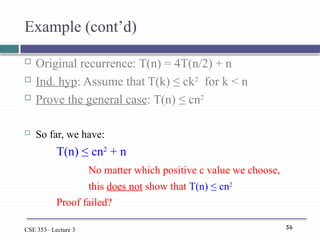
56
CSE 353– Lecture 3
Example (cont’d)
 Original recurrence: T(n) = 4T(n/2) + n
 Ind. hyp: Assume that T(k) ≤ ck2
for k < n
 Prove the general case: T(n) ≤ cn2
 So far, we have:
T(n) ≤ cn2
+ n
No matter which positive c value we choose,
this does not show that T(n) ≤ cn2
Proof failed?
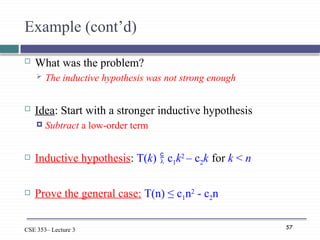
57
CSE 353– Lecture 3
Example (cont’d)
 What was the problem?
 The inductive hypothesis was not strong enough
 Idea: Start with a stronger inductive hypothesis
 Subtract a low-order term
 Inductive hypothesis: T(k)  c1k2
– c2k for k < n
 Prove the general case: T(n) ≤ c1n2
- c2n
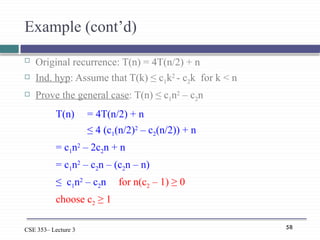
58
CSE 353– Lecture 3
Example (cont’d)
 Original recurrence: T(n) = 4T(n/2) + n
 Ind. hyp: Assume that T(k) ≤ c1k2
- c2k for k < n
 Prove the general case: T(n) ≤ c1n2
– c2n
T(n) = 4T(n/2) + n
≤ 4 (c1(n/2)2
– c2(n/2)) + n
= c1n2
– 2c2n + n
= c1n2
– c2n – (c2n – n)
≤ c1n2
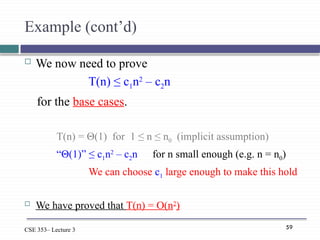
– c2n for n(c2 – 1) ≥ 0
choose c2 ≥ 1
59
CSE 353– Lecture 3
Example (cont’d)
 We now need to prove
T(n) ≤ c1n2
– c2n
for the base cases.
T(n) = Θ(1) for 1 ≤ n ≤ n0 (implicit assumption)
“Θ(1)” ≤ c1n2
– c2n for n small enough (e.g. n = n0)
We can choose c1 large enough to make this hold
 We have proved that T(n) = O(n2
)
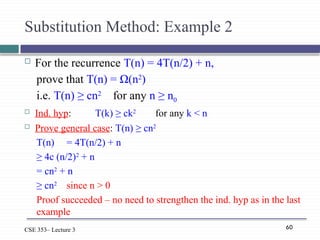
60
CSE 353– Lecture 3
Substitution Method: Example 2
 For the recurrence T(n) = 4T(n/2) + n,
prove that T(n) = Ω(n2
)
i.e. T(n) ≥ cn2
for any n ≥ n0
 Ind. hyp: T(k) ≥ ck2
for any k < n
 Prove general case: T(n) ≥ cn2
T(n) = 4T(n/2) + n
≥ 4c (n/2)2
+ n
= cn2
+ n
≥ cn2
since n > 0
Proof succeeded – no need to strengthen the ind. hyp as in the last
example
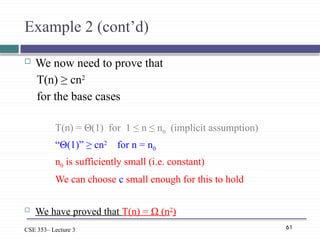
61
CSE 353– Lecture 3
Example 2 (cont’d)
 We now need to prove that
T(n) ≥ cn2
for the base cases
T(n) = Θ(1) for 1 ≤ n ≤ n0 (implicit assumption)
“Θ(1)” ≥ cn2
for n = n0
n0 is sufficiently small (i.e. constant)
We can choose c small enough for this to hold
 We have proved that T(n) = Ω (n2
)
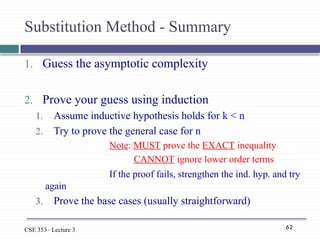
62
CSE 353– Lecture 3
Substitution Method - Summary
1. Guess the asymptotic complexity
2. Prove your guess using induction
1. Assume inductive hypothesis holds for k < n
2. Try to prove the general case for n
Note: MUST prove the EXACT inequality
CANNOT ignore lower order terms
If the proof fails, strengthen the ind. hyp. and try
again
3. Prove the base cases (usually straightforward)
63
CSE 353– Lecture 3
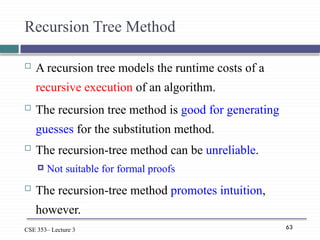
Recursion Tree Method
 A recursion tree models the runtime costs of a
recursive execution of an algorithm.
 The recursion tree method is good for generating
guesses for the substitution method.
 The recursion-tree method can be unreliable.
 Not suitable for formal proofs
 The recursion-tree method promotes intuition,
however.
64
CSE 353– Lecture 3
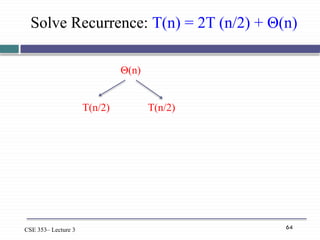
Solve Recurrence: T(n) = 2T (n/2) + Θ(n)
Θ(n)
T(n/2) T(n/2)
65
CSE 353– Lecture 3
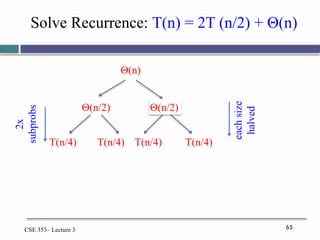
Solve Recurrence: T(n) = 2T (n/2) + Θ(n)
Θ(n)
Θ(n/2)
T(n/4) T(n/4) T(n/4) T(n/4)
T(n/2)
Θ(n/2)
2x
subprobs
each
size
halved
66
CSE 353– Lecture 3
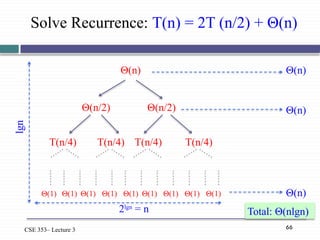
Solve Recurrence: T(n) = 2T (n/2) + Θ(n)
Θ(n)
Θ(n/2) Θ(n/2)
T(n/4) T(n/4) T(n/4) T(n/4)
Θ(1) Θ(1) Θ(1) Θ(1) Θ(1)
Θ(1)
Θ(1) Θ(1) Θ(1)
2lgn
= n
lgn
Θ(n)
Θ(n)
Θ(n)
Total: Θ(nlgn)
67
CSE 353– Lecture 3
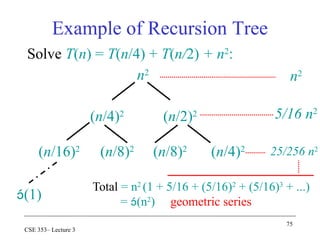
Example of Recursion Tree
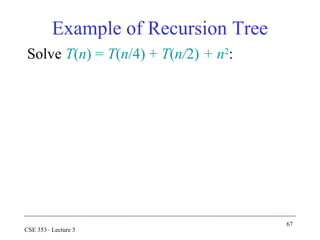
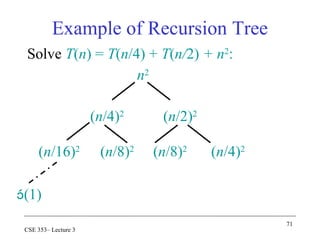
Solve T(n) = T(n/4) + T(n/2) + n2
:
68
CSE 353– Lecture 3
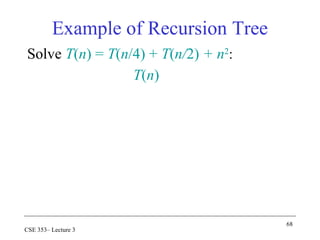
Solve T(n) = T(n/4) + T(n/2) + n2
:
T(n)
Example of Recursion Tree
69
CSE 353– Lecture 3
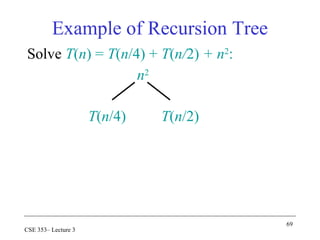
Solve T(n) = T(n/4) + T(n/2) + n2
:
n2
T(n/4) T(n/2)
Example of Recursion Tree
70
CSE 353– Lecture 3
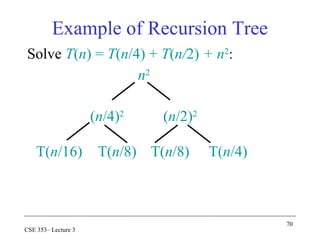
Solve T(n) = T(n/4) + T(n/2) + n2
:
n2
(n/4)2
(n/2)2
T(n/16) T(n/8) T(n/8) T(n/4)
Example of Recursion Tree
71
CSE 353– Lecture 3
Solve T(n) = T(n/4) + T(n/2) + n2
:
n2
(n/4)2
(n/2)2
(n/16)2
(n/8)2
(n/8)2
(n/4)2
(1)
Example of Recursion Tree
72
CSE 353– Lecture 3
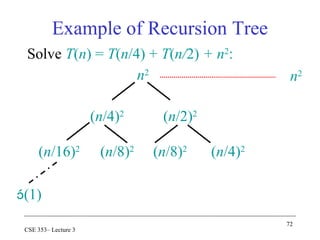
Solve T(n) = T(n/4) + T(n/2) + n2
:
n2
(n/4)2
(n/2)2
(n/16)2
(n/8)2
(n/8)2
(n/4)2
(1)
n2
Example of Recursion Tree
73
CSE 353– Lecture 3
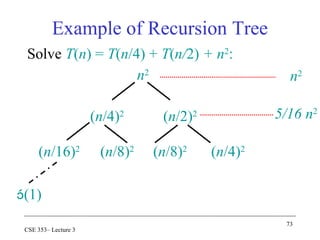
Solve T(n) = T(n/4) + T(n/2) + n2
:
n2
(n/4)2
(n/2)2
(n/16)2
(n/8)2
(n/8)2
(n/4)2
(1)
n2
5/16 n2
Example of Recursion Tree
74
CSE 353– Lecture 3
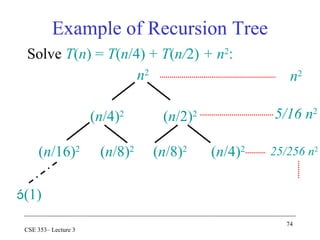
Solve T(n) = T(n/4) + T(n/2) + n2
:
n2
(n/4)2
(n/2)2
(n/16)2
(n/8)2
(n/8)2
(n/4)2
(1)
n2
5/16 n2
25/256 n2
Example of Recursion Tree
75
CSE 353– Lecture 3
Solve T(n) = T(n/4) + T(n/2) + n2
:
n2
(n/4)2
(n/2)2
(n/16)2
(n/8)2
(n/8)2
(n/4)2
(1)
n2
5/16 n2
25/256 n2
Total = n2
(1 + 5/16 + (5/16)2
+ (5/16)3
+ ...)
= (n2
) geometric series
Example of Recursion Tree
76
CSE 353– Lecture 3
The Master Method
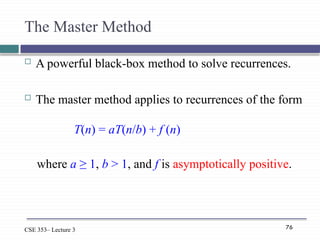
 A powerful black-box method to solve recurrences.
 The master method applies to recurrences of the form
T(n) = aT(n/b) + f (n)
where a ≥ 1, b > 1, and f is asymptotically positive.
77
CSE 353– Lecture 3
The Master Method: 3 Cases
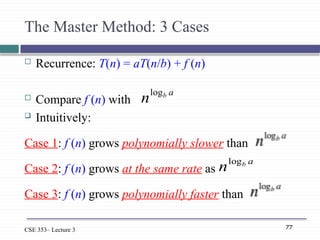
 Recurrence: T(n) = aT(n/b) + f (n)
 Compare f (n) with
 Intuitively:
Case 1: f (n) grows polynomially slower than
Case 2: f (n) grows at the same rate as
Case 3: f (n) grows polynomially faster than
a
b
nlog
a
b
nlog
78
CSE 353– Lecture 3
The Master Method: Case 1
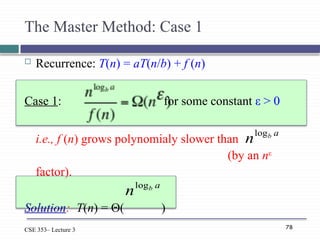
 Recurrence: T(n) = aT(n/b) + f (n)
Case 1: for some constant ε > 0
i.e., f (n) grows polynomialy slower than
(by an nε
factor).
Solution: T(n) = Θ( )
a
b
nlog
a
b
nlog
79
CSE 353– Lecture 3
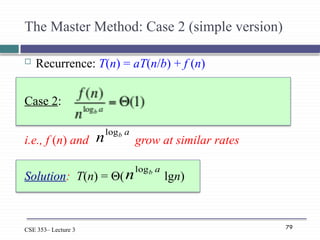
The Master Method: Case 2 (simple version)
 Recurrence: T(n) = aT(n/b) + f (n)
Case 2:
i.e., f (n) and grow at similar rates
Solution: T(n) = Θ( lgn)
a
b
nlog
a
b
nlog
80
CSE 353– Lecture 3
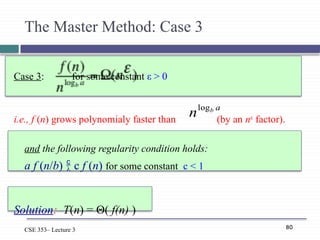
The Master Method: Case 3
Case 3: for some constant ε > 0
i.e., f (n) grows polynomialy faster than (by an nε
factor).
and the following regularity condition holds:
a f (n/b)  c f (n) for some constant c < 1
Solution: T(n) = Θ( f(n) )
a
b
nlog
81
CSE 353– Lecture 3
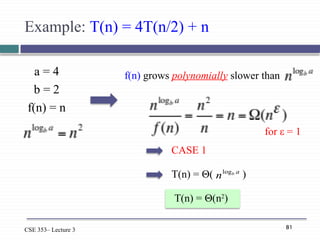
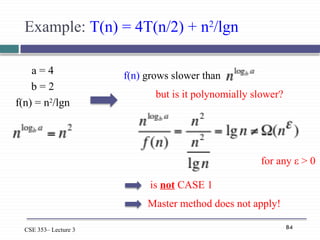
Example: T(n) = 4T(n/2) + n
a = 4
b = 2
f(n) = n
f(n) grows polynomially slower than
CASE 1
T(n) = Θ( )
a
b
nlog
T(n) = Θ(n2
)
for ε = 1
82
CSE 353– Lecture 3
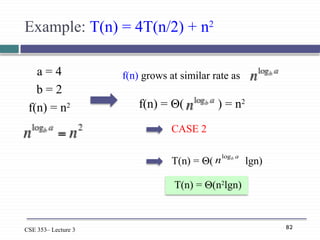
Example: T(n) = 4T(n/2) + n2
a = 4
b = 2
f(n) = n2
f(n) grows at similar rate as
CASE 2
T(n) = Θ( lgn)
a
b
nlog
T(n) = Θ(n2
lgn)
f(n) = Θ( ) = n2
83
CSE 353– Lecture 3
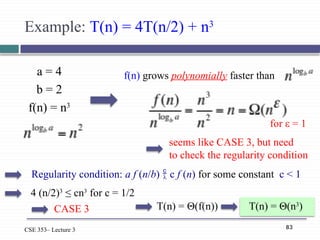
Example: T(n) = 4T(n/2) + n3
a = 4
b = 2
f(n) = n3
f(n) grows polynomially faster than
seems like CASE 3, but need
to check the regularity condition
T(n) = Θ(f(n)) T(n) = Θ(n3
)
for ε = 1
Regularity condition: a f (n/b)  c f (n) for some constant c < 1
4 (n/2)3
≤ cn3
for c = 1/2
CASE 3
84
CSE 353– Lecture 3
Example: T(n) = 4T(n/2) + n2
/lgn
a = 4
b = 2
f(n) = n2
/lgn
f(n) grows slower than
is not CASE 1
for any ε > 0
but is it polynomially slower?
Master method does not apply!
85
CSE 353– Lecture 3
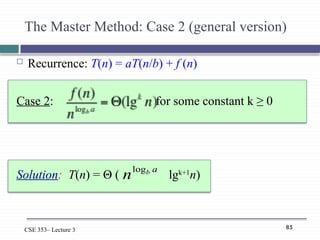
The Master Method: Case 2 (general version)
 Recurrence: T(n) = aT(n/b) + f (n)
Case 2: for some constant k ≥ 0
Solution: T(n) = Θ ( lgk+1
n)
a
b
nlog
86
CSE 353– Lecture 3
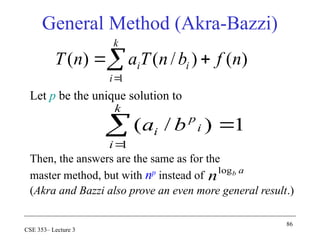
General Method (Akra-Bazzi)
Let p be the unique solution to
Then, the answers are the same as for the
master method, but with np
instead of
(Akra and Bazzi also prove an even more general result.)




k
i
i
i n
f
b
n
T
a
n
T
1
)
(
)
/
(
)
(



k
i
i
p
i b
a
1
1
)
/
(
a
b
nlog
87
CSE 353– Lecture 3
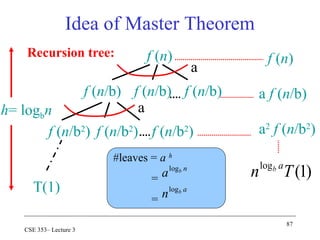
Idea of Master Theorem
Recursion tree:
)
1
(
log
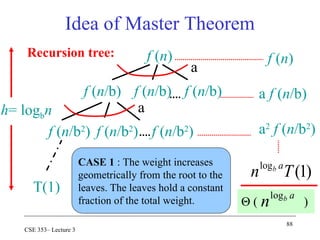
T
n a
b
T(1)
f (n/b)
f (n)
f (n)
f (n/b) f (n/b)
a
a f (n/b)
f (n/b2
) f (n/b2
) f (n/b2
)
a
h= logbn
a2
f (n/b2
)
#leaves = a h
=
=
n
b
alog
a
b
nlog
88
CSE 353– Lecture 3
Recursion tree:
)
1
(
log
T
n a
b
T(1)
f (n/b)
f (n)
f (n)
f (n/b) f (n/b)
a
a f (n/b)
f (n/b2
) f (n/b2
) f (n/b2
)
a
h= logbn
a2
f (n/b2
)
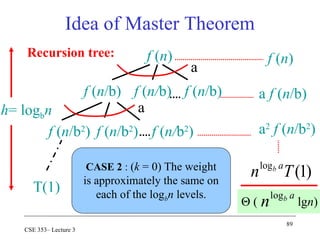
CASE 1 : The weight increases
geometrically from the root to the
leaves. The leaves hold a constant
fraction of the total weight. Θ ( )
a
b
nlog
Idea of Master Theorem
89
CSE 353– Lecture 3
Recursion tree:
)
1
(
log
T
n a
b
T(1)
f (n/b)
f (n)
f (n)
f (n/b) f (n/b)
a
a f (n/b)
f (n/b2
) f (n/b2
) f (n/b2
)
a
h= logbn
a2
f (n/b2
)
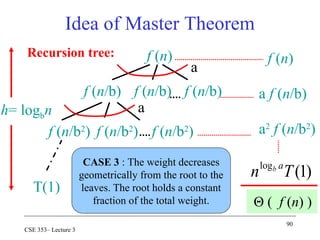
CASE 2 : (k = 0) The weight
is approximately the same on
each of the logbn levels.
Θ ( lgn)
a
b
nlog
Idea of Master Theorem
90
CSE 353– Lecture 3
Recursion tree:
)
1
(
log
T
n a
b
T(1)
f (n/b)
f (n)
f (n)
f (n/b) f (n/b)
a
a f (n/b)
f (n/b2
) f (n/b2
) f (n/b2
)
a
h= logbn
a2
f (n/b2
)
CASE 3 : The weight decreases
geometrically from the root to the
leaves. The root holds a constant
fraction of the total weight. Θ ( f (n) )
Idea of Master Theorem
91
CSE 353– Lecture 3
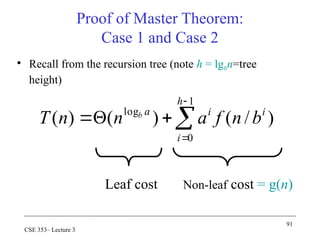
Proof of Master Theorem:
Case 1 and Case 2
• Recall from the recursion tree (note h = lgbn=tree
height)






1
0
log
)
/
(
)
(
)
(
h
i
i
i
a
b
n
f
a
n
n
T b
Leaf cost Non-leaf cost = g(n)
92
CSE 353– Lecture 3
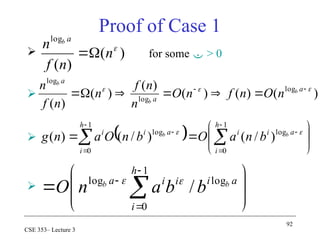
Proof of Case 1
 for some  > 0



)
(
)
(
log

n
n
f
n a
b


)
(
)
(
)
(
)
(
)
(
)
(
log
log
log


 






 a
a
a
b
b
b
n
O
n
f
n
O
n
n
f
n
n
f
n
  






 







1
0
log
1
0
log
)
/
(
)
/
(
)
(
h
i
a
i
i
h
i
a
i
i b
b
b
n
a
O
b
n
O
a
n
g 







 



1
0
log
log
/
h
i
a
i
i
i
a b
b
b
b
a
n
O 

93
CSE 353– Lecture 3
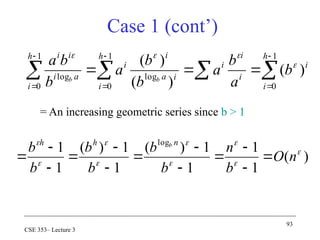
= An increasing geometric series since b > 1













1
0
1
0
log
1
0
log
)
(
)
(
)
( h
i
i
i
i
i
h
i
i
a
i
i
h
i
a
i
i
i
b
a
b
a
b
b
a
b
b
a
b
b




)
(
1
1
1
1
)
(
1
1
)
(
1
1 log









n
O
b
n
b
b
b
b
b
b n
h
h b













Case 1 (cont’)
94
CSE 353– Lecture 3
  








 
)
(
)
(
)
(
log
log 



n
O
n
n
O
n
O
n
O
n
g
a
a
b
b
)
(
)
(
)
(
)
(
)
( log
log
log a
a
a b
b
b
n
O
n
n
g
n
n
T 





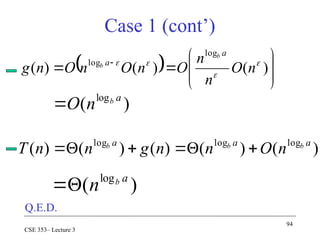
Case 1 (cont’)
)
( log a
b
n
O

)
( log a
b
n


Q.E.D.
95
CSE 353– Lecture 3
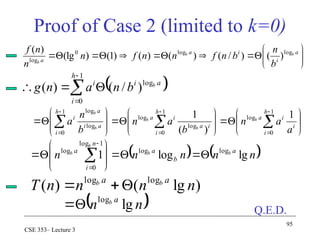
Proof of Case 2 (limited to k=0)



























 








1
0
log
1
0
log
log
1
0
log
log
1
)
(
1 h
i
i
i
a
h
i
i
a
i
a
h
i
a
i
a
i
a
a
n
b
a
n
b
n
a b
b
b
b
b















 a
i
i
a
a
b
b
b
b
n
b
n
f
n
n
f
n
n
n
f log
log
0
log
)
(
)
/
(
)
(
)
(
)
1
(
)
(lg
)
(
 






1
0
log
)
/
(
)
(
h
i
a
i
i b
b
n
a
n
g
)
lg
(
)
( log
log
n
n
n
n
T a
a b
b



 
n
n a
b
lg
log


   
n
n
n
n
n a
b
a
n
i
a b
b
b
b
lg
log
1 log
log
1
log
0
log













 


Q.E.D.
96
CSE 353– Lecture 3
Conclusion
• Next time: applying the master method.

Divided and conqurddddddddddddddfffffe.pptx

  • 1.
    1 Design and Analysisof Algorithms CSE 353– Lecture 3 Lecture7 Divide and conquer
  • 2.
    © 2004 Goodrich,Tamassia Divide-and-Conquer 7 2  9 4  2 4 7 9 7  2  2 7 9  4  4 9 7  7 2  2 9  9 4  4
  • 3.
    3 Divide-and-Conquer  Divide-and conqueris a general algorithm design paradigm:  Divide: divide the input data S in two or more subproblems subsets S1, S2, …(same types as original, nature of the problem does not change)  Recur: solve the subproblems recursively  Conquer: combine the solutions for S1, S2, …, into a solution for S  The base case for the recursion are subproblems of constant size  Analysis can be done using recurrence equations
  • 4.
    4 Divide Problem p P(n) SubProblem1 (n/k) SubProblem 2 (n/k) SubProblemk (n/k) ... Find Solution Find Solution Find Solution Combine 𝐹1 (𝑛) 𝐹2(𝑛) (𝟏)𝑻𝒊𝒎𝒆𝒓𝒆𝒒𝒖𝒊𝒓𝒆𝒅𝒕𝒐𝒅𝒊𝒗𝒊𝒅𝒆 (𝟑)𝑻𝒊𝒎𝒆𝒓𝒆𝒒𝒖𝒊𝒓𝒆𝒅𝒕𝒐𝒄𝒐𝒎𝒃𝒊𝒏𝒆 K times, required to solve Subproblem K. Divide-and-Conquer
  • 5.
    5 Divide-and-Conquer + 𝑻 𝑫𝒂𝒏𝒅𝑪 (𝒏)=𝐹1(𝑛)+K . 𝑻𝑫𝒂𝒏𝒅𝑪 (𝒏 𝒌 )+𝐹 1 (𝑛) 𝑻 𝑫𝒂𝒏𝒅𝑪 (𝒏)=K.𝑻 𝑫𝒂𝒏𝒅𝑪 (𝒏 𝒌)+ 𝐹(𝑛) Algorithm DandC(P) Begin if p is unmangibly then 1. Split p into ‘K’ subproblems (says , P1, P2, P3,…… pk) 2. Work for each Pi , i=1,2,3,…,k: DandC(Pi) 3. Combine solution of each Pi where i=1,2,3,…,k else produces the solutions to p Ifend Algend 𝑻𝒊𝒎𝒆𝒂𝒏𝒂𝒍𝒚𝒔𝒊𝒔𝒐𝒇 𝑫𝒂𝒏𝒅𝑪
  • 6.
    6 CSE 353– Lecture3 Finding the max of N elements
  • 7.
    7 CSE 353– Lecture3 Finding Max of n Elements Divide Input array A i level Log n level n n/2 . . . . . . . . . . . . n/8 n/4 1 + 2 + 4 + 8 + + n/2 No of Comparison L U
  • 8.
    8 Algorithm Max (A,L, U) if L = U then return A[L] else mid   (L+U)/2; (Divide) M1=Max(A, L, mid); (Conquer) M1=Max(A, mid+1, U); (Conquer) Return (M1>M2?M1:M2); endif  Call Merge-Sort(A,1,n) to sort A[1..n]  Recursion bottoms out when subsequences have length 1 Merge Sort
  • 9.
    9 9 = The analysis ofthis algorithms is as follows: The analysis of Max of n elements Log n =i n n 𝑇 𝑀𝑎𝑥 (𝑛, 𝑚)= { 𝑏, 𝑖𝑓 𝐿=𝑈 2.𝑇 𝑀𝑎𝑥 (𝑛 2 )+C ,𝑖𝑓 𝐿≠𝑈
  • 10.
    10 10 6 = = = =2[+C = 4.C = 4.C = 8.C = 8.C = 16.C =16[2.C = 32.C = = = Time complexity for Tower of Hanoi Algorithm is (n) The analysis of this algorithms is as follows: The analysis of Max of n elements Log n =i n n . . .
  • 11.
  • 12.
    12 CSE 353– Lecture3 Merge Sort: Basic Idea Divide Input array A Conquer sort this half sort this half merge two sorted halves Combine
  • 13.
    13 Algorithm Merge-Sort (A,L, U) if p = r then return; else mid   (L+U)/2; (Divide) Merge-Sort (A, L, mid); (Conquer) Merge-Sort (A, mid+1, U); (Conquer) Merge (A, L, mid, U); (Combine) endif  Call Merge-Sort(A,1,n) to sort A[1..n]  Recursion bottoms out when subsequences have length 1 Merge Sort
  • 14.
    14 CSE 353– Lecture3 Algorithm Merge-Sort (A, L, U) if L= U then return else Mid   (L+U)/2 Merge-Sort (A, L, Mid ) Merge-Sort (A, Mid +1, U) Merge(A, L, Mid , U) endif Merge Sort: Example 5 2 4 6 1 3 L U Mid 2 4 5 1 3 6 L U Mid 1 2 3 4 5 6
  • 15.
    15 CSE 353– Lecture3 How to merge 2 sorted subarrays?  HW: Study the pseudo-code in the textbook (Sec. 2.3.1)  What is the complexity of this step? (n) 2 4 5 1 3 6 A[L..Mid] A[Mid+1..U] 1 2 3 4 5 6
  • 16.
    16 CSE 353– Lecture3 Algorithm Merge-Sort (A, L, U) if L = U then return else Mid   (L+U)/2 Merge-Sort (A, L, Mid) Merge-Sort (A, Mid+1, U) Merge(A, L, Mid, U) endif Merge Sort Base case: L = U  Trivially correct Inductive hypothesis: MERGE-SORT is correct for any subarray that is a strict (smaller) subset of A[L, Mid]. General Case: MERGE-SORT is correct for A[L, U]. From inductive hypothesis and correctness of Merge.
  • 17.
    17 CSE 353– Lecture3 Algorithm Merge (A, L, Mid,U) i=L J=Mid+1 K=L While(i<=mid and j<=U) if a[i]<A[j] then B[k]=A[i] i=i+1 else B[k]=A[j] j=j+1 ifend k=k+1 whileend Merge Sort: Correctness If i<=mid then For p=I to mid do B[k]=A[p] k=k+1 forend else For p= j to U do B[k]=A[p] k=k+1 forend ifend for i=L to U do A[i]=B[i] Forend
  • 18.
    18 CSE 353– Lecture3 Algorithm Merge-Sort (A, L, U) if p = r then return else Mid   (L+U)/2 Merge-Sort (A, L, Mid) Merge-Sort (A, mid+1, U) Merge(A, L, Mid, U) endif Merge Sort: Complexity (1) T(n) (1) T(n/2) T(n/2) (n)
  • 19.
    19 CSE 353– Lecture3 Merge Sort – Recurrence  Describe a function recursively in terms of itself  To analyze the performance of recursive algorithms  For merge sort: (1) if n=1 2T(n/2) + (n) otherwise T(n) =
  • 20.
    20 CSE 353– Lecture3 How to solve for T(n)?  Generally, we will assume T(n) = (1) for sufficiently small n  The recurrence above can be rewritten as: T(n) = 2 T(n/2) + (n)  How to solve this recurrence? (1) if n=1 2T(n/2) + (n) otherwise T(n) =
  • 21.
    21 CSE 353– Lecture3 Solve Recurrence: T(n) = 2T (n/2) + Θ(n) Θ(n) T(n/2) T(n/2)
  • 22.
    22 CSE 353– Lecture3 Solve Recurrence: T(n) = 2T (n/2) + Θ(n) Θ(n) Θ(n/2) T(n/4) T(n/4) T(n/4) T(n/4) T(n/2) Θ(n/2) 2x subprobs each size halved
  • 23.
    23 CSE 353– Lecture3 Solve Recurrence: T(n) = 2T (n/2) + Θ(n) Θ(n) Θ(n/2) Θ(n/2) T(n/4) T(n/4) T(n/4) T(n/4) Θ(1) Θ(1) Θ(1) Θ(1) Θ(1) Θ(1) Θ(1) Θ(1) Θ(1) Θ(n) Θ(lgn) Θ(n) Θ(n) Θ(n) Total: Θ(nlgn)
  • 24.
    24 CSE 353– Lecture3 Merge Sort Complexity  Recurrence: T(n) = 2T(n/2) + Θ(n)  Solution to recurrence: T(n) = Θ(nlgn)
  • 25.
    25 CSE 353– Lecture3 Solving Recurrences  We will focus on 3 techniques in this lecture: 1. Substitution method 2. Recursion tree approach 3. Master method
  • 26.
    26 Recurrence Equation Analysis The conquer step of merge-sort consists of merging two sorted sequences, each with n/2 elements and implemented by means of a doubly linked list, takes at most bn steps, for some constant b.  Likewise, the basis case (n < 2) will take at b most steps.  Therefore, if we let T(n) denote the running time of merge-sort:  We can therefore analyze the running time of merge-sort by finding a closed form solution to the above equation.  That is, a solution that has T(n) only on the left-hand side.        2 if ) 2 / ( 2 2 if ) ( n bn n T n b n T
  • 27.
    27 Iterative Substitution  Inthe iterative substitution, or “plug-and-chug,” technique, we iteratively apply the recurrence equation to itself and see if we can find a pattern:  Note that base, T(n)=b, case occurs when 2i =n. That is, i = log n.  So,  Thus, T(n) is O(n log n). ibn n T bn n T bn n T bn n T bn n b n T bn n T n T i i               ) 2 / ( 2 ... 4 ) 2 / ( 2 3 ) 2 / ( 2 2 ) 2 / ( 2 )) 2 / ( )) 2 / ( 2 ( 2 ) 2 / ( 2 ) ( 4 4 3 3 2 2 2 n bn bn n T log ) (  
  • 28.
    28 The Recursion Tree Draw the recursion tree for the recurrence relation and look for a pattern: depth T’s size 0 1 n 1 2 n/2 i 2i n/2i … … …        2 if ) 2 / ( 2 2 if ) ( n bn n T n b n T time bn bn bn … Total time = bn + bn log n (last level plus all previous levels)
  • 29.
    29 Guess-and-Test Method  Inthe guess-and-test method, we guess a closed form solution and then try to prove it is true by induction:  Guess: T(n) < cn log n.  Wrong: we cannot make this last line be less than cn log n n bn cn n cn n bn n cn n bn n n c n bn n T n T log log log ) 2 log (log log )) 2 / log( ) 2 / ( ( 2 log ) 2 / ( 2 ) (                  2 if log ) 2 / ( 2 2 if ) ( n n bn n T n b n T
  • 30.
    30 Guess-and-Test Method, Part2  Recall the recurrence equation:  Guess #2: T(n) < cn log2 n.  if c > b.  So, T(n) is O(n log2 n).  In general, to use this method, you need to have a good guess and you need to be good at induction proofs. n cn n bn cn n cn n cn n bn n cn n bn n n c n bn n T n T 2 2 2 2 log log log 2 log log ) 2 log (log log )) 2 / ( log ) 2 / ( ( 2 log ) 2 / ( 2 ) (                    2 if log ) 2 / ( 2 2 if ) ( n n bn n T n b n T
  • 31.
    31 Master Method (Appendix) Many divide-and-conquer recurrence equations have the form:  The Master Theorem:        d n n f b n aT d n c n T if ) ( ) / ( if ) ( . 1 some for ) ( ) / ( provided )), ( ( is ) ( then ), ( is ) ( if 3. ) log ( is ) ( then ), log ( is ) ( if 2. ) ( is ) ( then ), ( is ) ( if 1. log 1 log log log log               n f b n af n f n T n n f n n n T n n n f n n T n O n f a k a k a a a b b b b b
  • 32.
    32 Master Method, Example1  The form:  The Master Theorem:  Example:        d n n f b n aT d n c n T if ) ( ) / ( if ) ( . 1 some for ) ( ) / ( provided )), ( ( is ) ( then ), ( is ) ( if 3. ) log ( is ) ( then ), log ( is ) ( if 2. ) ( is ) ( then ), ( is ) ( if 1. log 1 log log log log               n f b n af n f n T n n f n n n T n n n f n n T n O n f a k a k a a a b b b b b n n T n T   ) 2 / ( 4 ) ( Solution: logba=2, so case 1 says T(n) is O(n2 ).
  • 33.
    33 Master Method, Example2  The form:  The Master Theorem:  Example:        d n n f b n aT d n c n T if ) ( ) / ( if ) ( . 1 some for ) ( ) / ( provided )), ( ( is ) ( then ), ( is ) ( if 3. ) log ( is ) ( then ), log ( is ) ( if 2. ) ( is ) ( then ), ( is ) ( if 1. log 1 log log log log               n f b n af n f n T n n f n n n T n n n f n n T n O n f a k a k a a a b b b b b n n n T n T log ) 2 / ( 2 ) (   Solution: logba=1, so case 2 says T(n) is O(n log2 n).
  • 34.
    34 Master Method, Example3  The form:  The Master Theorem:  Example:        d n n f b n aT d n c n T if ) ( ) / ( if ) ( . 1 some for ) ( ) / ( provided )), ( ( is ) ( then ), ( is ) ( if 3. ) log ( is ) ( then ), log ( is ) ( if 2. ) ( is ) ( then ), ( is ) ( if 1. log 1 log log log log               n f b n af n f n T n n f n n n T n n n f n n T n O n f a k a k a a a b b b b b n n n T n T log ) 3 / ( ) (   Solution: logba=0, so case 3 says T(n) is O(n log n).
  • 35.
    35 Master Method, Example4  The form:  The Master Theorem:  Example:        d n n f b n aT d n c n T if ) ( ) / ( if ) ( . 1 some for ) ( ) / ( provided )), ( ( is ) ( then ), ( is ) ( if 3. ) log ( is ) ( then ), log ( is ) ( if 2. ) ( is ) ( then ), ( is ) ( if 1. log 1 log log log log               n f b n af n f n T n n f n n n T n n n f n n T n O n f a k a k a a a b b b b b 2 ) 2 / ( 8 ) ( n n T n T   Solution: logba=3, so case 1 says T(n) is O(n3 ).
  • 36.
    36 Master Method, Example5  The form:  The Master Theorem:  Example:        d n n f b n aT d n c n T if ) ( ) / ( if ) ( . 1 some for ) ( ) / ( provided )), ( ( is ) ( then ), ( is ) ( if 3. ) log ( is ) ( then ), log ( is ) ( if 2. ) ( is ) ( then ), ( is ) ( if 1. log 1 log log log log               n f b n af n f n T n n f n n n T n n n f n n T n O n f a k a k a a a b b b b b 3 ) 3 / ( 9 ) ( n n T n T   Solution: logba=2, so case 3 says T(n) is O(n3 ).
  • 37.
    37 Master Method, Example6  The form:  The Master Theorem:  Example:        d n n f b n aT d n c n T if ) ( ) / ( if ) ( . 1 some for ) ( ) / ( provided )), ( ( is ) ( then ), ( is ) ( if 3. ) log ( is ) ( then ), log ( is ) ( if 2. ) ( is ) ( then ), ( is ) ( if 1. log 1 log log log log               n f b n af n f n T n n f n n n T n n n f n n T n O n f a k a k a a a b b b b b 1 ) 2 / ( ) (   n T n T Solution: logba=0, so case 2 says T(n) is O(log n). (binary search)
  • 38.
    38 Master Method, Example7  The form:  The Master Theorem:  Example:        d n n f b n aT d n c n T if ) ( ) / ( if ) ( . 1 some for ) ( ) / ( provided )), ( ( is ) ( then ), ( is ) ( if 3. ) log ( is ) ( then ), log ( is ) ( if 2. ) ( is ) ( then ), ( is ) ( if 1. log 1 log log log log               n f b n af n f n T n n f n n n T n n n f n n T n O n f a k a k a a a b b b b b n n T n T log ) 2 / ( 2 ) (   Solution: logba=1, so case 1 says T(n) is O(n). (heap construction)
  • 39.
    39 Iterative “Proof” ofthe Master Theorem  Using iterative substitution, let us see if we can find a pattern:  We then distinguish the three cases as  The first term is dominant  Each part of the summation is equally dominant  The summation is a geometric series                        1 ) (log 0 log 1 ) (log 0 log 2 2 3 3 2 2 2 ) / ( ) 1 ( ) / ( ) 1 ( . . . ) ( ) / ( ) / ( ) / ( ) ( ) / ( ) / ( )) / ( )) / ( ( ) ( ) / ( ) ( n i i i a n i i i n b b b b b n f a T n b n f a T a n f b n af b n f a b n T a n f b n af b n T a bn b n f b n aT a n f b n aT n T
  • 40.
    40 Integer Multiplication  Algorithm:Multiply two n-bit integers I and J.  Divide step: Split I and J into high-order and low-order bits  We can then define I*J by multiplying the parts and adding:  So, T(n) = 4T(n/2) + n, which implies T(n) is O(n2 ).  But that is no better than the algorithm we learned in grade school. l n h l n h J J J I I I     2 / 2 / 2 2 l l n h l n l h n h h l n h l n h J I J I J I J I J J I I J I        2 / 2 / 2 / 2 / 2 2 2 ) 2 ( * ) 2 ( *
  • 41.
    41 An Improved IntegerMultiplication Algorithm  Algorithm: Multiply two n-bit integers I and J.  Divide step: Split I and J into high-order and low-order bits  Observe that there is a different way to multiply parts:  So, T(n) = 3T(n/2) + n, which implies T(n) is O(nlog 2 3 ), by the Master Theorem.  Thus, T(n) is O(n1.585 ). l n h l n h J J J I I I     2 / 2 / 2 2 l l n h l l h n h h l l n l l h h h l h h l l l h n h h l l n l l h h h l l h n h h J I J I J I J I J I J I J I J I J I J I J I J I J I J I J I J J I I J I J I                    2 / 2 / 2 / 2 ) ( 2 2 ] ) [( 2 2 ] ) )( [( 2 *
  • 42.
    42 CSE 353– Lecture3 Solving Recurrences  Reminder: Runtime (T(n)) of MergeSort was expressed as a recurrence  Solving recurrences is like solving differential equations, integrals, etc. Need to learn a few tricks (1) if n=1 2T(n/2) + (n) otherwise T(n) =
  • 43.
    43 CSE 353– Lecture3 Recurrences  Recurrence: An equation or inequality that describes a function in terms of its value on smaller inputs.        1 ) 2 / ( 1 ) ( n T n T if n=1 if n >1 Example:
  • 44.
    44 CSE 353– Lecture3 Recurrence - Example  Simplification: Assume n = 2k  Claimed answer: T(n) = lgn + 1  Substitute claimed answer in the recurrence:        1 ) 2 / ( 1 ) ( n T n T if n = 1 if n > 1 True when n = 2k if n=1 if n >1
  • 45.
    45 CSE 353– Lecture3 Technicalities: Floor/Ceiling  Technically, should be careful about the floor and ceiling functions (as in the book).  e.g. For merge sort, the recurrence should in fact be: if n = 1 if n > 1  But, it’s usually ok to:  ignore floor/ceiling  solve for exact powers of 2 (or another number)
  • 46.
    46 CSE 353– Lecture3 Technicalities: Boundary Conditions  Usually assume: T(n) = Θ(1) for sufficiently small n  Changes the exact solution, but usually the asymptotic solution is not affected (e.g. if polynomially bounded)  For convenience, the boundary conditions generally implicitly stated in a recurrence T(n) = 2T(n/2) + Θ(n) assuming that T(n) = Θ(1) for sufficiently small n
  • 47.
    47 CSE 353– Lecture3 Example: When Boundary Conditions Matter  Exponential function: T(n) = (T(n/2))2  Assume T(1) = c (where c is a positive constant). T(2) = (T(1))2 = c2 T(4) = (T(2))2 = c4 T(n) = Θ(cn )  e.g. ) 1 ( ) 1 ( ) ( 1 ) 1 (       n n T T  Difference in solution more dramatic when:
  • 48.
    48 CSE 353– Lecture3 Solving Recurrences  We will focus on 3 techniques in this lecture: 1. Substitution method 2. Recursion tree approach 3. Master method
  • 49.
    49 CSE 353– Lecture3 Substitution Method  The most general method: 1. Guess 2. Prove by induction 3. Solve for constants
  • 50.
    50 CSE 353– Lecture3 Solve T(n) = 4T(n/2) + n (assume T(1) = Θ(1)) 1. Guess T(n) = O(n3 ) (need to prove O and Ω separately) 2. Prove by induction that T(n) ≤ cn3 for large n (i.e. n ≥ n0) Inductive hypothesis: T(k) ≤ ck3 for any k < n Assuming ind. hyp. holds, prove T(n) ≤ cn3 Substitution Method: Example
  • 51.
    51 CSE 353– Lecture3 Substitution Method: Example – cont’d Original recurrence: T(n) = 4T(n/2) + n From inductive hypothesis: T(n/2) ≤ c(n/2)3 Substitute this into the original recurrence: T(n) ≤ 4c (n/2)3 + n = (c/2) n3 + n = cn3 – ((c/2)n3 – n) ≤ cn3 when ((c/2)n3 – n) ≥ 0 desired - residual
  • 52.
    52 CSE 353– Lecture3 Substitution Method: Example – cont’d  So far, we have shown: T(n) ≤ cn3 when ((c/2)n3 – n) ≥ 0  We can choose c ≥ 2 and n0 ≥ 1  But, the proof is not complete yet.  Reminder: Proof by induction: 1. Prove the base cases 2. Inductive hypothesis for smaller sizes 3. Prove the general case haven’t proved the base cases yet
  • 53.
    53 CSE 353– Lecture3 Substitution Method: Example – cont’d  We need to prove the base cases Base: T(n) = Θ(1) for small n (e.g. for n = n0)  We should show that: “Θ(1)” ≤ cn3 for n = n0 This holds if we pick c big enough  So, the proof of T(n) = O(n3 ) is complete.  But, is this a tight bound?
  • 54.
    54 CSE 353– Lecture3 Example: A tighter upper bound?  Original recurrence: T(n) = 4T(n/2) + n  Try to prove that T(n) = O(n2 ), i.e. T(n) ≤ cn2 for all n ≥ n0  Ind. hyp: Assume that T(k) ≤ ck2 for k < n  Prove the general case: T(n) ≤ cn2
  • 55.
    55 CSE 353– Lecture3 Example (cont’d)  Original recurrence: T(n) = 4T(n/2) + n  Ind. hyp: Assume that T(k) ≤ ck2 for k < n  Prove the general case: T(n) ≤ cn2 T(n) = 4T(n/2) + n ≤ 4c(n/2)2 + n = cn2 + n = O(n2 ) Wrong! We must prove exactly
  • 56.
    56 CSE 353– Lecture3 Example (cont’d)  Original recurrence: T(n) = 4T(n/2) + n  Ind. hyp: Assume that T(k) ≤ ck2 for k < n  Prove the general case: T(n) ≤ cn2  So far, we have: T(n) ≤ cn2 + n No matter which positive c value we choose, this does not show that T(n) ≤ cn2 Proof failed?
  • 57.
    57 CSE 353– Lecture3 Example (cont’d)  What was the problem?  The inductive hypothesis was not strong enough  Idea: Start with a stronger inductive hypothesis  Subtract a low-order term  Inductive hypothesis: T(k)  c1k2 – c2k for k < n  Prove the general case: T(n) ≤ c1n2 - c2n
  • 58.
    58 CSE 353– Lecture3 Example (cont’d)  Original recurrence: T(n) = 4T(n/2) + n  Ind. hyp: Assume that T(k) ≤ c1k2 - c2k for k < n  Prove the general case: T(n) ≤ c1n2 – c2n T(n) = 4T(n/2) + n ≤ 4 (c1(n/2)2 – c2(n/2)) + n = c1n2 – 2c2n + n = c1n2 – c2n – (c2n – n) ≤ c1n2 – c2n for n(c2 – 1) ≥ 0 choose c2 ≥ 1
  • 59.
    59 CSE 353– Lecture3 Example (cont’d)  We now need to prove T(n) ≤ c1n2 – c2n for the base cases. T(n) = Θ(1) for 1 ≤ n ≤ n0 (implicit assumption) “Θ(1)” ≤ c1n2 – c2n for n small enough (e.g. n = n0) We can choose c1 large enough to make this hold  We have proved that T(n) = O(n2 )
  • 60.
    60 CSE 353– Lecture3 Substitution Method: Example 2  For the recurrence T(n) = 4T(n/2) + n, prove that T(n) = Ω(n2 ) i.e. T(n) ≥ cn2 for any n ≥ n0  Ind. hyp: T(k) ≥ ck2 for any k < n  Prove general case: T(n) ≥ cn2 T(n) = 4T(n/2) + n ≥ 4c (n/2)2 + n = cn2 + n ≥ cn2 since n > 0 Proof succeeded – no need to strengthen the ind. hyp as in the last example
  • 61.
    61 CSE 353– Lecture3 Example 2 (cont’d)  We now need to prove that T(n) ≥ cn2 for the base cases T(n) = Θ(1) for 1 ≤ n ≤ n0 (implicit assumption) “Θ(1)” ≥ cn2 for n = n0 n0 is sufficiently small (i.e. constant) We can choose c small enough for this to hold  We have proved that T(n) = Ω (n2 )
  • 62.
    62 CSE 353– Lecture3 Substitution Method - Summary 1. Guess the asymptotic complexity 2. Prove your guess using induction 1. Assume inductive hypothesis holds for k < n 2. Try to prove the general case for n Note: MUST prove the EXACT inequality CANNOT ignore lower order terms If the proof fails, strengthen the ind. hyp. and try again 3. Prove the base cases (usually straightforward)
  • 63.
    63 CSE 353– Lecture3 Recursion Tree Method  A recursion tree models the runtime costs of a recursive execution of an algorithm.  The recursion tree method is good for generating guesses for the substitution method.  The recursion-tree method can be unreliable.  Not suitable for formal proofs  The recursion-tree method promotes intuition, however.
  • 64.
    64 CSE 353– Lecture3 Solve Recurrence: T(n) = 2T (n/2) + Θ(n) Θ(n) T(n/2) T(n/2)
  • 65.
    65 CSE 353– Lecture3 Solve Recurrence: T(n) = 2T (n/2) + Θ(n) Θ(n) Θ(n/2) T(n/4) T(n/4) T(n/4) T(n/4) T(n/2) Θ(n/2) 2x subprobs each size halved
  • 66.
    66 CSE 353– Lecture3 Solve Recurrence: T(n) = 2T (n/2) + Θ(n) Θ(n) Θ(n/2) Θ(n/2) T(n/4) T(n/4) T(n/4) T(n/4) Θ(1) Θ(1) Θ(1) Θ(1) Θ(1) Θ(1) Θ(1) Θ(1) Θ(1) 2lgn = n lgn Θ(n) Θ(n) Θ(n) Total: Θ(nlgn)
  • 67.
    67 CSE 353– Lecture3 Example of Recursion Tree Solve T(n) = T(n/4) + T(n/2) + n2 :
  • 68.
    68 CSE 353– Lecture3 Solve T(n) = T(n/4) + T(n/2) + n2 : T(n) Example of Recursion Tree
  • 69.
    69 CSE 353– Lecture3 Solve T(n) = T(n/4) + T(n/2) + n2 : n2 T(n/4) T(n/2) Example of Recursion Tree
  • 70.
    70 CSE 353– Lecture3 Solve T(n) = T(n/4) + T(n/2) + n2 : n2 (n/4)2 (n/2)2 T(n/16) T(n/8) T(n/8) T(n/4) Example of Recursion Tree
  • 71.
    71 CSE 353– Lecture3 Solve T(n) = T(n/4) + T(n/2) + n2 : n2 (n/4)2 (n/2)2 (n/16)2 (n/8)2 (n/8)2 (n/4)2 (1) Example of Recursion Tree
  • 72.
    72 CSE 353– Lecture3 Solve T(n) = T(n/4) + T(n/2) + n2 : n2 (n/4)2 (n/2)2 (n/16)2 (n/8)2 (n/8)2 (n/4)2 (1) n2 Example of Recursion Tree
  • 73.
    73 CSE 353– Lecture3 Solve T(n) = T(n/4) + T(n/2) + n2 : n2 (n/4)2 (n/2)2 (n/16)2 (n/8)2 (n/8)2 (n/4)2 (1) n2 5/16 n2 Example of Recursion Tree
  • 74.
    74 CSE 353– Lecture3 Solve T(n) = T(n/4) + T(n/2) + n2 : n2 (n/4)2 (n/2)2 (n/16)2 (n/8)2 (n/8)2 (n/4)2 (1) n2 5/16 n2 25/256 n2 Example of Recursion Tree
  • 75.
    75 CSE 353– Lecture3 Solve T(n) = T(n/4) + T(n/2) + n2 : n2 (n/4)2 (n/2)2 (n/16)2 (n/8)2 (n/8)2 (n/4)2 (1) n2 5/16 n2 25/256 n2 Total = n2 (1 + 5/16 + (5/16)2 + (5/16)3 + ...) = (n2 ) geometric series Example of Recursion Tree
  • 76.
    76 CSE 353– Lecture3 The Master Method  A powerful black-box method to solve recurrences.  The master method applies to recurrences of the form T(n) = aT(n/b) + f (n) where a ≥ 1, b > 1, and f is asymptotically positive.
  • 77.
    77 CSE 353– Lecture3 The Master Method: 3 Cases  Recurrence: T(n) = aT(n/b) + f (n)  Compare f (n) with  Intuitively: Case 1: f (n) grows polynomially slower than Case 2: f (n) grows at the same rate as Case 3: f (n) grows polynomially faster than a b nlog a b nlog
  • 78.
    78 CSE 353– Lecture3 The Master Method: Case 1  Recurrence: T(n) = aT(n/b) + f (n) Case 1: for some constant ε > 0 i.e., f (n) grows polynomialy slower than (by an nε factor). Solution: T(n) = Θ( ) a b nlog a b nlog
  • 79.
    79 CSE 353– Lecture3 The Master Method: Case 2 (simple version)  Recurrence: T(n) = aT(n/b) + f (n) Case 2: i.e., f (n) and grow at similar rates Solution: T(n) = Θ( lgn) a b nlog a b nlog
  • 80.
    80 CSE 353– Lecture3 The Master Method: Case 3 Case 3: for some constant ε > 0 i.e., f (n) grows polynomialy faster than (by an nε factor). and the following regularity condition holds: a f (n/b)  c f (n) for some constant c < 1 Solution: T(n) = Θ( f(n) ) a b nlog
  • 81.
    81 CSE 353– Lecture3 Example: T(n) = 4T(n/2) + n a = 4 b = 2 f(n) = n f(n) grows polynomially slower than CASE 1 T(n) = Θ( ) a b nlog T(n) = Θ(n2 ) for ε = 1
  • 82.
    82 CSE 353– Lecture3 Example: T(n) = 4T(n/2) + n2 a = 4 b = 2 f(n) = n2 f(n) grows at similar rate as CASE 2 T(n) = Θ( lgn) a b nlog T(n) = Θ(n2 lgn) f(n) = Θ( ) = n2
  • 83.
    83 CSE 353– Lecture3 Example: T(n) = 4T(n/2) + n3 a = 4 b = 2 f(n) = n3 f(n) grows polynomially faster than seems like CASE 3, but need to check the regularity condition T(n) = Θ(f(n)) T(n) = Θ(n3 ) for ε = 1 Regularity condition: a f (n/b)  c f (n) for some constant c < 1 4 (n/2)3 ≤ cn3 for c = 1/2 CASE 3
  • 84.
    84 CSE 353– Lecture3 Example: T(n) = 4T(n/2) + n2 /lgn a = 4 b = 2 f(n) = n2 /lgn f(n) grows slower than is not CASE 1 for any ε > 0 but is it polynomially slower? Master method does not apply!
  • 85.
    85 CSE 353– Lecture3 The Master Method: Case 2 (general version)  Recurrence: T(n) = aT(n/b) + f (n) Case 2: for some constant k ≥ 0 Solution: T(n) = Θ ( lgk+1 n) a b nlog
  • 86.
    86 CSE 353– Lecture3 General Method (Akra-Bazzi) Let p be the unique solution to Then, the answers are the same as for the master method, but with np instead of (Akra and Bazzi also prove an even more general result.)     k i i i n f b n T a n T 1 ) ( ) / ( ) (    k i i p i b a 1 1 ) / ( a b nlog
  • 87.
    87 CSE 353– Lecture3 Idea of Master Theorem Recursion tree: ) 1 ( log T n a b T(1) f (n/b) f (n) f (n) f (n/b) f (n/b) a a f (n/b) f (n/b2 ) f (n/b2 ) f (n/b2 ) a h= logbn a2 f (n/b2 ) #leaves = a h = = n b alog a b nlog
  • 88.
    88 CSE 353– Lecture3 Recursion tree: ) 1 ( log T n a b T(1) f (n/b) f (n) f (n) f (n/b) f (n/b) a a f (n/b) f (n/b2 ) f (n/b2 ) f (n/b2 ) a h= logbn a2 f (n/b2 ) CASE 1 : The weight increases geometrically from the root to the leaves. The leaves hold a constant fraction of the total weight. Θ ( ) a b nlog Idea of Master Theorem
  • 89.
    89 CSE 353– Lecture3 Recursion tree: ) 1 ( log T n a b T(1) f (n/b) f (n) f (n) f (n/b) f (n/b) a a f (n/b) f (n/b2 ) f (n/b2 ) f (n/b2 ) a h= logbn a2 f (n/b2 ) CASE 2 : (k = 0) The weight is approximately the same on each of the logbn levels. Θ ( lgn) a b nlog Idea of Master Theorem
  • 90.
    90 CSE 353– Lecture3 Recursion tree: ) 1 ( log T n a b T(1) f (n/b) f (n) f (n) f (n/b) f (n/b) a a f (n/b) f (n/b2 ) f (n/b2 ) f (n/b2 ) a h= logbn a2 f (n/b2 ) CASE 3 : The weight decreases geometrically from the root to the leaves. The root holds a constant fraction of the total weight. Θ ( f (n) ) Idea of Master Theorem
  • 91.
    91 CSE 353– Lecture3 Proof of Master Theorem: Case 1 and Case 2 • Recall from the recursion tree (note h = lgbn=tree height)       1 0 log ) / ( ) ( ) ( h i i i a b n f a n n T b Leaf cost Non-leaf cost = g(n)
  • 92.
    92 CSE 353– Lecture3 Proof of Case 1  for some  > 0    ) ( ) ( log  n n f n a b   ) ( ) ( ) ( ) ( ) ( ) ( log log log            a a a b b b n O n f n O n n f n n f n                   1 0 log 1 0 log ) / ( ) / ( ) ( h i a i i h i a i i b b b n a O b n O a n g              1 0 log log / h i a i i i a b b b b a n O  
  • 93.
    93 CSE 353– Lecture3 = An increasing geometric series since b > 1              1 0 1 0 log 1 0 log ) ( ) ( ) ( h i i i i i h i i a i i h i a i i i b a b a b b a b b a b b     ) ( 1 1 1 1 ) ( 1 1 ) ( 1 1 log          n O b n b b b b b b n h h b              Case 1 (cont’)
  • 94.
    94 CSE 353– Lecture3              ) ( ) ( ) ( log log     n O n n O n O n O n g a a b b ) ( ) ( ) ( ) ( ) ( log log log a a a b b b n O n n g n n T       Case 1 (cont’) ) ( log a b n O  ) ( log a b n   Q.E.D.
  • 95.
    95 CSE 353– Lecture3 Proof of Case 2 (limited to k=0)                                      1 0 log 1 0 log log 1 0 log log 1 ) ( 1 h i i i a h i i a i a h i a i a i a a n b a n b n a b b b b b                 a i i a a b b b b n b n f n n f n n n f log log 0 log ) ( ) / ( ) ( ) ( ) 1 ( ) (lg ) (         1 0 log ) / ( ) ( h i a i i b b n a n g ) lg ( ) ( log log n n n n T a a b b      n n a b lg log       n n n n n a b a n i a b b b b lg log 1 log log 1 log 0 log                  Q.E.D.
  • 96.
    96 CSE 353– Lecture3 Conclusion • Next time: applying the master method.