Quick Sort

 Characteristics
   sorts almost in "place," i.e., does not require
    an additional array
   very practical, average sort performance O(n
    log n) (with small constant factors), but worst
    case O(n2)


                                                      1
Quick Sort – the Principle

 To understand quick-sort, let’s look at a
  high-level description of the algorithm
 A divide-and-conquer algorithm
   Divide: partition array into 2 subarrays such
    that elements in the lower part <= elements in
    the higher part
   Conquer: recursively sort the 2 subarrays
   Combine: trivial since sorting is done in place

                                                  2
Partitioning
 Linear     time partitioning procedure
Partition(A,p,r)                i i                            j j
01   x A[r]                       17 12    6   19 23   8   5   10
02   i p-1
03   j r+1            X=10             i                   j
04   while TRUE
                                  10 12    6   19 23   8   5   17
05      repeat j j-1
06         until A[j] x
                                               i       j
07      repeat i i+1
08         until A[i] x           10   5   6   19 23   8   12 17
09      if i<j
10         then exchange A[i]   A[j]
                                               j   i
11         else return j
                                  10   5   6   8   23 19 12 17

                                                                3
Quick Sort Algorithm

 Initial   call Quicksort(A, 1, length[A])
    Quicksort(A,p,r)
    01 if p<r
    02    then q   Partition(A,p,r)
    03         Quicksort(A,p,q)
    04         Quicksort(A,q+1,r)


                                              4
Analysis of Quicksort

 Assume    that all input elements are distinct
 The running time depends on the
  distribution of splits


                                               5
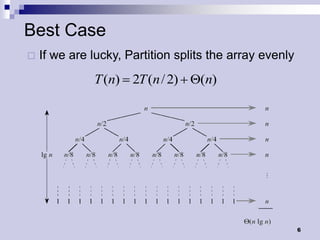
Best Case
   If we are lucky, Partition splits the array evenly
              T (n) 2T (n / 2)     (n)


                                                         6
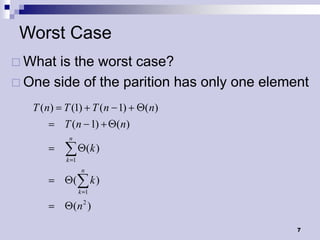
Worst Case
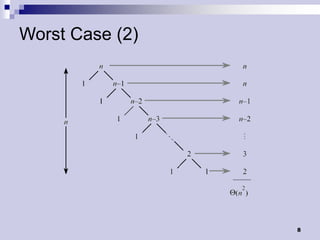
 What is the worst case?
 One side of the parition has only one element

   T (n) T (1) T (n 1)              ( n)
         T (n 1)             ( n)
          n
                      (k )
         k 1
                  n
              (         k)
                  k 1

              (n 2 )

                                             7
Worst Case (2)


                 8
Worst Case (3)
 When   does the worst case appear?
   input is sorted
   input reverse sorted

 Same   recurrence for the worst case of
  insertion sort
 However, sorted input yields the best case
  for insertion sort!


                                               9
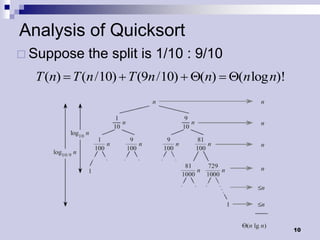
Analysis of Quicksort
 Suppose   the split is 1/10 : 9/10
  T (n) T (n /10) T (9n /10)   (n)     (n log n)!


                                                    10
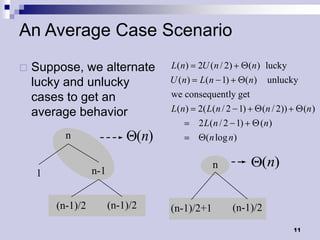
An Average Case Scenario
   Suppose, we alternate           L( n) 2U ( n / 2)      (n ) lucky
    lucky and unlucky               U ( n) L( n 1)     (n) unlucky
    cases to get an                 we consequently get
    average behavior                L( n) 2( L(n / 2 1)    (n / 2)) (n )
                                           2 L(n / 2 1)       (n )
          n                   (n)            (n log n )

                                                n             (n)
    1             n-1


        (n-1)/2         (n-1)/2     (n-1)/2+1           (n-1)/2
                                                                        11
An Average Case Scenario (2)
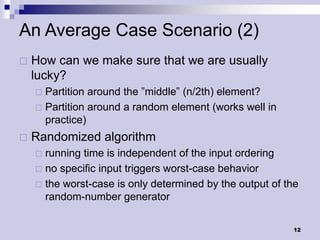
   How can we make sure that we are usually
    lucky?
     Partition around the ”middle” (n/2th) element?
     Partition around a random element (works well in
      practice)
   Randomized algorithm
     running time is independent of the input ordering
     no specific input triggers worst-case behavior
     the worst-case is only determined by the output of the
      random-number generator

                                                          12
Randomized Quicksort
 Assume    all elements are distinct
 Partition around a random element
 Consequently, all splits (1:n-1, 2:n-2, ..., n-
  1:1) are equally likely with probability 1/n

 Randomization   is a general tool to improve
  algorithms with bad worst-case but good
  average-case complexity

                                                13
Randomized Quicksort (2)
    Randomized-Partition(A,p,r)
    01 i   Random(p,r)
    02 exchange A[r]     A[i]
    03 return Partition(A,p,r)

    Randomized-Quicksort(A,p,r)
    01 if p < r then
    02    q     Randomized-Partition(A,p,r)
    03    Randomized-Quicksort(A,p,q)
    04    Randomized-Quicksort(A,q+1,r)


                                              14
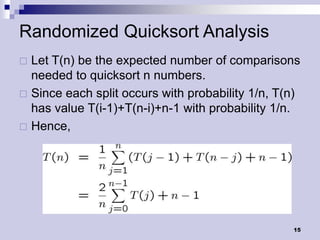
Randomized Quicksort Analysis
 Let T(n) be the expected number of comparisons
  needed to quicksort n numbers.
 Since each split occurs with probability 1/n, T(n)
  has value T(i-1)+T(n-i)+n-1 with probability 1/n.
 Hence,


                                                  15
Randomized Quicksort Analysis(2)
 We    have seen this recurrence before.
 It is the recurrence for the expected
  number of comparisons required to insert
  a randomly chosen permutation of n
  elements.
 We proved that T(n) = O(nlog2 n).
 Hence expected number of comparisons
  required by randomized quicksort is
  O(nlog2 n)
                                             16
Randomized Quicksort running times


 Worst   case running time of quicksort is
  O(n2)
 Best case running time of quicksort is
  O(nlog2 n)
 Expected running time of quicksort is
  O(nlog2 n)


                                              17
What does expected running time mean?
 The running time of quicksort does not depend
  on the input. It depends on the random numbers
  provided by the generator.
 Thus for the same input the program might take
  3sec today and 5sec tomorrow.
 The average time taken over many different runs
  of the program would give us the expected time.
 Same as saying that we are taking average over
  all possible random number sequences provided
  by the generator.
                                                18
Analysis of insertion in BST
 When creating a binary search tree on n
  elements the running time does depend on the
  order of the elements.
 Our algorithm for insertion did not employ an
  random bits.
 Given a specific input order the algorithm takes
  the same time each day.
 However, the time taken is different for different
  input orders.
 The average time taken over all possible input
  orders is O(nlog2 n).
                                                       19

Lec10

  • 1.
    Quick Sort  Characteristics  sorts almost in "place," i.e., does not require an additional array  very practical, average sort performance O(n log n) (with small constant factors), but worst case O(n2) 1
  • 2.
    Quick Sort –the Principle  To understand quick-sort, let’s look at a high-level description of the algorithm  A divide-and-conquer algorithm  Divide: partition array into 2 subarrays such that elements in the lower part <= elements in the higher part  Conquer: recursively sort the 2 subarrays  Combine: trivial since sorting is done in place 2
  • 3.
    Partitioning  Linear time partitioning procedure Partition(A,p,r) i i j j 01 x A[r] 17 12 6 19 23 8 5 10 02 i p-1 03 j r+1 X=10 i j 04 while TRUE 10 12 6 19 23 8 5 17 05 repeat j j-1 06 until A[j] x i j 07 repeat i i+1 08 until A[i] x 10 5 6 19 23 8 12 17 09 if i<j 10 then exchange A[i] A[j] j i 11 else return j 10 5 6 8 23 19 12 17 3
  • 4.
    Quick Sort Algorithm Initial call Quicksort(A, 1, length[A]) Quicksort(A,p,r) 01 if p<r 02 then q Partition(A,p,r) 03 Quicksort(A,p,q) 04 Quicksort(A,q+1,r) 4
  • 5.
    Analysis of Quicksort Assume that all input elements are distinct  The running time depends on the distribution of splits 5
  • 6.
    Best Case  If we are lucky, Partition splits the array evenly T (n) 2T (n / 2) (n) 6
  • 7.
    Worst Case  Whatis the worst case?  One side of the parition has only one element T (n) T (1) T (n 1) ( n) T (n 1) ( n) n (k ) k 1 n ( k) k 1 (n 2 ) 7
  • 8.
  • 9.
    Worst Case (3) When does the worst case appear?  input is sorted  input reverse sorted  Same recurrence for the worst case of insertion sort  However, sorted input yields the best case for insertion sort! 9
  • 10.
    Analysis of Quicksort Suppose the split is 1/10 : 9/10 T (n) T (n /10) T (9n /10) (n) (n log n)! 10
  • 11.
    An Average CaseScenario  Suppose, we alternate L( n) 2U ( n / 2) (n ) lucky lucky and unlucky U ( n) L( n 1) (n) unlucky cases to get an we consequently get average behavior L( n) 2( L(n / 2 1) (n / 2)) (n ) 2 L(n / 2 1) (n ) n (n) (n log n ) n (n) 1 n-1 (n-1)/2 (n-1)/2 (n-1)/2+1 (n-1)/2 11
  • 12.
    An Average CaseScenario (2)  How can we make sure that we are usually lucky?  Partition around the ”middle” (n/2th) element?  Partition around a random element (works well in practice)  Randomized algorithm  running time is independent of the input ordering  no specific input triggers worst-case behavior  the worst-case is only determined by the output of the random-number generator 12
  • 13.
    Randomized Quicksort  Assume all elements are distinct  Partition around a random element  Consequently, all splits (1:n-1, 2:n-2, ..., n- 1:1) are equally likely with probability 1/n  Randomization is a general tool to improve algorithms with bad worst-case but good average-case complexity 13
  • 14.
    Randomized Quicksort (2) Randomized-Partition(A,p,r) 01 i Random(p,r) 02 exchange A[r] A[i] 03 return Partition(A,p,r) Randomized-Quicksort(A,p,r) 01 if p < r then 02 q Randomized-Partition(A,p,r) 03 Randomized-Quicksort(A,p,q) 04 Randomized-Quicksort(A,q+1,r) 14
  • 15.
    Randomized Quicksort Analysis Let T(n) be the expected number of comparisons needed to quicksort n numbers.  Since each split occurs with probability 1/n, T(n) has value T(i-1)+T(n-i)+n-1 with probability 1/n.  Hence, 15
  • 16.
    Randomized Quicksort Analysis(2) We have seen this recurrence before.  It is the recurrence for the expected number of comparisons required to insert a randomly chosen permutation of n elements.  We proved that T(n) = O(nlog2 n).  Hence expected number of comparisons required by randomized quicksort is O(nlog2 n) 16
  • 17.
    Randomized Quicksort runningtimes  Worst case running time of quicksort is O(n2)  Best case running time of quicksort is O(nlog2 n)  Expected running time of quicksort is O(nlog2 n) 17
  • 18.
    What does expectedrunning time mean?  The running time of quicksort does not depend on the input. It depends on the random numbers provided by the generator.  Thus for the same input the program might take 3sec today and 5sec tomorrow.  The average time taken over many different runs of the program would give us the expected time.  Same as saying that we are taking average over all possible random number sequences provided by the generator. 18
  • 19.
    Analysis of insertionin BST  When creating a binary search tree on n elements the running time does depend on the order of the elements.  Our algorithm for insertion did not employ an random bits.  Given a specific input order the algorithm takes the same time each day.  However, the time taken is different for different input orders.  The average time taken over all possible input orders is O(nlog2 n). 19