Cssfounder.com
• Website development company Surat
• Website designing company in Surat
© 2011 Pearson Education, Inc http://cssfounder.com
© 2011 Pearson Education, Inc
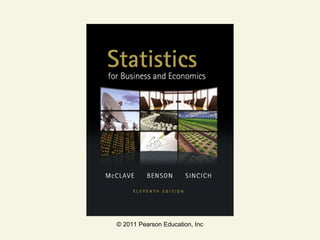
Statistics for Business and
Economics
Chapter 1
Statistics, Data, &
Statistical Thinking
© 2011 Pearson Education, Inc
Contents
1. The Science of Statistics
2. Types of Statistical Applications in Business
3. Fundamental Elements of Statistics
4. Processes
5. Types of Data
6. Collecting Data
7. The Role of Statistics in Managerial Decision
Making
© 2011 Pearson Education, Inc
Learning Objectives
1. Introduce the field of statistics
2. Demonstrate how statistics applies to business
3. Establish the link between statistics and data
4. Identify the different types of data and data-
collection methods
5. Differentiate between population and sample data
6. Differentiate between descriptive and inferential
statistics
© 2011 Pearson Education, Inc
1.1
The Science of Statistics
© 2011 Pearson Education, Inc
What Is Statistics?
Why?1. Collecting Data
e.g., Survey
1. Presenting Data
e.g., Charts & Tables
1. Characterizing Data
e.g., Average
Data
Analysis
Decision-
Making
© 1984-1994 T/Maker Co.
© 2011 Pearson Education, Inc
What Is Statistics?
Statistics is the science of data. It involves
collecting, classifying, summarizing, organizing,
analyzing, and interpreting numerical
information.
© 2011 Pearson Education, Inc
1.2
Types of Statistical Applications in
Business
© 2011 Pearson Education, Inc
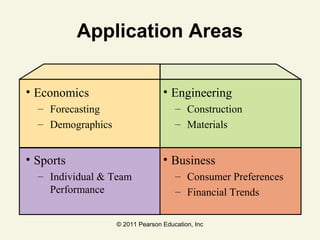
Application Areas
• Economics
– Forecasting
– Demographics
• Sports
– Individual & Team
Performance
• Engineering
– Construction
– Materials
• Business
– Consumer Preferences
– Financial Trends
© 2011 Pearson Education, Inc
Statistics: Two Processes
Describing sets of data
and
Drawing conclusions (making estimates,
decisions, predictions, etc. about sets of data
based on sampling)
© 2011 Pearson Education, Inc
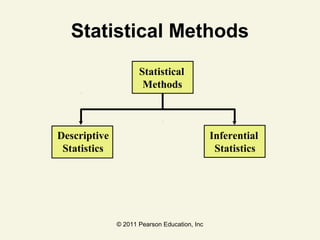
Statistical Methods
Statistical
Methods
Descriptive
Statistics
Inferential
Statistics
© 2011 Pearson Education, Inc
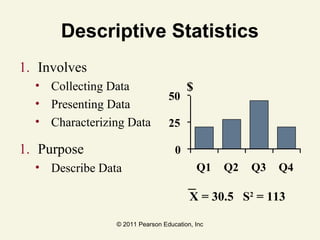
Descriptive Statistics
1. Involves
• Collecting Data
• Presenting Data
• Characterizing Data
1. Purpose
• Describe Data
X = 30.5 S2
= 113
0
25
50
Q1 Q2 Q3 Q4
$
© 2011 Pearson Education, Inc
1. Involves
• Estimation
• Hypothesis
Testing
1. Purpose
• Make decisions about
population characteristics
Inferential Statistics
Population?
© 2011 Pearson Education, Inc
1.3
Fundamental Elements
of Statistics
© 2011 Pearson Education, Inc
Fundamental Elements
1. Experimental unit
• Object upon which we collect data
1. Population
• All items of interest
1. Variable
• Characteristic of an individual
experimental unit
1. Sample
• Subset of the units of a population
• PP in PPopulation
& PParameter
• SS in SSample
& SStatistic
© 2011 Pearson Education, Inc
Fundamental Elements
1. Statistical Inference
• Estimate or prediction or generalization about a
population based on information contained in a
sample
1. Measure of Reliability
• Statement (usually qualified) about the degree
of uncertainty associated with a statistical
inference
© 2011 Pearson Education, Inc
Four Elements of Descriptive
Statistical Problems
1. The population or sample of interest
2. One or more variables (characteristics of the
population or sample units) that are to be
investigated
3. Tables, graphs, or numerical summary tools
4. Identification of patterns in the data
© 2011 Pearson Education, Inc
Five Elements of Inferential
Statistical Problems
1. The population of interest
2. One or more variables (characteristics of the
population units) that are to be investigated
3. The sample of population units
4. The inference about the population based on
information contained in the sample
5. A measure of reliability for the inference
© 2011 Pearson Education, Inc
1.4
Processes
© 2011 Pearson Education, Inc
Process
A process is a series of actions or operations that
transforms inputs to outputs. A process produces or
generates output over time.
© 2011 Pearson Education, Inc
Process
A process whose operations or actions are unknown or
unspecified is called a black box.
Any set of output (object or numbers) produced by a
process is called a sample.
© 2011 Pearson Education, Inc
1.5
Types of Data
© 2011 Pearson Education, Inc
Types of Data
Quantitative data are measurements that are recorded
on a naturally occurring numerical scale.
Qualitative data are measurements that cannot be
measured on a natural numerical scale; they can only be
classified into one of a group of categories.
© 2011 Pearson Education, Inc
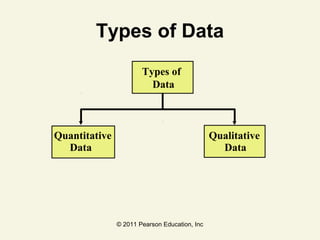
Types of Data
Types of
Data
Quantitative
Data
Qualitative
Data
© 2011 Pearson Education, Inc
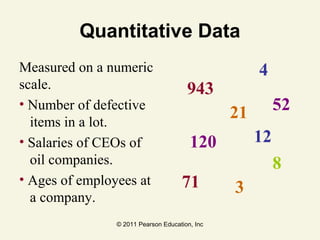
Quantitative Data
Measured on a numeric
scale.
• Number of defective
items in a lot.
• Salaries of CEOs of
oil companies.
• Ages of employees at
a company.
3
52
71
4
8
943
120 12
21
© 2011 Pearson Education, Inc
Qualitative Data
Classified into categories.
• College major of each
student in a class.
• Gender of each employee
at a company.
• Method of payment
(cash, check, credit card).
$$ Credit
© 2011 Pearson Education, Inc
1.6
Collecting Data
© 2011 Pearson Education, Inc
Obtaining Data
1. Data from a published source
2. Data from a designed experiment
3. Data from a survey
4. Data collected observationally
© 2011 Pearson Education, Inc
Obtaining Data
Published source:
book, journal, newspaper, Web site
Designed experiment:
researcher exerts strict control over units
Survey:
a group of people are surveyed and their
responses are recorded
Observation study:
units are observed in natural setting and
variables of interest are recorded
© 2011 Pearson Education, Inc
Samples
A representative sample exhibits characteristics
typical of those possessed by the population of
interest.
A random sample of n experimental units is a
sample selected from the population in such a way
that every different sample of size n has an equal
chance of selection.
© 2011 Pearson Education, Inc
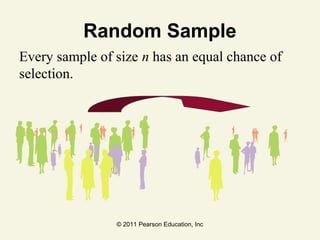
Random Sample
Every sample of size n has an equal chance of
selection.
© 2011 Pearson Education, Inc
1.7
The Role of Statistics in
Managerial Decision Making
© 2011 Pearson Education, Inc
Statistical Thinking
Statistical thinking involves applying rational
thought and the science of statistics to critically
assess data and inferences. Fundamental to the
thought process is that variation exists in
populations and process data.
A random sample of n experimental units is a
sample selected from the population in such a way
that every different sample of size n has an equal
chance of selection.
© 2011 Pearson Education, Inc
Nonrandom Sample Errors
Selection bias results when a subset of the
experimental units in the population is excluded so
that these units have no chance of being selected for
the sample.
Nonresponse bias results when the researchers
conducting a survey or study are unable to obtain data
on all experimental units selected for the sample.
Measurement error refers to inaccuracies in the
values of the data recorded. In surveys, the error may
be due to ambiguous or leading questions and the
interviewer’s effect on the respondent.
© 2011 Pearson Education, Inc
Real-World Problem
© 2011 Pearson Education, Inc
Statistical
Computer Packages
1. Typical Software
• SPSS
• MINITAB
• Excel
1. Need Statistical
Understanding
• Assumptions
• Limitations
© 2011 Pearson Education, Inc
Key Ideas
Types of Statistical Applications
Descriptive
1. Identify population and sample (collection
of experimental units)
2. Identify variable(s)
3. Collect data
4. Describe data
© 2011 Pearson Education, Inc
Key Ideas
Types of Statistical Applications
Inferential
1. Identify population (collection of all
experimental units)
2. Identify variable(s)
3. Collect sample data (subset of population)
4. Inference about population based on sample
5. Measure of reliability for inference
© 2011 Pearson Education, Inc
Key Ideas
Types of Data
1. Quantitative (numerical in nature)
2. Qualitative (categorical in nature)
© 2011 Pearson Education, Inc
Key Ideas
Data-Collection Methods
1. Observational
2. Published source
3. Survey
4. Designed experiment
© 2011 Pearson Education, Inc
Key Ideas
Problems with Nonrandom Samples
1. Selection bias
2. Nonresponse bias
3. Measurement error

Website development company surat

  • 1.
    Cssfounder.com • Website developmentcompany Surat • Website designing company in Surat © 2011 Pearson Education, Inc http://cssfounder.com
  • 2.
    © 2011 PearsonEducation, Inc
  • 3.
    © 2011 PearsonEducation, Inc Statistics for Business and Economics Chapter 1 Statistics, Data, & Statistical Thinking
  • 4.
    © 2011 PearsonEducation, Inc Contents 1. The Science of Statistics 2. Types of Statistical Applications in Business 3. Fundamental Elements of Statistics 4. Processes 5. Types of Data 6. Collecting Data 7. The Role of Statistics in Managerial Decision Making
  • 5.
    © 2011 PearsonEducation, Inc Learning Objectives 1. Introduce the field of statistics 2. Demonstrate how statistics applies to business 3. Establish the link between statistics and data 4. Identify the different types of data and data- collection methods 5. Differentiate between population and sample data 6. Differentiate between descriptive and inferential statistics
  • 6.
    © 2011 PearsonEducation, Inc 1.1 The Science of Statistics
  • 7.
    © 2011 PearsonEducation, Inc What Is Statistics? Why?1. Collecting Data e.g., Survey 1. Presenting Data e.g., Charts & Tables 1. Characterizing Data e.g., Average Data Analysis Decision- Making © 1984-1994 T/Maker Co. © 1984-1994 T/Maker Co.
  • 8.
    © 2011 PearsonEducation, Inc What Is Statistics? Statistics is the science of data. It involves collecting, classifying, summarizing, organizing, analyzing, and interpreting numerical information.
  • 9.
    © 2011 PearsonEducation, Inc 1.2 Types of Statistical Applications in Business
  • 10.
    © 2011 PearsonEducation, Inc Application Areas • Economics – Forecasting – Demographics • Sports – Individual & Team Performance • Engineering – Construction – Materials • Business – Consumer Preferences – Financial Trends
  • 11.
    © 2011 PearsonEducation, Inc Statistics: Two Processes Describing sets of data and Drawing conclusions (making estimates, decisions, predictions, etc. about sets of data based on sampling)
  • 12.
    © 2011 PearsonEducation, Inc Statistical Methods Statistical Methods Descriptive Statistics Inferential Statistics
  • 13.
    © 2011 PearsonEducation, Inc Descriptive Statistics 1. Involves • Collecting Data • Presenting Data • Characterizing Data 1. Purpose • Describe Data X = 30.5 S2 = 113 0 25 50 Q1 Q2 Q3 Q4 $
  • 14.
    © 2011 PearsonEducation, Inc 1. Involves • Estimation • Hypothesis Testing 1. Purpose • Make decisions about population characteristics Inferential Statistics Population?
  • 15.
    © 2011 PearsonEducation, Inc 1.3 Fundamental Elements of Statistics
  • 16.
    © 2011 PearsonEducation, Inc Fundamental Elements 1. Experimental unit • Object upon which we collect data 1. Population • All items of interest 1. Variable • Characteristic of an individual experimental unit 1. Sample • Subset of the units of a population • PP in PPopulation & PParameter • SS in SSample & SStatistic
  • 17.
    © 2011 PearsonEducation, Inc Fundamental Elements 1. Statistical Inference • Estimate or prediction or generalization about a population based on information contained in a sample 1. Measure of Reliability • Statement (usually qualified) about the degree of uncertainty associated with a statistical inference
  • 18.
    © 2011 PearsonEducation, Inc Four Elements of Descriptive Statistical Problems 1. The population or sample of interest 2. One or more variables (characteristics of the population or sample units) that are to be investigated 3. Tables, graphs, or numerical summary tools 4. Identification of patterns in the data
  • 19.
    © 2011 PearsonEducation, Inc Five Elements of Inferential Statistical Problems 1. The population of interest 2. One or more variables (characteristics of the population units) that are to be investigated 3. The sample of population units 4. The inference about the population based on information contained in the sample 5. A measure of reliability for the inference
  • 20.
    © 2011 PearsonEducation, Inc 1.4 Processes
  • 21.
    © 2011 PearsonEducation, Inc Process A process is a series of actions or operations that transforms inputs to outputs. A process produces or generates output over time.
  • 22.
    © 2011 PearsonEducation, Inc Process A process whose operations or actions are unknown or unspecified is called a black box. Any set of output (object or numbers) produced by a process is called a sample.
  • 23.
    © 2011 PearsonEducation, Inc 1.5 Types of Data
  • 24.
    © 2011 PearsonEducation, Inc Types of Data Quantitative data are measurements that are recorded on a naturally occurring numerical scale. Qualitative data are measurements that cannot be measured on a natural numerical scale; they can only be classified into one of a group of categories.
  • 25.
    © 2011 PearsonEducation, Inc Types of Data Types of Data Quantitative Data Qualitative Data
  • 26.
    © 2011 PearsonEducation, Inc Quantitative Data Measured on a numeric scale. • Number of defective items in a lot. • Salaries of CEOs of oil companies. • Ages of employees at a company. 3 52 71 4 8 943 120 12 21
  • 27.
    © 2011 PearsonEducation, Inc Qualitative Data Classified into categories. • College major of each student in a class. • Gender of each employee at a company. • Method of payment (cash, check, credit card). $$ Credit
  • 28.
    © 2011 PearsonEducation, Inc 1.6 Collecting Data
  • 29.
    © 2011 PearsonEducation, Inc Obtaining Data 1. Data from a published source 2. Data from a designed experiment 3. Data from a survey 4. Data collected observationally
  • 30.
    © 2011 PearsonEducation, Inc Obtaining Data Published source: book, journal, newspaper, Web site Designed experiment: researcher exerts strict control over units Survey: a group of people are surveyed and their responses are recorded Observation study: units are observed in natural setting and variables of interest are recorded
  • 31.
    © 2011 PearsonEducation, Inc Samples A representative sample exhibits characteristics typical of those possessed by the population of interest. A random sample of n experimental units is a sample selected from the population in such a way that every different sample of size n has an equal chance of selection.
  • 32.
    © 2011 PearsonEducation, Inc Random Sample Every sample of size n has an equal chance of selection.
  • 33.
    © 2011 PearsonEducation, Inc 1.7 The Role of Statistics in Managerial Decision Making
  • 34.
    © 2011 PearsonEducation, Inc Statistical Thinking Statistical thinking involves applying rational thought and the science of statistics to critically assess data and inferences. Fundamental to the thought process is that variation exists in populations and process data. A random sample of n experimental units is a sample selected from the population in such a way that every different sample of size n has an equal chance of selection.
  • 35.
    © 2011 PearsonEducation, Inc Nonrandom Sample Errors Selection bias results when a subset of the experimental units in the population is excluded so that these units have no chance of being selected for the sample. Nonresponse bias results when the researchers conducting a survey or study are unable to obtain data on all experimental units selected for the sample. Measurement error refers to inaccuracies in the values of the data recorded. In surveys, the error may be due to ambiguous or leading questions and the interviewer’s effect on the respondent.
  • 36.
    © 2011 PearsonEducation, Inc Real-World Problem
  • 37.
    © 2011 PearsonEducation, Inc Statistical Computer Packages 1. Typical Software • SPSS • MINITAB • Excel 1. Need Statistical Understanding • Assumptions • Limitations
  • 38.
    © 2011 PearsonEducation, Inc Key Ideas Types of Statistical Applications Descriptive 1. Identify population and sample (collection of experimental units) 2. Identify variable(s) 3. Collect data 4. Describe data
  • 39.
    © 2011 PearsonEducation, Inc Key Ideas Types of Statistical Applications Inferential 1. Identify population (collection of all experimental units) 2. Identify variable(s) 3. Collect sample data (subset of population) 4. Inference about population based on sample 5. Measure of reliability for inference
  • 40.
    © 2011 PearsonEducation, Inc Key Ideas Types of Data 1. Quantitative (numerical in nature) 2. Qualitative (categorical in nature)
  • 41.
    © 2011 PearsonEducation, Inc Key Ideas Data-Collection Methods 1. Observational 2. Published source 3. Survey 4. Designed experiment
  • 42.
    © 2011 PearsonEducation, Inc Key Ideas Problems with Nonrandom Samples 1. Selection bias 2. Nonresponse bias 3. Measurement error

Editor's Notes

  • #7 :1, 1, 3
  • #8 :1, 1, 3
  • #9 :1, 1, 3
  • #10 :1, 1, 3
  • #12 :1, 1, 3
  • #16 :1, 1, 3
  • #17 Data facts or information that is relevant or appropriate to a decision maker Population the totality of objects under consideration Sample a portion of the population that is selected for analysis Parameter a summary measure (e.g., mean) that is computed to describe a characteristic of the population Statistic a summary measure (e.g., mean) that is computed to describe a characteristic of the sample
  • #18 Data facts or information that is relevant or appropriate to a decision maker Population the totality of objects under consideration Sample a portion of the population that is selected for analysis Parameter a summary measure (e.g., mean) that is computed to describe a characteristic of the population Statistic a summary measure (e.g., mean) that is computed to describe a characteristic of the sample
  • #19 Data facts or information that is relevant or appropriate to a decision maker Population the totality of objects under consideration Sample a portion of the population that is selected for analysis Parameter a summary measure (e.g., mean) that is computed to describe a characteristic of the population Statistic a summary measure (e.g., mean) that is computed to describe a characteristic of the sample
  • #20 Data facts or information that is relevant or appropriate to a decision maker Population the totality of objects under consideration Sample a portion of the population that is selected for analysis Parameter a summary measure (e.g., mean) that is computed to describe a characteristic of the population Statistic a summary measure (e.g., mean) that is computed to describe a characteristic of the sample
  • #21 :1, 1, 3
  • #22 Data facts or information that is relevant or appropriate to a decision maker Population the totality of objects under consideration Sample a portion of the population that is selected for analysis Parameter a summary measure (e.g., mean) that is computed to describe a characteristic of the population Statistic a summary measure (e.g., mean) that is computed to describe a characteristic of the sample
  • #23 Data facts or information that is relevant or appropriate to a decision maker Population the totality of objects under consideration Sample a portion of the population that is selected for analysis Parameter a summary measure (e.g., mean) that is computed to describe a characteristic of the population Statistic a summary measure (e.g., mean) that is computed to describe a characteristic of the sample
  • #24 :1, 1, 3
  • #25 Data facts or information that is relevant or appropriate to a decision maker Population the totality of objects under consideration Sample a portion of the population that is selected for analysis Parameter a summary measure (e.g., mean) that is computed to describe a characteristic of the population Statistic a summary measure (e.g., mean) that is computed to describe a characteristic of the sample
  • #29 :1, 1, 3
  • #30 Data facts or information that is relevant or appropriate to a decision maker Population the totality of objects under consideration Sample a portion of the population that is selected for analysis Parameter a summary measure (e.g., mean) that is computed to describe a characteristic of the population Statistic a summary measure (e.g., mean) that is computed to describe a characteristic of the sample
  • #34 :1, 1, 3