David Luebke 1 8/29/2022
CS 332: Algorithms
Quicksort
David Luebke 2 8/29/2022
Homework 2
 Assigned today, due next Wednesday
 Will be on web page shortly after class
 Go over now
David Luebke 3 8/29/2022
Review: Quicksort
 Sorts in place
 Sorts O(n lg n) in the average case
 Sorts O(n2) in the worst case
 But in practice, it’s quick
 And the worst case doesn’t happen often (but more
on this later…)
David Luebke 4 8/29/2022
Quicksort
 Another divide-and-conquer algorithm
 The array A[p..r] is partitioned into two non-empty
subarrays A[p..q] and A[q+1..r]
 Invariant: All elements in A[p..q] are less than all
elements in A[q+1..r]
 The subarrays are recursively sorted by calls to
quicksort
 Unlike merge sort, no combining step: two
subarrays form an already-sorted array
David Luebke 5 8/29/2022
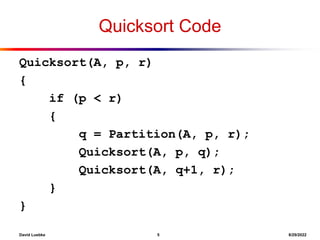
Quicksort Code
Quicksort(A, p, r)
{
if (p < r)
{
q = Partition(A, p, r);
Quicksort(A, p, q);
Quicksort(A, q+1, r);
}
}
David Luebke 6 8/29/2022
Partition
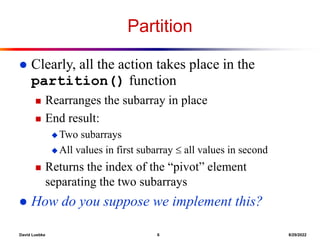
 Clearly, all the action takes place in the
partition() function
 Rearranges the subarray in place
 End result:
 Two subarrays
 All values in first subarray  all values in second
 Returns the index of the “pivot” element
separating the two subarrays
 How do you suppose we implement this?
David Luebke 7 8/29/2022
Partition In Words
 Partition(A, p, r):
 Select an element to act as the “pivot” (which?)
 Grow two regions, A[p..i] and A[j..r]
 All elements in A[p..i] <= pivot
 All elements in A[j..r] >= pivot
 Increment i until A[i] >= pivot
 Decrement j until A[j] <= pivot
 Swap A[i] and A[j]
 Repeat until i >= j
 Return j
Note: slightly different from
book’s partition()
David Luebke 8 8/29/2022
Partition Code
Partition(A, p, r)
x = A[p];
i = p - 1;
j = r + 1;
while (TRUE)
repeat
j--;
until A[j] <= x;
repeat
i++;
until A[i] >= x;
if (i < j)
Swap(A, i, j);
else
return j;
Illustrate on
A = {5, 3, 2, 6, 4, 1, 3, 7};
What is the running time of
partition()?
David Luebke 9 8/29/2022
Partition Code
Partition(A, p, r)
x = A[p];
i = p - 1;
j = r + 1;
while (TRUE)
repeat
j--;
until A[j] <= x;
repeat
i++;
until A[i] >= x;
if (i < j)
Swap(A, i, j);
else
return j;
partition() runs in O(n) time
David Luebke 10 8/29/2022
Analyzing Quicksort
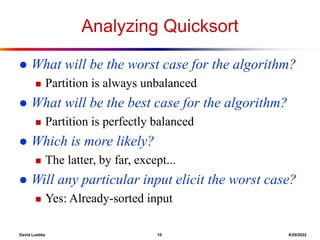
 What will be the worst case for the algorithm?
 Partition is always unbalanced
 What will be the best case for the algorithm?
 Partition is perfectly balanced
 Which is more likely?
 The latter, by far, except...
 Will any particular input elicit the worst case?
 Yes: Already-sorted input
David Luebke 11 8/29/2022
Analyzing Quicksort
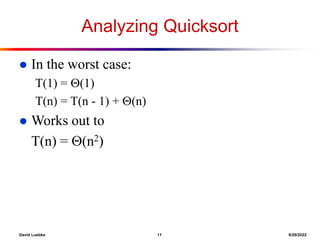
 In the worst case:
T(1) = (1)
T(n) = T(n - 1) + (n)
 Works out to
T(n) = (n2)
David Luebke 12 8/29/2022
Analyzing Quicksort
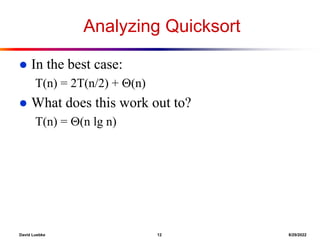
 In the best case:
T(n) = 2T(n/2) + (n)
 What does this work out to?
T(n) = (n lg n)
David Luebke 13 8/29/2022
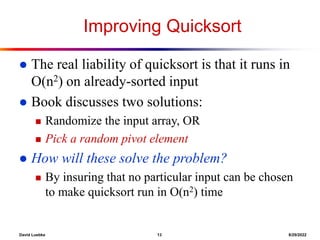
Improving Quicksort
 The real liability of quicksort is that it runs in
O(n2) on already-sorted input
 Book discusses two solutions:
 Randomize the input array, OR
 Pick a random pivot element
 How will these solve the problem?
 By insuring that no particular input can be chosen
to make quicksort run in O(n2) time
David Luebke 14 8/29/2022
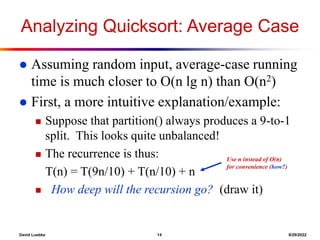
Analyzing Quicksort: Average Case
 Assuming random input, average-case running
time is much closer to O(n lg n) than O(n2)
 First, a more intuitive explanation/example:
 Suppose that partition() always produces a 9-to-1
split. This looks quite unbalanced!
 The recurrence is thus:
T(n) = T(9n/10) + T(n/10) + n
 How deep will the recursion go? (draw it)
Use n instead of O(n)
for convenience (how?)
David Luebke 15 8/29/2022
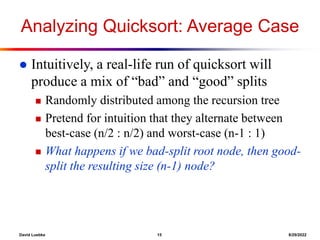
Analyzing Quicksort: Average Case
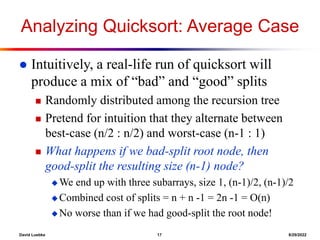
 Intuitively, a real-life run of quicksort will
produce a mix of “bad” and “good” splits
 Randomly distributed among the recursion tree
 Pretend for intuition that they alternate between
best-case (n/2 : n/2) and worst-case (n-1 : 1)
 What happens if we bad-split root node, then good-
split the resulting size (n-1) node?
David Luebke 16 8/29/2022
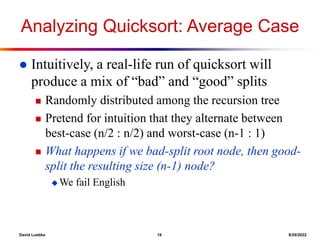
Analyzing Quicksort: Average Case
 Intuitively, a real-life run of quicksort will
produce a mix of “bad” and “good” splits
 Randomly distributed among the recursion tree
 Pretend for intuition that they alternate between
best-case (n/2 : n/2) and worst-case (n-1 : 1)
 What happens if we bad-split root node, then good-
split the resulting size (n-1) node?
 We fail English
David Luebke 17 8/29/2022
Analyzing Quicksort: Average Case
 Intuitively, a real-life run of quicksort will
produce a mix of “bad” and “good” splits
 Randomly distributed among the recursion tree
 Pretend for intuition that they alternate between
best-case (n/2 : n/2) and worst-case (n-1 : 1)
 What happens if we bad-split root node, then
good-split the resulting size (n-1) node?
 We end up with three subarrays, size 1, (n-1)/2, (n-1)/2
 Combined cost of splits = n + n -1 = 2n -1 = O(n)
 No worse than if we had good-split the root node!
David Luebke 18 8/29/2022
Analyzing Quicksort: Average Case
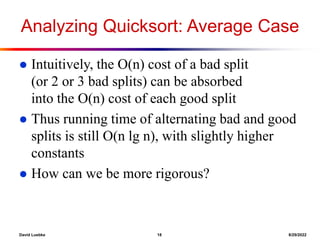
 Intuitively, the O(n) cost of a bad split
(or 2 or 3 bad splits) can be absorbed
into the O(n) cost of each good split
 Thus running time of alternating bad and good
splits is still O(n lg n), with slightly higher
constants
 How can we be more rigorous?
David Luebke 19 8/29/2022
Analyzing Quicksort: Average Case
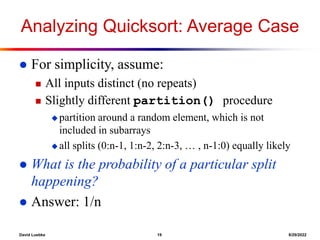
 For simplicity, assume:
 All inputs distinct (no repeats)
 Slightly different partition() procedure
 partition around a random element, which is not
included in subarrays
 all splits (0:n-1, 1:n-2, 2:n-3, … , n-1:0) equally likely
 What is the probability of a particular split
happening?
 Answer: 1/n
David Luebke 20 8/29/2022
Analyzing Quicksort: Average Case
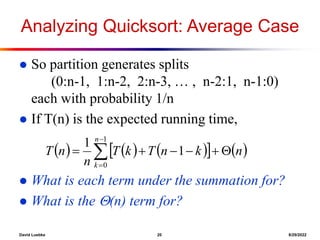
 So partition generates splits
(0:n-1, 1:n-2, 2:n-3, … , n-2:1, n-1:0)
each with probability 1/n
 If T(n) is the expected running time,
 What is each term under the summation for?
 What is the (n) term for?
     
   









1
0
1
1 n
k
n
k
n
T
k
T
n
n
T
David Luebke 21 8/29/2022
Analyzing Quicksort: Average Case
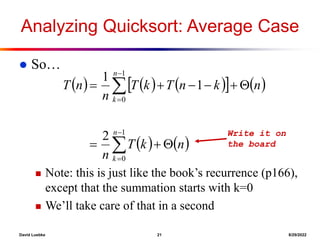
 So…
 Note: this is just like the book’s recurrence (p166),
except that the summation starts with k=0
 We’ll take care of that in a second
     
   
   















1
0
1
0
2
1
1
n
k
n
k
n
k
T
n
n
k
n
T
k
T
n
n
T
Write it on
the board
David Luebke 22 8/29/2022
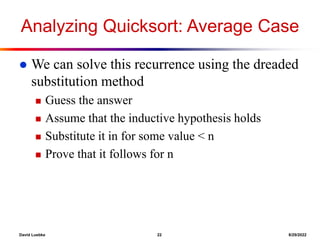
Analyzing Quicksort: Average Case
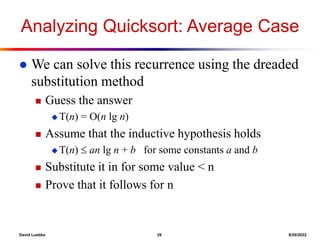
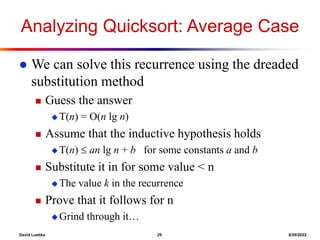
 We can solve this recurrence using the dreaded
substitution method
 Guess the answer
 Assume that the inductive hypothesis holds
 Substitute it in for some value < n
 Prove that it follows for n
David Luebke 23 8/29/2022
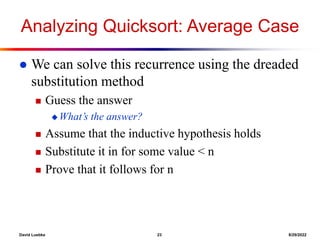
Analyzing Quicksort: Average Case
 We can solve this recurrence using the dreaded
substitution method
 Guess the answer
 What’s the answer?
 Assume that the inductive hypothesis holds
 Substitute it in for some value < n
 Prove that it follows for n
David Luebke 24 8/29/2022
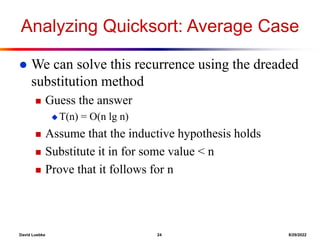
Analyzing Quicksort: Average Case
 We can solve this recurrence using the dreaded
substitution method
 Guess the answer
 T(n) = O(n lg n)
 Assume that the inductive hypothesis holds
 Substitute it in for some value < n
 Prove that it follows for n
David Luebke 25 8/29/2022
Analyzing Quicksort: Average Case
 We can solve this recurrence using the dreaded
substitution method
 Guess the answer
 T(n) = O(n lg n)
 Assume that the inductive hypothesis holds
 What’s the inductive hypothesis?
 Substitute it in for some value < n
 Prove that it follows for n
David Luebke 26 8/29/2022
Analyzing Quicksort: Average Case
 We can solve this recurrence using the dreaded
substitution method
 Guess the answer
 T(n) = O(n lg n)
 Assume that the inductive hypothesis holds
 T(n)  an lg n + b for some constants a and b
 Substitute it in for some value < n
 Prove that it follows for n
David Luebke 27 8/29/2022
Analyzing Quicksort: Average Case
 We can solve this recurrence using the dreaded
substitution method
 Guess the answer
 T(n) = O(n lg n)
 Assume that the inductive hypothesis holds
 T(n)  an lg n + b for some constants a and b
 Substitute it in for some value < n
 What value?
 Prove that it follows for n
David Luebke 28 8/29/2022
Analyzing Quicksort: Average Case
 We can solve this recurrence using the dreaded
substitution method
 Guess the answer
 T(n) = O(n lg n)
 Assume that the inductive hypothesis holds
 T(n)  an lg n + b for some constants a and b
 Substitute it in for some value < n
 The value k in the recurrence
 Prove that it follows for n
David Luebke 29 8/29/2022
Analyzing Quicksort: Average Case
 We can solve this recurrence using the dreaded
substitution method
 Guess the answer
 T(n) = O(n lg n)
 Assume that the inductive hypothesis holds
 T(n)  an lg n + b for some constants a and b
 Substitute it in for some value < n
 The value k in the recurrence
 Prove that it follows for n
 Grind through it…
David Luebke 30 8/29/2022
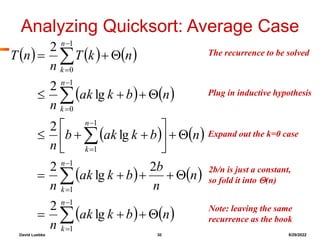
Note: leaving the same
recurrence as the book
What are we doing here?
Analyzing Quicksort: Average Case
     
   
   
   
   










































1
1
1
1
1
1
1
0
1
0
lg
2
2
lg
2
lg
2
lg
2
2
n
k
n
k
n
k
n
k
n
k
n
b
k
ak
n
n
n
b
b
k
ak
n
n
b
k
ak
b
n
n
b
k
ak
n
n
k
T
n
n
T The recurrence to be solved
What are we doing here?
Plug in inductive hypothesis
Expand out the k=0 case
2b/n is just a constant,
so fold it into (n)
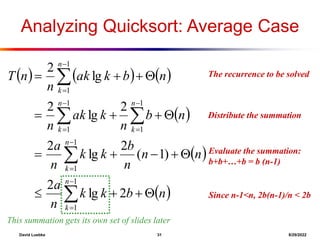
David Luebke 31 8/29/2022
What are we doing here?
Evaluate the summation:
b+b+…+b = b (n-1)
The recurrence to be solved
Since n-1<n, 2b(n-1)/n < 2b
Analyzing Quicksort: Average Case
     
 
 
 
n
b
k
k
n
a
n
n
n
b
k
k
n
a
n
b
n
k
ak
n
n
b
k
ak
n
n
T
n
k
n
k
n
k
n
k
n
k
































2
lg
2
)
1
(
2
lg
2
2
lg
2
lg
2
1
1
1
1
1
1
1
1
1
1
What are we doing here?
Distribute the summation
This summation gets its own set of slides later
David Luebke 32 8/29/2022
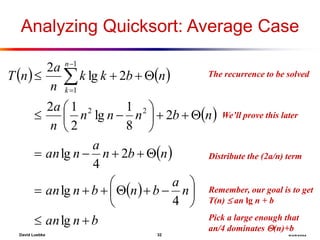
How did we do this?
Pick a large enough that
an/4 dominates (n)+b
What are we doing here?
Remember, our goal is to get
T(n)  an lg n + b
What the hell?
We’ll prove this later
What are we doing here?
Distribute the (2a/n) term
The recurrence to be solved
Analyzing Quicksort: Average Case
   
 
 
 
b
n
an
n
a
b
n
b
n
an
n
b
n
a
n
an
n
b
n
n
n
n
a
n
b
k
k
n
a
n
T
n
k

































 


lg
4
lg
2
4
lg
2
8
1
lg
2
1
2
2
lg
2
2
2
1
1
David Luebke 33 8/29/2022
Analyzing Quicksort: Average Case
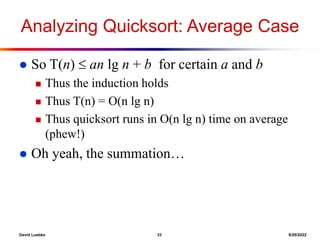
 So T(n)  an lg n + b for certain a and b
 Thus the induction holds
 Thus T(n) = O(n lg n)
 Thus quicksort runs in O(n lg n) time on average
(phew!)
 Oh yeah, the summation…
David Luebke 34 8/29/2022
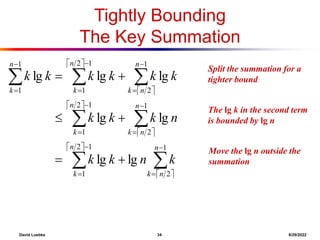
What are we doing here?
The lg k in the second term
is bounded by lg n
Tightly Bounding
The Key Summation
 
 
 
 
 
 



























1
2
1
2
1
1
2
1
2
1
1
2
1
2
1
1
1
lg
lg
lg
lg
lg
lg
lg
n
n
k
n
k
n
n
k
n
k
n
n
k
n
k
n
k
k
n
k
k
n
k
k
k
k
k
k
k
k
k
What are we doing here?
Move the lg n outside the
summation
What are we doing here?
Split the summation for a
tighter bound
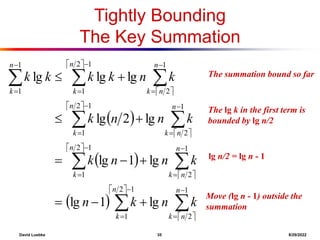
David Luebke 35 8/29/2022
The summation bound so far
Tightly Bounding
The Key Summation
 
 
 
 
 
 
 
 
 
 
 





































1
2
1
2
1
1
2
1
2
1
1
2
1
2
1
1
2
1
2
1
1
1
lg
1
lg
lg
1
lg
lg
2
lg
lg
lg
lg
n
n
k
n
k
n
n
k
n
k
n
n
k
n
k
n
n
k
n
k
n
k
k
n
k
n
k
n
n
k
k
n
n
k
k
n
k
k
k
k
What are we doing here?
The lg k in the first term is
bounded by lg n/2
What are we doing here?
lg n/2 = lg n - 1
What are we doing here?
Move (lg n - 1) outside the
summation
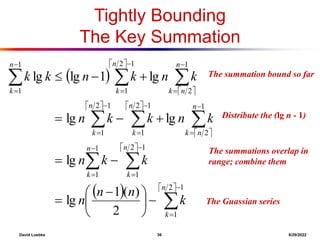
David Luebke 36 8/29/2022
The summation bound so far
Tightly Bounding
The Key Summation
 
 
 
   
 
 
   

































 









1
2
1
1
2
1
1
1
1
2
1
2
1
1
2
1
1
2
1
2
1
1
1
2
)
(
1
lg
lg
lg
lg
lg
1
lg
lg
n
k
n
k
n
k
n
n
k
n
k
n
k
n
n
k
n
k
n
k
k
n
n
n
k
k
n
k
n
k
k
n
k
n
k
n
k
k
What are we doing here?
Distribute the (lg n - 1)
What are we doing here?
The summations overlap in
range; combine them
What are we doing here?
The Guassian series
David Luebke 37 8/29/2022
The summation bound so far
Tightly Bounding
The Key Summation
   
 
 
 
 
  4
8
1
lg
lg
2
1
1
2
2
2
1
lg
1
2
1
lg
1
2
1
lg
2
)
(
1
lg
2
2
1
2
1
1
2
1
1
1
n
n
n
n
n
n
n
n
n
n
n
k
n
n
n
k
n
n
n
k
k
n
k
n
k
n
k





























 










What are we doing here?
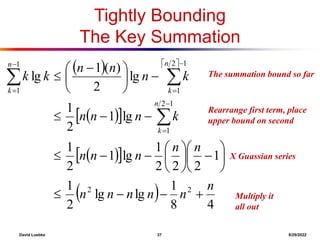
Rearrange first term, place
upper bound on second
What are we doing?
X Guassian series
What are we doing?
Multiply it
all out
David Luebke 38 8/29/2022
Tightly Bounding
The Key Summation
 
!
!
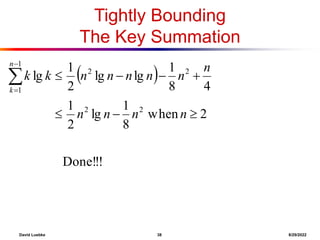
Done!
2
when
8
1
lg
2
1
4
8
1
lg
lg
2
1
lg
2
2
2
2
1
1










n
n
n
n
n
n
n
n
n
n
k
k
n
k

lecture7.ppt

  • 1.
    David Luebke 18/29/2022 CS 332: Algorithms Quicksort
  • 2.
    David Luebke 28/29/2022 Homework 2  Assigned today, due next Wednesday  Will be on web page shortly after class  Go over now
  • 3.
    David Luebke 38/29/2022 Review: Quicksort  Sorts in place  Sorts O(n lg n) in the average case  Sorts O(n2) in the worst case  But in practice, it’s quick  And the worst case doesn’t happen often (but more on this later…)
  • 4.
    David Luebke 48/29/2022 Quicksort  Another divide-and-conquer algorithm  The array A[p..r] is partitioned into two non-empty subarrays A[p..q] and A[q+1..r]  Invariant: All elements in A[p..q] are less than all elements in A[q+1..r]  The subarrays are recursively sorted by calls to quicksort  Unlike merge sort, no combining step: two subarrays form an already-sorted array
  • 5.
    David Luebke 58/29/2022 Quicksort Code Quicksort(A, p, r) { if (p < r) { q = Partition(A, p, r); Quicksort(A, p, q); Quicksort(A, q+1, r); } }
  • 6.
    David Luebke 68/29/2022 Partition  Clearly, all the action takes place in the partition() function  Rearranges the subarray in place  End result:  Two subarrays  All values in first subarray  all values in second  Returns the index of the “pivot” element separating the two subarrays  How do you suppose we implement this?
  • 7.
    David Luebke 78/29/2022 Partition In Words  Partition(A, p, r):  Select an element to act as the “pivot” (which?)  Grow two regions, A[p..i] and A[j..r]  All elements in A[p..i] <= pivot  All elements in A[j..r] >= pivot  Increment i until A[i] >= pivot  Decrement j until A[j] <= pivot  Swap A[i] and A[j]  Repeat until i >= j  Return j Note: slightly different from book’s partition()
  • 8.
    David Luebke 88/29/2022 Partition Code Partition(A, p, r) x = A[p]; i = p - 1; j = r + 1; while (TRUE) repeat j--; until A[j] <= x; repeat i++; until A[i] >= x; if (i < j) Swap(A, i, j); else return j; Illustrate on A = {5, 3, 2, 6, 4, 1, 3, 7}; What is the running time of partition()?
  • 9.
    David Luebke 98/29/2022 Partition Code Partition(A, p, r) x = A[p]; i = p - 1; j = r + 1; while (TRUE) repeat j--; until A[j] <= x; repeat i++; until A[i] >= x; if (i < j) Swap(A, i, j); else return j; partition() runs in O(n) time
  • 10.
    David Luebke 108/29/2022 Analyzing Quicksort  What will be the worst case for the algorithm?  Partition is always unbalanced  What will be the best case for the algorithm?  Partition is perfectly balanced  Which is more likely?  The latter, by far, except...  Will any particular input elicit the worst case?  Yes: Already-sorted input
  • 11.
    David Luebke 118/29/2022 Analyzing Quicksort  In the worst case: T(1) = (1) T(n) = T(n - 1) + (n)  Works out to T(n) = (n2)
  • 12.
    David Luebke 128/29/2022 Analyzing Quicksort  In the best case: T(n) = 2T(n/2) + (n)  What does this work out to? T(n) = (n lg n)
  • 13.
    David Luebke 138/29/2022 Improving Quicksort  The real liability of quicksort is that it runs in O(n2) on already-sorted input  Book discusses two solutions:  Randomize the input array, OR  Pick a random pivot element  How will these solve the problem?  By insuring that no particular input can be chosen to make quicksort run in O(n2) time
  • 14.
    David Luebke 148/29/2022 Analyzing Quicksort: Average Case  Assuming random input, average-case running time is much closer to O(n lg n) than O(n2)  First, a more intuitive explanation/example:  Suppose that partition() always produces a 9-to-1 split. This looks quite unbalanced!  The recurrence is thus: T(n) = T(9n/10) + T(n/10) + n  How deep will the recursion go? (draw it) Use n instead of O(n) for convenience (how?)
  • 15.
    David Luebke 158/29/2022 Analyzing Quicksort: Average Case  Intuitively, a real-life run of quicksort will produce a mix of “bad” and “good” splits  Randomly distributed among the recursion tree  Pretend for intuition that they alternate between best-case (n/2 : n/2) and worst-case (n-1 : 1)  What happens if we bad-split root node, then good- split the resulting size (n-1) node?
  • 16.
    David Luebke 168/29/2022 Analyzing Quicksort: Average Case  Intuitively, a real-life run of quicksort will produce a mix of “bad” and “good” splits  Randomly distributed among the recursion tree  Pretend for intuition that they alternate between best-case (n/2 : n/2) and worst-case (n-1 : 1)  What happens if we bad-split root node, then good- split the resulting size (n-1) node?  We fail English
  • 17.
    David Luebke 178/29/2022 Analyzing Quicksort: Average Case  Intuitively, a real-life run of quicksort will produce a mix of “bad” and “good” splits  Randomly distributed among the recursion tree  Pretend for intuition that they alternate between best-case (n/2 : n/2) and worst-case (n-1 : 1)  What happens if we bad-split root node, then good-split the resulting size (n-1) node?  We end up with three subarrays, size 1, (n-1)/2, (n-1)/2  Combined cost of splits = n + n -1 = 2n -1 = O(n)  No worse than if we had good-split the root node!
  • 18.
    David Luebke 188/29/2022 Analyzing Quicksort: Average Case  Intuitively, the O(n) cost of a bad split (or 2 or 3 bad splits) can be absorbed into the O(n) cost of each good split  Thus running time of alternating bad and good splits is still O(n lg n), with slightly higher constants  How can we be more rigorous?
  • 19.
    David Luebke 198/29/2022 Analyzing Quicksort: Average Case  For simplicity, assume:  All inputs distinct (no repeats)  Slightly different partition() procedure  partition around a random element, which is not included in subarrays  all splits (0:n-1, 1:n-2, 2:n-3, … , n-1:0) equally likely  What is the probability of a particular split happening?  Answer: 1/n
  • 20.
    David Luebke 208/29/2022 Analyzing Quicksort: Average Case  So partition generates splits (0:n-1, 1:n-2, 2:n-3, … , n-2:1, n-1:0) each with probability 1/n  If T(n) is the expected running time,  What is each term under the summation for?  What is the (n) term for?                    1 0 1 1 n k n k n T k T n n T
  • 21.
    David Luebke 218/29/2022 Analyzing Quicksort: Average Case  So…  Note: this is just like the book’s recurrence (p166), except that the summation starts with k=0  We’ll take care of that in a second                              1 0 1 0 2 1 1 n k n k n k T n n k n T k T n n T Write it on the board
  • 22.
    David Luebke 228/29/2022 Analyzing Quicksort: Average Case  We can solve this recurrence using the dreaded substitution method  Guess the answer  Assume that the inductive hypothesis holds  Substitute it in for some value < n  Prove that it follows for n
  • 23.
    David Luebke 238/29/2022 Analyzing Quicksort: Average Case  We can solve this recurrence using the dreaded substitution method  Guess the answer  What’s the answer?  Assume that the inductive hypothesis holds  Substitute it in for some value < n  Prove that it follows for n
  • 24.
    David Luebke 248/29/2022 Analyzing Quicksort: Average Case  We can solve this recurrence using the dreaded substitution method  Guess the answer  T(n) = O(n lg n)  Assume that the inductive hypothesis holds  Substitute it in for some value < n  Prove that it follows for n
  • 25.
    David Luebke 258/29/2022 Analyzing Quicksort: Average Case  We can solve this recurrence using the dreaded substitution method  Guess the answer  T(n) = O(n lg n)  Assume that the inductive hypothesis holds  What’s the inductive hypothesis?  Substitute it in for some value < n  Prove that it follows for n
  • 26.
    David Luebke 268/29/2022 Analyzing Quicksort: Average Case  We can solve this recurrence using the dreaded substitution method  Guess the answer  T(n) = O(n lg n)  Assume that the inductive hypothesis holds  T(n)  an lg n + b for some constants a and b  Substitute it in for some value < n  Prove that it follows for n
  • 27.
    David Luebke 278/29/2022 Analyzing Quicksort: Average Case  We can solve this recurrence using the dreaded substitution method  Guess the answer  T(n) = O(n lg n)  Assume that the inductive hypothesis holds  T(n)  an lg n + b for some constants a and b  Substitute it in for some value < n  What value?  Prove that it follows for n
  • 28.
    David Luebke 288/29/2022 Analyzing Quicksort: Average Case  We can solve this recurrence using the dreaded substitution method  Guess the answer  T(n) = O(n lg n)  Assume that the inductive hypothesis holds  T(n)  an lg n + b for some constants a and b  Substitute it in for some value < n  The value k in the recurrence  Prove that it follows for n
  • 29.
    David Luebke 298/29/2022 Analyzing Quicksort: Average Case  We can solve this recurrence using the dreaded substitution method  Guess the answer  T(n) = O(n lg n)  Assume that the inductive hypothesis holds  T(n)  an lg n + b for some constants a and b  Substitute it in for some value < n  The value k in the recurrence  Prove that it follows for n  Grind through it…
  • 30.
    David Luebke 308/29/2022 Note: leaving the same recurrence as the book What are we doing here? Analyzing Quicksort: Average Case                                                                 1 1 1 1 1 1 1 0 1 0 lg 2 2 lg 2 lg 2 lg 2 2 n k n k n k n k n k n b k ak n n n b b k ak n n b k ak b n n b k ak n n k T n n T The recurrence to be solved What are we doing here? What are we doing here? Plug in inductive hypothesis Expand out the k=0 case 2b/n is just a constant, so fold it into (n)
  • 31.
    David Luebke 318/29/2022 What are we doing here? What are we doing here? Evaluate the summation: b+b+…+b = b (n-1) The recurrence to be solved Since n-1<n, 2b(n-1)/n < 2b Analyzing Quicksort: Average Case             n b k k n a n n n b k k n a n b n k ak n n b k ak n n T n k n k n k n k n k                                 2 lg 2 ) 1 ( 2 lg 2 2 lg 2 lg 2 1 1 1 1 1 1 1 1 1 1 What are we doing here? Distribute the summation This summation gets its own set of slides later
  • 32.
    David Luebke 328/29/2022 How did we do this? Pick a large enough that an/4 dominates (n)+b What are we doing here? Remember, our goal is to get T(n)  an lg n + b What the hell? We’ll prove this later What are we doing here? Distribute the (2a/n) term The recurrence to be solved Analyzing Quicksort: Average Case           b n an n a b n b n an n b n a n an n b n n n n a n b k k n a n T n k                                      lg 4 lg 2 4 lg 2 8 1 lg 2 1 2 2 lg 2 2 2 1 1
  • 33.
    David Luebke 338/29/2022 Analyzing Quicksort: Average Case  So T(n)  an lg n + b for certain a and b  Thus the induction holds  Thus T(n) = O(n lg n)  Thus quicksort runs in O(n lg n) time on average (phew!)  Oh yeah, the summation…
  • 34.
    David Luebke 348/29/2022 What are we doing here? The lg k in the second term is bounded by lg n Tightly Bounding The Key Summation                                        1 2 1 2 1 1 2 1 2 1 1 2 1 2 1 1 1 lg lg lg lg lg lg lg n n k n k n n k n k n n k n k n k k n k k n k k k k k k k k k What are we doing here? Move the lg n outside the summation What are we doing here? Split the summation for a tighter bound
  • 35.
    David Luebke 358/29/2022 The summation bound so far Tightly Bounding The Key Summation                                                            1 2 1 2 1 1 2 1 2 1 1 2 1 2 1 1 2 1 2 1 1 1 lg 1 lg lg 1 lg lg 2 lg lg lg lg n n k n k n n k n k n n k n k n n k n k n k k n k n k n n k k n n k k n k k k k What are we doing here? The lg k in the first term is bounded by lg n/2 What are we doing here? lg n/2 = lg n - 1 What are we doing here? Move (lg n - 1) outside the summation
  • 36.
    David Luebke 368/29/2022 The summation bound so far Tightly Bounding The Key Summation                                                               1 2 1 1 2 1 1 1 1 2 1 2 1 1 2 1 1 2 1 2 1 1 1 2 ) ( 1 lg lg lg lg lg 1 lg lg n k n k n k n n k n k n k n n k n k n k k n n n k k n k n k k n k n k n k k What are we doing here? Distribute the (lg n - 1) What are we doing here? The summations overlap in range; combine them What are we doing here? The Guassian series
  • 37.
    David Luebke 378/29/2022 The summation bound so far Tightly Bounding The Key Summation               4 8 1 lg lg 2 1 1 2 2 2 1 lg 1 2 1 lg 1 2 1 lg 2 ) ( 1 lg 2 2 1 2 1 1 2 1 1 1 n n n n n n n n n n n k n n n k n n n k k n k n k n k                                          What are we doing here? Rearrange first term, place upper bound on second What are we doing? X Guassian series What are we doing? Multiply it all out
  • 38.
    David Luebke 388/29/2022 Tightly Bounding The Key Summation   ! ! Done! 2 when 8 1 lg 2 1 4 8 1 lg lg 2 1 lg 2 2 2 2 1 1           n n n n n n n n n n k k n k