Analysis & Design of
Algorithms
www.advanced.edu.in 1
Greedy Algorithms
Greedy Algorithms
The General Method
Continuous Knapsack Problem
www.advanced.edu.in 2
1. Greedy Algorithms
Greedy Algorithm:
A greedy algorithm is an algorithm that follows the
problem solving heuristic of making the locally
optimal choice at each stage with the hope of finding
a global optimum.
www.advanced.edu.in 3
1.Greedy Algorithms
Methodology:
 Start with a solution to a small sub-problem
 Build up to the whole problem
 Make choices that look good in the short term but
not necessarily in the long term
www.advanced.edu.in 4
1.Greedy Algorithms
Advantages:
 When they work, they work fast
 Simple and easy to implement
Disadvantages:
 They do not always work.
 Short term choices may be disastrous on the long
term.
 Correctness is hard to prove
www.advanced.edu.in 5
1.Greedy Algorithms
Applications:
 Applications of greedy method are very board
Example:
 Sorting.
 Merging sorted list.
 Knapsack
 Minimum Spanning Tree (MST)
 Hoffman Encoding
www.advanced.edu.in 6
1.Greedy Algorithms
Characteristics and Features:
To construct the solution in an optimal way. Algorithm
maintains two sets. One contains chosen items and
the other contains rejected items.
The greedy algorithm consists of four (4) function.
A function that checks whether chosen set of items
provide a solution.
www.advanced.edu.in 7
1.Greedy Algorithms (Cont.)
Characteristics and Features:
A function that checks the feasibility of a set.
The selection function tells which of the candidates is
the most promising.
An objective function, which does not appear
explicitly, gives the value of a solution.
www.advanced.edu.in 8
2. The General Method
Let a[ ] be an array of elements that may contribute to
a solution. Let S be a solution,
Greedy (a[ ],n)
{
S = empty;
for each element (i) from a[ ], i = 1:n
{
x = Select (a,i);
if (Feasible(S,x)) S = Union(S,x);
}
return S;
}
www.advanced.edu.in 9
2. The General Method (Cont.)
 Select:
Selects an element from a[ ] and removes it. Selection is optimized
to satisfy an objective function.
 Feasible:
True if selected value can be included in the solution vector, False
otherwise.
 Union:
Combines value with solution and updates objective function.
www.advanced.edu.in 10
3. Knapsack Problem
There are two versions of the problem:
1. 0-1 Knapsack Problem
2. Fractional Knapsack Problem
i. Bounded Knapsack Problem
ii. Unbounded Knapsack Problem
www.advanced.edu.in 11
3. Knapsack Problem
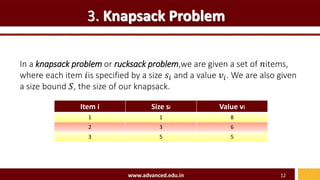
In a knapsack problem or rucksack problem,we are given a set of 𝑛items,
where each item 𝑖is specified by a size 𝑠𝑖 and a value 𝑣𝑖. We are also given
a size bound 𝑆, the size of our knapsack.
www.advanced.edu.in 12
Item i Size si Value vi
1 1 8
2 3 6
3 5 5
3. Knapsack Problem
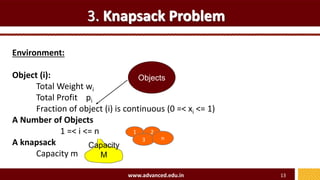
Environment:
Object (i):
Total Weight wi
Total Profit pi
Fraction of object (i) is continuous (0 =< xi <= 1)
A Number of Objects
1 =< i <= n
A knapsack
Capacity m
www.advanced.edu.in 13
Objects
1 2
3 n
Capacity
M
3. Knapsack Problem
GreedyKnapsack ( p[ ] , w[ ] , m , n ,x[ ] )
{
insert indices (i) of items in a maximum heap on value vi = pi / wi ;
Zero the vector x; Rem = m ;
For k = 1..n
{ remove top of heap to get index (i);
if (w[i] > Rem) then break;
x[i] = 1.0 ; Rem = Rem – w[i] ;
}
if (k < = n ) x[i] = Rem / w[i] ;
}
// T(n) = O(n log n)
www.advanced.edu.in 14
3. Knapsack Problem
Example:
www.advanced.edu.in 15
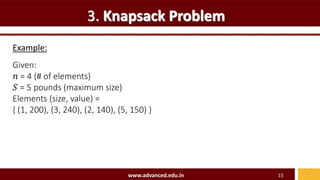
Given:
𝑛 = 4 (# of elements)
𝑆 = 5 pounds (maximum size)
Elements (size, value) =
{ (1, 200), (3, 240), (2, 140), (5, 150) }
3. Knapsack Problem
Example:
www.advanced.edu.in 16
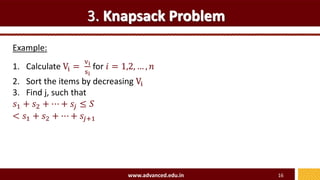
1. Calculate Vi =
vi
si
for 𝑖 = 1,2, … , 𝑛
2. Sort the items by decreasing Vi
3. Find j, such that
𝑠1 + 𝑠2 + ⋯ + 𝑠𝑗 ≤ 𝑆
< 𝑠1 + 𝑠2 + ⋯ + 𝑠𝑗+1
3. Knapsack Problem
Example:
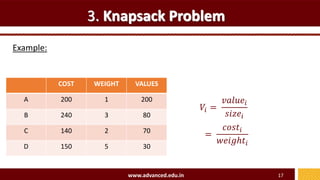
www.advanced.edu.in 17
𝑉𝑖 =
𝑣𝑎𝑙𝑢𝑒𝑖
𝑠𝑖𝑧𝑒𝑖
=
𝑐𝑜𝑠𝑡𝑖
𝑤𝑒𝑖𝑔ℎ𝑡𝑖
COST WEIGHT VALUES
A 200 1 200
B 240 3 80
C 140 2 70
D 150 5 30
3. Knapsack Problem
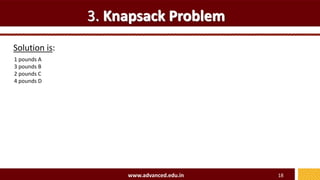
Solution is:
www.advanced.edu.in 18
1 pounds A
3 pounds B
2 pounds C
4 pounds D
THANK YOU
www.advanced.edu.in 19
Contact Email Id: nikitaguptapalwal@gmail.com
Website: http://www.advanced.edu.in

Ms nikita greedy agorithm

  • 1.
    Analysis & Designof Algorithms www.advanced.edu.in 1
  • 2.
    Greedy Algorithms Greedy Algorithms TheGeneral Method Continuous Knapsack Problem www.advanced.edu.in 2
  • 3.
    1. Greedy Algorithms GreedyAlgorithm: A greedy algorithm is an algorithm that follows the problem solving heuristic of making the locally optimal choice at each stage with the hope of finding a global optimum. www.advanced.edu.in 3
  • 4.
    1.Greedy Algorithms Methodology:  Startwith a solution to a small sub-problem  Build up to the whole problem  Make choices that look good in the short term but not necessarily in the long term www.advanced.edu.in 4
  • 5.
    1.Greedy Algorithms Advantages:  Whenthey work, they work fast  Simple and easy to implement Disadvantages:  They do not always work.  Short term choices may be disastrous on the long term.  Correctness is hard to prove www.advanced.edu.in 5
  • 6.
    1.Greedy Algorithms Applications:  Applicationsof greedy method are very board Example:  Sorting.  Merging sorted list.  Knapsack  Minimum Spanning Tree (MST)  Hoffman Encoding www.advanced.edu.in 6
  • 7.
    1.Greedy Algorithms Characteristics andFeatures: To construct the solution in an optimal way. Algorithm maintains two sets. One contains chosen items and the other contains rejected items. The greedy algorithm consists of four (4) function. A function that checks whether chosen set of items provide a solution. www.advanced.edu.in 7
  • 8.
    1.Greedy Algorithms (Cont.) Characteristicsand Features: A function that checks the feasibility of a set. The selection function tells which of the candidates is the most promising. An objective function, which does not appear explicitly, gives the value of a solution. www.advanced.edu.in 8
  • 9.
    2. The GeneralMethod Let a[ ] be an array of elements that may contribute to a solution. Let S be a solution, Greedy (a[ ],n) { S = empty; for each element (i) from a[ ], i = 1:n { x = Select (a,i); if (Feasible(S,x)) S = Union(S,x); } return S; } www.advanced.edu.in 9
  • 10.
    2. The GeneralMethod (Cont.)  Select: Selects an element from a[ ] and removes it. Selection is optimized to satisfy an objective function.  Feasible: True if selected value can be included in the solution vector, False otherwise.  Union: Combines value with solution and updates objective function. www.advanced.edu.in 10
  • 11.
    3. Knapsack Problem Thereare two versions of the problem: 1. 0-1 Knapsack Problem 2. Fractional Knapsack Problem i. Bounded Knapsack Problem ii. Unbounded Knapsack Problem www.advanced.edu.in 11
  • 12.
    3. Knapsack Problem Ina knapsack problem or rucksack problem,we are given a set of 𝑛items, where each item 𝑖is specified by a size 𝑠𝑖 and a value 𝑣𝑖. We are also given a size bound 𝑆, the size of our knapsack. www.advanced.edu.in 12 Item i Size si Value vi 1 1 8 2 3 6 3 5 5
  • 13.
    3. Knapsack Problem Environment: Object(i): Total Weight wi Total Profit pi Fraction of object (i) is continuous (0 =< xi <= 1) A Number of Objects 1 =< i <= n A knapsack Capacity m www.advanced.edu.in 13 Objects 1 2 3 n Capacity M
  • 14.
    3. Knapsack Problem GreedyKnapsack( p[ ] , w[ ] , m , n ,x[ ] ) { insert indices (i) of items in a maximum heap on value vi = pi / wi ; Zero the vector x; Rem = m ; For k = 1..n { remove top of heap to get index (i); if (w[i] > Rem) then break; x[i] = 1.0 ; Rem = Rem – w[i] ; } if (k < = n ) x[i] = Rem / w[i] ; } // T(n) = O(n log n) www.advanced.edu.in 14
  • 15.
    3. Knapsack Problem Example: www.advanced.edu.in15 Given: 𝑛 = 4 (# of elements) 𝑆 = 5 pounds (maximum size) Elements (size, value) = { (1, 200), (3, 240), (2, 140), (5, 150) }
  • 16.
    3. Knapsack Problem Example: www.advanced.edu.in16 1. Calculate Vi = vi si for 𝑖 = 1,2, … , 𝑛 2. Sort the items by decreasing Vi 3. Find j, such that 𝑠1 + 𝑠2 + ⋯ + 𝑠𝑗 ≤ 𝑆 < 𝑠1 + 𝑠2 + ⋯ + 𝑠𝑗+1
  • 17.
    3. Knapsack Problem Example: www.advanced.edu.in17 𝑉𝑖 = 𝑣𝑎𝑙𝑢𝑒𝑖 𝑠𝑖𝑧𝑒𝑖 = 𝑐𝑜𝑠𝑡𝑖 𝑤𝑒𝑖𝑔ℎ𝑡𝑖 COST WEIGHT VALUES A 200 1 200 B 240 3 80 C 140 2 70 D 150 5 30
  • 18.
    3. Knapsack Problem Solutionis: www.advanced.edu.in 18 1 pounds A 3 pounds B 2 pounds C 4 pounds D
  • 19.
    THANK YOU www.advanced.edu.in 19 ContactEmail Id: nikitaguptapalwal@gmail.com Website: http://www.advanced.edu.in