Ca in Dwarka
• CA in Dwarka waiting for you. GST, ITR, Notice
and all solution on your doorstep
• http://caindwarka.com
http://caindwarka.com/
What are we going to cover
• What is motivation
• Nature / characteristics of motivation
• Classification of motivation
• What are motives
• Classification of motives
• Theories of Work Motivation
– Maslow's theory of need hierarchy
http://caindwarka.com/
What are we going to cover
• Theories of Work Motivation
– Herzberg's two-factor theory
– Mc Gregor’s theory
– Vroom’s Expectancy theory
– Porter Lawler model
• Morale - Definition
• Relationship with productivity
• Morale Indicators
http://caindwarka.com/
What is motivation?
Motivation is a Latin word, which means to move.
It is the willingness of an individual to respond to
organisational requirements.
Koontz O’Donnell defines it as “ a general term applying
to the entire class of drives, desires, needs wishes &
similar forces that induce an individual or a group of
people at work.”
http://caindwarka.com/
What is motivation?
It can also be defined as “a willingness to expend
energy to achieve a goal or a reward. It is a force that
activates dormant energies & sets in motion the
action of people. It is the function that kindles a
burning passion for action among the human beings
of an organisation.”
Performance = Ability x Motivation
http://caindwarka.com/
What is motivation?
It is a process which starts with a physiological or
psychological deficiency or need that activates or a
drive that is aimed at a goal or incentive.
Needs: are created when there is a deprivation or
deficiency. Here, a physiological or psychological
imbalance exists.
Drives or motives: Drives are deficiencies with
direction. They are action oriented & provide a thrust
towards achieving an incentive or goal.
http://caindwarka.com/
What is motivation?
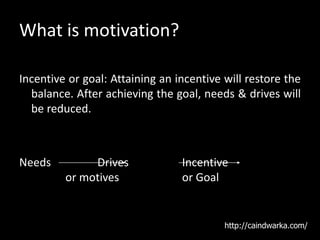
Incentive or goal: Attaining an incentive will restore the
balance. After achieving the goal, needs & drives will
be reduced.
Needs Drives Incentive
or motives or Goal
http://caindwarka.com/
Nature / characteristics of motivation
1. Unending process: human wants keep changing &
increasing.
2. A psychological concept: deals with the human
mind.
3. Whole individual is motivated: as it is based on
psychology of the individual.
http://caindwarka.com/
Nature / characteristics of motivation
4. Motivation may be financial or non-financial:
Financial includes increasing wages, allowance,
bonus, perquisites etc.
5. Motivation can be positive or negative: positive
motivation means use of incentives - financial or
non-financial. Egs. of positive motivation:
confirmation, pay rise, praise etc. Negative
motivation means emphasizing penalties. It is
based on force of fear. Eg. demotion, termination.
http://caindwarka.com/
Nature / characteristics of motivation
6. Motivation: motivation & job satisfaction are
different. Motivation is goal-oriented behaviour.
Job satisfaction is the outcome of job performance.
http://caindwarka.com/
Classification of motivation
1. Positive and negative
2. Financial and non – financial
3. Extrinsic and intrinsic:
Extrinsic motivation is available only after completion
of the job. Eg. increase in wages, rest periods,
holidays etc.
Intrinsic motivation is available at the time of
performance of a job. Eg. praise, recognition,
delegation of authority & responsibility.http://caindwarka.com/
What are motives?
A motive is an inner state that energizes, activates, or
moves & directs, channels behaviour towards goals.
http://caindwarka.com/
Classification of motives
Motives can be classified as:
1. Primary motives
2. General motives
3. Secondary motives
http://caindwarka.com/
Classification of motives
Primary motives:
Also called physiological / biological / unlearned
motives. 2 criteria for the motive to be primary are
that they should be unlearned & physiological.
Eg. hunger, thirst, sleep, avoidance of pain, sex &
material concern.
Primary motives tend to reduce the tension or
stimulation.
http://caindwarka.com/
Classification of motives
General motives:
Are ones which are unlearned but are not
physiologically based.
These needs induce the person to increase the amount
of stimulation.
Eg. curiosity, manipulation, activity & affection
http://caindwarka.com/
Classification of motives
Secondary motives:
These are the most important w.r.t. the study of O.B.
A motive must be learned in order to be a secondary
one.
These drives are closely tied to the learning concepts,
such as motives for power, achievement, affiliation
referred to as n Pow, n Ach, n Aff.
Security & status are also secondary motives.
http://caindwarka.com/
Classification of motives
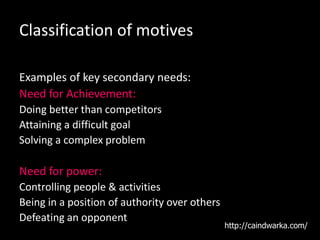
Examples of key secondary needs:
Need for Achievement:
Doing better than competitors
Attaining a difficult goal
Solving a complex problem
Need for power:
Controlling people & activities
Being in a position of authority over others
Defeating an opponent
http://caindwarka.com/
Classification of motives
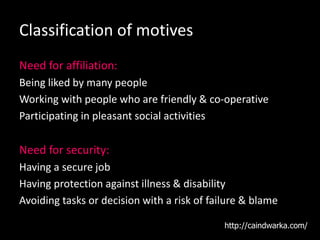
Need for affiliation:
Being liked by many people
Working with people who are friendly & co-operative
Participating in pleasant social activities
Need for security:
Having a secure job
Having protection against illness & disability
Avoiding tasks or decision with a risk of failure & blame
http://caindwarka.com/
Classification of motives
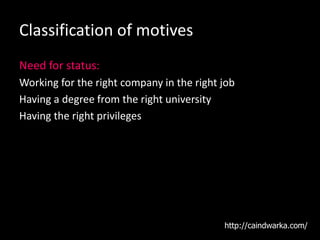
Need for status:
Working for the right company in the right job
Having a degree from the right university
Having the right privileges
http://caindwarka.com/
Theories of Work Motivation
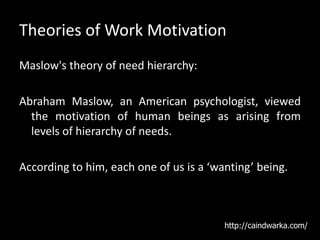
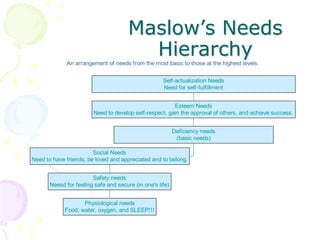
Maslow's theory of need hierarchy:
Abraham Maslow, an American psychologist, viewed
the motivation of human beings as arising from
levels of hierarchy of needs.
According to him, each one of us is a ‘wanting’ being.
http://caindwarka.com/
Theories of Work Motivation
His basic assumptions were:
1. All human needs cannot be satisfied, because, if
one need is satisfied, another arises.
2. A satisfied need does not motivate behaviour. eg.
need for food motivates only till one gets food.
http://caindwarka.com/
Theories of Work Motivation
3. Some needs are innate (natural / inherent) eg. the
need for food & water; while some are acquired
from social experiences eg. need for social esteem.
4. Human beings attempt to satisfy their needs in a
specific order, based on hierarchy.
http://caindwarka.com/
Theories of Work Motivation
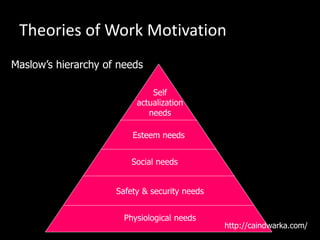
Physiological needs
Safety & security needs
Social needs
Esteem needs
Self
actualization
needs
Maslow’s hierarchy of needs
http://caindwarka.com/
Theories of Work Motivation
Maslow explained each level of hierarchy as follows:
1. Physiological needs:
These are necessary to sustain life. They include food,
water, clothing, shelter.
These needs have the highest potency for motivation.
A person who lacks these will be motivated by these.
http://caindwarka.com/
Theories of Work Motivation
2. Safety needs:
When physiological needs are reasonably satisfied,
safety needs begin to manifest themselves.
These needs include protection from physical dangers,
such as fire or accident.
Economic security, security of income against
contingencies such as sickness, injury, non-hostile
working atmosphere are also safety needs.
http://caindwarka.com/
Theories of Work Motivation
3. Social needs:
When physiological & safety needs are reasonably
satisfied, social needs become important
motivators.
Man is a social being & wants to receive & give
acceptance, friendship & affection.
He feels the need for belonging, for being an accepted
member of a formal or an informal group.
http://caindwarka.com/
Theories of Work Motivation
4. Esteem needs:
When the first three needs are essentially satisfied,
esteem needs become dominant.
The person must feel important & must also receive
recognition from others, as that recognition
supports the feelings of personal worth.
Thus feelings of self-esteem, self-confidence, prestige &
power are produced which are related to
enhancing competence, knowledge &
achievement.
http://caindwarka.com/
Theories of Work Motivation
5. Self actualization needs:
At the summit of the hierarchy is the need to realize
one’s potentialities so as to satisfy what Maslow
referred to as ‘the desire to become everything
that one is capable of becoming.’
Thus the person becomes interested in self-fulfillment,
self-development, & creativity in the broadest
sense of the term.
http://caindwarka.com/
Theories of Work Motivation
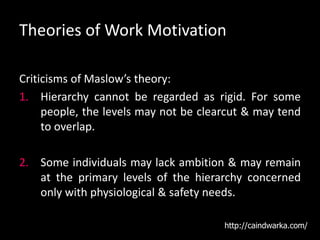
Criticisms of Maslow’s theory:
1. Hierarchy cannot be regarded as rigid. For some
people, the levels may not be clearcut & may tend
to overlap.
2. Some individuals may lack ambition & may remain
at the primary levels of the hierarchy concerned
only with physiological & safety needs.
http://caindwarka.com/
Theories of Work Motivation
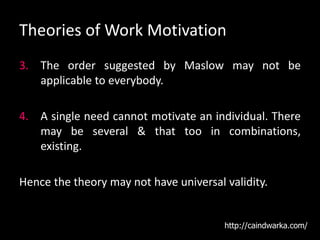
3. The order suggested by Maslow may not be
applicable to everybody.
4. A single need cannot motivate an individual. There
may be several & that too in combinations,
existing.
Hence the theory may not have universal validity.
http://caindwarka.com/
To be continued …..
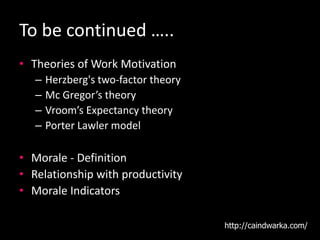
• Theories of Work Motivation
– Herzberg's two-factor theory
– Mc Gregor’s theory
– Vroom’s Expectancy theory
– Porter Lawler model
• Morale - Definition
• Relationship with productivity
• Morale Indicators
http://caindwarka.com/
What are we going to cover
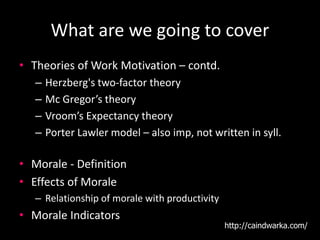
• Theories of Work Motivation – contd.
– Herzberg's two-factor theory
– Mc Gregor’s theory
– Vroom’s Expectancy theory
– Porter Lawler model – also imp, not written in syll.
• Morale - Definition
• Effects of Morale
– Relationship of morale with productivity
• Morale Indicators
http://caindwarka.com/
Theories of Work Motivation
Herzberg's two-factor theory:
Frederick Herzberg, in the late 1950s conducted a study
on motivation. He and his associates used semi-
structured interviews to elicit from 200 engineers
& accountants in Pittsburgh area, the factors which
satisfy or dissatisfy the workers.
http://caindwarka.com/
Theories of Work Motivation
His study revealed that factors responsible for job
satisfaction are quite different from those
responsible for job dissatisfaction.
Certain factors give job satisfaction, but absence of
these does not mean job dissatisfaction. It only
means no job satisfaction.
Similarly, certain factors cause job dissatisfaction, but
absence of these does not mean job satisfaction. It
only means no job dissatisfaction.
http://caindwarka.com/
Theories of Work Motivation
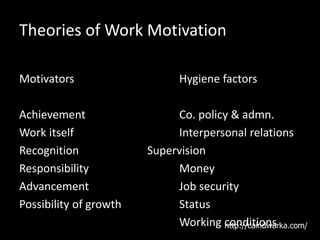
According to Herzberg, motivational factors are
responsible for job satisfaction; and Hygiene or
Maintenance factors are responsible for job
dissatisfaction.
http://caindwarka.com/
Theories of Work Motivation
Motivational factors:
The presence of these factors motivates workers & at
the same time, absence of these does not cause
dissatisfaction.
http://caindwarka.com/
Theories of Work Motivation
Hygiene or Maintenance factors:
The presence of these factors maintains motivation at
zero level, but absence of these factors causes
serious dissatisfaction.
In other words, presence of these factors prevents
dissatisfaction.
Maintaining motivation at zero level thus prevents
negative motivation, hence they are called
maintenance factors. http://caindwarka.com/
Theories of Work Motivation
Motivators Hygiene factors
Achievement Co. policy & admn.
Work itself Interpersonal relations
Recognition Supervision
Responsibility Money
Advancement Job security
Possibility of growth Status
Working conditionshttp://caindwarka.com/
Theories of Work Motivation
Herzberg’s framework is compatible with Maslow’s
need hierarchy. Maslow’s lower order needs are
analogous to Herzberg’s hygiene factors & his upper
level needs correspond to Herzberg’s motivators.
Herzberg’s theory was also challenged by the thought
that there exists a tendency of people to attribute
good results to their own effort & blame others for
poor results.
http://caindwarka.com/
Theories of Work Motivation
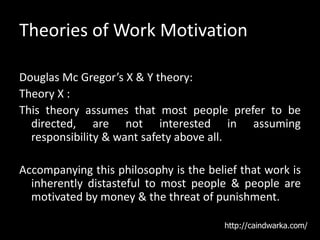
Douglas Mc Gregor’s X & Y theory:
Theory X :
This theory assumes that most people prefer to be
directed, are not interested in assuming
responsibility & want safety above all.
Accompanying this philosophy is the belief that work is
inherently distasteful to most people & people are
motivated by money & the threat of punishment.
http://caindwarka.com/
Theories of Work Motivation
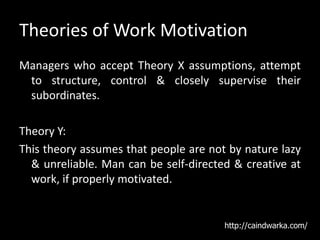
Managers who accept Theory X assumptions, attempt
to structure, control & closely supervise their
subordinates.
Theory Y:
This theory assumes that people are not by nature lazy
& unreliable. Man can be self-directed & creative at
work, if properly motivated.
http://caindwarka.com/
Theories of Work Motivation
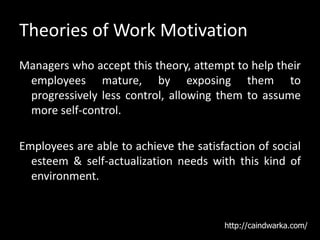
Managers who accept this theory, attempt to help their
employees mature, by exposing them to
progressively less control, allowing them to assume
more self-control.
Employees are able to achieve the satisfaction of social
esteem & self-actualization needs with this kind of
environment.
http://caindwarka.com/
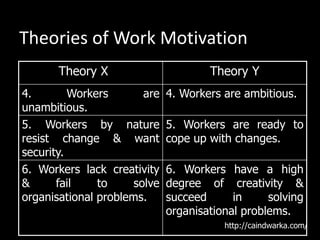
Theories of Work Motivation
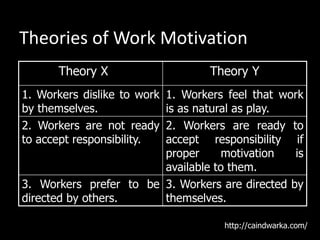
Theory X Theory Y
1. Workers dislike to work
by themselves.
1. Workers feel that work
is as natural as play.
2. Workers are not ready
to accept responsibility.
2. Workers are ready to
accept responsibility if
proper motivation is
available to them.
3. Workers prefer to be
directed by others.
3. Workers are directed by
themselves.
http://caindwarka.com/
Theories of Work Motivation
Theory X Theory Y
4. Workers are
unambitious.
4. Workers are ambitious.
5. Workers by nature
resist change & want
security.
5. Workers are ready to
cope up with changes.
6. Workers lack creativity
& fail to solve
organisational problems.
6. Workers have a high
degree of creativity &
succeed in solving
organisational problems.
http://caindwarka.com/
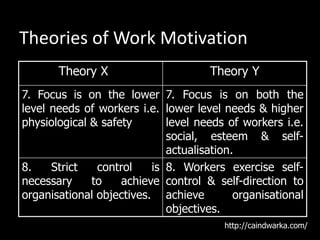
Theories of Work Motivation
Theory X Theory Y
7. Focus is on the lower
level needs of workers i.e.
physiological & safety
7. Focus is on both the
lower level needs & higher
level needs of workers i.e.
social, esteem & self-
actualisation.
8. Strict control is
necessary to achieve
organisational objectives.
8. Workers exercise self-
control & self-direction to
achieve organisational
objectives.
http://caindwarka.com/
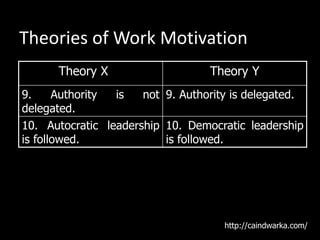
Theories of Work Motivation
Theory X Theory Y
9. Authority is not
delegated.
9. Authority is delegated.
10. Autocratic leadership
is followed.
10. Democratic leadership
is followed.
http://caindwarka.com/
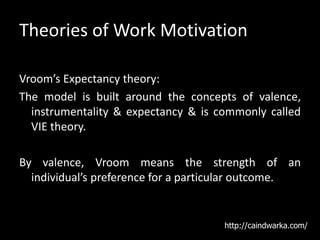
Theories of Work Motivation
Vroom’s Expectancy theory:
The model is built around the concepts of valence,
instrumentality & expectancy & is commonly called
VIE theory.
By valence, Vroom means the strength of an
individual’s preference for a particular outcome.
http://caindwarka.com/
Theories of Work Motivation
Valence is positive when a person prefers attaining the
outcome to not attaining it.
Valence is zero when the individual is indifferent
towards the outcome.
Valence is negative when a person prefers not attaining
the outcome to attaining it.
http://caindwarka.com/
Theories of Work Motivation
Another major input into the valence is the
instrumentality of the first level outcome in obtaining
a desired second level outcome.
Eg. person would be motivated towards superior
performance because of the desire to be promoted.
The superior performance (first level outcome) is
seen as being instrumental in obtaining a promotion
(second level outcome).
http://caindwarka.com/
Theories of Work Motivation
Another important variable is Expectancy. It relates
efforts to first level outcomes; while instrumentality
relates first level & second level outcomes.
So, expectancy is the probability (ranging from 0 to 1)
that a particular action or effort will lead to a
particular first level outcome.
Instrumentality refers to the degree to which a first
level outcome will lead to a desired second level
outcome.
http://caindwarka.com/http://caindwarka.com/
Theories of Work Motivation
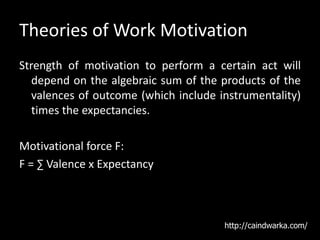
Strength of motivation to perform a certain act will
depend on the algebraic sum of the products of the
valences of outcome (which include instrumentality)
times the expectancies.
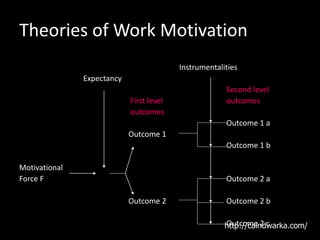
Motivational force F:
F = ∑ Valence x Expectancy
http://caindwarka.com/
Theories of Work Motivation
Instrumentalities
Expectancy
Second level
First level outcomes
outcomes
Outcome 1 a
Outcome 1
Outcome 1 b
Motivational
Force F Outcome 2 a
Outcome 2 Outcome 2 b
Outcome 2 c
VIE theory
http://caindwarka.com/
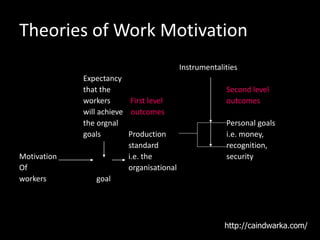
Theories of Work Motivation
Instrumentalities
Expectancy
that the Second level
workers First level outcomes
will achieve outcomes
the orgnal Personal goals
goals Production i.e. money,
standard recognition,
Motivation i.e. the security
Of organisational
workers goal
Eg. of VIE
theory
http://caindwarka.com/
Theories of Work Motivation
This model can clarify the relationship between
individual & organisational goals. Eg. suppose
workers are given a certain standard of production.
By measuring the worker’s output, mgt can determine
how imp. their personal goals are, the
instrumentality of the organisational goal in attaining
their personal goals & the worker’s expectancies that
their effort & ability will accomplish the
organisational goals.
http://caindwarka.com/
Theories of Work Motivation
If the output is below standard, it may be that workers
do not give high importance to the second level
outcome;
or they may not see the first level outcome being
instrumental in achieving the second level outcome;
or they may think that their efforts will not accomplish
the first level outcome.
Anyone or a combination of these possibilities will
result in low motivation, according to Vroom.
Morale
What is Morale?
The dictionary meaning is mood & spirit. High morale
means an enthusiastic, confident feeling with respect
to individual or group achievement.
In employment, morale refers to the participative
attitudes towards achievement of organisational
objectives. It means team spirit & togetherness of
people for a common purpose.
What is Morale?
It is defined as the capacity of a group of people to pull
together persistently (i.e. tirelessly, patiently) &
consistently (again & again) in the pursuit of a
common purpose.
What is Morale?
It consists of 3 different aspects:
1. Feeling of being accepted by one’s work group
2. Sharing common goals with one’s group
3. Having confidence in the desirability of these goals.
What is Morale?
Individual & group morale:
An individual’s morale is related with knowing one’s
expectations & living up to them.
It reflects the individual’s attitude towards life.
Group morale reflects the group feeling – a group
assessment of conditions – esprit de corps (team
spirit)
Effects of Morale
Relationship of morale with productivity:
There are various schools of thought on this concept.
Some believe that high morale is related to high
productivity & vice-versa.
Some believe that morale is not related to productivity.
Effects of Morale
Miller & Form have given 4 combinations of morale &
productivity:
1. High productivity – high morale
2. Low productivity – high morale
3. High productivity – low morale
4. Low productivity – low morale
Effects of Morale
High productivity – high morale: this situation occurs
when group goals (pride in work group, group
recognition) & individual goals (freedom on work,
good wages, job interest) are satisfied leading to
high motivation, high productivity & high morale.
Effects of Morale
Low productivity – high morale: individual goals only
are satisfied. Individual behaviour is determined by
informal groups causing restriction of output,
where supervisors lack technical & administrative
skills & where workers lack adequate skills.
Effects of Morale
High productivity – low morale: in this situation,
supervisor is only able to increase productivity
through his skills or planning ability by use of
penalty (loss of pay or loss of job) rather than
motivating the workers.
Low productivity – low morale: occurs when opposite
factors to situation 1 arise.
Morale Indicators
1. Organisation itself: goals, public reputation,
organisational structure
2. Nature of work: routine or specialised, stress
3. Level of satisfaction: is determined by –
opportunity for advancement, job security,
opportunity to learn, use new ideas, co-operation
of fellow employees, working hours, recognition,
communication.
Morale Indicators
4. Supervision received: high rate of turnover
indicates a poor leadership.
5. Perception of the self: Morale of employees who
lack self-confidence or who suffer from a poor
physical or mental health is generally low.
6. Employee’s perception of past awards & future
opportunities for rewards: whether fair,
satisfactory
Morale Indicators
7. Employee’s age: Earlier belief was that there exists
a U shaped relation between age & morale –
initially high, then low & again high.
But, today it is believed that there is a direct
relationship – high morale with high age, because
of stability, serious attitude towards work,
reliability, less absenteeism, sense of responsibility.
Morale Indicators
8. Employee’s educational level & occupational level:
Inverse relation exists between educational level &
morale. Higher the education, less satisfaction –
because employee compares his attainment with
others.
But a high educational level gives the opportunity to be
high in the ladder, hence satisfaction must be
derived by the individual.
Morale Indicators
Occupational level: also influences morale. Eg.
executives are more satisfied than managers,
managers are more satisfied than the subordinates
etc.
To sum up…..
A manager’s success depends on how well he
can motivate his subordinates & boost
their morale to give their best & also keep
them satisfied.
Motivation is one of the key tools for the
success of any enterprise.
McClelland Achievement
Motivation Theory
What is Motivation?
• The word 'motivation' comes from the
Latin word meaning 'to move‘
• External motivation: bonus, work conditions
(getting the office with the window)
• An inner (self-motivation) or outer drive to
meet a need or goal
Why is Motivation Important?
• It is one of the three key elements in
performance
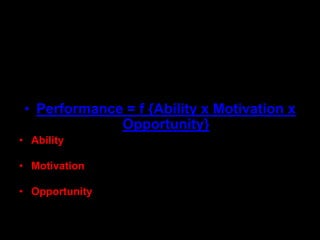
• Performance = f {Ability x Motivation x
Opportunity}
• Ability refers to a natural talent to do something mental
or physical
• Motivation is not a stable individual characteristic.
Motivation is not a trait.
• Opportunity refers to the different situations that
workers may find themselves in.
McClelland's Achievement
Motivation
• McClelland's Achievement Motivation
Theory is based upon the idea that people
have an achievement need. An
achievement need is the need to be
successful and to receive recognition for
your success.
3 characteristics of people
1. Need for Achievement - doing innovative,
new, interesting and challenging things.
2. Need for Affiliation - the need for
feedback / contact with others.
3. Need for Power - the need for
responsibility, or to be responsible for
others.
McClelland's experiment
-- The Thematic Apperception Test (TAT) --
It consisted of showing individuals a series of
pictures and asking them to give brief
descriptions of what was happening in the
pictures. The responses were analysed in terms
of the presence or absence of certain themes.
The themes McClelland and his associates were
looking for revolved around the following
motivators: achievement, affiliation and power.
THEMATIC APPERCEPTION TEST
• The Thematic Apperception Test or TAT is
amongst the most widely used, researched, and
taught psychological tests
• TAT was developed by the American psychologist
Henry A. Murray and Christina D. Morgan at
during the 1930s to explore the underlying
dynamics of personality, such as internal
conflicts, dominant drives and interests and
motives.
• It uses a standard series of 31 provocative yet
ambiguous pictures about which the subject
must tell a story.
• A subject is asked questions such as: What
dialogue might be carried on between
characters? How might the "story" continue after
the picture shown?
• For this reason, the TAT is also known as the
'picture interpretation technique'.
• Today, the TAT is widely used as a tool for
research around areas of psychology such as
dreams, fantasies and what motivates people to
choose their occupation.
• Sometimes it is used in a psychiatric context to
assess disordered thinking, in forensic
examinations to evaluate crime suspects or to
screen candidates for high-stress occupations.
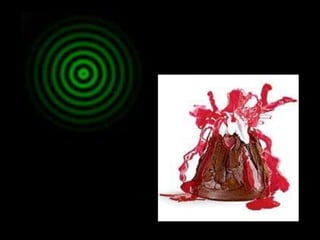
• THE NEXT FEW SLIDES WILL CONTAIN SOME
PICTURES.
• THEIR MEANING WILL DIFFER FROM PERSON TO
PERSON AS THEY WILL BE INTEPRETED ACOORDING
TO INDIVIDUAL PERCEPTION
Achievement
• The need for achievement is characterised by the
wish to take responsibility for finding solutions to
problems, master complex tasks, set goals, get
feedback on level of success.
THE NEED FOR ACHIEVEMENT (N-ACH)
The n-ach person is 'achievement motivated'
and therefore:
• seeks achievement,
• attainment of realistic but challenging goals,
• advancement in the job.
• There is a strong need for feedback as to
achievement and progress, accompained with
a need for a sense of accomplishment.
Affiliation
• The need for affiliation is characterised by
a desire to belong, an enjoyment of
teamwork, a concern about interpersonal
relationships, and a need to reduce
uncertainty.
THE NEED FOR AFFILIATION (N-AFFIL)
• The n-affil person is 'affiliation motivated',
• He has a need for friendly relationships and is
motivated towards interaction with other
people.
• The affiliation driver produces motivation and
need to be liked and held in popular regard.
• These people are team players.
Power (Influence)
• The need for power is characterised by a
drive to control and influence others, a
need to win arguments, a need to
persuade and prevail.
THE NEED FOR AUTHORITY AND POWER (N-
POW)
The n-pow person is 'authority motivated'. This
driver produces a need to be
• influential,
• effective
• to make an impact.
• There is a strong need to lead and for their ideas to
prevail.
• There is also motivation and need towards increasing
personal status and prestige.
TYPES OF POWER
A persons need for power is of two types
• PERSONAL POWER
Those who need Personal Power want to
direct others, which is often perceived as
undesirable.
INSTITUTIONAL POWER
• Persons who need Institutional power or
Social Power want to organise the efforts of
others to further the goals of the organisation.
• Managers with high need for institutional
power tend to be more effective managers as
compared to those with high Personal Power.
Need for Achievement and
Entrepreneurship
• McClelland further described the profile of
an entrepreneur as someone high in
achievement motivation and low in power
motivation, while good managers have
high power motivation and low
achievement motivation.
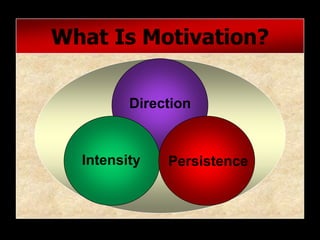
What Is Motivation?
Direction
PersistenceIntensity
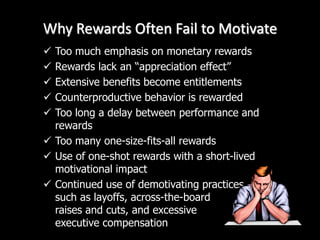
Why Rewards Often Fail to Motivate
 Too much emphasis on monetary rewards
 Rewards lack an “appreciation effect”
 Extensive benefits become entitlements
 Counterproductive behavior is rewarded
 Too long a delay between performance and
rewards
 Too many one-size-fits-all rewards
 Use of one-shot rewards with a short-lived
motivational impact
 Continued use of demotivating practices
such as layoffs, across-the-board
raises and cuts, and excessive
executive compensation
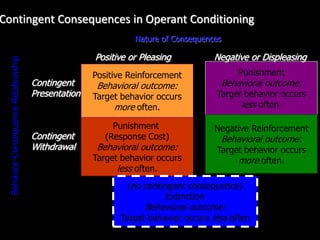
Contingent Consequences in Operant Conditioning
Contingent
Withdrawal
Contingent
Presentation
Punishment
Behavioral outcome:
Target behavior occurs
less often.
Negative Reinforcement
Behavioral outcome:
Target behavior occurs
more often.
Punishment
(Response Cost)
Behavioral outcome:
Target behavior occurs
less often.
Positive Reinforcement
Behavioral outcome:
Target behavior occurs
more often.
(no contingent consequence)
Extinction
Behavioral outcome:
Target behavior occurs less often
Positive or Pleasing Negative or Displeasing
Nature of Consequences
Behavior-ConsequenceRelationship
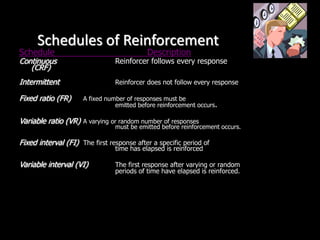
Schedules of Reinforcement
Schedule Description
Continuous Reinforcer follows every response
(CRF)
Intermittent Reinforcer does not follow every response
Fixed ratio (FR) A fixed number of responses must be
emitted before reinforcement occurs.
Variable ratio (VR) A varying or random number of responses
must be emitted before reinforcement occurs.
Fixed interval (FI) The first response after a specific period of
time has elapsed is reinforced
Variable interval (VI) The first response after varying or random
periods of time have elapsed is reinforced.
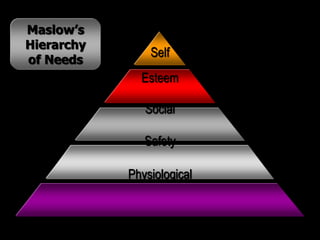
Maslow’s
Hierarchy
of Needs
Self
Esteem
Social
Safety
Physiological
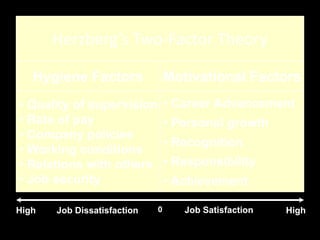
Herzberg’s Two-Factor Theory
Hygiene Factors Motivational Factors
• Quality of supervision
• Rate of pay
• Company policies
• Working conditions
• Relations with others
• Job security
• Career Advancement
• Personal growth
• Recognition
• Responsibility
• Achievement
High HighJob Dissatisfaction Job Satisfaction0
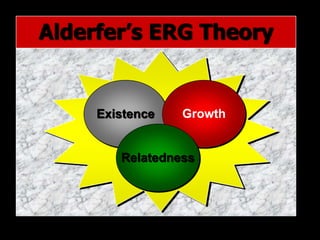
Alderfer’s ERG Theory
Existence Growth
Relatedness
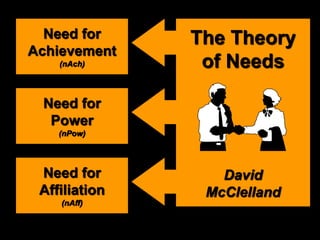
The Theory
of Needs
David
McClelland
Need for
Achievement
(nAch)
Need for
Power
(nPow)
Need for
Affiliation
(nAff)
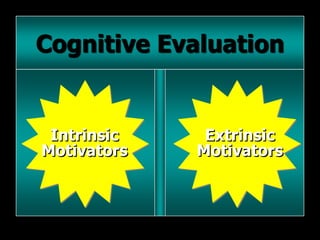
Cognitive Evaluation
Intrinsic
Motivators
Extrinsic
Motivators
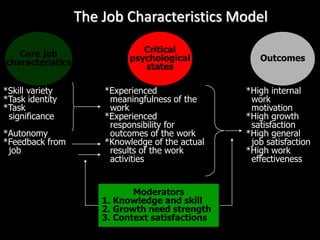
The Job Characteristics Model
Outcomes
*High internal
work
motivation
*High growth
satisfaction
*High general
job satisfaction
*High work
effectiveness
Critical
psychological
states
*Experienced
meaningfulness of the
work
*Experienced
responsibility for
outcomes of the work
*Knowledge of the actual
results of the work
activities
Core job
characteristics
*Skill variety
*Task identity
*Task
significance
*Autonomy
*Feedback from
job
Moderators
1. Knowledge and skill
2. Growth need strength
3. Context satisfactions
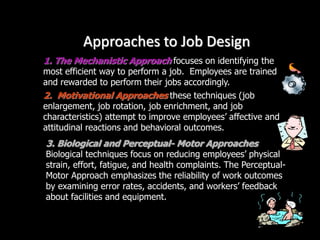
Approaches to Job Design
2. Motivational Approaches these techniques (job
enlargement, job rotation, job enrichment, and job
characteristics) attempt to improve employees’ affective and
attitudinal reactions and behavioral outcomes.
3. Biological and Perceptual- Motor Approaches
Biological techniques focus on reducing employees’ physical
strain, effort, fatigue, and health complaints. The Perceptual-
Motor Approach emphasizes the reliability of work outcomes
by examining error rates, accidents, and workers’ feedback
about facilities and equipment.
1. The Mechanistic Approach focuses on identifying the
most efficient way to perform a job. Employees are trained
and rewarded to perform their jobs accordingly.
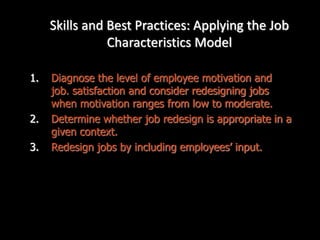
Skills and Best Practices: Applying the Job
Characteristics Model
1. Diagnose the level of employee motivation and
job. satisfaction and consider redesigning jobs
when motivation ranges from low to moderate.
2. Determine whether job redesign is appropriate in a
given context.
3. Redesign jobs by including employees’ input.
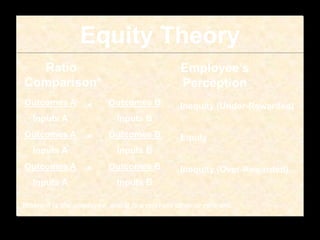
Ratio
Comparison*
Employee’s
Perception
Outcomes A
Inputs A
Outcomes A
Inputs A
Outcomes A
Inputs A
Outcomes B
Inputs B
Outcomes B
Inputs B
Outcomes B
Inputs B
<
=
>
Inequity (Under-Rewarded)
Equity
Inequity (Over-Rewarded)
*Where A is the employee, and B is a relevant other or referent.
Equity Theory
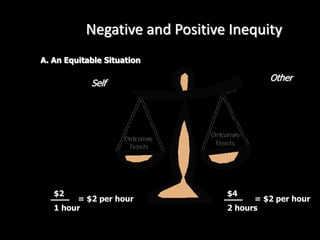
Negative and Positive Inequity
A. An Equitable Situation
Self
Other
$2
1 hour
= $2 per hour
$4
2 hours
= $2 per hour
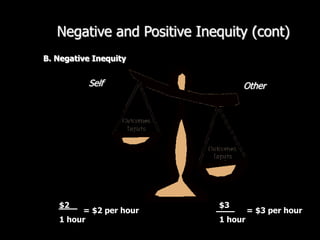
Negative and Positive Inequity (cont)
$2
1 hour
= $2 per hour
$3
1 hour
= $3 per hour
B. Negative Inequity
Self Other
Negative and Positive Inequity (cont)
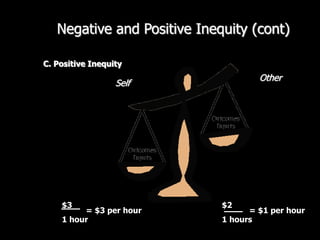
$2
1 hours
= $1 per hour
C. Positive Inequity
$3
1 hour
= $3 per hour
Self
Other
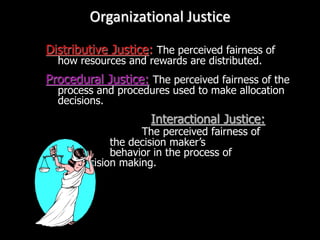
Organizational Justice
Distributive Justice: The perceived fairness of
how resources and rewards are distributed.
Procedural Justice: The perceived fairness of the
process and procedures used to make allocation
decisions.
Interactional Justice:
The perceived fairness of
the decision maker’s
behavior in the process of
decision making.
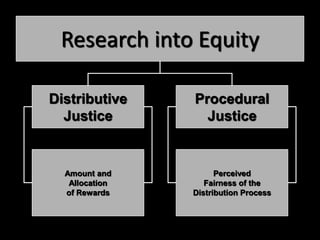
Research into Equity
Amount and
Allocation
of Rewards
Perceived
Fairness of the
Distribution Process
Distributive
Justice
Procedural
Justice
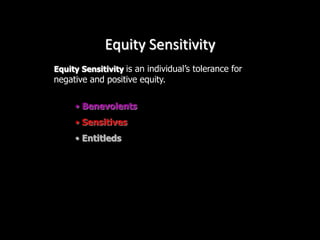
Equity Sensitivity
Equity Sensitivity is an individual’s tolerance for
negative and positive equity.
• Benevolents
• Sensitives
• Entitleds
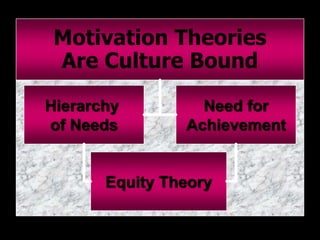
Motivation Theories
Are Culture Bound
Need for
Achievement
Hierarchy
of Needs
Equity Theory
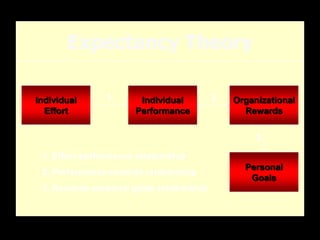
Expectancy Theory
3. Rewards-personal goals relationship
1. Effort-performance relationship
2. Performance-rewards relationship
Individual
Effort
Individual
Performance
Personal
Goals
Organizational
Rewards
1 2
3
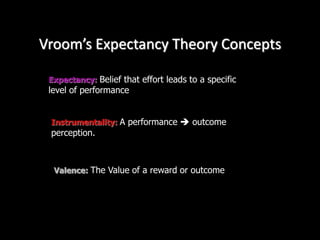
Vroom’s Expectancy Theory Concepts
Expectancy: Belief that effort leads to a specific
level of performance
Instrumentality: A performance  outcome
perception.
Valence: The Value of a reward or outcome
Managerial Implications of
Expectancy Theory
• Determine the outcomes employees value.
• Identify good performance so appropriate behaviors
can be rewarded.
• Make sure employees can achieve targeted
performance levels.
• Link desired outcomes to targeted levels of
performance.
• Make sure changes in outcomes are large enough
to motivate high effort.
• Monitor the reward system for inequities.
Organizational Implications of
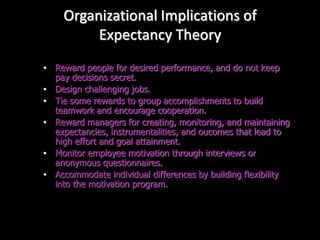
Expectancy Theory
• Reward people for desired performance, and do not keep
pay decisions secret.
• Design challenging jobs.
• Tie some rewards to group accomplishments to build
teamwork and encourage cooperation.
• Reward managers for creating, monitoring, and maintaining
expectancies, instrumentalities, and oucomes that lead to
high effort and goal attainment.
• Monitor employee motivation through interviews or
anonymous questionnaires.
• Accommodate individual differences by building flexibility
into the motivation program.
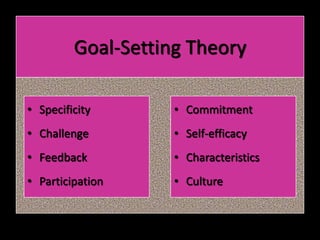
Goal-Setting Theory
• Specificity
• Challenge
• Feedback
• Participation
• Commitment
• Self-efficacy
• Characteristics
• Culture
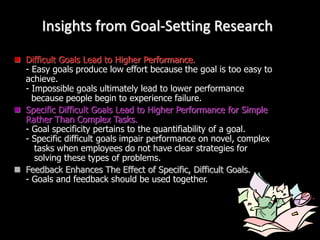
Insights from Goal-Setting Research
 Difficult Goals Lead to Higher Performance.
- Easy goals produce low effort because the goal is too easy to
achieve.
- Impossible goals ultimately lead to lower performance
because people begin to experience failure.
 Specific Difficult Goals Lead to Higher Performance for Simple
Rather Than Complex Tasks.
- Goal specificity pertains to the quantifiability of a goal.
- Specific difficult goals impair performance on novel, complex
tasks when employees do not have clear strategies for
solving these types of problems.
 Feedback Enhances The Effect of Specific, Difficult Goals.
- Goals and feedback should be used together.
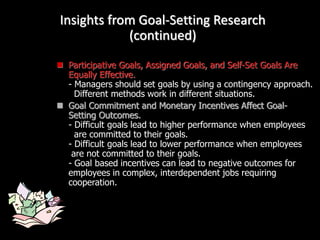
Insights from Goal-Setting Research
(continued)
 Participative Goals, Assigned Goals, and Self-Set Goals Are
Equally Effective.
- Managers should set goals by using a contingency approach.
Different methods work in different situations.
 Goal Commitment and Monetary Incentives Affect Goal-
Setting Outcomes.
- Difficult goals lead to higher performance when employees
are committed to their goals.
- Difficult goals lead to lower performance when employees
are not committed to their goals.
- Goal based incentives can lead to negative outcomes for
employees in complex, interdependent jobs requiring
cooperation.
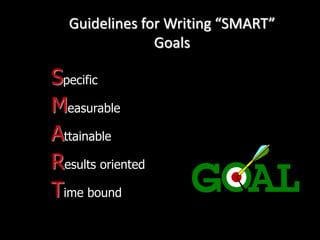
Guidelines for Writing “SMART”
Goals
Specific
Measurable
Attainable
Results oriented
Time bound
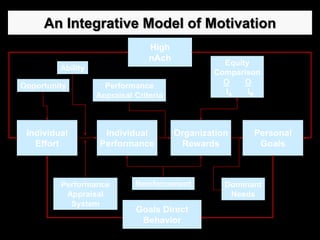
An Integrative Model of Motivation
Personal
Goals
Individual
Performance
Individual
Effort
Goals Direct
Behavior
High
nAch
Ability
Opportunity Performance
Appraisal Criteria
Performance
Appraisal
System
Reinforcement Dominant
Needs
Equity
Comparison
O O
IA IB
Organization
Rewards
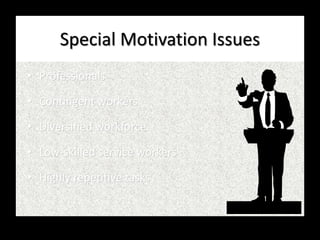
Special Motivation Issues
• Professionals
• Contingent workers
• Diversified workforce
• Low-skilled service workers
• Highly repetitive tasks
MOTIVATION
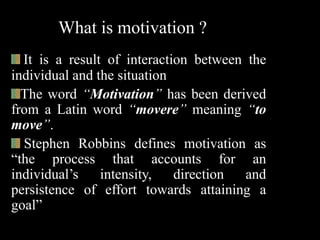
What is motivation ?
It is a result of interaction between the
individual and the situation
The word “Motivation” has been derived
from a Latin word “movere” meaning “to
move”.
Stephen Robbins defines motivation as
“the process that accounts for an
individual’s intensity, direction and
persistence of effort towards attaining a
goal”
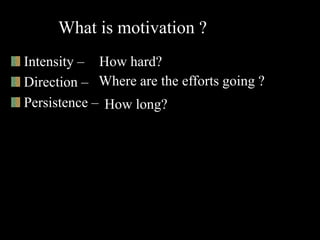
What is motivation ?
Intensity –
Direction –
Persistence –
How hard?
Where are the efforts going ?
How long?
What is motivation ?
According to Fred Luthans “ motivation is
a process that starts with physiological and
psychological deficiency or need that
activates a behavior or a drive that is aimed
at a goal or incentive”
Needs : are created where there is
physiological or psychological imbalance.
Drives : or motives are set up to alleviate
needs
Incentives : are anything that will
alleviate a need & reduce the drive.
Types of motives
Primary Motives
General Motives
Secondary Motives
Primary Motives
Primary Motives are unlearned and
physiologically based.
These motives not necessarily take
precedence over general and secondary
motive.
E.g. Hunger, thirst, avoidance of
pain, maternal concerns and physical
needs.
General Motives
General Motives are unlearned but
not physiologically based.
Unlike primary motives, they induce
the amount of stimulation.
E.g. Curiosity, manipulation, activity
and affection.
Secondary Motives
Secondary Motives are learned and
not physiologically based.
E.g. Power, achievement, affiliation
security and status.
Secondary Motive – Power motive
Need for power
Influencing people to change their
attitudes or behavior
Controlling people and activities
Being in a position of authority over
others.
Gaining control over information &
resources
Defeating an opponent or enemy.
Secondary Motive – Achievement motive
Need for achievement
Doing better than competitors
Attaining or surpassing a difficult goal
Solving a complex problem
Carrying out a challenging assignment
successfully
Developing a better way to do
something.
Secondary Motive – Affiliation motive
Need for affiliation
Being liked by many people
Being accepted as a part of the group /
team
Maintaining harmonious relations and
avoiding conflicts
Participating in pleasant social activities.
Secondary Motive – Security motive
Need for security
Having a secure job
Being protected against loss of income
Having protection against illness or
disability
Avoiding tasks or decisions with a risk of
failure and blame.
Security is basically based on fear or
loss of something.
Secondary Motive – Status motive
Status is defined as “relative ranking”
that a person holds in the group,
organization or society.
Status may be high or low
Secondary Motive – Status motive
Need for status
Having the right car and clothes
Working for the right job and right
company
Having a degree from the right
university
Living in the right neighborhood and
having the membership of the right club
Having executive privileges.
THEORIES
OF
MOTIVATION
Maslow’s hierarchy of needs Theory.
Herzberg’s two-factor theory.
Victor Vroom’s theory.
Porter and Lawler’s theory.
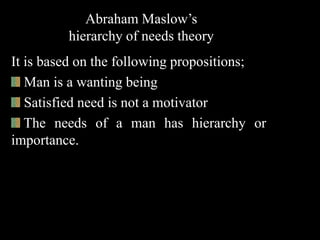
Abraham Maslow’s
hierarchy of needs theory
It is based on the following propositions;
Man is a wanting being
Satisfied need is not a motivator
The needs of a man has hierarchy or
importance.
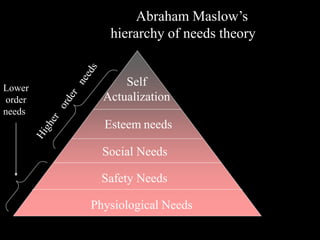
Abraham Maslow’s
hierarchy of needs theory
Self
Actualization
Esteem needs
Social Needs
Safety Needs
Physiological Needs
Lower
order
needs
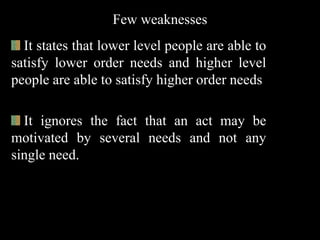
Few weaknesses
It states that lower level people are able to
satisfy lower order needs and higher level
people are able to satisfy higher order needs
It ignores the fact that an act may be
motivated by several needs and not any
single need.
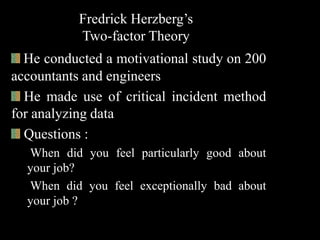
Fredrick Herzberg’s
Two-factor Theory
He conducted a motivational study on 200
accountants and engineers
He made use of critical incident method
for analyzing data
Questions :
When did you feel particularly good about
your job?
When did you feel exceptionally bad about
your job ?
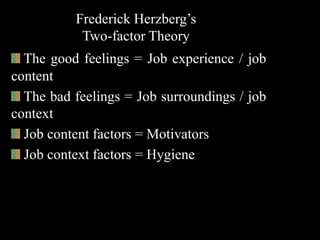
Frederick Herzberg’s
Two-factor Theory
The good feelings = Job experience / job
content
The bad feelings = Job surroundings / job
context
Job content factors = Motivators
Job context factors = Hygiene
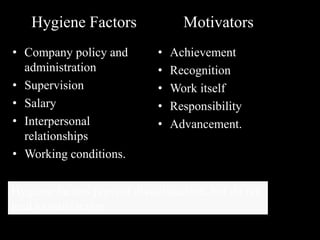
Hygiene Factors Motivators
• Company policy and
administration
• Supervision
• Salary
• Interpersonal
relationships
• Working conditions.
• Achievement
• Recognition
• Work itself
• Responsibility
• Advancement.
Hygiene factors prevent dissatisfaction, but do not
lead to satisfaction.
Few weaknesses
There is always a question regarding the
samples used by Herzberg
Low-complexity job workers
Age
The varied situations may affect
preferences for motivators.
Victor Vroom’s
Expectancy theory of motivation
 Expectancy theory
argues that the
strength of the
tendency to act in a
certain way depends
on
 the strength of an
expectation that the
act will be followed
by a given outcome
and
 on the attractiveness
of that outcome to the
individual.
 An employee will be
motivated to exert high
level of effort when
 he/she believes that the
effort will lead to a good
performance appraisal;
that a good appraisal will
lead to organizational
rewards such as a bonus,
salary increments or
promotion;
 and that the rewards will
satisfy the employee’s
personal goals.
Vroom’s Expectancy theory
This theory focuses on three relationships;
Valence : Effort – performance
Expectancy : Performance – reward
Instrumentality : Rewards – personal goals
Let us see the applicability
If I give a max. effort, will it be recognized in my
performance appraisal?
If I get a good performance appraisal, will it
lead to organizational rewards?
if I am rewarded, are the rewards the ones that I
find personally attractive?
Weakness
Like other theories, this too is a model
that helps managers understand certain
aspects of motivation, but
it does not give practical solutions to
solve motivational problems.
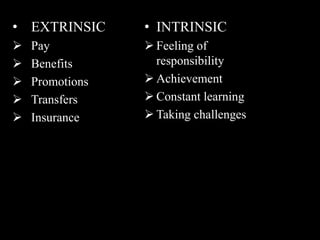
• EXTRINSIC
 Pay
 Benefits
 Promotions
 Transfers
 Insurance
• INTRINSIC
 Feeling of
responsibility
 Achievement
 Constant learning
 Taking challenges
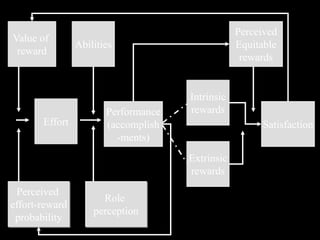
Value of
reward
Perceived
effort-reward
probability
Abilities
Effort
Role
perception
Performance
(accomplish
-ments)
Intrinsic
rewards
Extrinsic
rewards
Satisfaction
Perceived
Equitable
rewards
Chapter 4
Motivating
Self and Others
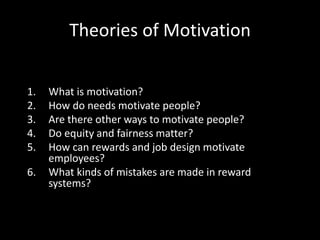
Theories of Motivation
1. What is motivation?
2. How do needs motivate people?
3. Are there other ways to motivate people?
4. Do equity and fairness matter?
5. How can rewards and job design motivate
employees?
6. What kinds of mistakes are made in reward
systems?
What is Motivation?
• Motivation
– The processes that account for an individual’s
intensity, direction, and persistence of effort
toward attaining a goal
Theory X and Theory Y
• Theory X
• Theory Y
Motivators
• Intrinsic
• Extrinsic
Needs Theories of Motivation
• Basic idea:
– Individuals have needs that, when unsatisfied, will
result in motivation
• Maslow’s Hierarchy of Needs
• Motivation-Hygiene theory
• Alderfer’s ERG theory
• McClelland’s Theory of Needs
Maslow’s Hierarchy of Needs
• Physiological
• Safety
• Social
• Esteem
• Self-actualization
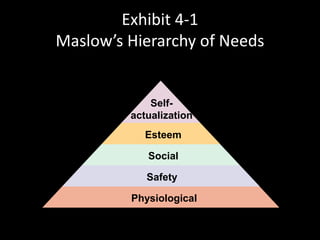
Exhibit 4-1
Maslow’s Hierarchy of Needs
Physiological
Safety
Social
Esteem
Self-
actualization
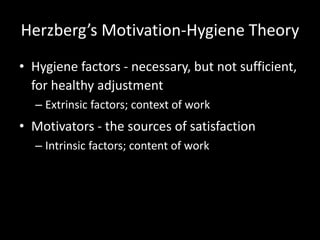
Herzberg’s Motivation-Hygiene Theory
• Hygiene factors - necessary, but not sufficient,
for healthy adjustment
– Extrinsic factors; context of work
• Motivators - the sources of satisfaction
– Intrinsic factors; content of work
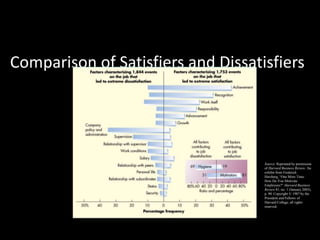
Comparison of Satisfiers and Dissatisfiers
Source: Reprinted by permission
of Harvard Business Review. An
exhibit from Frederick
Herzberg, “One More Time:
How Do You Motivate
Employees?” Harvard Business
Review 81, no. 1 (January 2003),
p. 90. Copyright © 1987 by the
President and Fellows of
Harvard College; all rights
reserved.
Criticisms of Motivation-Hygiene
Theory
• The procedure that Herzberg used is limited by its
methodology
• The reliability of Herzberg’s methodology is
questioned
• Herzberg did not really produce a theory of
motivation
• No overall measure of satisfaction was used
• The theory is inconsistent with previous research
Alderfer’s ERG Theory
• Existence
• Relatedness
• Growth
McClelland’s Theory of Needs
• Need for Achievement
• Need for Power
• Need for Affiliation
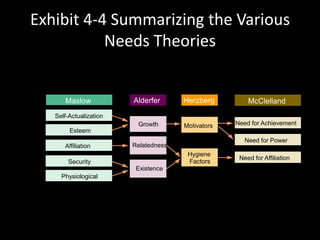
Exhibit 4-4 Summarizing the Various
Needs Theories
Hygiene
Factors
Need for Achievement
Need for Power
Need for Affiliation
Self-Actualization
Esteem
Affiliation
Security
Physiological
Motivators
Relatedness
Existence
Growth
Maslow Alderfer Herzberg McClelland
Summary: Hierarchy of Needs
• Maslow
• Herzberg
• Alderfer
• McClelland
Summary: Impact of Theory
• Maslow
• Herzberg
• Alderfer
• McClelland
Summary: Support and Criticism of
Theory
• Maslow
• Herzberg
• Alderfer
• McClelland
Process Theories of Motivation
• Look at the actual process of motivation
– Expectancy theory
– Goal-setting theory
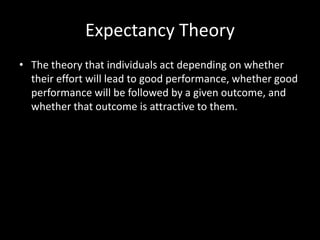
Expectancy Theory
• The theory that individuals act depending on whether
their effort will lead to good performance, whether good
performance will be followed by a given outcome, and
whether that outcome is attractive to them.
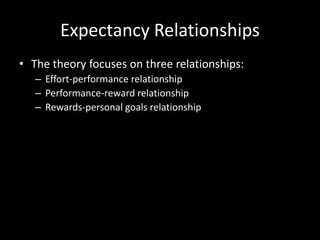
Expectancy Relationships
• The theory focuses on three relationships:
– Effort-performance relationship
– Performance-reward relationship
– Rewards-personal goals relationship
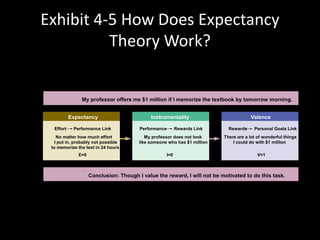
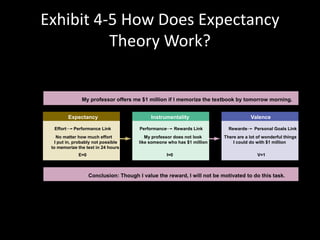
Exhibit 4-5 How Does Expectancy
Theory Work?
Expectancy
Effort Performance Link
E=0
No matter how much effort
I put in, probably not possible
to memorize the text in 24 hours
Instrumentality
Performance Rewards Link
I=0
My professor does not look
like someone who has $1 million
Valence
Rewards Personal Goals Link
V=1
There are a lot of wonderful things
I could do with $1 million
My professor offers me $1 million if I memorize the textbook by tomorrow morning.
Conclusion: Though I value the reward, I will not be motivated to do this task.
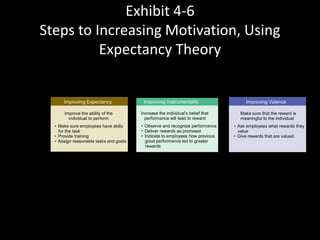
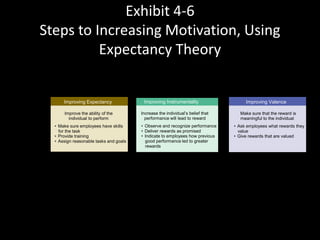
Exhibit 4-6
Steps to Increasing Motivation, Using
Expectancy Theory
Improving Expectancy
Improve the ability of the
individual to perform
• Make sure employees have skills
for the task
• Provide training
• Assign reasonable tasks and goals
Improving Instrumentality Improving Valence
Increase the individual’s belief that
performance will lead to reward
• Observe and recognize performance
• Deliver rewards as promised
• Indicate to employees how previous
good performance led to greater
rewards
Make sure that the reward is
meaningful to the individual
• Ask employees what rewards they
value
• Give rewards that are valued
Goal-Setting Theory
• The theory that specific and difficult goals lead to
higher performance.
– Goals tell an employee what needs to be done and how much
effort will need to be expended.
– Specific hard goals produce a higher level of output than does
the generalized goal of “do your best.”
How Does Goal Setting Motivate?
• Goals:
– Direct attention
– Regulate effort
– Increase persistence
– Encourage the development of strategies and
action plans
Chapter 4, Nancy Langton and Stephen
P. Robbins, Fundamentals of
Organizational Behaviour, Third
Canadian Edition
4-178
Goals Should Be SMART
• For goals to be effective, they should be
SMART:
Chapter 4, Nancy Langton and Stephen
P. Robbins, Fundamentals of
Organizational Behaviour, Third
Canadian Edition
4-179
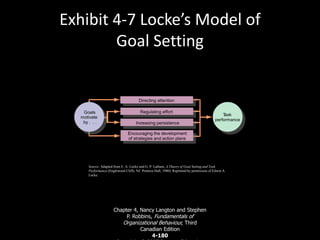
Exhibit 4-7 Locke’s Model of
Goal Setting
Chapter 4, Nancy Langton and Stephen
P. Robbins, Fundamentals of
Organizational Behaviour, Third
Canadian Edition
4-180
Regulating effort
Increasing persistence
Encouraging the development
of strategies and action plans
Task
performance
Directing attention
Goals
motivate
by . . .
Source: Adapted from E. A. Locke and G. P. Latham, A Theory of Goal Setting and Task
Performance (Englewood Cliffs, NJ: Prentice Hall, 1980). Reprinted by permission of Edwin A.
Locke.
Contingency Factors in
Goal Setting
• Self-efficacy
– An individual’s belief that he or she is capable of
performing a task.
Chapter 4, Nancy Langton and Stephen
P. Robbins, Fundamentals of
Organizational Behaviour, Third
Canadian Edition
4-181
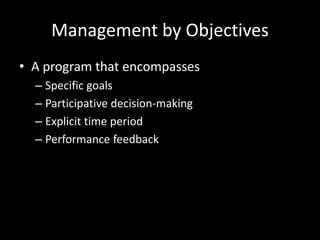
Management by Objectives
• A program that encompasses
– Specific goals
– Participative decision-making
– Explicit time period
– Performance feedback
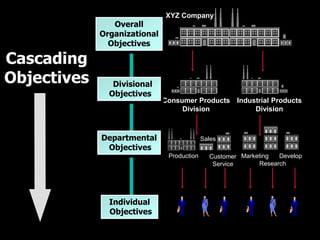
Overall
Organizational
Objectives
XYZ Company
Consumer Products
Division
Industrial Products
Division
Divisional
Objectives
Departmental
Objectives
Individual
Objectives
Production
Sales
Customer
Service
Marketing
Research
Develop
Cascading
Objectives
Responses to the Reward System
• Equity Theory
• Fair Process
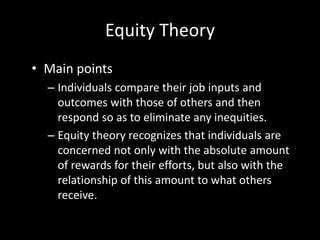
Equity Theory
• Main points
– Individuals compare their job inputs and
outcomes with those of others and then
respond so as to eliminate any inequities.
– Equity theory recognizes that individuals are
concerned not only with the absolute amount
of rewards for their efforts, but also with the
relationship of this amount to what others
receive.
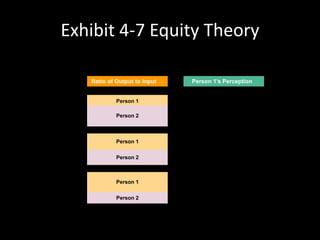
Exhibit 4-7 Equity Theory
Person 1
Inequity, underrewarded
Equity
Inequity, overrewarded
Ratio of Output to Input Person 1’s Perception
Person 2
Person 1
Person 2
Person 1
Person 2
Responses to Inequity
• Change Inputs
• Change Outcomes
• Adjust Perceptions of Self
• Adjust Perceptions of Others
• Choose a Different Referent
• Leave the Field
Fair Process and Treatment
• Historically, equity theory focused on:
– Distributive justice
• However, equity should also consider
– Procedural justice
Fair Process and Treatment
• Distributive Justice
• Procedural Justice
• Interactional Justice
Motivators
• Intrinsic
• Extrinsic
Four Key Rewards to Increase Intrinsic
Motivation
1. Choice
2. Competence
3. Meaningfulness
4. Progress
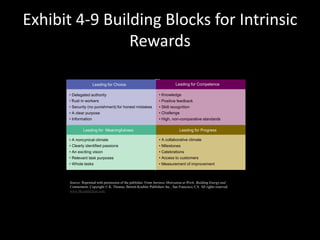
Exhibit 4-9 Building Blocks for Intrinsic
Rewards
• Delegated authority
•Trust in workers
• Security (no punishment) for honest mistakes
• A clear purpose
• Information
• A noncynical climate
• Clearly identified passions
• An exciting vision
• Relevant task purposes
• Whole tasks
• Knowledge
• Positive feedback
• Skill recognition
• Challenge
• High, non-comparative standards
• A collaborative climate
• Milestones
• Celebrations
• Access to customers
• Measurement of improvement
Leading for Choice Leading for Competence
Leading for Meaningfulness Leading for Progress
Source: Reprinted with permission of the publisher. From Intrinsic Motivation at Work: Building Energy and
Commitment. Copyright © K. Thomas. Berrett-Koehler Publishers Inc., San Francisco, CA. All rights reserved.
www.bkconnection.com.
Variable-Pay Programs
• A portion of an employee’s pay is based on
some individual and/or organizational
measure of performance.
– Individual-based
– Group-based
– Organizational-based
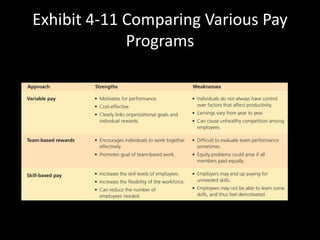
Exhibit 4-11 Comparing Various Pay
Programs
Designing Motivating Jobs
• Job Characteristic Model (JCM) is a model that identifies five
core job dimensions and their relationship to personal and
work outcomes.
• Job Enrichment
JCM – Core Job Dimensions
• Skill variety
• Task identity
• Task significance
• Autonomy
• Feedback
JCM – Critical Psychological States
• Experienced meaningfulness
• Experienced responsibility for outcomes
• Knowledge of the actual results
Exhibit 4-12 – Examples of High and
Low Job Characteristics
Skill Variety
Task Identity
Task Significance
Autonomy
Feedback
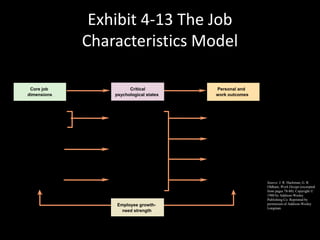
Exhibit 4-13 The Job
Characteristics Model
Core job
dimensions
Personal and
work outcomes
Skill variety
Task identity
Task significance
Experienced
meaningfulness
of the work
High internal
work motivation
Autonomy
Experienced
responsibility
for outcomes
of the work
High-quality
work performance
Feedback
Knowledge of the
actual results of
the work activities
High satisfaction
with the work
Low absenteeism
and turnover
Employee growth-
need strength
Critical
psychological states
Source: J. R. Hackman, G. R.
Oldham, Work Design (excerpted
from pages 78-80). Copyright ©
1980 by Addison-Wesley
Publishing Co. Reprinted by
permission of Addison-Wesley
Longman.
Beware the Signals That Are Sent By
Rewards
• Often reward systems do not reflect
organizational goals:
– Individuals are stuck in old patterns of rewards
and recognition.
– Organizations don’t look at the big picture.
– Management and shareholders focus on short-
term results.
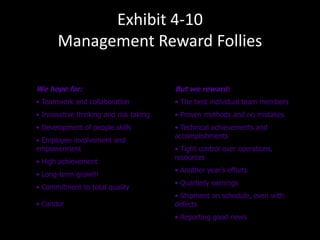
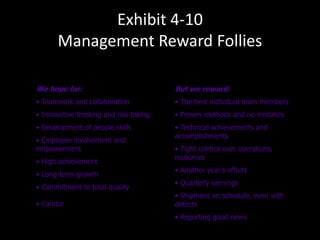
We hope for:
• Teamwork and collaboration
• Innovative thinking and risk taking
• Development of people skills
• Employee involvement and
empowerment
• High achievement
• Long-term growth
• Commitment to total quality
• Candor
But we reward:
• The best individual team members
• Proven methods and no mistakes
• Technical achievements and
accomplishments
• Tight control over operations,
resources
• Another year’s efforts
• Quarterly earnings
• Shipment on schedule, even with
defects
• Reporting good news
Exhibit 4-10
Management Reward Follies
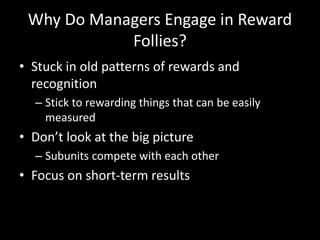
Why Do Managers Engage in Reward
Follies?
• Stuck in old patterns of rewards and
recognition
• Don’t look at the big picture
• Focus on short-term results
Caveat Emptor: Apply Motivation
Theories Wisely
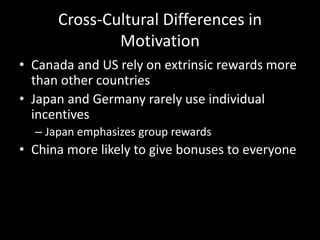
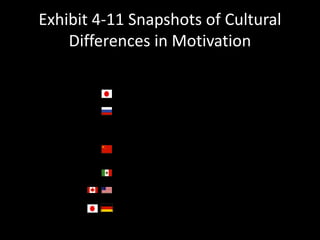
• Motivation Theories Are Culture-Bound
– Canada and US rely on extrinsic rewards more
than other countries.
– Japan and Germany rarely use individual
incentives.
– China is more likely to give bonuses to everyone.
Can We Just Eliminate Rewards?
• Alfie Kohn suggests that organizations should focus less
on rewards, more on creating motivating environments:
– Abolish Incentives.
– Re-evaluate Evaluation.
– Create Conditions for Authentic Motivation.
– Encourage Collaboration.
– Enhance Content.
– Provide Choice.
Putting It All Together
• What we know about motivating employees in organizations:
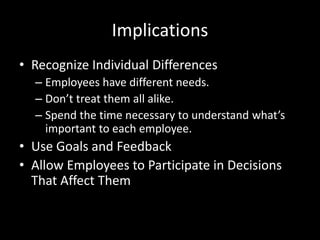
– Recognize individual differences.
– Employees have different needs.
– Don’t treat them all alike.
– Spend the time necessary to understand what’s important to each
employee.
– Use goals and feedback.
– Allow employees to participate in decisions that affect them.
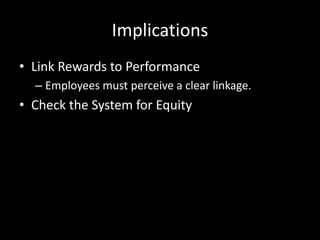
– Link rewards to performance.
– Check the system for equity.
Summary and Implications
1. What is Motivation?
– Motivation is the process that accounts for an
individual’s intensity, direction, and persistence
of effort toward reaching the goal.
2. How do needs motivate people?
– All needs theories of motivation propose a
similar idea: individuals have needs that, when
unsatisfied, will result in motivation.
Summary and Implications
3. Are there other ways to motivate people?
– Process theories focus on the broader picture of how
someone can set about motivating another individual.
Process theories include expectancy theory and goal-
setting theory (and its application, management by
objectives).
4. Do equity and fairness matter?
– Individuals look for fairness in the reward system.
Rewards should be perceived by employees as related
to the inputs they bring to the job.
Summary and Implications
5. How can rewards and job design motivate employees?
– Recognition helps employees feel that they matter. Employers
can use variable-pay programs to reward performance.
Employers can use job design to motivate employees. Jobs that
have variety, autonomy, feedback, and similar complex task
characteristics tend to be more motivating for employees.
6. What kinds of mistakes are made in reward systems?
– Often reward systems do not reward the performance that is
expected. Also, reward systems sometimes do not recognize that
rewards are culture-bound.
Summary
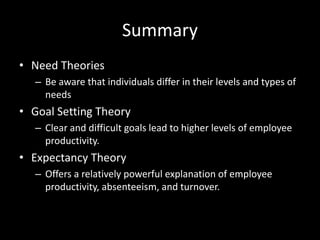
• Need Theories
– Be aware that individuals differ in their levels and types of
needs
• Goal Setting Theory
– Clear and difficult goals lead to higher levels of employee
productivity.
• Expectancy Theory
– Offers a relatively powerful explanation of employee
productivity, absenteeism, and turnover.
Summary
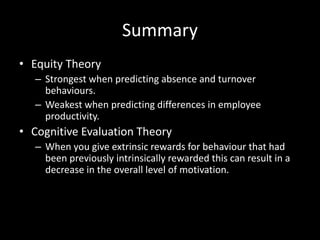
• Equity Theory
– Strongest when predicting absence and turnover behaviours.
– Weakest when predicting differences in employee
productivity.
• Cognitive Evaluation Theory
– When you give extrinsic rewards for behaviour that had been
previously intrinsically rewarded this can result in a decrease
in the overall level of motivation.
Chapter 4
Motivating
Self and Others
Motivating Self and Others
1. What is motivation?
2. How do needs motivate people?
3. Are there other ways to motivate people?
4. Do equity and fairness matter?
5. Are there tips for motivating people for different goals?
6. How do you motivate for individual differences?
7. What kinds of mistakes are made in reward systems?
8. Do motivational theories work the same in every country?
9. Could rewards be overrated?
Questionsfor Consideration
What is Motivation?
• Motivation
– The processes that account for an individual’s
intensity, direction, and persistence of effort
toward attaining a goal
• Intensity: how hard a person tries
• Direction: where effort is channeled
• Persistence: how long effort is maintained
Theory X and Theory Y
• Theory X
– The assumption that employees dislike work, will attempt
to avoid it, and must be coerced, controlled, or threatened
with punishment if they are to perform.
• Theory Y
– The assumption that employees like work, are creative,
seek responsibility, and can exercise self-direction and self-
control.
Motivators
• Intrinsic
– A person’s internal desire to do something, due to
such things as interest, challenge, and personal
satisfaction.
• Extrinsic
– Motivation that comes from outside the person,
such as pay, bonuses, and other tangible rewards.
Needs Theories of Motivation
• Basic idea:
– Individuals have needs that, when unsatisfied, will
result in motivation
• Maslow’s hierarchy of needs
• Herzberg’s two factor theory (motivation-hygiene
theory)
• Alderfer’s ERG theory
• McClelland’s theory of needs
Maslow’s Hierarchy of Needs
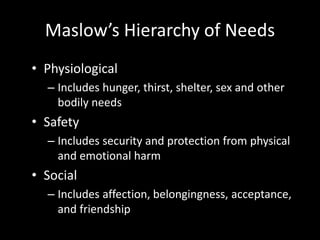
• Physiological
– Includes hunger, thirst, shelter, sex and other
bodily needs
• Safety
– Includes security and protection from physical
and emotional harm
• Social
– Includes affection, belongingness, acceptance,
and friendship
Maslow’s Hierarchy of Needs
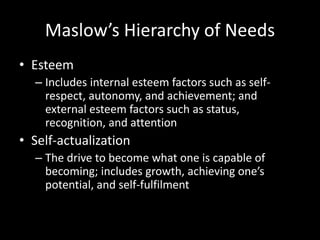
• Esteem
– Includes internal esteem factors such as self-
respect, autonomy, and achievement; and
external esteem factors such as status,
recognition, and attention
• Self-actualization
– The drive to become what one is capable of
becoming; includes growth, achieving one’s
potential, and self-fulfilment
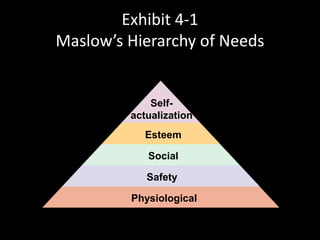
Exhibit 4-1
Maslow’s Hierarchy of Needs
Physiological
Safety
Social
Esteem
Self-
actualization
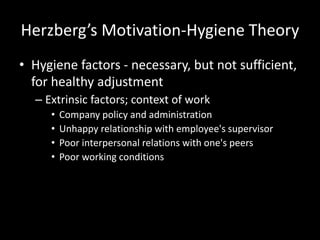
Herzberg’s Motivation-Hygiene Theory
• Hygiene factors - necessary, but not sufficient,
for healthy adjustment
– Extrinsic factors; context of work
• Company policy and administration
• Unhappy relationship with employee's supervisor
• Poor interpersonal relations with one's peers
• Poor working conditions
Herzberg’s Motivation-Hygiene Theory
• Motivators - the sources of satisfaction
– Intrinsic factors; content of work
• Achievement
• Recognition
• Challenging, varied or interesting work
• Responsibility
• Advancement
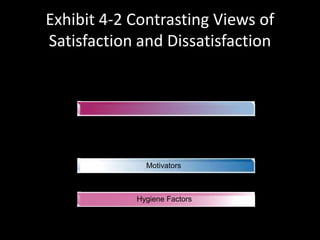
Exhibit 4-2 Contrasting Views of
Satisfaction and Dissatisfaction
Dissatisfaction Satisfaction
Traditional view
No Satisfaction Satisfaction
Herzberg's view
Dissatisfaction No dissatisfaction
Hygiene Factors
Motivators
Criticisms of Motivation-Hygiene
Theory
• The procedure that Herzberg used is limited by its
methodology
• The reliability of Herzberg’s methodology is
questioned
• Herzberg did not really produce a theory of
motivation
• No overall measure of satisfaction was used
• The theory is inconsistent with previous research
Alderfer’s ERG Theory
• Existence
– Concerned with providing basic material existence
requirements
• Relatedness
– Desire for maintaining important interpersonal
relationships
• Growth
– Intrinsic desire for personal development
McClelland’s Theory of Needs
• Need for Achievement
– The drive to excel, to achieve in relation to a set of
standards, to strive to succeed
• Need for Power
– The need to make others behave in a way that they would
not have behaved otherwise
• Need for Affiliation
– The desire for friendly and close interpersonal
relationships
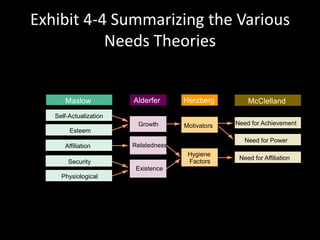
Exhibit 4-4 Summarizing the Various
Needs Theories
Hygiene
Factors
Need for Achievement
Need for Power
Need for Affiliation
Self-Actualization
Esteem
Affiliation
Security
Physiological
Motivators
Relatedness
Existence
Growth
Maslow Alderfer Herzberg McClelland
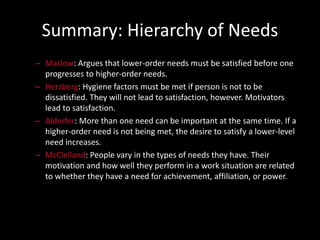
Summary: Hierarchy of Needs
– Maslow: Argues that lower-order needs must be satisfied before one
progresses to higher-order needs.
– Herzberg: Hygiene factors must be met if person is not to be
dissatisfied. They will not lead to satisfaction, however. Motivators
lead to satisfaction.
– Alderfer: More than one need can be important at the same time. If a
higher-order need is not being met, the desire to satisfy a lower-level
need increases.
– McClelland: People vary in the types of needs they have. Their
motivation and how well they perform in a work situation are related
to whether they have a need for achievement, affiliation, or power.
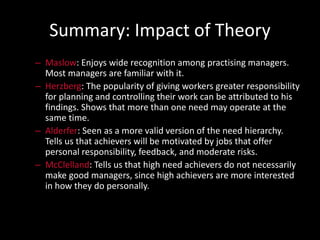
Summary: Impact of Theory
– Maslow: Enjoys wide recognition among practising managers.
Most managers are familiar with it.
– Herzberg: The popularity of giving workers greater responsibility
for planning and controlling their work can be attributed to his
findings. Shows that more than one need may operate at the
same time.
– Alderfer: Seen as a more valid version of the need hierarchy.
Tells us that achievers will be motivated by jobs that offer
personal responsibility, feedback, and moderate risks.
– McClelland: Tells us that high need achievers do not necessarily
make good managers, since high achievers are more interested
in how they do personally.
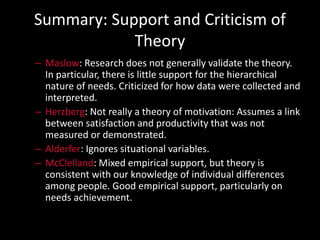
Summary: Support and Criticism of
Theory
– Maslow: Research does not generally validate the theory.
In particular, there is little support for the hierarchical
nature of needs. Criticized for how data were collected and
interpreted.
– Herzberg: Not really a theory of motivation: Assumes a link
between satisfaction and productivity that was not
measured or demonstrated.
– Alderfer: Ignores situational variables.
– McClelland: Mixed empirical support, but theory is
consistent with our knowledge of individual differences
among people. Good empirical support, particularly on
needs achievement.
Process Theories of Motivation
• Look at the actual process of motivation
– Expectancy theory
– Goal-setting theory
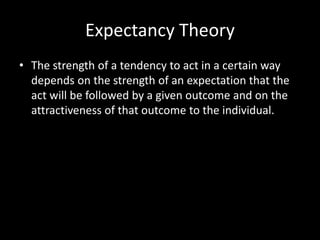
Expectancy Theory
• The strength of a tendency to act in a certain way
depends on the strength of an expectation that the
act will be followed by a given outcome and on the
attractiveness of that outcome to the individual.
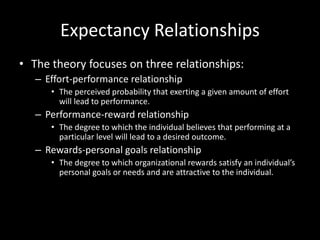
Expectancy Relationships
• The theory focuses on three relationships:
– Effort-performance relationship
• The perceived probability that exerting a given amount of effort
will lead to performance.
– Performance-reward relationship
• The degree to which the individual believes that performing at a
particular level will lead to a desired outcome.
– Rewards-personal goals relationship
• The degree to which organizational rewards satisfy an individual’s
personal goals or needs and are attractive to the individual.
Exhibit 4-5 How Does Expectancy
Theory Work?
Expectancy
Effort Performance Link
E=0
No matter how much effort
I put in, probably not possible
to memorize the text in 24 hours
Instrumentality
Performance Rewards Link
I=0
My professor does not look
like someone who has $1 million
Valence
Rewards Personal Goals Link
V=1
There are a lot of wonderful things
I could do with $1 million
My professor offers me $1 million if I memorize the textbook by tomorrow morning.
Conclusion: Though I value the reward, I will not be motivated to do this task.
Exhibit 4-6
Steps to Increasing Motivation, Using
Expectancy Theory
Improving Expectancy
Improve the ability of the
individual to perform
• Make sure employees have skills
for the task
• Provide training
• Assign reasonable tasks and goals
Improving Instrumentality Improving Valence
Increase the individual’s belief that
performance will lead to reward
• Observe and recognize performance
• Deliver rewards as promised
• Indicate to employees how previous
good performance led to greater
rewards
Make sure that the reward is
meaningful to the individual
• Ask employees what rewards they
value
• Give rewards that are valued
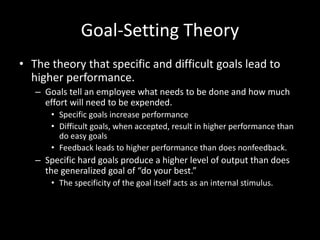
Goal-Setting Theory
• The theory that specific and difficult goals lead to
higher performance.
– Goals tell an employee what needs to be done and how much
effort will need to be expended.
• Specific goals increase performance
• Difficult goals, when accepted, result in higher performance than
do easy goals
• Feedback leads to higher performance than does nonfeedback.
– Specific hard goals produce a higher level of output than does
the generalized goal of “do your best.”
• The specificity of the goal itself acts as an internal stimulus.
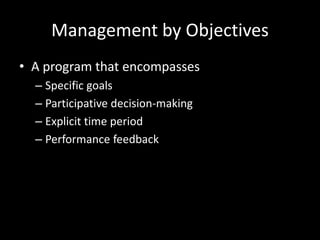
Management by Objectives
• A program that encompasses
– Specific goals
– Participative decision-making
– Explicit time period
– Performance feedback
Responses to the Reward System
• Equity Theory
• Fair Process
Equity Theory
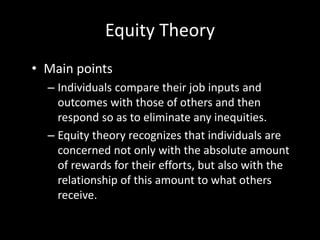
• Main points
– Individuals compare their job inputs and
outcomes with those of others and then
respond so as to eliminate any inequities.
– Equity theory recognizes that individuals are
concerned not only with the absolute amount
of rewards for their efforts, but also with the
relationship of this amount to what others
receive.
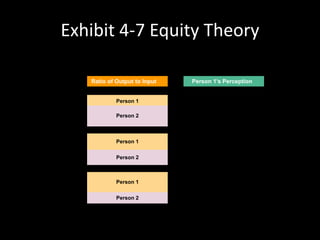
Exhibit 4-7 Equity Theory
Person 1
Inequity, underrewarded
Equity
Inequity, overrewarded
Ratio of Output to Input Person 1’s Perception
Person 2
Person 1
Person 2
Person 1
Person 2
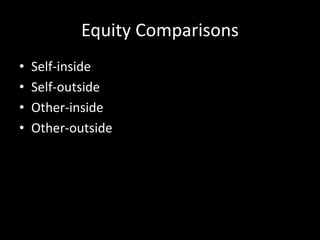
Equity Comparisons
• Self-inside
• Self-outside
• Other-inside
• Other-outside
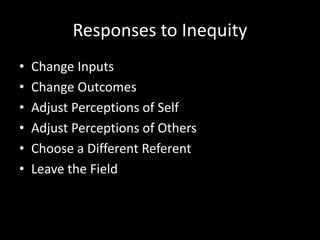
Responses to Inequity
• Change Inputs
• Change Outcomes
• Adjust Perceptions of Self
• Adjust Perceptions of Others
• Choose a Different Referent
• Leave the Field
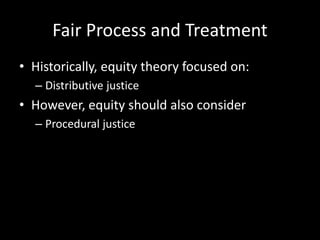
Fair Process and Treatment
• Historically, equity theory focused on:
– Distributive justice
• However, equity should also consider
– Procedural justice
Fair Process
• Distributive Justice
– Perceived fairness of the amount and allocation of rewards
among individuals
• Procedural Justice
– Perceived fairness of the process used to determine the
distribution of rewards
• Interactional Justice
– The quality of the interpersonal treatment received from
another
Motivating to Show People Matter
• Employee Recognition Programs
– Programs that use multiple sources and recognizes both
individual and group accomplishments.
• Linking Programs and Reinforcement Theory
– Consistent with reinforcement theory, rewarding a
behaviour with recognition immediately following that
behaviour is likely to encourage its repetition.
• Employee Recognition Programs in Practice
– In contrast to most other motivators, recognizing an
employee’s superior performance often costs little or no
money, making them highly attractive to industry.
Variable Pay Programs
• A portion of an employee’s pay is based on some
individual and/or organizational measure(s) of
performance.
– Individual-based
• Piece-rate wages, bonuses
• Workers are paid a fixed sum for each unit of production
completed.
– Group-based
• Gainsharing: an incentive plan where improvements in group
productivity determine the total amount of money that is
allocated.
Variable Pay Programs
– Organizational-based
• Profit-sharing: organization wide programs that distribute
compensation based on some established formula designed
around a company’s profitability.
• Employee stock ownership plans (ESOPs): company-established
benefit plans in which employees acquire stock as part of their
benefits.
Exhibit 4-8 Comparing Various Pay
Programs
Approach Strengths Weaknesses
Variable
pay
• Motivates for performance.
• Cost-effective.
• Makes a clear link between
organizational goals and individual
rewards.
• Individuals do not always have
control over factors that affect
productivity.
• Earnings vary from year to year.
• Can cause unhealthy competition
among employees.
Team-
based pay
• Encourages individuals to work
together effectively.
• Promotes goal of team-based
work.
• Difficult to evaluate team
performance sometimes.
• Equity problems could arise if all
members paid equally.
Skill-based
pay
• Increases the skill levels of
employees.
• Increases the flexibility of the
workforce.
• Can reduce the number of
employees needed.
• Employers may end up paying for
unneeded skills.
• Employees may not be able to
learn some skills, and thus feel
demotivated.
Variable-Pay Programs
• Linking variable-pay plans and expectancy theory
– Evidence supports the importance of this linkage,
especially for operative employees working under piece-
rate systems.
– Group and organization wide incentives reinforce and
encourage employees to sublimate personal goals for the
best interests of their department or organization.
Rewards for Other Types of
Performance
• Commissions beyond sales
– Customer satisfaction and/or sales team outcomes, such as
meeting revenue or profit targets.
• Leadership effectiveness
– Employee satisfaction, or how the manager handles his or
her employees.
• New goals
– All employees who contribute to specific organizational
goals, such as customer satisfaction, cycle time, or quality
measures.
Rewards for Other Types of
Performance
• Knowledge workers in teams
– Performance of knowledge workers and/or professional
employees who work on teams.
• Competency and/or skills
– Abstract knowledge or competencies—for example,
knowledge of technology, the international business
context, customer service, or social skills.
Motivating Specific Groups
• Professionals
• Contingent workers
• Low-skilled service workers
• Unionized employees
• Public sector employees
Motivating Professionals
• How are “professionals” different?
– Receive a great deal of “intrinsic” satisfaction from
their work.
– Strong and long-term commitment to their field of
expertise
– Well paid/ Chief reward is work itself.
– Value support
– More focused on work as central life interest.
Motivating Professionals
• How do we motivate professionals?
– Provide challenging projects
– Give them autonomy in follow interests and
structure work.
– Reward with educational opportunities.
– Recognize their contributions.
Motivating Contingent Workers
• No simple solutions to motivating contingent
workers.
– Contingent or temporary workers have little or no job
security/stability, therefore they don’t identify with the
organization or display the commitment of permanent
employees.
– Contingent or temporary workers are typically provided
with little or no health care, pensions, or similar benefits.
Motivating Contingent Workers
• Greatest motivating factor is the opportunity
to gain permanent employment.
• Motivation is also increased if the employee
sees that the job he or she is doing for the
firm can develop salable skills.
Motivating Low-Skilled Service
Workers
• Many 15- to 24-year-olds have “McJobs” with pay
levels near minimum wage
• To motivate
– Employees want more respect
– Make jobs more appealing
– Raise pay levels
– Find unusual ways to motivate:
• Flexible work schedules
• Broader responsibility for inventory, scheduling, and hiring
• Creation of a “family” atmosphere among employees
Motivating Unionized Employees
• Constraints of contract affect some forms of rewards
– Some unions against pay-for-performance
• Additional ideas
– Create better work environments
– Show appreciation
– Provide opportunities for training and advancement
– Listen to employees concerns
Motivating Public Sector Employees
• Special challenge
– Much work is service-oriented, harder to measure
productivity
– Hard to link rewards to performance
• What to do
– Goal setting helps
• Goal difficulty and goal specificity help improve
motivation
We hope for:
• Teamwork and collaboration
• Innovative thinking and risk taking
• Development of people skills
• Employee involvement and
empowerment
• High achievement
• Long-term growth
• Commitment to total quality
• Candor
But we reward:
• The best individual team members
• Proven methods and no mistakes
• Technical achievements and
accomplishments
• Tight control over operations,
resources
• Another year’s efforts
• Quarterly earnings
• Shipment on schedule, even with
defects
• Reporting good news
Exhibit 4-10
Management Reward Follies
Why Do Managers Engage in Reward
Follies?
• Stuck in old patterns of rewards and
recognition
– Stick to rewarding things that can be easily
measured
• Don’t look at the big picture
– Subunits compete with each other
• Focus on short-term results
Cross-Cultural Differences in
Motivation
• Canada and US rely on extrinsic rewards more
than other countries
• Japan and Germany rarely use individual
incentives
– Japan emphasizes group rewards
• China more likely to give bonuses to everyone
Exhibit 4-11 Snapshots of Cultural
Differences in Motivation
Japan:Sales representatives preferred being members of a successful
team with shared goals and values, rather than financial rewards.
Russia:Cotton mill employees given either valued extrinsic rewards
(North American T-shirts with logos, children’s sweatpants, tapes of
North American music, etc.) or praise and rewards were more productive.
However, rewards did not help for those who worked on
Saturdays.
China: Bonuses often given to everyone, regardless of individual
productivity. Many employees expect jobs for life, rather than jobs based
on performance.
Mexico: Employees prefer immediate feedback on their work. Therefore
daily rewards for exceeding quotas are preferred.
Canada and the United States:Managers rely more heavily on extrinsic
motivators.
Japan and Germany:Firms rarely give rewards based on individual
performance.
Are Rewards Overrated? Cognitive
Evaluation Theory
• Allocating extrinsic rewards for behaviour that
had been previously intrinsically rewarded
tends to decrease the overall level of
motivation.
Abolishing Rewards
• Alfie Kohn suggests that organizations should focus
less on rewards, more on creating motivating
environments
– Abolish incentives
– Re-evaluate evaluation
– Create conditions for authentic motivation
– Collaboration
– Content
– Choice
Summary
• Need Theories
– Be aware that individuals differ in their levels and types of
needs
• Goal Setting Theory
– Clear and difficult goals lead to higher levels of employee
productivity.
• Expectancy Theory
– Offers a relatively powerful explanation of employee
productivity, absenteeism, and turnover.
Summary
• Equity Theory
– Strongest when predicting absence and turnover
behaviours.
– Weakest when predicting differences in employee
productivity.
• Cognitive Evaluation Theory
– When you give extrinsic rewards for behaviour that had
been previously intrinsically rewarded this can result in a
decrease in the overall level of motivation.
Implications
• Recognize Individual Differences
– Employees have different needs.
– Don’t treat them all alike.
– Spend the time necessary to understand what’s
important to each employee.
• Use Goals and Feedback
• Allow Employees to Participate in Decisions
That Affect Them
Implications
• Link Rewards to Performance
– Employees must perceive a clear linkage.
• Check the System for Equity
OB at Work
For Review
1. What are the implications of Theories X and Y for
motivation practices?
2. Identify the variables in expectancy theory.
3. Relate goal-setting theory to the MBO process. How
are they similar? Different?
4. What are the pluses and minuses of variable-pay
programs from an employee’s viewpoint? From
management’s viewpoint?
For Review
5. What is an ESOP? How might it positively influence
employee motivation?
6. What motivates professional employees?
7. What motivates contingent employees?
8. Explain cognitive evaluation theory. How applicable
is it to management practice?
9. What can firms do to create more motivating
environments for their employees?
For Critical Thinking
1. Identify three activities you really enjoy. Next, identify
three activities you really dislike. Using the expectancy
model, analyze why some activities stimulate your effort
while others don’t.
2. Identify five different criteria by which organizations can
compensate employees. Based on your knowledge and
experience, is performance the criterion most used in
practice? Discuss.
For Critical Thinking
3. “Recognition may be motivational for the moment but it doesn’t have any
staying power. Why? Because they don’t take recognition at Safeway or
The Bay!” Do you agree or disagree? Discuss.
4. “Performance can’t be measured, so any effort to link pay with
performance is a fantasy. Differences in performance are often caused by
the system, which means the organization ends up rewarding the
circumstances. It’s the same thing as rewarding the weather forecaster for
a pleasant day.” Do you agree or disagree with this statement? Support
your position.
5. Your text argues for recognizing individual differences. It also suggests
paying attention to members of diverse groups. Does this view contradict
the principles of equity theory? Discuss.
OB at Work
Breakout Group Exercises
• Form small groups to discuss the following topics:
1. One of the members of your team continually arrives late for meetings
and does not turn drafts of assignments in on time. Choose one of the
available theories and indicate how the theory explains the member’s
current behaviour and how the theory could be used to motivate the
group member to perform more responsibly.
2. You are unhappy with the performance of one of your instructors and
would like to encourage the instructor to present more lively classes.
Choose one of the available theories and indicate how the theory
explains the instructor’s current behaviour. How could you as a
student use the theory to motivate the instructor to present more
lively classes?
Breakout Group Exercises
3. Harvard University recently changed its grading policy to recommend
to instructors that the average course mark should be a B. This was the
result of a study showing that more than 50 percent of students were
receiving an A or A- for coursework. Harvard students are often
referred to as “the best and the brightest,” and they pay $27 000 (US)
for their education, so they expect high grades. Discuss the impact of
this change in policy on the motivation of Harvard students to study
harder.
Exhibit 4-12
2002 Compensation of Canada’s Five Best-
Paid CEOs
2002 Compensation of Canada’sFive Best-Paid CEOs
Rank on share return
CEO and Company 2002 To tal Compensation past 3 years
($000’s) (out of 150)
1. Jozef Straus 229 122 148
JDS Uniphase Corp.
2. Eugene Melnyk 122 481 28
Biovail Corp.
3. Gerald Schwartz 49 266 46
Onex Corp.
4. Peter C. Godsoe 20 365 40
Scotiabank
5. Firoz A. Rasul 19 354 137
Ballard Power Systems Inc.
Supplemental Material
Slides for activities I do in my own
classroom
Exercise on Motivation Theories
• Jesse has been underperforming at work, coming in
late, and causing some problems with the other
workers. Previously Jesse has been one of your star
employees. Using the theory assigned to your group,
explain what steps you might take to motivate Jesse
to perform better.
– Describe the plan
– Indicate how the plan relates to the theory
Theories to Apply
• Herzberg Motivation-Hygiene (Two-Factor)
Theory
• Expectancy
• Goal-Setting Theory
• Equity
• Cognitive Evaluation Theory
Motivation and
Emotion
Chapter 10
Internal processes that:
1.
2.
3.
G
A
S
uide
ctivate
ustain
Motivation
Physiological
 Hunger
 Sexual motivation
Cognitive
 Expectancy
 Self-fulfillment
Theories of Motivation
• Drive Theory
• Arousal Theory
• Expectancy Theory
• Goal-Setting Theory
p. 377
Drive Theory
• Biological needs arising within our
bodies create unpleasant states of
arousal
• Hunger, thirst, fatigue, etc.
• Homeostasis- balanced
physiological state
• Motivation is basically a process in
which various biological needs
PUSH us to actions
Drive Theory: An
Overview
Behaviors that do not reduce drive are weakened Behaviors that reduce drive are strenghtened
Activation of many different behaviors
Drive state
(hunger, thirst, etc.)
Biological need
(need for food, water, oxygen, etc.
Arousal Theory
• Optimization NOT
Minimization
• Arousal: our general level
of activation
• May fluctuate
• Biological influences??
Sensation seekers
• Yerkes-Dodson law
Yerkes-Dodson law
• There is a relationship
between, optimal
performance and the level
of arousal necessary.
Expectancy Theory• Behavior is determined by
expectations (desirable outcomes).
• Thoughts about future PULL your
behavior.
• Incentives: almost anything we have
learned to value.
Goal-Setting
• Wood & Locke(1990)
• Specific
• Challenging
• Attainable
• Feedback can improve
performance.
• Take life in strides…
Maslow’s Needs
HierarchyAn arrangement of needs from the most basic to those at the highest levels.
Physiological needs
Food, water, oxygen, and SLEEP!!!
Safety needs
Neesd for feeling safe and secure (in one's life)
Social Needs
Need to have friends, be loved and appreciated and to belong.
Deficiency needs
(basic needs)
Esteem Needs
Need to develop self-respect, gain the approval of others, and achieve success.
Self-actualization Needs
Need for self-fulfillment
Emotions
1.Physiological responses
2.Subjective feelings
3.Expressive reactions
How do we respond?
Cannon – Bard
• Earliest theory
• Simultaneous occurrence .
James – Lange
•More preferred
•Interpretations determine emotions
•Facial feedback hypothesis
Why go to scary movies?
Schacter – Singer
• Two stage theory
• Dutton & Aron (1974)
Opponent-Process
• Every action has an equal and opposite
reaction
The Emotional Brain
Anterior vs. Posterior
• Pleasant – Unpleasant
• Arousal
Right vs. Left
• Avoidence – withdrawl
• Positive affect - Rewards
Speaking without
Words
1. Nonverbal
Cues
2. Gestures
3. Body language
Check out more great forwards at
vparakhiya@rediffmail.com
vasant_parakhiya@yahoo.com
Ca in dwarka

Ca in dwarka

  • 1.
    Ca in Dwarka •CA in Dwarka waiting for you. GST, ITR, Notice and all solution on your doorstep • http://caindwarka.com
  • 2.
  • 3.
    What are wegoing to cover • What is motivation • Nature / characteristics of motivation • Classification of motivation • What are motives • Classification of motives • Theories of Work Motivation – Maslow's theory of need hierarchy http://caindwarka.com/
  • 4.
    What are wegoing to cover • Theories of Work Motivation – Herzberg's two-factor theory – Mc Gregor’s theory – Vroom’s Expectancy theory – Porter Lawler model • Morale - Definition • Relationship with productivity • Morale Indicators http://caindwarka.com/
  • 5.
    What is motivation? Motivationis a Latin word, which means to move. It is the willingness of an individual to respond to organisational requirements. Koontz O’Donnell defines it as “ a general term applying to the entire class of drives, desires, needs wishes & similar forces that induce an individual or a group of people at work.” http://caindwarka.com/
  • 6.
    What is motivation? Itcan also be defined as “a willingness to expend energy to achieve a goal or a reward. It is a force that activates dormant energies & sets in motion the action of people. It is the function that kindles a burning passion for action among the human beings of an organisation.” Performance = Ability x Motivation http://caindwarka.com/
  • 7.
    What is motivation? Itis a process which starts with a physiological or psychological deficiency or need that activates or a drive that is aimed at a goal or incentive. Needs: are created when there is a deprivation or deficiency. Here, a physiological or psychological imbalance exists. Drives or motives: Drives are deficiencies with direction. They are action oriented & provide a thrust towards achieving an incentive or goal. http://caindwarka.com/
  • 8.
    What is motivation? Incentiveor goal: Attaining an incentive will restore the balance. After achieving the goal, needs & drives will be reduced. Needs Drives Incentive or motives or Goal http://caindwarka.com/
  • 9.
    Nature / characteristicsof motivation 1. Unending process: human wants keep changing & increasing. 2. A psychological concept: deals with the human mind. 3. Whole individual is motivated: as it is based on psychology of the individual. http://caindwarka.com/
  • 10.
    Nature / characteristicsof motivation 4. Motivation may be financial or non-financial: Financial includes increasing wages, allowance, bonus, perquisites etc. 5. Motivation can be positive or negative: positive motivation means use of incentives - financial or non-financial. Egs. of positive motivation: confirmation, pay rise, praise etc. Negative motivation means emphasizing penalties. It is based on force of fear. Eg. demotion, termination. http://caindwarka.com/
  • 11.
    Nature / characteristicsof motivation 6. Motivation: motivation & job satisfaction are different. Motivation is goal-oriented behaviour. Job satisfaction is the outcome of job performance. http://caindwarka.com/
  • 12.
    Classification of motivation 1.Positive and negative 2. Financial and non – financial 3. Extrinsic and intrinsic: Extrinsic motivation is available only after completion of the job. Eg. increase in wages, rest periods, holidays etc. Intrinsic motivation is available at the time of performance of a job. Eg. praise, recognition, delegation of authority & responsibility.http://caindwarka.com/
  • 13.
    What are motives? Amotive is an inner state that energizes, activates, or moves & directs, channels behaviour towards goals. http://caindwarka.com/
  • 14.
    Classification of motives Motivescan be classified as: 1. Primary motives 2. General motives 3. Secondary motives http://caindwarka.com/
  • 15.
    Classification of motives Primarymotives: Also called physiological / biological / unlearned motives. 2 criteria for the motive to be primary are that they should be unlearned & physiological. Eg. hunger, thirst, sleep, avoidance of pain, sex & material concern. Primary motives tend to reduce the tension or stimulation. http://caindwarka.com/
  • 16.
    Classification of motives Generalmotives: Are ones which are unlearned but are not physiologically based. These needs induce the person to increase the amount of stimulation. Eg. curiosity, manipulation, activity & affection http://caindwarka.com/
  • 17.
    Classification of motives Secondarymotives: These are the most important w.r.t. the study of O.B. A motive must be learned in order to be a secondary one. These drives are closely tied to the learning concepts, such as motives for power, achievement, affiliation referred to as n Pow, n Ach, n Aff. Security & status are also secondary motives. http://caindwarka.com/
  • 18.
    Classification of motives Examplesof key secondary needs: Need for Achievement: Doing better than competitors Attaining a difficult goal Solving a complex problem Need for power: Controlling people & activities Being in a position of authority over others Defeating an opponent http://caindwarka.com/
  • 19.
    Classification of motives Needfor affiliation: Being liked by many people Working with people who are friendly & co-operative Participating in pleasant social activities Need for security: Having a secure job Having protection against illness & disability Avoiding tasks or decision with a risk of failure & blame http://caindwarka.com/
  • 20.
    Classification of motives Needfor status: Working for the right company in the right job Having a degree from the right university Having the right privileges http://caindwarka.com/
  • 21.
    Theories of WorkMotivation Maslow's theory of need hierarchy: Abraham Maslow, an American psychologist, viewed the motivation of human beings as arising from levels of hierarchy of needs. According to him, each one of us is a ‘wanting’ being. http://caindwarka.com/
  • 22.
    Theories of WorkMotivation His basic assumptions were: 1. All human needs cannot be satisfied, because, if one need is satisfied, another arises. 2. A satisfied need does not motivate behaviour. eg. need for food motivates only till one gets food. http://caindwarka.com/
  • 23.
    Theories of WorkMotivation 3. Some needs are innate (natural / inherent) eg. the need for food & water; while some are acquired from social experiences eg. need for social esteem. 4. Human beings attempt to satisfy their needs in a specific order, based on hierarchy. http://caindwarka.com/
  • 24.
    Theories of WorkMotivation Physiological needs Safety & security needs Social needs Esteem needs Self actualization needs Maslow’s hierarchy of needs http://caindwarka.com/
  • 25.
    Theories of WorkMotivation Maslow explained each level of hierarchy as follows: 1. Physiological needs: These are necessary to sustain life. They include food, water, clothing, shelter. These needs have the highest potency for motivation. A person who lacks these will be motivated by these. http://caindwarka.com/
  • 26.
    Theories of WorkMotivation 2. Safety needs: When physiological needs are reasonably satisfied, safety needs begin to manifest themselves. These needs include protection from physical dangers, such as fire or accident. Economic security, security of income against contingencies such as sickness, injury, non-hostile working atmosphere are also safety needs. http://caindwarka.com/
  • 27.
    Theories of WorkMotivation 3. Social needs: When physiological & safety needs are reasonably satisfied, social needs become important motivators. Man is a social being & wants to receive & give acceptance, friendship & affection. He feels the need for belonging, for being an accepted member of a formal or an informal group. http://caindwarka.com/
  • 28.
    Theories of WorkMotivation 4. Esteem needs: When the first three needs are essentially satisfied, esteem needs become dominant. The person must feel important & must also receive recognition from others, as that recognition supports the feelings of personal worth. Thus feelings of self-esteem, self-confidence, prestige & power are produced which are related to enhancing competence, knowledge & achievement. http://caindwarka.com/
  • 29.
    Theories of WorkMotivation 5. Self actualization needs: At the summit of the hierarchy is the need to realize one’s potentialities so as to satisfy what Maslow referred to as ‘the desire to become everything that one is capable of becoming.’ Thus the person becomes interested in self-fulfillment, self-development, & creativity in the broadest sense of the term. http://caindwarka.com/
  • 30.
    Theories of WorkMotivation Criticisms of Maslow’s theory: 1. Hierarchy cannot be regarded as rigid. For some people, the levels may not be clearcut & may tend to overlap. 2. Some individuals may lack ambition & may remain at the primary levels of the hierarchy concerned only with physiological & safety needs. http://caindwarka.com/
  • 31.
    Theories of WorkMotivation 3. The order suggested by Maslow may not be applicable to everybody. 4. A single need cannot motivate an individual. There may be several & that too in combinations, existing. Hence the theory may not have universal validity. http://caindwarka.com/
  • 32.
    To be continued….. • Theories of Work Motivation – Herzberg's two-factor theory – Mc Gregor’s theory – Vroom’s Expectancy theory – Porter Lawler model • Morale - Definition • Relationship with productivity • Morale Indicators http://caindwarka.com/
  • 33.
  • 34.
    What are wegoing to cover • Theories of Work Motivation – contd. – Herzberg's two-factor theory – Mc Gregor’s theory – Vroom’s Expectancy theory – Porter Lawler model – also imp, not written in syll. • Morale - Definition • Effects of Morale – Relationship of morale with productivity • Morale Indicators http://caindwarka.com/
  • 35.
    Theories of WorkMotivation Herzberg's two-factor theory: Frederick Herzberg, in the late 1950s conducted a study on motivation. He and his associates used semi- structured interviews to elicit from 200 engineers & accountants in Pittsburgh area, the factors which satisfy or dissatisfy the workers. http://caindwarka.com/
  • 36.
    Theories of WorkMotivation His study revealed that factors responsible for job satisfaction are quite different from those responsible for job dissatisfaction. Certain factors give job satisfaction, but absence of these does not mean job dissatisfaction. It only means no job satisfaction. Similarly, certain factors cause job dissatisfaction, but absence of these does not mean job satisfaction. It only means no job dissatisfaction. http://caindwarka.com/
  • 37.
    Theories of WorkMotivation According to Herzberg, motivational factors are responsible for job satisfaction; and Hygiene or Maintenance factors are responsible for job dissatisfaction. http://caindwarka.com/
  • 38.
    Theories of WorkMotivation Motivational factors: The presence of these factors motivates workers & at the same time, absence of these does not cause dissatisfaction. http://caindwarka.com/
  • 39.
    Theories of WorkMotivation Hygiene or Maintenance factors: The presence of these factors maintains motivation at zero level, but absence of these factors causes serious dissatisfaction. In other words, presence of these factors prevents dissatisfaction. Maintaining motivation at zero level thus prevents negative motivation, hence they are called maintenance factors. http://caindwarka.com/
  • 40.
    Theories of WorkMotivation Motivators Hygiene factors Achievement Co. policy & admn. Work itself Interpersonal relations Recognition Supervision Responsibility Money Advancement Job security Possibility of growth Status Working conditionshttp://caindwarka.com/
  • 41.
    Theories of WorkMotivation Herzberg’s framework is compatible with Maslow’s need hierarchy. Maslow’s lower order needs are analogous to Herzberg’s hygiene factors & his upper level needs correspond to Herzberg’s motivators. Herzberg’s theory was also challenged by the thought that there exists a tendency of people to attribute good results to their own effort & blame others for poor results. http://caindwarka.com/
  • 42.
    Theories of WorkMotivation Douglas Mc Gregor’s X & Y theory: Theory X : This theory assumes that most people prefer to be directed, are not interested in assuming responsibility & want safety above all. Accompanying this philosophy is the belief that work is inherently distasteful to most people & people are motivated by money & the threat of punishment. http://caindwarka.com/
  • 43.
    Theories of WorkMotivation Managers who accept Theory X assumptions, attempt to structure, control & closely supervise their subordinates. Theory Y: This theory assumes that people are not by nature lazy & unreliable. Man can be self-directed & creative at work, if properly motivated. http://caindwarka.com/
  • 44.
    Theories of WorkMotivation Managers who accept this theory, attempt to help their employees mature, by exposing them to progressively less control, allowing them to assume more self-control. Employees are able to achieve the satisfaction of social esteem & self-actualization needs with this kind of environment. http://caindwarka.com/
  • 45.
    Theories of WorkMotivation Theory X Theory Y 1. Workers dislike to work by themselves. 1. Workers feel that work is as natural as play. 2. Workers are not ready to accept responsibility. 2. Workers are ready to accept responsibility if proper motivation is available to them. 3. Workers prefer to be directed by others. 3. Workers are directed by themselves. http://caindwarka.com/
  • 46.
    Theories of WorkMotivation Theory X Theory Y 4. Workers are unambitious. 4. Workers are ambitious. 5. Workers by nature resist change & want security. 5. Workers are ready to cope up with changes. 6. Workers lack creativity & fail to solve organisational problems. 6. Workers have a high degree of creativity & succeed in solving organisational problems. http://caindwarka.com/
  • 47.
    Theories of WorkMotivation Theory X Theory Y 7. Focus is on the lower level needs of workers i.e. physiological & safety 7. Focus is on both the lower level needs & higher level needs of workers i.e. social, esteem & self- actualisation. 8. Strict control is necessary to achieve organisational objectives. 8. Workers exercise self- control & self-direction to achieve organisational objectives. http://caindwarka.com/
  • 48.
    Theories of WorkMotivation Theory X Theory Y 9. Authority is not delegated. 9. Authority is delegated. 10. Autocratic leadership is followed. 10. Democratic leadership is followed. http://caindwarka.com/
  • 49.
    Theories of WorkMotivation Vroom’s Expectancy theory: The model is built around the concepts of valence, instrumentality & expectancy & is commonly called VIE theory. By valence, Vroom means the strength of an individual’s preference for a particular outcome. http://caindwarka.com/
  • 50.
    Theories of WorkMotivation Valence is positive when a person prefers attaining the outcome to not attaining it. Valence is zero when the individual is indifferent towards the outcome. Valence is negative when a person prefers not attaining the outcome to attaining it. http://caindwarka.com/
  • 51.
    Theories of WorkMotivation Another major input into the valence is the instrumentality of the first level outcome in obtaining a desired second level outcome. Eg. person would be motivated towards superior performance because of the desire to be promoted. The superior performance (first level outcome) is seen as being instrumental in obtaining a promotion (second level outcome). http://caindwarka.com/
  • 52.
    Theories of WorkMotivation Another important variable is Expectancy. It relates efforts to first level outcomes; while instrumentality relates first level & second level outcomes. So, expectancy is the probability (ranging from 0 to 1) that a particular action or effort will lead to a particular first level outcome. Instrumentality refers to the degree to which a first level outcome will lead to a desired second level outcome. http://caindwarka.com/http://caindwarka.com/
  • 53.
    Theories of WorkMotivation Strength of motivation to perform a certain act will depend on the algebraic sum of the products of the valences of outcome (which include instrumentality) times the expectancies. Motivational force F: F = ∑ Valence x Expectancy http://caindwarka.com/
  • 54.
    Theories of WorkMotivation Instrumentalities Expectancy Second level First level outcomes outcomes Outcome 1 a Outcome 1 Outcome 1 b Motivational Force F Outcome 2 a Outcome 2 Outcome 2 b Outcome 2 c VIE theory http://caindwarka.com/
  • 55.
    Theories of WorkMotivation Instrumentalities Expectancy that the Second level workers First level outcomes will achieve outcomes the orgnal Personal goals goals Production i.e. money, standard recognition, Motivation i.e. the security Of organisational workers goal Eg. of VIE theory http://caindwarka.com/
  • 56.
    Theories of WorkMotivation This model can clarify the relationship between individual & organisational goals. Eg. suppose workers are given a certain standard of production. By measuring the worker’s output, mgt can determine how imp. their personal goals are, the instrumentality of the organisational goal in attaining their personal goals & the worker’s expectancies that their effort & ability will accomplish the organisational goals. http://caindwarka.com/
  • 57.
    Theories of WorkMotivation If the output is below standard, it may be that workers do not give high importance to the second level outcome; or they may not see the first level outcome being instrumental in achieving the second level outcome; or they may think that their efforts will not accomplish the first level outcome. Anyone or a combination of these possibilities will result in low motivation, according to Vroom.
  • 58.
  • 59.
    What is Morale? Thedictionary meaning is mood & spirit. High morale means an enthusiastic, confident feeling with respect to individual or group achievement. In employment, morale refers to the participative attitudes towards achievement of organisational objectives. It means team spirit & togetherness of people for a common purpose.
  • 60.
    What is Morale? Itis defined as the capacity of a group of people to pull together persistently (i.e. tirelessly, patiently) & consistently (again & again) in the pursuit of a common purpose.
  • 61.
    What is Morale? Itconsists of 3 different aspects: 1. Feeling of being accepted by one’s work group 2. Sharing common goals with one’s group 3. Having confidence in the desirability of these goals.
  • 62.
    What is Morale? Individual& group morale: An individual’s morale is related with knowing one’s expectations & living up to them. It reflects the individual’s attitude towards life. Group morale reflects the group feeling – a group assessment of conditions – esprit de corps (team spirit)
  • 63.
    Effects of Morale Relationshipof morale with productivity: There are various schools of thought on this concept. Some believe that high morale is related to high productivity & vice-versa. Some believe that morale is not related to productivity.
  • 64.
    Effects of Morale Miller& Form have given 4 combinations of morale & productivity: 1. High productivity – high morale 2. Low productivity – high morale 3. High productivity – low morale 4. Low productivity – low morale
  • 65.
    Effects of Morale Highproductivity – high morale: this situation occurs when group goals (pride in work group, group recognition) & individual goals (freedom on work, good wages, job interest) are satisfied leading to high motivation, high productivity & high morale.
  • 66.
    Effects of Morale Lowproductivity – high morale: individual goals only are satisfied. Individual behaviour is determined by informal groups causing restriction of output, where supervisors lack technical & administrative skills & where workers lack adequate skills.
  • 67.
    Effects of Morale Highproductivity – low morale: in this situation, supervisor is only able to increase productivity through his skills or planning ability by use of penalty (loss of pay or loss of job) rather than motivating the workers. Low productivity – low morale: occurs when opposite factors to situation 1 arise.
  • 68.
    Morale Indicators 1. Organisationitself: goals, public reputation, organisational structure 2. Nature of work: routine or specialised, stress 3. Level of satisfaction: is determined by – opportunity for advancement, job security, opportunity to learn, use new ideas, co-operation of fellow employees, working hours, recognition, communication.
  • 69.
    Morale Indicators 4. Supervisionreceived: high rate of turnover indicates a poor leadership. 5. Perception of the self: Morale of employees who lack self-confidence or who suffer from a poor physical or mental health is generally low. 6. Employee’s perception of past awards & future opportunities for rewards: whether fair, satisfactory
  • 70.
    Morale Indicators 7. Employee’sage: Earlier belief was that there exists a U shaped relation between age & morale – initially high, then low & again high. But, today it is believed that there is a direct relationship – high morale with high age, because of stability, serious attitude towards work, reliability, less absenteeism, sense of responsibility.
  • 71.
    Morale Indicators 8. Employee’seducational level & occupational level: Inverse relation exists between educational level & morale. Higher the education, less satisfaction – because employee compares his attainment with others. But a high educational level gives the opportunity to be high in the ladder, hence satisfaction must be derived by the individual.
  • 72.
    Morale Indicators Occupational level:also influences morale. Eg. executives are more satisfied than managers, managers are more satisfied than the subordinates etc.
  • 73.
    To sum up….. Amanager’s success depends on how well he can motivate his subordinates & boost their morale to give their best & also keep them satisfied. Motivation is one of the key tools for the success of any enterprise.
  • 74.
  • 75.
    What is Motivation? •The word 'motivation' comes from the Latin word meaning 'to move‘ • External motivation: bonus, work conditions (getting the office with the window) • An inner (self-motivation) or outer drive to meet a need or goal
  • 76.
    Why is MotivationImportant? • It is one of the three key elements in performance • Performance = f {Ability x Motivation x Opportunity} • Ability refers to a natural talent to do something mental or physical • Motivation is not a stable individual characteristic. Motivation is not a trait. • Opportunity refers to the different situations that workers may find themselves in.
  • 77.
    McClelland's Achievement Motivation • McClelland'sAchievement Motivation Theory is based upon the idea that people have an achievement need. An achievement need is the need to be successful and to receive recognition for your success.
  • 78.
    3 characteristics ofpeople 1. Need for Achievement - doing innovative, new, interesting and challenging things. 2. Need for Affiliation - the need for feedback / contact with others. 3. Need for Power - the need for responsibility, or to be responsible for others.
  • 79.
    McClelland's experiment -- TheThematic Apperception Test (TAT) -- It consisted of showing individuals a series of pictures and asking them to give brief descriptions of what was happening in the pictures. The responses were analysed in terms of the presence or absence of certain themes. The themes McClelland and his associates were looking for revolved around the following motivators: achievement, affiliation and power.
  • 80.
    THEMATIC APPERCEPTION TEST •The Thematic Apperception Test or TAT is amongst the most widely used, researched, and taught psychological tests • TAT was developed by the American psychologist Henry A. Murray and Christina D. Morgan at during the 1930s to explore the underlying dynamics of personality, such as internal conflicts, dominant drives and interests and motives.
  • 81.
    • It usesa standard series of 31 provocative yet ambiguous pictures about which the subject must tell a story. • A subject is asked questions such as: What dialogue might be carried on between characters? How might the "story" continue after the picture shown? • For this reason, the TAT is also known as the 'picture interpretation technique'.
  • 82.
    • Today, theTAT is widely used as a tool for research around areas of psychology such as dreams, fantasies and what motivates people to choose their occupation. • Sometimes it is used in a psychiatric context to assess disordered thinking, in forensic examinations to evaluate crime suspects or to screen candidates for high-stress occupations.
  • 83.
    • THE NEXTFEW SLIDES WILL CONTAIN SOME PICTURES. • THEIR MEANING WILL DIFFER FROM PERSON TO PERSON AS THEY WILL BE INTEPRETED ACOORDING TO INDIVIDUAL PERCEPTION
  • 88.
    Achievement • The needfor achievement is characterised by the wish to take responsibility for finding solutions to problems, master complex tasks, set goals, get feedback on level of success.
  • 89.
    THE NEED FORACHIEVEMENT (N-ACH) The n-ach person is 'achievement motivated' and therefore: • seeks achievement, • attainment of realistic but challenging goals, • advancement in the job. • There is a strong need for feedback as to achievement and progress, accompained with a need for a sense of accomplishment.
  • 90.
    Affiliation • The needfor affiliation is characterised by a desire to belong, an enjoyment of teamwork, a concern about interpersonal relationships, and a need to reduce uncertainty.
  • 91.
    THE NEED FORAFFILIATION (N-AFFIL) • The n-affil person is 'affiliation motivated', • He has a need for friendly relationships and is motivated towards interaction with other people. • The affiliation driver produces motivation and need to be liked and held in popular regard. • These people are team players.
  • 92.
    Power (Influence) • Theneed for power is characterised by a drive to control and influence others, a need to win arguments, a need to persuade and prevail.
  • 93.
    THE NEED FORAUTHORITY AND POWER (N- POW) The n-pow person is 'authority motivated'. This driver produces a need to be • influential, • effective • to make an impact. • There is a strong need to lead and for their ideas to prevail. • There is also motivation and need towards increasing personal status and prestige.
  • 94.
    TYPES OF POWER Apersons need for power is of two types • PERSONAL POWER Those who need Personal Power want to direct others, which is often perceived as undesirable.
  • 95.
    INSTITUTIONAL POWER • Personswho need Institutional power or Social Power want to organise the efforts of others to further the goals of the organisation. • Managers with high need for institutional power tend to be more effective managers as compared to those with high Personal Power.
  • 96.
    Need for Achievementand Entrepreneurship • McClelland further described the profile of an entrepreneur as someone high in achievement motivation and low in power motivation, while good managers have high power motivation and low achievement motivation.
  • 97.
  • 98.
    Why Rewards OftenFail to Motivate  Too much emphasis on monetary rewards  Rewards lack an “appreciation effect”  Extensive benefits become entitlements  Counterproductive behavior is rewarded  Too long a delay between performance and rewards  Too many one-size-fits-all rewards  Use of one-shot rewards with a short-lived motivational impact  Continued use of demotivating practices such as layoffs, across-the-board raises and cuts, and excessive executive compensation
  • 99.
    Contingent Consequences inOperant Conditioning Contingent Withdrawal Contingent Presentation Punishment Behavioral outcome: Target behavior occurs less often. Negative Reinforcement Behavioral outcome: Target behavior occurs more often. Punishment (Response Cost) Behavioral outcome: Target behavior occurs less often. Positive Reinforcement Behavioral outcome: Target behavior occurs more often. (no contingent consequence) Extinction Behavioral outcome: Target behavior occurs less often Positive or Pleasing Negative or Displeasing Nature of Consequences Behavior-ConsequenceRelationship
  • 100.
    Schedules of Reinforcement ScheduleDescription Continuous Reinforcer follows every response (CRF) Intermittent Reinforcer does not follow every response Fixed ratio (FR) A fixed number of responses must be emitted before reinforcement occurs. Variable ratio (VR) A varying or random number of responses must be emitted before reinforcement occurs. Fixed interval (FI) The first response after a specific period of time has elapsed is reinforced Variable interval (VI) The first response after varying or random periods of time have elapsed is reinforced.
  • 101.
  • 102.
    Herzberg’s Two-Factor Theory HygieneFactors Motivational Factors • Quality of supervision • Rate of pay • Company policies • Working conditions • Relations with others • Job security • Career Advancement • Personal growth • Recognition • Responsibility • Achievement High HighJob Dissatisfaction Job Satisfaction0
  • 103.
  • 104.
    The Theory of Needs David McClelland Needfor Achievement (nAch) Need for Power (nPow) Need for Affiliation (nAff)
  • 105.
  • 106.
    The Job CharacteristicsModel Outcomes *High internal work motivation *High growth satisfaction *High general job satisfaction *High work effectiveness Critical psychological states *Experienced meaningfulness of the work *Experienced responsibility for outcomes of the work *Knowledge of the actual results of the work activities Core job characteristics *Skill variety *Task identity *Task significance *Autonomy *Feedback from job Moderators 1. Knowledge and skill 2. Growth need strength 3. Context satisfactions
  • 107.
    Approaches to JobDesign 2. Motivational Approaches these techniques (job enlargement, job rotation, job enrichment, and job characteristics) attempt to improve employees’ affective and attitudinal reactions and behavioral outcomes. 3. Biological and Perceptual- Motor Approaches Biological techniques focus on reducing employees’ physical strain, effort, fatigue, and health complaints. The Perceptual- Motor Approach emphasizes the reliability of work outcomes by examining error rates, accidents, and workers’ feedback about facilities and equipment. 1. The Mechanistic Approach focuses on identifying the most efficient way to perform a job. Employees are trained and rewarded to perform their jobs accordingly.
  • 108.
    Skills and BestPractices: Applying the Job Characteristics Model 1. Diagnose the level of employee motivation and job. satisfaction and consider redesigning jobs when motivation ranges from low to moderate. 2. Determine whether job redesign is appropriate in a given context. 3. Redesign jobs by including employees’ input.
  • 109.
    Ratio Comparison* Employee’s Perception Outcomes A Inputs A OutcomesA Inputs A Outcomes A Inputs A Outcomes B Inputs B Outcomes B Inputs B Outcomes B Inputs B < = > Inequity (Under-Rewarded) Equity Inequity (Over-Rewarded) *Where A is the employee, and B is a relevant other or referent. Equity Theory
  • 110.
    Negative and PositiveInequity A. An Equitable Situation Self Other $2 1 hour = $2 per hour $4 2 hours = $2 per hour
  • 111.
    Negative and PositiveInequity (cont) $2 1 hour = $2 per hour $3 1 hour = $3 per hour B. Negative Inequity Self Other
  • 112.
    Negative and PositiveInequity (cont) $2 1 hours = $1 per hour C. Positive Inequity $3 1 hour = $3 per hour Self Other
  • 113.
    Organizational Justice Distributive Justice:The perceived fairness of how resources and rewards are distributed. Procedural Justice: The perceived fairness of the process and procedures used to make allocation decisions. Interactional Justice: The perceived fairness of the decision maker’s behavior in the process of decision making.
  • 114.
    Research into Equity Amountand Allocation of Rewards Perceived Fairness of the Distribution Process Distributive Justice Procedural Justice
  • 115.
    Equity Sensitivity Equity Sensitivityis an individual’s tolerance for negative and positive equity. • Benevolents • Sensitives • Entitleds
  • 116.
    Motivation Theories Are CultureBound Need for Achievement Hierarchy of Needs Equity Theory
  • 117.
    Expectancy Theory 3. Rewards-personalgoals relationship 1. Effort-performance relationship 2. Performance-rewards relationship Individual Effort Individual Performance Personal Goals Organizational Rewards 1 2 3
  • 118.
    Vroom’s Expectancy TheoryConcepts Expectancy: Belief that effort leads to a specific level of performance Instrumentality: A performance  outcome perception. Valence: The Value of a reward or outcome
  • 119.
    Managerial Implications of ExpectancyTheory • Determine the outcomes employees value. • Identify good performance so appropriate behaviors can be rewarded. • Make sure employees can achieve targeted performance levels. • Link desired outcomes to targeted levels of performance. • Make sure changes in outcomes are large enough to motivate high effort. • Monitor the reward system for inequities.
  • 120.
    Organizational Implications of ExpectancyTheory • Reward people for desired performance, and do not keep pay decisions secret. • Design challenging jobs. • Tie some rewards to group accomplishments to build teamwork and encourage cooperation. • Reward managers for creating, monitoring, and maintaining expectancies, instrumentalities, and oucomes that lead to high effort and goal attainment. • Monitor employee motivation through interviews or anonymous questionnaires. • Accommodate individual differences by building flexibility into the motivation program.
  • 121.
    Goal-Setting Theory • Specificity •Challenge • Feedback • Participation • Commitment • Self-efficacy • Characteristics • Culture
  • 122.
    Insights from Goal-SettingResearch  Difficult Goals Lead to Higher Performance. - Easy goals produce low effort because the goal is too easy to achieve. - Impossible goals ultimately lead to lower performance because people begin to experience failure.  Specific Difficult Goals Lead to Higher Performance for Simple Rather Than Complex Tasks. - Goal specificity pertains to the quantifiability of a goal. - Specific difficult goals impair performance on novel, complex tasks when employees do not have clear strategies for solving these types of problems.  Feedback Enhances The Effect of Specific, Difficult Goals. - Goals and feedback should be used together.
  • 123.
    Insights from Goal-SettingResearch (continued)  Participative Goals, Assigned Goals, and Self-Set Goals Are Equally Effective. - Managers should set goals by using a contingency approach. Different methods work in different situations.  Goal Commitment and Monetary Incentives Affect Goal- Setting Outcomes. - Difficult goals lead to higher performance when employees are committed to their goals. - Difficult goals lead to lower performance when employees are not committed to their goals. - Goal based incentives can lead to negative outcomes for employees in complex, interdependent jobs requiring cooperation.
  • 124.
    Guidelines for Writing“SMART” Goals Specific Measurable Attainable Results oriented Time bound
  • 125.
    An Integrative Modelof Motivation Personal Goals Individual Performance Individual Effort Goals Direct Behavior High nAch Ability Opportunity Performance Appraisal Criteria Performance Appraisal System Reinforcement Dominant Needs Equity Comparison O O IA IB Organization Rewards
  • 126.
    Special Motivation Issues •Professionals • Contingent workers • Diversified workforce • Low-skilled service workers • Highly repetitive tasks
  • 127.
  • 128.
    What is motivation? It is a result of interaction between the individual and the situation The word “Motivation” has been derived from a Latin word “movere” meaning “to move”. Stephen Robbins defines motivation as “the process that accounts for an individual’s intensity, direction and persistence of effort towards attaining a goal”
  • 129.
    What is motivation? Intensity – Direction – Persistence – How hard? Where are the efforts going ? How long?
  • 130.
    What is motivation? According to Fred Luthans “ motivation is a process that starts with physiological and psychological deficiency or need that activates a behavior or a drive that is aimed at a goal or incentive” Needs : are created where there is physiological or psychological imbalance. Drives : or motives are set up to alleviate needs Incentives : are anything that will alleviate a need & reduce the drive.
  • 131.
    Types of motives PrimaryMotives General Motives Secondary Motives
  • 132.
    Primary Motives Primary Motivesare unlearned and physiologically based. These motives not necessarily take precedence over general and secondary motive. E.g. Hunger, thirst, avoidance of pain, maternal concerns and physical needs.
  • 133.
    General Motives General Motivesare unlearned but not physiologically based. Unlike primary motives, they induce the amount of stimulation. E.g. Curiosity, manipulation, activity and affection.
  • 134.
    Secondary Motives Secondary Motivesare learned and not physiologically based. E.g. Power, achievement, affiliation security and status.
  • 135.
    Secondary Motive –Power motive Need for power Influencing people to change their attitudes or behavior Controlling people and activities Being in a position of authority over others. Gaining control over information & resources Defeating an opponent or enemy.
  • 136.
    Secondary Motive –Achievement motive Need for achievement Doing better than competitors Attaining or surpassing a difficult goal Solving a complex problem Carrying out a challenging assignment successfully Developing a better way to do something.
  • 137.
    Secondary Motive –Affiliation motive Need for affiliation Being liked by many people Being accepted as a part of the group / team Maintaining harmonious relations and avoiding conflicts Participating in pleasant social activities.
  • 138.
    Secondary Motive –Security motive Need for security Having a secure job Being protected against loss of income Having protection against illness or disability Avoiding tasks or decisions with a risk of failure and blame. Security is basically based on fear or loss of something.
  • 139.
    Secondary Motive –Status motive Status is defined as “relative ranking” that a person holds in the group, organization or society. Status may be high or low
  • 140.
    Secondary Motive –Status motive Need for status Having the right car and clothes Working for the right job and right company Having a degree from the right university Living in the right neighborhood and having the membership of the right club Having executive privileges.
  • 141.
  • 142.
    Maslow’s hierarchy ofneeds Theory. Herzberg’s two-factor theory. Victor Vroom’s theory. Porter and Lawler’s theory.
  • 143.
    Abraham Maslow’s hierarchy ofneeds theory It is based on the following propositions; Man is a wanting being Satisfied need is not a motivator The needs of a man has hierarchy or importance.
  • 144.
    Abraham Maslow’s hierarchy ofneeds theory Self Actualization Esteem needs Social Needs Safety Needs Physiological Needs Lower order needs
  • 145.
    Few weaknesses It statesthat lower level people are able to satisfy lower order needs and higher level people are able to satisfy higher order needs It ignores the fact that an act may be motivated by several needs and not any single need.
  • 146.
    Fredrick Herzberg’s Two-factor Theory Heconducted a motivational study on 200 accountants and engineers He made use of critical incident method for analyzing data Questions : When did you feel particularly good about your job? When did you feel exceptionally bad about your job ?
  • 147.
    Frederick Herzberg’s Two-factor Theory Thegood feelings = Job experience / job content The bad feelings = Job surroundings / job context Job content factors = Motivators Job context factors = Hygiene
  • 148.
    Hygiene Factors Motivators •Company policy and administration • Supervision • Salary • Interpersonal relationships • Working conditions. • Achievement • Recognition • Work itself • Responsibility • Advancement. Hygiene factors prevent dissatisfaction, but do not lead to satisfaction.
  • 149.
    Few weaknesses There isalways a question regarding the samples used by Herzberg Low-complexity job workers Age The varied situations may affect preferences for motivators.
  • 150.
    Victor Vroom’s Expectancy theoryof motivation  Expectancy theory argues that the strength of the tendency to act in a certain way depends on  the strength of an expectation that the act will be followed by a given outcome and  on the attractiveness of that outcome to the individual.  An employee will be motivated to exert high level of effort when  he/she believes that the effort will lead to a good performance appraisal; that a good appraisal will lead to organizational rewards such as a bonus, salary increments or promotion;  and that the rewards will satisfy the employee’s personal goals.
  • 151.
    Vroom’s Expectancy theory Thistheory focuses on three relationships; Valence : Effort – performance Expectancy : Performance – reward Instrumentality : Rewards – personal goals Let us see the applicability If I give a max. effort, will it be recognized in my performance appraisal? If I get a good performance appraisal, will it lead to organizational rewards? if I am rewarded, are the rewards the ones that I find personally attractive?
  • 152.
    Weakness Like other theories,this too is a model that helps managers understand certain aspects of motivation, but it does not give practical solutions to solve motivational problems.
  • 153.
    • EXTRINSIC  Pay Benefits  Promotions  Transfers  Insurance • INTRINSIC  Feeling of responsibility  Achievement  Constant learning  Taking challenges
  • 154.
  • 155.
  • 156.
    Theories of Motivation 1.What is motivation? 2. How do needs motivate people? 3. Are there other ways to motivate people? 4. Do equity and fairness matter? 5. How can rewards and job design motivate employees? 6. What kinds of mistakes are made in reward systems?
  • 157.
    What is Motivation? •Motivation – The processes that account for an individual’s intensity, direction, and persistence of effort toward attaining a goal
  • 158.
    Theory X andTheory Y • Theory X • Theory Y
  • 159.
  • 160.
    Needs Theories ofMotivation • Basic idea: – Individuals have needs that, when unsatisfied, will result in motivation • Maslow’s Hierarchy of Needs • Motivation-Hygiene theory • Alderfer’s ERG theory • McClelland’s Theory of Needs
  • 161.
    Maslow’s Hierarchy ofNeeds • Physiological • Safety • Social • Esteem • Self-actualization
  • 162.
    Exhibit 4-1 Maslow’s Hierarchyof Needs Physiological Safety Social Esteem Self- actualization
  • 163.
    Herzberg’s Motivation-Hygiene Theory •Hygiene factors - necessary, but not sufficient, for healthy adjustment – Extrinsic factors; context of work • Motivators - the sources of satisfaction – Intrinsic factors; content of work
  • 164.
    Comparison of Satisfiersand Dissatisfiers Source: Reprinted by permission of Harvard Business Review. An exhibit from Frederick Herzberg, “One More Time: How Do You Motivate Employees?” Harvard Business Review 81, no. 1 (January 2003), p. 90. Copyright © 1987 by the President and Fellows of Harvard College; all rights reserved.
  • 165.
    Criticisms of Motivation-Hygiene Theory •The procedure that Herzberg used is limited by its methodology • The reliability of Herzberg’s methodology is questioned • Herzberg did not really produce a theory of motivation • No overall measure of satisfaction was used • The theory is inconsistent with previous research
  • 166.
    Alderfer’s ERG Theory •Existence • Relatedness • Growth
  • 167.
    McClelland’s Theory ofNeeds • Need for Achievement • Need for Power • Need for Affiliation
  • 168.
    Exhibit 4-4 Summarizingthe Various Needs Theories Hygiene Factors Need for Achievement Need for Power Need for Affiliation Self-Actualization Esteem Affiliation Security Physiological Motivators Relatedness Existence Growth Maslow Alderfer Herzberg McClelland
  • 169.
    Summary: Hierarchy ofNeeds • Maslow • Herzberg • Alderfer • McClelland
  • 170.
    Summary: Impact ofTheory • Maslow • Herzberg • Alderfer • McClelland
  • 171.
    Summary: Support andCriticism of Theory • Maslow • Herzberg • Alderfer • McClelland
  • 172.
    Process Theories ofMotivation • Look at the actual process of motivation – Expectancy theory – Goal-setting theory
  • 173.
    Expectancy Theory • Thetheory that individuals act depending on whether their effort will lead to good performance, whether good performance will be followed by a given outcome, and whether that outcome is attractive to them.
  • 174.
    Expectancy Relationships • Thetheory focuses on three relationships: – Effort-performance relationship – Performance-reward relationship – Rewards-personal goals relationship
  • 175.
    Exhibit 4-5 HowDoes Expectancy Theory Work? Expectancy Effort Performance Link E=0 No matter how much effort I put in, probably not possible to memorize the text in 24 hours Instrumentality Performance Rewards Link I=0 My professor does not look like someone who has $1 million Valence Rewards Personal Goals Link V=1 There are a lot of wonderful things I could do with $1 million My professor offers me $1 million if I memorize the textbook by tomorrow morning. Conclusion: Though I value the reward, I will not be motivated to do this task.
  • 176.
    Exhibit 4-6 Steps toIncreasing Motivation, Using Expectancy Theory Improving Expectancy Improve the ability of the individual to perform • Make sure employees have skills for the task • Provide training • Assign reasonable tasks and goals Improving Instrumentality Improving Valence Increase the individual’s belief that performance will lead to reward • Observe and recognize performance • Deliver rewards as promised • Indicate to employees how previous good performance led to greater rewards Make sure that the reward is meaningful to the individual • Ask employees what rewards they value • Give rewards that are valued
  • 177.
    Goal-Setting Theory • Thetheory that specific and difficult goals lead to higher performance. – Goals tell an employee what needs to be done and how much effort will need to be expended. – Specific hard goals produce a higher level of output than does the generalized goal of “do your best.”
  • 178.
    How Does GoalSetting Motivate? • Goals: – Direct attention – Regulate effort – Increase persistence – Encourage the development of strategies and action plans Chapter 4, Nancy Langton and Stephen P. Robbins, Fundamentals of Organizational Behaviour, Third Canadian Edition 4-178
  • 179.
    Goals Should BeSMART • For goals to be effective, they should be SMART: Chapter 4, Nancy Langton and Stephen P. Robbins, Fundamentals of Organizational Behaviour, Third Canadian Edition 4-179
  • 180.
    Exhibit 4-7 Locke’sModel of Goal Setting Chapter 4, Nancy Langton and Stephen P. Robbins, Fundamentals of Organizational Behaviour, Third Canadian Edition 4-180 Regulating effort Increasing persistence Encouraging the development of strategies and action plans Task performance Directing attention Goals motivate by . . . Source: Adapted from E. A. Locke and G. P. Latham, A Theory of Goal Setting and Task Performance (Englewood Cliffs, NJ: Prentice Hall, 1980). Reprinted by permission of Edwin A. Locke.
  • 181.
    Contingency Factors in GoalSetting • Self-efficacy – An individual’s belief that he or she is capable of performing a task. Chapter 4, Nancy Langton and Stephen P. Robbins, Fundamentals of Organizational Behaviour, Third Canadian Edition 4-181
  • 182.
    Management by Objectives •A program that encompasses – Specific goals – Participative decision-making – Explicit time period – Performance feedback
  • 183.
    Overall Organizational Objectives XYZ Company Consumer Products Division IndustrialProducts Division Divisional Objectives Departmental Objectives Individual Objectives Production Sales Customer Service Marketing Research Develop Cascading Objectives
  • 184.
    Responses to theReward System • Equity Theory • Fair Process
  • 185.
    Equity Theory • Mainpoints – Individuals compare their job inputs and outcomes with those of others and then respond so as to eliminate any inequities. – Equity theory recognizes that individuals are concerned not only with the absolute amount of rewards for their efforts, but also with the relationship of this amount to what others receive.
  • 186.
    Exhibit 4-7 EquityTheory Person 1 Inequity, underrewarded Equity Inequity, overrewarded Ratio of Output to Input Person 1’s Perception Person 2 Person 1 Person 2 Person 1 Person 2
  • 187.
    Responses to Inequity •Change Inputs • Change Outcomes • Adjust Perceptions of Self • Adjust Perceptions of Others • Choose a Different Referent • Leave the Field
  • 188.
    Fair Process andTreatment • Historically, equity theory focused on: – Distributive justice • However, equity should also consider – Procedural justice
  • 189.
    Fair Process andTreatment • Distributive Justice • Procedural Justice • Interactional Justice
  • 190.
  • 191.
    Four Key Rewardsto Increase Intrinsic Motivation 1. Choice 2. Competence 3. Meaningfulness 4. Progress
  • 192.
    Exhibit 4-9 BuildingBlocks for Intrinsic Rewards • Delegated authority •Trust in workers • Security (no punishment) for honest mistakes • A clear purpose • Information • A noncynical climate • Clearly identified passions • An exciting vision • Relevant task purposes • Whole tasks • Knowledge • Positive feedback • Skill recognition • Challenge • High, non-comparative standards • A collaborative climate • Milestones • Celebrations • Access to customers • Measurement of improvement Leading for Choice Leading for Competence Leading for Meaningfulness Leading for Progress Source: Reprinted with permission of the publisher. From Intrinsic Motivation at Work: Building Energy and Commitment. Copyright © K. Thomas. Berrett-Koehler Publishers Inc., San Francisco, CA. All rights reserved. www.bkconnection.com.
  • 193.
    Variable-Pay Programs • Aportion of an employee’s pay is based on some individual and/or organizational measure of performance. – Individual-based – Group-based – Organizational-based
  • 194.
    Exhibit 4-11 ComparingVarious Pay Programs
  • 195.
    Designing Motivating Jobs •Job Characteristic Model (JCM) is a model that identifies five core job dimensions and their relationship to personal and work outcomes. • Job Enrichment
  • 196.
    JCM – CoreJob Dimensions • Skill variety • Task identity • Task significance • Autonomy • Feedback
  • 197.
    JCM – CriticalPsychological States • Experienced meaningfulness • Experienced responsibility for outcomes • Knowledge of the actual results
  • 198.
    Exhibit 4-12 –Examples of High and Low Job Characteristics Skill Variety Task Identity Task Significance Autonomy Feedback
  • 199.
    Exhibit 4-13 TheJob Characteristics Model Core job dimensions Personal and work outcomes Skill variety Task identity Task significance Experienced meaningfulness of the work High internal work motivation Autonomy Experienced responsibility for outcomes of the work High-quality work performance Feedback Knowledge of the actual results of the work activities High satisfaction with the work Low absenteeism and turnover Employee growth- need strength Critical psychological states Source: J. R. Hackman, G. R. Oldham, Work Design (excerpted from pages 78-80). Copyright © 1980 by Addison-Wesley Publishing Co. Reprinted by permission of Addison-Wesley Longman.
  • 200.
    Beware the SignalsThat Are Sent By Rewards • Often reward systems do not reflect organizational goals: – Individuals are stuck in old patterns of rewards and recognition. – Organizations don’t look at the big picture. – Management and shareholders focus on short- term results.
  • 201.
    We hope for: •Teamwork and collaboration • Innovative thinking and risk taking • Development of people skills • Employee involvement and empowerment • High achievement • Long-term growth • Commitment to total quality • Candor But we reward: • The best individual team members • Proven methods and no mistakes • Technical achievements and accomplishments • Tight control over operations, resources • Another year’s efforts • Quarterly earnings • Shipment on schedule, even with defects • Reporting good news Exhibit 4-10 Management Reward Follies
  • 202.
    Why Do ManagersEngage in Reward Follies? • Stuck in old patterns of rewards and recognition • Don’t look at the big picture • Focus on short-term results
  • 203.
    Caveat Emptor: ApplyMotivation Theories Wisely • Motivation Theories Are Culture-Bound – Canada and US rely on extrinsic rewards more than other countries. – Japan and Germany rarely use individual incentives. – China is more likely to give bonuses to everyone.
  • 204.
    Can We JustEliminate Rewards? • Alfie Kohn suggests that organizations should focus less on rewards, more on creating motivating environments: – Abolish Incentives. – Re-evaluate Evaluation. – Create Conditions for Authentic Motivation. – Encourage Collaboration. – Enhance Content. – Provide Choice.
  • 205.
    Putting It AllTogether • What we know about motivating employees in organizations: – Recognize individual differences. – Employees have different needs. – Don’t treat them all alike. – Spend the time necessary to understand what’s important to each employee. – Use goals and feedback. – Allow employees to participate in decisions that affect them. – Link rewards to performance. – Check the system for equity.
  • 206.
    Summary and Implications 1.What is Motivation? – Motivation is the process that accounts for an individual’s intensity, direction, and persistence of effort toward reaching the goal. 2. How do needs motivate people? – All needs theories of motivation propose a similar idea: individuals have needs that, when unsatisfied, will result in motivation.
  • 207.
    Summary and Implications 3.Are there other ways to motivate people? – Process theories focus on the broader picture of how someone can set about motivating another individual. Process theories include expectancy theory and goal- setting theory (and its application, management by objectives). 4. Do equity and fairness matter? – Individuals look for fairness in the reward system. Rewards should be perceived by employees as related to the inputs they bring to the job.
  • 208.
    Summary and Implications 5.How can rewards and job design motivate employees? – Recognition helps employees feel that they matter. Employers can use variable-pay programs to reward performance. Employers can use job design to motivate employees. Jobs that have variety, autonomy, feedback, and similar complex task characteristics tend to be more motivating for employees. 6. What kinds of mistakes are made in reward systems? – Often reward systems do not reward the performance that is expected. Also, reward systems sometimes do not recognize that rewards are culture-bound.
  • 209.
    Summary • Need Theories –Be aware that individuals differ in their levels and types of needs • Goal Setting Theory – Clear and difficult goals lead to higher levels of employee productivity. • Expectancy Theory – Offers a relatively powerful explanation of employee productivity, absenteeism, and turnover.
  • 210.
    Summary • Equity Theory –Strongest when predicting absence and turnover behaviours. – Weakest when predicting differences in employee productivity. • Cognitive Evaluation Theory – When you give extrinsic rewards for behaviour that had been previously intrinsically rewarded this can result in a decrease in the overall level of motivation.
  • 211.
  • 212.
    Motivating Self andOthers 1. What is motivation? 2. How do needs motivate people? 3. Are there other ways to motivate people? 4. Do equity and fairness matter? 5. Are there tips for motivating people for different goals? 6. How do you motivate for individual differences? 7. What kinds of mistakes are made in reward systems? 8. Do motivational theories work the same in every country? 9. Could rewards be overrated? Questionsfor Consideration
  • 213.
    What is Motivation? •Motivation – The processes that account for an individual’s intensity, direction, and persistence of effort toward attaining a goal • Intensity: how hard a person tries • Direction: where effort is channeled • Persistence: how long effort is maintained
  • 214.
    Theory X andTheory Y • Theory X – The assumption that employees dislike work, will attempt to avoid it, and must be coerced, controlled, or threatened with punishment if they are to perform. • Theory Y – The assumption that employees like work, are creative, seek responsibility, and can exercise self-direction and self- control.
  • 215.
    Motivators • Intrinsic – Aperson’s internal desire to do something, due to such things as interest, challenge, and personal satisfaction. • Extrinsic – Motivation that comes from outside the person, such as pay, bonuses, and other tangible rewards.
  • 216.
    Needs Theories ofMotivation • Basic idea: – Individuals have needs that, when unsatisfied, will result in motivation • Maslow’s hierarchy of needs • Herzberg’s two factor theory (motivation-hygiene theory) • Alderfer’s ERG theory • McClelland’s theory of needs
  • 217.
    Maslow’s Hierarchy ofNeeds • Physiological – Includes hunger, thirst, shelter, sex and other bodily needs • Safety – Includes security and protection from physical and emotional harm • Social – Includes affection, belongingness, acceptance, and friendship
  • 218.
    Maslow’s Hierarchy ofNeeds • Esteem – Includes internal esteem factors such as self- respect, autonomy, and achievement; and external esteem factors such as status, recognition, and attention • Self-actualization – The drive to become what one is capable of becoming; includes growth, achieving one’s potential, and self-fulfilment
  • 219.
    Exhibit 4-1 Maslow’s Hierarchyof Needs Physiological Safety Social Esteem Self- actualization
  • 220.
    Herzberg’s Motivation-Hygiene Theory •Hygiene factors - necessary, but not sufficient, for healthy adjustment – Extrinsic factors; context of work • Company policy and administration • Unhappy relationship with employee's supervisor • Poor interpersonal relations with one's peers • Poor working conditions
  • 221.
    Herzberg’s Motivation-Hygiene Theory •Motivators - the sources of satisfaction – Intrinsic factors; content of work • Achievement • Recognition • Challenging, varied or interesting work • Responsibility • Advancement
  • 222.
    Exhibit 4-2 ContrastingViews of Satisfaction and Dissatisfaction Dissatisfaction Satisfaction Traditional view No Satisfaction Satisfaction Herzberg's view Dissatisfaction No dissatisfaction Hygiene Factors Motivators
  • 223.
    Criticisms of Motivation-Hygiene Theory •The procedure that Herzberg used is limited by its methodology • The reliability of Herzberg’s methodology is questioned • Herzberg did not really produce a theory of motivation • No overall measure of satisfaction was used • The theory is inconsistent with previous research
  • 224.
    Alderfer’s ERG Theory •Existence – Concerned with providing basic material existence requirements • Relatedness – Desire for maintaining important interpersonal relationships • Growth – Intrinsic desire for personal development
  • 225.
    McClelland’s Theory ofNeeds • Need for Achievement – The drive to excel, to achieve in relation to a set of standards, to strive to succeed • Need for Power – The need to make others behave in a way that they would not have behaved otherwise • Need for Affiliation – The desire for friendly and close interpersonal relationships
  • 226.
    Exhibit 4-4 Summarizingthe Various Needs Theories Hygiene Factors Need for Achievement Need for Power Need for Affiliation Self-Actualization Esteem Affiliation Security Physiological Motivators Relatedness Existence Growth Maslow Alderfer Herzberg McClelland
  • 227.
    Summary: Hierarchy ofNeeds – Maslow: Argues that lower-order needs must be satisfied before one progresses to higher-order needs. – Herzberg: Hygiene factors must be met if person is not to be dissatisfied. They will not lead to satisfaction, however. Motivators lead to satisfaction. – Alderfer: More than one need can be important at the same time. If a higher-order need is not being met, the desire to satisfy a lower-level need increases. – McClelland: People vary in the types of needs they have. Their motivation and how well they perform in a work situation are related to whether they have a need for achievement, affiliation, or power.
  • 228.
    Summary: Impact ofTheory – Maslow: Enjoys wide recognition among practising managers. Most managers are familiar with it. – Herzberg: The popularity of giving workers greater responsibility for planning and controlling their work can be attributed to his findings. Shows that more than one need may operate at the same time. – Alderfer: Seen as a more valid version of the need hierarchy. Tells us that achievers will be motivated by jobs that offer personal responsibility, feedback, and moderate risks. – McClelland: Tells us that high need achievers do not necessarily make good managers, since high achievers are more interested in how they do personally.
  • 229.
    Summary: Support andCriticism of Theory – Maslow: Research does not generally validate the theory. In particular, there is little support for the hierarchical nature of needs. Criticized for how data were collected and interpreted. – Herzberg: Not really a theory of motivation: Assumes a link between satisfaction and productivity that was not measured or demonstrated. – Alderfer: Ignores situational variables. – McClelland: Mixed empirical support, but theory is consistent with our knowledge of individual differences among people. Good empirical support, particularly on needs achievement.
  • 230.
    Process Theories ofMotivation • Look at the actual process of motivation – Expectancy theory – Goal-setting theory
  • 231.
    Expectancy Theory • Thestrength of a tendency to act in a certain way depends on the strength of an expectation that the act will be followed by a given outcome and on the attractiveness of that outcome to the individual.
  • 232.
    Expectancy Relationships • Thetheory focuses on three relationships: – Effort-performance relationship • The perceived probability that exerting a given amount of effort will lead to performance. – Performance-reward relationship • The degree to which the individual believes that performing at a particular level will lead to a desired outcome. – Rewards-personal goals relationship • The degree to which organizational rewards satisfy an individual’s personal goals or needs and are attractive to the individual.
  • 233.
    Exhibit 4-5 HowDoes Expectancy Theory Work? Expectancy Effort Performance Link E=0 No matter how much effort I put in, probably not possible to memorize the text in 24 hours Instrumentality Performance Rewards Link I=0 My professor does not look like someone who has $1 million Valence Rewards Personal Goals Link V=1 There are a lot of wonderful things I could do with $1 million My professor offers me $1 million if I memorize the textbook by tomorrow morning. Conclusion: Though I value the reward, I will not be motivated to do this task.
  • 234.
    Exhibit 4-6 Steps toIncreasing Motivation, Using Expectancy Theory Improving Expectancy Improve the ability of the individual to perform • Make sure employees have skills for the task • Provide training • Assign reasonable tasks and goals Improving Instrumentality Improving Valence Increase the individual’s belief that performance will lead to reward • Observe and recognize performance • Deliver rewards as promised • Indicate to employees how previous good performance led to greater rewards Make sure that the reward is meaningful to the individual • Ask employees what rewards they value • Give rewards that are valued
  • 235.
    Goal-Setting Theory • Thetheory that specific and difficult goals lead to higher performance. – Goals tell an employee what needs to be done and how much effort will need to be expended. • Specific goals increase performance • Difficult goals, when accepted, result in higher performance than do easy goals • Feedback leads to higher performance than does nonfeedback. – Specific hard goals produce a higher level of output than does the generalized goal of “do your best.” • The specificity of the goal itself acts as an internal stimulus.
  • 236.
    Management by Objectives •A program that encompasses – Specific goals – Participative decision-making – Explicit time period – Performance feedback
  • 237.
    Responses to theReward System • Equity Theory • Fair Process
  • 238.
    Equity Theory • Mainpoints – Individuals compare their job inputs and outcomes with those of others and then respond so as to eliminate any inequities. – Equity theory recognizes that individuals are concerned not only with the absolute amount of rewards for their efforts, but also with the relationship of this amount to what others receive.
  • 239.
    Exhibit 4-7 EquityTheory Person 1 Inequity, underrewarded Equity Inequity, overrewarded Ratio of Output to Input Person 1’s Perception Person 2 Person 1 Person 2 Person 1 Person 2
  • 240.
    Equity Comparisons • Self-inside •Self-outside • Other-inside • Other-outside
  • 241.
    Responses to Inequity •Change Inputs • Change Outcomes • Adjust Perceptions of Self • Adjust Perceptions of Others • Choose a Different Referent • Leave the Field
  • 242.
    Fair Process andTreatment • Historically, equity theory focused on: – Distributive justice • However, equity should also consider – Procedural justice
  • 243.
    Fair Process • DistributiveJustice – Perceived fairness of the amount and allocation of rewards among individuals • Procedural Justice – Perceived fairness of the process used to determine the distribution of rewards • Interactional Justice – The quality of the interpersonal treatment received from another
  • 244.
    Motivating to ShowPeople Matter • Employee Recognition Programs – Programs that use multiple sources and recognizes both individual and group accomplishments. • Linking Programs and Reinforcement Theory – Consistent with reinforcement theory, rewarding a behaviour with recognition immediately following that behaviour is likely to encourage its repetition. • Employee Recognition Programs in Practice – In contrast to most other motivators, recognizing an employee’s superior performance often costs little or no money, making them highly attractive to industry.
  • 245.
    Variable Pay Programs •A portion of an employee’s pay is based on some individual and/or organizational measure(s) of performance. – Individual-based • Piece-rate wages, bonuses • Workers are paid a fixed sum for each unit of production completed. – Group-based • Gainsharing: an incentive plan where improvements in group productivity determine the total amount of money that is allocated.
  • 246.
    Variable Pay Programs –Organizational-based • Profit-sharing: organization wide programs that distribute compensation based on some established formula designed around a company’s profitability. • Employee stock ownership plans (ESOPs): company-established benefit plans in which employees acquire stock as part of their benefits.
  • 247.
    Exhibit 4-8 ComparingVarious Pay Programs Approach Strengths Weaknesses Variable pay • Motivates for performance. • Cost-effective. • Makes a clear link between organizational goals and individual rewards. • Individuals do not always have control over factors that affect productivity. • Earnings vary from year to year. • Can cause unhealthy competition among employees. Team- based pay • Encourages individuals to work together effectively. • Promotes goal of team-based work. • Difficult to evaluate team performance sometimes. • Equity problems could arise if all members paid equally. Skill-based pay • Increases the skill levels of employees. • Increases the flexibility of the workforce. • Can reduce the number of employees needed. • Employers may end up paying for unneeded skills. • Employees may not be able to learn some skills, and thus feel demotivated.
  • 248.
    Variable-Pay Programs • Linkingvariable-pay plans and expectancy theory – Evidence supports the importance of this linkage, especially for operative employees working under piece- rate systems. – Group and organization wide incentives reinforce and encourage employees to sublimate personal goals for the best interests of their department or organization.
  • 249.
    Rewards for OtherTypes of Performance • Commissions beyond sales – Customer satisfaction and/or sales team outcomes, such as meeting revenue or profit targets. • Leadership effectiveness – Employee satisfaction, or how the manager handles his or her employees. • New goals – All employees who contribute to specific organizational goals, such as customer satisfaction, cycle time, or quality measures.
  • 250.
    Rewards for OtherTypes of Performance • Knowledge workers in teams – Performance of knowledge workers and/or professional employees who work on teams. • Competency and/or skills – Abstract knowledge or competencies—for example, knowledge of technology, the international business context, customer service, or social skills.
  • 251.
    Motivating Specific Groups •Professionals • Contingent workers • Low-skilled service workers • Unionized employees • Public sector employees
  • 252.
    Motivating Professionals • Howare “professionals” different? – Receive a great deal of “intrinsic” satisfaction from their work. – Strong and long-term commitment to their field of expertise – Well paid/ Chief reward is work itself. – Value support – More focused on work as central life interest.
  • 253.
    Motivating Professionals • Howdo we motivate professionals? – Provide challenging projects – Give them autonomy in follow interests and structure work. – Reward with educational opportunities. – Recognize their contributions.
  • 254.
    Motivating Contingent Workers •No simple solutions to motivating contingent workers. – Contingent or temporary workers have little or no job security/stability, therefore they don’t identify with the organization or display the commitment of permanent employees. – Contingent or temporary workers are typically provided with little or no health care, pensions, or similar benefits.
  • 255.
    Motivating Contingent Workers •Greatest motivating factor is the opportunity to gain permanent employment. • Motivation is also increased if the employee sees that the job he or she is doing for the firm can develop salable skills.
  • 256.
    Motivating Low-Skilled Service Workers •Many 15- to 24-year-olds have “McJobs” with pay levels near minimum wage • To motivate – Employees want more respect – Make jobs more appealing – Raise pay levels – Find unusual ways to motivate: • Flexible work schedules • Broader responsibility for inventory, scheduling, and hiring • Creation of a “family” atmosphere among employees
  • 257.
    Motivating Unionized Employees •Constraints of contract affect some forms of rewards – Some unions against pay-for-performance • Additional ideas – Create better work environments – Show appreciation – Provide opportunities for training and advancement – Listen to employees concerns
  • 258.
    Motivating Public SectorEmployees • Special challenge – Much work is service-oriented, harder to measure productivity – Hard to link rewards to performance • What to do – Goal setting helps • Goal difficulty and goal specificity help improve motivation
  • 259.
    We hope for: •Teamwork and collaboration • Innovative thinking and risk taking • Development of people skills • Employee involvement and empowerment • High achievement • Long-term growth • Commitment to total quality • Candor But we reward: • The best individual team members • Proven methods and no mistakes • Technical achievements and accomplishments • Tight control over operations, resources • Another year’s efforts • Quarterly earnings • Shipment on schedule, even with defects • Reporting good news Exhibit 4-10 Management Reward Follies
  • 260.
    Why Do ManagersEngage in Reward Follies? • Stuck in old patterns of rewards and recognition – Stick to rewarding things that can be easily measured • Don’t look at the big picture – Subunits compete with each other • Focus on short-term results
  • 261.
    Cross-Cultural Differences in Motivation •Canada and US rely on extrinsic rewards more than other countries • Japan and Germany rarely use individual incentives – Japan emphasizes group rewards • China more likely to give bonuses to everyone
  • 262.
    Exhibit 4-11 Snapshotsof Cultural Differences in Motivation Japan:Sales representatives preferred being members of a successful team with shared goals and values, rather than financial rewards. Russia:Cotton mill employees given either valued extrinsic rewards (North American T-shirts with logos, children’s sweatpants, tapes of North American music, etc.) or praise and rewards were more productive. However, rewards did not help for those who worked on Saturdays. China: Bonuses often given to everyone, regardless of individual productivity. Many employees expect jobs for life, rather than jobs based on performance. Mexico: Employees prefer immediate feedback on their work. Therefore daily rewards for exceeding quotas are preferred. Canada and the United States:Managers rely more heavily on extrinsic motivators. Japan and Germany:Firms rarely give rewards based on individual performance.
  • 263.
    Are Rewards Overrated?Cognitive Evaluation Theory • Allocating extrinsic rewards for behaviour that had been previously intrinsically rewarded tends to decrease the overall level of motivation.
  • 264.
    Abolishing Rewards • AlfieKohn suggests that organizations should focus less on rewards, more on creating motivating environments – Abolish incentives – Re-evaluate evaluation – Create conditions for authentic motivation – Collaboration – Content – Choice
  • 265.
    Summary • Need Theories –Be aware that individuals differ in their levels and types of needs • Goal Setting Theory – Clear and difficult goals lead to higher levels of employee productivity. • Expectancy Theory – Offers a relatively powerful explanation of employee productivity, absenteeism, and turnover.
  • 266.
    Summary • Equity Theory –Strongest when predicting absence and turnover behaviours. – Weakest when predicting differences in employee productivity. • Cognitive Evaluation Theory – When you give extrinsic rewards for behaviour that had been previously intrinsically rewarded this can result in a decrease in the overall level of motivation.
  • 267.
    Implications • Recognize IndividualDifferences – Employees have different needs. – Don’t treat them all alike. – Spend the time necessary to understand what’s important to each employee. • Use Goals and Feedback • Allow Employees to Participate in Decisions That Affect Them
  • 268.
    Implications • Link Rewardsto Performance – Employees must perceive a clear linkage. • Check the System for Equity
  • 269.
  • 270.
    For Review 1. Whatare the implications of Theories X and Y for motivation practices? 2. Identify the variables in expectancy theory. 3. Relate goal-setting theory to the MBO process. How are they similar? Different? 4. What are the pluses and minuses of variable-pay programs from an employee’s viewpoint? From management’s viewpoint?
  • 271.
    For Review 5. Whatis an ESOP? How might it positively influence employee motivation? 6. What motivates professional employees? 7. What motivates contingent employees? 8. Explain cognitive evaluation theory. How applicable is it to management practice? 9. What can firms do to create more motivating environments for their employees?
  • 272.
    For Critical Thinking 1.Identify three activities you really enjoy. Next, identify three activities you really dislike. Using the expectancy model, analyze why some activities stimulate your effort while others don’t. 2. Identify five different criteria by which organizations can compensate employees. Based on your knowledge and experience, is performance the criterion most used in practice? Discuss.
  • 273.
    For Critical Thinking 3.“Recognition may be motivational for the moment but it doesn’t have any staying power. Why? Because they don’t take recognition at Safeway or The Bay!” Do you agree or disagree? Discuss. 4. “Performance can’t be measured, so any effort to link pay with performance is a fantasy. Differences in performance are often caused by the system, which means the organization ends up rewarding the circumstances. It’s the same thing as rewarding the weather forecaster for a pleasant day.” Do you agree or disagree with this statement? Support your position. 5. Your text argues for recognizing individual differences. It also suggests paying attention to members of diverse groups. Does this view contradict the principles of equity theory? Discuss.
  • 274.
  • 275.
    Breakout Group Exercises •Form small groups to discuss the following topics: 1. One of the members of your team continually arrives late for meetings and does not turn drafts of assignments in on time. Choose one of the available theories and indicate how the theory explains the member’s current behaviour and how the theory could be used to motivate the group member to perform more responsibly. 2. You are unhappy with the performance of one of your instructors and would like to encourage the instructor to present more lively classes. Choose one of the available theories and indicate how the theory explains the instructor’s current behaviour. How could you as a student use the theory to motivate the instructor to present more lively classes?
  • 276.
    Breakout Group Exercises 3.Harvard University recently changed its grading policy to recommend to instructors that the average course mark should be a B. This was the result of a study showing that more than 50 percent of students were receiving an A or A- for coursework. Harvard students are often referred to as “the best and the brightest,” and they pay $27 000 (US) for their education, so they expect high grades. Discuss the impact of this change in policy on the motivation of Harvard students to study harder.
  • 277.
    Exhibit 4-12 2002 Compensationof Canada’s Five Best- Paid CEOs 2002 Compensation of Canada’sFive Best-Paid CEOs Rank on share return CEO and Company 2002 To tal Compensation past 3 years ($000’s) (out of 150) 1. Jozef Straus 229 122 148 JDS Uniphase Corp. 2. Eugene Melnyk 122 481 28 Biovail Corp. 3. Gerald Schwartz 49 266 46 Onex Corp. 4. Peter C. Godsoe 20 365 40 Scotiabank 5. Firoz A. Rasul 19 354 137 Ballard Power Systems Inc.
  • 278.
    Supplemental Material Slides foractivities I do in my own classroom
  • 279.
    Exercise on MotivationTheories • Jesse has been underperforming at work, coming in late, and causing some problems with the other workers. Previously Jesse has been one of your star employees. Using the theory assigned to your group, explain what steps you might take to motivate Jesse to perform better. – Describe the plan – Indicate how the plan relates to the theory
  • 280.
    Theories to Apply •Herzberg Motivation-Hygiene (Two-Factor) Theory • Expectancy • Goal-Setting Theory • Equity • Cognitive Evaluation Theory
  • 281.
    Motivation and Emotion Chapter 10 Internalprocesses that: 1. 2. 3. G A S uide ctivate ustain
  • 282.
    Motivation Physiological  Hunger  Sexualmotivation Cognitive  Expectancy  Self-fulfillment
  • 283.
    Theories of Motivation •Drive Theory • Arousal Theory • Expectancy Theory • Goal-Setting Theory p. 377
  • 284.
    Drive Theory • Biologicalneeds arising within our bodies create unpleasant states of arousal • Hunger, thirst, fatigue, etc. • Homeostasis- balanced physiological state • Motivation is basically a process in which various biological needs PUSH us to actions
  • 285.
    Drive Theory: An Overview Behaviorsthat do not reduce drive are weakened Behaviors that reduce drive are strenghtened Activation of many different behaviors Drive state (hunger, thirst, etc.) Biological need (need for food, water, oxygen, etc.
  • 286.
    Arousal Theory • OptimizationNOT Minimization • Arousal: our general level of activation • May fluctuate • Biological influences?? Sensation seekers • Yerkes-Dodson law
  • 287.
    Yerkes-Dodson law • Thereis a relationship between, optimal performance and the level of arousal necessary.
  • 288.
    Expectancy Theory• Behavioris determined by expectations (desirable outcomes). • Thoughts about future PULL your behavior. • Incentives: almost anything we have learned to value.
  • 289.
    Goal-Setting • Wood &Locke(1990) • Specific • Challenging • Attainable • Feedback can improve performance. • Take life in strides…
  • 290.
    Maslow’s Needs HierarchyAn arrangementof needs from the most basic to those at the highest levels. Physiological needs Food, water, oxygen, and SLEEP!!! Safety needs Neesd for feeling safe and secure (in one's life) Social Needs Need to have friends, be loved and appreciated and to belong. Deficiency needs (basic needs) Esteem Needs Need to develop self-respect, gain the approval of others, and achieve success. Self-actualization Needs Need for self-fulfillment
  • 291.
  • 292.
    How do werespond? Cannon – Bard • Earliest theory • Simultaneous occurrence . James – Lange •More preferred •Interpretations determine emotions •Facial feedback hypothesis
  • 293.
    Why go toscary movies? Schacter – Singer • Two stage theory • Dutton & Aron (1974) Opponent-Process • Every action has an equal and opposite reaction
  • 294.
    The Emotional Brain Anteriorvs. Posterior • Pleasant – Unpleasant • Arousal Right vs. Left • Avoidence – withdrawl • Positive affect - Rewards
  • 295.
  • 297.
    Check out moregreat forwards at vparakhiya@rediffmail.com vasant_parakhiya@yahoo.com