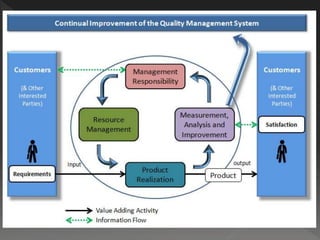
Quality Assurance The primary function of quality
assurance is to obtain completed construction that meets
all contract requirements. Assurance is defined as a degree
of certainty. Quality assurance personnel continually
assure--or make certain-that the contractor's work complies
with contract requirements.
Quality Control The primary function of quality assurance
is to obtain completed construction that meets all contract
requirements. Assurance is defined as a degree of
certainty. Quality assurance personnel continually assure--
or make certain-that the contractor's work complies with
contract requirements.
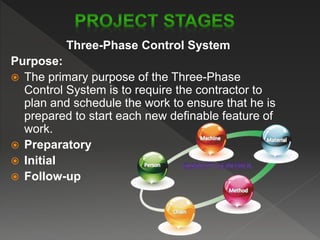
Three-Phase Control System
Purpose:
 The primary purpose of the Three-Phase
Control System is to require the contractor to
plan and schedule the work to ensure that he is
prepared to start each new definable feature of
work.
 Preparatory
 Initial
 Follow-up
 This phase shall be performed prior to beginning
work on each definable feature of work.
Perform this work as detailed below
 A review of each paragraph of applicable
specifications and references.
 A review of contract plans
 A review of the appropriate activity hazard
analysis
 Discussion of procedures for constructing the
work including the review of repetitive
deficiencies
 This phase must be accomplished at the
beginning of a definable feature of work. The
“Initial Phase” will verify that control for the work
developed in the “Preparatory Meeting”
 Review minutes of Preparatory Meeting
 Verify adequacy of controls to ensure full
contract compliance.
 Establish level of workmanship.
 Resolve all differences.
 Check safety to include compliance with the
safety plan and activity hazard analysis
 Daily checks shall be performed to assure
continuing compliance with contract
requirements, including safety and control
testing, until completion of the particular feature
of work. The checks shall be made a matter of
record in the QC documentation
Quality Management Record Keeping:
 A comprehensive record keeping and
information exchange system is an
indispensable quality management tool. In
addition to identifying specific deficiencies.
 Testing is an extremely important part of QM.
If tests are not performed properly, there are
many construction procedures and materials
that cannot be confirmed as adequate. Visual
observation alone is insufficient.
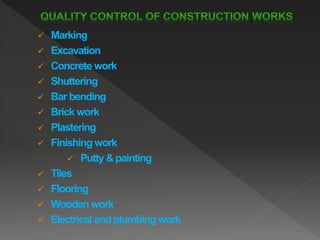
 Marking
 Excavation
 Concrete work
 Shuttering
 Bar bending
 Brick work
 Plastering
 Finishing work
 Putty & painting
 Tiles
 Flooring
 Wooden work
 Electrical and plumbing work
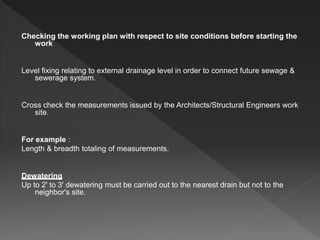
Checking the working plan with respect to site conditions before starting the
work
Level fixing relating to external drainage level in order to connect future sewage &
sewerage system.
Cross check the measurements issued by the Architects/Structural Engineers work
site.
For example :
Length & breadth totaling of measurements.
Dewatering
Up to 2' to 3' dewatering must be carried out to the nearest drain but not to the
neighbor's site.
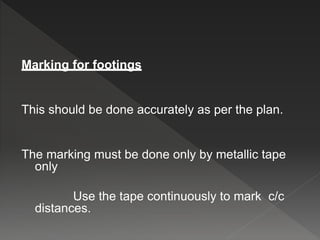
Marking for footings
This should be done accurately as per the plan.
The marking must be done only by metallic tape
only
Use the tape continuously to mark c/c
distances.
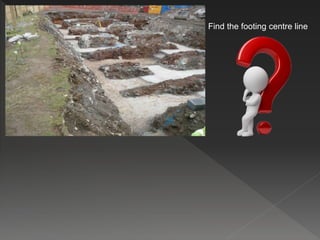
Find the footing centre line
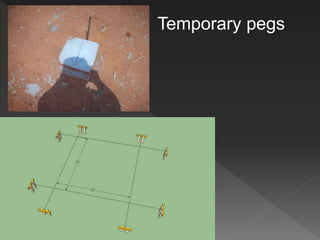
Temporary pegs
Quality checking
Quality checking
Quality checking
Quality checking
Quality checking
Quality checking
Quality checking
Quality checking
Quality checking
Quality checking
Quality checking
Quality checking
Quality checking
Quality checking
Quality checking
Quality checking
Quality checking
Quality checking
Quality checking
Quality checking
Quality checking
Quality checking
Quality checking
Quality checking
Quality checking
Quality checking
Quality checking
Quality checking
Quality checking
Quality checking
Quality checking

Quality checking

  • 2.
    Quality Assurance Theprimary function of quality assurance is to obtain completed construction that meets all contract requirements. Assurance is defined as a degree of certainty. Quality assurance personnel continually assure--or make certain-that the contractor's work complies with contract requirements. Quality Control The primary function of quality assurance is to obtain completed construction that meets all contract requirements. Assurance is defined as a degree of certainty. Quality assurance personnel continually assure-- or make certain-that the contractor's work complies with contract requirements.
  • 3.
    Three-Phase Control System Purpose: The primary purpose of the Three-Phase Control System is to require the contractor to plan and schedule the work to ensure that he is prepared to start each new definable feature of work.  Preparatory  Initial  Follow-up
  • 4.
     This phaseshall be performed prior to beginning work on each definable feature of work. Perform this work as detailed below  A review of each paragraph of applicable specifications and references.  A review of contract plans  A review of the appropriate activity hazard analysis  Discussion of procedures for constructing the work including the review of repetitive deficiencies
  • 5.
     This phasemust be accomplished at the beginning of a definable feature of work. The “Initial Phase” will verify that control for the work developed in the “Preparatory Meeting”  Review minutes of Preparatory Meeting  Verify adequacy of controls to ensure full contract compliance.  Establish level of workmanship.  Resolve all differences.  Check safety to include compliance with the safety plan and activity hazard analysis
  • 6.
     Daily checksshall be performed to assure continuing compliance with contract requirements, including safety and control testing, until completion of the particular feature of work. The checks shall be made a matter of record in the QC documentation
  • 7.
    Quality Management RecordKeeping:  A comprehensive record keeping and information exchange system is an indispensable quality management tool. In addition to identifying specific deficiencies.
  • 8.
     Testing isan extremely important part of QM. If tests are not performed properly, there are many construction procedures and materials that cannot be confirmed as adequate. Visual observation alone is insufficient.
  • 10.
     Marking  Excavation Concrete work  Shuttering  Bar bending  Brick work  Plastering  Finishing work  Putty & painting  Tiles  Flooring  Wooden work  Electrical and plumbing work
  • 11.
    Checking the workingplan with respect to site conditions before starting the work Level fixing relating to external drainage level in order to connect future sewage & sewerage system. Cross check the measurements issued by the Architects/Structural Engineers work site. For example : Length & breadth totaling of measurements. Dewatering Up to 2' to 3' dewatering must be carried out to the nearest drain but not to the neighbor's site.
  • 12.
    Marking for footings Thisshould be done accurately as per the plan. The marking must be done only by metallic tape only Use the tape continuously to mark c/c distances.
  • 13.
    Find the footingcentre line
  • 14.