PHYLOGENETIC
ANALYSIS
SMT. P.SANGEETHA
LECTURER IN BIOTECHNOLOGY
KVRGCW(A), KURNOOL
PHYLOGENETIC ANALYSIS
 Phylogenetic analysis of a family of related nucleic acid or protein
sequences is a determination of how the family might have been derived
during evolution.
 It is possible to reconstruct the evolutionary relationships (ancestral
relationships) among the genes and organisms.
 This involves creating a branching structure, termed phylogeny or tree
that determines the relationships between sequences.
PHYLOGENETIC ANALYSIS
 Placing the sequences as outer branches on a tree represents the evolutionary
relationships.
 Two sequences that are much alike will be located as neighbouring outside
branches and would be joined to a common branch beneath them.
 Phylogenetic tree is a 2- dimensional graph showing the evolutionary relationship
among the organisms. The tree is composed of nodes [ where branches bifurcate]
representing the taxa and branches representing the relationships among the taxa.
STEPS INVOLVED IN PHYLOGENETIC
ANALYSIS
The phylogenetic analysis is a four step method
1. Alignment strategy.
2. Determination of the substitution model.
3. Tree building.
4. Tree evaluation.
METHODS OF PHYLOGENETIC
ANALYSIS
There are two main categories of phylogeny methods :
1. Distance methods
2. Character methods
I. DISTANCE METHODS
 Pairs of sequences are aligned to determine which pairs are the most
similar or closely related.
 These alignments provide a measure of genetic distance between the
sequence.
 These distance measurements are used to predict the evolutionary
relationship.
1. NJ METHOD [NEIGHBOUR JOINING METHOD]
 The NJ method is one of the simplest distance methods.
 It begins by choosing the two most closely related sequences and then
adding the next most distant sequence as a third branch to the tree.
1. NJ METHOD [NEIGHBOUR JOINING METHOD]
ADVANTAGES :
1. Fastest tree building method.
2. Can use empirical substitution scoring methods.
DISADVANTAGES :
1. Tests only a single tree.
2. Does not consider intermediate ancestors.
1. NJ METHOD [NEIGHBOUR JOINING METHOD]
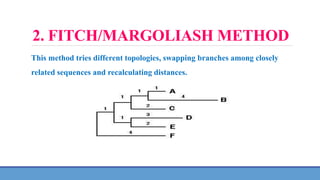
2. FITCH/MARGOLIASH METHOD
This method tries different topologies, swapping branches among closely
related sequences and recalculating distances.
2. FITCH/MARGOLIASH METHOD
ADVANTAGES:
1. Tests more than one tree.
2. Can use empirical substitution scoring methods.
DISADVANTAGES:
1. Does not consider intermediate ancestors.
2. Longer execution time.
II. CHARACTER METHODS
Character methods are basically of two types:
1. Maximum Parsimony Method.
2. Maximum Likelihood Method.
1. MAXIMUM PARSIMONY METHOD
 In MP Method, a MSA is produced in order to predict which sequence
positions are likely to correspond.
 This analyses the sequence alignment for every position.
ADVANTAGES :
1. Reconstructs ancestral nodes.
2. Performs better than distance methods.
1. MAXIMUM PARSIMONY METHOD
DISADVANTAGES :
1. Branch lengths cannot be determined.
2. Slower than matrix methods.
2. MAXIMUM LIKELIHOOD METHOD
 The ML method depend upon first obtaining a reliable multiple sequence
alignment and then examining the changes in each column in the alignment.
 The probabilities for each aligned position are then multiplied to provide
likelihood for each tree.
 The tree that provides the maximum likelihood value is the most probable
tree.
2. MAXIMUM LIKELIHOOD METHOD
ADVANTAGES :
1. Reconstructs ancestral nodes.
2. Generates branch lengths
3. Generates statistical estimate of significance of each branch.
DISADVANTAGES :
1. Very slow.
TREE EVALUATION
 Even when an alignment has been carefully done and conditions such as
substitution matrices or scoring methods are carefully chosen, it is possible
to generate a meaningless tree and hence be evaluated.
 Two methods available are
1. Jumble Sequence addition order.
2. Boot strap and Jack knife replicates.
1. JUMBLE SEQUENCE ADDITION
ORDER
 Most methods for phylogeny constructions are sensitive to the order in which
sequences are added to the tree.
 The simplest way to test a phylogeny is to repeat the analysis several times with
different addition orders.
 All PHYLIP programs and most other phylogeny programs, have an option called
JUMBLE, that uses a random number generator to choose which sequence to add
at each step, rather than adding them in the order in which they appear in the file.
2. BOOT STRAPAND JACK KNIFE
REPLICATES
 The statistical method of boot strapping is based on the assumption that
the statistical properties of a sample should be similar to the statistical
properties of the population from which that the sample is drawn.
THANK
YOU

PHYLOGENETIC TREE CONSTRUCTION.pptx

  • 1.
  • 2.
    PHYLOGENETIC ANALYSIS  Phylogeneticanalysis of a family of related nucleic acid or protein sequences is a determination of how the family might have been derived during evolution.  It is possible to reconstruct the evolutionary relationships (ancestral relationships) among the genes and organisms.  This involves creating a branching structure, termed phylogeny or tree that determines the relationships between sequences.
  • 3.
    PHYLOGENETIC ANALYSIS  Placingthe sequences as outer branches on a tree represents the evolutionary relationships.  Two sequences that are much alike will be located as neighbouring outside branches and would be joined to a common branch beneath them.  Phylogenetic tree is a 2- dimensional graph showing the evolutionary relationship among the organisms. The tree is composed of nodes [ where branches bifurcate] representing the taxa and branches representing the relationships among the taxa.
  • 4.
    STEPS INVOLVED INPHYLOGENETIC ANALYSIS The phylogenetic analysis is a four step method 1. Alignment strategy. 2. Determination of the substitution model. 3. Tree building. 4. Tree evaluation.
  • 5.
    METHODS OF PHYLOGENETIC ANALYSIS Thereare two main categories of phylogeny methods : 1. Distance methods 2. Character methods
  • 6.
    I. DISTANCE METHODS Pairs of sequences are aligned to determine which pairs are the most similar or closely related.  These alignments provide a measure of genetic distance between the sequence.  These distance measurements are used to predict the evolutionary relationship.
  • 7.
    1. NJ METHOD[NEIGHBOUR JOINING METHOD]  The NJ method is one of the simplest distance methods.  It begins by choosing the two most closely related sequences and then adding the next most distant sequence as a third branch to the tree.
  • 8.
    1. NJ METHOD[NEIGHBOUR JOINING METHOD] ADVANTAGES : 1. Fastest tree building method. 2. Can use empirical substitution scoring methods. DISADVANTAGES : 1. Tests only a single tree. 2. Does not consider intermediate ancestors.
  • 9.
    1. NJ METHOD[NEIGHBOUR JOINING METHOD]
  • 10.
    2. FITCH/MARGOLIASH METHOD Thismethod tries different topologies, swapping branches among closely related sequences and recalculating distances.
  • 11.
    2. FITCH/MARGOLIASH METHOD ADVANTAGES: 1.Tests more than one tree. 2. Can use empirical substitution scoring methods. DISADVANTAGES: 1. Does not consider intermediate ancestors. 2. Longer execution time.
  • 12.
    II. CHARACTER METHODS Charactermethods are basically of two types: 1. Maximum Parsimony Method. 2. Maximum Likelihood Method.
  • 13.
    1. MAXIMUM PARSIMONYMETHOD  In MP Method, a MSA is produced in order to predict which sequence positions are likely to correspond.  This analyses the sequence alignment for every position. ADVANTAGES : 1. Reconstructs ancestral nodes. 2. Performs better than distance methods.
  • 14.
    1. MAXIMUM PARSIMONYMETHOD DISADVANTAGES : 1. Branch lengths cannot be determined. 2. Slower than matrix methods.
  • 15.
    2. MAXIMUM LIKELIHOODMETHOD  The ML method depend upon first obtaining a reliable multiple sequence alignment and then examining the changes in each column in the alignment.  The probabilities for each aligned position are then multiplied to provide likelihood for each tree.  The tree that provides the maximum likelihood value is the most probable tree.
  • 16.
    2. MAXIMUM LIKELIHOODMETHOD ADVANTAGES : 1. Reconstructs ancestral nodes. 2. Generates branch lengths 3. Generates statistical estimate of significance of each branch. DISADVANTAGES : 1. Very slow.
  • 17.
    TREE EVALUATION  Evenwhen an alignment has been carefully done and conditions such as substitution matrices or scoring methods are carefully chosen, it is possible to generate a meaningless tree and hence be evaluated.  Two methods available are 1. Jumble Sequence addition order. 2. Boot strap and Jack knife replicates.
  • 18.
    1. JUMBLE SEQUENCEADDITION ORDER  Most methods for phylogeny constructions are sensitive to the order in which sequences are added to the tree.  The simplest way to test a phylogeny is to repeat the analysis several times with different addition orders.  All PHYLIP programs and most other phylogeny programs, have an option called JUMBLE, that uses a random number generator to choose which sequence to add at each step, rather than adding them in the order in which they appear in the file.
  • 19.
    2. BOOT STRAPANDJACK KNIFE REPLICATES  The statistical method of boot strapping is based on the assumption that the statistical properties of a sample should be similar to the statistical properties of the population from which that the sample is drawn.
  • 20.