EDUCAUSE 2008  Annual Conference October 30, 2008 Tomorrow’s Students, Today’s K-12 Digital Learners -  Are you ready for them?
What are the expectations of  our future students?  How do we prepare for these  students of tomorrow?  What are the important trends in education & technology that we should  be discussing today?   Our discussion today:
“ We want technology to be almost a thoughtless, seamless process.  When you go to a classroom, you pick up a piece of chalk.  Technology should be as automatic as picking up the chalk.   The newer teachers are expecting it and our students are expecting it when they come into the classroom.” Irving (Nick) Nicholson Director of eLearning Programs Chicago Public Schools
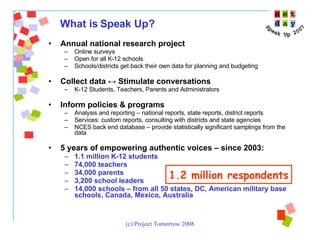
Annual national research project Online surveys Open for all K-12 schools Schools/districts get back their own data for planning and budgeting Collect data  ↔ Stimulate conversations K-12 Students, Teachers, Parents and Administrators Inform policies & programs Analysis and reporting – national reports, state reports, district reports  Services: custom reports, consulting with districts and state agencies NCES back end database – provide statistically significant samplings from the data 5 years of empowering authentic voices – since 2003:   1.1 million K-12 students 74,000 teachers 34,000 parents 3,200 school leaders 14,000 schools – from all 50 states, DC, American military base schools, Canada, Mexico, Australia What is Speak Up? 1.2 million respondents
Speak Up is facilitated annually by  Project Tomorrow   (formerly known as NetDay) About Project Tomorrow:  A national education nonprofit organization providing leadership, research and programs to support science, math and technology education in America’s schools
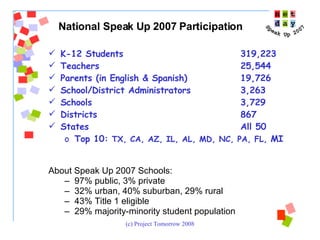
K-12 Students 319,223 Teachers 25,544 Parents (in English & Spanish) 19,726 School/District Administrators 3,263 Schools 3,729 Districts 867 States  All 50 Top 10:  TX, CA, AZ, IL, AL, MD, NC, PA, FL,  MI About Speak Up 2007 Schools: 97% public, 3% private 32% urban, 40% suburban, 29% rural 43% Title 1 eligible 29% majority-minority student population  National Speak Up 2007 Participation
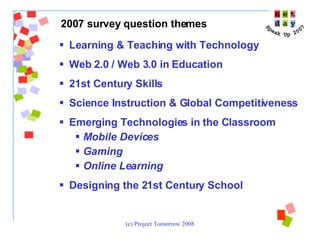
Learning & Teaching with Technology Web 2.0 / Web 3.0 in Education 21st Century Skills Science Instruction & Global Competitiveness Emerging Technologies in the Classroom Mobile Devices Gaming Online Learning Designing the 21st Century School 2007 survey question themes
Creating context: How do we prepare for the students of  tomorrow? Tomorrow’s  Students Current Forces @ Work ?
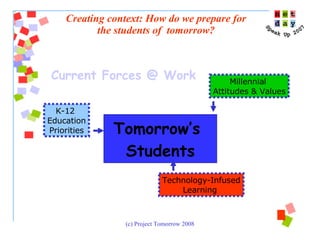
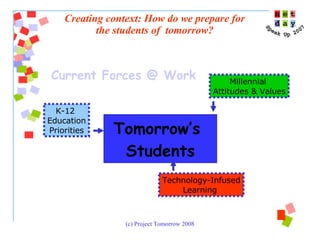
Tomorrow’s  Students Millennial  Attitudes & Values K-12  Education Priorities Technology-Infused Learning  Current Forces @ Work Creating context: How do we prepare for the students of  tomorrow?
K-12 Education Priorities What issues are  “waking up”  our  nation’s school and district leaders  in the middle of the night?  What issues are driving  their priorities and education vision?
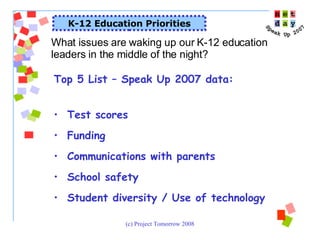
K-12 Education Priorities What issues are waking up our K-12 education leaders in the middle of the night?  Top 5 List – Speak Up 2007 data: Test scores Funding Communications with parents School safety Student diversity / Use of technology
K-12 Education Priorities Seismic changes in K-12 education since early 1970’s A sampling of those “earthquakes” Standards based education Teacher quality/retention issues Role of education More education stakeholders  Expectations for success for all Diversity of languages, styles, cultures
K-12 Education Priorities Seismic changes in K-12 education since early 1970’s A sampling of those “earthquakes” Standards based education Teacher quality/retention issues Role of education More education stakeholders  Expectations for success for all Diversity of languages, styles, cultures A different kind of learner
Tomorrow’s  Students Millennial  Attitudes & Values K-12  Education Priorities Technology-Infused Learning  Current Forces @ Work Creating context: How do we prepare for the students of  tomorrow?
Millennial Attitudes & Values Millennials Rising  (Neil Howe and William Strauss) How do they want to learn? Collaboratively  Anytime, anyplace, anywhere, any pace Structured activities Relevancy with real world And with all kinds of technology
  Creating context: How do we prepare for the students of  tomorrow? Tomorrow’s  Students Millennial  Attitudes & Values K-12  Education Priorities Technology-Infused Learning  Current Forces @ Work
Students, technology & learning:  Activities,  Attitudes & Aspirations Disconnects & Differences Trends & Leverage Points Speak Up 2007 Data Findings
“ Digital disconnect” is alive & well:  the gap between how  today’s students learn and  how they live!   Key findings from Speak Up 2007 data:
“ Digital disconnect” is alive & well:  Between students and teachers Between advanced tech students and other students Between girls and boys Between older and younger students Key findings from Speak Up 2007 data:
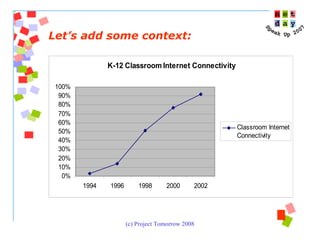
Let’s add some context:
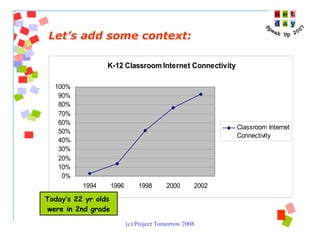
Let’s add some context: Today’s 22 yr olds  were in 2nd grade
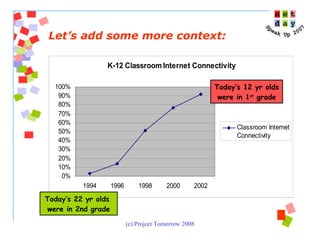
Let’s add some more context: Today’s 22 yr olds  were in 2nd grade Today’s 12 yr olds were in 1 st  grade
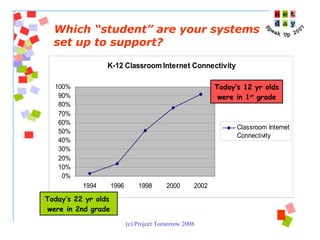
Which “student” are your systems set up to support? Today’s 22 yr olds  were in 2nd grade Today’s 12 yr olds were in 1 st  grade
Let’s get to know each other! How would you assess your own technology skills compared to your peers? Beginner Average Advanced
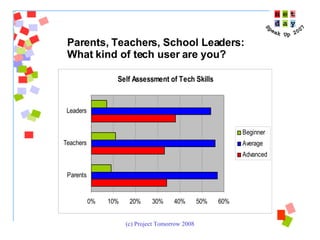
Parents, Teachers, School Leaders:  What kind of tech user are you?
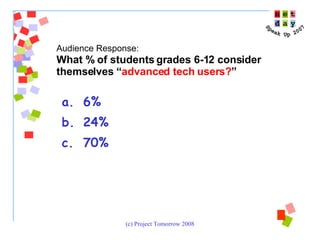
6% 24% 70% Audience Response:   What % of students grades 6-12 consider themselves “ advanced tech users? ”
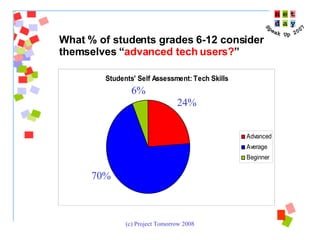
What % of students grades 6-12 consider themselves “ advanced tech users? ”  70% 24% 6%
Students:  What do you do regularly with technology?
The “Big 4” today  : Online and computer gaming Download music Communications – email, IM, Txt Maintain a personal website Students:  What do you do regularly with technology?
The “Big 4” Online and computer gaming Over 64% of students K-12 play Download music #1 with students in grades 6-12 Communications – email, IM, Txt Girls still lead in usage Maintain a personal website 40% of students grades 6-8 67% of students grades 9-12
On the horizon – coming quickly to a tipping point near you!  Virtual worlds 24% of students gr 3-5 participate regularly Video creation/sharing 20% of high school students 50% in focus groups have posted a video Remixing content  21% of middle school students are doing this now
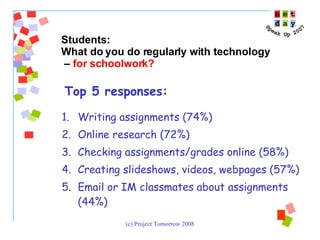
Top 5 responses:   Writing assignments (74%) Online research (72%) Checking assignments/grades online (58%) Creating slideshows, videos, webpages (57%) Email or IM classmates about assignments (44%) Students:  What do you do regularly with technology –  for schoolwork?
How satisfied are today’s students with technology use at their school?
Top responses: Filters block websites I need Teachers limit tech use  Lots of rules  That limit use of my school’s technology That prevent me from using my own tools such email / IM / MySpace Obstacles to student tech use at school
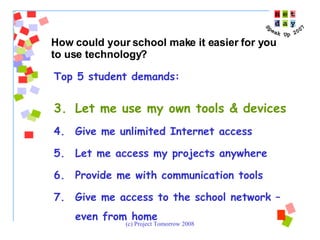
Top 5 student demands:  Let me use my own tools & devices Give me unlimited Internet access Let me access my projects anywhere Provide me with communication tools Give me access to the school network – even from home  How could your school make it easier for you to use technology?
Mobile devices Online learning Gaming technologies Digital Disconnect:  A new “battleground” with emerging technologies  in education
Mobile devices @ school Cell phones Laptops MP3 players Smartphones & PDAs Digital Disconnect:  A new battleground with emerging technologies  in education
Using Mobile Devices for Learning
Communications Collaborations Creativity Productivity How student want to use mobile devices  to support learning
Communications Email teachers, classmates Access personal websites Collaborations Projects and calendars Creativity Create/share documents   Productivity Research, downloads, ed games   How student want to use mobile devices  to support learning
Online learning Dedicated online class Blended class On own or through school Digital Disconnect:  A new “battleground” with emerging technologies  in education
High School Students’ Usage 8% taken online class 9% taken a class with an online component 6% taken an online class outside of school Almost 1 our 4 high school students have experience with online learning Online learning and students
Online learning and students Is there interest in taking online classes?  Yes!  Beyond the students with current experience:  +33% of high school students +24% of middle school students +19% of students grades 3-5
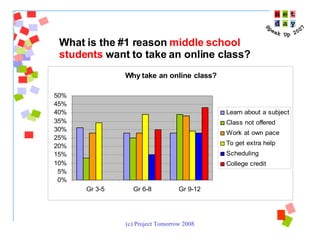
Take class not offered at my school Get extra help in a subject Earn college credit To work at my own pace To learn more about the subject Audience Response:  What is the #1 reason  middle school students  want to take an online class?
What is the #1 reason  middle school students  want to take an online class?
Gaming technologies for learning Digital Disconnect:  A new “battleground” with emerging technologies  in education
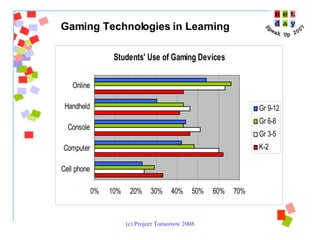
Over 64% of students K-12 play Average is  8 – 10 hours  per week Using a wide variety of devices Gaming Technologies in Learning
Over 64% of students K-12 play Average is 8 – 10 hours per week Using a wide variety of devices Cell phones Computer games Console video players Handhelds Web-based: single or multi user Gaming Technologies in Learning
Gaming Technologies in Learning
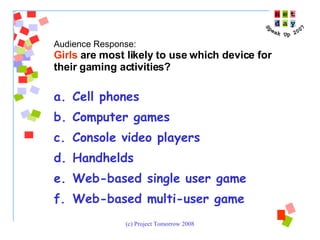
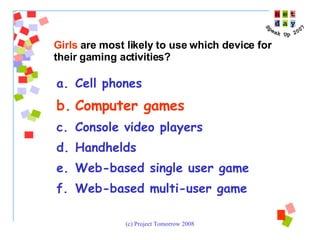
Cell phones Computer games Console video players Handhelds Web-based single user game Web-based multi-user game Audience Response:  Girls  are most likely to use which device for their gaming activities?
Cell phones Computer games Console video players Handhelds Web-based single user game Web-based multi-user game Girls  are most likely to use which device for their gaming activities?
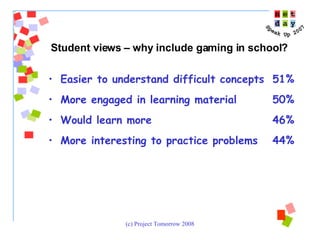
Easier to understand difficult concepts 51% More engaged in learning material 50% Would learn more 46% More interesting to practice problems 44% Student views – why include gaming in school?
Easier to understand difficult concepts 51% More engaged in learning material 50% Would learn more 46% More interesting to practice problems 44% Go beyond & try new things 37% See results of my problem solving 35% Direct my own learning 34% Student views – why include gaming in school?
What if you could design the  ultimate school . . . . what technologies would have the greatest impact on your learning?
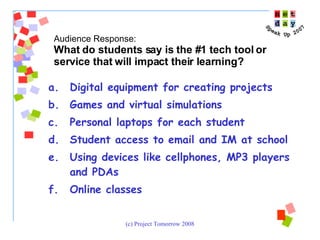
Digital equipment for creating projects Games and virtual simulations Personal laptops for each student Student access to email and IM at school Using devices like cellphones, MP3 players and PDAs Online classes Audience Response:  What do students say is the #1 tech tool or service that will impact their learning?
Students in Kindergarten thru 12 th  grade say the same thing every year:  What do students say is the #1 tech tool or service that will impact their learning?
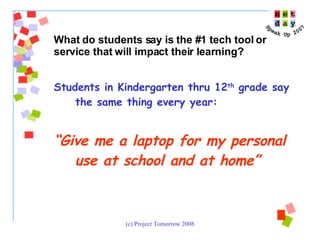
Students in Kindergarten thru 12 th  grade say the same thing every year:  “ Give me a laptop for my personal use at school and at home” What do students say is the #1 tech tool or service that will impact their learning?
What if you could design the  ultimate school?
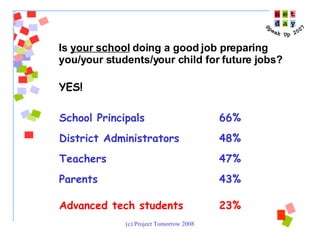
Is  your school  doing a good job preparing  you/your students/your child for future jobs?
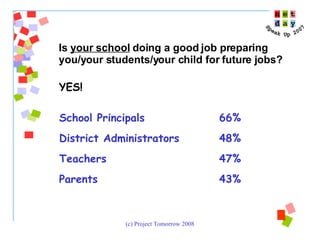
YES!  School Principals 66% District Administrators 48% Teachers 47% Parents 43% Is  your school  doing a good job preparing  you/your students/your child for future jobs?
YES!  School Principals 66% District Administrators 48% Teachers 47% Parents 43% Advanced tech students 23% Is  your school  doing a good job preparing  you/your students/your child for future jobs?
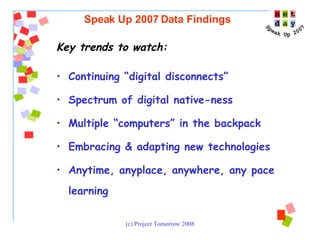
Key trends to watch: Continuing “digital disconnects”  Spectrum of digital native-ness Multiple “computers” in the backpack Embracing & adapting new technologies Anytime, anyplace, anywhere, any pace learning Speak Up 2007 Data Findings
Key trends to watch: Self directed learning for student & teacher  Everyone is a content developer Make it relevant to me!  Blend of informal & formal learning opps Beyond engagement to productivity benefits “ Long tail” of training & education  Speak Up 2007 Data Findings
But what is the  #1 trend  that you  should watch regarding your  future students? Speak Up 2007 Data Findings
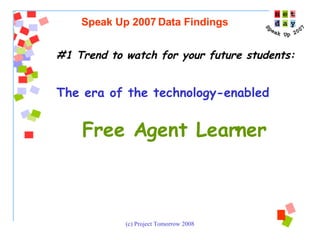
#1 Trend to watch for your future students:  The era of the technology-enabled   Free Agent Learner   Speak Up 2007 Data Findings
Free Agent Learner Characteristics: Self directed learning Un-tethered to trad’l education  Expert at personal data aggregation  Examples:  Online learning Control over knowledge  authenticity Speak Up 2007 Data Findings
Free Agent Learner Characteristics:  Power of connections Creating new communities Not tethered to physical networks Example: Mobile devices  Speak Up 2007 Data Findings
Free Agent Learner Characteristics:  Experiential learning – make it real  Content developers Process as important as knowledge gained ( sometimes more important ) Example: Gaming, simulations, animations, m/m content  Speak Up 2007 Data Findings
What is the impact of this  Free Agent Learner  on your institution? What is the impact of these  other emerging trends?  What are the  tough questions   you need to be asking today?
Content Culture Competition Control Tough questions to think about today:
Tough questions to think about today: Content What is content today, what will define it tomorrow? Culture How will these Free Agents fit into our existing culture or is a new culture required/preferred? Competition Do we need new “business models?” Control Who controls the learning process in this new world?
Visit  www.tomorrow.org Student, Teacher, Parent & Administrator Data Findings – updated annually Reports such as:  Learning in the 21 st  Century: A National Report of  Online Learning  (Oct 2007, Updated Jun 2008) Inspiring the Next Generation of Innovators Students, Teachers and Parents Speak Up about  Science Education (June 2008) Leadership in the 21 st  Century:  The New  Visionary Administrator  (October 2008)  More Speak Up?  New!
Speak Up 2008 Oct 27 – Dec 19 Help K-12 students, educators and parents have a  voice   in national discussions  Learn about the  ideas   of your future students Inform  plans, budgets and programs  Participating schools and districts get  free online access  to their  own quantitative data –  with national benchmark data
Surveys for K-12 students, teachers, parents and administrators 100% online surveys – parent survey in English and Spanish Schools and districts register to participate Takes 20 minutes to complete; all data is confidential  Participating schools/districts get their data back in early February 2009 – with national benchmark data National Findings in Congressional Briefing - March 2009  Speak Up 2008 survey logistics
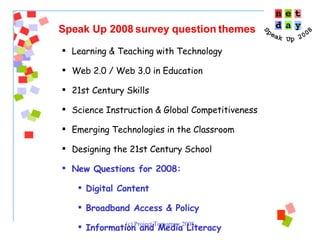
Learning & Teaching with Technology Web 2.0 / Web 3.0 in Education 21st Century Skills Science Instruction & Global Competitiveness Emerging Technologies in the Classroom Designing the 21st Century School New Questions for 2008:  Digital Content  Broadband Access & Policy Information and Media Literacy  Speak Up 2008 survey question themes
New Ideas for Higher Education!  K-12 Teacher Preparation Programs Have your pre-service students take the  teacher survey  Compare your students’ views with in-service teachers
New Ideas for Higher Education!   K-12 Teacher Preparation Programs Have your pre-service students take the  teacher survey  Compare your students’ views with in-service teachers Outreach to K-12 Schools and Districts Facilitate this service for your regional partners Use the data in outreach workshops
New Ideas for Higher Education!  K-12 Teacher Preparation Programs Have your pre-service students take the  teacher survey  Compare your students’ views with in-service teachers Outreach to K-12 Schools and Districts Facilitate this service for your regional partners Use the data in outreach workshops Presentations, Workshops, Webinars, Consulting Inform your faculty & administration Leverage data for strategic planning
It has been great to learn from you today.  If you have any questions, please contact us: Julie Evans Project Tomorrow [email_address] 949-609-4660 x15 Copyright Project Tomorrow 2008.  This work is the intellectual property of the author. Permission is granted for this material to be shared for non-commercial, educational purposes, provided that this copyright statement appears on the reproduced materials and notice is given that the copying is by permission of the author. To disseminate otherwise or to republish requires written permission from the author.

Tomorrow's Students, Today's K-12 Digital Learners

  • 1.
    EDUCAUSE 2008 Annual Conference October 30, 2008 Tomorrow’s Students, Today’s K-12 Digital Learners - Are you ready for them?
  • 2.
    What are theexpectations of our future students? How do we prepare for these students of tomorrow? What are the important trends in education & technology that we should be discussing today? Our discussion today:
  • 3.
    “ We wanttechnology to be almost a thoughtless, seamless process. When you go to a classroom, you pick up a piece of chalk. Technology should be as automatic as picking up the chalk. The newer teachers are expecting it and our students are expecting it when they come into the classroom.” Irving (Nick) Nicholson Director of eLearning Programs Chicago Public Schools
  • 4.
    Annual national researchproject Online surveys Open for all K-12 schools Schools/districts get back their own data for planning and budgeting Collect data ↔ Stimulate conversations K-12 Students, Teachers, Parents and Administrators Inform policies & programs Analysis and reporting – national reports, state reports, district reports Services: custom reports, consulting with districts and state agencies NCES back end database – provide statistically significant samplings from the data 5 years of empowering authentic voices – since 2003: 1.1 million K-12 students 74,000 teachers 34,000 parents 3,200 school leaders 14,000 schools – from all 50 states, DC, American military base schools, Canada, Mexico, Australia What is Speak Up? 1.2 million respondents
  • 5.
    Speak Up isfacilitated annually by Project Tomorrow (formerly known as NetDay) About Project Tomorrow: A national education nonprofit organization providing leadership, research and programs to support science, math and technology education in America’s schools
  • 6.
    K-12 Students 319,223Teachers 25,544 Parents (in English & Spanish) 19,726 School/District Administrators 3,263 Schools 3,729 Districts 867 States All 50 Top 10: TX, CA, AZ, IL, AL, MD, NC, PA, FL, MI About Speak Up 2007 Schools: 97% public, 3% private 32% urban, 40% suburban, 29% rural 43% Title 1 eligible 29% majority-minority student population National Speak Up 2007 Participation
  • 7.
    Learning & Teachingwith Technology Web 2.0 / Web 3.0 in Education 21st Century Skills Science Instruction & Global Competitiveness Emerging Technologies in the Classroom Mobile Devices Gaming Online Learning Designing the 21st Century School 2007 survey question themes
  • 8.
    Creating context: Howdo we prepare for the students of tomorrow? Tomorrow’s Students Current Forces @ Work ?
  • 9.
    Tomorrow’s StudentsMillennial Attitudes & Values K-12 Education Priorities Technology-Infused Learning Current Forces @ Work Creating context: How do we prepare for the students of tomorrow?
  • 10.
    K-12 Education PrioritiesWhat issues are “waking up” our nation’s school and district leaders in the middle of the night? What issues are driving their priorities and education vision?
  • 11.
    K-12 Education PrioritiesWhat issues are waking up our K-12 education leaders in the middle of the night? Top 5 List – Speak Up 2007 data: Test scores Funding Communications with parents School safety Student diversity / Use of technology
  • 12.
    K-12 Education PrioritiesSeismic changes in K-12 education since early 1970’s A sampling of those “earthquakes” Standards based education Teacher quality/retention issues Role of education More education stakeholders Expectations for success for all Diversity of languages, styles, cultures
  • 13.
    K-12 Education PrioritiesSeismic changes in K-12 education since early 1970’s A sampling of those “earthquakes” Standards based education Teacher quality/retention issues Role of education More education stakeholders Expectations for success for all Diversity of languages, styles, cultures A different kind of learner
  • 14.
    Tomorrow’s StudentsMillennial Attitudes & Values K-12 Education Priorities Technology-Infused Learning Current Forces @ Work Creating context: How do we prepare for the students of tomorrow?
  • 15.
    Millennial Attitudes &Values Millennials Rising (Neil Howe and William Strauss) How do they want to learn? Collaboratively Anytime, anyplace, anywhere, any pace Structured activities Relevancy with real world And with all kinds of technology
  • 16.
    Creatingcontext: How do we prepare for the students of tomorrow? Tomorrow’s Students Millennial Attitudes & Values K-12 Education Priorities Technology-Infused Learning Current Forces @ Work
  • 17.
    Students, technology &learning: Activities, Attitudes & Aspirations Disconnects & Differences Trends & Leverage Points Speak Up 2007 Data Findings
  • 18.
    “ Digital disconnect”is alive & well: the gap between how today’s students learn and how they live! Key findings from Speak Up 2007 data:
  • 19.
    “ Digital disconnect”is alive & well: Between students and teachers Between advanced tech students and other students Between girls and boys Between older and younger students Key findings from Speak Up 2007 data:
  • 20.
  • 21.
    Let’s add somecontext: Today’s 22 yr olds were in 2nd grade
  • 22.
    Let’s add somemore context: Today’s 22 yr olds were in 2nd grade Today’s 12 yr olds were in 1 st grade
  • 23.
    Which “student” areyour systems set up to support? Today’s 22 yr olds were in 2nd grade Today’s 12 yr olds were in 1 st grade
  • 24.
    Let’s get toknow each other! How would you assess your own technology skills compared to your peers? Beginner Average Advanced
  • 25.
    Parents, Teachers, SchoolLeaders: What kind of tech user are you?
  • 26.
    6% 24% 70%Audience Response: What % of students grades 6-12 consider themselves “ advanced tech users? ”
  • 27.
    What % ofstudents grades 6-12 consider themselves “ advanced tech users? ” 70% 24% 6%
  • 28.
    Students: Whatdo you do regularly with technology?
  • 29.
    The “Big 4”today : Online and computer gaming Download music Communications – email, IM, Txt Maintain a personal website Students: What do you do regularly with technology?
  • 30.
    The “Big 4”Online and computer gaming Over 64% of students K-12 play Download music #1 with students in grades 6-12 Communications – email, IM, Txt Girls still lead in usage Maintain a personal website 40% of students grades 6-8 67% of students grades 9-12
  • 31.
    On the horizon– coming quickly to a tipping point near you! Virtual worlds 24% of students gr 3-5 participate regularly Video creation/sharing 20% of high school students 50% in focus groups have posted a video Remixing content 21% of middle school students are doing this now
  • 32.
    Top 5 responses: Writing assignments (74%) Online research (72%) Checking assignments/grades online (58%) Creating slideshows, videos, webpages (57%) Email or IM classmates about assignments (44%) Students: What do you do regularly with technology – for schoolwork?
  • 33.
    How satisfied aretoday’s students with technology use at their school?
  • 34.
    Top responses: Filtersblock websites I need Teachers limit tech use Lots of rules That limit use of my school’s technology That prevent me from using my own tools such email / IM / MySpace Obstacles to student tech use at school
  • 35.
    Top 5 studentdemands: Let me use my own tools & devices Give me unlimited Internet access Let me access my projects anywhere Provide me with communication tools Give me access to the school network – even from home How could your school make it easier for you to use technology?
  • 36.
    Mobile devices Onlinelearning Gaming technologies Digital Disconnect: A new “battleground” with emerging technologies in education
  • 37.
    Mobile devices @school Cell phones Laptops MP3 players Smartphones & PDAs Digital Disconnect: A new battleground with emerging technologies in education
  • 38.
  • 39.
    Communications Collaborations CreativityProductivity How student want to use mobile devices to support learning
  • 40.
    Communications Email teachers,classmates Access personal websites Collaborations Projects and calendars Creativity Create/share documents Productivity Research, downloads, ed games How student want to use mobile devices to support learning
  • 41.
    Online learning Dedicatedonline class Blended class On own or through school Digital Disconnect: A new “battleground” with emerging technologies in education
  • 42.
    High School Students’Usage 8% taken online class 9% taken a class with an online component 6% taken an online class outside of school Almost 1 our 4 high school students have experience with online learning Online learning and students
  • 43.
    Online learning andstudents Is there interest in taking online classes? Yes! Beyond the students with current experience: +33% of high school students +24% of middle school students +19% of students grades 3-5
  • 44.
    Take class notoffered at my school Get extra help in a subject Earn college credit To work at my own pace To learn more about the subject Audience Response: What is the #1 reason middle school students want to take an online class?
  • 45.
    What is the#1 reason middle school students want to take an online class?
  • 46.
    Gaming technologies forlearning Digital Disconnect: A new “battleground” with emerging technologies in education
  • 47.
    Over 64% ofstudents K-12 play Average is 8 – 10 hours per week Using a wide variety of devices Gaming Technologies in Learning
  • 48.
    Over 64% ofstudents K-12 play Average is 8 – 10 hours per week Using a wide variety of devices Cell phones Computer games Console video players Handhelds Web-based: single or multi user Gaming Technologies in Learning
  • 49.
  • 50.
    Cell phones Computergames Console video players Handhelds Web-based single user game Web-based multi-user game Audience Response: Girls are most likely to use which device for their gaming activities?
  • 51.
    Cell phones Computergames Console video players Handhelds Web-based single user game Web-based multi-user game Girls are most likely to use which device for their gaming activities?
  • 52.
    Easier to understanddifficult concepts 51% More engaged in learning material 50% Would learn more 46% More interesting to practice problems 44% Student views – why include gaming in school?
  • 53.
    Easier to understanddifficult concepts 51% More engaged in learning material 50% Would learn more 46% More interesting to practice problems 44% Go beyond & try new things 37% See results of my problem solving 35% Direct my own learning 34% Student views – why include gaming in school?
  • 54.
    What if youcould design the ultimate school . . . . what technologies would have the greatest impact on your learning?
  • 55.
    Digital equipment forcreating projects Games and virtual simulations Personal laptops for each student Student access to email and IM at school Using devices like cellphones, MP3 players and PDAs Online classes Audience Response: What do students say is the #1 tech tool or service that will impact their learning?
  • 56.
    Students in Kindergartenthru 12 th grade say the same thing every year: What do students say is the #1 tech tool or service that will impact their learning?
  • 57.
    Students in Kindergartenthru 12 th grade say the same thing every year: “ Give me a laptop for my personal use at school and at home” What do students say is the #1 tech tool or service that will impact their learning?
  • 58.
    What if youcould design the ultimate school?
  • 59.
    Is yourschool doing a good job preparing you/your students/your child for future jobs?
  • 60.
    YES! SchoolPrincipals 66% District Administrators 48% Teachers 47% Parents 43% Is your school doing a good job preparing you/your students/your child for future jobs?
  • 61.
    YES! SchoolPrincipals 66% District Administrators 48% Teachers 47% Parents 43% Advanced tech students 23% Is your school doing a good job preparing you/your students/your child for future jobs?
  • 62.
    Key trends towatch: Continuing “digital disconnects” Spectrum of digital native-ness Multiple “computers” in the backpack Embracing & adapting new technologies Anytime, anyplace, anywhere, any pace learning Speak Up 2007 Data Findings
  • 63.
    Key trends towatch: Self directed learning for student & teacher Everyone is a content developer Make it relevant to me! Blend of informal & formal learning opps Beyond engagement to productivity benefits “ Long tail” of training & education Speak Up 2007 Data Findings
  • 64.
    But what isthe #1 trend that you should watch regarding your future students? Speak Up 2007 Data Findings
  • 65.
    #1 Trend towatch for your future students: The era of the technology-enabled Free Agent Learner Speak Up 2007 Data Findings
  • 66.
    Free Agent LearnerCharacteristics: Self directed learning Un-tethered to trad’l education Expert at personal data aggregation Examples: Online learning Control over knowledge authenticity Speak Up 2007 Data Findings
  • 67.
    Free Agent LearnerCharacteristics: Power of connections Creating new communities Not tethered to physical networks Example: Mobile devices Speak Up 2007 Data Findings
  • 68.
    Free Agent LearnerCharacteristics: Experiential learning – make it real Content developers Process as important as knowledge gained ( sometimes more important ) Example: Gaming, simulations, animations, m/m content Speak Up 2007 Data Findings
  • 69.
    What is theimpact of this Free Agent Learner on your institution? What is the impact of these other emerging trends? What are the tough questions you need to be asking today?
  • 70.
    Content Culture CompetitionControl Tough questions to think about today:
  • 71.
    Tough questions tothink about today: Content What is content today, what will define it tomorrow? Culture How will these Free Agents fit into our existing culture or is a new culture required/preferred? Competition Do we need new “business models?” Control Who controls the learning process in this new world?
  • 72.
    Visit www.tomorrow.orgStudent, Teacher, Parent & Administrator Data Findings – updated annually Reports such as: Learning in the 21 st Century: A National Report of Online Learning (Oct 2007, Updated Jun 2008) Inspiring the Next Generation of Innovators Students, Teachers and Parents Speak Up about Science Education (June 2008) Leadership in the 21 st Century: The New Visionary Administrator (October 2008) More Speak Up? New!
  • 73.
    Speak Up 2008Oct 27 – Dec 19 Help K-12 students, educators and parents have a voice in national discussions Learn about the ideas of your future students Inform plans, budgets and programs Participating schools and districts get free online access to their own quantitative data – with national benchmark data
  • 74.
    Surveys for K-12students, teachers, parents and administrators 100% online surveys – parent survey in English and Spanish Schools and districts register to participate Takes 20 minutes to complete; all data is confidential Participating schools/districts get their data back in early February 2009 – with national benchmark data National Findings in Congressional Briefing - March 2009 Speak Up 2008 survey logistics
  • 75.
    Learning & Teachingwith Technology Web 2.0 / Web 3.0 in Education 21st Century Skills Science Instruction & Global Competitiveness Emerging Technologies in the Classroom Designing the 21st Century School New Questions for 2008: Digital Content Broadband Access & Policy Information and Media Literacy Speak Up 2008 survey question themes
  • 76.
    New Ideas forHigher Education! K-12 Teacher Preparation Programs Have your pre-service students take the teacher survey Compare your students’ views with in-service teachers
  • 77.
    New Ideas forHigher Education! K-12 Teacher Preparation Programs Have your pre-service students take the teacher survey Compare your students’ views with in-service teachers Outreach to K-12 Schools and Districts Facilitate this service for your regional partners Use the data in outreach workshops
  • 78.
    New Ideas forHigher Education! K-12 Teacher Preparation Programs Have your pre-service students take the teacher survey Compare your students’ views with in-service teachers Outreach to K-12 Schools and Districts Facilitate this service for your regional partners Use the data in outreach workshops Presentations, Workshops, Webinars, Consulting Inform your faculty & administration Leverage data for strategic planning
  • 79.
    It has beengreat to learn from you today. If you have any questions, please contact us: Julie Evans Project Tomorrow [email_address] 949-609-4660 x15 Copyright Project Tomorrow 2008. This work is the intellectual property of the author. Permission is granted for this material to be shared for non-commercial, educational purposes, provided that this copyright statement appears on the reproduced materials and notice is given that the copying is by permission of the author. To disseminate otherwise or to republish requires written permission from the author.