Students “Speak Up”  about 21 st  Century Learning  and Education Games FETC 2009 January 23, 2009 Julie Evans Chief Executive Officer Project Tomorrow
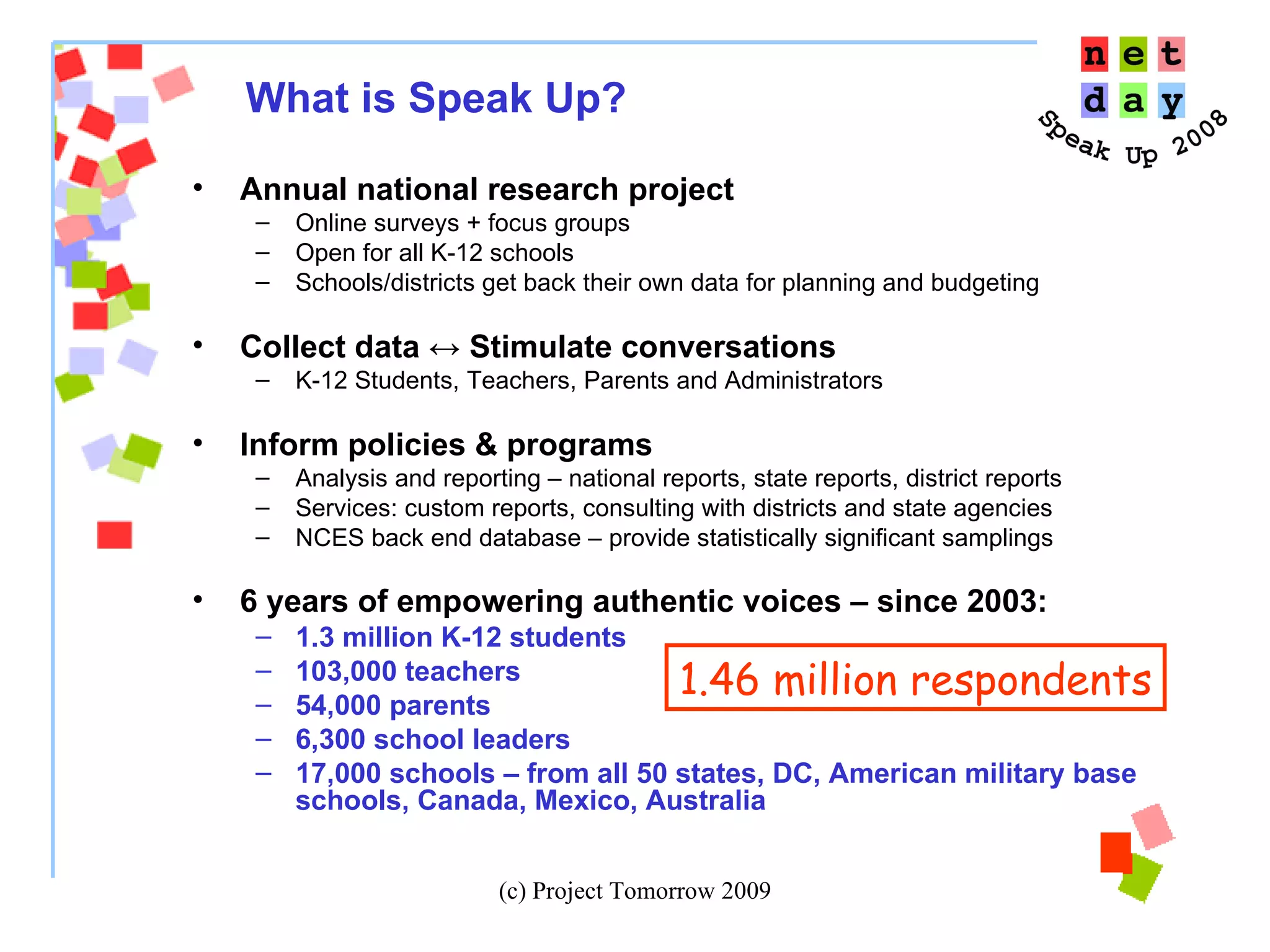
Annual national research project Online surveys + focus groups Open for all K-12 schools Schools/districts get back their own data for planning and budgeting Collect data  ↔ Stimulate conversations K-12 Students, Teachers, Parents and Administrators Inform policies & programs Analysis and reporting – national reports, state reports, district reports  Services: custom reports, consulting with districts and state agencies NCES back end database – provide statistically significant samplings  6 years of empowering authentic voices – since 2003:   1.3 million K-12 students 103,000 teachers 54,000 parents 6,300 school leaders 17,000 schools – from all 50 states, DC, American military base schools, Canada, Mexico, Australia What is Speak Up? 1.46 million respondents
Speak Up is facilitated annually by  Project Tomorrow   (formerly known as NetDay) About Project Tomorrow:  A national education nonprofit organization providing leadership, research and programs to support science, math and technology education in America’s schools
We would like to recognize our Speak Up 2008 Sponsors:
We would like to also acknowledge the support  of our Speak Up 2008 National Champion Outreach Partners:
We would like to also acknowledge the support  of  FETC  in providing free registrations for these school districts that had high participation in Speak Up 2008:   Brevard County School District Charlotte County School District Clay County School District
Special thanks:
Learning & Teaching with Technology Web 2.0 in Education 21st Century Skills Science Instruction & Global Competitiveness Emerging Technologies in the Classroom Mobile Devices Games within Instruction Online Learning Designing the 21st Century School Speak Up survey question themes
K-12 Students 319,223 Teachers 25,544 Parents (in English & Spanish) 19,726 School/District Administrators 3,263 Schools 3,729 Districts 867 States  All 50 Top 10:  TX, CA, AZ, IL, AL, MD, NC, PA, FL,  MI About Speak Up Schools: 97% public, 3% private 32% urban, 40% suburban, 29% rural 43% Title 1 eligible 29% majority-minority student population  National Speak Up 2007 Participation
“ Digital disconnect” is alive & well:  the gap between how  today’s students learn and  how they live!   Key findings from Speak Up data:
“ Digital disconnect” is alive & well:  Between students and teachers Between advanced tech students and other students Between girls and boys Between older and younger students Key findings from Speak Up data:
Let’s get to know each other!   Audience Response How would you assess your own technology skills compared to your peers? Beginner Average Advanced
Parents, Teachers, School Leaders:  What kind of tech user are you?
6% 24% 70% Audience Response:   What % of students grades 6-12 consider themselves “ advanced tech users? ”
What % of students grades 6-12  consider themselves “ advanced tech users? ”  70% 24% 6% C B A
Students:  What do you do regularly with technology?
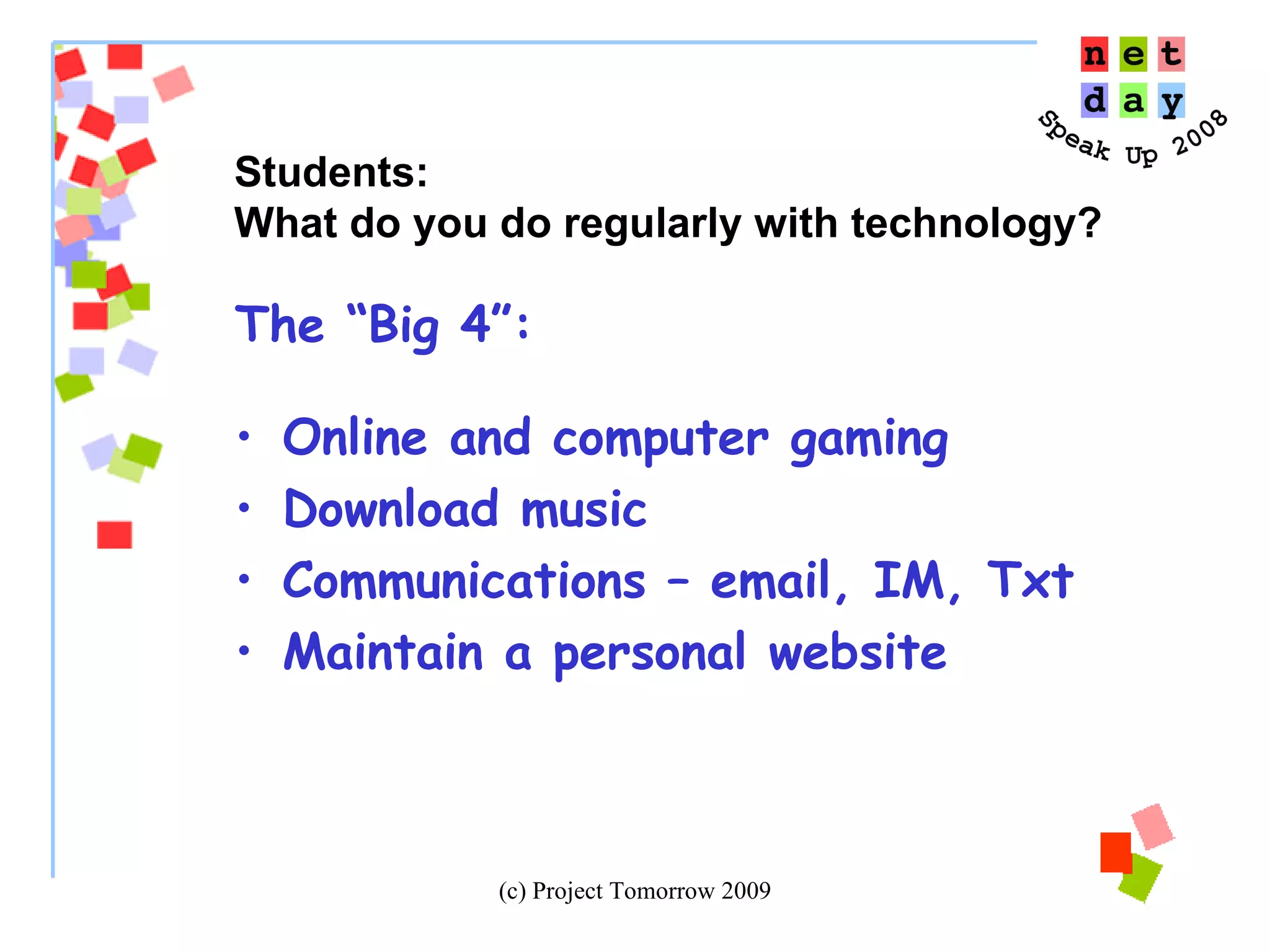
The “Big 4”: Online and computer gaming Download music Communications – email, IM, Txt Maintain a personal website Students:  What do you do regularly with technology?
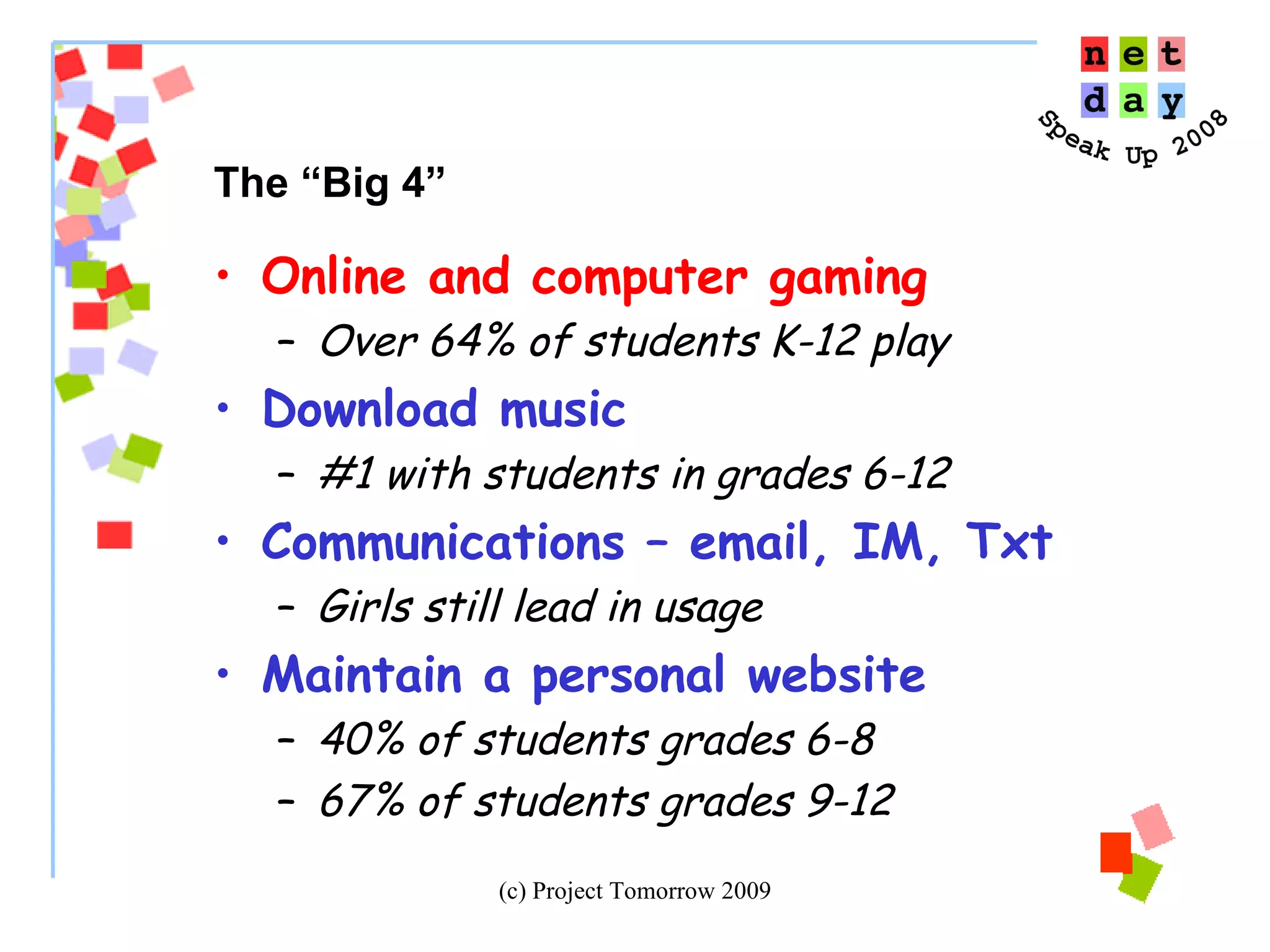
The “Big 4” Online and computer gaming Over 64% of students K-12 play Download music #1 with students in grades 6-12 Communications – email, IM, Txt Girls still lead in usage Maintain a personal website 40% of students grades 6-8 67% of students grades 9-12
On the horizon – coming quickly to a tipping point near you!  Virtual worlds 24% of students gr 3-5 participate regularly Video creation/sharing 20% of high school students 50% in focus groups have posted a video Remixing content  21% of middle school students are doing this now
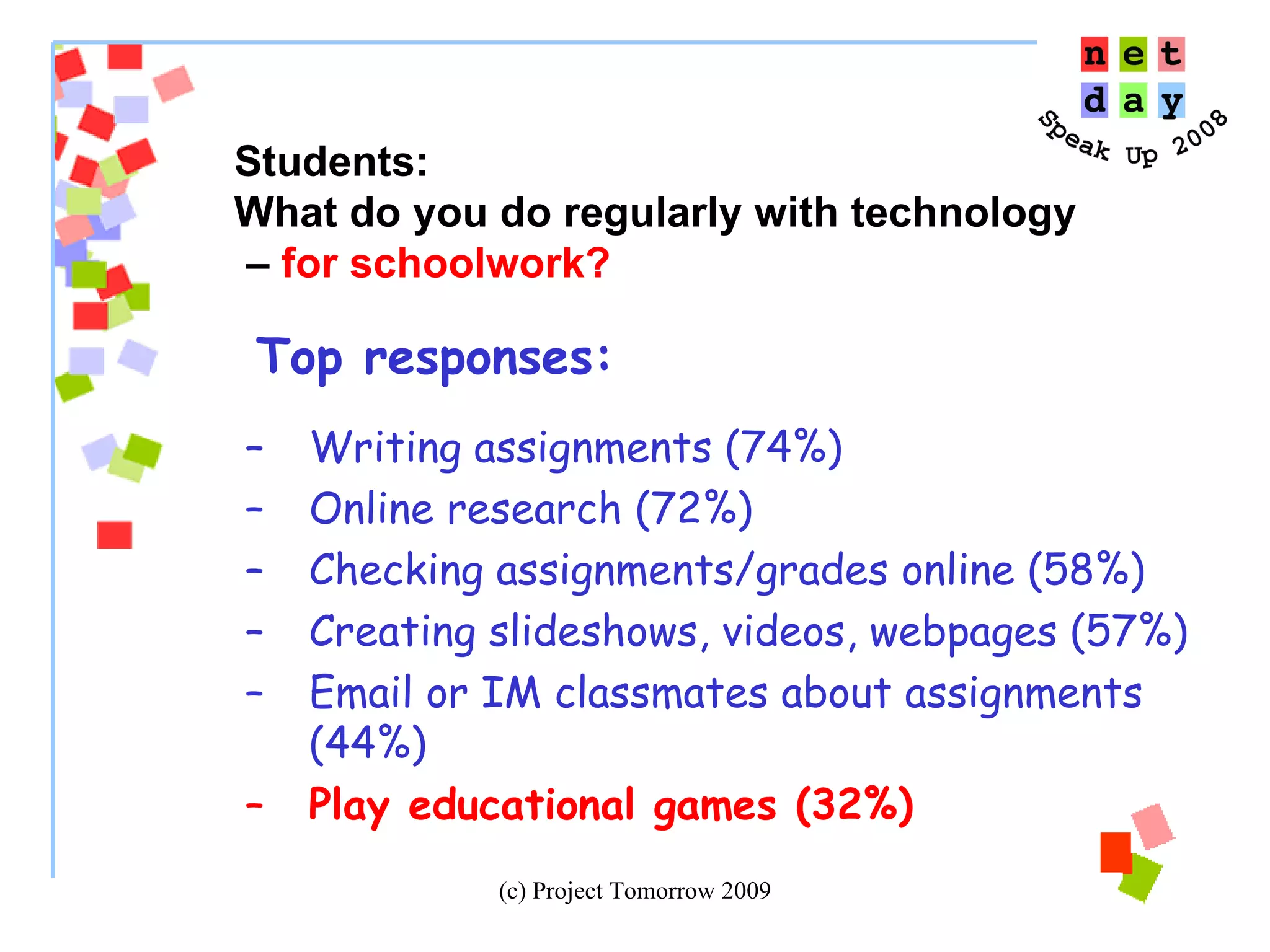
Top responses:   Writing assignments (74%) Online research (72%) Checking assignments/grades online (58%) Creating slideshows, videos, webpages (57%) Email or IM classmates about assignments (44%) Play educational games (32%) Students:  What do you do regularly with technology –  for schoolwork?
How satisfied are today’s students with technology use at their school?
How satisfied are today’s students with technology use at their school? Audience Response What is the #1 obstacle for students? Teachers don’t know how to use technology Too many rules against using technology  School filters and firewalls
Top responses: Filters block websites I need Teachers limit tech use  Lots of rules  That limit use of my school’s technology That prevent me from using my own tools such email / IM / MySpace That prohibit emerging technologies for learning Obstacles to student tech use at school
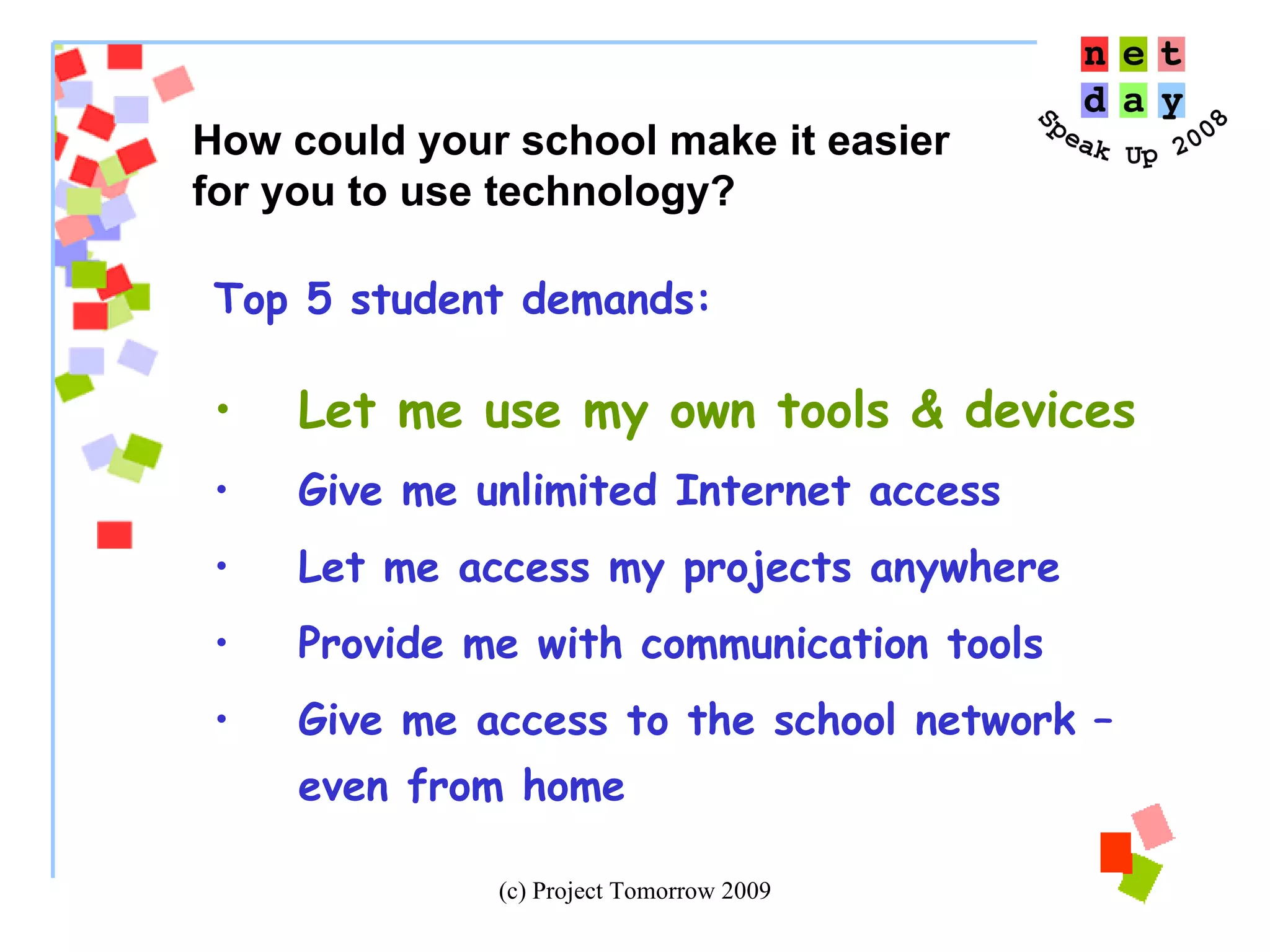
Top 5 student demands:  Let me use my own tools & devices Give me unlimited Internet access Let me access my projects anywhere Provide me with communication tools Give me access to the school network – even from home  How could your school make it easier  for you to use technology?
Students’ Access to Mobile Devices
Gaming technologies for learning Digital Disconnect:  A new “battleground” with emerging technologies  in education
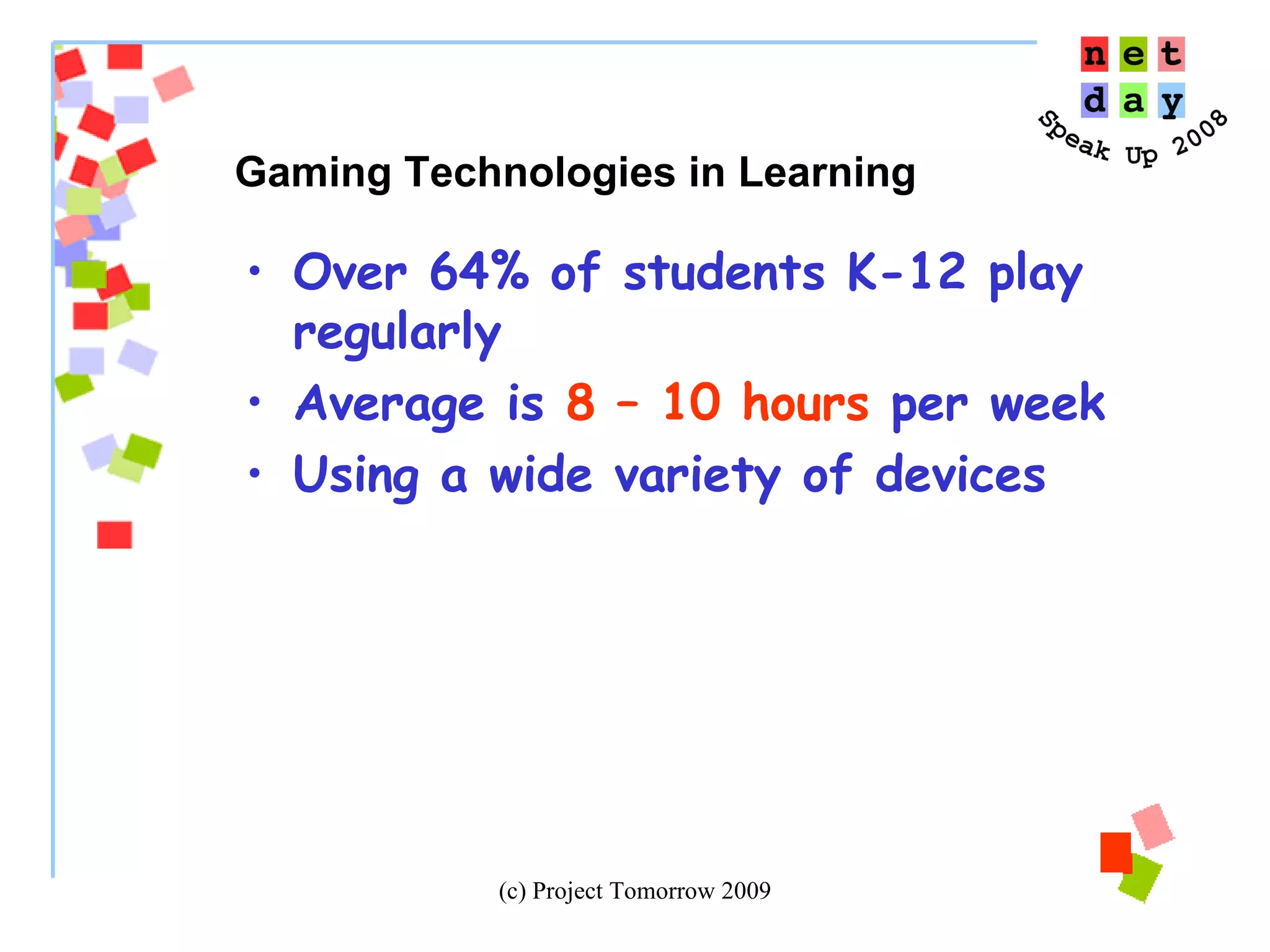
Over 64% of students K-12 play regularly Average is  8 – 10 hours  per week Using a wide variety of devices Gaming Technologies in Learning
Over 64% of students K-12 play Average is 8 – 10 hours per week Using a wide variety of devices Cell phones Computer games Console video players Handhelds Web-based: single or multi user Gaming Technologies in Learning
Cell phones Computer games Console video players Handhelds Web-based single user game Web-based multi-user game Audience Response:  Girls  are most likely to use which device  for their gaming activities?
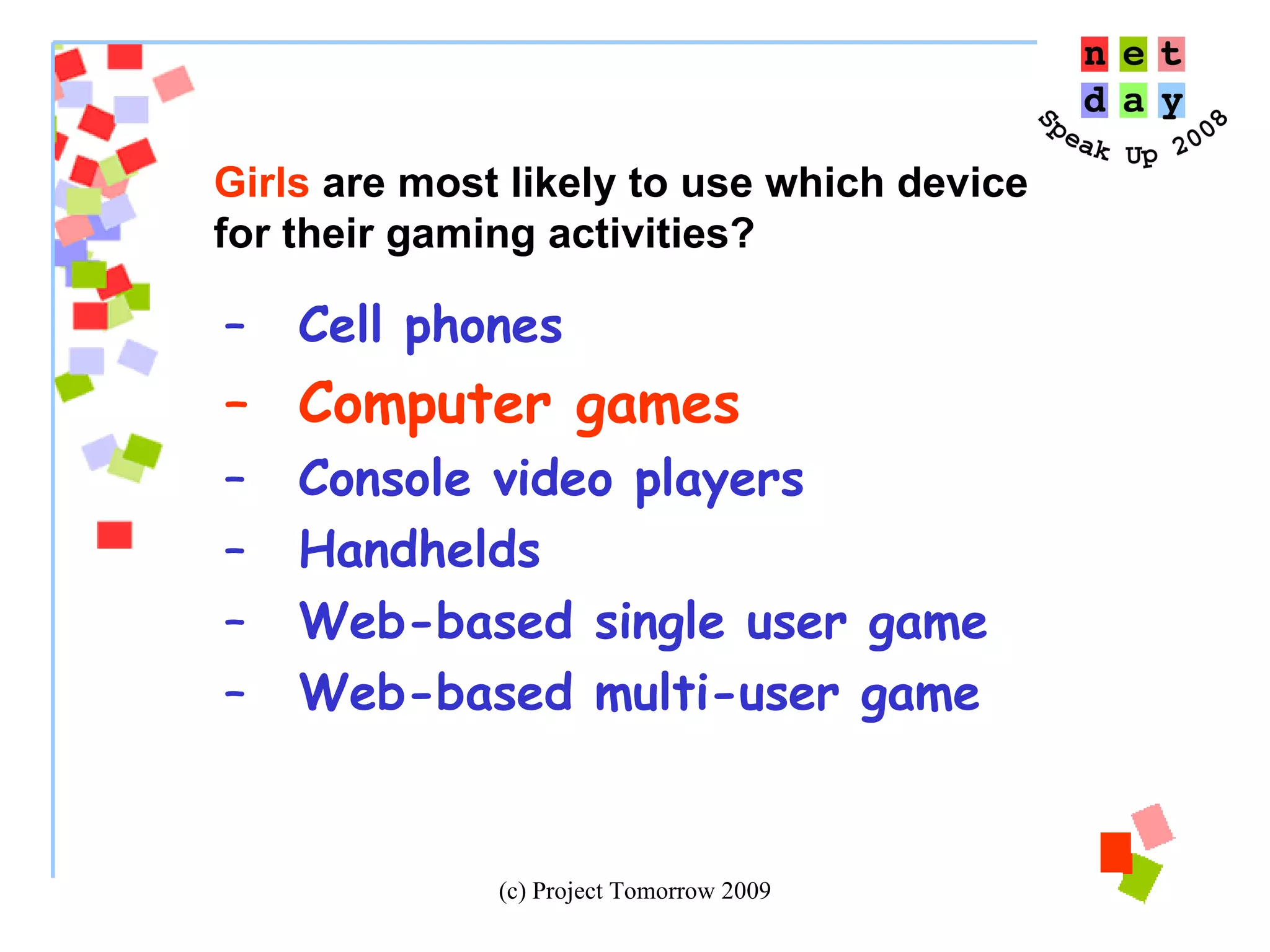
Cell phones Computer games Console video players Handhelds Web-based single user game Web-based multi-user game Girls  are most likely to use which device  for their gaming activities?
Gaming Technologies in Learning
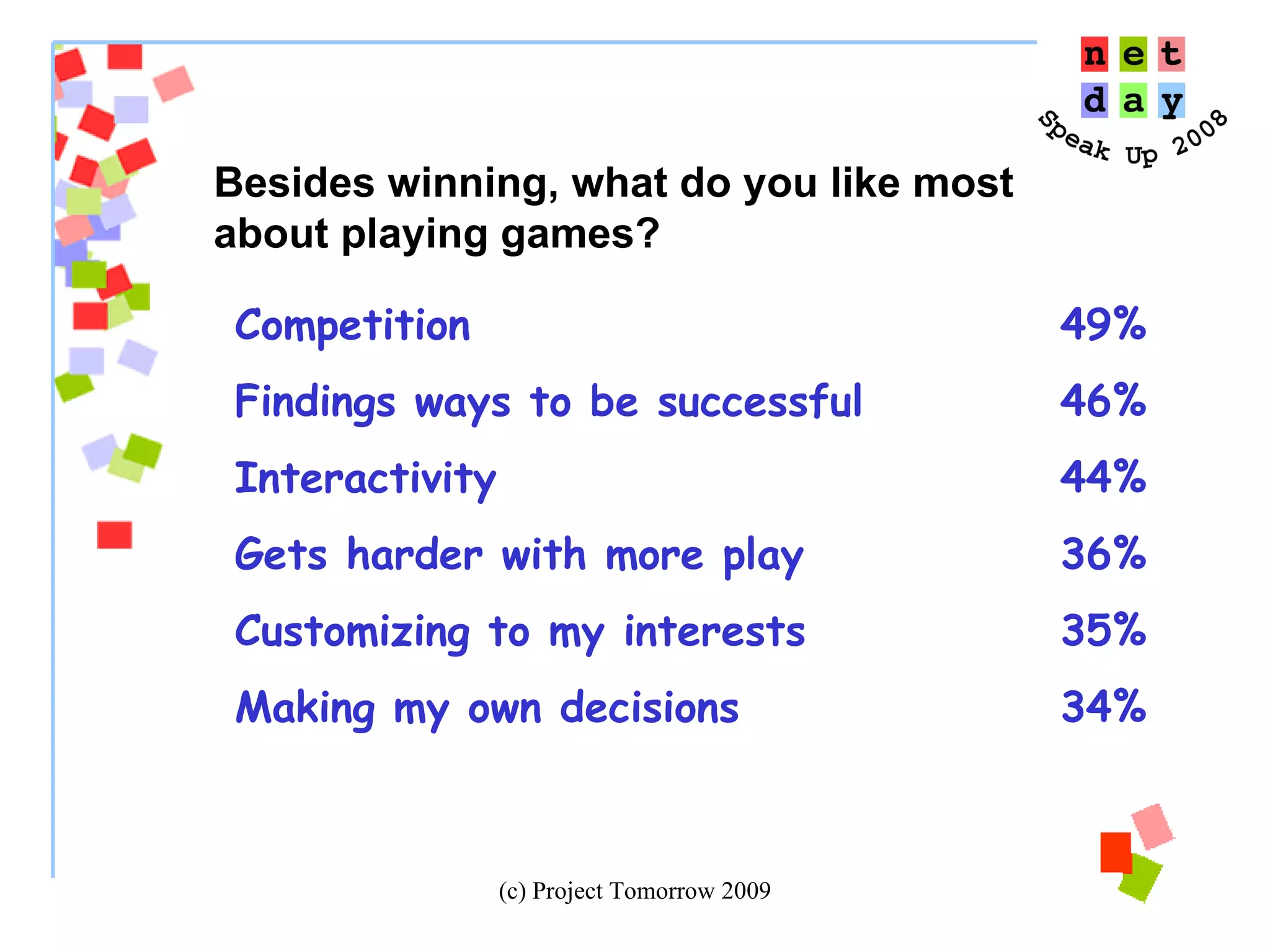
Competition 49% Findings ways to be successful  46% Interactivity 44% Gets harder with more play 36% Customizing to my interests 35% Making my own decisions 34% Besides winning, what do you like most about playing games?
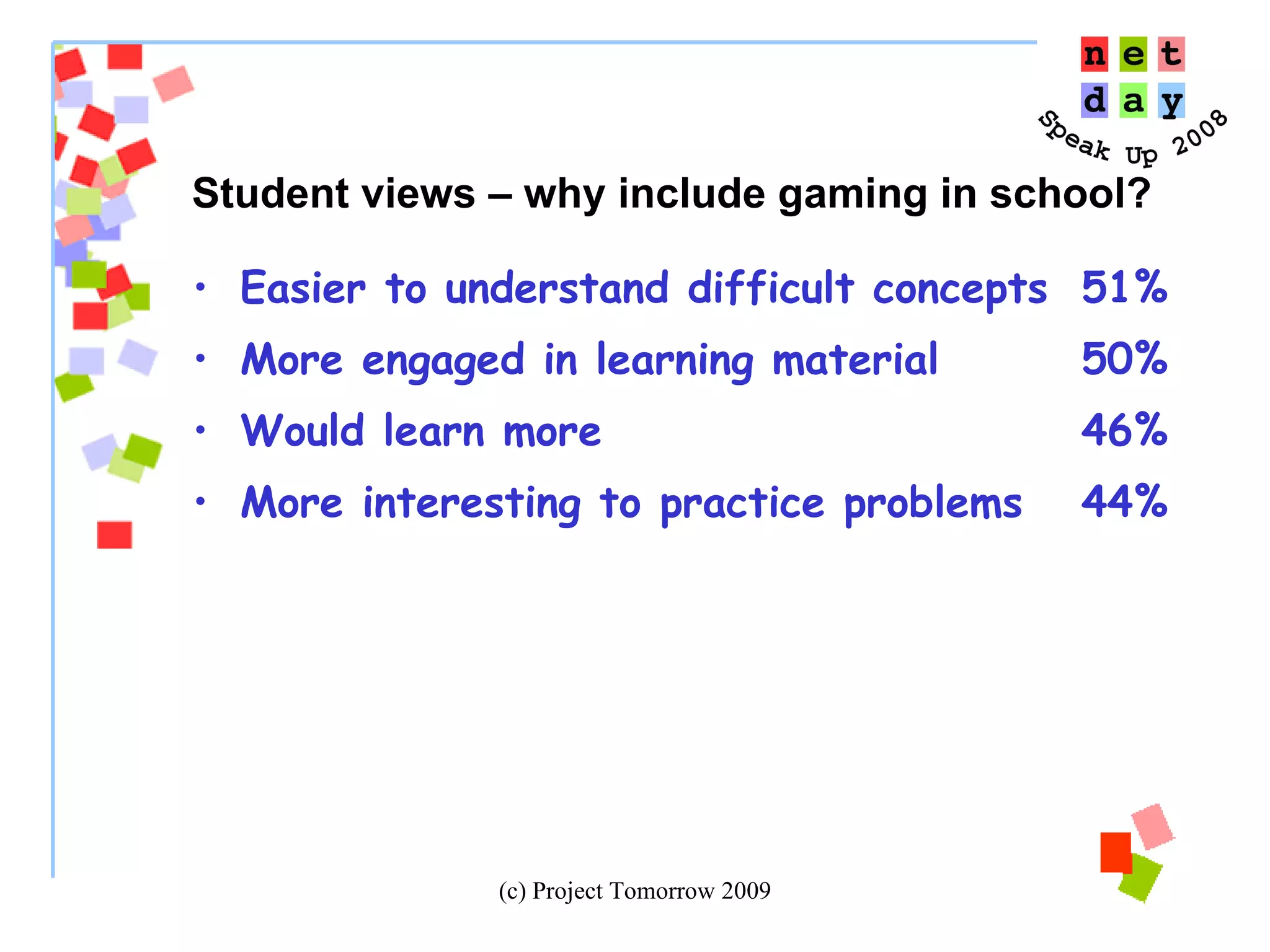
Easier to understand difficult concepts 51% More engaged in learning material 50% Would learn more 46% More interesting to practice problems 44% Student views – why include gaming in school?
Easier to understand difficult concepts 51% More engaged in learning material 50% Would learn more 46% More interesting to practice problems 44% Go beyond & try new things 37% See results of my problem solving 35% Direct my own learning 34% Student views – why include gaming in school?
Learn more about integration 51% Professional development  46% Learn about promising practices 29% Currently using gaming in my classroom 11% Sharing ideas with other teachers 7% Not interested 12% Teacher views –  interest in educational gaming?
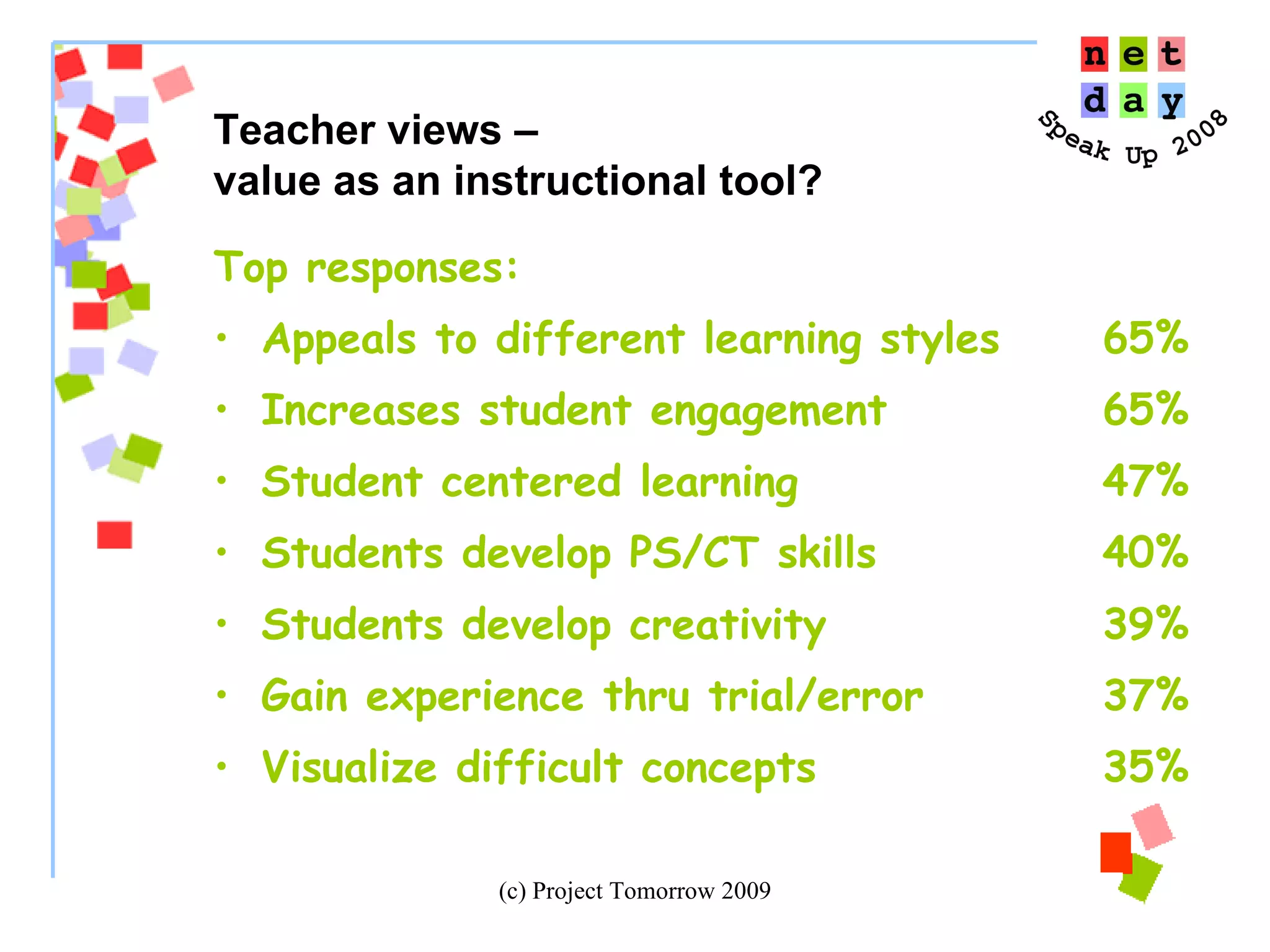
Top responses:  Appeals to different learning styles 65% Increases student engagement 65% Student centered learning 47% Students develop PS/CT skills 40% Students develop creativity 39% Gain experience thru trial/error 37% Visualize difficult concepts 35% Teacher views –  value as an instructional tool?
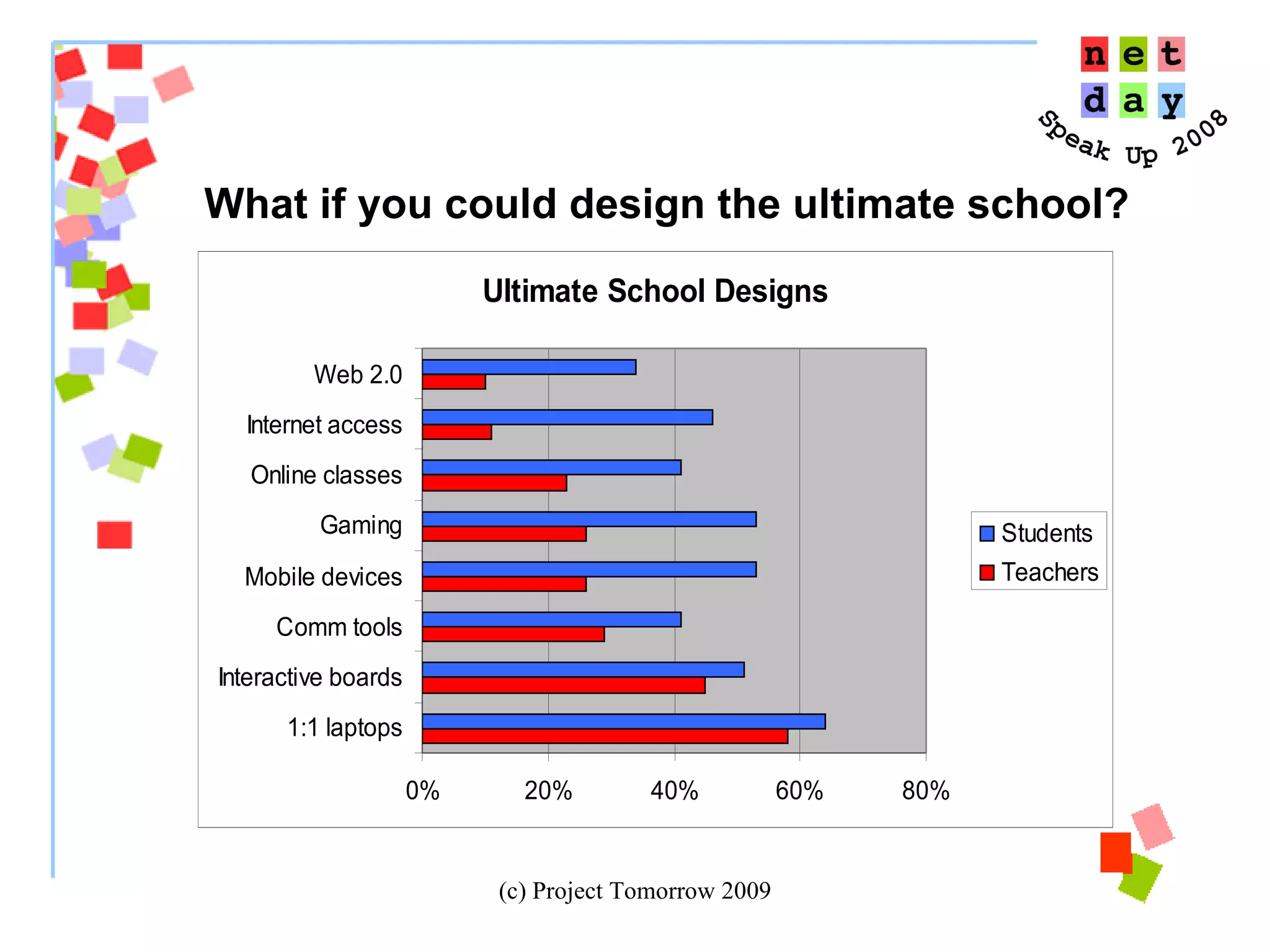
What if you could design the  ultimate school . . . . what technologies would have the greatest impact on your learning?
Digital equipment for creating projects Games and virtual simulations Personal laptops for each student Student access to email and IM at school Using devices like cellphones, MP3 players and PDAs Online classes Audience Response:  What do students say is the #1 tech tool or service that will impact their learning?
Students in Kindergarten thru 12 th  grade say the same thing every year:  What do students say is the #1 tech tool or service that will impact their learning?
Students in Kindergarten thru 12 th  grade say the same thing every year:  “ Give me a laptop for my personal use at school and at home” What do students say is the #1 tech tool or service that will impact their learning?
What if you could design the ultimate school?
And what if students could design their own games . . . what would they design?
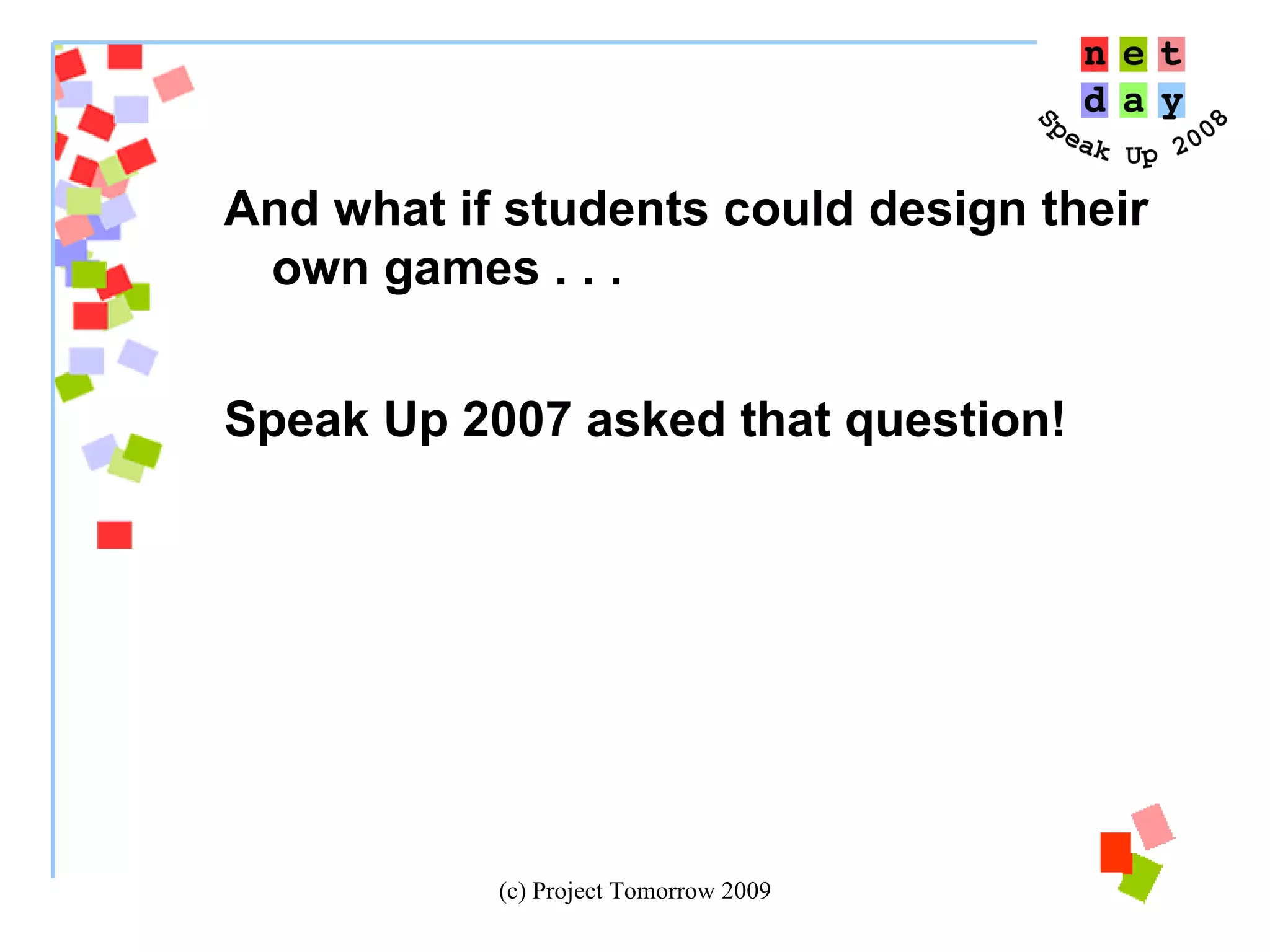
And what if students could design their own games . . .  Speak Up 2007 asked that question!
Speak Up:  Students design their own games A sampling of student designed games: An online game where the students pick a job about science, math, history A game that would help students with money management and social skills A game about High School.. where you can make choices like those you make in high school, drugs, girls, skipping school A game where you create cities. Your city would then be confronted with physical, political, and environmental issues that we as a world face today. My game would be a video game in which you are a factory owner. As the owner, you would use math and other skills to produce the most products A game about issues that affect the world like World Hunger and Global Warming  + 100,000 more like this
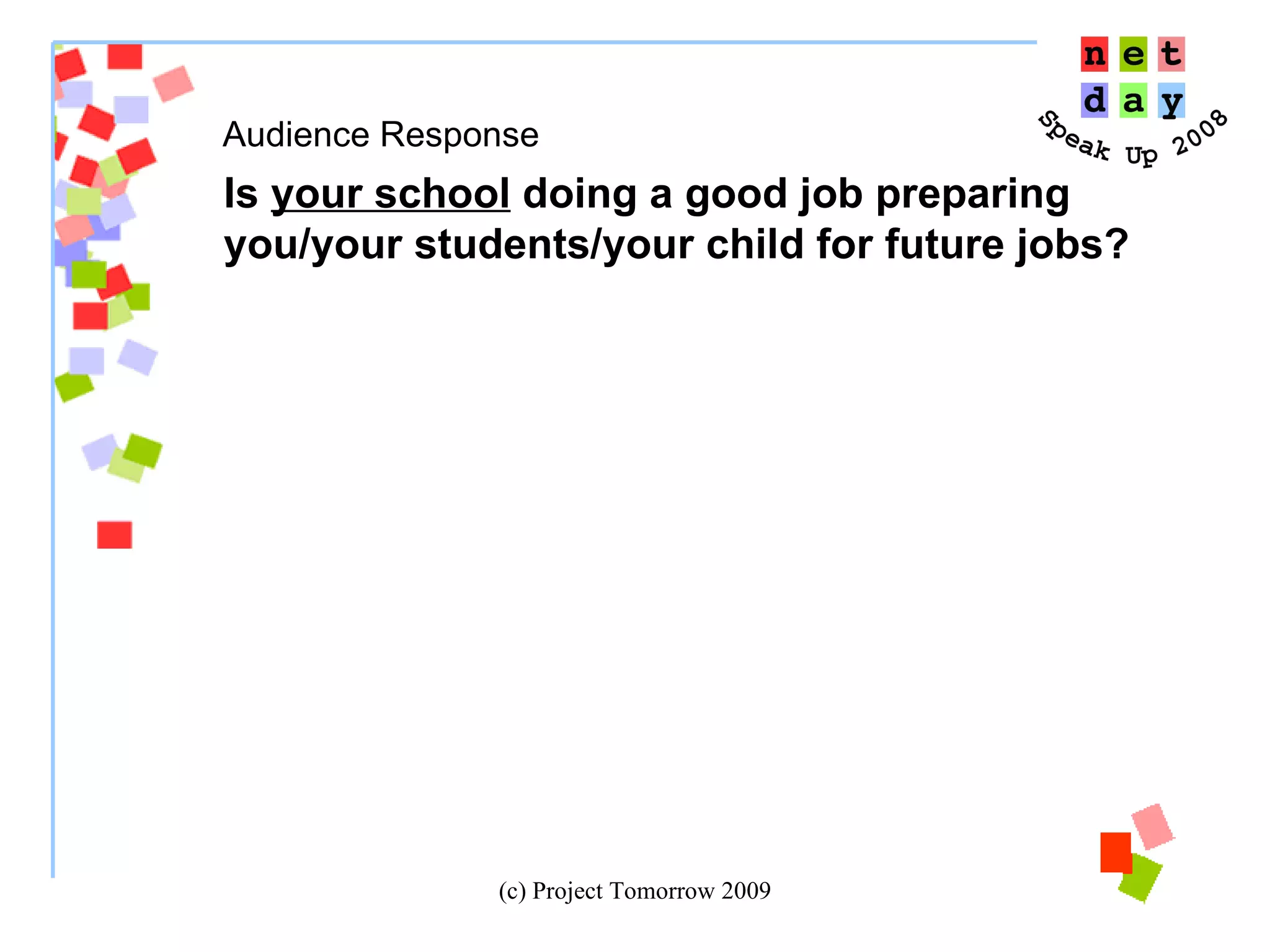
Audience Response Is  your school  doing a good job preparing  you/your students/your child for future jobs?
YES!  School Principals 66% District Administrators 48% Teachers 47% Parents 43% Is  your school  doing a good job preparing  you/your students/your child for future jobs?
YES!  School Principals 66% District Administrators 48% Teachers 47% Parents 43% Advanced tech students 23% Is  your school  doing a good job preparing  you/your students/your child for future jobs?
Summary:  What do the Students Say About 21 st  Century Learning?  Make learning relevant to me! The “long tail” of education – personalization Self-directed learning Adopting and adapting new technologies Using the “computers” in my backpack Process of learning is sometimes more important than the end result
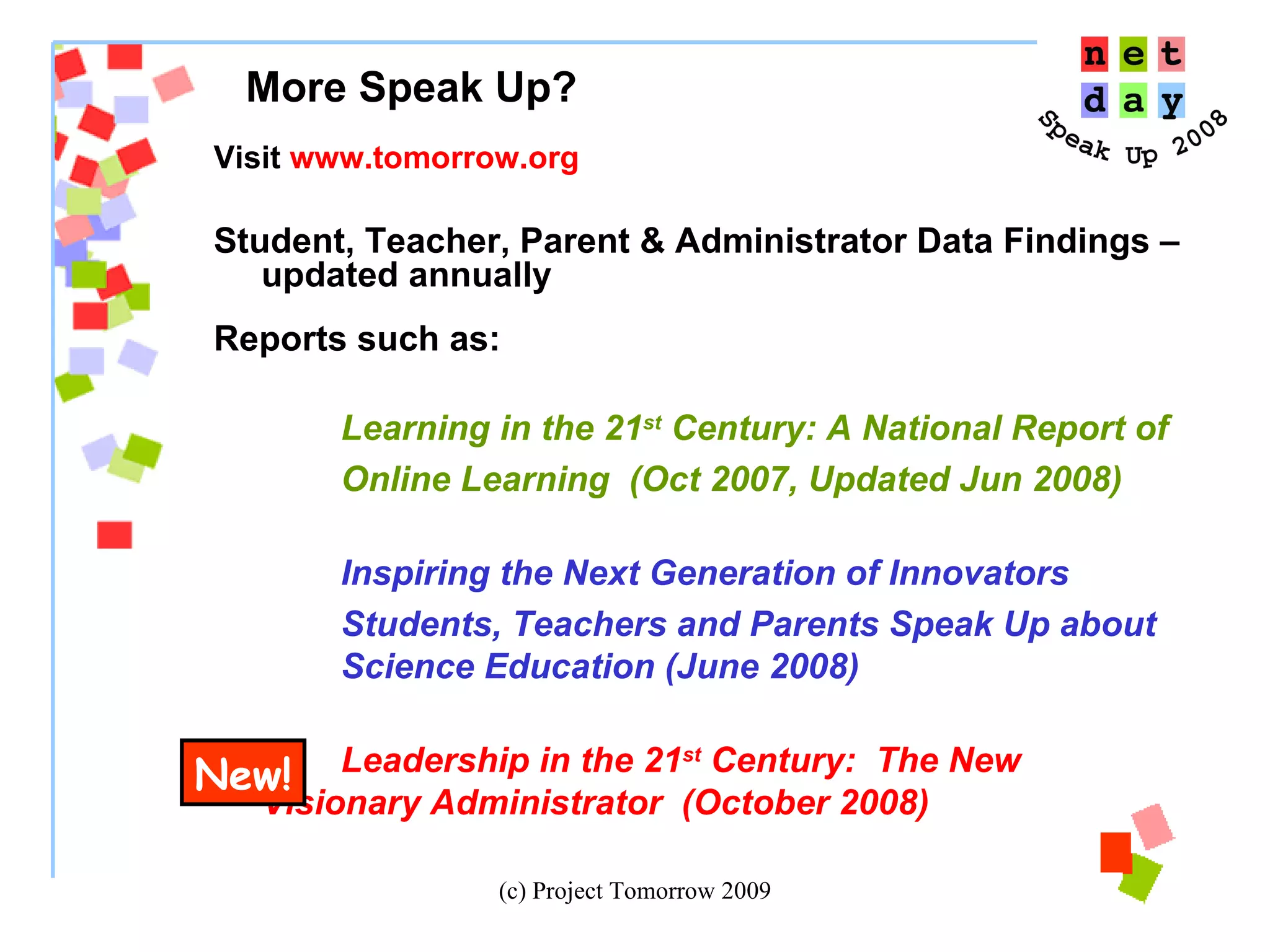
Visit  www.tomorrow.org Student, Teacher, Parent & Administrator Data Findings – updated annually Reports such as:  Learning in the 21 st  Century: A National Report of  Online Learning  (Oct 2007, Updated Jun 2008) Inspiring the Next Generation of Innovators Students, Teachers and Parents Speak Up about  Science Education (June 2008) Leadership in the 21 st  Century:  The New  Visionary Administrator  (October 2008)  More Speak Up?  New!
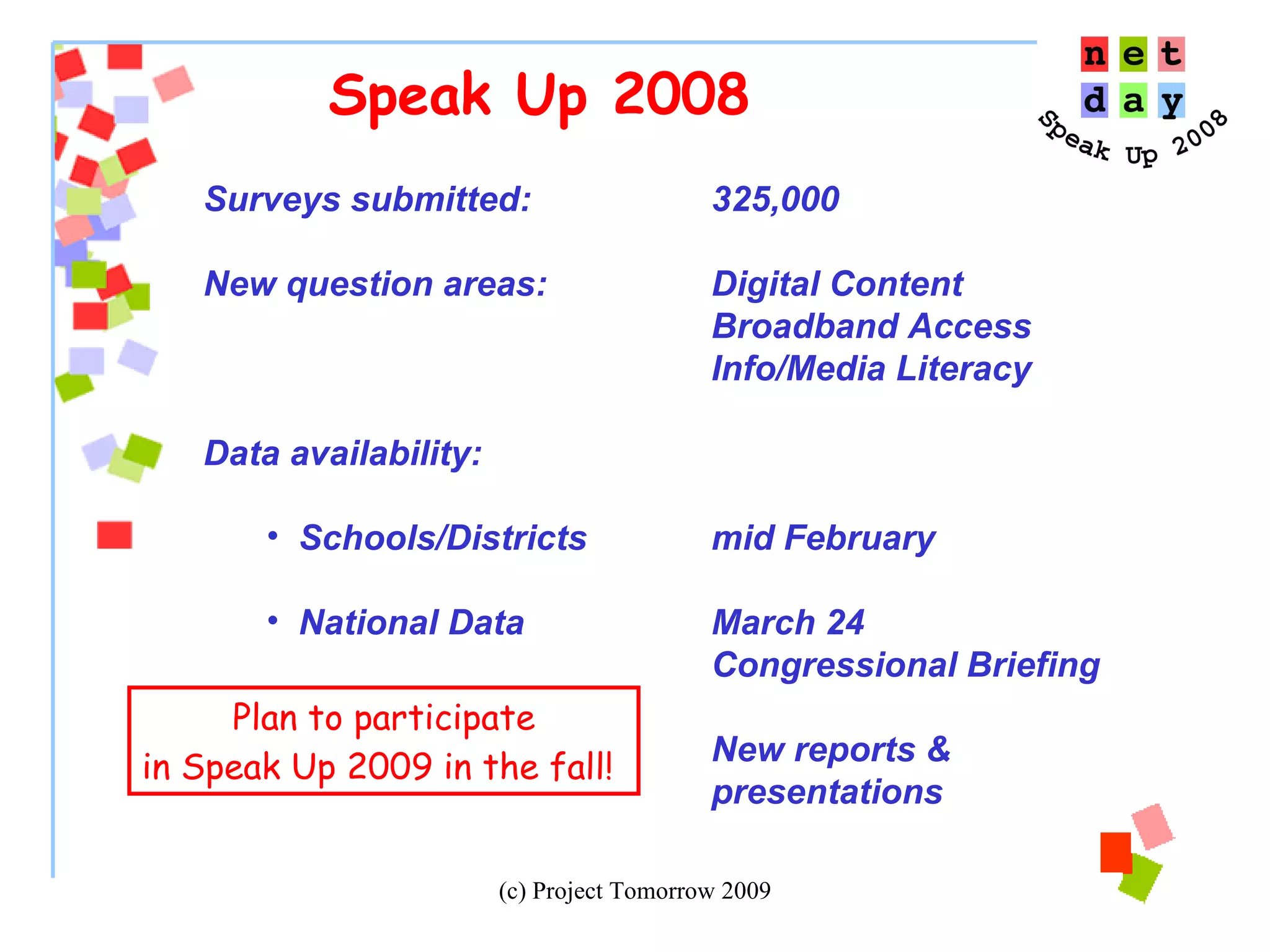
Speak Up 2008 Surveys submitted:  325,000 New question areas: Digital Content Broadband Access Info/Media Literacy Data availability: Schools/Districts  mid February National Data March 24 Congressional Briefing New reports &  presentations Plan to participate in Speak Up 2009 in the fall!
For more Speak Up data findings or information  about Speak Up 2008 data results, please visit us at  www.tomorrow.org   Julie Evans Project Tomorrow [email_address] 949-609-4660 x15 Copyright Project Tomorrow 2009.  This work is the intellectual property of the author. Permission is granted for this material to be shared for non-commercial, educational purposes, provided that this copyright statement appears on the reproduced materials and notice is given that the copying is by permission of the author. To disseminate otherwise or to republish requires written permission from the author.

Students Speak Up About Games

  • 1.
    Students “Speak Up” about 21 st Century Learning and Education Games FETC 2009 January 23, 2009 Julie Evans Chief Executive Officer Project Tomorrow
  • 2.
    Annual national researchproject Online surveys + focus groups Open for all K-12 schools Schools/districts get back their own data for planning and budgeting Collect data ↔ Stimulate conversations K-12 Students, Teachers, Parents and Administrators Inform policies & programs Analysis and reporting – national reports, state reports, district reports Services: custom reports, consulting with districts and state agencies NCES back end database – provide statistically significant samplings 6 years of empowering authentic voices – since 2003: 1.3 million K-12 students 103,000 teachers 54,000 parents 6,300 school leaders 17,000 schools – from all 50 states, DC, American military base schools, Canada, Mexico, Australia What is Speak Up? 1.46 million respondents
  • 3.
    Speak Up isfacilitated annually by Project Tomorrow (formerly known as NetDay) About Project Tomorrow: A national education nonprofit organization providing leadership, research and programs to support science, math and technology education in America’s schools
  • 4.
    We would liketo recognize our Speak Up 2008 Sponsors:
  • 5.
    We would liketo also acknowledge the support of our Speak Up 2008 National Champion Outreach Partners:
  • 6.
    We would liketo also acknowledge the support of FETC in providing free registrations for these school districts that had high participation in Speak Up 2008: Brevard County School District Charlotte County School District Clay County School District
  • 7.
  • 8.
    Learning & Teachingwith Technology Web 2.0 in Education 21st Century Skills Science Instruction & Global Competitiveness Emerging Technologies in the Classroom Mobile Devices Games within Instruction Online Learning Designing the 21st Century School Speak Up survey question themes
  • 9.
    K-12 Students 319,223Teachers 25,544 Parents (in English & Spanish) 19,726 School/District Administrators 3,263 Schools 3,729 Districts 867 States All 50 Top 10: TX, CA, AZ, IL, AL, MD, NC, PA, FL, MI About Speak Up Schools: 97% public, 3% private 32% urban, 40% suburban, 29% rural 43% Title 1 eligible 29% majority-minority student population National Speak Up 2007 Participation
  • 10.
    “ Digital disconnect”is alive & well: the gap between how today’s students learn and how they live! Key findings from Speak Up data:
  • 11.
    “ Digital disconnect”is alive & well: Between students and teachers Between advanced tech students and other students Between girls and boys Between older and younger students Key findings from Speak Up data:
  • 12.
    Let’s get toknow each other! Audience Response How would you assess your own technology skills compared to your peers? Beginner Average Advanced
  • 13.
    Parents, Teachers, SchoolLeaders: What kind of tech user are you?
  • 14.
    6% 24% 70%Audience Response: What % of students grades 6-12 consider themselves “ advanced tech users? ”
  • 15.
    What % ofstudents grades 6-12 consider themselves “ advanced tech users? ” 70% 24% 6% C B A
  • 16.
    Students: Whatdo you do regularly with technology?
  • 17.
    The “Big 4”:Online and computer gaming Download music Communications – email, IM, Txt Maintain a personal website Students: What do you do regularly with technology?
  • 18.
    The “Big 4”Online and computer gaming Over 64% of students K-12 play Download music #1 with students in grades 6-12 Communications – email, IM, Txt Girls still lead in usage Maintain a personal website 40% of students grades 6-8 67% of students grades 9-12
  • 19.
    On the horizon– coming quickly to a tipping point near you! Virtual worlds 24% of students gr 3-5 participate regularly Video creation/sharing 20% of high school students 50% in focus groups have posted a video Remixing content 21% of middle school students are doing this now
  • 20.
    Top responses: Writing assignments (74%) Online research (72%) Checking assignments/grades online (58%) Creating slideshows, videos, webpages (57%) Email or IM classmates about assignments (44%) Play educational games (32%) Students: What do you do regularly with technology – for schoolwork?
  • 21.
    How satisfied aretoday’s students with technology use at their school?
  • 22.
    How satisfied aretoday’s students with technology use at their school? Audience Response What is the #1 obstacle for students? Teachers don’t know how to use technology Too many rules against using technology School filters and firewalls
  • 23.
    Top responses: Filtersblock websites I need Teachers limit tech use Lots of rules That limit use of my school’s technology That prevent me from using my own tools such email / IM / MySpace That prohibit emerging technologies for learning Obstacles to student tech use at school
  • 24.
    Top 5 studentdemands: Let me use my own tools & devices Give me unlimited Internet access Let me access my projects anywhere Provide me with communication tools Give me access to the school network – even from home How could your school make it easier for you to use technology?
  • 25.
    Students’ Access toMobile Devices
  • 26.
    Gaming technologies forlearning Digital Disconnect: A new “battleground” with emerging technologies in education
  • 27.
    Over 64% ofstudents K-12 play regularly Average is 8 – 10 hours per week Using a wide variety of devices Gaming Technologies in Learning
  • 28.
    Over 64% ofstudents K-12 play Average is 8 – 10 hours per week Using a wide variety of devices Cell phones Computer games Console video players Handhelds Web-based: single or multi user Gaming Technologies in Learning
  • 29.
    Cell phones Computergames Console video players Handhelds Web-based single user game Web-based multi-user game Audience Response: Girls are most likely to use which device for their gaming activities?
  • 30.
    Cell phones Computergames Console video players Handhelds Web-based single user game Web-based multi-user game Girls are most likely to use which device for their gaming activities?
  • 31.
  • 32.
    Competition 49% Findingsways to be successful 46% Interactivity 44% Gets harder with more play 36% Customizing to my interests 35% Making my own decisions 34% Besides winning, what do you like most about playing games?
  • 33.
    Easier to understanddifficult concepts 51% More engaged in learning material 50% Would learn more 46% More interesting to practice problems 44% Student views – why include gaming in school?
  • 34.
    Easier to understanddifficult concepts 51% More engaged in learning material 50% Would learn more 46% More interesting to practice problems 44% Go beyond & try new things 37% See results of my problem solving 35% Direct my own learning 34% Student views – why include gaming in school?
  • 35.
    Learn more aboutintegration 51% Professional development 46% Learn about promising practices 29% Currently using gaming in my classroom 11% Sharing ideas with other teachers 7% Not interested 12% Teacher views – interest in educational gaming?
  • 36.
    Top responses: Appeals to different learning styles 65% Increases student engagement 65% Student centered learning 47% Students develop PS/CT skills 40% Students develop creativity 39% Gain experience thru trial/error 37% Visualize difficult concepts 35% Teacher views – value as an instructional tool?
  • 37.
    What if youcould design the ultimate school . . . . what technologies would have the greatest impact on your learning?
  • 38.
    Digital equipment forcreating projects Games and virtual simulations Personal laptops for each student Student access to email and IM at school Using devices like cellphones, MP3 players and PDAs Online classes Audience Response: What do students say is the #1 tech tool or service that will impact their learning?
  • 39.
    Students in Kindergartenthru 12 th grade say the same thing every year: What do students say is the #1 tech tool or service that will impact their learning?
  • 40.
    Students in Kindergartenthru 12 th grade say the same thing every year: “ Give me a laptop for my personal use at school and at home” What do students say is the #1 tech tool or service that will impact their learning?
  • 41.
    What if youcould design the ultimate school?
  • 42.
    And what ifstudents could design their own games . . . what would they design?
  • 43.
    And what ifstudents could design their own games . . . Speak Up 2007 asked that question!
  • 44.
    Speak Up: Students design their own games A sampling of student designed games: An online game where the students pick a job about science, math, history A game that would help students with money management and social skills A game about High School.. where you can make choices like those you make in high school, drugs, girls, skipping school A game where you create cities. Your city would then be confronted with physical, political, and environmental issues that we as a world face today. My game would be a video game in which you are a factory owner. As the owner, you would use math and other skills to produce the most products A game about issues that affect the world like World Hunger and Global Warming + 100,000 more like this
  • 45.
    Audience Response Is your school doing a good job preparing you/your students/your child for future jobs?
  • 46.
    YES! SchoolPrincipals 66% District Administrators 48% Teachers 47% Parents 43% Is your school doing a good job preparing you/your students/your child for future jobs?
  • 47.
    YES! SchoolPrincipals 66% District Administrators 48% Teachers 47% Parents 43% Advanced tech students 23% Is your school doing a good job preparing you/your students/your child for future jobs?
  • 48.
    Summary: Whatdo the Students Say About 21 st Century Learning? Make learning relevant to me! The “long tail” of education – personalization Self-directed learning Adopting and adapting new technologies Using the “computers” in my backpack Process of learning is sometimes more important than the end result
  • 49.
    Visit www.tomorrow.orgStudent, Teacher, Parent & Administrator Data Findings – updated annually Reports such as: Learning in the 21 st Century: A National Report of Online Learning (Oct 2007, Updated Jun 2008) Inspiring the Next Generation of Innovators Students, Teachers and Parents Speak Up about Science Education (June 2008) Leadership in the 21 st Century: The New Visionary Administrator (October 2008) More Speak Up? New!
  • 50.
    Speak Up 2008Surveys submitted: 325,000 New question areas: Digital Content Broadband Access Info/Media Literacy Data availability: Schools/Districts mid February National Data March 24 Congressional Briefing New reports & presentations Plan to participate in Speak Up 2009 in the fall!
  • 51.
    For more SpeakUp data findings or information about Speak Up 2008 data results, please visit us at www.tomorrow.org Julie Evans Project Tomorrow [email_address] 949-609-4660 x15 Copyright Project Tomorrow 2009. This work is the intellectual property of the author. Permission is granted for this material to be shared for non-commercial, educational purposes, provided that this copyright statement appears on the reproduced materials and notice is given that the copying is by permission of the author. To disseminate otherwise or to republish requires written permission from the author.