Engaging Parents’ Support for  Emerging Technologies in the Classroom Key findings  from Speak Up 2008 Julie Evans Chief Executive Officer Project Tomorrow National School Boards Association T+L Conference – Denver (in a snowstorm) October 28, 2009
Our Agenda Today What is Speak Up? Invitation to participate in Speak Up 2009 Review of selected national data findings Trends to Watch Panel discussion How to engage parents’ support
Introducing our expert panel: Mary Ann Guidos Technology Integration Supervisor Orange City School District (OH) Janet Herdman Executive Director, IT Services North Kansas City Schools (MO)  Kathy Politis Director, Instructional Technology,  Fulton County Schools (GA)   Jan Wee Information & Technology Director Holmen School District (WI)
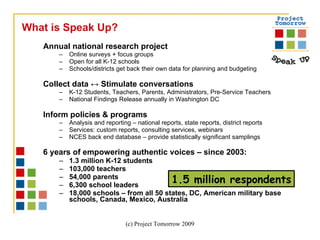
Annual national research project Online surveys + focus groups Open for all K-12 schools Schools/districts get back their own data for planning and budgeting Collect data  ↔ Stimulate conversations K-12 Students, Teachers, Parents, Administrators, Pre-Service Teachers National Findings Release annually in Washington DC Inform policies & programs Analysis and reporting – national reports, state reports, district reports  Services: custom reports, consulting services, webinars NCES back end database – provide statistically significant samplings  6 years of empowering authentic voices – since 2003:   1.3 million K-12 students 103,000 teachers 54,000 parents 6,300 school leaders 18,000 schools – from all 50 states, DC, American military base schools, Canada, Mexico, Australia What is Speak Up? 1.5 million respondents
Speak Up is facilitated annually  by  Project Tomorrow   (formerly known as NetDay) Project Tomorrow (www.tomorrow.org)  is the leading education nonprofit organization dedicated to the empowerment of student voices in education.
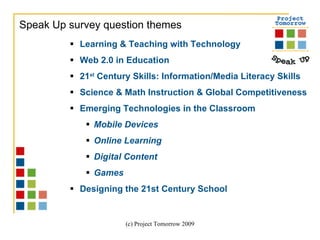
Learning & Teaching with Technology Web 2.0 in Education 21 st  Century Skills: Information/Media Literacy Skills Science & Math Instruction & Global Competitiveness Emerging Technologies in the Classroom Mobile Devices Online Learning Digital Content Games Designing the 21st Century School Speak Up survey question themes
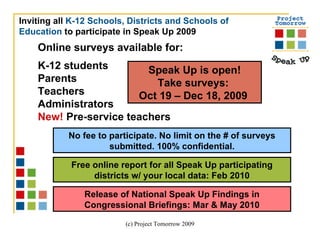
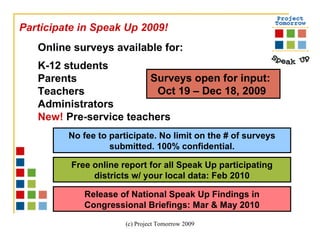
Online surveys available for: K-12 students Parents Teachers Administrators New!  Pre-service teachers   Speak Up is open! Take surveys:  Oct 19 – Dec 18, 2009  Inviting all  K-12 Schools, Districts and Schools of  Education  to participate in Speak Up 2009  Free online report for all Speak Up participating districts w/ your local data: Feb 2010 Release of National Speak Up Findings in Congressional Briefings: Mar & May 2010 No fee to participate. No limit on the # of surveys submitted. 100% confidential.
Collect  unique data  from stakeholders Give stakeholders a  voice  in national/state policy Support  specific initiatives  such as digital content, online learning, mobile devices, 1:1 programs or new teacher professional development programs Model for students the value of  civic engagement  and being part of a national discussion Recognition as an  innovation leader   Demonstrate to students, teachers and parents that their  ideas are valued  by their education leaders Understand the future of K-12 education Learn more at  www.tomorrow.org Why do schools, districts, & states participate in Speak Up?
We would like to recognize our Speak Up 2009 Sponsors:
Speak Up 2008 Key National Data Findings
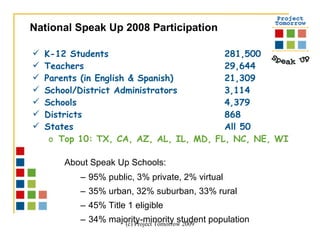
K-12 Students 281,500 Teachers 29,644 Parents (in English & Spanish) 21,309 School/District Administrators 3,114 Schools 4,379 Districts 868 States  All 50 Top 10: TX, CA, AZ, AL, IL, MD, FL, NC, NE, WI About Speak Up Schools: 95% public, 3% private, 2% virtual 35% urban, 32% suburban, 33% rural 45% Title 1 eligible 34% majority-minority student population   National Speak Up 2008 Participation
Speak Up 2008 Data Findings Who am I?  Warm Up Exercise
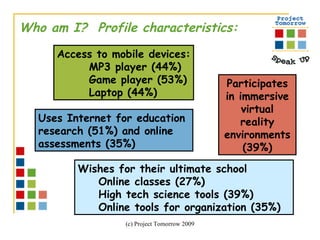
Who am I?  Profile characteristics: Wishes for their ultimate school Online classes (27%) High tech science tools (39%)  Online tools for organization (35%)   Access to mobile devices: MP3 player (44%) Game player (53%) Laptop (44%) Participates in immersive virtual reality environments (39%) Uses Internet for education  research (51%) and online  assessments (35%)
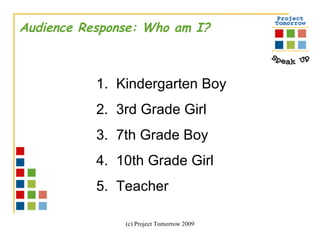
Audience Response: Who am I?  Kindergarten Boy 3rd Grade Girl  7th Grade Boy 10th Grade Girl Teacher
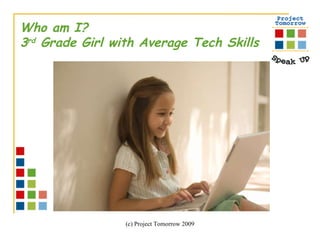
Who am I?  3 rd  Grade Girl with Average Tech Skills
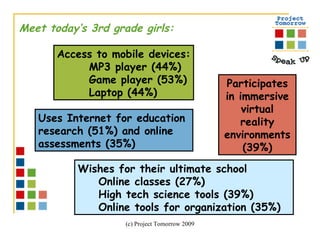
Meet today’s 3rd grade girls: Wishes for their ultimate school Online classes (27%) High tech science tools (39%)  Online tools for organization (35%)   Access to mobile devices: MP3 player (44%) Game player (53%) Laptop (44%) Participates in immersive virtual reality environments (39%) Uses Internet for education  research (51%) and online  assessments (35%)
Introducing the “Digital Advance Team” America’s K-12 Students Adopting/adapting technologies for learning Tech trend setters  Their use predicts widespread acceptance Out of school use drives in school use Pace car for others Teachers ultimately catch up
Introducing the “Digital Advance Team” Let’s listen in and learn!  What we are hearing:  Districts are using Speak Up data as  input for decisions on how to effectively  leverage historic new education funding
“ Digital disconnect”   is alive & well:   the gap between how  today’s students learn and  how they live!   Key findings from Speak Up data:
“ Digital disconnect” is alive & well:   Between students and teachers Between advanced tech students and other students Between girls and boys Between older and younger students Key findings from Speak Up data:
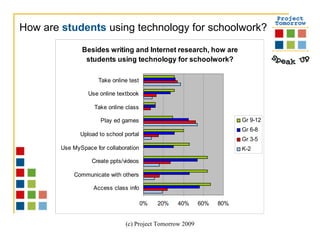
How are  students   using technology for schoolwork?
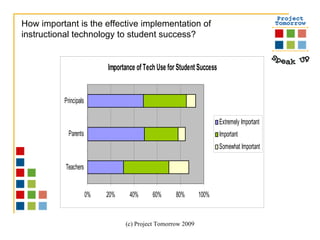
How important is the effective implementation of  instructional technology to student success?
How satisfied are  parents  with technology use at their child’s school?
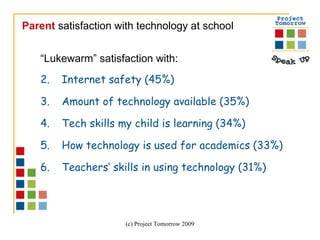
“ Lukewarm” satisfaction with:  Internet safety (45%) Amount of technology available (35%)  Tech skills my child is learning (34%) How technology is used for academics (33%) Teachers’ skills in using technology (31%) Parent  satisfaction with technology at school
How satisfied are today’s  students  with technology use at their school?
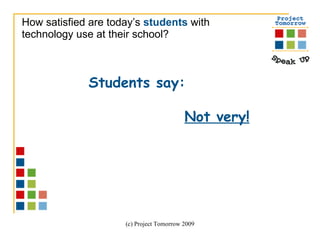
How satisfied are today’s  students  with  technology use at their school? Students say: Not very!
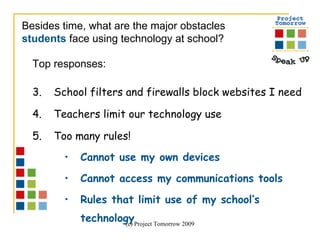
Top responses: School filters and firewalls block websites I need Teachers limit our technology use Too many rules!  Cannot use my own devices Cannot access my communications tools Rules that limit use of my school’s technology Besides time, what are the major obstacles  students  face using technology at school?
Top responses:  Let me use my own laptop, cell phone or mobile device Give me unlimited Internet access  Let me access my school projects from any computer – home or at school How schools could make it easier for  students   to work electronically?
The mobile learner It’s a Web 2.0 World “ I’ll take that class to go!”  The ultimate online textbook Exploring STEM careers Digital Advance Team Trends
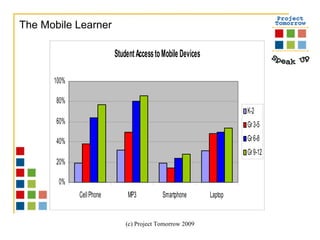
The mobile learner Cell phones Laptops MP3 players Smartphones & PDAs Speak Up 2008 Findings
The Mobile Learner
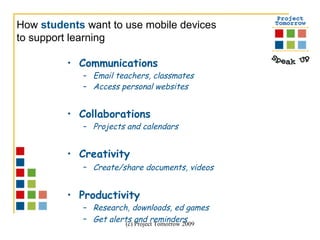
Communications Email teachers, classmates Access personal websites Collaborations Projects and calendars Creativity Create/share documents, videos   Productivity Research, downloads, ed games Get alerts   and reminders How  students  want to use mobile devices  to support learning
It’s a Web 2.0 World Speak Up 2008 Findings
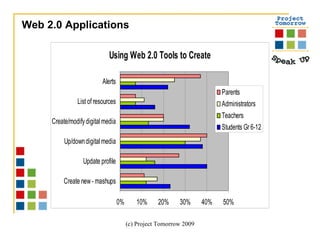
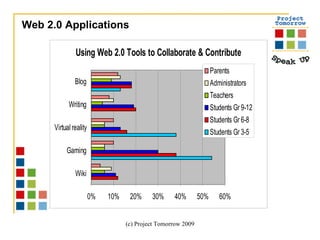
How are students using Web 2.0 tools?  Communications Creation Collaboration Contribution Speak Up 2008 Findings
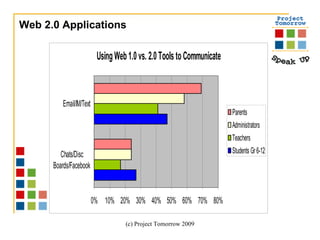
Web 2.0 Applications
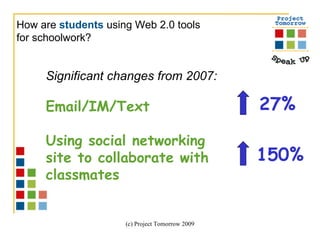
How are  students   using Web 2.0 tools  for schoolwork? Significant changes from 2007: Email/IM/Text Using social networking  site to collaborate with  classmates 150% 27%
“ I’ll take that class to go!”  Online learning Speak Up 2008 Findings
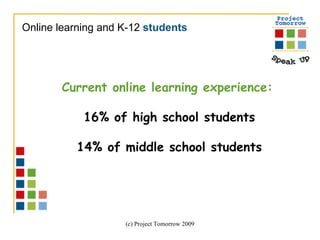
Online learning and K-12  students Current online learning experience: 16% of high school students 14% of middle school students
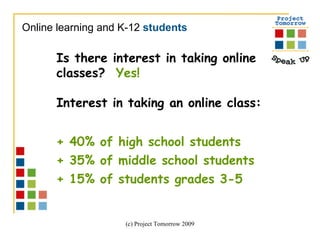
Online learning and K-12  students Is there interest in taking online classes?  Yes!  Interest in taking an online class:  + 40% of high school students + 35% of middle school students + 15% of students grades 3-5
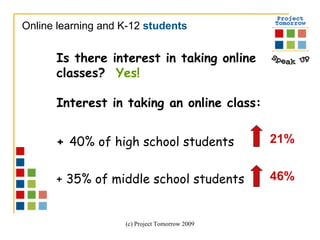
Online learning and K-12  students Is there interest in taking online classes?  Yes!  Interest in taking an online class:  +  40% of high school students + 35% of middle school students 21% 46%
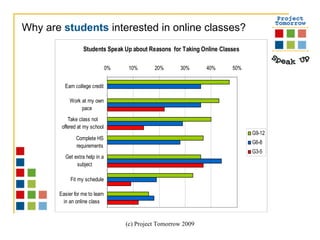
Why are  students  interested in online classes?
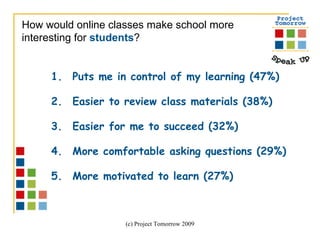
Puts me in control of my learning (47%) Easier to review class materials (38%) Easier for me to succeed (32%) More comfortable asking questions (29%) More motivated to learn (27%) How would online classes make school more interesting for  students ?
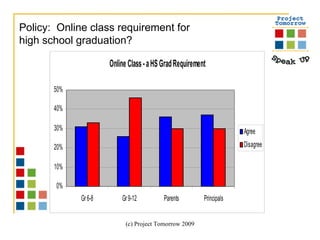
Policy:  Online class requirement for  high school graduation?
The ultimate online textbook What if . . . . students designed  that new textbook?  Speak Up 2008 Findings
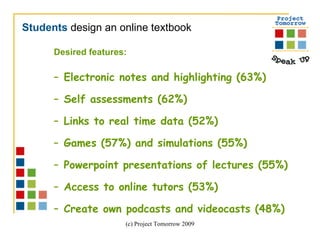
Desired features:  Electronic notes and highlighting (63%) Self assessments (62%) Links to real time data (52%)  Games (57%) and simulations (55%) Powerpoint presentations of lectures (55%) Access to online tutors (53%) Create own podcasts and videocasts (48%) Students  design an online textbook
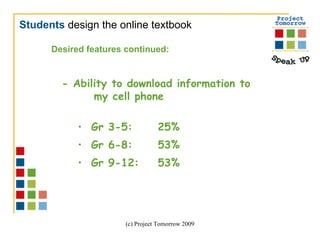
- Ability to download information to  my cell phone Gr 3-5:  25%  Gr 6-8:  53% Gr 9-12:  53%  Students   design the online textbook Desired features continued:
Exploring STEM careers Speak Up 2008 Findings
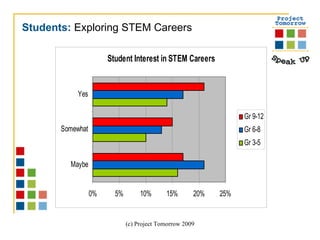
Students:  Exploring STEM Careers
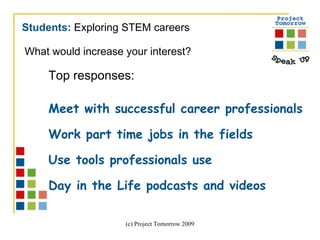
Top responses: Meet with successful career professionals Work part time jobs in the fields Use tools professionals use Day in the Life podcasts and videos  Students:  Exploring STEM careers What would increase your interest?
Is  your school  doing a good job preparing students for jobs of the future?
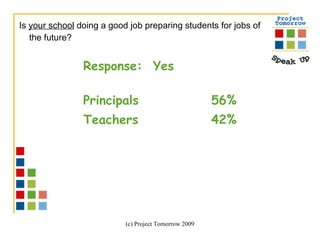
Is  your school  doing a good job preparing students for jobs of the future?   Response:  Yes Principals 56% Teachers 42%
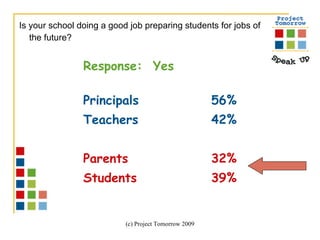
Is your school doing a good job preparing students for jobs of the future?   Response:  Yes Principals 56% Teachers 42% Parents 32% Students 39%
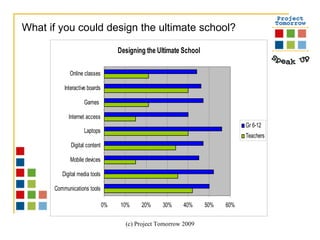
What if you could design the  ultimate school . . . . what technologies would have the greatest impact on your learning? Favorite question for districts seeking  stakeholder input  into technology investment decisions
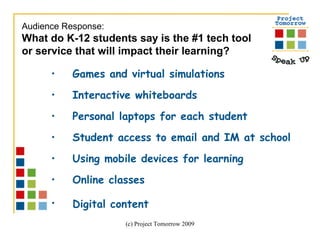
Games and virtual simulations Interactive whiteboards  Personal laptops for each student Student access to email and IM at school Using mobile devices for learning Online classes Digital content   Audience Response:  What do K-12 students say is the #1 tech tool or service that will impact their learning?
Students in Kindergarten thru 12 th  grade say the same thing every year:  What do  students  say is the #1 tech tool  or service that will impact their learning?
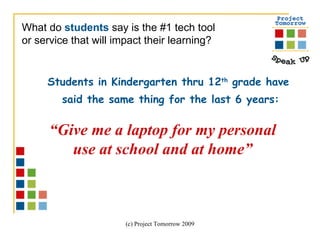
Students in Kindergarten thru 12 th  grade have  said the same thing for the last 6 years: What do  students  say is the #1 tech tool  or service that will impact their learning?   “ Give me a laptop for my personal use at school and at home”
What if you could design the ultimate school?
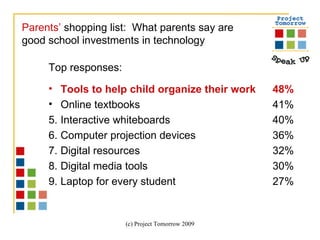
Parents’  shopping list:  What parents say are  good school investments in technology  Top responses: Tools to help child organize their work  48% Online textbooks 41% Interactive whiteboards 40% Computer projection devices 36% Digital resources 32% Digital media tools 30% Laptop for every student 27%
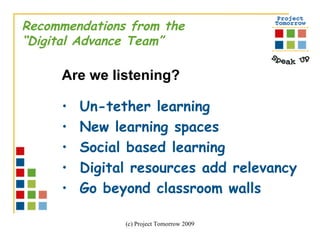
Recommendations from the “ Digital Advance Team”  Are we listening?  Un-tether learning New learning spaces Social based learning Digital resources add relevancy Go beyond classroom walls
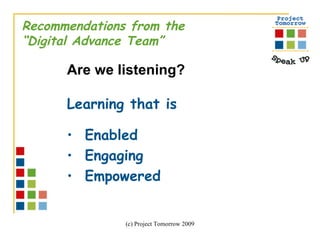
Recommendations from the “ Digital Advance Team”  Are we listening?  Learning that is   Enabled Engaging Empowered
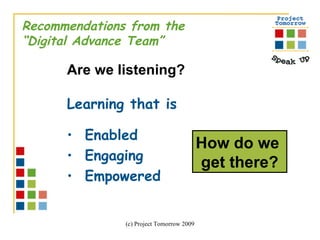
Recommendations from the “ Digital Advance Team”  Are we listening?  Learning that is   Enabled Engaging Empowered  How do we  get there?
Introducing our expert panel: Mary Ann Guidos Technology Integration Supervisor Orange City School District (OH) Janet Herdman Executive Director, IT Services North Kansas City Schools (MO)  Kathy Politis Director, Instructional Technology,  Fulton County Schools (GA)   Jan Wee Information & Technology Director Holmen School District (WI)
Recommendations from the “ Digital Advance Team”  Are we listening?  Learning that is   Enabled Engaging Empowered  How do we  get there?
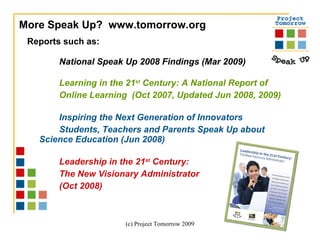
Reports such as:  National Speak Up 2008 Findings (Mar 2009) Learning in the 21 st  Century: A National Report of  Online Learning  (Oct 2007, Updated Jun 2008, 2009) Inspiring the Next Generation of Innovators Students, Teachers and Parents Speak Up about  Science Education (Jun 2008) Leadership in the 21 st  Century:  The New Visionary Administrator  (Oct 2008)  More Speak Up?  www.tomorrow.org
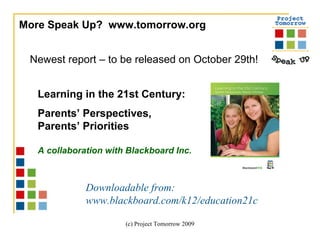
More Speak Up?  www.tomorrow.org  Newest report – to be released on October 29th! Learning in the 21st Century: Parents’ Perspectives,  Parents’ Priorities A collaboration with Blackboard Inc. Downloadable from: www.blackboard.com/k12/education21c
Online surveys available for: K-12 students Parents Teachers Administrators New!  Pre-service teachers   Surveys open for input:  Oct 19 – Dec 18, 2009  Participate in Speak Up 2009!  Free online report for all Speak Up participating districts w/ your local data: Feb 2010 Release of National Speak Up Findings in Congressional Briefings: Mar & May 2010 No fee to participate. No limit on the # of surveys submitted. 100% confidential.
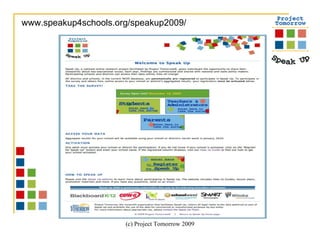
www.speakup4schools.org/speakup2009/
The Future Voice of Education? It is here today . . .
The Future Voice of Education? It is here today . . .  I believe that "the purpose of education is not to make men carpenters, but to make carpenters men." To be competitive in a workplace that is changing and will change continuously throughout our careers,  my peers and I need to be able to read and understand new information at a level never before prevalent.  This should be, however, a familiar aim for the forces of academia, however,  since what we must learn, in essence, is to learn. I would ensure a broad and balanced education that exposes every student to rigorous inquiry in every discipline, from physics to pottery and makes them  active participants in the process of inquiry and learning.  (11 th  grader, Pittsburgh PA)
More data and reports are available on  our website:  www.tomorrow.org Julie Evans Project Tomorrow [email_address] 949-609-4660 x15 Copyright Project Tomorrow 2009.  This work is the intellectual property of the author. Permission is granted for this material to be shared for non-commercial, educational purposes, provided that this copyright statement appears on the reproduced materials and notice is given that the copying is by permission of the author. To disseminate otherwise or to republish requires written permission from the author. Thank you!

Engaging Parents’ Support for Emerging Technologies in the Classroom

  • 1.
    Engaging Parents’ Supportfor Emerging Technologies in the Classroom Key findings from Speak Up 2008 Julie Evans Chief Executive Officer Project Tomorrow National School Boards Association T+L Conference – Denver (in a snowstorm) October 28, 2009
  • 2.
    Our Agenda TodayWhat is Speak Up? Invitation to participate in Speak Up 2009 Review of selected national data findings Trends to Watch Panel discussion How to engage parents’ support
  • 3.
    Introducing our expertpanel: Mary Ann Guidos Technology Integration Supervisor Orange City School District (OH) Janet Herdman Executive Director, IT Services North Kansas City Schools (MO) Kathy Politis Director, Instructional Technology, Fulton County Schools (GA)  Jan Wee Information & Technology Director Holmen School District (WI)
  • 4.
    Annual national researchproject Online surveys + focus groups Open for all K-12 schools Schools/districts get back their own data for planning and budgeting Collect data ↔ Stimulate conversations K-12 Students, Teachers, Parents, Administrators, Pre-Service Teachers National Findings Release annually in Washington DC Inform policies & programs Analysis and reporting – national reports, state reports, district reports Services: custom reports, consulting services, webinars NCES back end database – provide statistically significant samplings 6 years of empowering authentic voices – since 2003: 1.3 million K-12 students 103,000 teachers 54,000 parents 6,300 school leaders 18,000 schools – from all 50 states, DC, American military base schools, Canada, Mexico, Australia What is Speak Up? 1.5 million respondents
  • 5.
    Speak Up isfacilitated annually by Project Tomorrow (formerly known as NetDay) Project Tomorrow (www.tomorrow.org) is the leading education nonprofit organization dedicated to the empowerment of student voices in education.
  • 6.
    Learning & Teachingwith Technology Web 2.0 in Education 21 st Century Skills: Information/Media Literacy Skills Science & Math Instruction & Global Competitiveness Emerging Technologies in the Classroom Mobile Devices Online Learning Digital Content Games Designing the 21st Century School Speak Up survey question themes
  • 7.
    Online surveys availablefor: K-12 students Parents Teachers Administrators New! Pre-service teachers Speak Up is open! Take surveys: Oct 19 – Dec 18, 2009 Inviting all K-12 Schools, Districts and Schools of Education to participate in Speak Up 2009 Free online report for all Speak Up participating districts w/ your local data: Feb 2010 Release of National Speak Up Findings in Congressional Briefings: Mar & May 2010 No fee to participate. No limit on the # of surveys submitted. 100% confidential.
  • 8.
    Collect uniquedata from stakeholders Give stakeholders a voice in national/state policy Support specific initiatives such as digital content, online learning, mobile devices, 1:1 programs or new teacher professional development programs Model for students the value of civic engagement and being part of a national discussion Recognition as an innovation leader Demonstrate to students, teachers and parents that their ideas are valued by their education leaders Understand the future of K-12 education Learn more at www.tomorrow.org Why do schools, districts, & states participate in Speak Up?
  • 9.
    We would liketo recognize our Speak Up 2009 Sponsors:
  • 10.
    Speak Up 2008Key National Data Findings
  • 11.
    K-12 Students 281,500Teachers 29,644 Parents (in English & Spanish) 21,309 School/District Administrators 3,114 Schools 4,379 Districts 868 States All 50 Top 10: TX, CA, AZ, AL, IL, MD, FL, NC, NE, WI About Speak Up Schools: 95% public, 3% private, 2% virtual 35% urban, 32% suburban, 33% rural 45% Title 1 eligible 34% majority-minority student population National Speak Up 2008 Participation
  • 12.
    Speak Up 2008Data Findings Who am I? Warm Up Exercise
  • 13.
    Who am I? Profile characteristics: Wishes for their ultimate school Online classes (27%) High tech science tools (39%) Online tools for organization (35%) Access to mobile devices: MP3 player (44%) Game player (53%) Laptop (44%) Participates in immersive virtual reality environments (39%) Uses Internet for education research (51%) and online assessments (35%)
  • 14.
    Audience Response: Whoam I? Kindergarten Boy 3rd Grade Girl 7th Grade Boy 10th Grade Girl Teacher
  • 15.
    Who am I? 3 rd Grade Girl with Average Tech Skills
  • 16.
    Meet today’s 3rdgrade girls: Wishes for their ultimate school Online classes (27%) High tech science tools (39%) Online tools for organization (35%) Access to mobile devices: MP3 player (44%) Game player (53%) Laptop (44%) Participates in immersive virtual reality environments (39%) Uses Internet for education research (51%) and online assessments (35%)
  • 17.
    Introducing the “DigitalAdvance Team” America’s K-12 Students Adopting/adapting technologies for learning Tech trend setters Their use predicts widespread acceptance Out of school use drives in school use Pace car for others Teachers ultimately catch up
  • 18.
    Introducing the “DigitalAdvance Team” Let’s listen in and learn! What we are hearing: Districts are using Speak Up data as input for decisions on how to effectively leverage historic new education funding
  • 19.
    “ Digital disconnect” is alive & well: the gap between how today’s students learn and how they live! Key findings from Speak Up data:
  • 20.
    “ Digital disconnect”is alive & well: Between students and teachers Between advanced tech students and other students Between girls and boys Between older and younger students Key findings from Speak Up data:
  • 21.
    How are students using technology for schoolwork?
  • 22.
    How important isthe effective implementation of instructional technology to student success?
  • 23.
    How satisfied are parents with technology use at their child’s school?
  • 24.
    “ Lukewarm” satisfactionwith: Internet safety (45%) Amount of technology available (35%) Tech skills my child is learning (34%) How technology is used for academics (33%) Teachers’ skills in using technology (31%) Parent satisfaction with technology at school
  • 25.
    How satisfied aretoday’s students with technology use at their school?
  • 26.
    How satisfied aretoday’s students with technology use at their school? Students say: Not very!
  • 27.
    Top responses: Schoolfilters and firewalls block websites I need Teachers limit our technology use Too many rules! Cannot use my own devices Cannot access my communications tools Rules that limit use of my school’s technology Besides time, what are the major obstacles students face using technology at school?
  • 28.
    Top responses: Let me use my own laptop, cell phone or mobile device Give me unlimited Internet access Let me access my school projects from any computer – home or at school How schools could make it easier for students to work electronically?
  • 29.
    The mobile learnerIt’s a Web 2.0 World “ I’ll take that class to go!” The ultimate online textbook Exploring STEM careers Digital Advance Team Trends
  • 30.
    The mobile learnerCell phones Laptops MP3 players Smartphones & PDAs Speak Up 2008 Findings
  • 31.
  • 32.
    Communications Email teachers,classmates Access personal websites Collaborations Projects and calendars Creativity Create/share documents, videos Productivity Research, downloads, ed games Get alerts and reminders How students want to use mobile devices to support learning
  • 33.
    It’s a Web2.0 World Speak Up 2008 Findings
  • 34.
    How are studentsusing Web 2.0 tools? Communications Creation Collaboration Contribution Speak Up 2008 Findings
  • 35.
  • 36.
  • 37.
  • 38.
    How are students using Web 2.0 tools for schoolwork? Significant changes from 2007: Email/IM/Text Using social networking site to collaborate with classmates 150% 27%
  • 39.
    “ I’ll takethat class to go!” Online learning Speak Up 2008 Findings
  • 40.
    Online learning andK-12 students Current online learning experience: 16% of high school students 14% of middle school students
  • 41.
    Online learning andK-12 students Is there interest in taking online classes? Yes! Interest in taking an online class: + 40% of high school students + 35% of middle school students + 15% of students grades 3-5
  • 42.
    Online learning andK-12 students Is there interest in taking online classes? Yes! Interest in taking an online class: + 40% of high school students + 35% of middle school students 21% 46%
  • 43.
    Why are students interested in online classes?
  • 44.
    Puts me incontrol of my learning (47%) Easier to review class materials (38%) Easier for me to succeed (32%) More comfortable asking questions (29%) More motivated to learn (27%) How would online classes make school more interesting for students ?
  • 45.
    Policy: Onlineclass requirement for high school graduation?
  • 46.
    The ultimate onlinetextbook What if . . . . students designed that new textbook? Speak Up 2008 Findings
  • 47.
    Desired features: Electronic notes and highlighting (63%) Self assessments (62%) Links to real time data (52%) Games (57%) and simulations (55%) Powerpoint presentations of lectures (55%) Access to online tutors (53%) Create own podcasts and videocasts (48%) Students design an online textbook
  • 48.
    - Ability todownload information to my cell phone Gr 3-5: 25% Gr 6-8: 53% Gr 9-12: 53% Students design the online textbook Desired features continued:
  • 49.
    Exploring STEM careersSpeak Up 2008 Findings
  • 50.
    Students: ExploringSTEM Careers
  • 51.
    Top responses: Meetwith successful career professionals Work part time jobs in the fields Use tools professionals use Day in the Life podcasts and videos Students: Exploring STEM careers What would increase your interest?
  • 52.
    Is yourschool doing a good job preparing students for jobs of the future?
  • 53.
    Is yourschool doing a good job preparing students for jobs of the future? Response: Yes Principals 56% Teachers 42%
  • 54.
    Is your schooldoing a good job preparing students for jobs of the future? Response: Yes Principals 56% Teachers 42% Parents 32% Students 39%
  • 55.
    What if youcould design the ultimate school . . . . what technologies would have the greatest impact on your learning? Favorite question for districts seeking stakeholder input into technology investment decisions
  • 56.
    Games and virtualsimulations Interactive whiteboards Personal laptops for each student Student access to email and IM at school Using mobile devices for learning Online classes Digital content Audience Response: What do K-12 students say is the #1 tech tool or service that will impact their learning?
  • 57.
    Students in Kindergartenthru 12 th grade say the same thing every year: What do students say is the #1 tech tool or service that will impact their learning?
  • 58.
    Students in Kindergartenthru 12 th grade have said the same thing for the last 6 years: What do students say is the #1 tech tool or service that will impact their learning? “ Give me a laptop for my personal use at school and at home”
  • 59.
    What if youcould design the ultimate school?
  • 60.
    Parents’ shoppinglist: What parents say are good school investments in technology Top responses: Tools to help child organize their work 48% Online textbooks 41% Interactive whiteboards 40% Computer projection devices 36% Digital resources 32% Digital media tools 30% Laptop for every student 27%
  • 61.
    Recommendations from the“ Digital Advance Team” Are we listening? Un-tether learning New learning spaces Social based learning Digital resources add relevancy Go beyond classroom walls
  • 62.
    Recommendations from the“ Digital Advance Team” Are we listening? Learning that is Enabled Engaging Empowered
  • 63.
    Recommendations from the“ Digital Advance Team” Are we listening? Learning that is Enabled Engaging Empowered How do we get there?
  • 64.
    Introducing our expertpanel: Mary Ann Guidos Technology Integration Supervisor Orange City School District (OH) Janet Herdman Executive Director, IT Services North Kansas City Schools (MO) Kathy Politis Director, Instructional Technology, Fulton County Schools (GA)  Jan Wee Information & Technology Director Holmen School District (WI)
  • 65.
    Recommendations from the“ Digital Advance Team” Are we listening? Learning that is Enabled Engaging Empowered How do we get there?
  • 66.
    Reports such as: National Speak Up 2008 Findings (Mar 2009) Learning in the 21 st Century: A National Report of Online Learning (Oct 2007, Updated Jun 2008, 2009) Inspiring the Next Generation of Innovators Students, Teachers and Parents Speak Up about Science Education (Jun 2008) Leadership in the 21 st Century: The New Visionary Administrator (Oct 2008) More Speak Up? www.tomorrow.org
  • 67.
    More Speak Up? www.tomorrow.org Newest report – to be released on October 29th! Learning in the 21st Century: Parents’ Perspectives, Parents’ Priorities A collaboration with Blackboard Inc. Downloadable from: www.blackboard.com/k12/education21c
  • 68.
    Online surveys availablefor: K-12 students Parents Teachers Administrators New! Pre-service teachers Surveys open for input: Oct 19 – Dec 18, 2009 Participate in Speak Up 2009! Free online report for all Speak Up participating districts w/ your local data: Feb 2010 Release of National Speak Up Findings in Congressional Briefings: Mar & May 2010 No fee to participate. No limit on the # of surveys submitted. 100% confidential.
  • 69.
  • 70.
    The Future Voiceof Education? It is here today . . .
  • 71.
    The Future Voiceof Education? It is here today . . . I believe that "the purpose of education is not to make men carpenters, but to make carpenters men." To be competitive in a workplace that is changing and will change continuously throughout our careers, my peers and I need to be able to read and understand new information at a level never before prevalent. This should be, however, a familiar aim for the forces of academia, however, since what we must learn, in essence, is to learn. I would ensure a broad and balanced education that exposes every student to rigorous inquiry in every discipline, from physics to pottery and makes them active participants in the process of inquiry and learning. (11 th grader, Pittsburgh PA)
  • 72.
    More data andreports are available on our website: www.tomorrow.org Julie Evans Project Tomorrow [email_address] 949-609-4660 x15 Copyright Project Tomorrow 2009. This work is the intellectual property of the author. Permission is granted for this material to be shared for non-commercial, educational purposes, provided that this copyright statement appears on the reproduced materials and notice is given that the copying is by permission of the author. To disseminate otherwise or to republish requires written permission from the author. Thank you!