University Of Aden
 Faculty of dentistry
        2012


Oral Medicine
 Dr .Muhgat Abdo

Oral & Dentofacial Surgeon
 www.adendent-faculty.net
 muhgatabdo@hotmail.de
Temporomandibular Joint
                 (TMJ)
                Disorders
   What is the main function of
    Cartilage?
   What is the difference between
    TMJ articular cartilage and
    cartilage of other synovial
    joints?
   What are the goals of non-
    surgical management of TMJ
    disorders?
   What are the indications to
    proceed with TMJ surgery?
Temporomandibular Joint
               Disorders

Anatomy of TMJ:
    Glennoid Fossa
    Mandibular Condyle
    Articular Disc
    Ligamentous Structurres:
1.   Functional Ligament
2.   Accessory ligament
Temporomandibular Joint
               Disorders

Functional Movement of TMJ:
1.   Elevation (Jaw Closing)
2.   Depression (Jaw Opening)
3.   Protrusion
4.   Retrution
5.   Laterotrusion
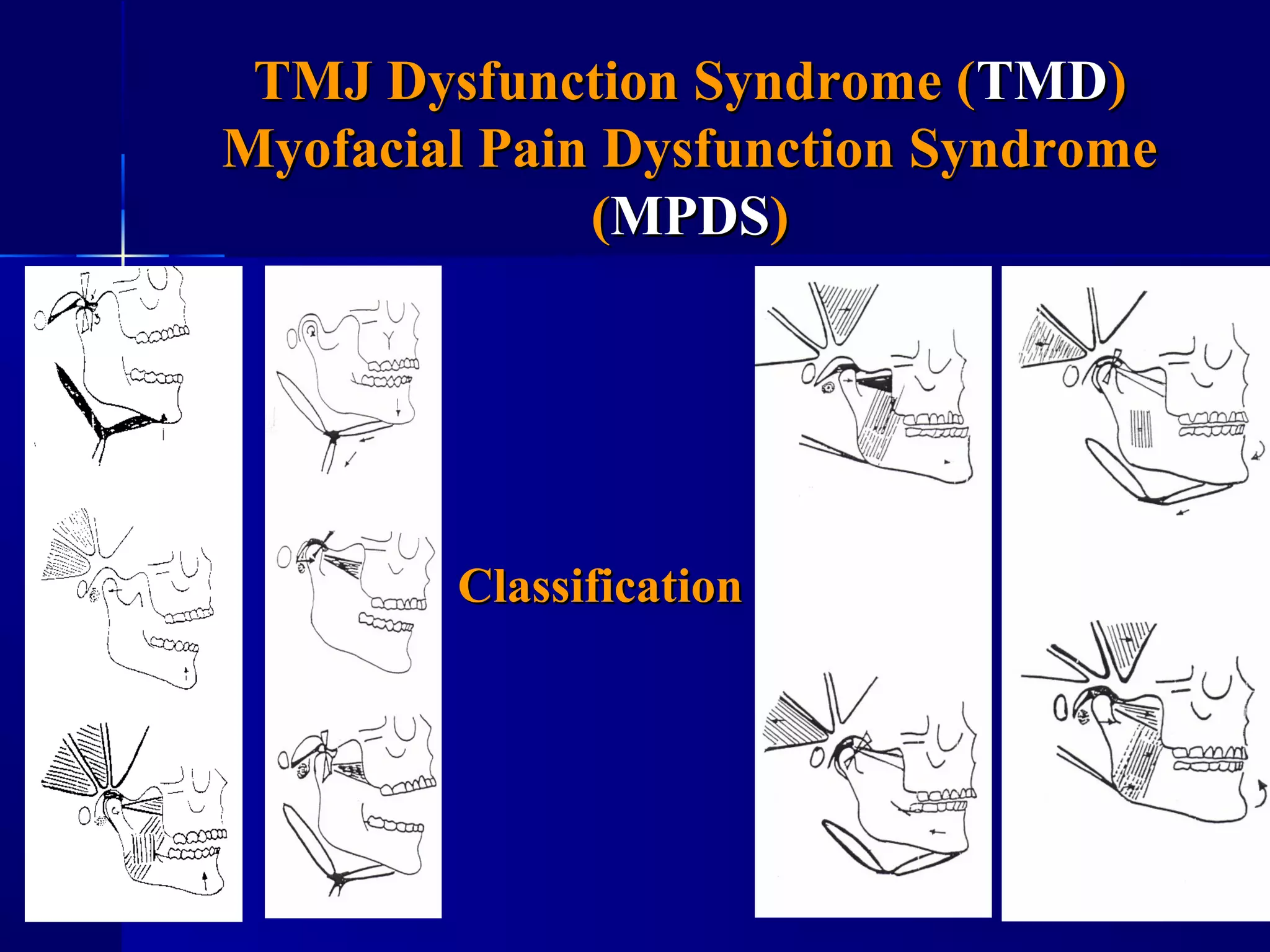
TMJ Dysfunction Syndrome (TMD)
Myofacial Pain Dysfunction Syndrome
              (MPDS)


        Classification
Temporomandibular Joint
               Disorders

Classification of TMJ Disorders:
1.   Developmental Disorders of TMJ
2.   Degenerative Joint Disease
3.   Inflammatory Disorders of the Joint
4.   Traumatic Disorders of TMJ
5.   Metabolic Disorders
6.   Neoplastic Disorders
7.   TMJ Disorders Syndrome or Myofacial
     Pain Dysfunction Syndrome
TMJ Dysfunction Syndrome (TMD)
     Myofacial Pain Dysfunction Syndrome
                   (MPDS)
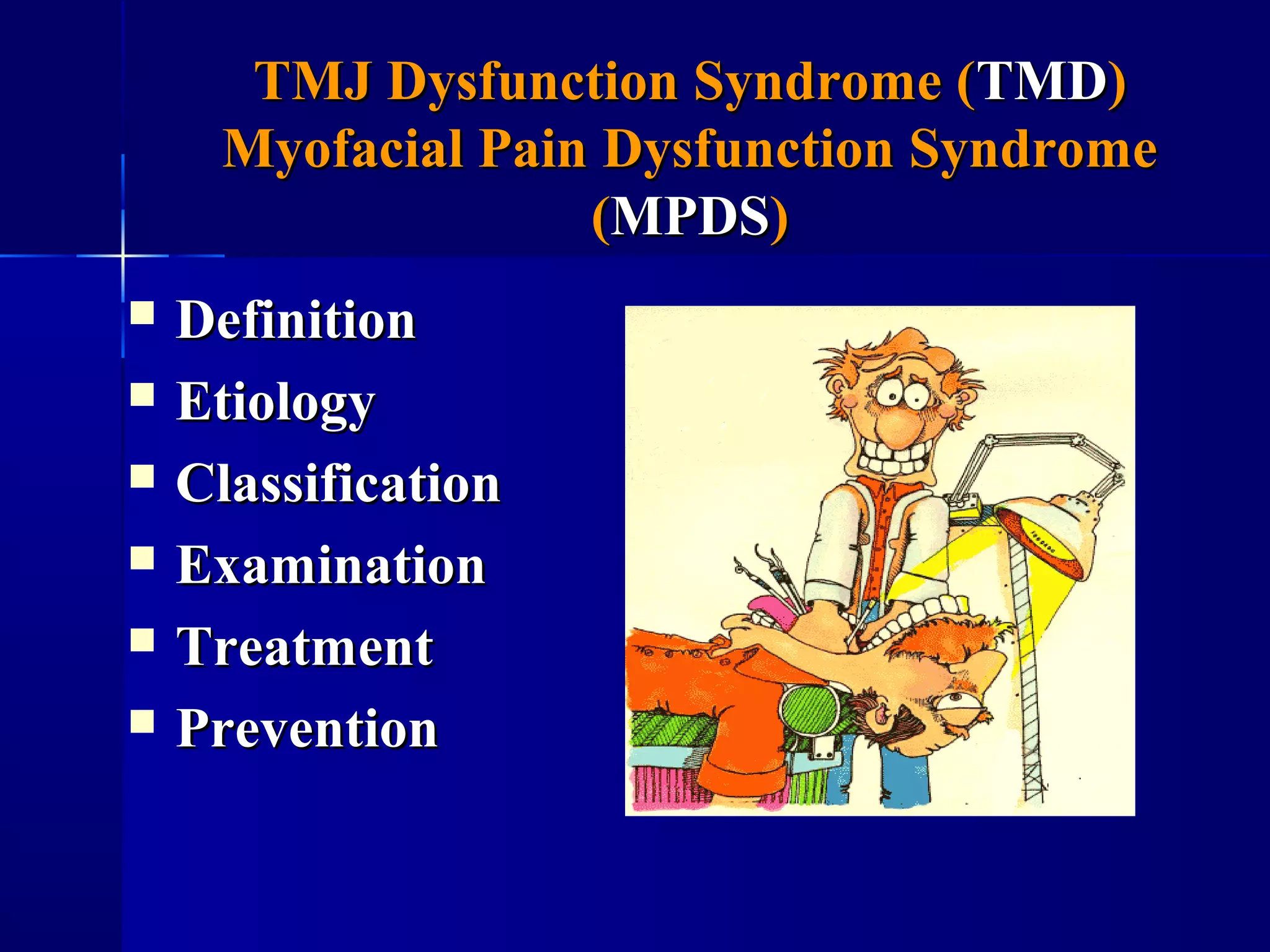
   Definition
   Etiology
   Classification
   Examination
   Treatment
   Prevention
TMJ Dysfunction Syndrome (TMD)
      Myofacial Pain Dysfunction Syndrome
                    (MPDS)
Definition:
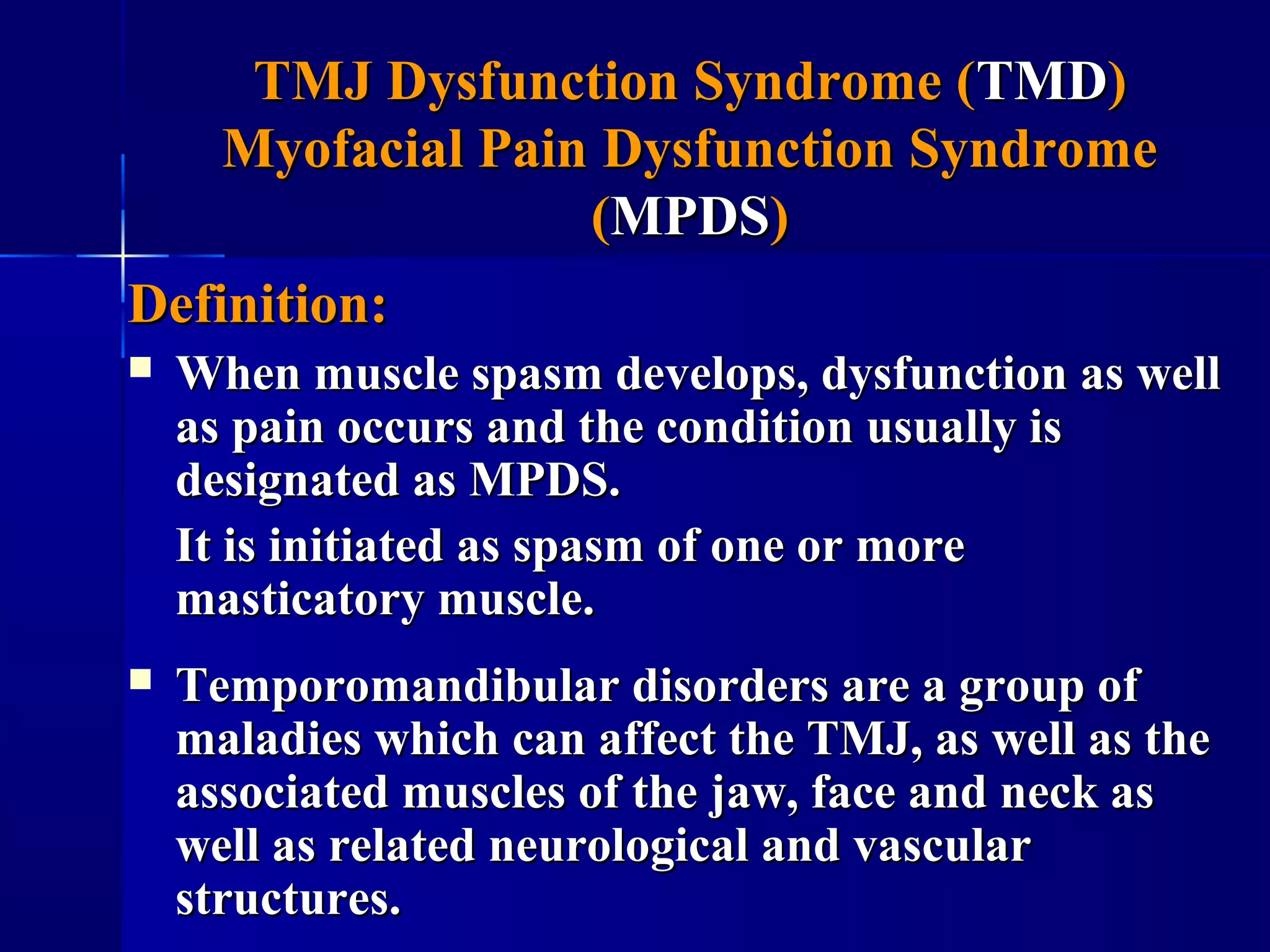
   When muscle spasm develops, dysfunction as well
    as pain occurs and the condition usually is
    designated as MPDS.
    It is initiated as spasm of one or more
    masticatory muscle.
   Temporomandibular disorders are a group of
    maladies which can affect the TMJ, as well as the
    associated muscles of the jaw, face and neck as
    well as related neurological and vascular
    structures.
TMJ Dysfunction Syndrome (TMD)
   Myofacial Pain Dysfunction Syndrome
                 (MPDS)
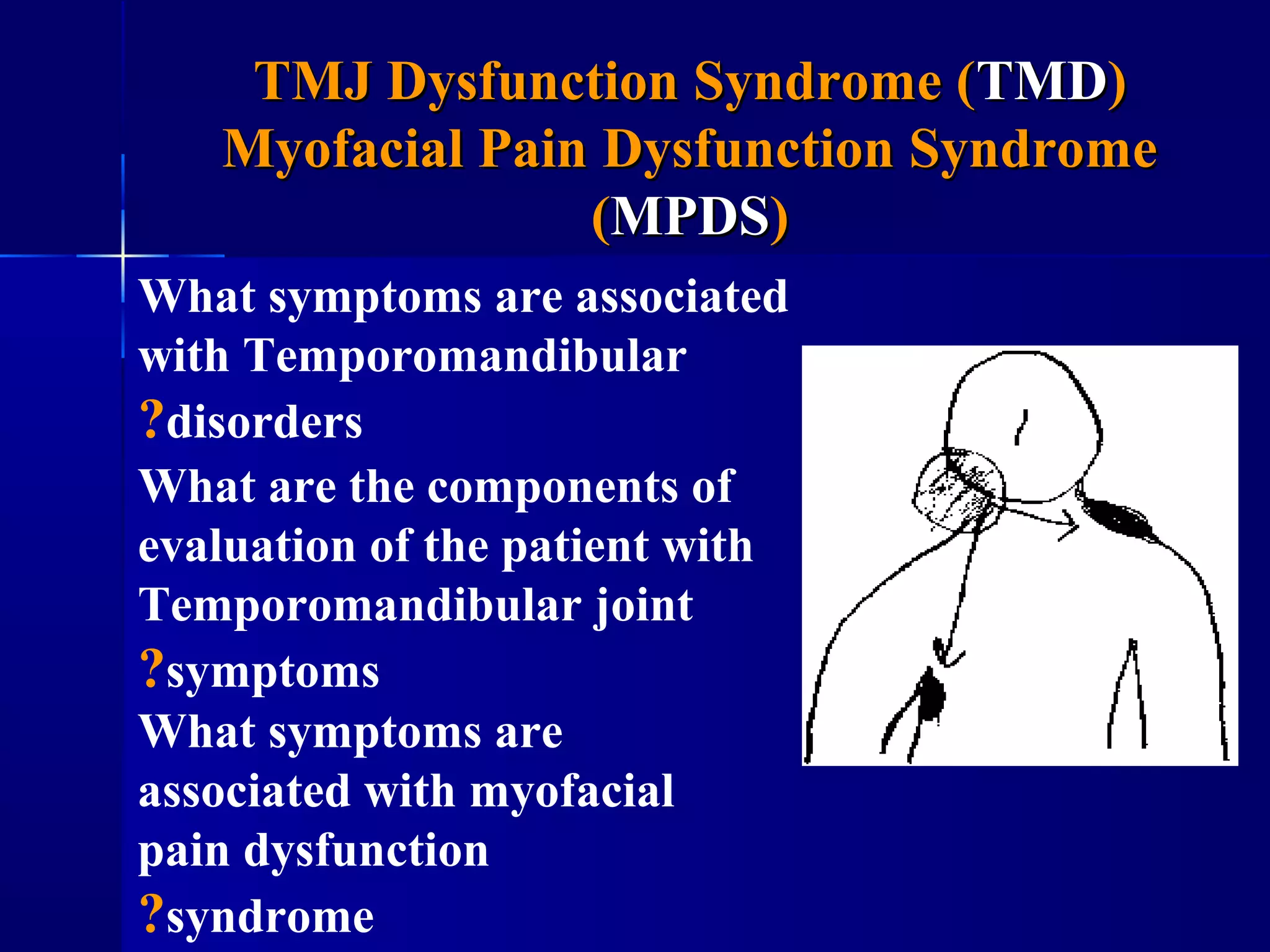
What symptoms are associated
with Temporomandibular
?disorders
What are the components of
evaluation of the patient with
Temporomandibular joint
?symptoms
What symptoms are
associated with myofacial
pain dysfunction
?syndrome
TMJ Dysfunction Syndrome (TMD)
   Myofacial Pain Dysfunction Syndrome
                 (MPDS)
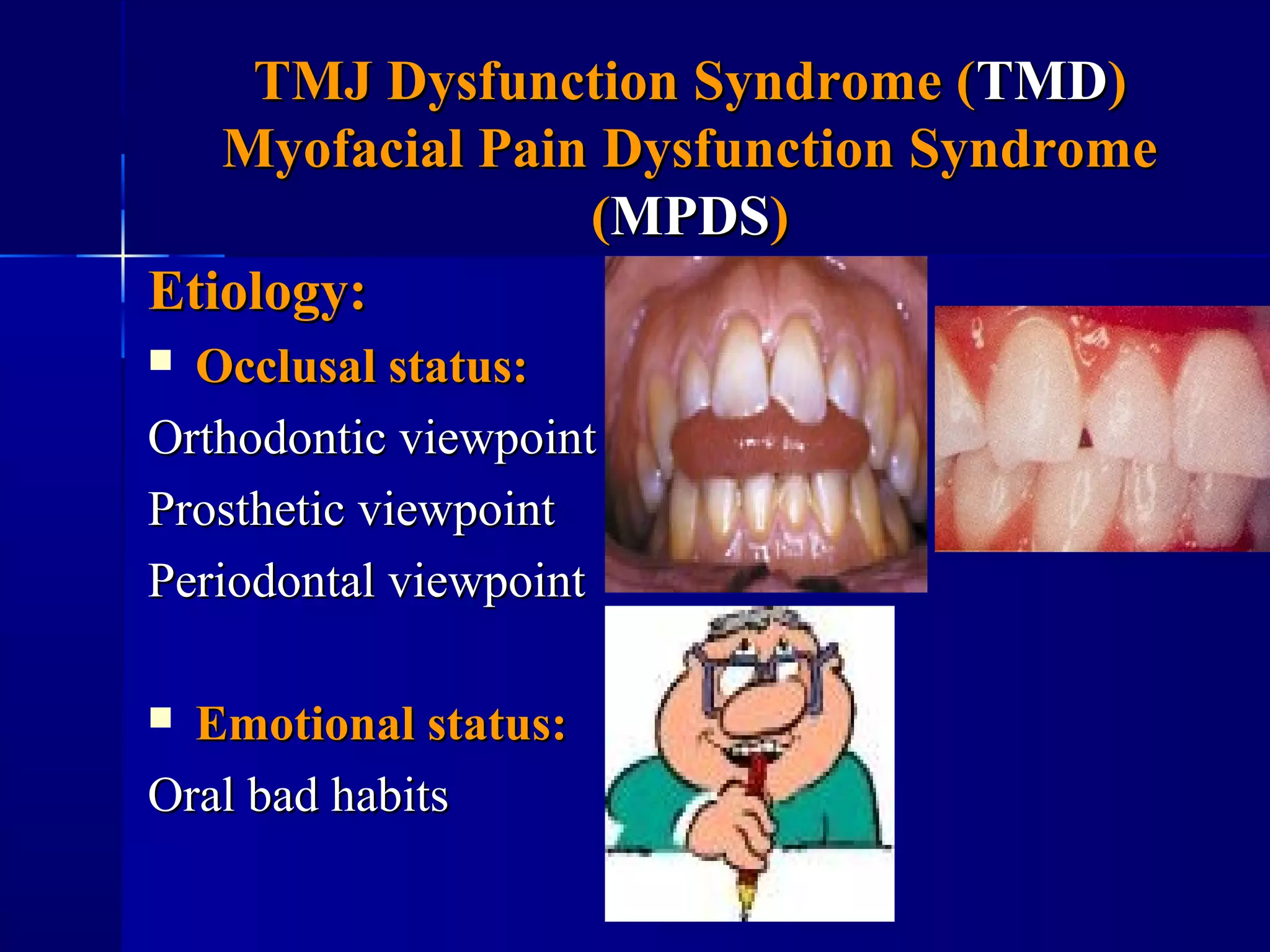
Etiology:
 Occlusal status:
Orthodontic viewpoint
Prosthetic viewpoint
Periodontal viewpoint

 Emotional status:
Oral bad habits
TMJ Dysfunction Syndrome (TMD)
   Myofacial Pain Dysfunction Syndrome
                 (MPDS)
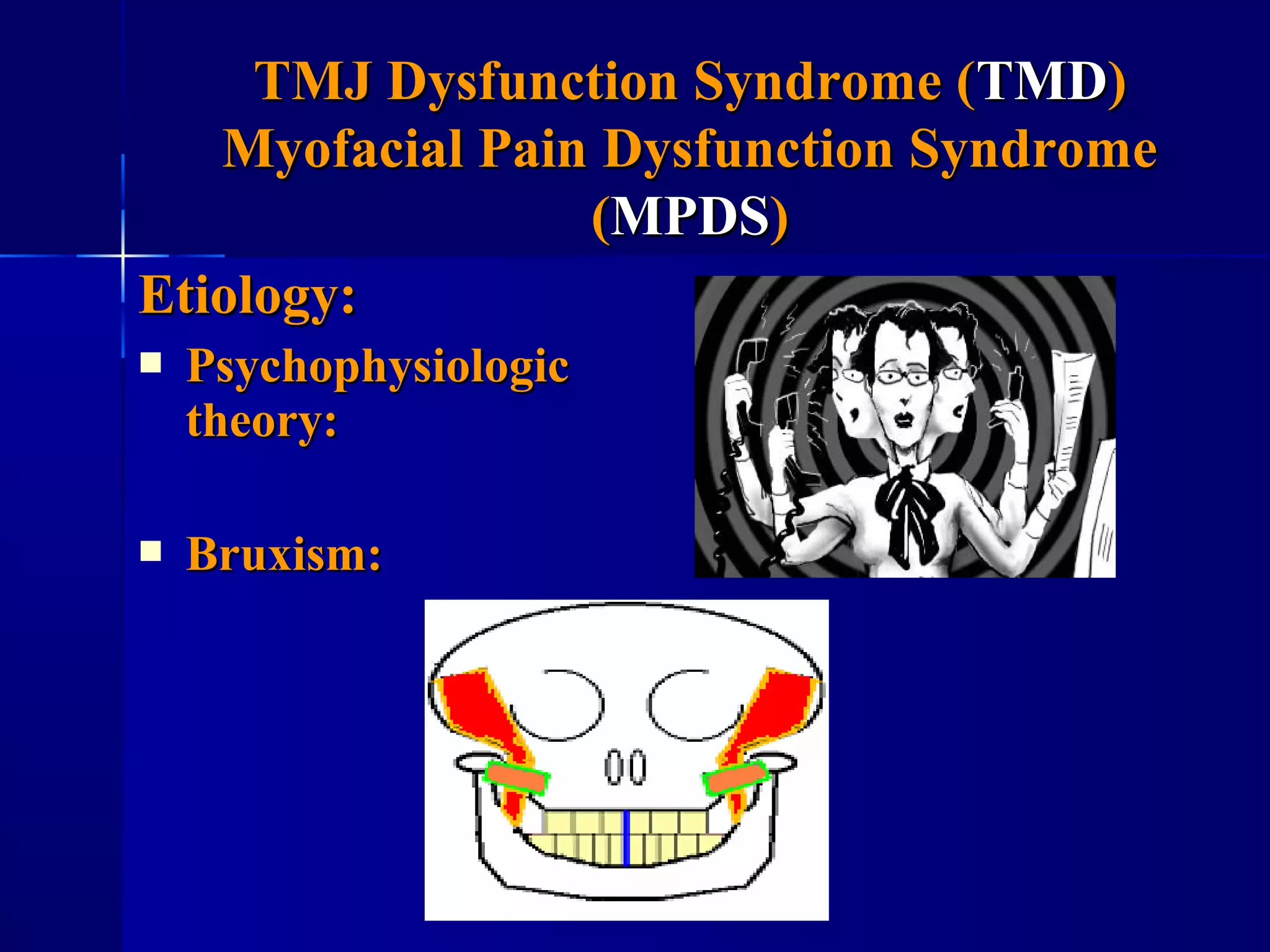
Etiology:
   Psychophysiologic
    theory:

   Bruxism:
TMJ Dysfunction Syndrome (TMD)
   Myofacial Pain Dysfunction Syndrome
                 (MPDS)
Classification:
1. Disc displacement
2. Structural incompatibility (Deviation,
   Adhesion, Hypermobility)
3. Inflammatory disorders (Synovitis/capsulitis,
   Arthritides)
4. Ankylosis
5. Neoplasia
TMJ Dysfunction Syndrome (TMD)
Myofacial Pain Dysfunction Syndrome
              (MPDS)


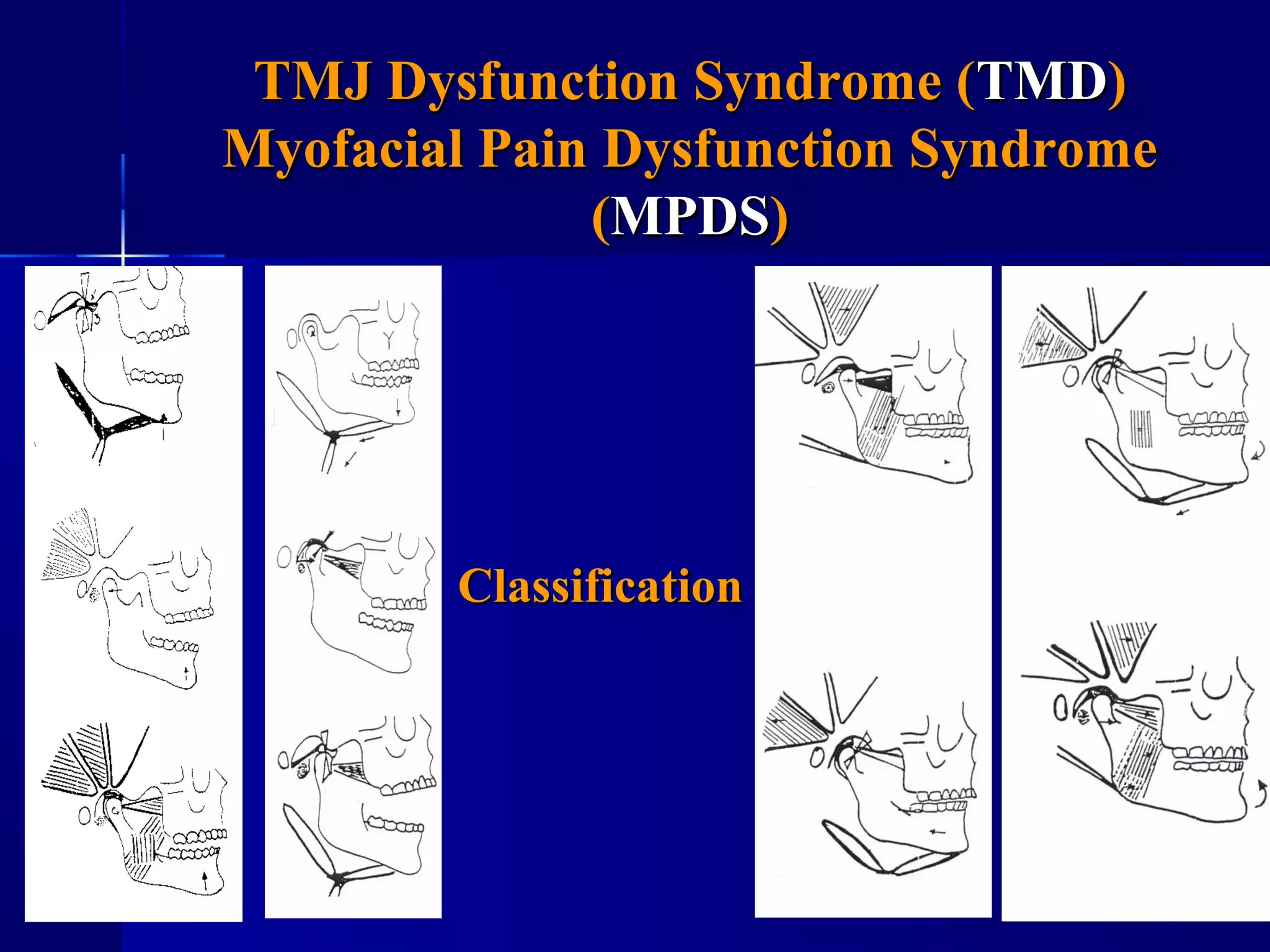
        Classification
TMJ Dysfunction Syndrome (TMD)
    Myofacial Pain Dysfunction Syndrome
                  (MPDS)
Signs & Symptoms:
   Pain of the joint on palpation.
   Pain on movement of the joint.
   Altered TMJ function, including trismus,
    reduced opening, and mandibular deviation
    on opening.
   Joint popping, clicking or crepitus.
   Facial pain.
   Pain on palpation of the muscles of
    mastication.
   Pain on opening.
TMJ Dysfunction Syndrome (TMD)
   Myofacial Pain Dysfunction Syndrome
                 (MPDS)
Examination:
   History
   Physical Examination
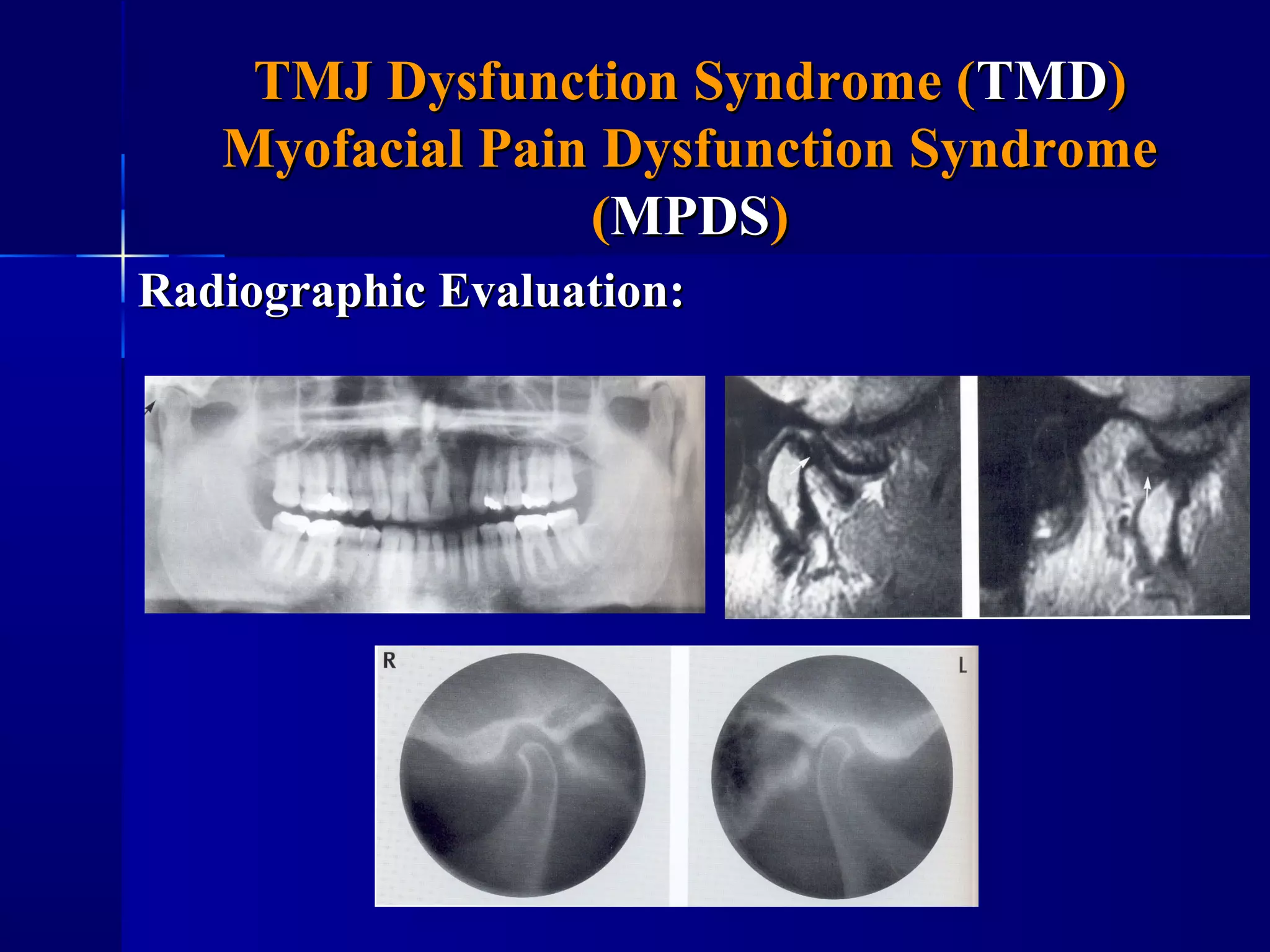
   Radiologic Examination:
Radiography (Normal Radiography)
C T (Tomography)
Arthrography
Electrography (MRI)
Arthroscopy
TMJ Dysfunction Syndrome (TMD)
   Myofacial Pain Dysfunction Syndrome
                 (MPDS)
Physical Examination: Palpation of Masticatory
Muscles:
TMJ Dysfunction Syndrome (TMD)
    Myofacial Pain Dysfunction Syndrome
                  (MPDS)
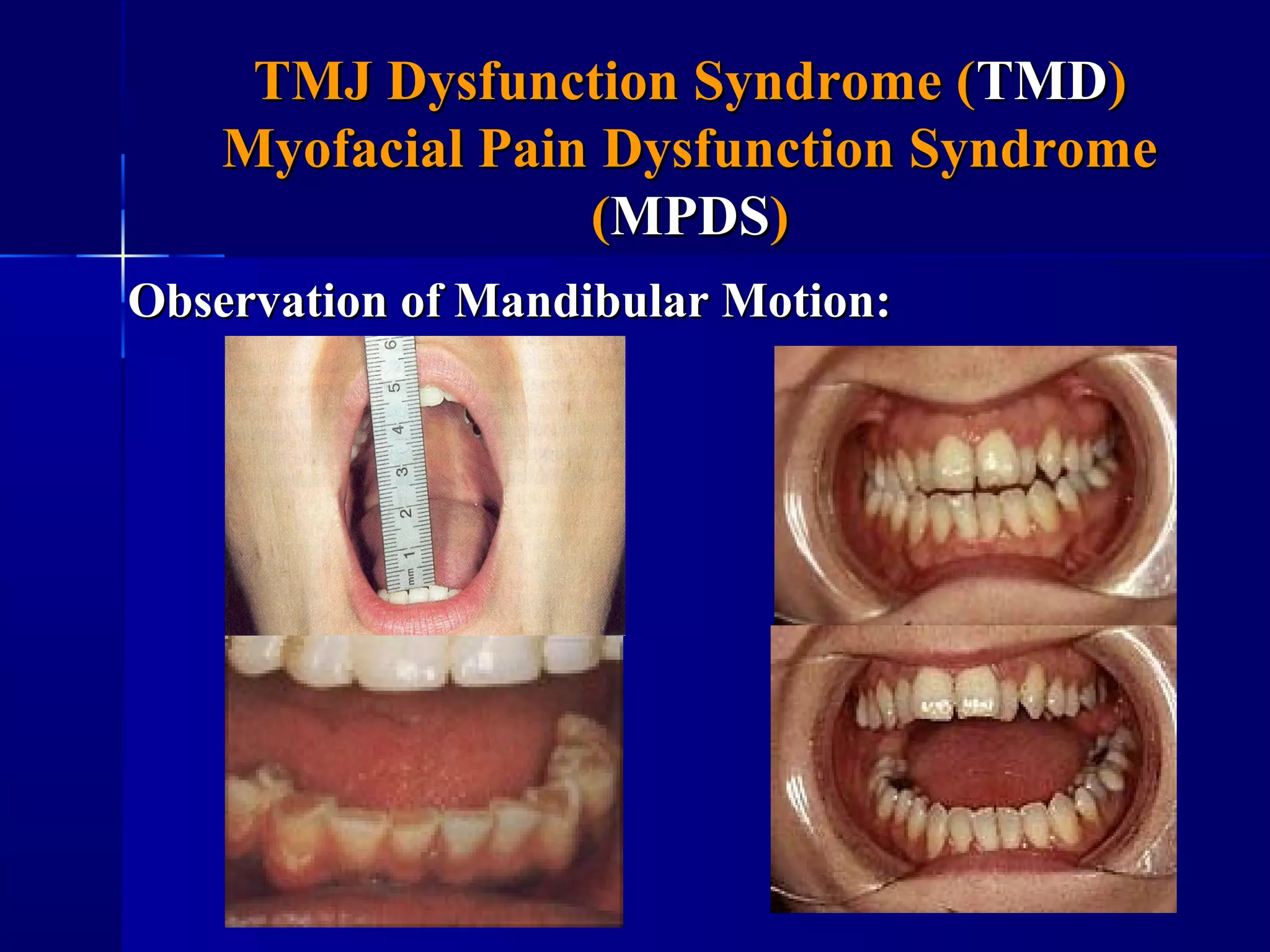
Observation of Mandibular Motion:
TMJ Dysfunction Syndrome (TMD)
    Myofacial Pain Dysfunction Syndrome
                  (MPDS)
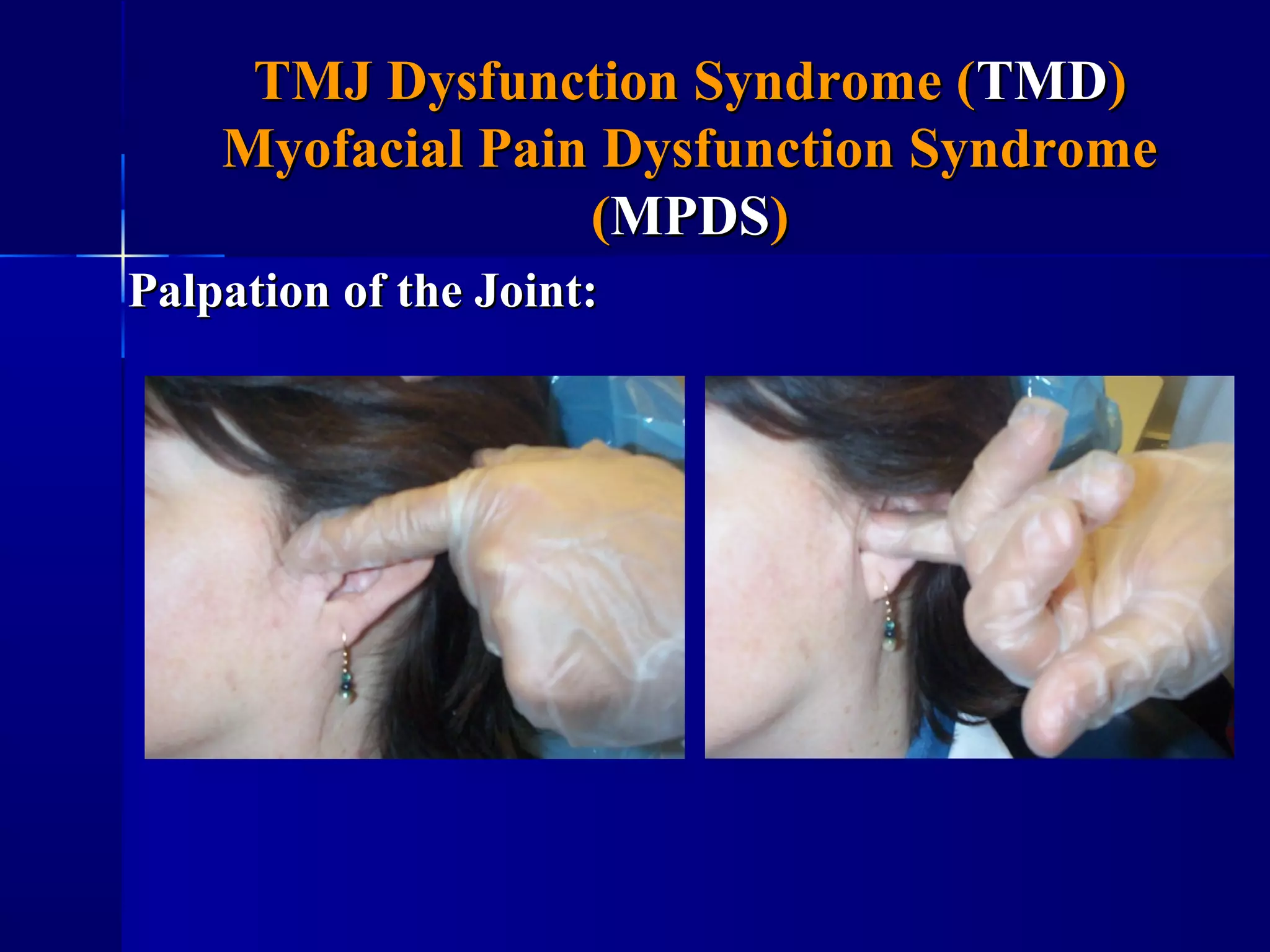
Palpation of the Joint:
TMJ Dysfunction Syndrome (TMD)
   Myofacial Pain Dysfunction Syndrome
                 (MPDS)
Radiographic Evaluation:
TMJ Dysfunction Syndrome (TMD)
    Myofacial Pain Dysfunction Syndrome
                  (MPDS)
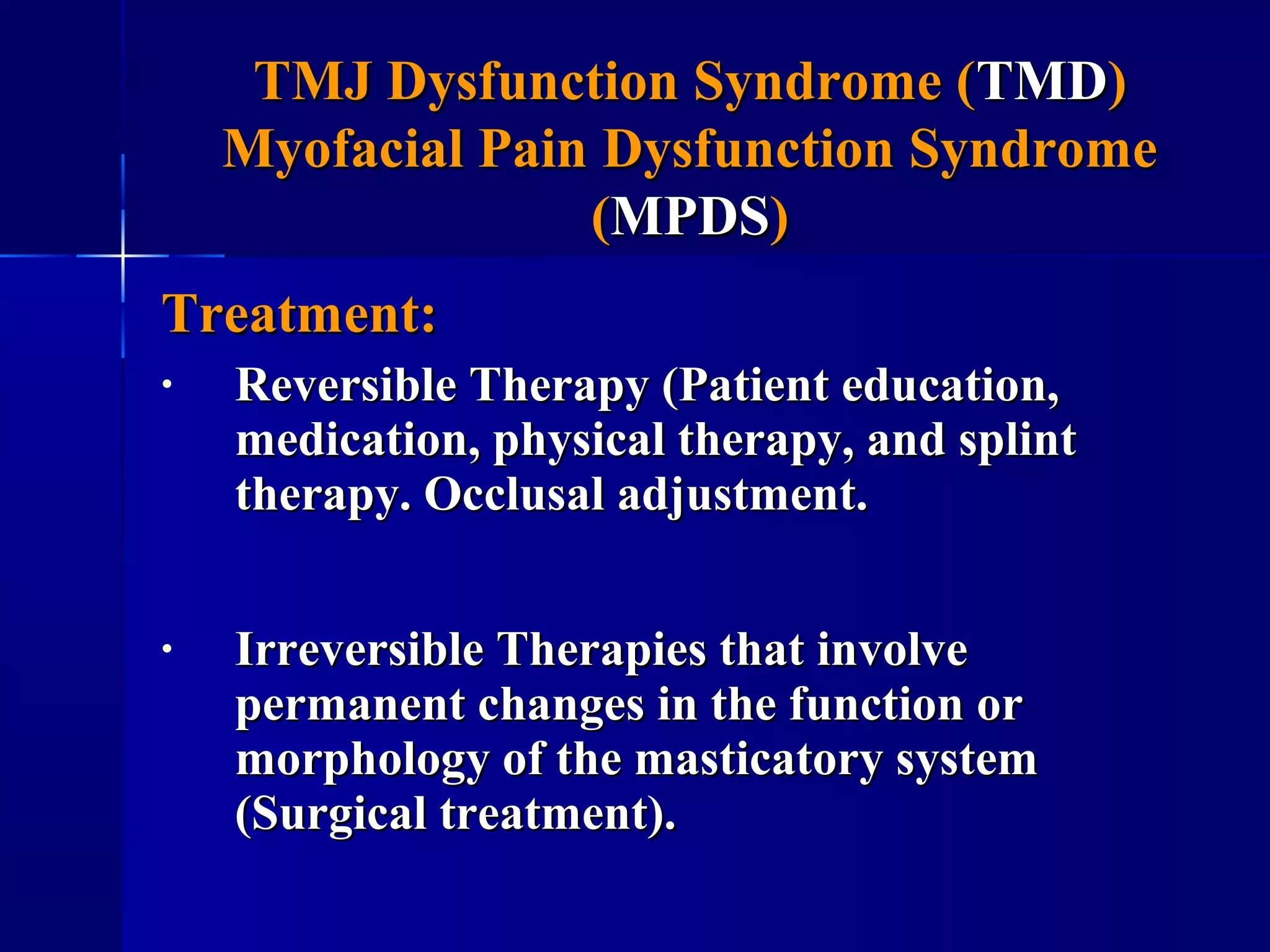
Treatment:
•   Reversible Therapy (Patient education,
    medication, physical therapy, and splint
    therapy. Occlusal adjustment.


•   Irreversible Therapies that involve
    permanent changes in the function or
    morphology of the masticatory system
    (Surgical treatment).
TMJ Dysfunction Syndrome (TMD)
     Myofacial Pain Dysfunction Syndrome
                   (MPDS)
Treatment:
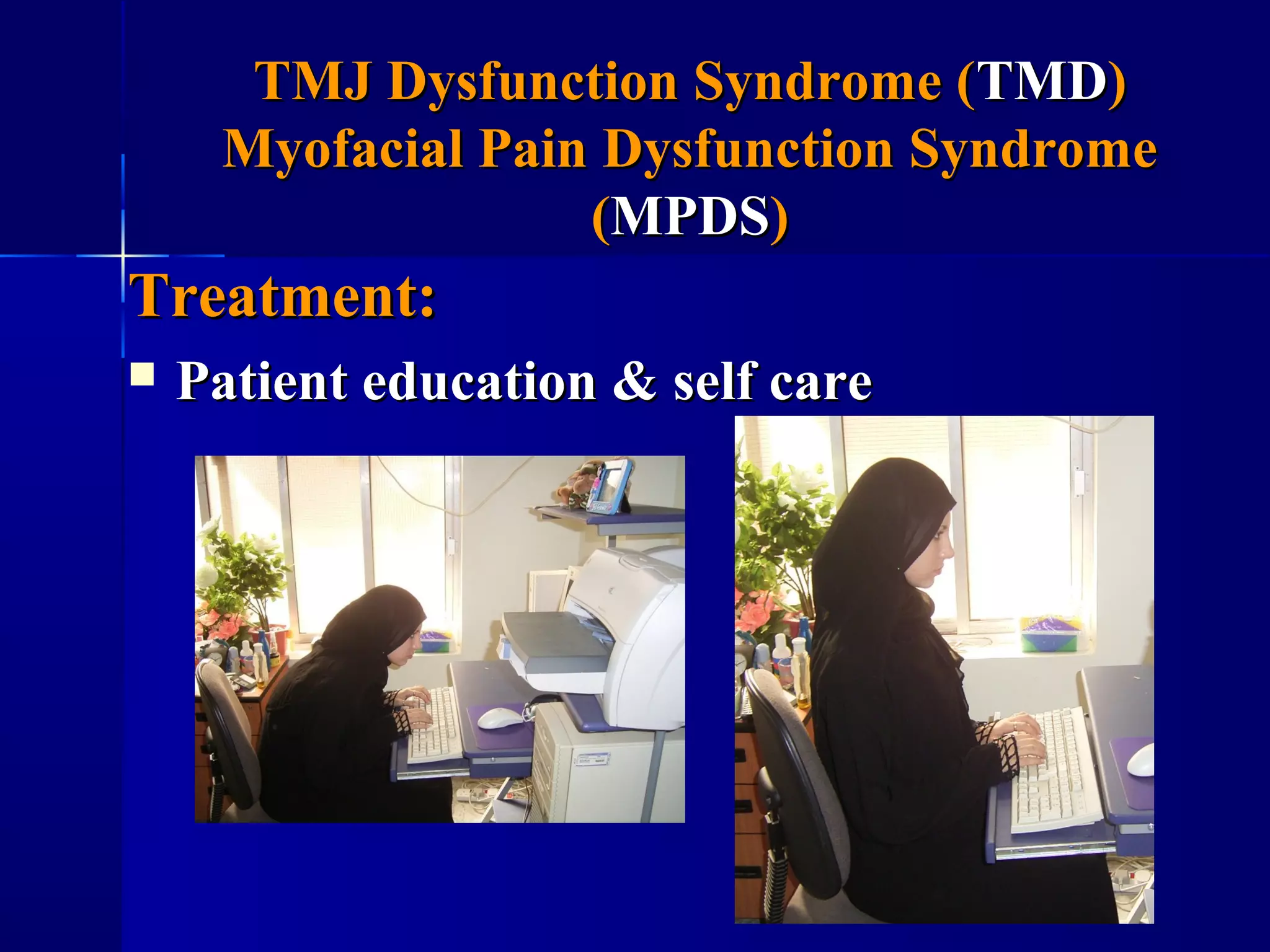
   Patient education & self care
TMJ Dysfunction Syndrome (TMD)
   Myofacial Pain Dysfunction Syndrome
                 (MPDS)
Treatment:
 Medication
TMJ Dysfunction Syndrome (TMD)
   Myofacial Pain Dysfunction Syndrome
                 (MPDS)
Treatment:
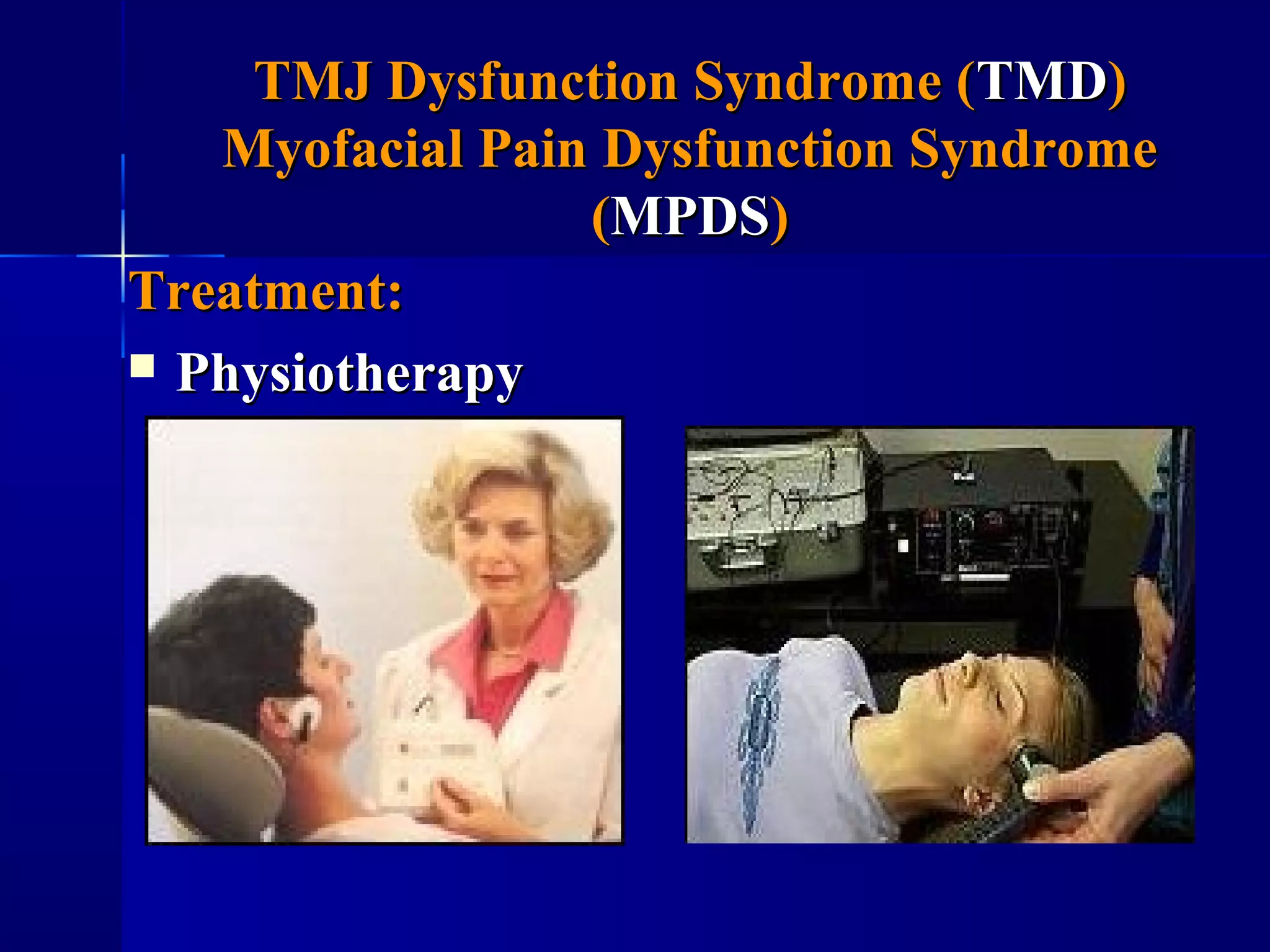
 Physiotherapy
TMJ Dysfunction Syndrome (TMD)
   Myofacial Pain Dysfunction Syndrome
                 (MPDS)
Treatment:
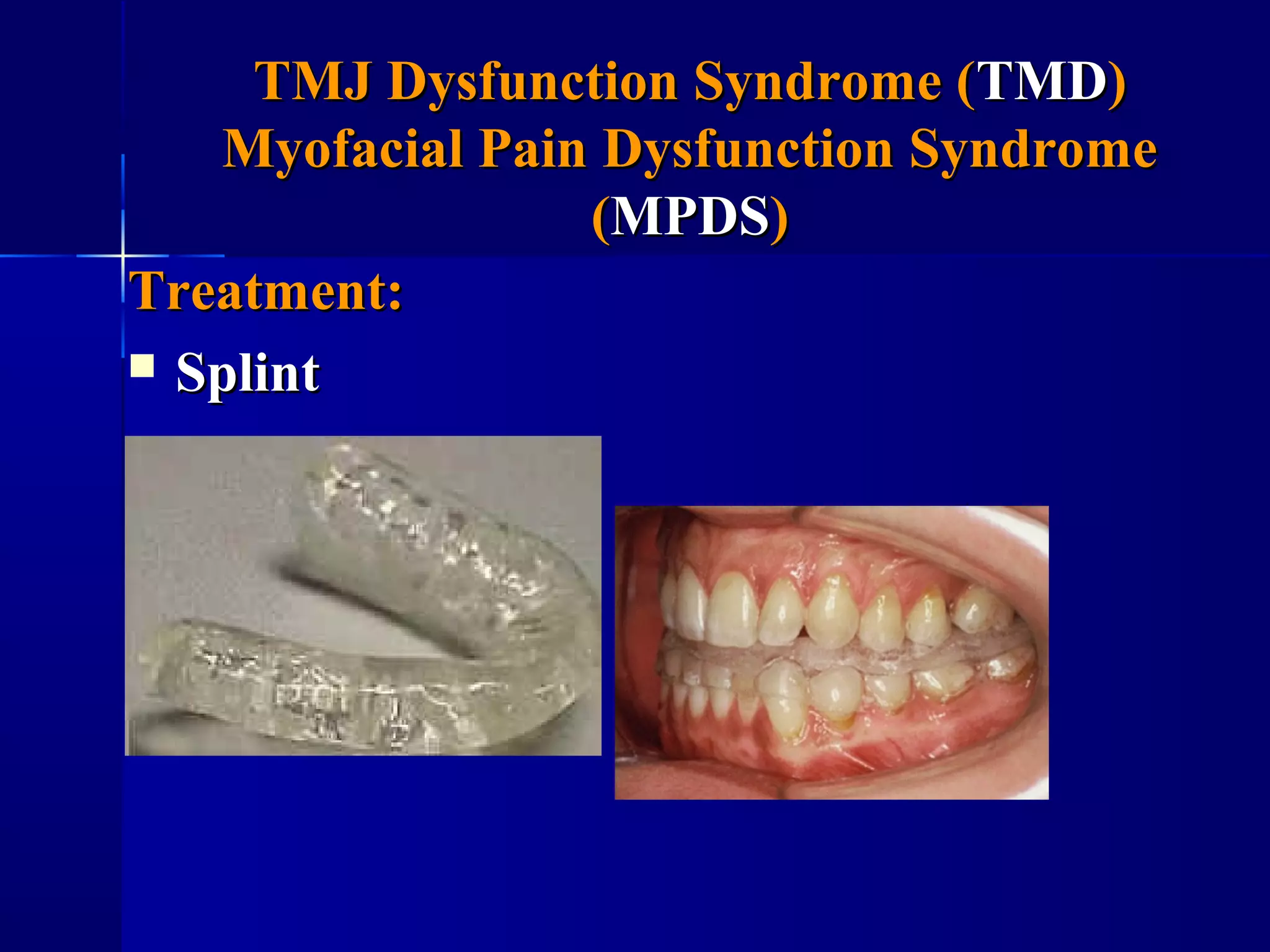
 Splint
TMJ Dysfunction Syndrome (TMD)
    Myofacial Pain Dysfunction Syndrome
                    (MPDS)
Treatment:
 Elimination the Stress
TMJ Dysfunction Syndrome (TMD)
   Myofacial Pain Dysfunction Syndrome
                 (MPDS)
Treatment:
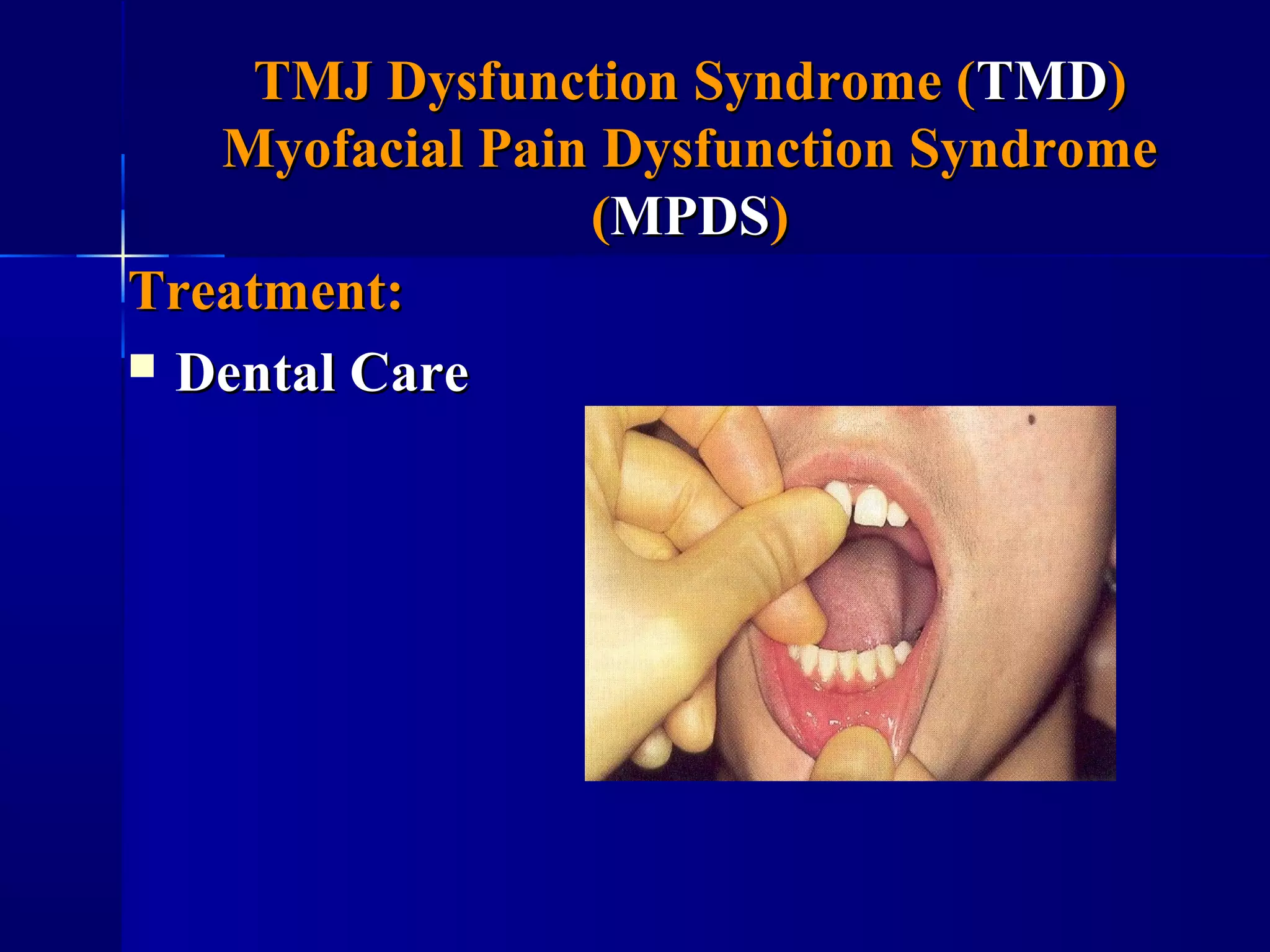
 Dental Care
TMJ Dysfunction Syndrome (TMD)
   Myofacial Pain Dysfunction Syndrome
                 (MPDS)
Prevention:
   Eliminate oral habits such as teeth grinding and
    yawing widely.

   Dental treatment (orthodontic treatment,
    prosthetic restoration, orthognathic surgery and
    TMJ surgery).

   Seek effective treatment for diseases such as
    osteoarthritis and fibromyalgia.
   Early Diagnosis and therapy.

Temporomandibular joint disorder

  • 1.
    University Of Aden Faculty of dentistry 2012 Oral Medicine Dr .Muhgat Abdo Oral & Dentofacial Surgeon www.adendent-faculty.net muhgatabdo@hotmail.de
  • 2.
    Temporomandibular Joint (TMJ) Disorders  What is the main function of Cartilage?  What is the difference between TMJ articular cartilage and cartilage of other synovial joints?  What are the goals of non- surgical management of TMJ disorders?  What are the indications to proceed with TMJ surgery?
  • 3.
    Temporomandibular Joint Disorders Anatomy of TMJ:  Glennoid Fossa  Mandibular Condyle  Articular Disc  Ligamentous Structurres: 1. Functional Ligament 2. Accessory ligament
  • 4.
    Temporomandibular Joint Disorders Functional Movement of TMJ: 1. Elevation (Jaw Closing) 2. Depression (Jaw Opening) 3. Protrusion 4. Retrution 5. Laterotrusion
  • 5.
    TMJ Dysfunction Syndrome(TMD) Myofacial Pain Dysfunction Syndrome (MPDS) Classification
  • 6.
    Temporomandibular Joint Disorders Classification of TMJ Disorders: 1. Developmental Disorders of TMJ 2. Degenerative Joint Disease 3. Inflammatory Disorders of the Joint 4. Traumatic Disorders of TMJ 5. Metabolic Disorders 6. Neoplastic Disorders 7. TMJ Disorders Syndrome or Myofacial Pain Dysfunction Syndrome
  • 7.
    TMJ Dysfunction Syndrome(TMD) Myofacial Pain Dysfunction Syndrome (MPDS)  Definition  Etiology  Classification  Examination  Treatment  Prevention
  • 8.
    TMJ Dysfunction Syndrome(TMD) Myofacial Pain Dysfunction Syndrome (MPDS) Definition:  When muscle spasm develops, dysfunction as well as pain occurs and the condition usually is designated as MPDS. It is initiated as spasm of one or more masticatory muscle.  Temporomandibular disorders are a group of maladies which can affect the TMJ, as well as the associated muscles of the jaw, face and neck as well as related neurological and vascular structures.
  • 9.
    TMJ Dysfunction Syndrome(TMD) Myofacial Pain Dysfunction Syndrome (MPDS) What symptoms are associated with Temporomandibular ?disorders What are the components of evaluation of the patient with Temporomandibular joint ?symptoms What symptoms are associated with myofacial pain dysfunction ?syndrome
  • 10.
    TMJ Dysfunction Syndrome(TMD) Myofacial Pain Dysfunction Syndrome (MPDS) Etiology:  Occlusal status: Orthodontic viewpoint Prosthetic viewpoint Periodontal viewpoint  Emotional status: Oral bad habits
  • 11.
    TMJ Dysfunction Syndrome(TMD) Myofacial Pain Dysfunction Syndrome (MPDS) Etiology:  Psychophysiologic theory:  Bruxism:
  • 12.
    TMJ Dysfunction Syndrome(TMD) Myofacial Pain Dysfunction Syndrome (MPDS) Classification: 1. Disc displacement 2. Structural incompatibility (Deviation, Adhesion, Hypermobility) 3. Inflammatory disorders (Synovitis/capsulitis, Arthritides) 4. Ankylosis 5. Neoplasia
  • 13.
    TMJ Dysfunction Syndrome(TMD) Myofacial Pain Dysfunction Syndrome (MPDS) Classification
  • 14.
    TMJ Dysfunction Syndrome(TMD) Myofacial Pain Dysfunction Syndrome (MPDS) Signs & Symptoms:  Pain of the joint on palpation.  Pain on movement of the joint.  Altered TMJ function, including trismus, reduced opening, and mandibular deviation on opening.  Joint popping, clicking or crepitus.  Facial pain.  Pain on palpation of the muscles of mastication.  Pain on opening.
  • 15.
    TMJ Dysfunction Syndrome(TMD) Myofacial Pain Dysfunction Syndrome (MPDS) Examination:  History  Physical Examination  Radiologic Examination: Radiography (Normal Radiography) C T (Tomography) Arthrography Electrography (MRI) Arthroscopy
  • 16.
    TMJ Dysfunction Syndrome(TMD) Myofacial Pain Dysfunction Syndrome (MPDS) Physical Examination: Palpation of Masticatory Muscles:
  • 17.
    TMJ Dysfunction Syndrome(TMD) Myofacial Pain Dysfunction Syndrome (MPDS) Observation of Mandibular Motion:
  • 18.
    TMJ Dysfunction Syndrome(TMD) Myofacial Pain Dysfunction Syndrome (MPDS) Palpation of the Joint:
  • 19.
    TMJ Dysfunction Syndrome(TMD) Myofacial Pain Dysfunction Syndrome (MPDS) Radiographic Evaluation:
  • 20.
    TMJ Dysfunction Syndrome(TMD) Myofacial Pain Dysfunction Syndrome (MPDS) Treatment: • Reversible Therapy (Patient education, medication, physical therapy, and splint therapy. Occlusal adjustment. • Irreversible Therapies that involve permanent changes in the function or morphology of the masticatory system (Surgical treatment).
  • 21.
    TMJ Dysfunction Syndrome(TMD) Myofacial Pain Dysfunction Syndrome (MPDS) Treatment:  Patient education & self care
  • 22.
    TMJ Dysfunction Syndrome(TMD) Myofacial Pain Dysfunction Syndrome (MPDS) Treatment:  Medication
  • 23.
    TMJ Dysfunction Syndrome(TMD) Myofacial Pain Dysfunction Syndrome (MPDS) Treatment:  Physiotherapy
  • 24.
    TMJ Dysfunction Syndrome(TMD) Myofacial Pain Dysfunction Syndrome (MPDS) Treatment:  Splint
  • 25.
    TMJ Dysfunction Syndrome(TMD) Myofacial Pain Dysfunction Syndrome (MPDS) Treatment:  Elimination the Stress
  • 26.
    TMJ Dysfunction Syndrome(TMD) Myofacial Pain Dysfunction Syndrome (MPDS) Treatment:  Dental Care
  • 27.
    TMJ Dysfunction Syndrome(TMD) Myofacial Pain Dysfunction Syndrome (MPDS) Prevention:  Eliminate oral habits such as teeth grinding and yawing widely.  Dental treatment (orthodontic treatment, prosthetic restoration, orthognathic surgery and TMJ surgery).  Seek effective treatment for diseases such as osteoarthritis and fibromyalgia.  Early Diagnosis and therapy.