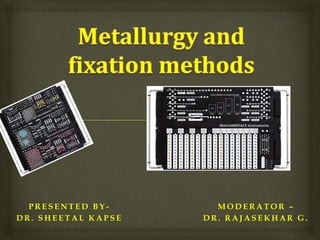
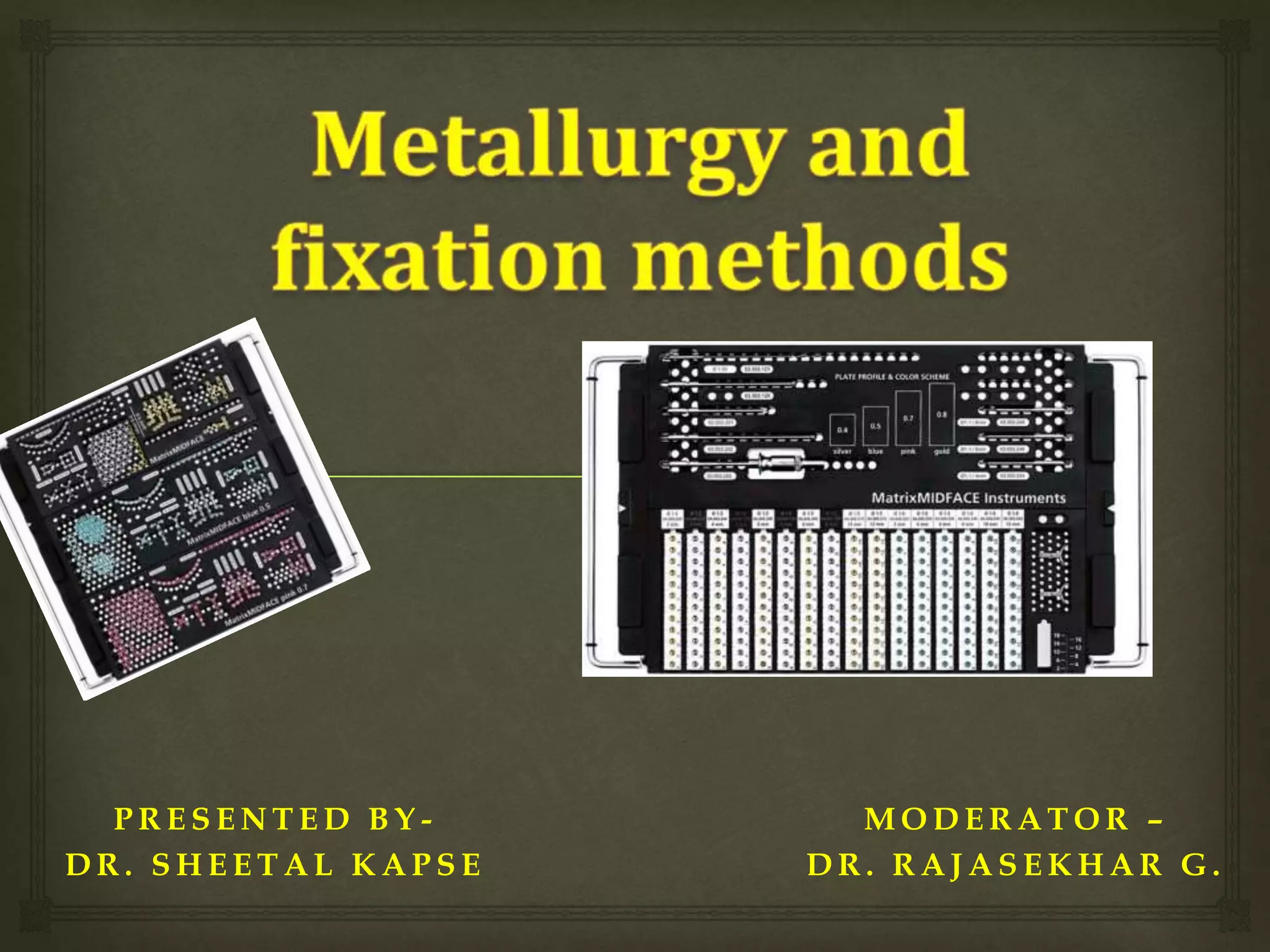
M O D E R A T O R –
D R . R A J A S E K H A R G .
P R E S E N T E D B Y -
D R . S H E E T A L K A P S E

 Introduction
 Metallurgy
 Evolution of fixation methods
 Various methods of fixation
 Principles of rigid internal fixation
 Conclusion
 References
Contents

 Maxillofacial injuries are most commonly involved in all type of body
injuries.
 Most of the maxillofacial fractures require open reduction and internal
fixation by using miniaturized metallic hardware.
 Therefore it is necessary to have the knowledge of these metals, their
properties & their effect on biological tissues.
Introduction
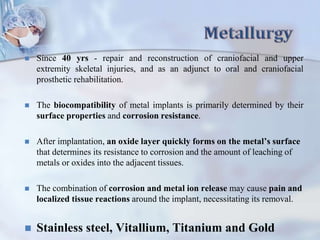
 Since 40 yrs - repair and reconstruction of craniofacial and upper
extremity skeletal injuries, and as an adjunct to oral and craniofacial
prosthetic rehabilitation.
 The biocompatibility of metal implants is primarily determined by their
surface properties and corrosion resistance.
 After implantation, an oxide layer quickly forms on the metal’s surface
that determines its resistance to corrosion and the amount of leaching of
metals or oxides into the adjacent tissues.
 The combination of corrosion and metal ion release may cause pain and
localized tissue reactions around the implant, necessitating its removal.
 Stainless steel, Vitallium, Titanium and Gold
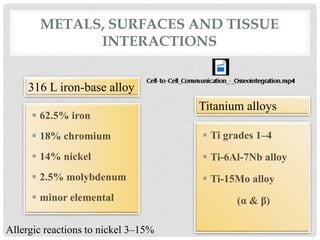
METALS, SURFACES AND TISSUE
INTERACTIONS
 62.5% iron
 18% chromium
 14% nickel
 2.5% molybdenum
 minor elemental
316 L iron-base alloy
Allergic reactions to nickel 3–15%
Titanium alloys
 Ti grades 1–4
 Ti-6Al-7Nb alloy
 Ti-15Mo alloy
(α & β)
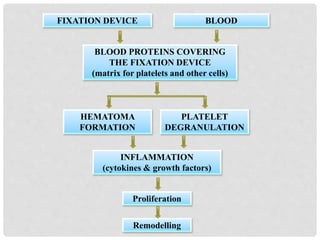
FIXATION DEVICE BLOOD
BLOOD PROTEINS COVERING
THE FIXATION DEVICE
(matrix for platelets and other cells)
PLATELET
DEGRANULATION
INFLAMMATION
(cytokines & growth factors)
HEMATOMA
FORMATION
Proliferation
Remodelling
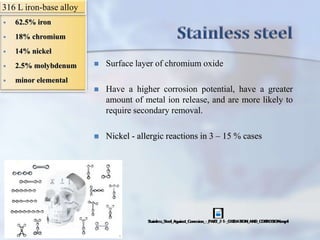
 Surface layer of chromium oxide
 Have a higher corrosion potential, have a greater
amount of metal ion release, and are more likely to
require secondary removal.
 Nickel - allergic reactions in 3 – 15 % cases
 62.5% iron
 18% chromium
 14% nickel
 2.5% molybdenum
 minor elemental
316 L iron-base alloy
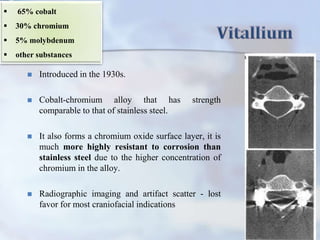
 Introduced in the 1930s.
 Cobalt-chromium alloy that has strength
comparable to that of stainless steel.
 It also forms a chromium oxide surface layer, it is
much more highly resistant to corrosion than
stainless steel due to the higher concentration of
chromium in the alloy.
 Radiographic imaging and artifact scatter - lost
favor for most craniofacial indications
 65% cobalt
 30% chromium
 5% molybdenum
 other substances
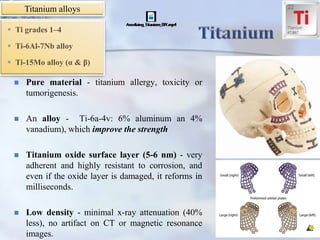
 Pure material - titanium allergy, toxicity or
tumorigenesis.
 An alloy - Ti-6a-4v: 6% aluminum an 4%
vanadium), which improve the strength
 Titanium oxide surface layer (5-6 nm) - very
adherent and highly resistant to corrosion, and
even if the oxide layer is damaged, it reforms in
milliseconds.
 Low density - minimal x-ray attenuation (40%
less), no artifact on CT or magnetic resonance
images.
Titanium alloys
 Ti grades 1–4
 Ti-6Al-7Nb alloy
 Ti-15Mo alloy (α & β)
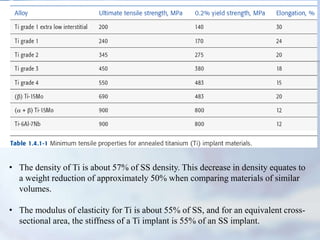
• The density of Ti is about 57% of SS density. This decrease in density equates to
a weight reduction of approximately 50% when comparing materials of similar
volumes.
• The modulus of elasticity for Ti is about 55% of SS, and for an equivalent cross-
sectional area, the stiffness of a Ti implant is 55% of an SS implant.
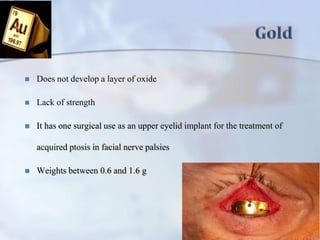
 Does not develop a layer of oxide
 Lack of strength
 It has one surgical use as an upper eyelid implant for the treatment of
acquired ptosis in facial nerve palsies
 Weights between 0.6 and 1.6 g
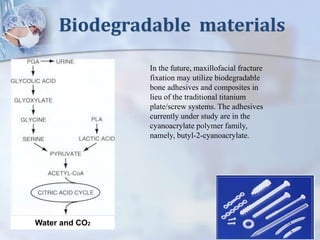
Biodegradable materials
Water and CO2
In the future, maxillofacial fracture
fixation may utilize biodegradable
bone adhesives and composites in
lieu of the traditional titanium
plate/screw systems. The adhesives
currently under study are in the
cyanoacrylate polymer family,
namely, butyl-2-cyanoacrylate.
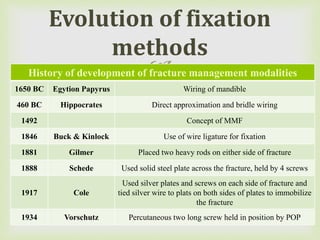
History of development of fracture management modalities
1650 BC Egytion Papyrus Wiring of mandible
460 BC Hippocrates Direct approximation and bridle wiring
1492 Concept of MMF
1846 Buck & Kinlock Use of wire ligature for fixation
1881 Gilmer Placed two heavy rods on either side of fracture
1888 Schede Used solid steel plate across the fracture, held by 4 screws
1917 Cole
Used silver plates and screws on each side of fracture and
tied silver wire to plats on both sides of plates to immobilize
the fracture
1934 Vorschutz Percutaneous two long screw held in position by POP
Evolution of fixation
methods
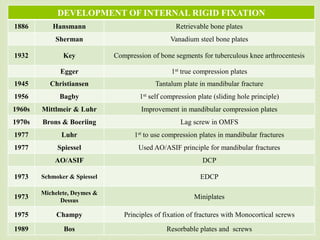
DEVELOPMENT OF INTERNAL RIGID FIXATION
1886 Hansmann Retrievable bone plates
Sherman Vanadium steel bone plates
1932 Key Compression of bone segments for tuberculous knee arthrocentesis
Egger 1st true compression plates
1945 Christiansen Tantalum plate in mandibular fracture
1956 Bagby 1st self compression plate (sliding hole principle)
1960s Mittlmeir & Luhr Improvement in mandibular compression plates
1970s Brons & Boeriing Lag screw in OMFS
1977 Luhr 1st to use compression plates in mandibular fractures
1977 Spiessel Used AO/ASIF principle for mandibular fractures
AO/ASIF DCP
1973 Schmoker & Spiessel EDCP
1973
Michelete, Deymes &
Dessus
Miniplates
1975 Champy Principles of fixation of fractures with Monocortical screws
1989 Bos Resorbable plates and screws

 In this phase the fractured fragments (after reduction) are fixed, in
their normal anatomical relationship to prevent displacement and
achieve proper approximation.
 “Any form of fixation applied to the bone that is strong enough to
prevent the mobility of bony fragments during active use of skeletal
structure during healing phase.”
Various methods of
fixation
• Direct skeletal fixation – Consists of:
i) External direct skeletal fixation, where the device is
outside the tissues, but inserted into the bone
percutaneously . In external direct fixation, bone clamps
or pin fixation are used.
ii) Internal direct skeletal fixation – by devices which are
totally enclosed within the tissues and uniting the bone
ends by direct approximation.It is carried out with
transosseous or intraosseous wiring or using bone
plating system.
• Indirect skeletal fixation:
 Here, the control of bone fragments is done via the
denture bearing area.
 By means of arch bars and IML or Gunning splint, if
the patient is edentulous.
 It can be extraoral or intraoral method.
Methods of immobilization
The methods of immobilization can be summarized as follows:
1. Osteosynthesis without intermaxillary fixation:
(A) non-compression small plates
(B) compression plates
(C) miniplates
(D) lag screws
(E) resorbable plates and screws
2. Intermaxillary fixation:
(A) bonded brackets
(B) dental wiring
(I) direct
(II) eyelet
(C) arch bars
(D) cap splints
3. Intermaxillary fixation with
osteosynthesis:
(A) transosseous wiring
(B) circumferential wiring
(C) external pin fixation
(D) bone clamps
(E) transfixation with kirschner wires
Closed Reduction & Fixation
Techniques
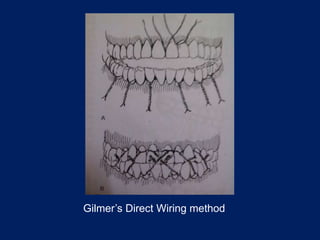
• Gilmer method
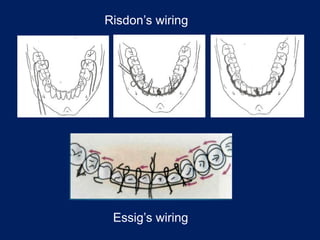
• Essig’s wiring
• Risdon’s wiring
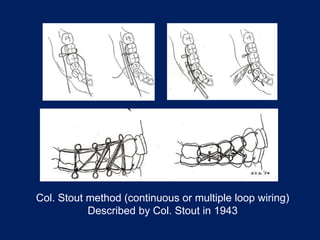
• Col. Stout’s multiloop wiring
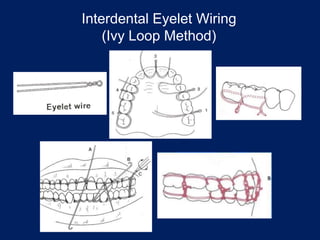
• Ivy loops/ eyelet method
• Arch bars – Erich arch bars
• Intermaxillary fixation screws
• Acrylic Splints
Gilmer’s Direct Wiring method
Risdon’s wiring
Essig’s wiring
Col. Stout method (continuous or multiple loop wiring)
Described by Col. Stout in 1943
Interdental Eyelet Wiring
(Ivy Loop Method)
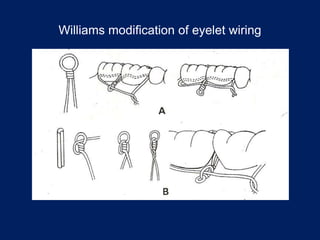
Williams modification of eyelet wiring
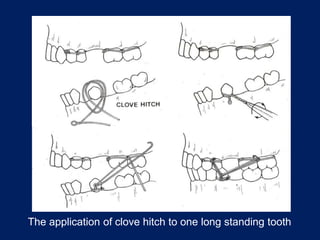
The application of clove hitch to one long standing tooth
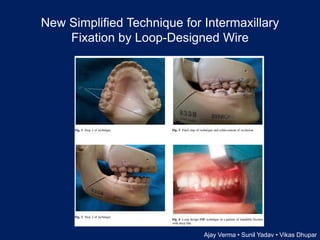
New Simplified Technique for Intermaxillary
Fixation by Loop-Designed Wire
Ajay Verma • Sunil Yadav • Vikas Dhupar
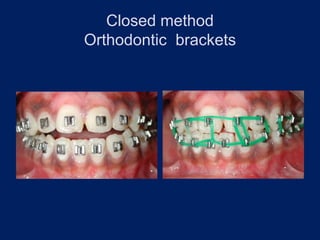
Closed method
Orthodontic brackets
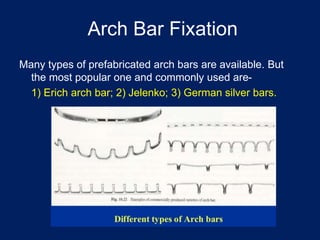
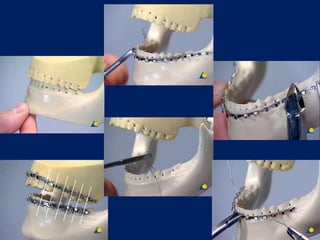
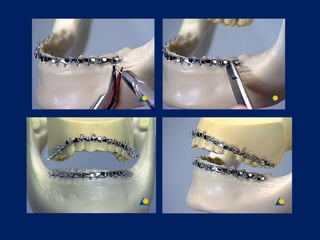
Arch Bar Fixation
Many types of prefabricated arch bars are available. But
the most popular one and commonly used are-
1) Erich arch bar; 2) Jelenko; 3) German silver bars.
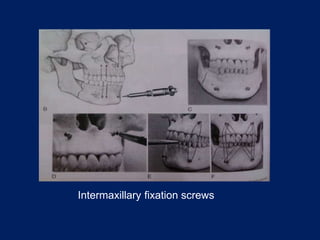
Intermaxillary fixation screws
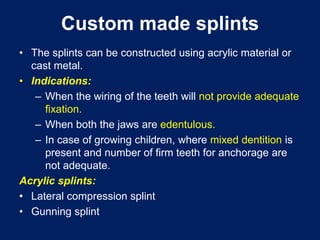
Custom made splints
• The splints can be constructed using acrylic material or
cast metal.
• Indications:
– When the wiring of the teeth will not provide adequate
fixation.
– When both the jaws are edentulous.
– In case of growing children, where mixed dentition is
present and number of firm teeth for anchorage are
not adequate.
Acrylic splints:
• Lateral compression splint
• Gunning splint
Multiple studies show clinical bone union (no
mobility, no pain, reduced on films)
in 4 weeks in adults and 2 weeks in children
Juniper et al. J Oral Surg 1973;36Juniper 36
Amaratunga NA. J Oral Maxillofac Surg 1987;45Amaratunga 45
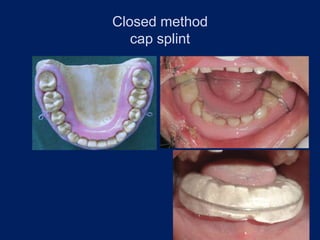
Closed method
cap splint
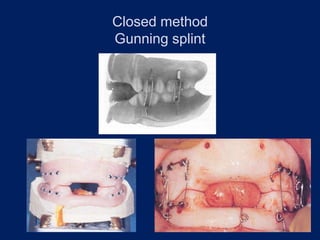
Closed method
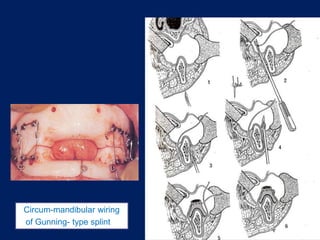
Gunning splint
Circum-mandibular wiring
of Gunning- type splint
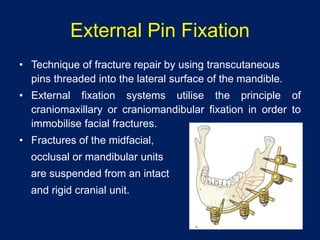
External Pin Fixation
• Technique of fracture repair by using transcutaneous
pins threaded into the lateral surface of the mandible.
• External fixation systems utilise the principle of
craniomaxillary or craniomandibular fixation in order to
immobilise facial fractures.
• Fractures of the midfacial,
occlusal or mandibular units
are suspended from an intact
and rigid cranial unit.
Indications:
• Comminuted mandible fractures with/without
displacement
• Avulsive gunshot wounds
• Edentulous mandible fractures
• Can be used on patients that are poor candidate
for open reduction and closed reduction (may
increase likelihood of follow-up)
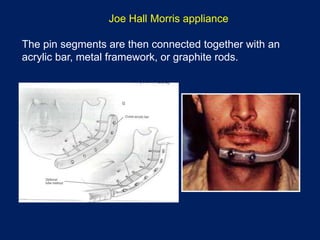
Joe Hall Morris appliance
The pin segments are then connected together with an
acrylic bar, metal framework, or graphite rods.
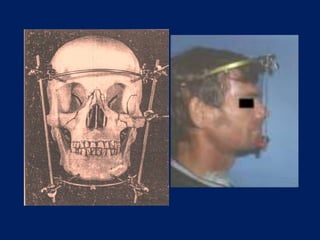
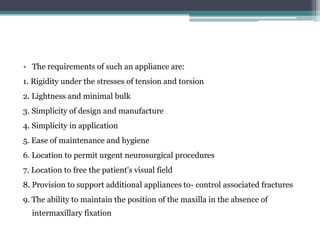
• Box frames consist of 4 threaded bone pins screwed
transcutaneously into the lateral supraorbital rims
above and the body of the mandible below.
• The pins are then linked by 2 vertical and 2 horizontal
bars via universal clamps.
• Combinations of pins and bars can be used to build
custom external fixation devices to support and control
virtually any facial bone fracture.
Disadvantages
• Involves closed fracture reduction, usually guided by
clinical observation of the occlusion and facial form thus,
there is a significant margin for error.
• External frames are cumbersome, unaesthetic, poorly
tolerated and prone to accidental dislodgement.
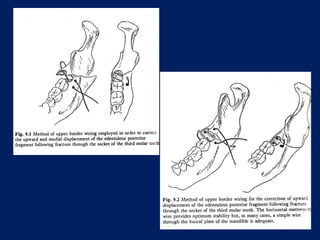
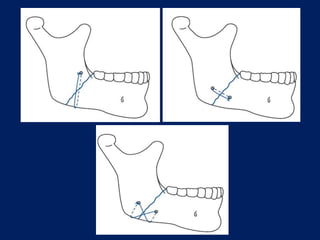
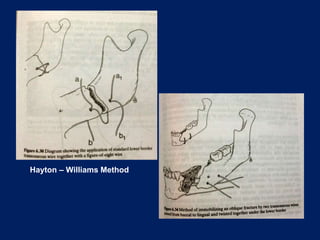
TRANSOSSEOUS WIRING
• Provides Non rigid fixation.
• Use of wire for direct skeletal fixation.
• Keeps the fragments in an exact anatomical alignment,
but must rely on other forms of fixation to maintain
stability (splints, IMF).
• Low cost, fast to perform, must rely on patient
compliance as does closed reduction techniques .
Hayton – Williams Method
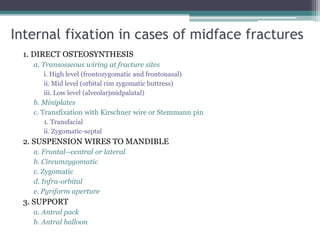
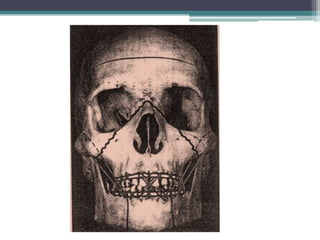
Internal fixation in cases of midface fractures
1. DIRECT OSTEOSYNTHESIS
a. Transosseous wiring at fracture sites
i. High level (frontozygomatic and frontonasal)
ii. Mid level (orbital rim zygomatic buttress)
iii. Low level (alveolarjmidpalatal)
b. Miniplates
c. Transfixation with Kirschner wire or Stemmann pin
1. Transfacial
ii. Zygomatic-septal
2. SUSPENSION WIRES TO MANDIBLE
a. Frontal--central or lateral
b. Circumzygomatic
c. Zygomatic
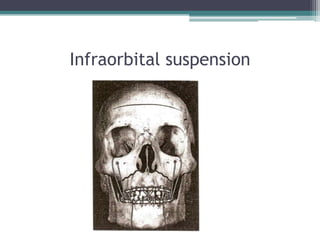
d. Infra-orbital
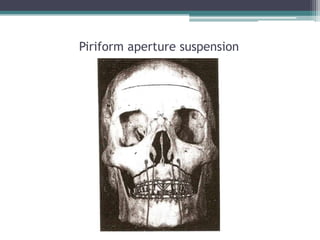
e. Pyriform aperture
3. SUPPORT
a. Antral pack
b. Antral balloon
External fixation
1. CRANIOMANDIBULAR
a. 'Box-frame'
b. 'Halo-frame'
c. Plaster-of-Paris headcap
2. CRANIOMAXILLARY
a. Supra-orbital pins
b. Zygomatic pins
c. Halo-frame
3. SUSPENSION BY CHEEK WIRES FROM HALO-FRAME OR HEADCAP
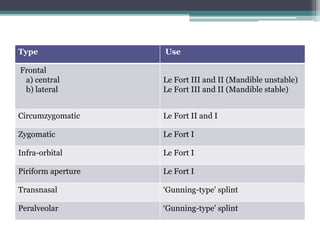
Type Use
Frontal
a) central
b) lateral
Le Fort III and II (Mandible unstable)
Le Fort III and II (Mandible stable)
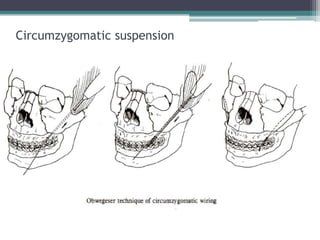
Circumzygomatic Le Fort II and I
Zygomatic Le Fort I
Infra-orbital Le Fort I
Piriform aperture Le Fort I
Transnasal ‘Gunning-type' splint
Peralveolar ‘Gunning-type' splint
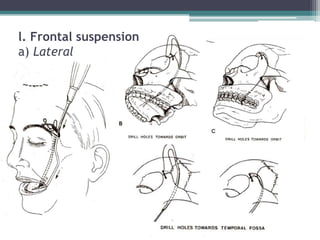
l. Frontal suspension
a) Lateral
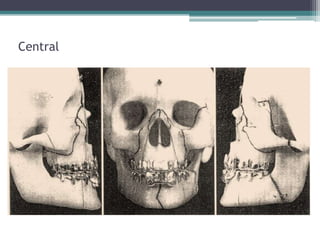
Central
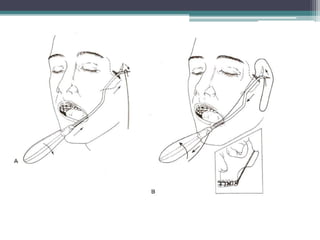
Circumzygomatic suspension
• Zygomatic suspension
• Guerman 1975
Infraorbital suspension
Piriform aperture suspension
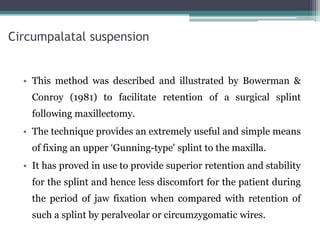
Circumpalatal suspension
• This method was described and illustrated by Bowerman &
Conroy (1981) to facilitate retention of a surgical splint
following maxillectomy.
• The technique provides an extremely useful and simple means
of fixing an upper ‘Gunning-type' splint to the maxilla.
• It has proved in use to provide superior retention and stability
for the splint and hence less discomfort for the patient during
the period of jaw fixation when compared with retention of
such a splint by peralveolar or circumzygomatic wires.
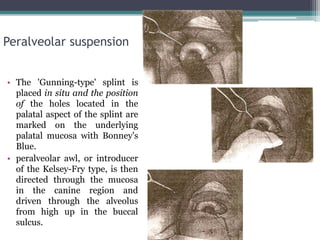
Peralveolar suspension
• The 'Gunning-type' splint is
placed in situ and the position
of the holes located in the
palatal aspect of the splint are
marked on the underlying
palatal mucosa with Bonney's
Blue.
• peralveolar awl, or introducer
of the Kelsey-Fry type, is then
directed through the mucosa
in the canine region and
driven through the alveolus
from high up in the buccal
sulcus.
External skeletal fixation
• The primary indication for external skeletal fixation of the mid-face
is the presence of antero-posterior instability of the facial
skeleton.
• This situation is classically seen when the mid-face fracture is
associated with concomitant bilateral condylar fractures of the
mandible.
• Stabilisation of this type of facial fracture usually requires open
reduction and direct transosseous wiring at critical fracture sites,
combined with the application of some form of rigid anterior
external skeletal fixation appliance.
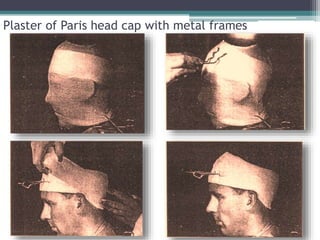
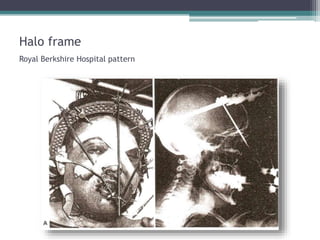
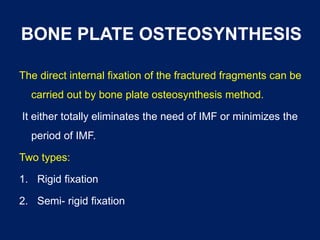
• There are four methods of external skeletal fixation
1. Plaster of Paris head cap
2. Halo frame (various designs)
3. Box frame
4. Levant frame
Plaster of Paris head cap with metal frames
Royal Berkshire Hospital pattern
Halo frame
Box Frame Fixation
Levant frame
• The requirements of such an appliance are:
1. Rigidity under the stresses of tension and torsion
2. Lightness and minimal bulk
3. Simplicity of design and manufacture
4. Simplicity in application
5. Ease of maintenance and hygiene
6. Location to permit urgent neurosurgical procedures
7. Location to free the patient's visual field
8. Provision to support additional appliances to- control associated fractures
9. The ability to maintain the position of the maxilla in the absence of
intermaxillary fixation
BONE PLATE OSTEOSYNTHESIS
The direct internal fixation of the fractured fragments can be
carried out by bone plate osteosynthesis method.
It either totally eliminates the need of IMF or minimizes the
period of IMF.
Two types:
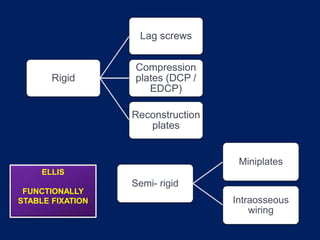
1. Rigid fixation
2. Semi- rigid fixation
Rigid
Lag screws
Compression
plates (DCP /
EDCP)
Reconstruction
plates
Semi- rigid
Miniplates
Intraosseous
wiring
ELLIS
FUNCTIONALLY
STABLE FIXATION

Biomechanics of
facial skeleton
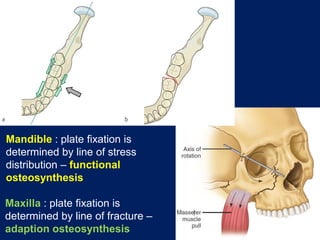
Mandible : plate fixation is
determined by line of stress
distribution – functional
osteosynthesis
Maxilla : plate fixation is
determined by line of fracture –
adaption osteosynthesis
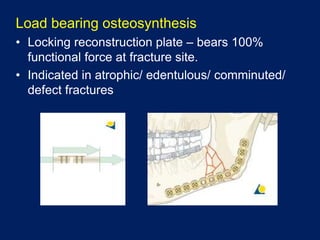
Load bearing osteosynthesis
• Locking reconstruction plate – bears 100%
functional force at fracture site.
• Indicated in atrophic/ edentulous/ comminuted/
defect fractures
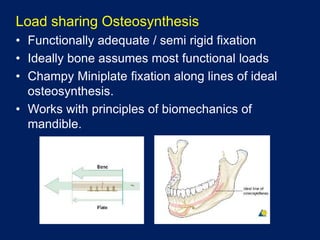
Load sharing Osteosynthesis
• Functionally adequate / semi rigid fixation
• Ideally bone assumes most functional loads
• Champy Miniplate fixation along lines of ideal
osteosynthesis.
• Works with principles of biomechanics of
mandible.
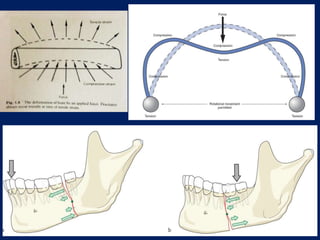
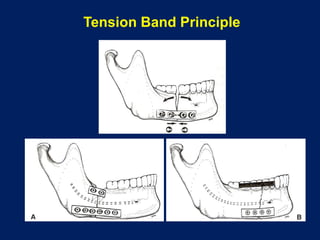
Tension Band Principle
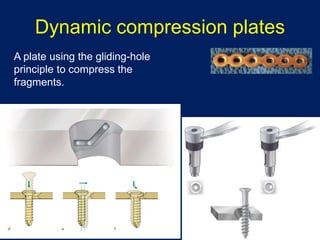
Dynamic compression plates
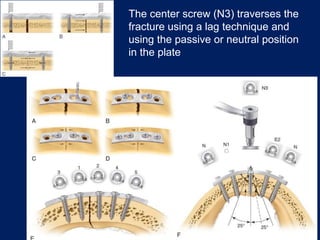
A plate using the gliding-hole
principle to compress the
fragments.
The center screw (N3) traverses the
fracture using a lag technique and
using the passive or neutral position
in the plate
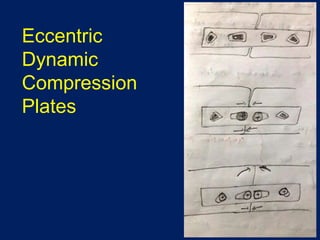
Eccentric
Dynamic
Compression
Plates
Advantages:
• Rigid fixation
• Thicker hardware
Disadvantages:
• Technique sensitive- plates must be adapted
properly or malalignment can occur
• More expensive than miniplates
• Bicortical screws
NON-COMPRESSION
OSTEOSYNTHESIS
1. Non-activated compression plates
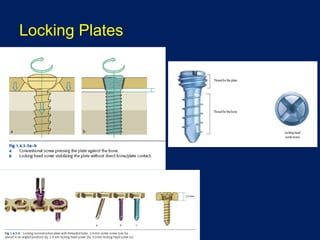
2. Locking plates
3. Reconstruction plates
4. THORP
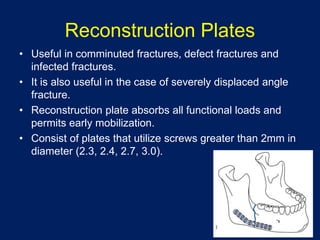
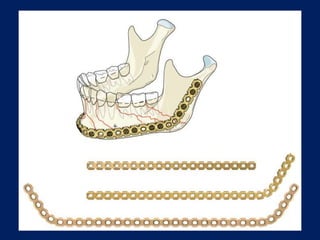
Reconstruction Plates
• Useful in comminuted fractures, defect fractures and
infected fractures.
• It is also useful in the case of severely displaced angle
fracture.
• Reconstruction plate absorbs all functional loads and
permits early mobilization.
• Consist of plates that utilize screws greater than 2mm in
diameter (2.3, 2.4, 2.7, 3.0).
Advantages:
• Rigid fixation with load-bearing properties
• Low infection rates in the literature, especially in the
mandibular angle region
• Can be used for edentulous and comminuted fractures
Disadvantages:
• Expensive
• Requires larger surgical opening
• Can be palpated by patient if in body or symphysis
region
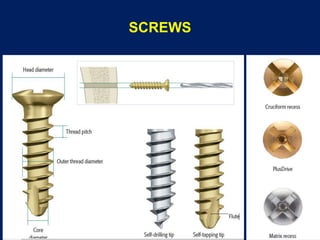
SCREWS
Locking Plates
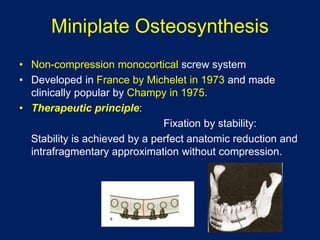
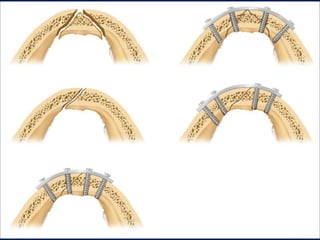
Miniplate Osteosynthesis
• Non-compression monocortical screw system
• Developed in France by Michelet in 1973 and made
clinically popular by Champy in 1975.
• Therapeutic principle:
Fixation by stability:
Stability is achieved by a perfect anatomic reduction and
intrafragmentary approximation without compression.
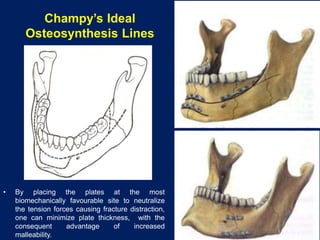
Champy’s Ideal
Osteosynthesis Lines
• By placing the plates at the most
biomechanically favourable site to neutralize
the tension forces causing fracture distraction,
one can minimize plate thickness, with the
consequent advantage of increased
malleability.
Advantages:
• Small and easily adapted plates
• Monocortical application
• Intraoral approach
• Functional stability
• Biomechanically favorable
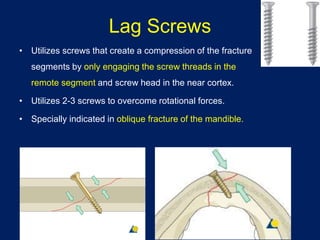
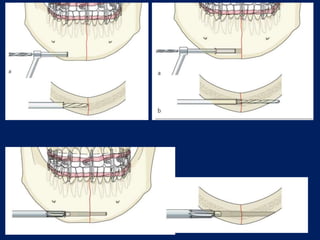
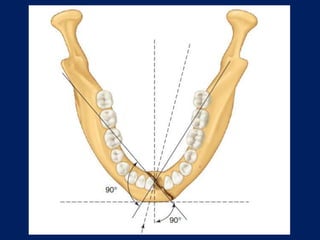
Lag Screws
• Utilizes screws that create a compression of the fracture
segments by only engaging the screw threads in the
remote segment and screw head in the near cortex.
• Utilizes 2-3 screws to overcome rotational forces.
• Specially indicated in oblique fracture of the mandible.
Advantages:
• Low cost, less equipment
• Faster technique than plating
• Rigid fixation
Disadvantages:
• Screw must be placed perpendicular to fracture;
technique sensitive
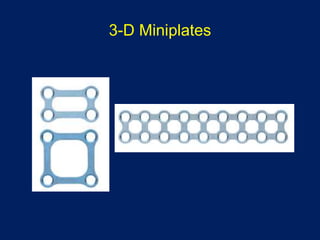
3-D Miniplates
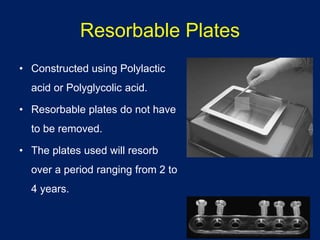
Resorbable Plates
• Constructed using Polylactic
acid or Polyglycolic acid.
• Resorbable plates do not have
to be removed.
• The plates used will resorb
over a period ranging from 2 to
4 years.

 It has been demonstrated that absolute rigid fixation is not necessary for
successful healing.
 In fact it has been shown that the additional plates necessary to establish
absolute rigidity may actually increase the complication rate.
 The rapid increase in bioresorbable technology has led to the introduction of
many successful resorbable plating systems that do not meet the criteria for
rigid fixation, and some of the plating manufacturers are even introducing
semi rigid fixation that is intentionally designed to allow minor post fixation
manipulation.
 Current clinical techniques using titanium or resorbable plating systems may
not meet the definition of rigid fixation yet are capable of providing clinically
adequate fracture stability. Ellis has used the term "functionally stable
fixation"
Conclusion

1. Fonseca Raymond J, Walker Robert V, Barber H Dexter, Powers, Michael P,
Frost David E. oral and maxillofacial trauma. China: Saunders; 2013.
2. AOCMF principles of internal fixations of craniomaxillofacial skeleton,
trauma & orthognathic surgery.
3. Rowe NL, William JL. Maxillofacial injuries. 1st ed. India ISBN 978-81-312-
1840—2 2009.
4. MAXILLOFACIAL SURGERY VOL – 1 PETER WARD BOOTH
References

Metallurgy & fixation methods

  • 1.
    M O DE R A T O R – D R . R A J A S E K H A R G . P R E S E N T E D B Y - D R . S H E E T A L K A P S E
  • 2.
      Introduction  Metallurgy Evolution of fixation methods  Various methods of fixation  Principles of rigid internal fixation  Conclusion  References Contents
  • 3.
      Maxillofacial injuriesare most commonly involved in all type of body injuries.  Most of the maxillofacial fractures require open reduction and internal fixation by using miniaturized metallic hardware.  Therefore it is necessary to have the knowledge of these metals, their properties & their effect on biological tissues. Introduction
  • 4.
     Since 40yrs - repair and reconstruction of craniofacial and upper extremity skeletal injuries, and as an adjunct to oral and craniofacial prosthetic rehabilitation.  The biocompatibility of metal implants is primarily determined by their surface properties and corrosion resistance.  After implantation, an oxide layer quickly forms on the metal’s surface that determines its resistance to corrosion and the amount of leaching of metals or oxides into the adjacent tissues.  The combination of corrosion and metal ion release may cause pain and localized tissue reactions around the implant, necessitating its removal.  Stainless steel, Vitallium, Titanium and Gold
  • 5.
    METALS, SURFACES ANDTISSUE INTERACTIONS  62.5% iron  18% chromium  14% nickel  2.5% molybdenum  minor elemental 316 L iron-base alloy Allergic reactions to nickel 3–15% Titanium alloys  Ti grades 1–4  Ti-6Al-7Nb alloy  Ti-15Mo alloy (α & β)
  • 6.
    FIXATION DEVICE BLOOD BLOODPROTEINS COVERING THE FIXATION DEVICE (matrix for platelets and other cells) PLATELET DEGRANULATION INFLAMMATION (cytokines & growth factors) HEMATOMA FORMATION Proliferation Remodelling
  • 7.
     Surface layerof chromium oxide  Have a higher corrosion potential, have a greater amount of metal ion release, and are more likely to require secondary removal.  Nickel - allergic reactions in 3 – 15 % cases  62.5% iron  18% chromium  14% nickel  2.5% molybdenum  minor elemental 316 L iron-base alloy
  • 8.
     Introduced inthe 1930s.  Cobalt-chromium alloy that has strength comparable to that of stainless steel.  It also forms a chromium oxide surface layer, it is much more highly resistant to corrosion than stainless steel due to the higher concentration of chromium in the alloy.  Radiographic imaging and artifact scatter - lost favor for most craniofacial indications  65% cobalt  30% chromium  5% molybdenum  other substances
  • 9.
     Pure material- titanium allergy, toxicity or tumorigenesis.  An alloy - Ti-6a-4v: 6% aluminum an 4% vanadium), which improve the strength  Titanium oxide surface layer (5-6 nm) - very adherent and highly resistant to corrosion, and even if the oxide layer is damaged, it reforms in milliseconds.  Low density - minimal x-ray attenuation (40% less), no artifact on CT or magnetic resonance images. Titanium alloys  Ti grades 1–4  Ti-6Al-7Nb alloy  Ti-15Mo alloy (α & β)
  • 10.
    • The densityof Ti is about 57% of SS density. This decrease in density equates to a weight reduction of approximately 50% when comparing materials of similar volumes. • The modulus of elasticity for Ti is about 55% of SS, and for an equivalent cross- sectional area, the stiffness of a Ti implant is 55% of an SS implant.
  • 11.
     Does notdevelop a layer of oxide  Lack of strength  It has one surgical use as an upper eyelid implant for the treatment of acquired ptosis in facial nerve palsies  Weights between 0.6 and 1.6 g
  • 12.
    Biodegradable materials Water andCO2 In the future, maxillofacial fracture fixation may utilize biodegradable bone adhesives and composites in lieu of the traditional titanium plate/screw systems. The adhesives currently under study are in the cyanoacrylate polymer family, namely, butyl-2-cyanoacrylate.
  • 13.
    History of developmentof fracture management modalities 1650 BC Egytion Papyrus Wiring of mandible 460 BC Hippocrates Direct approximation and bridle wiring 1492 Concept of MMF 1846 Buck & Kinlock Use of wire ligature for fixation 1881 Gilmer Placed two heavy rods on either side of fracture 1888 Schede Used solid steel plate across the fracture, held by 4 screws 1917 Cole Used silver plates and screws on each side of fracture and tied silver wire to plats on both sides of plates to immobilize the fracture 1934 Vorschutz Percutaneous two long screw held in position by POP Evolution of fixation methods
  • 14.
    DEVELOPMENT OF INTERNALRIGID FIXATION 1886 Hansmann Retrievable bone plates Sherman Vanadium steel bone plates 1932 Key Compression of bone segments for tuberculous knee arthrocentesis Egger 1st true compression plates 1945 Christiansen Tantalum plate in mandibular fracture 1956 Bagby 1st self compression plate (sliding hole principle) 1960s Mittlmeir & Luhr Improvement in mandibular compression plates 1970s Brons & Boeriing Lag screw in OMFS 1977 Luhr 1st to use compression plates in mandibular fractures 1977 Spiessel Used AO/ASIF principle for mandibular fractures AO/ASIF DCP 1973 Schmoker & Spiessel EDCP 1973 Michelete, Deymes & Dessus Miniplates 1975 Champy Principles of fixation of fractures with Monocortical screws 1989 Bos Resorbable plates and screws
  • 15.
      In thisphase the fractured fragments (after reduction) are fixed, in their normal anatomical relationship to prevent displacement and achieve proper approximation.  “Any form of fixation applied to the bone that is strong enough to prevent the mobility of bony fragments during active use of skeletal structure during healing phase.” Various methods of fixation
  • 16.
    • Direct skeletalfixation – Consists of: i) External direct skeletal fixation, where the device is outside the tissues, but inserted into the bone percutaneously . In external direct fixation, bone clamps or pin fixation are used. ii) Internal direct skeletal fixation – by devices which are totally enclosed within the tissues and uniting the bone ends by direct approximation.It is carried out with transosseous or intraosseous wiring or using bone plating system.
  • 17.
    • Indirect skeletalfixation:  Here, the control of bone fragments is done via the denture bearing area.  By means of arch bars and IML or Gunning splint, if the patient is edentulous.  It can be extraoral or intraoral method.
  • 18.
    Methods of immobilization Themethods of immobilization can be summarized as follows: 1. Osteosynthesis without intermaxillary fixation: (A) non-compression small plates (B) compression plates (C) miniplates (D) lag screws (E) resorbable plates and screws 2. Intermaxillary fixation: (A) bonded brackets (B) dental wiring (I) direct (II) eyelet (C) arch bars (D) cap splints 3. Intermaxillary fixation with osteosynthesis: (A) transosseous wiring (B) circumferential wiring (C) external pin fixation (D) bone clamps (E) transfixation with kirschner wires
  • 19.
    Closed Reduction &Fixation Techniques • Gilmer method • Essig’s wiring • Risdon’s wiring • Col. Stout’s multiloop wiring • Ivy loops/ eyelet method • Arch bars – Erich arch bars • Intermaxillary fixation screws • Acrylic Splints
  • 20.
  • 21.
  • 22.
    Col. Stout method(continuous or multiple loop wiring) Described by Col. Stout in 1943
  • 23.
  • 24.
  • 25.
    The application ofclove hitch to one long standing tooth
  • 26.
    New Simplified Techniquefor Intermaxillary Fixation by Loop-Designed Wire Ajay Verma • Sunil Yadav • Vikas Dhupar
  • 27.
  • 28.
    Arch Bar Fixation Manytypes of prefabricated arch bars are available. But the most popular one and commonly used are- 1) Erich arch bar; 2) Jelenko; 3) German silver bars.
  • 31.
  • 32.
    Custom made splints •The splints can be constructed using acrylic material or cast metal. • Indications: – When the wiring of the teeth will not provide adequate fixation. – When both the jaws are edentulous. – In case of growing children, where mixed dentition is present and number of firm teeth for anchorage are not adequate. Acrylic splints: • Lateral compression splint • Gunning splint
  • 33.
    Multiple studies showclinical bone union (no mobility, no pain, reduced on films) in 4 weeks in adults and 2 weeks in children Juniper et al. J Oral Surg 1973;36Juniper 36 Amaratunga NA. J Oral Maxillofac Surg 1987;45Amaratunga 45
  • 34.
  • 35.
  • 36.
  • 37.
    External Pin Fixation •Technique of fracture repair by using transcutaneous pins threaded into the lateral surface of the mandible. • External fixation systems utilise the principle of craniomaxillary or craniomandibular fixation in order to immobilise facial fractures. • Fractures of the midfacial, occlusal or mandibular units are suspended from an intact and rigid cranial unit.
  • 38.
    Indications: • Comminuted mandiblefractures with/without displacement • Avulsive gunshot wounds • Edentulous mandible fractures • Can be used on patients that are poor candidate for open reduction and closed reduction (may increase likelihood of follow-up)
  • 39.
    Joe Hall Morrisappliance The pin segments are then connected together with an acrylic bar, metal framework, or graphite rods.
  • 40.
    • Box framesconsist of 4 threaded bone pins screwed transcutaneously into the lateral supraorbital rims above and the body of the mandible below. • The pins are then linked by 2 vertical and 2 horizontal bars via universal clamps. • Combinations of pins and bars can be used to build custom external fixation devices to support and control virtually any facial bone fracture.
  • 42.
    Disadvantages • Involves closedfracture reduction, usually guided by clinical observation of the occlusion and facial form thus, there is a significant margin for error. • External frames are cumbersome, unaesthetic, poorly tolerated and prone to accidental dislodgement.
  • 43.
    TRANSOSSEOUS WIRING • ProvidesNon rigid fixation. • Use of wire for direct skeletal fixation. • Keeps the fragments in an exact anatomical alignment, but must rely on other forms of fixation to maintain stability (splints, IMF). • Low cost, fast to perform, must rely on patient compliance as does closed reduction techniques .
  • 46.
  • 47.
    Internal fixation incases of midface fractures 1. DIRECT OSTEOSYNTHESIS a. Transosseous wiring at fracture sites i. High level (frontozygomatic and frontonasal) ii. Mid level (orbital rim zygomatic buttress) iii. Low level (alveolarjmidpalatal) b. Miniplates c. Transfixation with Kirschner wire or Stemmann pin 1. Transfacial ii. Zygomatic-septal 2. SUSPENSION WIRES TO MANDIBLE a. Frontal--central or lateral b. Circumzygomatic c. Zygomatic d. Infra-orbital e. Pyriform aperture 3. SUPPORT a. Antral pack b. Antral balloon
  • 48.
    External fixation 1. CRANIOMANDIBULAR a.'Box-frame' b. 'Halo-frame' c. Plaster-of-Paris headcap 2. CRANIOMAXILLARY a. Supra-orbital pins b. Zygomatic pins c. Halo-frame 3. SUSPENSION BY CHEEK WIRES FROM HALO-FRAME OR HEADCAP
  • 49.
    Type Use Frontal a) central b)lateral Le Fort III and II (Mandible unstable) Le Fort III and II (Mandible stable) Circumzygomatic Le Fort II and I Zygomatic Le Fort I Infra-orbital Le Fort I Piriform aperture Le Fort I Transnasal ‘Gunning-type' splint Peralveolar ‘Gunning-type' splint
  • 50.
  • 51.
  • 52.
  • 55.
  • 56.
  • 57.
  • 58.
    Circumpalatal suspension • Thismethod was described and illustrated by Bowerman & Conroy (1981) to facilitate retention of a surgical splint following maxillectomy. • The technique provides an extremely useful and simple means of fixing an upper ‘Gunning-type' splint to the maxilla. • It has proved in use to provide superior retention and stability for the splint and hence less discomfort for the patient during the period of jaw fixation when compared with retention of such a splint by peralveolar or circumzygomatic wires.
  • 59.
    Peralveolar suspension • The'Gunning-type' splint is placed in situ and the position of the holes located in the palatal aspect of the splint are marked on the underlying palatal mucosa with Bonney's Blue. • peralveolar awl, or introducer of the Kelsey-Fry type, is then directed through the mucosa in the canine region and driven through the alveolus from high up in the buccal sulcus.
  • 60.
    External skeletal fixation •The primary indication for external skeletal fixation of the mid-face is the presence of antero-posterior instability of the facial skeleton. • This situation is classically seen when the mid-face fracture is associated with concomitant bilateral condylar fractures of the mandible. • Stabilisation of this type of facial fracture usually requires open reduction and direct transosseous wiring at critical fracture sites, combined with the application of some form of rigid anterior external skeletal fixation appliance.
  • 61.
    • There arefour methods of external skeletal fixation 1. Plaster of Paris head cap 2. Halo frame (various designs) 3. Box frame 4. Levant frame
  • 62.
    Plaster of Parishead cap with metal frames
  • 63.
    Royal Berkshire Hospitalpattern Halo frame
  • 64.
  • 65.
  • 66.
    • The requirementsof such an appliance are: 1. Rigidity under the stresses of tension and torsion 2. Lightness and minimal bulk 3. Simplicity of design and manufacture 4. Simplicity in application 5. Ease of maintenance and hygiene 6. Location to permit urgent neurosurgical procedures 7. Location to free the patient's visual field 8. Provision to support additional appliances to- control associated fractures 9. The ability to maintain the position of the maxilla in the absence of intermaxillary fixation
  • 67.
    BONE PLATE OSTEOSYNTHESIS Thedirect internal fixation of the fractured fragments can be carried out by bone plate osteosynthesis method. It either totally eliminates the need of IMF or minimizes the period of IMF. Two types: 1. Rigid fixation 2. Semi- rigid fixation
  • 68.
    Rigid Lag screws Compression plates (DCP/ EDCP) Reconstruction plates Semi- rigid Miniplates Intraosseous wiring ELLIS FUNCTIONALLY STABLE FIXATION
  • 69.
  • 71.
    Mandible : platefixation is determined by line of stress distribution – functional osteosynthesis Maxilla : plate fixation is determined by line of fracture – adaption osteosynthesis
  • 72.
    Load bearing osteosynthesis •Locking reconstruction plate – bears 100% functional force at fracture site. • Indicated in atrophic/ edentulous/ comminuted/ defect fractures
  • 73.
    Load sharing Osteosynthesis •Functionally adequate / semi rigid fixation • Ideally bone assumes most functional loads • Champy Miniplate fixation along lines of ideal osteosynthesis. • Works with principles of biomechanics of mandible.
  • 74.
  • 75.
    Dynamic compression plates Aplate using the gliding-hole principle to compress the fragments.
  • 76.
    The center screw(N3) traverses the fracture using a lag technique and using the passive or neutral position in the plate
  • 77.
  • 78.
    Advantages: • Rigid fixation •Thicker hardware Disadvantages: • Technique sensitive- plates must be adapted properly or malalignment can occur • More expensive than miniplates • Bicortical screws
  • 79.
    NON-COMPRESSION OSTEOSYNTHESIS 1. Non-activated compressionplates 2. Locking plates 3. Reconstruction plates 4. THORP
  • 80.
    Reconstruction Plates • Usefulin comminuted fractures, defect fractures and infected fractures. • It is also useful in the case of severely displaced angle fracture. • Reconstruction plate absorbs all functional loads and permits early mobilization. • Consist of plates that utilize screws greater than 2mm in diameter (2.3, 2.4, 2.7, 3.0).
  • 82.
    Advantages: • Rigid fixationwith load-bearing properties • Low infection rates in the literature, especially in the mandibular angle region • Can be used for edentulous and comminuted fractures Disadvantages: • Expensive • Requires larger surgical opening • Can be palpated by patient if in body or symphysis region
  • 83.
  • 84.
  • 85.
    Miniplate Osteosynthesis • Non-compressionmonocortical screw system • Developed in France by Michelet in 1973 and made clinically popular by Champy in 1975. • Therapeutic principle: Fixation by stability: Stability is achieved by a perfect anatomic reduction and intrafragmentary approximation without compression.
  • 86.
    Champy’s Ideal Osteosynthesis Lines •By placing the plates at the most biomechanically favourable site to neutralize the tension forces causing fracture distraction, one can minimize plate thickness, with the consequent advantage of increased malleability.
  • 87.
    Advantages: • Small andeasily adapted plates • Monocortical application • Intraoral approach • Functional stability • Biomechanically favorable
  • 88.
    Lag Screws • Utilizesscrews that create a compression of the fracture segments by only engaging the screw threads in the remote segment and screw head in the near cortex. • Utilizes 2-3 screws to overcome rotational forces. • Specially indicated in oblique fracture of the mandible.
  • 92.
    Advantages: • Low cost,less equipment • Faster technique than plating • Rigid fixation Disadvantages: • Screw must be placed perpendicular to fracture; technique sensitive
  • 93.
  • 94.
    Resorbable Plates • Constructedusing Polylactic acid or Polyglycolic acid. • Resorbable plates do not have to be removed. • The plates used will resorb over a period ranging from 2 to 4 years.
  • 95.
      It hasbeen demonstrated that absolute rigid fixation is not necessary for successful healing.  In fact it has been shown that the additional plates necessary to establish absolute rigidity may actually increase the complication rate.  The rapid increase in bioresorbable technology has led to the introduction of many successful resorbable plating systems that do not meet the criteria for rigid fixation, and some of the plating manufacturers are even introducing semi rigid fixation that is intentionally designed to allow minor post fixation manipulation.  Current clinical techniques using titanium or resorbable plating systems may not meet the definition of rigid fixation yet are capable of providing clinically adequate fracture stability. Ellis has used the term "functionally stable fixation" Conclusion
  • 96.
     1. Fonseca RaymondJ, Walker Robert V, Barber H Dexter, Powers, Michael P, Frost David E. oral and maxillofacial trauma. China: Saunders; 2013. 2. AOCMF principles of internal fixations of craniomaxillofacial skeleton, trauma & orthognathic surgery. 3. Rowe NL, William JL. Maxillofacial injuries. 1st ed. India ISBN 978-81-312- 1840—2 2009. 4. MAXILLOFACIAL SURGERY VOL – 1 PETER WARD BOOTH References

Editor's Notes

  • #5 Because of the development of metallic mesh and other, more stable metal reconstructive systems, Dacron-polyurethane implants are rarely used now.
  • #6 Ti for CMF applications because removal is not suggested. The driving force behind this change is primarily related to the superior corrosion resistance, lower stiffness, and enhanced diagnostic imaging compatibility associated with Ti and its alloys
  • #8 Chromium (Cr) This is the most important alloying element and it gives stainless steels their basic corrosion resistance. All stainless steels have a Cr content of at least 10.5% and the corrosion resistance increases the higher chromium content. Chromium also increases the resistance to oxidation at high temperatures and promotes a ferritic microstructure.   Nickel (Ni) The main reason for adding nickel is to promote an austenitic microstructure. Nickel generally increases ductility and toughness. It also reduces the corrosion rate in the active state and is therefore advantageous in acidic environments. In precipitation hardening steels nickel is also used to form the intermetallic compounds that are used to increase strength. In martensitic grades adding nickel, combined with reducing carbon content, improves weldability. molybdenum is used efficiently and economically in alloy steel & iron to improve hardenability and improve weldability, especially in high strength low alloy steels (HSLA)
  • #12 Because of the development of metallic mesh and other, more stable metal reconstructive systems, Dacron-polyurethane implants are rarely used now.
  • #75 Application of compression plates to the side of compression, the lower border resulting in distraction at the side of tension, the dental arch. A tension band at the upper border is required to overcome this distraction and maintain the correct occlusion. Application of compression to the convex buccal surface of the mandible results in a distraction of the fracture at the lingual plate which is difficult to overcome.
  • #87 In every mandibular fracture, the forces of mastication produce tension forces at the upper border and compression forces at the lower border. Therefore, distraction of the fractured fragments will be seen at the alveolar crest region. In the canine region, there are overlapping tensile and compressive loads in both the directions. Besides this torsional forces are also significant.