




Internal Derangements
Dr. Wael M. Talaat
Assistant Professor of Oral & Maxillofacial Surgery
University of Dammam
Overview











Definition
Prevalence
Disc Displacements
Pathogenesis
Etiology
Symptoms
Diagnosis
Treatment
What to gain ???
1.

2.
3.

4.
5.

Understand Internal Derangements and its
underlying causes
Be able to diagnose Disc Displacements
Choose the correct line of treatment
Arthrocentesis, when, how, why ???
Future Directions
Definition


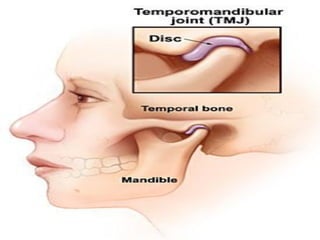
The Temporomandibular Joint (TMJ) is a
common site of complaint. Clicking sounds and
pain are indicators of a frequent condition called
internal derangement, most often affecting
females. As a general term, internal derangement
describes a structural abnormality within an
articulation.


The internal derangement of the
temporomandibular joint (TMJ) is a specific
term defined as an abnormal positional and
functional relationship between the disk and
articulating surfaces.


Emshoff R. and Rudisch A. (2003) defined
internal derangements of the
temporomandibular joint as an abnormal
relation of the articular disc to the mandibular
condyle and the articular eminence. Jaw pain,
clicking of the joint, irregular and limited
movement of the jaw are the characteristic
symptoms of this disorder.
Prevalence
Is TMJ Disorder a common disorder?


Internal derangement and associated
complications are the most common pathologic
entities affecting the jaw. Solberg W.K. (1979)


Nebbe et al (2000) in his study on prevalence
of TMJ disc displacement found normal joints
in only 50% of boys and in 23%–29% of girls.
The rest of the study population presented with
different degrees of slight to full disk
displacement with or without a change in
morphology. In other studies, asymptomatic
disk displacement was documented in
approximately 30% of adolescents.


82% of patients presenting with pain and
functional disturbance of their TMJ will have
displaced disks when examined with magnetic
resonance imaging. The overall prevalence of
symptomatic disk displacement or internal
derangement may range between 20% and 30%,
making them frequently encountered conditions.


The National Institute of Dental and
Craniofacial Research indicates that 10.8 million
people in the United States suffer from TMJ
problems at any given time. Both men and
women experience TMJ problems; however, 90
percent of those seeking treatment are women
in their childbearing years.
Disc Displacements




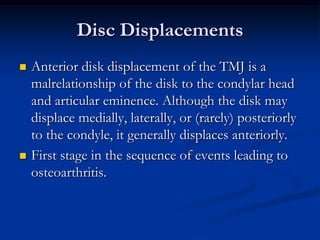
Anterior disk displacement of the TMJ is a
malrelationship of the disk to the condylar head
and articular eminence. Although the disk may
displace medially, laterally, or (rarely) posteriorly
to the condyle, it generally displaces anteriorly.
First stage in the sequence of events leading to
osteoarthritis.


TMJ morphology, have shown a path of
progression that includes changes not only in
the disc position, but also in its configuration.
The interpretation of the process leading up to a
dislocated disc as portrayed in the literature does
not always stand on firm evidence and at times
is contradictory.


Disc displacement is considered to be associated
with clinically noticeable clicking noises on
opening and closing of the mouth as long as the
disc reduces to its normal position on opening.
When it becomes nonreducible, the clicking
noise disappears and instead there is a certain
degree of limitation in mouth opening.
Classification of Disc Displacements


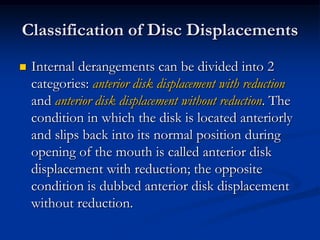
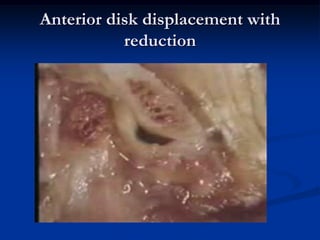
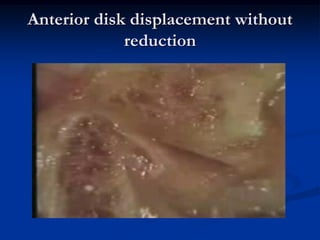
Internal derangements can be divided into 2
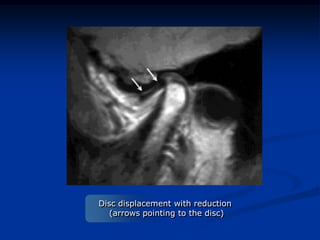
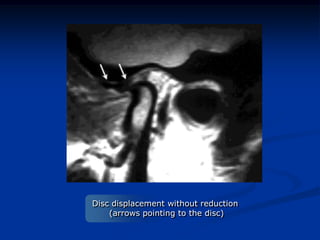
categories: anterior disk displacement with reduction
and anterior disk displacement without reduction. The
condition in which the disk is located anteriorly
and slips back into its normal position during
opening of the mouth is called anterior disk
displacement with reduction; the opposite
condition is dubbed anterior disk displacement
without reduction.
Anterior disk displacement with
reduction
Anterior disk displacement without
reduction
Pathogenesis






TMJ disc displacement results from its inability
to slide smoothly due to increased friction or
degenerative changes in the joint surfaces.
The sequence of events, starting with increased
friction in the upper joint compartment and
culminating in disc displacement
Activation of various parafunctions, such as
clenching, compromises the lubrication system
in the upper TMJ compartment.




The resulting increased friction prevents the disc
from sliding together with the condyle.
On jaw opening, the condyle is pulled away
from the disc by the inferior head of the lateral
pterygoid muscle. As a result, the ligaments
joining the disc to the condyle are gradually
stretched, and the ‘mobilized’ disc gravitates
slightly downward and forward.


Subsequently, on clenching, the unstable disc is
propelled forward by pressure from the condyle.
At this point, the force on the slightly displaced
disc is shared between two vectors, one of
which is directed forward. Apparently, on
mouth closure, the superior belly of the lateral
pterygoid muscle pulls the disc anteriorly


Subsequently, during mouth opening, the
condyle, which is now posterior to the loose
disc, gradually pushes it down the slope of the
eminence, displacing it further forward


Since the lateral articular disc bears the bulk of
the shearing and compressive loads, persistent
loading tends to drive it in a medial direction,
which is the ‘path of least resistance’.
Etiology
1.

2.
3.
4.
5.

TRAUMA
FUNCTIONAL OVERLOADING
JOINT LAXITY
MASTICATORY MUSCLE SPASM
INCREASED FRICTION
Symptoms


1.
2.
3.
4.

Disc Displacement With Reduction:
Pain
Joint sounds (single, short duration)
Catching sensation during mouth opening
Deviation in opening pathway

1.
2.

3.

4.
5.

Disc Displacement Without Reduction:
Limited mandibular opening
Normal eccentric movement to the ipsilateral
side
Restricted eccentric movement to the
contralateral side.
Pain
Joint sounds ( long duration sounds )
Diagnosis
1.

2.

Clinical evaluation
a. History
b. Physical examination
TMJ clicking
Pain
Limitation of mandibular opening
Radiographic evaluation:
Magnetic Resonance Imaging
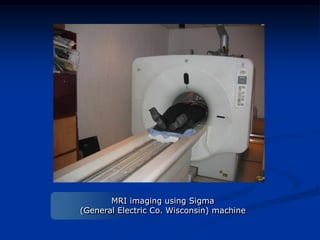
MRI imaging using Sigma
(General Electric Co. Wisconsin) machine
Disc displacement with reduction
(arrows pointing to the disc)
Disc displacement without reduction
(arrows pointing to the disc)
Treatment


1.
2.
3.
4.

Extrajoint therapy:
Splint therapy
Therapeutic manipulation
Physical therapy
Drug therapy


1.
2.
3.

Intrajoint therapy:
Surgical treatment
Arthroscopy
Arthrocentesis
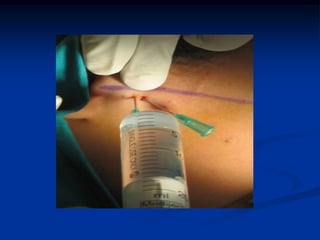
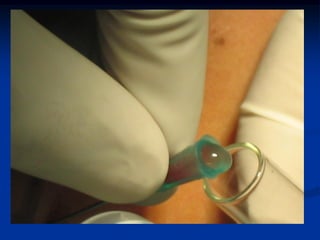
Arthrocentesis


Nitzan et al (1991) described a technique of
irrigation of the upper compartment of the TMJ
with Ringer's lactate solution to treat limited
mouth opening due to internal derangement.
The authors called this technique
`arthrocentesis'.


They reported an increase in mouth opening
from a range of 12±30 mm prior to the
procedure, to 35±50 mm following it. On a
visual analogue scale of 0±15, the pain decreased
from a mean rating of 8.75 to 2.3. This
technique marked an evolution towards less
surgical treatment.


Arthrocentesis is the most recent surgical
approach for internal derangement of the TMJ.
In the past many cases of anterior displacement
of the disc or closed lock that did not improve
with medical treatment (bite plates, muscle
relaxants, diet and physical therapy) were initially
treated with surgical repositioning of the disc
and arthroplasty of the mandibular fossa.


Arthrocentesis has an intermediate place
between the medical and the surgical forms of
treatment. Ease, lower cost of materials and
excellent published results so far include this
technique in the international protocol for the
treatment of TMJ dysfunction.


Arthrocentesis is a simple yet effective treatment
of temporomandibular joint disorders, and it
requires minimal invasion. Significant
improvements in width of mouth opening have
been reported with proven long-term results. It
is speculated that the increase in mouth opening
results from the elimination of the vacuum
effect within the joint compartment.


In 2003, Reston and Turkelson performed a
meta-analysis of surgical treatments for
temporomandibular articular disorders. They
concluded that among patients refractory to
nonsurgical therapies, surgical arthrocentesis and
arthroscopy were most effective for patients
with disc displacement without reduction.


It is suspected that lavage under sufficient
hydraulic pressure could widen the narrowed
joint space and release adhesion in the joint
space. Arthrocentesis with sufficient pressure
could be effective for closed lock cases with
adhesions in the upper joint compartment.
Mechanism of Action
1.

Reduction in pain level:
Arthrocentesis reduces pain by removing
inflammatory mediators from the joint. The
combined treatment of arthrocentesis and
Sodium Hyaluronate injection may improve
the results due to the long-term lubricating
effect of Sodium Hyaluronate, which prevents
the onset of inflammatory mediators that are
responsible for pain.
2.

Maximal Mouth Opening:
Arthrocentesis under high pressure is an
effective method to regain normal mouth
opening in closed lock cases. This effect is
usually due to elimination of the adhesions
around the disc. Also the lubricating effect of
Sodium Hyaluronate which either maintains
lubrication and minimizes wear and tear
mechanically, or plays a role in nutrition of the
avascular parts of the disc and condylar
cartilage.
3.

Clicking :
Usually disappears due to decreased friction
and lubricating effect.
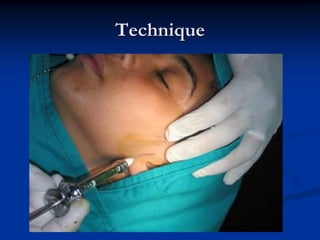
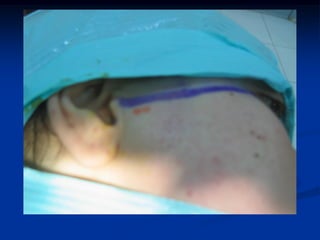
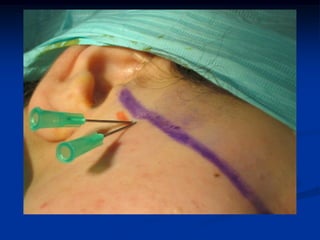
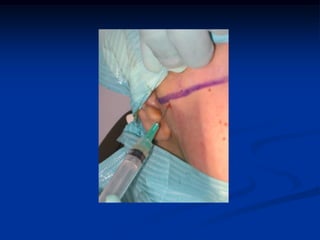
Technique
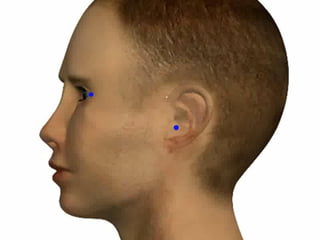
“Relationship between the Canthal-Tragus

Distance and the Puncture Point in
Temporomandibular Joint Arthroscopy”

Wael Talaat Taha1, PhD, Thomas A. McGraw 1,
DMD,
and Bruce Klitzman1, PhD
Int J Oral Maxillofac Surg. 2010; 39: 57 - 60
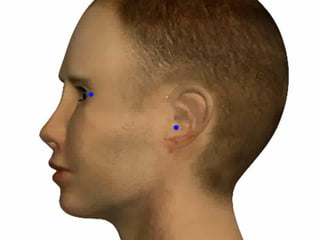
Nearby Vital Structures


The frontal branch of the facial nerve is located
a mean distance of 20 mm from the anterior
margin of the bony external auditory canal as it
crosses over the posterior aspect of the
zygomatic arch (a range of 8 to 35mm). The
main trunk of the bifurcation of the facial nerve
is located a mean distance of 23 mm (a range of
15 to 28 mm) inferior to the lowest concavity of
the bony external auditory canal.


Greene MW et al found the tympanic plate to be
located at a range of 6 to 9 mm anterior to the
posterior tragus and perpendicular to the skin at
a mean depth of 25.4 mm (range = 19 to 32
mm).
Future Directions


. In 2006, Betre et al designed a biologically based
drug delivery vehicle for intra-articular drug delivery
using elastin-like polypeptides (ELPs), a biopolymer
composed of repeating pentapeptides that undergo a
phase transition to form aggregates above their
transition temperature. The ELP drug delivery vehicle
was designed to aggregate upon intra-articular injection
at 37 °C, and form a drug ‘depot’ that could slowly
disaggregate and be cleared from the joint space over
time.
Thank You

Temporomandibular joint disorders II

  • 1.
    Internal Derangements Dr. WaelM. Talaat Assistant Professor of Oral & Maxillofacial Surgery University of Dammam
  • 2.
  • 3.
    What to gain??? 1. 2. 3. 4. 5. Understand Internal Derangements and its underlying causes Be able to diagnose Disc Displacements Choose the correct line of treatment Arthrocentesis, when, how, why ??? Future Directions
  • 4.
    Definition  The Temporomandibular Joint(TMJ) is a common site of complaint. Clicking sounds and pain are indicators of a frequent condition called internal derangement, most often affecting females. As a general term, internal derangement describes a structural abnormality within an articulation.
  • 5.
     The internal derangementof the temporomandibular joint (TMJ) is a specific term defined as an abnormal positional and functional relationship between the disk and articulating surfaces.
  • 6.
     Emshoff R. andRudisch A. (2003) defined internal derangements of the temporomandibular joint as an abnormal relation of the articular disc to the mandibular condyle and the articular eminence. Jaw pain, clicking of the joint, irregular and limited movement of the jaw are the characteristic symptoms of this disorder.
  • 9.
    Prevalence Is TMJ Disordera common disorder?  Internal derangement and associated complications are the most common pathologic entities affecting the jaw. Solberg W.K. (1979)
  • 10.
     Nebbe et al(2000) in his study on prevalence of TMJ disc displacement found normal joints in only 50% of boys and in 23%–29% of girls. The rest of the study population presented with different degrees of slight to full disk displacement with or without a change in morphology. In other studies, asymptomatic disk displacement was documented in approximately 30% of adolescents.
  • 11.
     82% of patientspresenting with pain and functional disturbance of their TMJ will have displaced disks when examined with magnetic resonance imaging. The overall prevalence of symptomatic disk displacement or internal derangement may range between 20% and 30%, making them frequently encountered conditions.
  • 12.
     The National Instituteof Dental and Craniofacial Research indicates that 10.8 million people in the United States suffer from TMJ problems at any given time. Both men and women experience TMJ problems; however, 90 percent of those seeking treatment are women in their childbearing years.
  • 13.
    Disc Displacements   Anterior diskdisplacement of the TMJ is a malrelationship of the disk to the condylar head and articular eminence. Although the disk may displace medially, laterally, or (rarely) posteriorly to the condyle, it generally displaces anteriorly. First stage in the sequence of events leading to osteoarthritis.
  • 14.
     TMJ morphology, haveshown a path of progression that includes changes not only in the disc position, but also in its configuration. The interpretation of the process leading up to a dislocated disc as portrayed in the literature does not always stand on firm evidence and at times is contradictory.
  • 15.
     Disc displacement isconsidered to be associated with clinically noticeable clicking noises on opening and closing of the mouth as long as the disc reduces to its normal position on opening. When it becomes nonreducible, the clicking noise disappears and instead there is a certain degree of limitation in mouth opening.
  • 16.
    Classification of DiscDisplacements  Internal derangements can be divided into 2 categories: anterior disk displacement with reduction and anterior disk displacement without reduction. The condition in which the disk is located anteriorly and slips back into its normal position during opening of the mouth is called anterior disk displacement with reduction; the opposite condition is dubbed anterior disk displacement without reduction.
  • 18.
  • 19.
    Anterior disk displacementwithout reduction
  • 20.
    Pathogenesis    TMJ disc displacementresults from its inability to slide smoothly due to increased friction or degenerative changes in the joint surfaces. The sequence of events, starting with increased friction in the upper joint compartment and culminating in disc displacement Activation of various parafunctions, such as clenching, compromises the lubrication system in the upper TMJ compartment.
  • 21.
      The resulting increasedfriction prevents the disc from sliding together with the condyle. On jaw opening, the condyle is pulled away from the disc by the inferior head of the lateral pterygoid muscle. As a result, the ligaments joining the disc to the condyle are gradually stretched, and the ‘mobilized’ disc gravitates slightly downward and forward.
  • 22.
     Subsequently, on clenching,the unstable disc is propelled forward by pressure from the condyle. At this point, the force on the slightly displaced disc is shared between two vectors, one of which is directed forward. Apparently, on mouth closure, the superior belly of the lateral pterygoid muscle pulls the disc anteriorly
  • 23.
     Subsequently, during mouthopening, the condyle, which is now posterior to the loose disc, gradually pushes it down the slope of the eminence, displacing it further forward
  • 24.
     Since the lateralarticular disc bears the bulk of the shearing and compressive loads, persistent loading tends to drive it in a medial direction, which is the ‘path of least resistance’.
  • 25.
  • 26.
    Symptoms  1. 2. 3. 4. Disc Displacement WithReduction: Pain Joint sounds (single, short duration) Catching sensation during mouth opening Deviation in opening pathway
  • 27.
     1. 2. 3. 4. 5. Disc Displacement WithoutReduction: Limited mandibular opening Normal eccentric movement to the ipsilateral side Restricted eccentric movement to the contralateral side. Pain Joint sounds ( long duration sounds )
  • 28.
    Diagnosis 1. 2. Clinical evaluation a. History b.Physical examination TMJ clicking Pain Limitation of mandibular opening Radiographic evaluation: Magnetic Resonance Imaging
  • 29.
    MRI imaging usingSigma (General Electric Co. Wisconsin) machine
  • 30.
    Disc displacement withreduction (arrows pointing to the disc)
  • 31.
    Disc displacement withoutreduction (arrows pointing to the disc)
  • 32.
  • 33.
  • 34.
    Arthrocentesis  Nitzan et al(1991) described a technique of irrigation of the upper compartment of the TMJ with Ringer's lactate solution to treat limited mouth opening due to internal derangement. The authors called this technique `arthrocentesis'.
  • 35.
     They reported anincrease in mouth opening from a range of 12±30 mm prior to the procedure, to 35±50 mm following it. On a visual analogue scale of 0±15, the pain decreased from a mean rating of 8.75 to 2.3. This technique marked an evolution towards less surgical treatment.
  • 36.
     Arthrocentesis is themost recent surgical approach for internal derangement of the TMJ. In the past many cases of anterior displacement of the disc or closed lock that did not improve with medical treatment (bite plates, muscle relaxants, diet and physical therapy) were initially treated with surgical repositioning of the disc and arthroplasty of the mandibular fossa.
  • 37.
     Arthrocentesis has anintermediate place between the medical and the surgical forms of treatment. Ease, lower cost of materials and excellent published results so far include this technique in the international protocol for the treatment of TMJ dysfunction.
  • 38.
     Arthrocentesis is asimple yet effective treatment of temporomandibular joint disorders, and it requires minimal invasion. Significant improvements in width of mouth opening have been reported with proven long-term results. It is speculated that the increase in mouth opening results from the elimination of the vacuum effect within the joint compartment.
  • 39.
     In 2003, Restonand Turkelson performed a meta-analysis of surgical treatments for temporomandibular articular disorders. They concluded that among patients refractory to nonsurgical therapies, surgical arthrocentesis and arthroscopy were most effective for patients with disc displacement without reduction.
  • 40.
     It is suspectedthat lavage under sufficient hydraulic pressure could widen the narrowed joint space and release adhesion in the joint space. Arthrocentesis with sufficient pressure could be effective for closed lock cases with adhesions in the upper joint compartment.
  • 41.
    Mechanism of Action 1. Reductionin pain level: Arthrocentesis reduces pain by removing inflammatory mediators from the joint. The combined treatment of arthrocentesis and Sodium Hyaluronate injection may improve the results due to the long-term lubricating effect of Sodium Hyaluronate, which prevents the onset of inflammatory mediators that are responsible for pain.
  • 42.
    2. Maximal Mouth Opening: Arthrocentesisunder high pressure is an effective method to regain normal mouth opening in closed lock cases. This effect is usually due to elimination of the adhesions around the disc. Also the lubricating effect of Sodium Hyaluronate which either maintains lubrication and minimizes wear and tear mechanically, or plays a role in nutrition of the avascular parts of the disc and condylar cartilage.
  • 43.
    3. Clicking : Usually disappearsdue to decreased friction and lubricating effect.
  • 44.
  • 46.
    “Relationship between theCanthal-Tragus Distance and the Puncture Point in Temporomandibular Joint Arthroscopy” Wael Talaat Taha1, PhD, Thomas A. McGraw 1, DMD, and Bruce Klitzman1, PhD Int J Oral Maxillofac Surg. 2010; 39: 57 - 60
  • 53.
    Nearby Vital Structures  Thefrontal branch of the facial nerve is located a mean distance of 20 mm from the anterior margin of the bony external auditory canal as it crosses over the posterior aspect of the zygomatic arch (a range of 8 to 35mm). The main trunk of the bifurcation of the facial nerve is located a mean distance of 23 mm (a range of 15 to 28 mm) inferior to the lowest concavity of the bony external auditory canal.
  • 54.
     Greene MW etal found the tympanic plate to be located at a range of 6 to 9 mm anterior to the posterior tragus and perpendicular to the skin at a mean depth of 25.4 mm (range = 19 to 32 mm).
  • 55.
    Future Directions  . In2006, Betre et al designed a biologically based drug delivery vehicle for intra-articular drug delivery using elastin-like polypeptides (ELPs), a biopolymer composed of repeating pentapeptides that undergo a phase transition to form aggregates above their transition temperature. The ELP drug delivery vehicle was designed to aggregate upon intra-articular injection at 37 °C, and form a drug ‘depot’ that could slowly disaggregate and be cleared from the joint space over time.
  • 56.