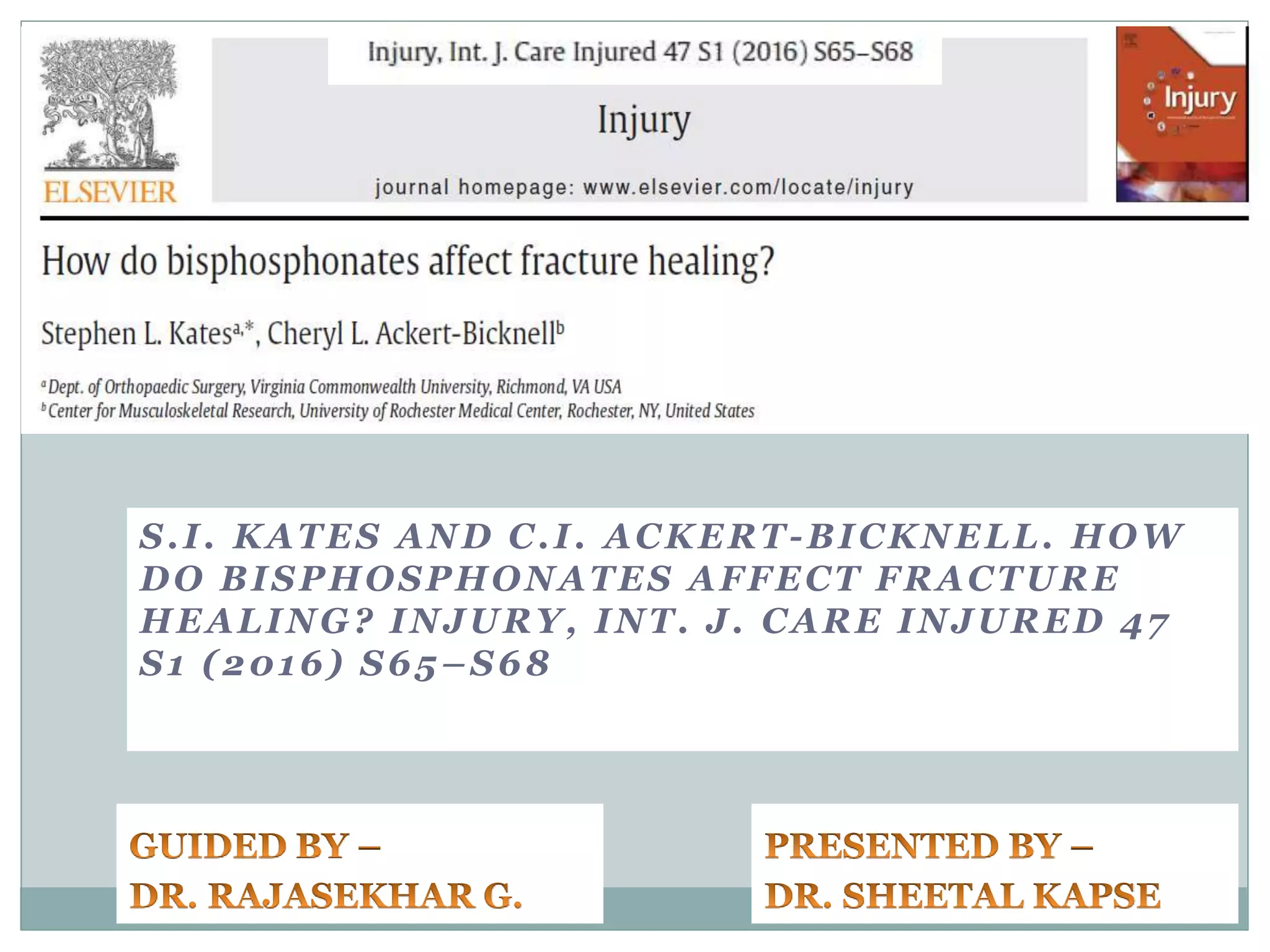
S.I. KATES AND C.I. ACKERT-BICKNELL. HOW
DO BISPHOSPHONATES AFFECT FRACTURE
HEALING? INJURY, INT. J. CARE INJURED 47
S1 (2016) S65–S68
1. Stephen L. Kates -
2. Cheryl L. Ackert-Bicknell -
Dept. of Orthopaedic Surgery, Virginia
Commonwealth University, Richmond, VA USA
Center for Musculoskeletal Research, University
of Rochester Medical Center, Rochester, NY,
United States
 Introduction
 Materials and methods
 Results & Discussion
 Cross references
 Conclusion
 Pros and Cons of study
 References
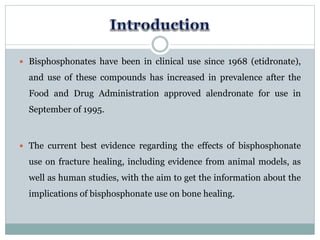
 Bisphosphonates have been in clinical use since 1968 (etidronate),
and use of these compounds has increased in prevalence after the
Food and Drug Administration approved alendronate for use in
September of 1995.
 The current best evidence regarding the effects of bisphosphonate
use on fracture healing, including evidence from animal models, as
well as human studies, with the aim to get the information about the
implications of bisphosphonate use on bone healing.
BONE HEALING
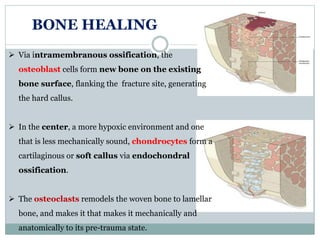
 Via intramembranous ossification, the
osteoblast cells form new bone on the existing
bone surface, flanking the fracture site, generating
the hard callus.
 In the center, a more hypoxic environment and one
that is less mechanically sound, chondrocytes form a
cartilaginous or soft callus via endochondral
ossification.
 The osteoclasts remodels the woven bone to lamellar
bone, and makes it that makes it mechanically and
anatomically to its pre-trauma state.
BISPHOSPHONATES
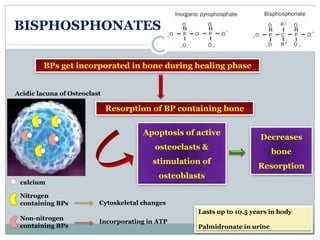
BPs get incorporated in bone during healing phase
Resorption of BP containing bone
Lasts up to 10.5 years in body
Palmidronate in urine
Acidic lacuna of Osteoclast
Nitrogen
containing BPs
calcium
Non-nitrogen
containing BPs
Cytoskeletal changes
Incorporating in ATP
Decreases
bone
Resorption
Apoptosis of active
osteoclasts &
stimulation of
osteoblasts
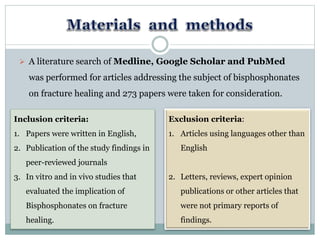
 A literature search of Medline, Google Scholar and PubMed
was performed for articles addressing the subject of bisphosphonates
on fracture healing and 273 papers were taken for consideration.
Inclusion criteria:
1. Papers were written in English,
2. Publication of the study findings in
peer-reviewed journals
3. In vitro and in vivo studies that
evaluated the implication of
Bisphosphonates on fracture
healing.
Exclusion criteria:
1. Articles using languages other than
English
2. Letters, reviews, expert opinion
publications or other articles that
were not primary reports of
findings.
Less effects on human study
Affects the 26% patients already on BPs
Doesn’t affect when given after fracture
No effects on callus formation
Delays bone remodeling
Remodeling delays maximum by 1 week
Mechanical strength of healed callus is similar
Drug – holiday effect is not clear yet
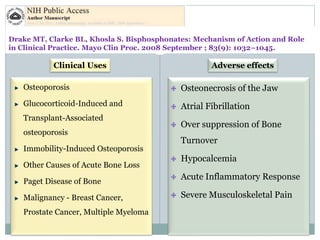
Drake MT, Clarke BL, Khosla S. Bisphosphonates: Mechanism of Action and Role
in Clinical Practice. Mayo Clin Proc. 2008 September ; 83(9): 1032–1045.
Osteoporosis
Glucocorticoid-Induced and
Transplant-Associated
osteoporosis
Immobility-Induced Osteoporosis
Other Causes of Acute Bone Loss
Paget Disease of Bone
Malignancy - Breast Cancer,
Prostate Cancer, Multiple Myeloma
Osteonecrosis of the Jaw
Atrial Fibrillation
Over suppression of Bone
Turnover
Hypocalcemia
Acute Inflammatory Response
Severe Musculoskeletal Pain
Clinical Uses Adverse effects
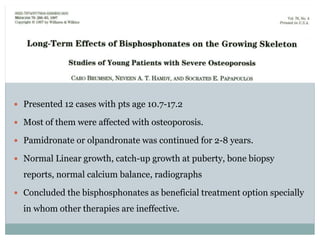
 Presented 12 cases with pts age 10.7-17.2
 Most of them were affected with osteoporosis.
 Pamidronate or olpandronate was continued for 2-8 years.
 Normal Linear growth, catch-up growth at puberty, bone biopsy
reports, normal calcium balance, radiographs
 Concluded the bisphosphonates as beneficial treatment option specially
in whom other therapies are ineffective.
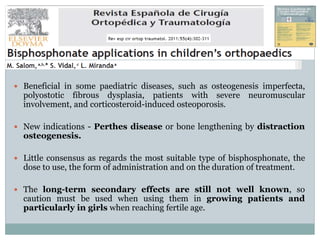
 Beneficial in some paediatric diseases, such as osteogenesis imperfecta,
polyostotic fibrous dysplasia, patients with severe neuromuscular
involvement, and corticosteroid-induced osteoporosis.
 New indications - Perthes disease or bone lengthening by distraction
osteogenesis.
 Little consensus as regards the most suitable type of bisphosphonate, the
dose to use, the form of administration and on the duration of treatment.
 The long-term secondary effects are still not well known, so
caution must be used when using them in growing patients and
particularly in girls when reaching fertile age.
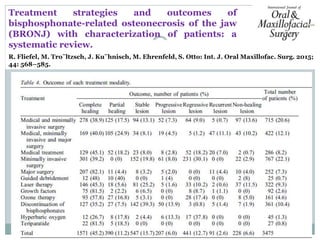
R. Fliefel, M. Tro¨ltzsch, J. Ku¨hnisch, M. Ehrenfeld, S. Otto: Int. J. Oral Maxillofac. Surg. 2015;
44: 568–585.
Treatment strategies and outcomes of
bisphosphonate-related osteonecrosis of the jaw
(BRONJ) with characterization of patients: a
systematic review.
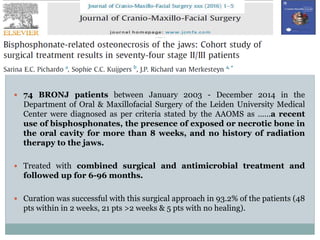
 74 BRONJ patients between January 2003 - December 2014 in the
Department of Oral & Maxillofacial Surgery of the Leiden University Medical
Center were diagnosed as per criteria stated by the AAOMS as ……a recent
use of bisphosphonates, the presence of exposed or necrotic bone in
the oral cavity for more than 8 weeks, and no history of radiation
therapy to the jaws.
 Treated with combined surgical and antimicrobial treatment and
followed up for 6-96 months.
 Curation was successful with this surgical approach in 93.2% of the patients (48
pts within in 2 weeks, 21 pts >2 weeks & 5 pts with no healing).
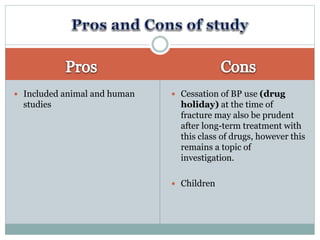
 Included animal and human
studies
 Cessation of BP use (drug
holiday) at the time of
fracture may also be prudent
after long-term treatment with
this class of drugs, however this
remains a topic of
investigation.
 Children
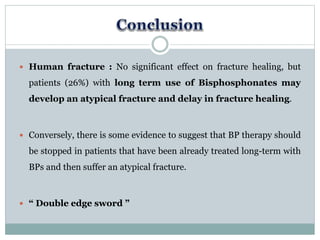
 Human fracture : No significant effect on fracture healing, but
patients (26%) with long term use of Bisphosphonates may
develop an atypical fracture and delay in fracture healing.
 Conversely, there is some evidence to suggest that BP therapy should
be stopped in patients that have been already treated long-term with
BPs and then suffer an atypical fracture.
 “ Double edge sword ”
1. Drake MT, Clarke BL, Khosla S. Bisphosphonates: Mechanism of Action and Role in Clinical Practice.
Mayo Clin Proc. 2008 September ; 83(9): 1032–1045.
2. R. Fliefel, M. Tro¨ltzsch, J. Ku¨hnisch, M. Ehrenfeld, S. Otto: Treatment strategies and outcomes of
bisphosphonate-related osteonecrosis of the jaw (BRONJ) with characterization of patients: a
systematic review. Int. J. Oral Maxillofac. Surg. 2015; 44: 568–585.
3. Sarina E.C. Pichardo, Sophie C.C. Kuijpers , J.P. Richard van Merkesteyn. Bisphosphonate-related
osteonecrosis of the jaws: Cohort study of surgical treatment results in seventy-four stage II/III
patients. Journal of Cranio-Maxillo-Facial Surgery xxx (2016) 1e5.
4. Beumsen, Hamdy and Papapolus. Long-term effects of bisphosphonates on the growing skeleton
studies of young patients with severe osteoporosis. MEDICINE. 1997;76:266-83.
5. M. Salom, S. Vidal, L. Miranda. Bisphosphonate applications in children’s orthopaedics. Rev esp cir
ortop traumatol. 2011;55(4):302-311

How do bisphosphonated affect # healing

  • 1.
    S.I. KATES ANDC.I. ACKERT-BICKNELL. HOW DO BISPHOSPHONATES AFFECT FRACTURE HEALING? INJURY, INT. J. CARE INJURED 47 S1 (2016) S65–S68
  • 2.
    1. Stephen L.Kates - 2. Cheryl L. Ackert-Bicknell - Dept. of Orthopaedic Surgery, Virginia Commonwealth University, Richmond, VA USA Center for Musculoskeletal Research, University of Rochester Medical Center, Rochester, NY, United States
  • 3.
     Introduction  Materialsand methods  Results & Discussion  Cross references  Conclusion  Pros and Cons of study  References
  • 4.
     Bisphosphonates havebeen in clinical use since 1968 (etidronate), and use of these compounds has increased in prevalence after the Food and Drug Administration approved alendronate for use in September of 1995.  The current best evidence regarding the effects of bisphosphonate use on fracture healing, including evidence from animal models, as well as human studies, with the aim to get the information about the implications of bisphosphonate use on bone healing.
  • 5.
    BONE HEALING  Viaintramembranous ossification, the osteoblast cells form new bone on the existing bone surface, flanking the fracture site, generating the hard callus.  In the center, a more hypoxic environment and one that is less mechanically sound, chondrocytes form a cartilaginous or soft callus via endochondral ossification.  The osteoclasts remodels the woven bone to lamellar bone, and makes it that makes it mechanically and anatomically to its pre-trauma state.
  • 6.
    BISPHOSPHONATES BPs get incorporatedin bone during healing phase Resorption of BP containing bone Lasts up to 10.5 years in body Palmidronate in urine Acidic lacuna of Osteoclast Nitrogen containing BPs calcium Non-nitrogen containing BPs Cytoskeletal changes Incorporating in ATP Decreases bone Resorption Apoptosis of active osteoclasts & stimulation of osteoblasts
  • 7.
     A literaturesearch of Medline, Google Scholar and PubMed was performed for articles addressing the subject of bisphosphonates on fracture healing and 273 papers were taken for consideration. Inclusion criteria: 1. Papers were written in English, 2. Publication of the study findings in peer-reviewed journals 3. In vitro and in vivo studies that evaluated the implication of Bisphosphonates on fracture healing. Exclusion criteria: 1. Articles using languages other than English 2. Letters, reviews, expert opinion publications or other articles that were not primary reports of findings.
  • 8.
    Less effects onhuman study Affects the 26% patients already on BPs Doesn’t affect when given after fracture No effects on callus formation Delays bone remodeling Remodeling delays maximum by 1 week Mechanical strength of healed callus is similar Drug – holiday effect is not clear yet
  • 10.
    Drake MT, ClarkeBL, Khosla S. Bisphosphonates: Mechanism of Action and Role in Clinical Practice. Mayo Clin Proc. 2008 September ; 83(9): 1032–1045. Osteoporosis Glucocorticoid-Induced and Transplant-Associated osteoporosis Immobility-Induced Osteoporosis Other Causes of Acute Bone Loss Paget Disease of Bone Malignancy - Breast Cancer, Prostate Cancer, Multiple Myeloma Osteonecrosis of the Jaw Atrial Fibrillation Over suppression of Bone Turnover Hypocalcemia Acute Inflammatory Response Severe Musculoskeletal Pain Clinical Uses Adverse effects
  • 11.
     Presented 12cases with pts age 10.7-17.2  Most of them were affected with osteoporosis.  Pamidronate or olpandronate was continued for 2-8 years.  Normal Linear growth, catch-up growth at puberty, bone biopsy reports, normal calcium balance, radiographs  Concluded the bisphosphonates as beneficial treatment option specially in whom other therapies are ineffective.
  • 12.
     Beneficial insome paediatric diseases, such as osteogenesis imperfecta, polyostotic fibrous dysplasia, patients with severe neuromuscular involvement, and corticosteroid-induced osteoporosis.  New indications - Perthes disease or bone lengthening by distraction osteogenesis.  Little consensus as regards the most suitable type of bisphosphonate, the dose to use, the form of administration and on the duration of treatment.  The long-term secondary effects are still not well known, so caution must be used when using them in growing patients and particularly in girls when reaching fertile age.
  • 13.
    R. Fliefel, M.Tro¨ltzsch, J. Ku¨hnisch, M. Ehrenfeld, S. Otto: Int. J. Oral Maxillofac. Surg. 2015; 44: 568–585. Treatment strategies and outcomes of bisphosphonate-related osteonecrosis of the jaw (BRONJ) with characterization of patients: a systematic review.
  • 14.
     74 BRONJpatients between January 2003 - December 2014 in the Department of Oral & Maxillofacial Surgery of the Leiden University Medical Center were diagnosed as per criteria stated by the AAOMS as ……a recent use of bisphosphonates, the presence of exposed or necrotic bone in the oral cavity for more than 8 weeks, and no history of radiation therapy to the jaws.  Treated with combined surgical and antimicrobial treatment and followed up for 6-96 months.  Curation was successful with this surgical approach in 93.2% of the patients (48 pts within in 2 weeks, 21 pts >2 weeks & 5 pts with no healing).
  • 15.
     Included animaland human studies  Cessation of BP use (drug holiday) at the time of fracture may also be prudent after long-term treatment with this class of drugs, however this remains a topic of investigation.  Children
  • 16.
     Human fracture: No significant effect on fracture healing, but patients (26%) with long term use of Bisphosphonates may develop an atypical fracture and delay in fracture healing.  Conversely, there is some evidence to suggest that BP therapy should be stopped in patients that have been already treated long-term with BPs and then suffer an atypical fracture.  “ Double edge sword ”
  • 17.
    1. Drake MT,Clarke BL, Khosla S. Bisphosphonates: Mechanism of Action and Role in Clinical Practice. Mayo Clin Proc. 2008 September ; 83(9): 1032–1045. 2. R. Fliefel, M. Tro¨ltzsch, J. Ku¨hnisch, M. Ehrenfeld, S. Otto: Treatment strategies and outcomes of bisphosphonate-related osteonecrosis of the jaw (BRONJ) with characterization of patients: a systematic review. Int. J. Oral Maxillofac. Surg. 2015; 44: 568–585. 3. Sarina E.C. Pichardo, Sophie C.C. Kuijpers , J.P. Richard van Merkesteyn. Bisphosphonate-related osteonecrosis of the jaws: Cohort study of surgical treatment results in seventy-four stage II/III patients. Journal of Cranio-Maxillo-Facial Surgery xxx (2016) 1e5. 4. Beumsen, Hamdy and Papapolus. Long-term effects of bisphosphonates on the growing skeleton studies of young patients with severe osteoporosis. MEDICINE. 1997;76:266-83. 5. M. Salom, S. Vidal, L. Miranda. Bisphosphonate applications in children’s orthopaedics. Rev esp cir ortop traumatol. 2011;55(4):302-311

Editor's Notes

  • #6 This creates an inflammatory environment that recruits mesenchymal stem cells (MSCs) to the site of healing, followed by expansion of these cells and their differentiation into either osteoblasts or chondrocytes.
  • #7 Clinically used BPs can be divided into nonnitrogen containing compounds such as etidronate, clodronate, tiludronate and nitrogen containing BPs such as pamidronate, alendronate, ibandronate, risedronate and zoledronate. All BPs have a high affinity for calcium and in the body, they concentrate in the skeleton at sites of active bone remodeling
  • #15 American Association of Oral and Maxillofacial Surgeons (AAOMS)