• Introduction
• History of negative pressure therapy
(The VAC system)
• Mechanisms of action
• Clinical applications of NPWT
• Clinical considerations
• Future perspectives
• Cross references
• Summary
• References
• Vacuum-assisted closure (VAC), sometimes referred to
as microdeformational wound therapy (MDWT) or
negative pressure wound therapy (NPWT), has
revolutionized wound care over the last 15 years.
• This monograph describes the current understanding of
these technologies, the questions that remain, and what
the future may hold for technologies based on
mechanotransduction principles.
• Dressings to treat complex wounds have traditionally
been made of cotton gauze which could be soaked with
a variety of chemicals including normal saline and
sodium hypochlorite solutions.
• In the 1960s, the importance of keeping the wound
moist was discovered and a wide array of hydrogels,
alginates, and other polymeric and biologically based
dressings were developed.
• More recently, these dressing materials have been
combined with antimicrobial compounds such as
silver. Collectively, there are approximately 1500
dressing types available.
Any device that applies
differential suction (ie,
reduced local pressure) to
wounds.
Type of NPWT
systems that create
microdeformations
(appearing as
microdome like
structures) at the
wound surface
These novel
therapies have
been shown to
facilitate the
healing of various
types of wounds
derived from
trauma,
infection,
congenital
deformities, and
tumors.
• Bier described the use of suction cups for a variety of ailments that
have been largely abandoned.
• Typically, these devices have been designed to apply low levels of
suction (<40 mmHg).
• In 1993 Fleischmann et al initially developed the vacuum sealing
drainage technique and successfully used it to treat limb open-
fracture injuries.
• In 1997 Argenta and Morykwas introduced a vacuum-assisted
closure (VAC) system to manage complicated wounds.
Argenta LC, Morykwas MJ: Vacuum-assisted closure: A new method for wound
control and treatment: Clinical experience. Ann Plast Surg 38:563, 1997
FleischmannW, StreckerW, Bombelli M, et al: Vacuum sealing as treatment of
soft tissue damage in open fractures. Unfallchirurg 96:488, 1993
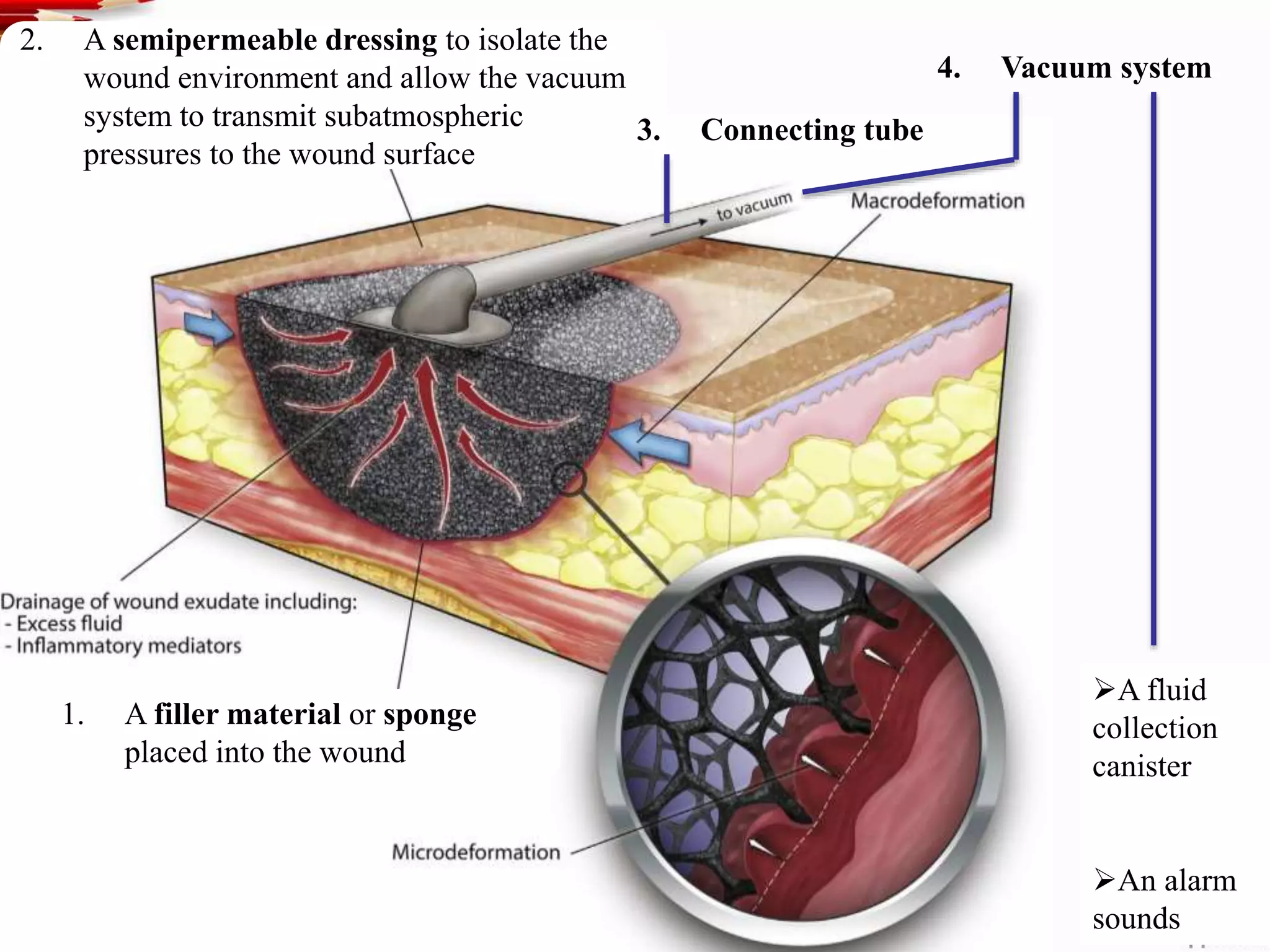
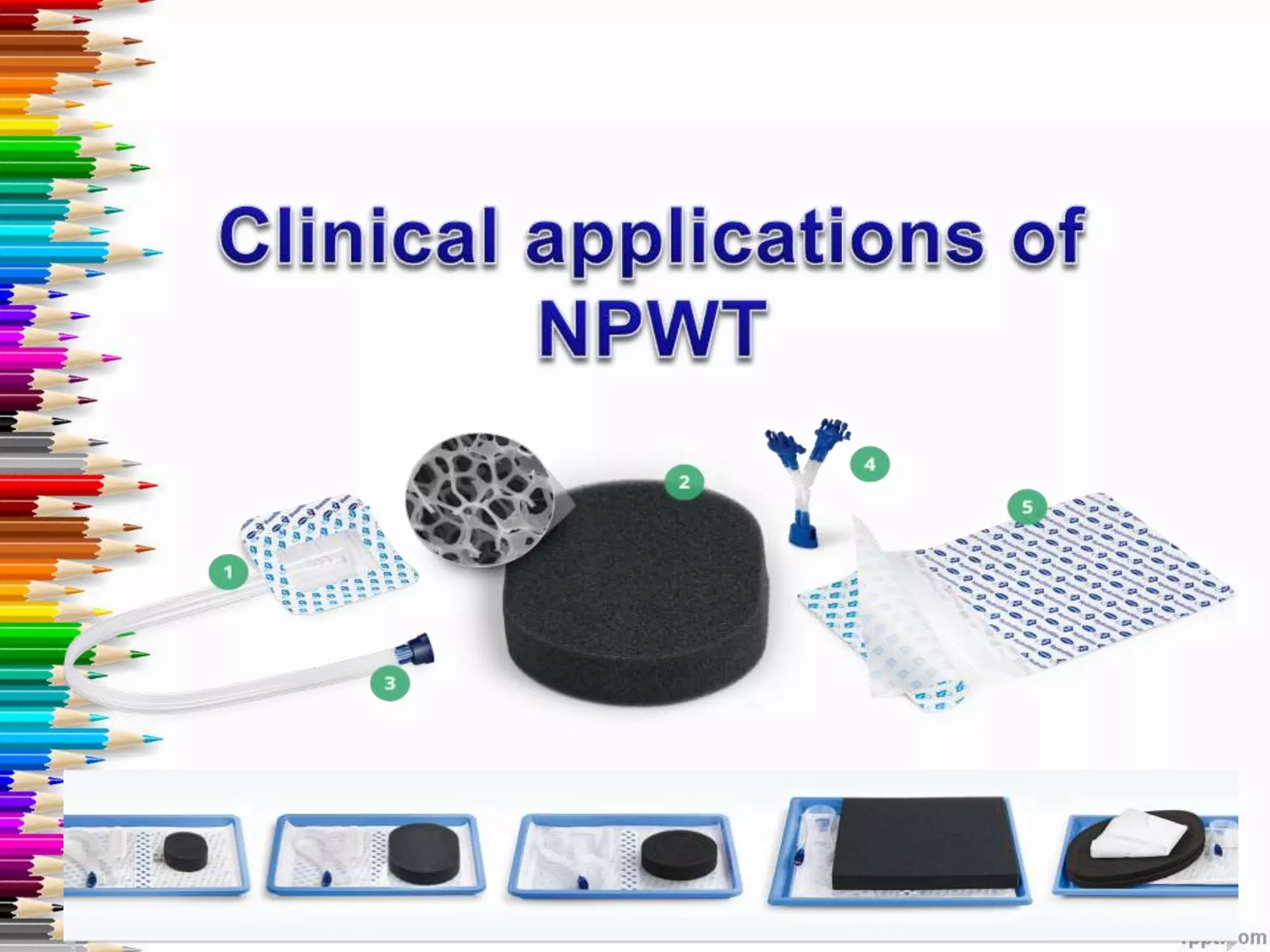
1. A filler material or sponge
placed into the wound
2. A semipermeable dressing to isolate the
wound environment and allow the vacuum
system to transmit subatmospheric
pressures to the wound surface
4. Vacuum system
3. Connecting tube
A fluid
collection
canister
An alarm
sounds
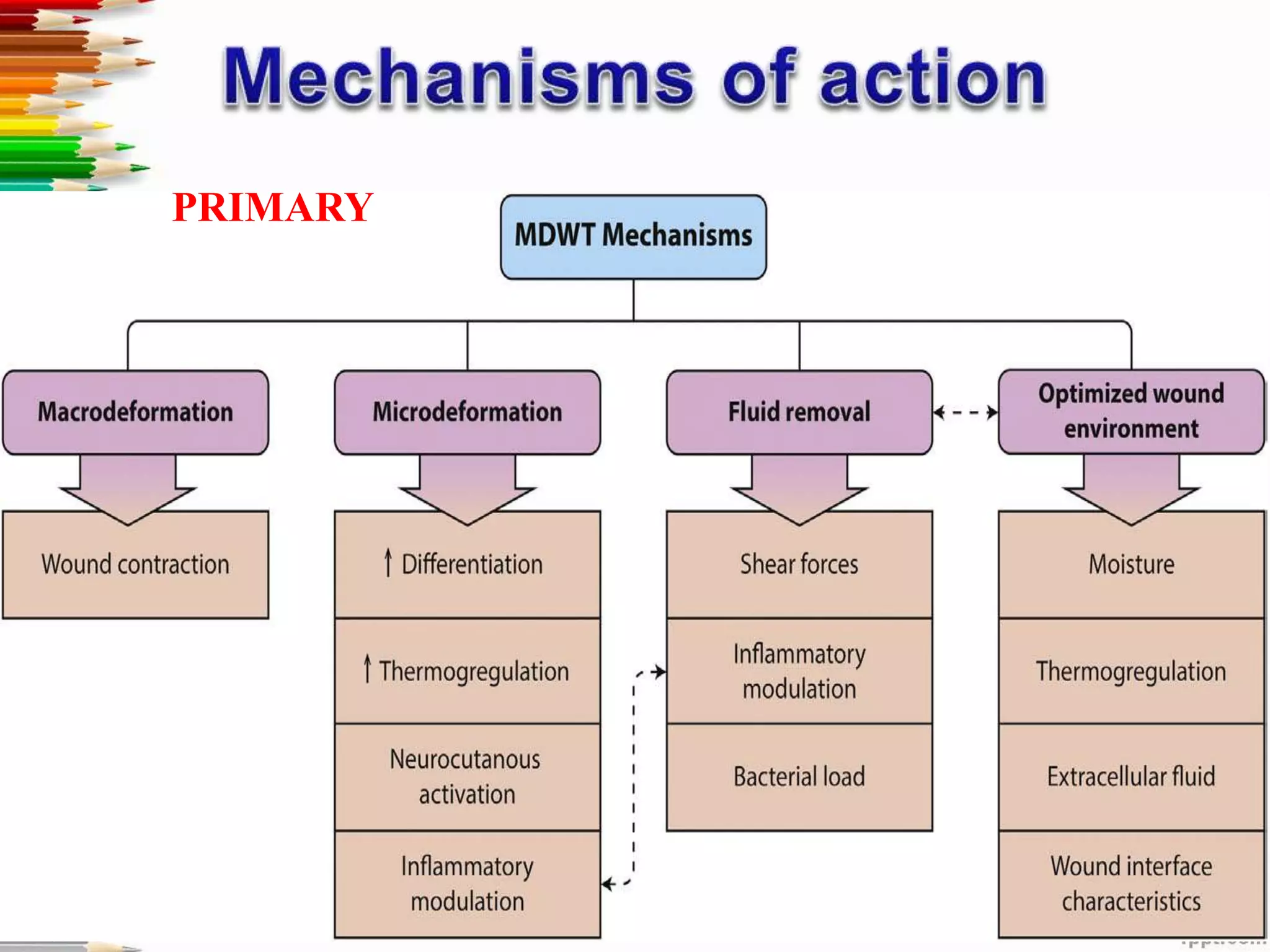
PRIMARY
Therefore, we use the term MDWT for devices that deform wounds on the micron-to-
millimeter scale, incurring morphologic and functional changes in cells that further improve
wound healing.
The most popular clinical
systems use open-pore
foam dressings, which
result in the formation of
tiny, domelike structures
at the wound surface that
cause microdeformations
to the wound surface.
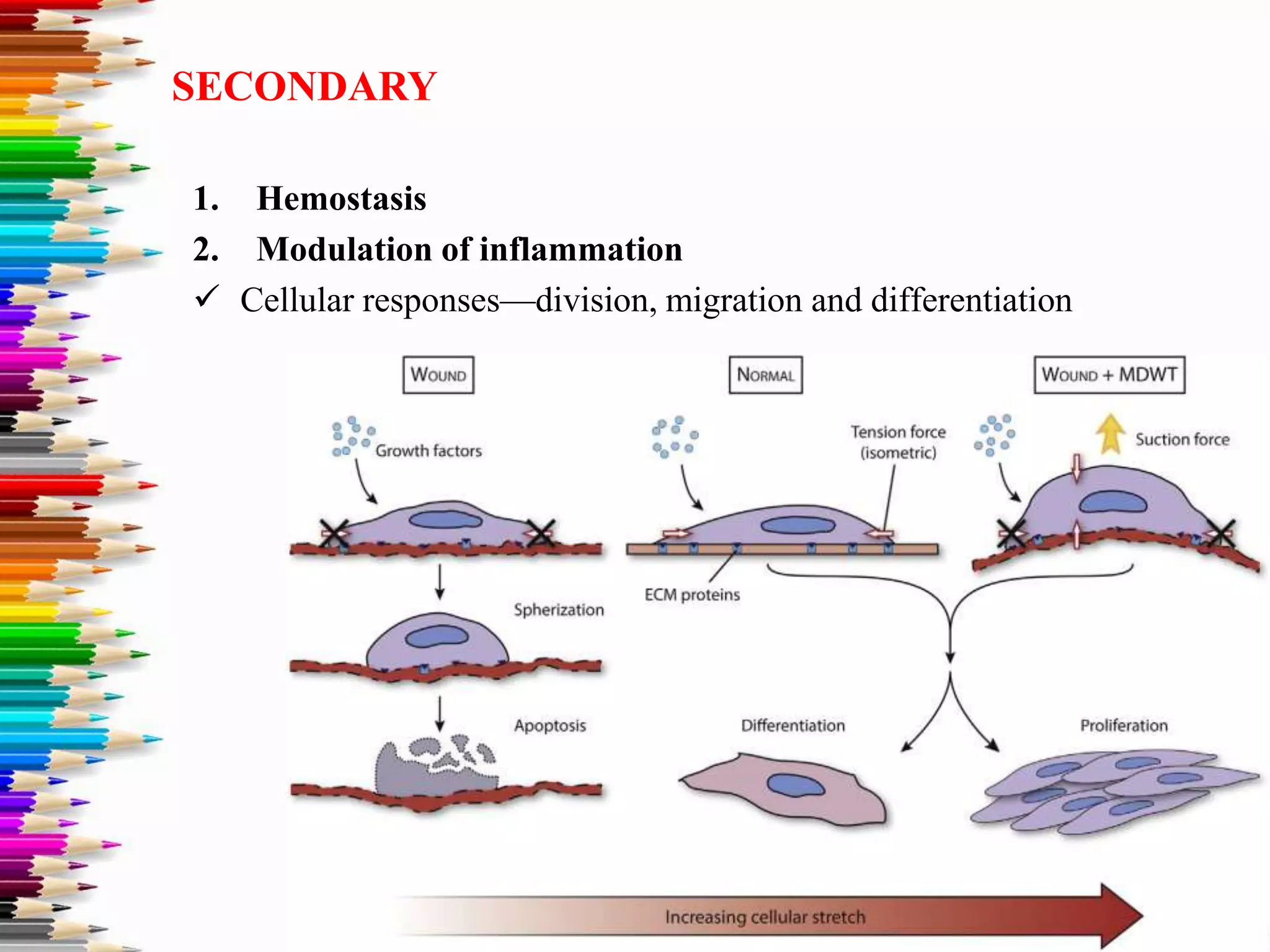
1. Hemostasis
2. Modulation of inflammation
 Cellular responses—division, migration and differentiation
SECONDARY
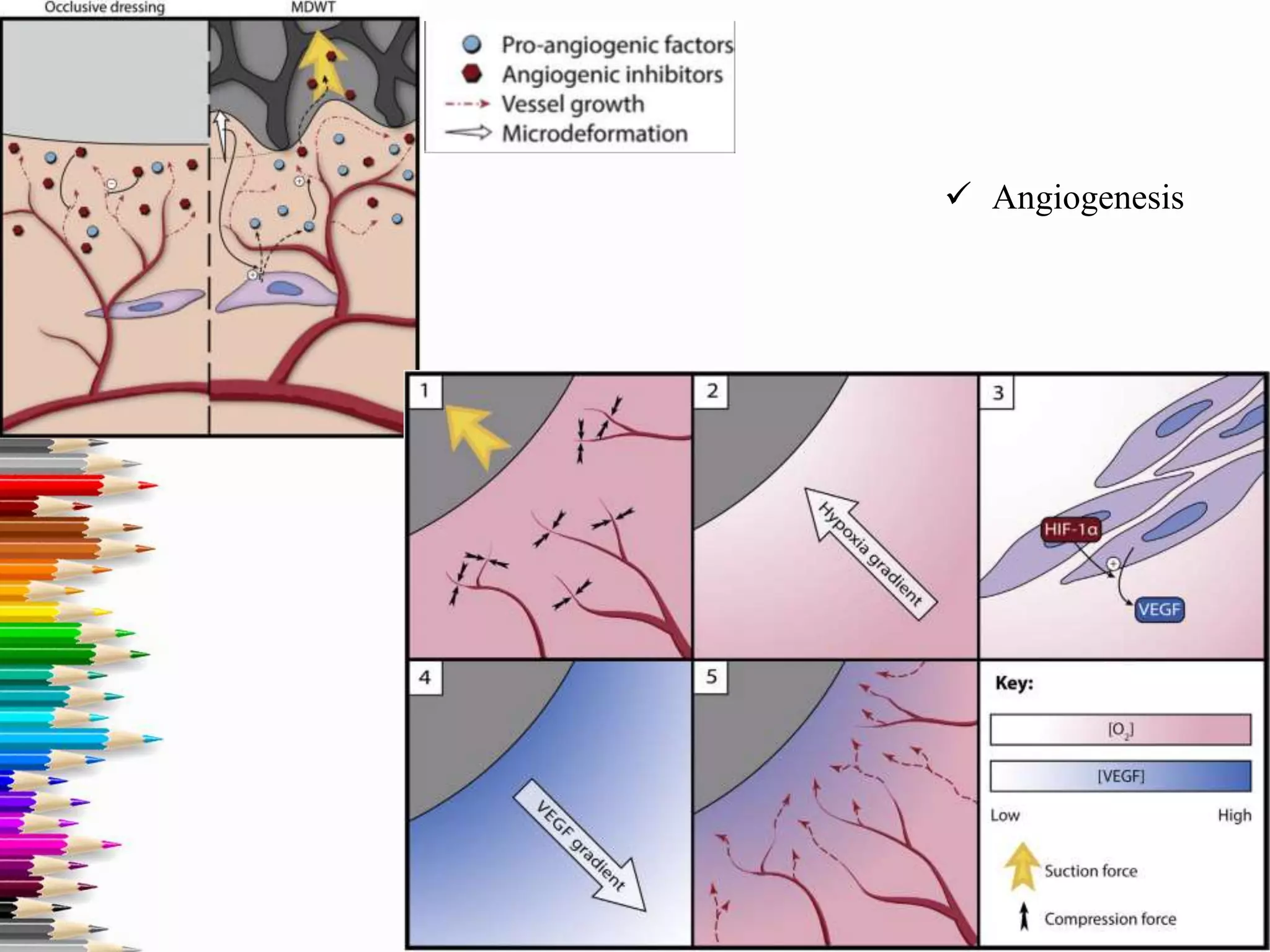
 Angiogenesis
 Granulation tissue formation
 Peripheral nerve response
Open wounds
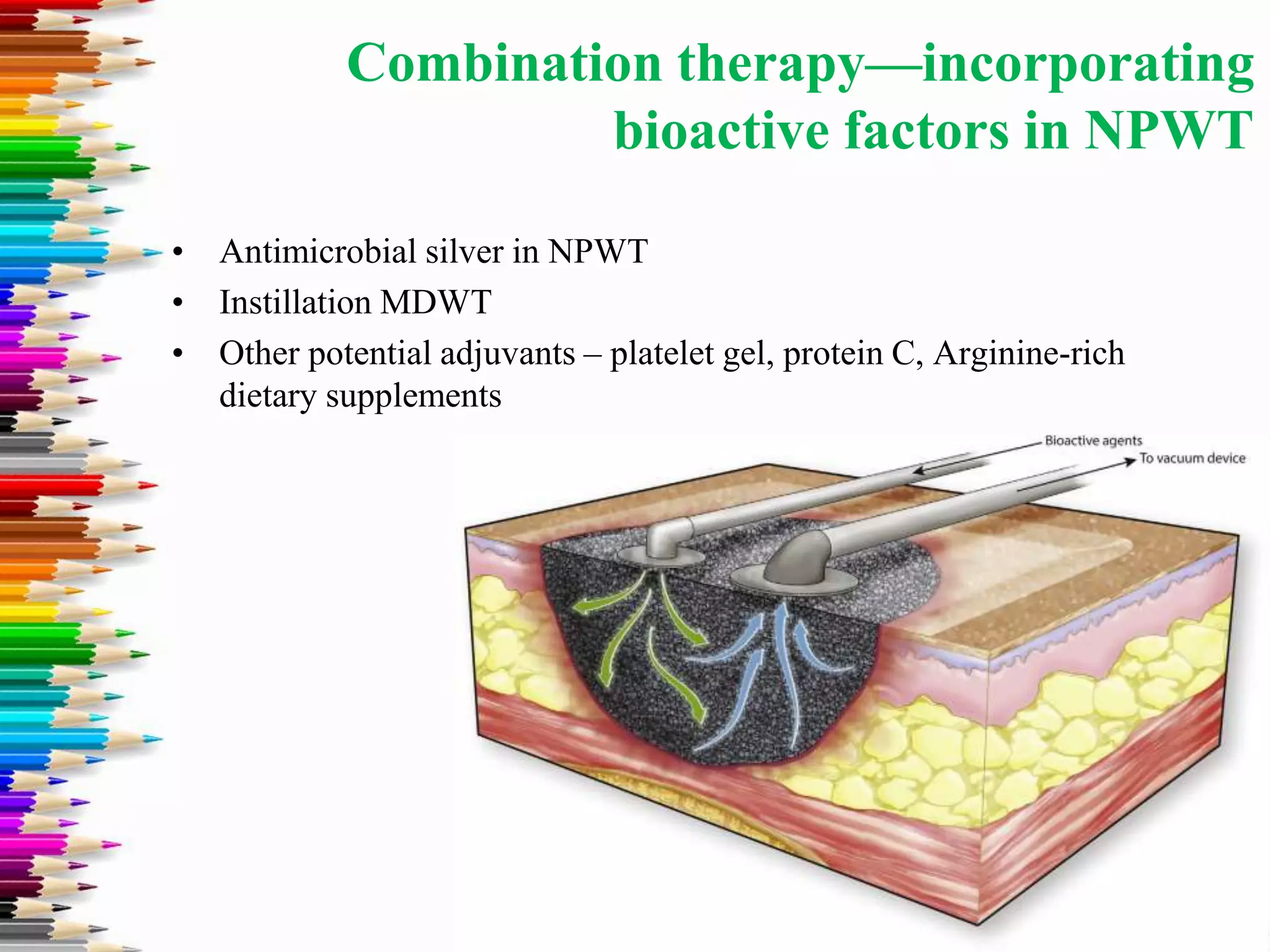
Combination therapy—incorporating
bioactive factors in NPWT
• Antimicrobial silver in NPWT
• Instillation MDWT
• Other potential adjuvants – platelet gel, protein C, Arginine-rich
dietary supplements
• The FDA has approved NPWT for managing poorly healing
wounds.
• Manufacturer guidelines for the widely used KCI V.A.C. therapy
systems list chronic, acute, traumatic, subacute, and dehisced
wounds, partial thickness burns, ulcers (such as diabetic, pressure
or venous insufficiency), flaps and grafts as indications for use.
Contraindications
1. Necrotic tissue with eschar present
2. Untreated osteomyelitis
3. Nonenteric and unexplored fistulas
4. Malignancy in the wound
5. Exposed vasculature
6. Exposed nerves
7. Exposed anastomotic site
8. Exposed organs
Potential risks
1. High risk of bleeding and hemorrhage
2. Ongoing treatment with anticoagulants or platelet aggregation
inhibitors
3. Friable or infected blood vessels, vascular anastomosis, infected
wounds, osteomyelitis, exposed organs, vessels, nerves, tendon or
ligaments, sharp edges at the wound, spinal cord injury and eteric
fistulas
4. Patient requires magnetic resonance imaging or hyperbaric chamber
or defibrillation
5. Patient weight and size
6. Proximity of foam to vagus nerve
7. Circumferential dressing application
8. Mode of therapy (continuous or intermittent suction )
• Interface material
• Optimal cycling
• Adhesives
• From January 2004 to December 2009
• 13 male patients (mean age: 50 years)
• 12 patients (92%) had complicated wounds with infection
and one patient (8%) with partial loss of the free flap.
• Eight of these 13 patients (62%) had saliva leakage and
fistula formation.
• The average duration of the NPWT usage was 10.8 days (4 -
24 days); most of the wounds healed within 1 week after the
NPWT application.
J Oral Maxillofac Surg 74:401-405, 2016
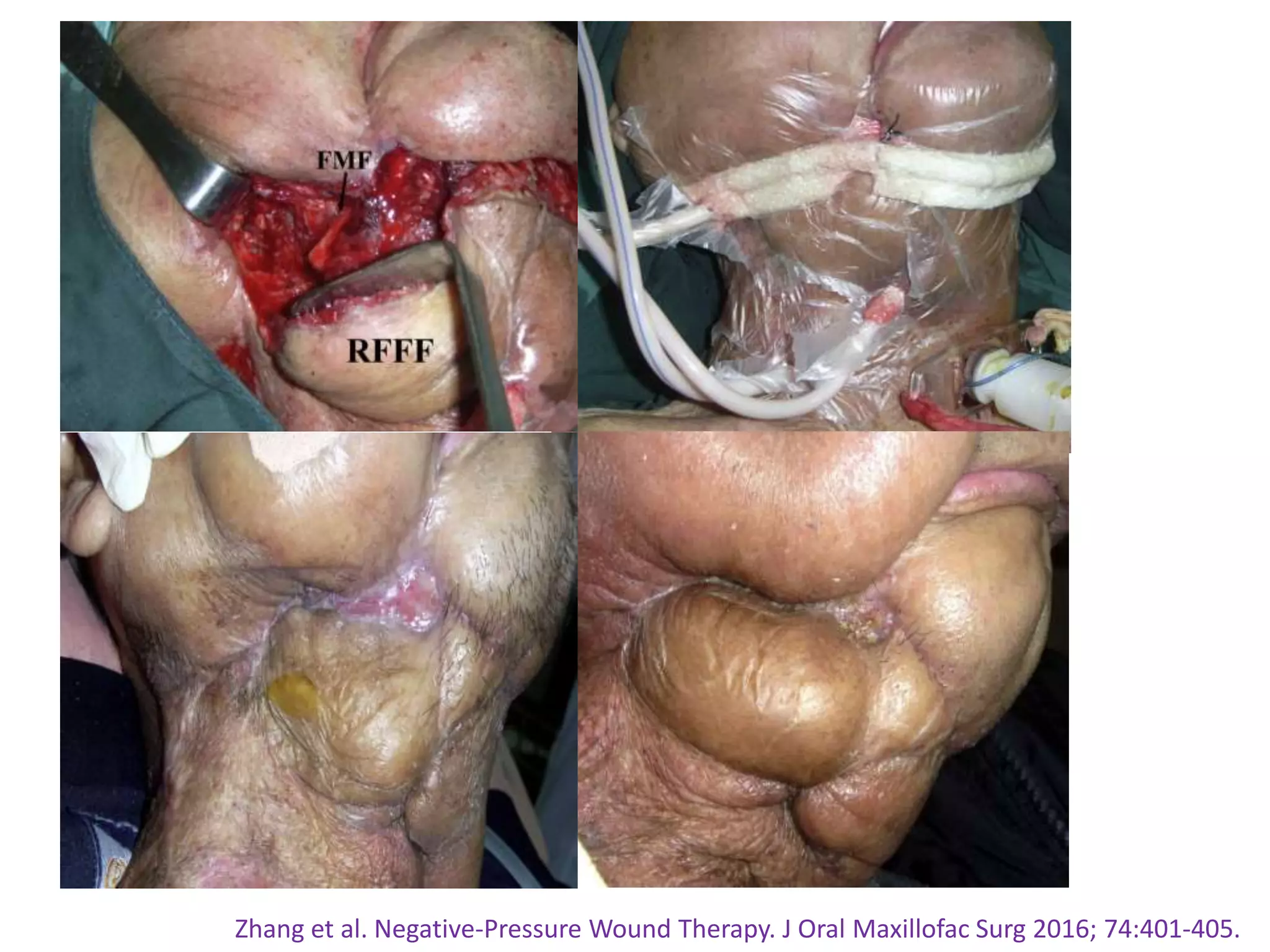
• Nine patients with submandibular fistulas after reconstruction for osteoradionecrosis
treated with NPWT between 2011 and 2014 were included in the study.
• The NPWT device was removed postoperatively between days 7 and 12 (mean
duration, 9.6 days).
• The wound bed was filled with healthy
granulation tissue, and successful healing by
second intention was observed in all patients
within 2 weeks.
• No complications were observed. The follow-up
ranged from 4 to 27 months (mean, 18 months);
the fistulas exhibited excellent healing, and no
recurrence or infection was observed.
Zhang et al. Negative-Pressure Wound Therapy. J Oral Maxillofac Surg 2016; 74:401-405.
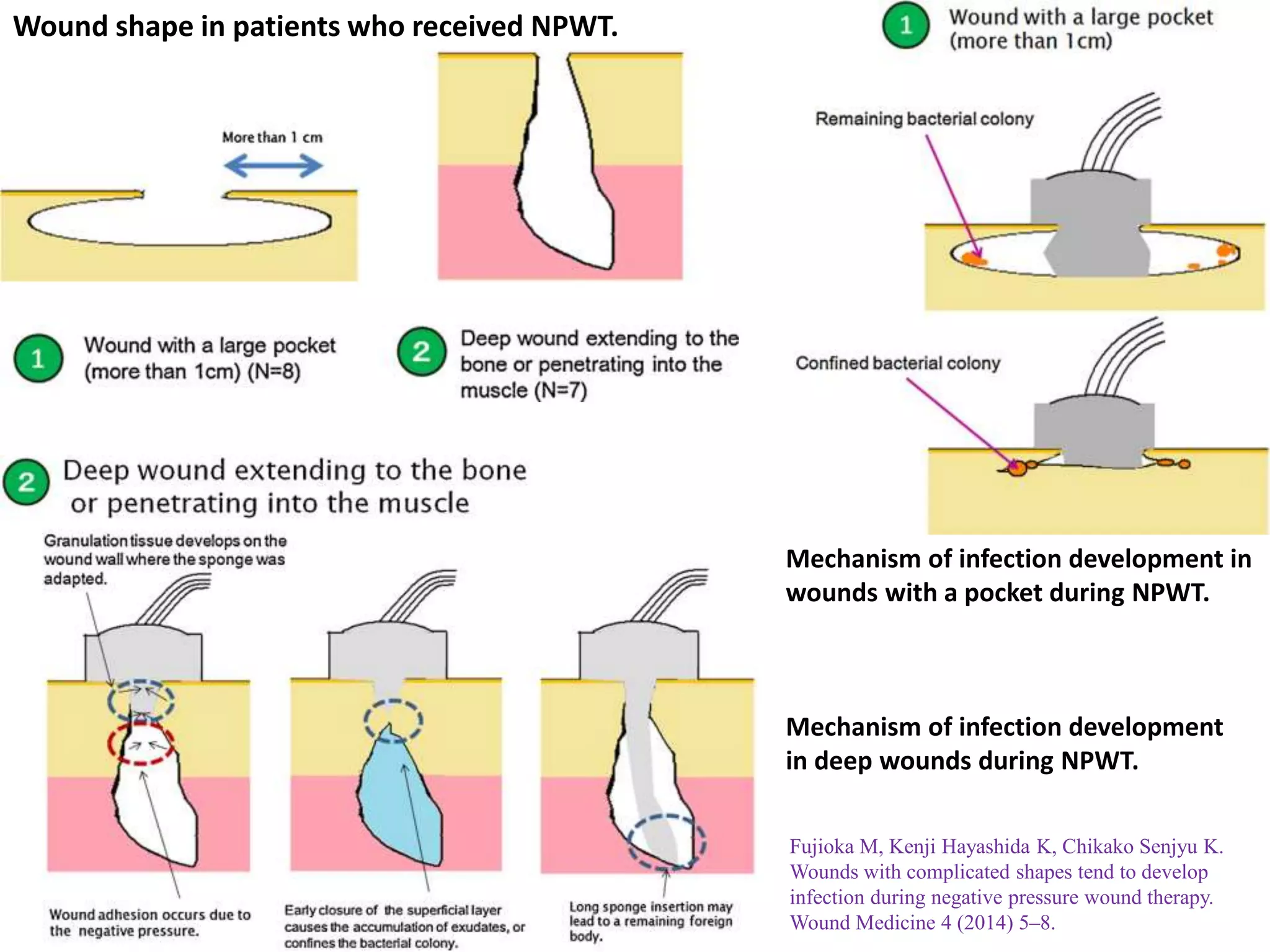
A total of 55 patients with wounds were treated using NPWT in 2011. 8 whose
wounds formed a pocket, 7 whose wounds were deep, and 40 whose wounds did
not come under the above 2 types were eligible for this retrospective study.
15 patients (27.3%) - relapse of local infection. 6/8 patients (75.0%) - wound
with pocket group, 5 of the 7 (71.4%) in the deep wound group, and 4 /40
(10.0%) - wounds developed infection. The wound infection development ratio
of the wound with pocket and deep wound groups was significantly higher than
that of the other wound group.
Wound shape in patients who received NPWT.
Mechanism of infection development in
wounds with a pocket during NPWT.
Mechanism of infection development
in deep wounds during NPWT.
Fujioka M, Kenji Hayashida K, Chikako Senjyu K.
Wounds with complicated shapes tend to develop
infection during negative pressure wound therapy.
Wound Medicine 4 (2014) 5–8.
• The efficacy of NPWT in promoting wound healing has been largely
accepted by clinicians, yet the number of high-level clinical studies
demonstrating its effectiveness is small and much more can be learned
about the mechanisms of action.
• In the future, hopefully we will have the data to assist clinicians in
selecting optimal parameters for specific wounds including interface
material, waveform of suction application, and the amount of suction
to be applied.
• Further investigation into specific interface coatings and instillation
therapy are also needed.
1. Yang YH, Jeng SF, Hsieh CH, Feng GM, Chen CC. Vacuum-assisted
closure for complicated wounds in head and neck region after
reconstruction. J Plast Reconstr Aesthet Surg. 2013 Aug;66(8):e209-16.
2. Zhang DM, Yang ZH, Zhuang PL, Wang YY, Chen WL, Zhang B. role
of negative pressure wound therapy in the management of
submandibular fistula after reconstruction for osteoradionecrosis. J Oral
Maxillofac Surg. 2016 Feb;74(2):401-5.
3. Fujioka M, Kenji Hayashida K, Chikako Senjyu K. Wounds with
complicated shapes tend to develop infection during negative pressure
wound therapy. Wound Medicine 4 (2014) 5–8.

Npwt

  • 3.
    • Introduction • Historyof negative pressure therapy (The VAC system) • Mechanisms of action • Clinical applications of NPWT • Clinical considerations • Future perspectives • Cross references • Summary • References
  • 4.
    • Vacuum-assisted closure(VAC), sometimes referred to as microdeformational wound therapy (MDWT) or negative pressure wound therapy (NPWT), has revolutionized wound care over the last 15 years. • This monograph describes the current understanding of these technologies, the questions that remain, and what the future may hold for technologies based on mechanotransduction principles.
  • 5.
    • Dressings totreat complex wounds have traditionally been made of cotton gauze which could be soaked with a variety of chemicals including normal saline and sodium hypochlorite solutions. • In the 1960s, the importance of keeping the wound moist was discovered and a wide array of hydrogels, alginates, and other polymeric and biologically based dressings were developed. • More recently, these dressing materials have been combined with antimicrobial compounds such as silver. Collectively, there are approximately 1500 dressing types available.
  • 6.
    Any device thatapplies differential suction (ie, reduced local pressure) to wounds. Type of NPWT systems that create microdeformations (appearing as microdome like structures) at the wound surface These novel therapies have been shown to facilitate the healing of various types of wounds derived from trauma, infection, congenital deformities, and tumors.
  • 7.
    • Bier describedthe use of suction cups for a variety of ailments that have been largely abandoned. • Typically, these devices have been designed to apply low levels of suction (<40 mmHg). • In 1993 Fleischmann et al initially developed the vacuum sealing drainage technique and successfully used it to treat limb open- fracture injuries. • In 1997 Argenta and Morykwas introduced a vacuum-assisted closure (VAC) system to manage complicated wounds. Argenta LC, Morykwas MJ: Vacuum-assisted closure: A new method for wound control and treatment: Clinical experience. Ann Plast Surg 38:563, 1997 FleischmannW, StreckerW, Bombelli M, et al: Vacuum sealing as treatment of soft tissue damage in open fractures. Unfallchirurg 96:488, 1993
  • 9.
    1. A fillermaterial or sponge placed into the wound 2. A semipermeable dressing to isolate the wound environment and allow the vacuum system to transmit subatmospheric pressures to the wound surface 4. Vacuum system 3. Connecting tube A fluid collection canister An alarm sounds
  • 10.
  • 11.
    Therefore, we usethe term MDWT for devices that deform wounds on the micron-to- millimeter scale, incurring morphologic and functional changes in cells that further improve wound healing. The most popular clinical systems use open-pore foam dressings, which result in the formation of tiny, domelike structures at the wound surface that cause microdeformations to the wound surface.
  • 12.
    1. Hemostasis 2. Modulationof inflammation  Cellular responses—division, migration and differentiation SECONDARY
  • 13.
  • 14.
     Granulation tissueformation  Peripheral nerve response
  • 17.
  • 18.
    Combination therapy—incorporating bioactive factorsin NPWT • Antimicrobial silver in NPWT • Instillation MDWT • Other potential adjuvants – platelet gel, protein C, Arginine-rich dietary supplements
  • 19.
    • The FDAhas approved NPWT for managing poorly healing wounds. • Manufacturer guidelines for the widely used KCI V.A.C. therapy systems list chronic, acute, traumatic, subacute, and dehisced wounds, partial thickness burns, ulcers (such as diabetic, pressure or venous insufficiency), flaps and grafts as indications for use. Contraindications 1. Necrotic tissue with eschar present 2. Untreated osteomyelitis 3. Nonenteric and unexplored fistulas 4. Malignancy in the wound 5. Exposed vasculature 6. Exposed nerves 7. Exposed anastomotic site 8. Exposed organs
  • 20.
    Potential risks 1. Highrisk of bleeding and hemorrhage 2. Ongoing treatment with anticoagulants or platelet aggregation inhibitors 3. Friable or infected blood vessels, vascular anastomosis, infected wounds, osteomyelitis, exposed organs, vessels, nerves, tendon or ligaments, sharp edges at the wound, spinal cord injury and eteric fistulas 4. Patient requires magnetic resonance imaging or hyperbaric chamber or defibrillation 5. Patient weight and size 6. Proximity of foam to vagus nerve 7. Circumferential dressing application 8. Mode of therapy (continuous or intermittent suction )
  • 21.
    • Interface material •Optimal cycling • Adhesives
  • 23.
    • From January2004 to December 2009 • 13 male patients (mean age: 50 years) • 12 patients (92%) had complicated wounds with infection and one patient (8%) with partial loss of the free flap. • Eight of these 13 patients (62%) had saliva leakage and fistula formation. • The average duration of the NPWT usage was 10.8 days (4 - 24 days); most of the wounds healed within 1 week after the NPWT application.
  • 24.
    J Oral MaxillofacSurg 74:401-405, 2016 • Nine patients with submandibular fistulas after reconstruction for osteoradionecrosis treated with NPWT between 2011 and 2014 were included in the study. • The NPWT device was removed postoperatively between days 7 and 12 (mean duration, 9.6 days). • The wound bed was filled with healthy granulation tissue, and successful healing by second intention was observed in all patients within 2 weeks. • No complications were observed. The follow-up ranged from 4 to 27 months (mean, 18 months); the fistulas exhibited excellent healing, and no recurrence or infection was observed.
  • 25.
    Zhang et al.Negative-Pressure Wound Therapy. J Oral Maxillofac Surg 2016; 74:401-405.
  • 26.
    A total of55 patients with wounds were treated using NPWT in 2011. 8 whose wounds formed a pocket, 7 whose wounds were deep, and 40 whose wounds did not come under the above 2 types were eligible for this retrospective study. 15 patients (27.3%) - relapse of local infection. 6/8 patients (75.0%) - wound with pocket group, 5 of the 7 (71.4%) in the deep wound group, and 4 /40 (10.0%) - wounds developed infection. The wound infection development ratio of the wound with pocket and deep wound groups was significantly higher than that of the other wound group.
  • 27.
    Wound shape inpatients who received NPWT. Mechanism of infection development in wounds with a pocket during NPWT. Mechanism of infection development in deep wounds during NPWT. Fujioka M, Kenji Hayashida K, Chikako Senjyu K. Wounds with complicated shapes tend to develop infection during negative pressure wound therapy. Wound Medicine 4 (2014) 5–8.
  • 28.
    • The efficacyof NPWT in promoting wound healing has been largely accepted by clinicians, yet the number of high-level clinical studies demonstrating its effectiveness is small and much more can be learned about the mechanisms of action. • In the future, hopefully we will have the data to assist clinicians in selecting optimal parameters for specific wounds including interface material, waveform of suction application, and the amount of suction to be applied. • Further investigation into specific interface coatings and instillation therapy are also needed.
  • 29.
    1. Yang YH,Jeng SF, Hsieh CH, Feng GM, Chen CC. Vacuum-assisted closure for complicated wounds in head and neck region after reconstruction. J Plast Reconstr Aesthet Surg. 2013 Aug;66(8):e209-16. 2. Zhang DM, Yang ZH, Zhuang PL, Wang YY, Chen WL, Zhang B. role of negative pressure wound therapy in the management of submandibular fistula after reconstruction for osteoradionecrosis. J Oral Maxillofac Surg. 2016 Feb;74(2):401-5. 3. Fujioka M, Kenji Hayashida K, Chikako Senjyu K. Wounds with complicated shapes tend to develop infection during negative pressure wound therapy. Wound Medicine 4 (2014) 5–8.

Editor's Notes

  • #9 Suction is frequently used for many indications including evacuation of purulence, closed suction drainage of surgical wounds, removal of gastric fluids, and collapse of the pleural space.
  • #25 Pedicle is near the dead space and fistula. Watertight suturing at mucosal side; NPWT application into the dead space. With negative-pressure suctioning on, mid-portion of fistula closes (two pink arrows). With time, granulation tissue grows and fills the dead space. Eventually, granulation tissue closes the fistula from the inside out. NPWT is removed; wound is left for secondary healing or covered with a skin graft.