Time Series Analytics
with Spark
Simon Ouellette
Faimdata
What is spark-timeseries?
• Open source time series library for Apache Spark 2.0
• Sandy Ryza
– Advanced Analytics with Spark: Patterns for Learning from Data
at Scale
– Senior Data Scientist at Clover Health
• Started in February 2015
https://github.com/sryza/spark-timeseries
Who am I?
• Chief Data Science Officer at Faimdata
• Contributor to spark-timeseries since September 2015
• Participated in early design discussions (March 2015)
• Been an active user for ~2 years
http://faimdata.com
Survey: Who uses time series?
Design Question #1: How do we
structure multivariate time series?
Columnar or Row-based?
Vectors Date/
Time
Series 1 Series 2
Vector 1 2:30:01 4.56 78.93
Vector 2 2:30:02 4.57 79.92
Vector 3 2:30:03 4.87 79.91
Vector 4 2:30:04 4.48 78.99
RDD[(ZonedDateTime, Vector)]
DateTime
Index
Vector for
Series 1
Vector for
Series 2
2:30:01 4.56 78.93
2:30:02 4.57 79.92
2:30:03 4.87 79.91
2:30:04 4.48 78.99
TimeSeriesRDD(
DateTimeIndex,
RDD[Vector]
)
Columnar representation Row-based representation
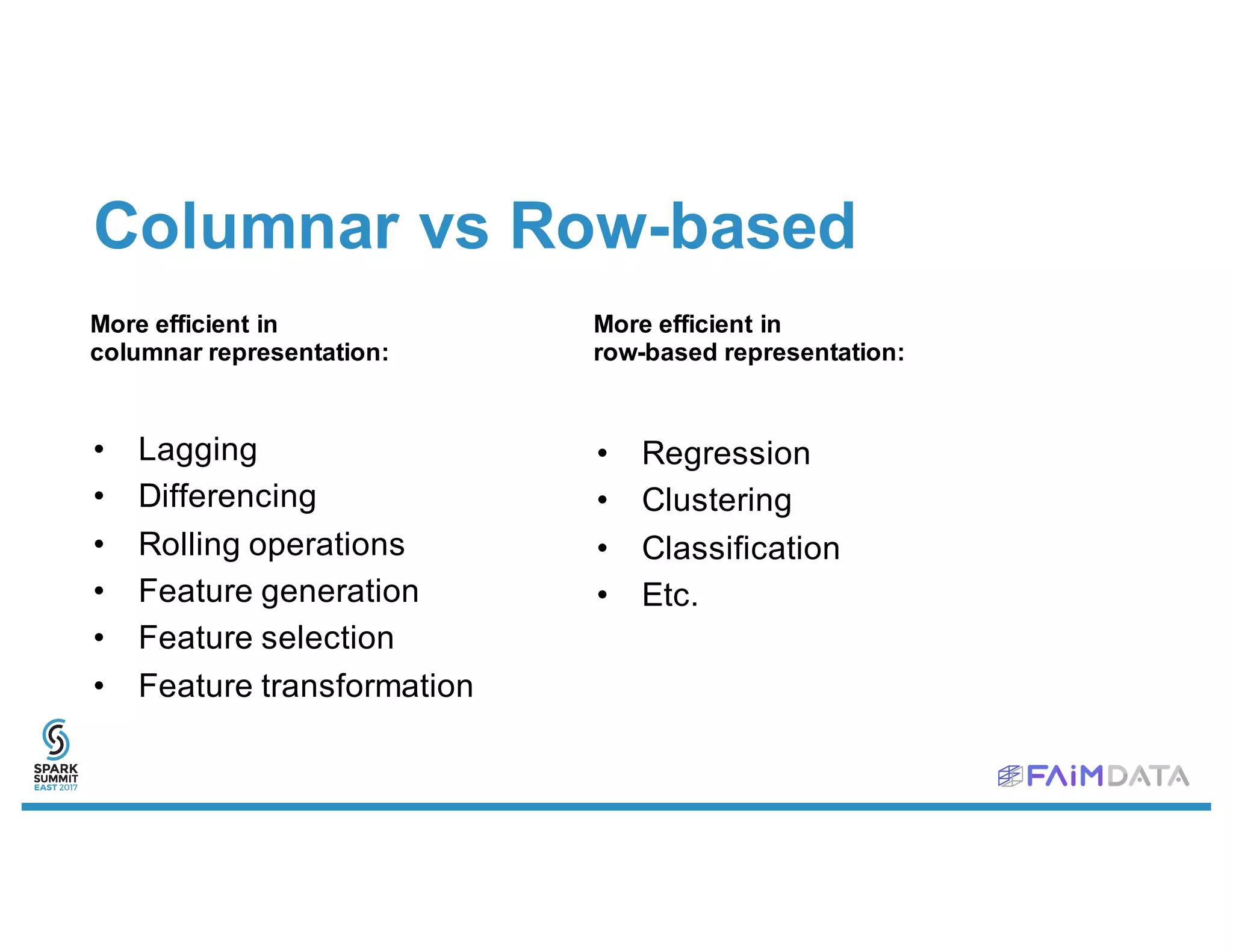
Columnar vs Row-based
• Lagging
• Differencing
• Rolling operations
• Feature generation
• Feature selection
• Feature transformation
• Regression
• Clustering
• Classification
• Etc.
More efficient in
columnar representation:
More efficient in
row-based representation:
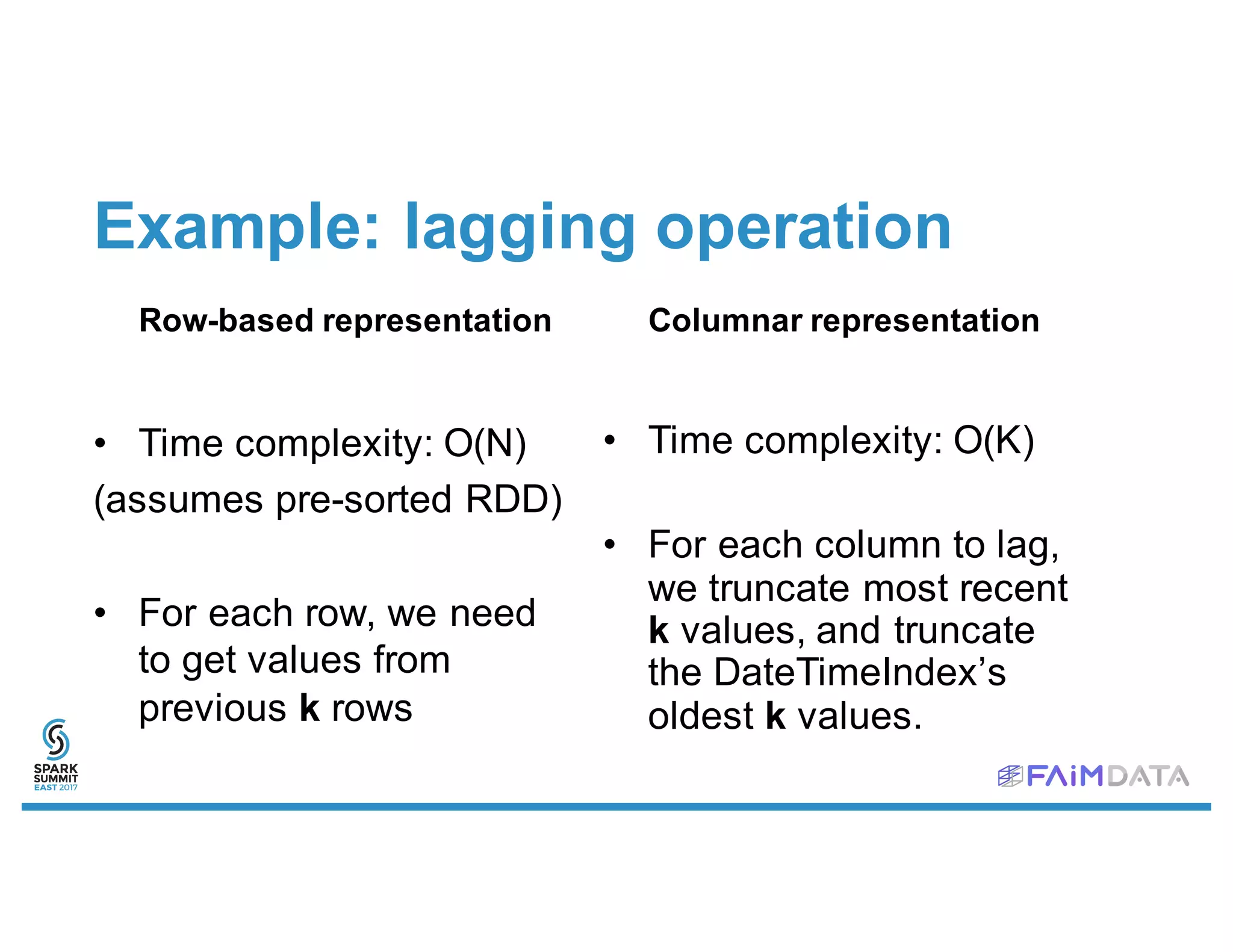
Example: lagging operation
• Time complexity: O(N)
(assumes pre-sorted RDD)
• For each row, we need
to get values from
previous k rows
• Time complexity: O(K)
• For each column to lag,
we truncate most recent
k values, and truncate
the DateTimeIndex’s
oldest k values.
Columnar representationRow-based representation
Example: regression
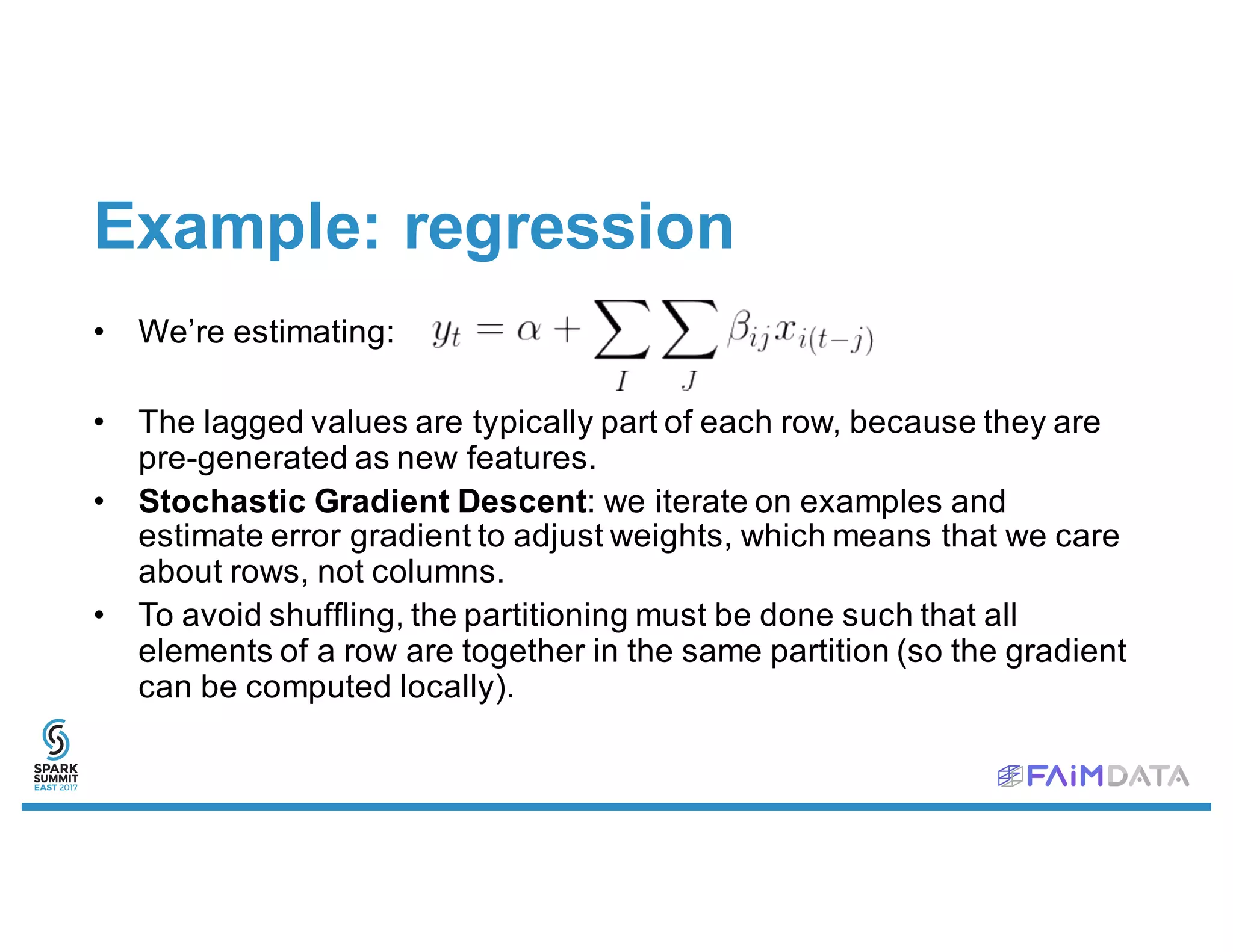
• We’re estimating:
• The lagged values are typically part of each row, because they are
pre-generated as new features.
• Stochastic Gradient Descent: we iterate on examples and
estimate error gradient to adjust weights, which means that we care
about rows, not columns.
• To avoid shuffling, the partitioning must be done such that all
elements of a row are together in the same partition (so the gradient
can be computed locally).
Current solution
• Core representation is columnar.
• Utility functions to go to/from row-based.
• Reasoning: spark-timeseries operations are
mostly time-related, i.e. columnar. Row-based
operations are about relationships between the
variables (ML/statistical), thus external to spark-
timeseries.
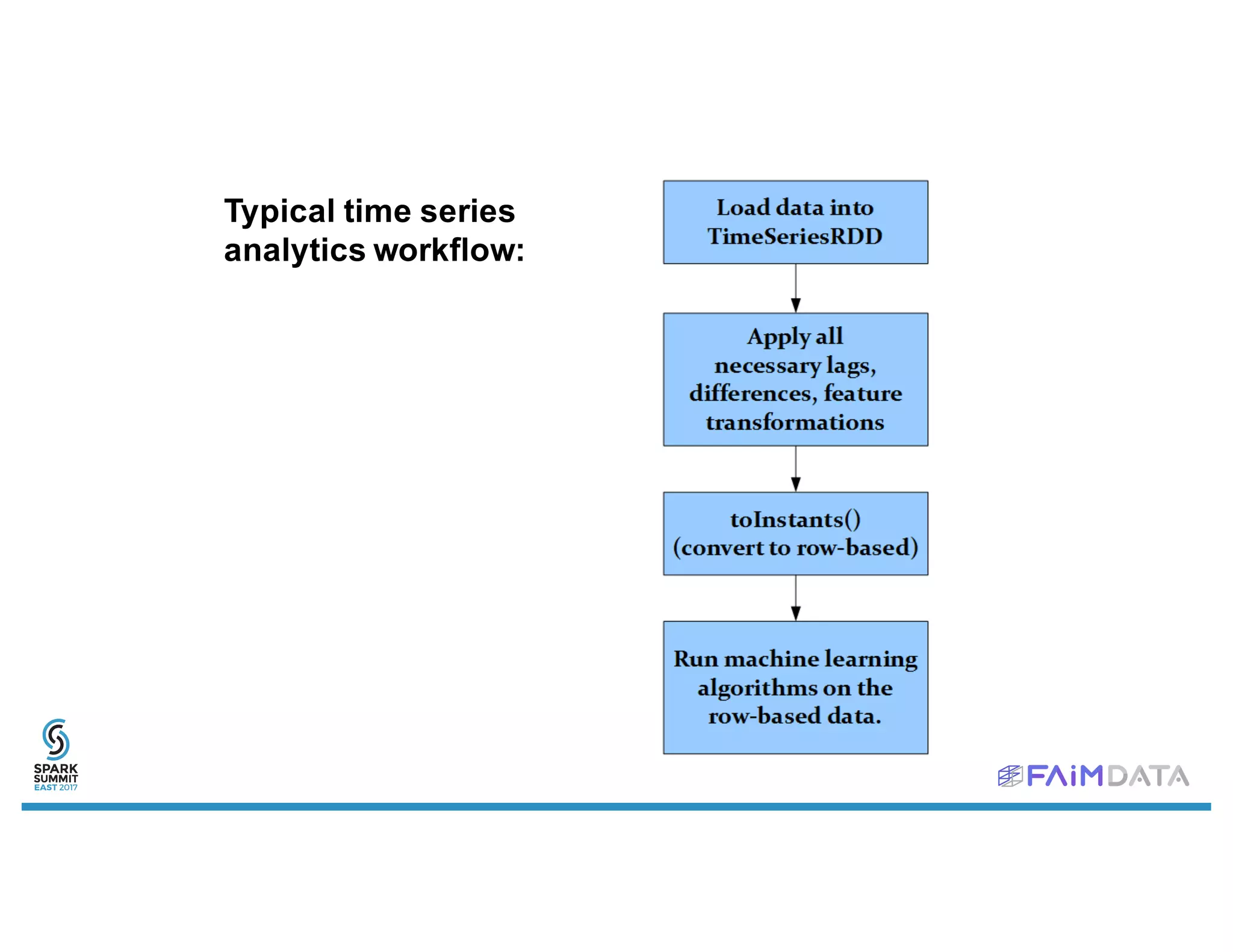
Typical time series
analytics workflow:
Survey: Who uses univariate time
series that don’t fit inside a single
executor’s memory?
(or multivariate of which a single
variable’s time series doesn’t fit)
Design Question #2: How do we
partition the multi-variate time series
for distributed processing?
Across features, or across time?
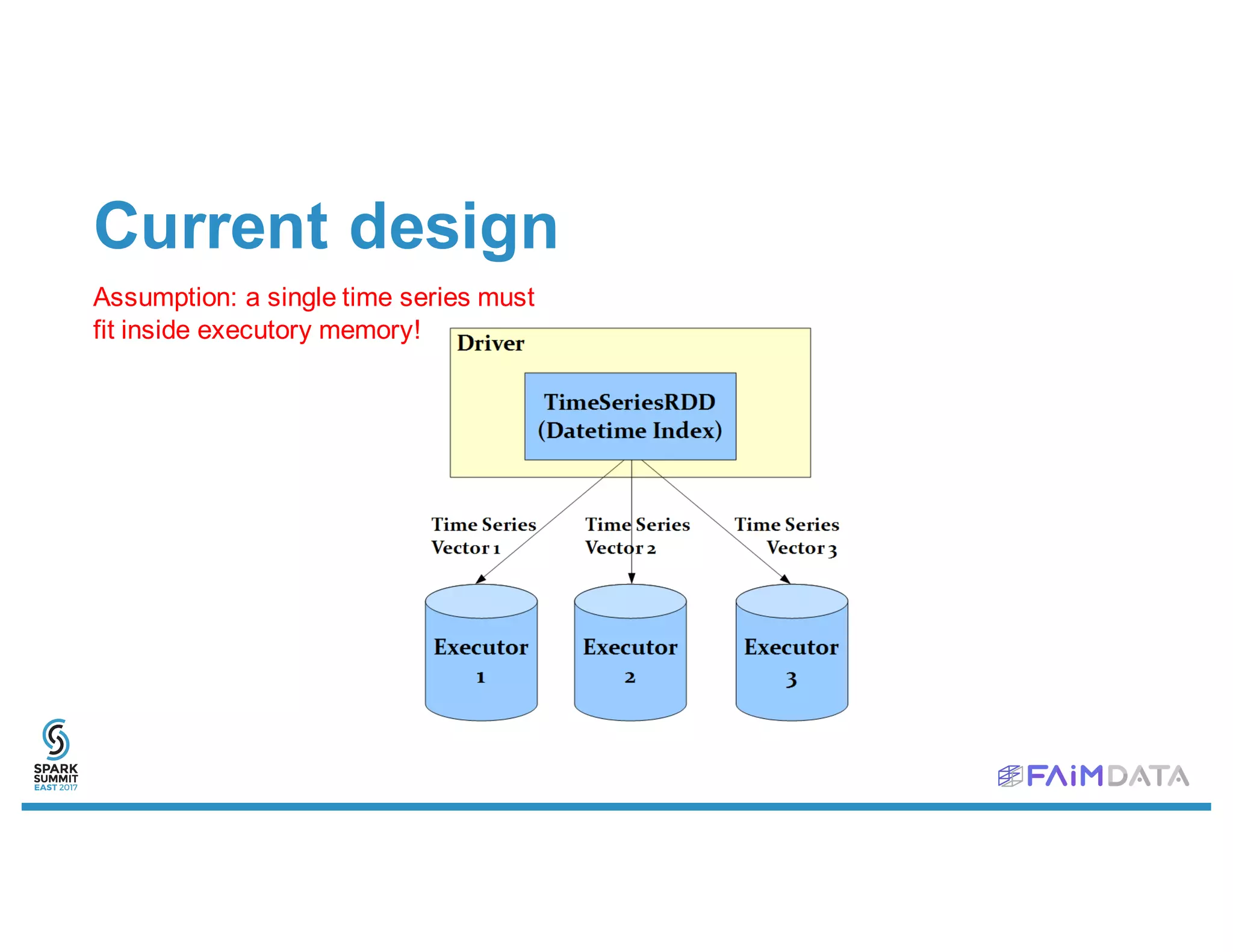
Current design
Assumption: a single time series must
fit inside executory memory!
Current design
Assumption: a single time series must
fit inside executory memory!
TimeSeriesRDD (
DatetimeIndex,
RDD[(K, Vector)]
)
IrregularDatetimeIndex (
Array[Long], // Other limitation: Scala arrays = 232 elements
java.time.ZoneId
)
Future improvements
• Creation of a new TimeSeriesRDD-like class that
will be longitudinally (i.e. across time) partitioned
rather than horizontally (i.e. across features).
• Keep both types of partitioning, on a case-by-
case basis.
Design Question #3: How do we
lag, difference, etc.?
Re-sampling, or index-preserving?
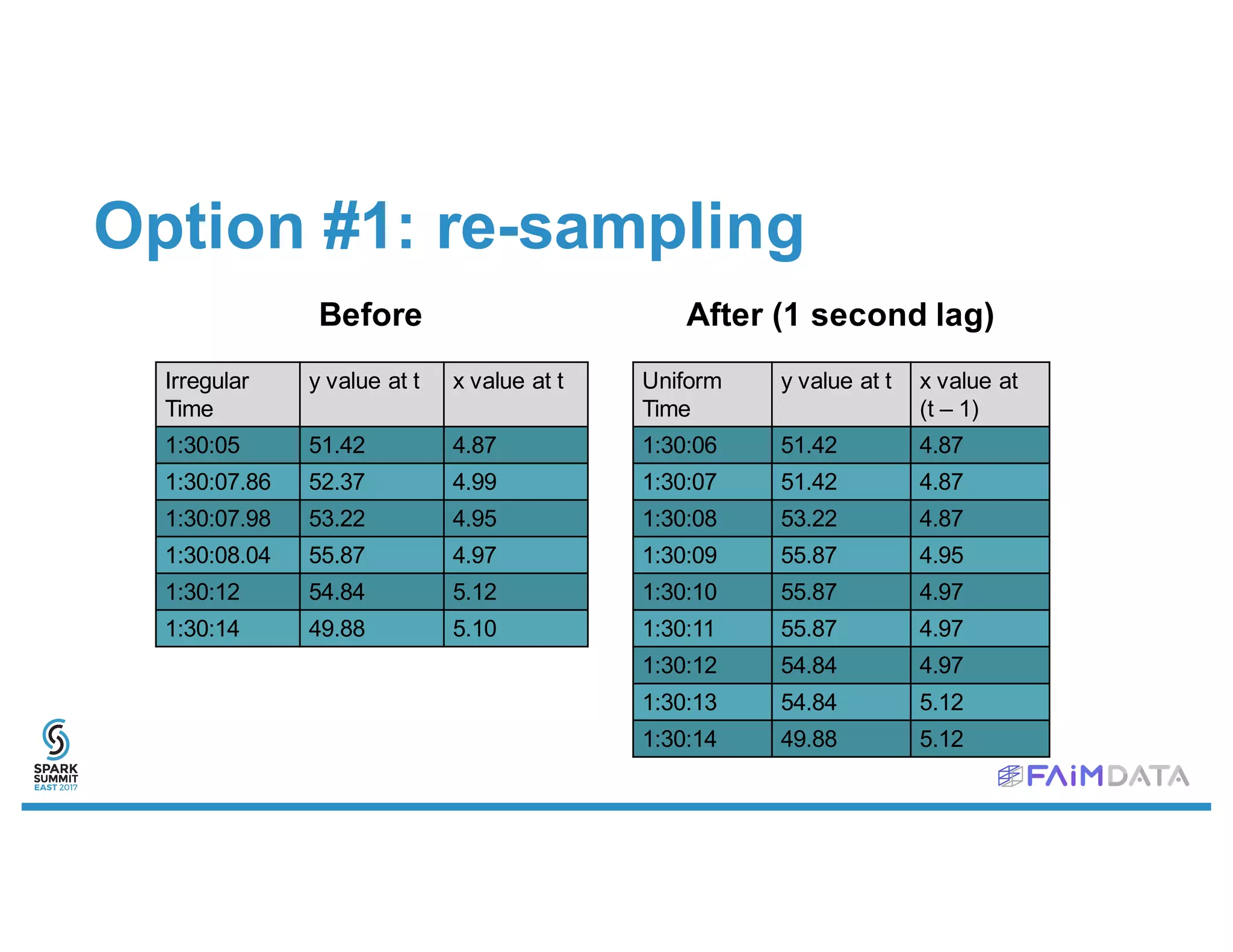
Option #1: re-sampling
Irregular
Time
y value at t x value at t
1:30:05 51.42 4.87
1:30:07.86 52.37 4.99
1:30:07.98 53.22 4.95
1:30:08.04 55.87 4.97
1:30:12 54.84 5.12
1:30:14 49.88 5.10
Uniform
Time
y value at t x value at
(t – 1)
1:30:06 51.42 4.87
1:30:07 51.42 4.87
1:30:08 53.22 4.87
1:30:09 55.87 4.95
1:30:10 55.87 4.97
1:30:11 55.87 4.97
1:30:12 54.84 4.97
1:30:13 54.84 5.12
1:30:14 49.88 5.12
Before After (1 second lag)
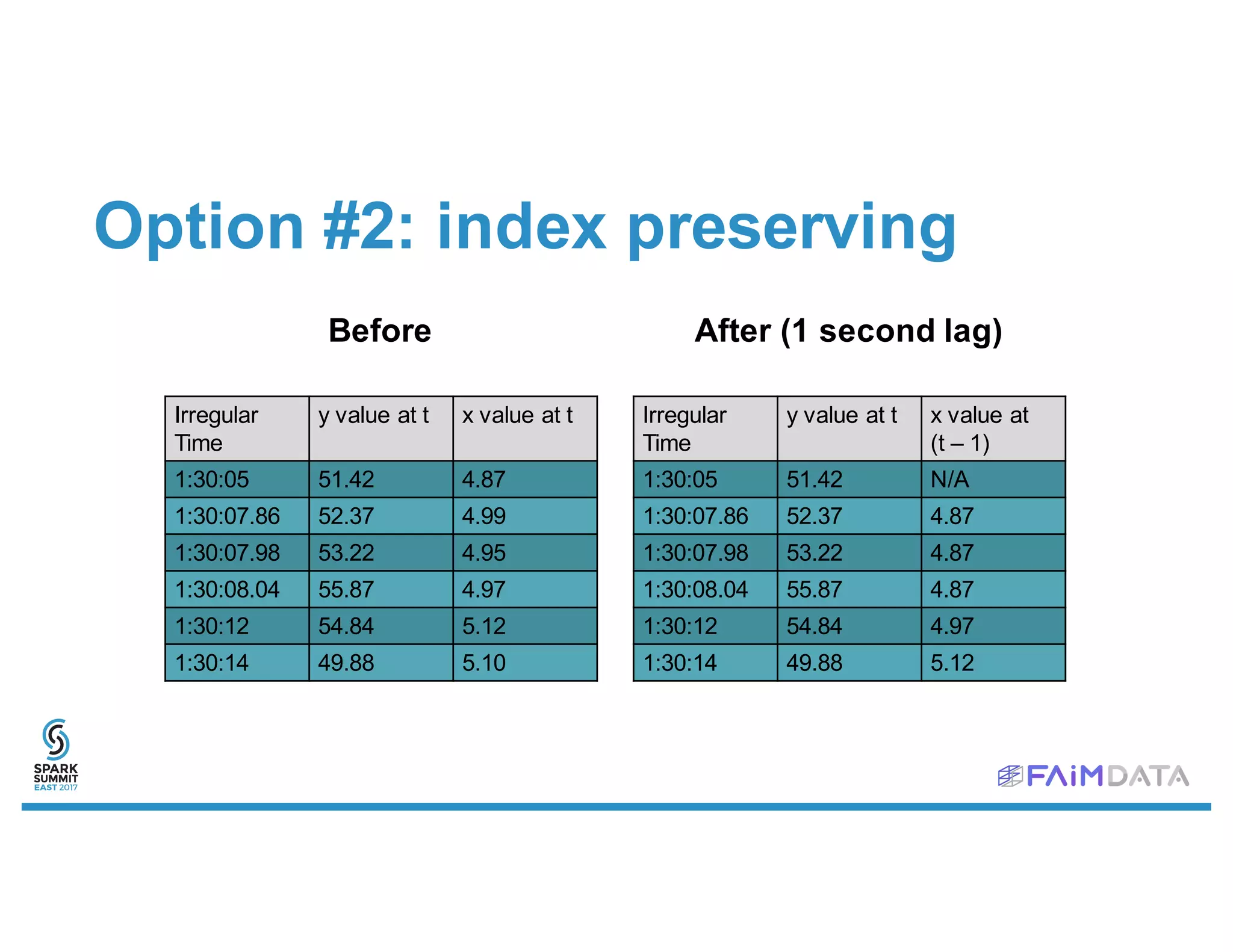
Option #2: index preserving
Irregular
Time
y value at t x value at t
1:30:05 51.42 4.87
1:30:07.86 52.37 4.99
1:30:07.98 53.22 4.95
1:30:08.04 55.87 4.97
1:30:12 54.84 5.12
1:30:14 49.88 5.10
Irregular
Time
y value at t x value at
(t – 1)
1:30:05 51.42 N/A
1:30:07.86 52.37 4.87
1:30:07.98 53.22 4.87
1:30:08.04 55.87 4.87
1:30:12 54.84 4.97
1:30:14 49.88 5.12
Before After (1 second lag)
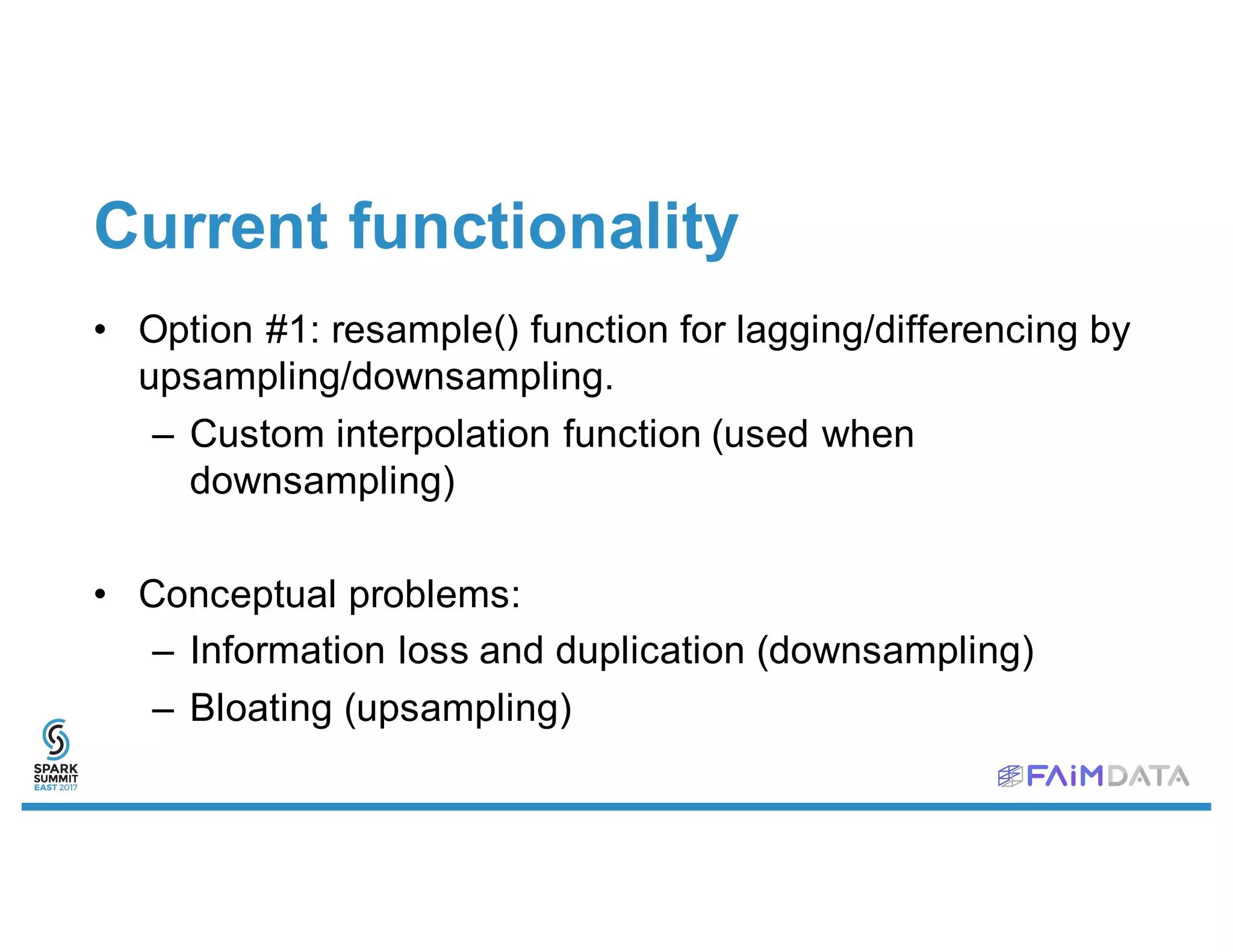
Current functionality
• Option #1: resample() function for lagging/differencing by
upsampling/downsampling.
– Custom interpolation function (used when
downsampling)
• Conceptual problems:
– Information loss and duplication (downsampling)
– Bloating (upsampling)
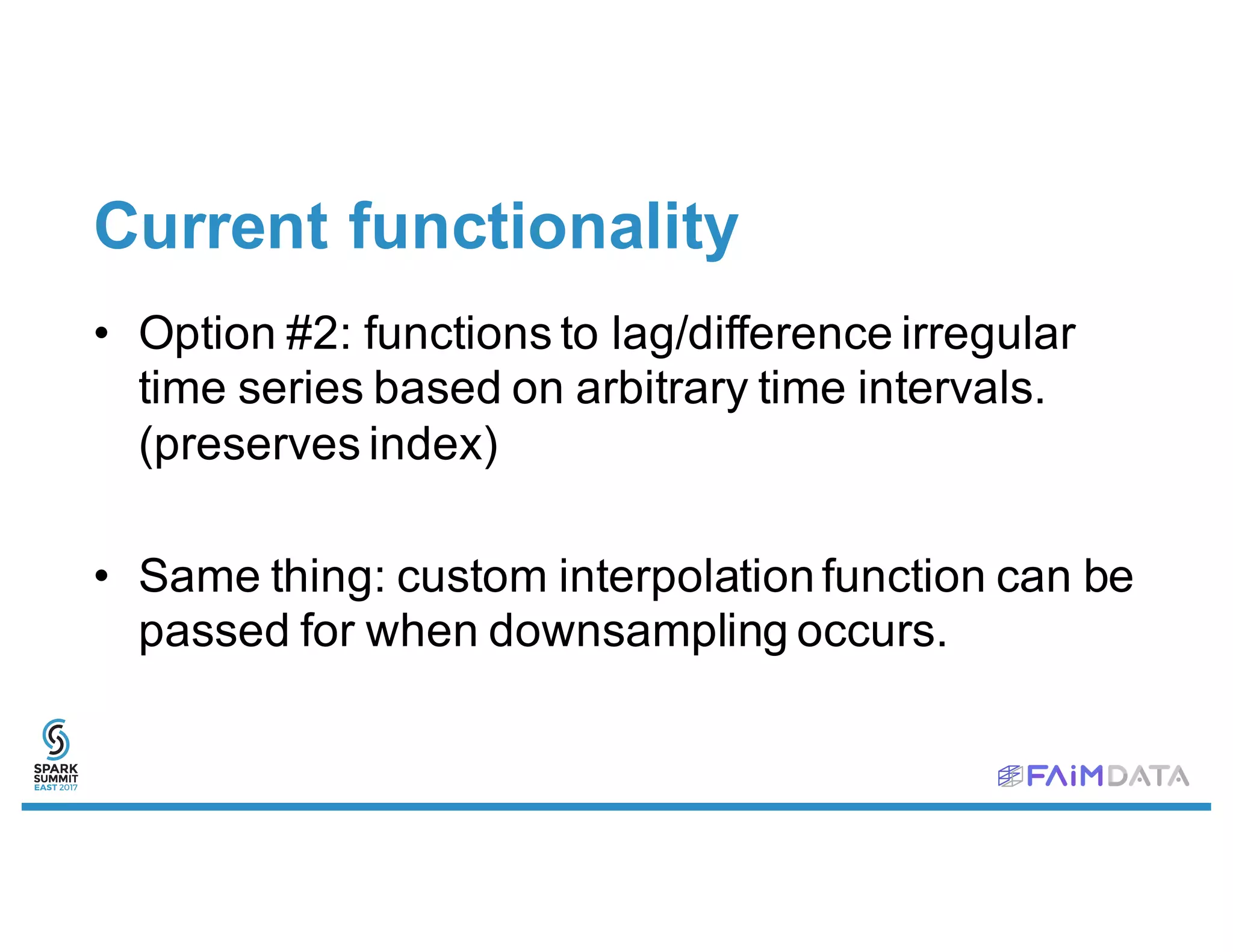
Current functionality
• Option #2: functions to lag/difference irregular
time series based on arbitrary time intervals.
(preserves index)
• Same thing: custom interpolationfunction can be
passed for when downsampling occurs.
Overview of current API
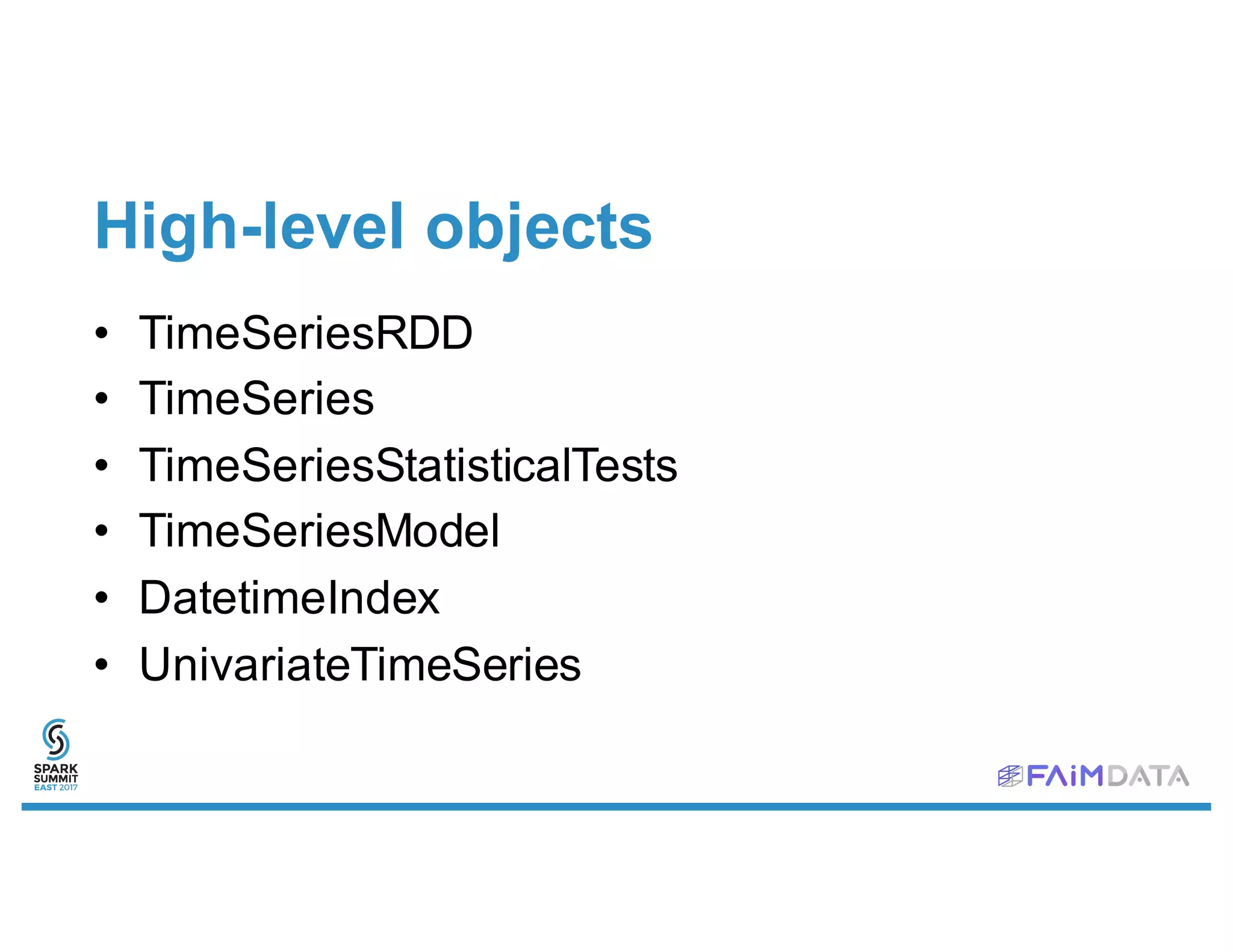
High-level objects
• TimeSeriesRDD
• TimeSeries
• TimeSeriesStatisticalTests
• TimeSeriesModel
• DatetimeIndex
• UnivariateTimeSeries
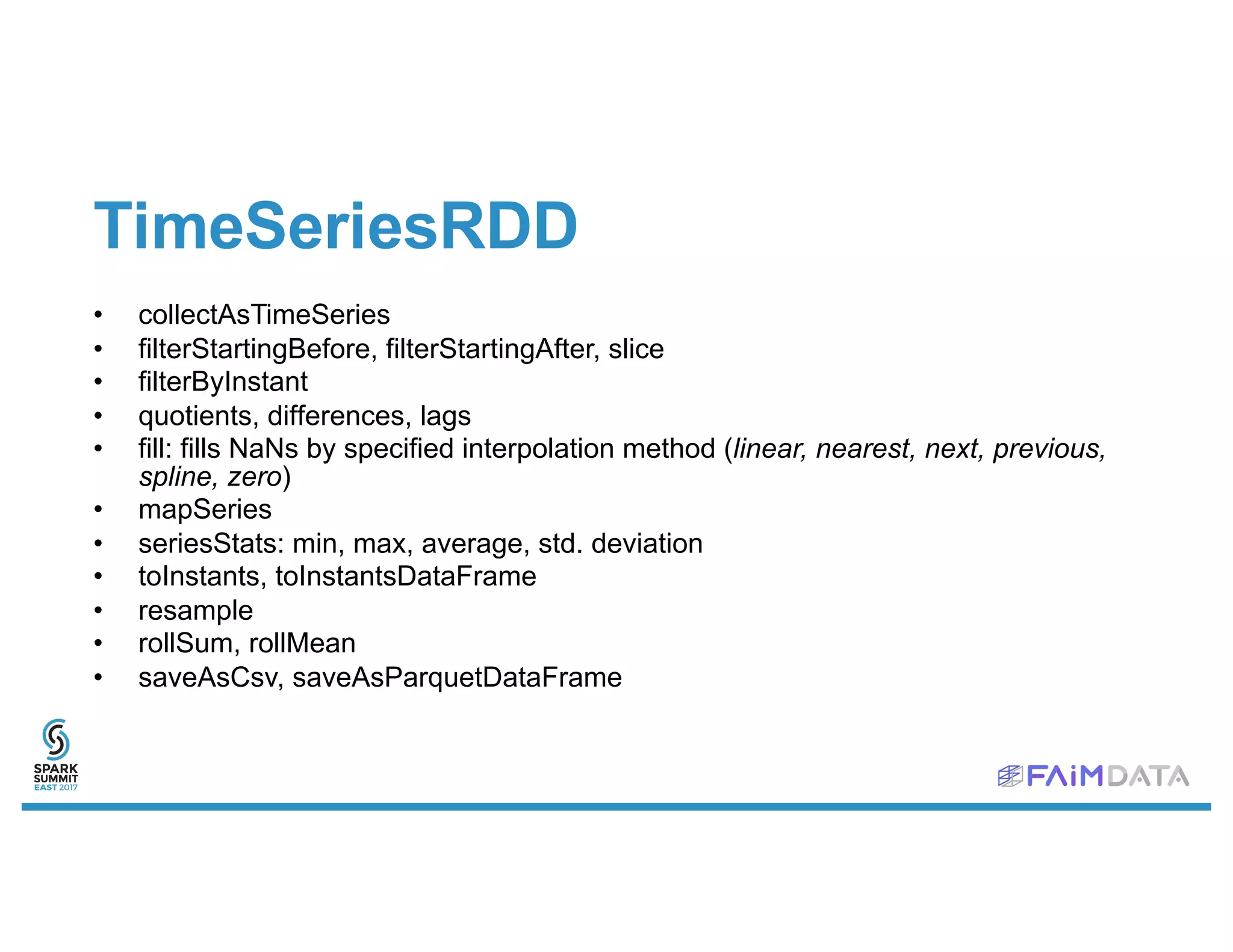
TimeSeriesRDD
• collectAsTimeSeries
• filterStartingBefore, filterStartingAfter, slice
• filterByInstant
• quotients, differences, lags
• fill: fills NaNs by specified interpolation method (linear, nearest, next, previous,
spline, zero)
• mapSeries
• seriesStats: min, max, average, std. deviation
• toInstants, toInstantsDataFrame
• resample
• rollSum, rollMean
• saveAsCsv, saveAsParquetDataFrame
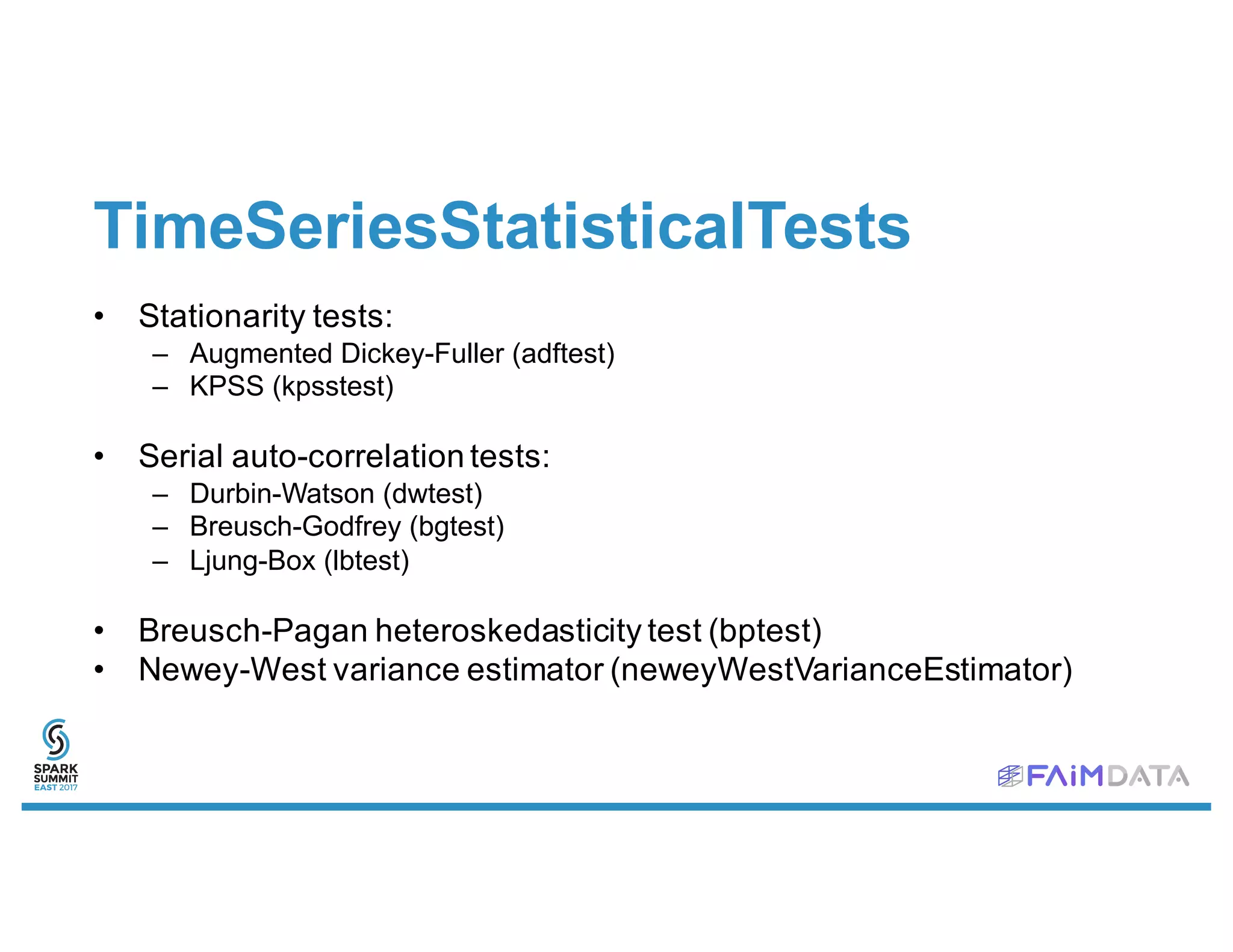
TimeSeriesStatisticalTests
• Stationarity tests:
– Augmented Dickey-Fuller (adftest)
– KPSS (kpsstest)
• Serial auto-correlation tests:
– Durbin-Watson (dwtest)
– Breusch-Godfrey (bgtest)
– Ljung-Box (lbtest)
• Breusch-Pagan heteroskedasticity test (bptest)
• Newey-West variance estimator (neweyWestVarianceEstimator)
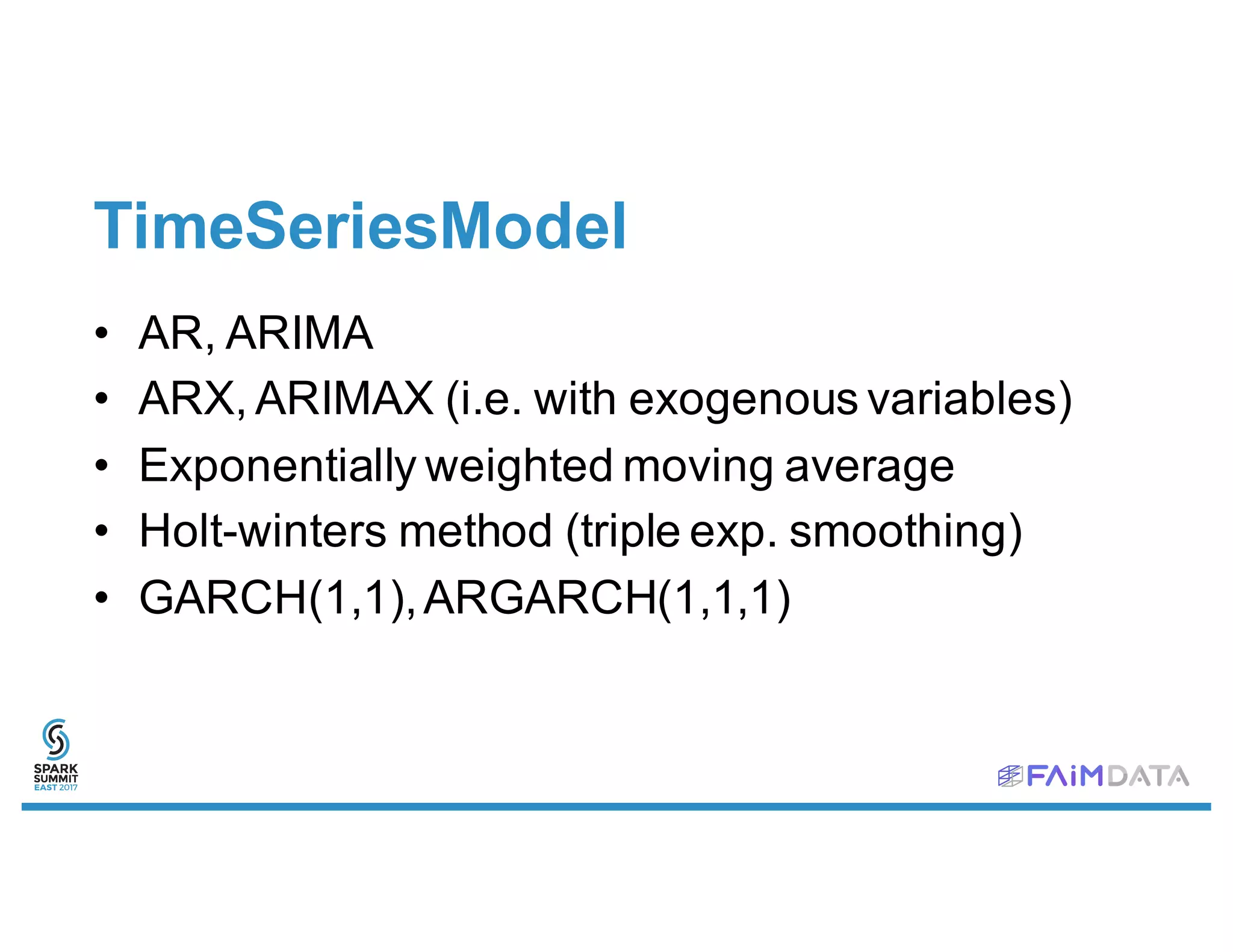
TimeSeriesModel
• AR, ARIMA
• ARX, ARIMAX (i.e. with exogenous variables)
• Exponentially weighted moving average
• Holt-winters method (triple exp. smoothing)
• GARCH(1,1),ARGARCH(1,1,1)
Others
• Java bindings
• Python bindings
• YAHOO financial data parser
Code example #1
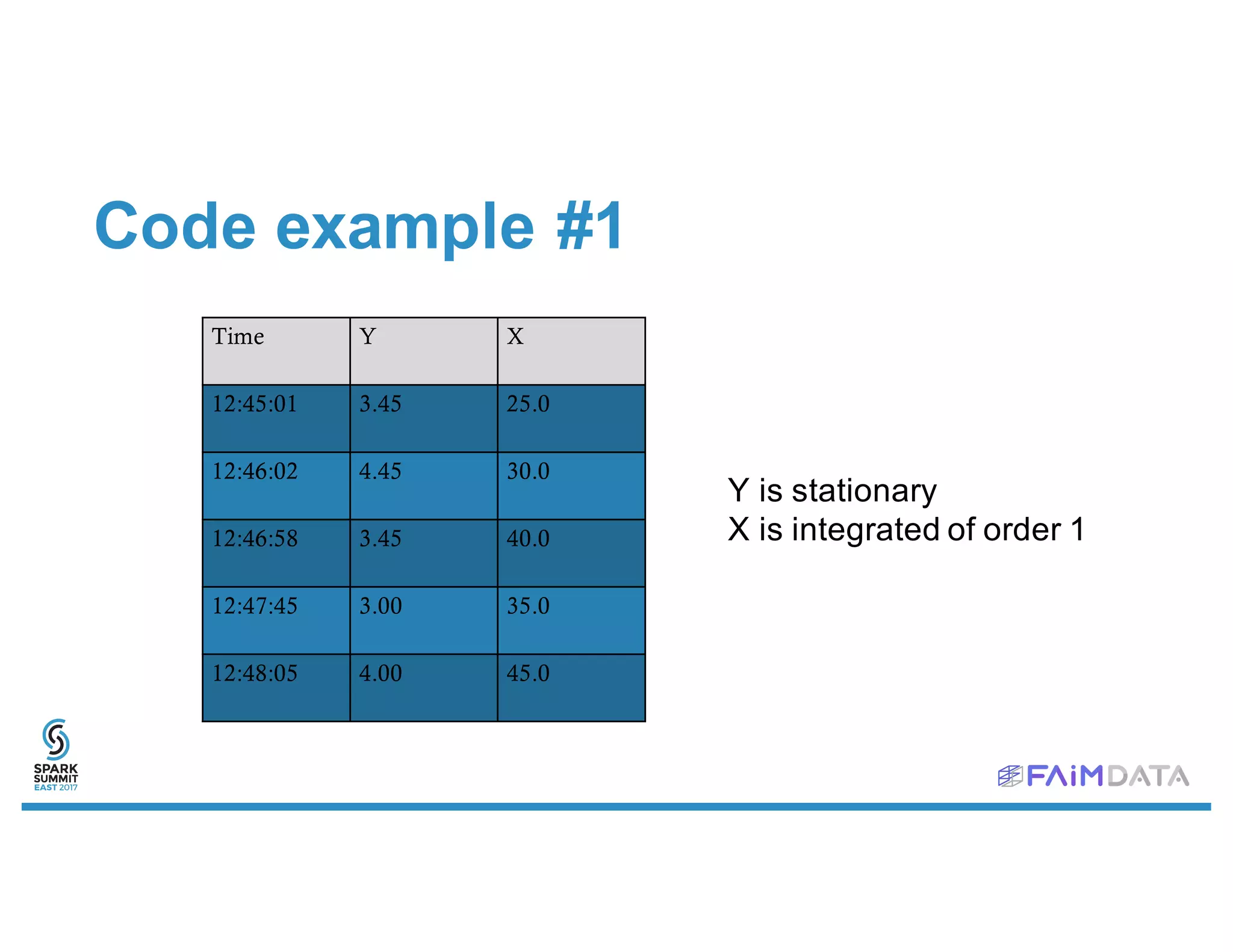
Time Y X
12:45:01 3.45 25.0
12:46:02 4.45 30.0
12:46:58 3.45 40.0
12:47:45 3.00 35.0
12:48:05 4.00 45.0
Y is stationary
X is integrated of order 1
Code example #1
Code example #1
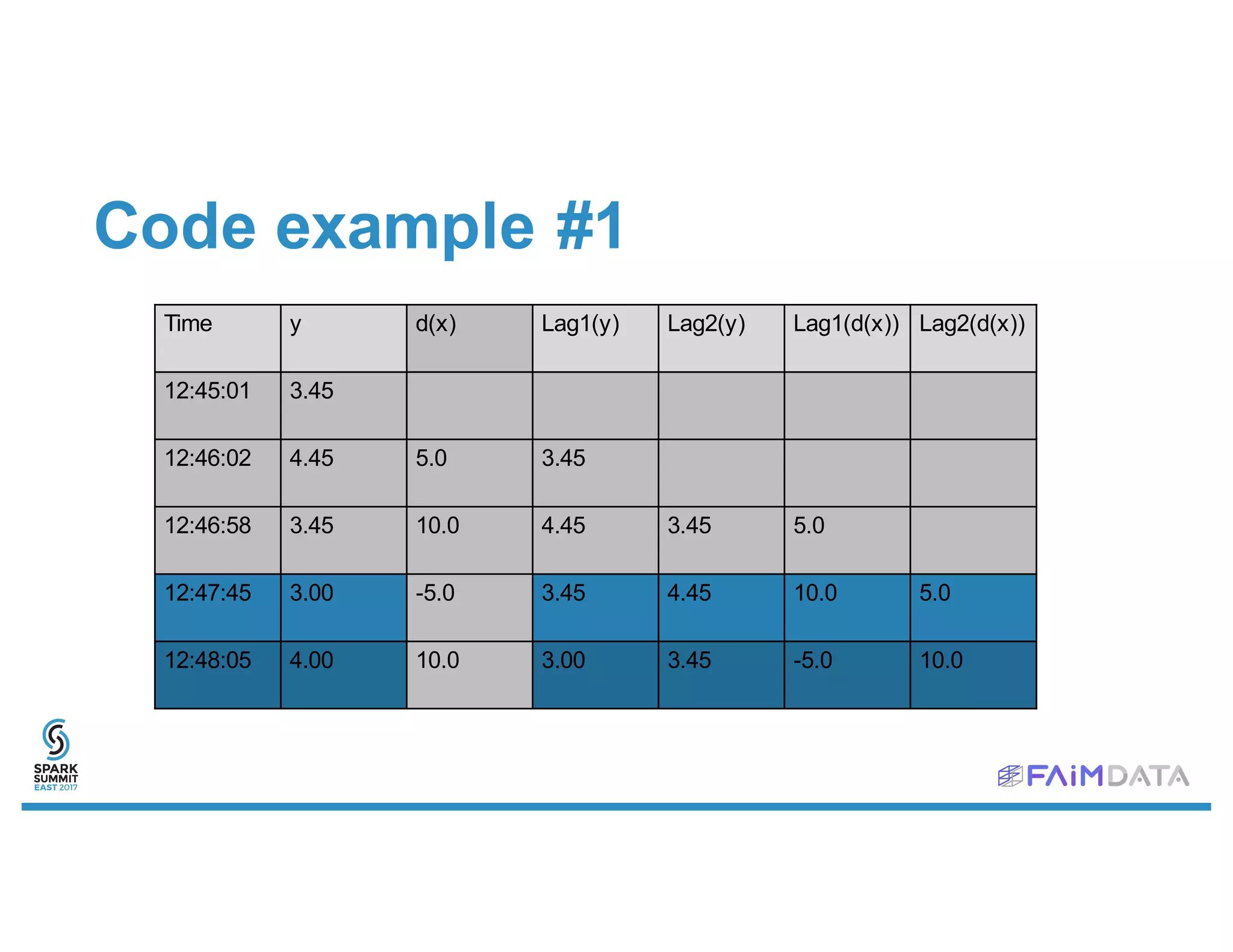
Time y d(x) Lag1(y) Lag2(y) Lag1(d(x)) Lag2(d(x))
12:45:01 3.45
12:46:02 4.45 5.0 3.45
12:46:58 3.45 10.0 4.45 3.45 5.0
12:47:45 3.00 -5.0 3.45 4.45 10.0 5.0
12:48:05 4.00 10.0 3.00 3.45 -5.0 10.0
Code example #2
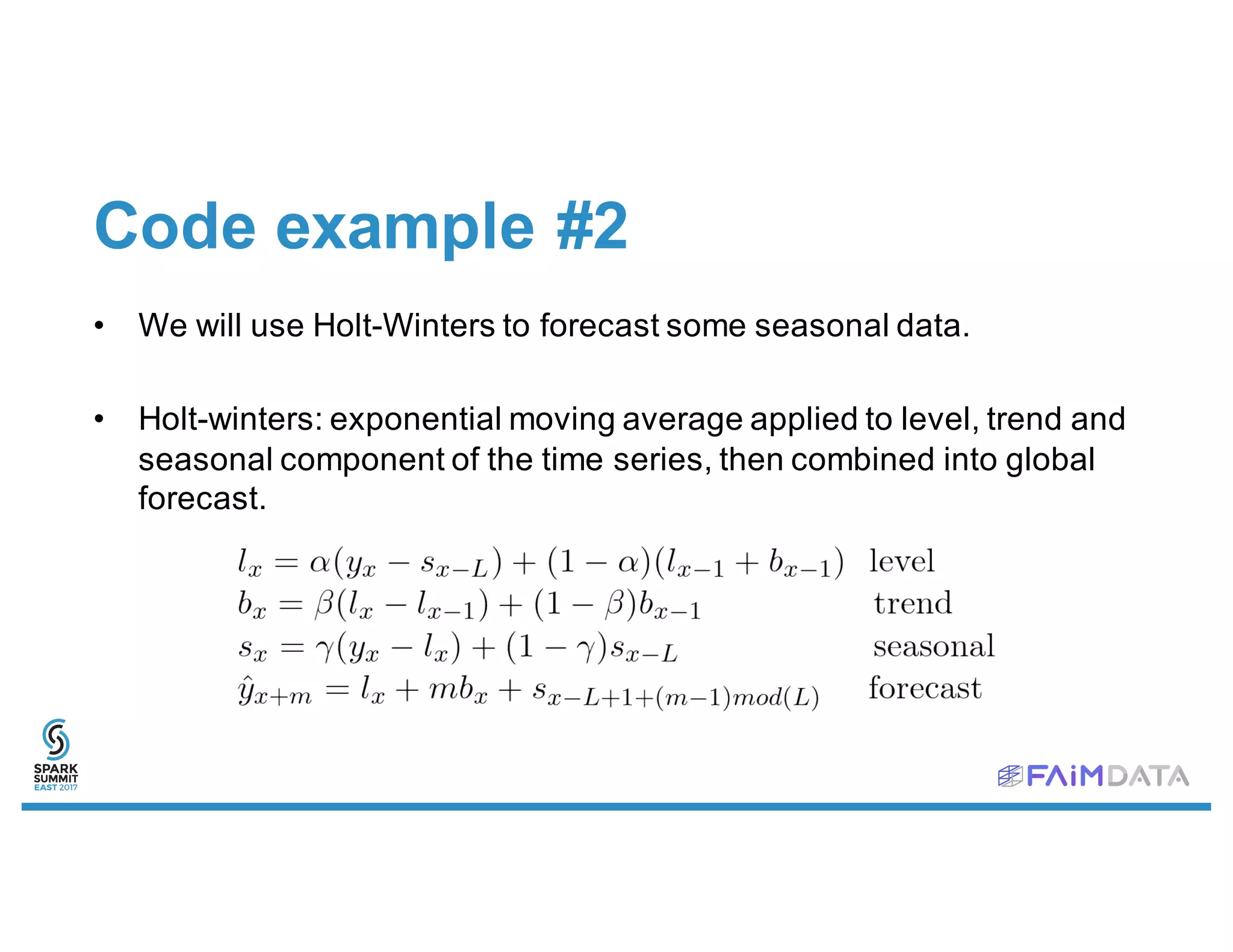
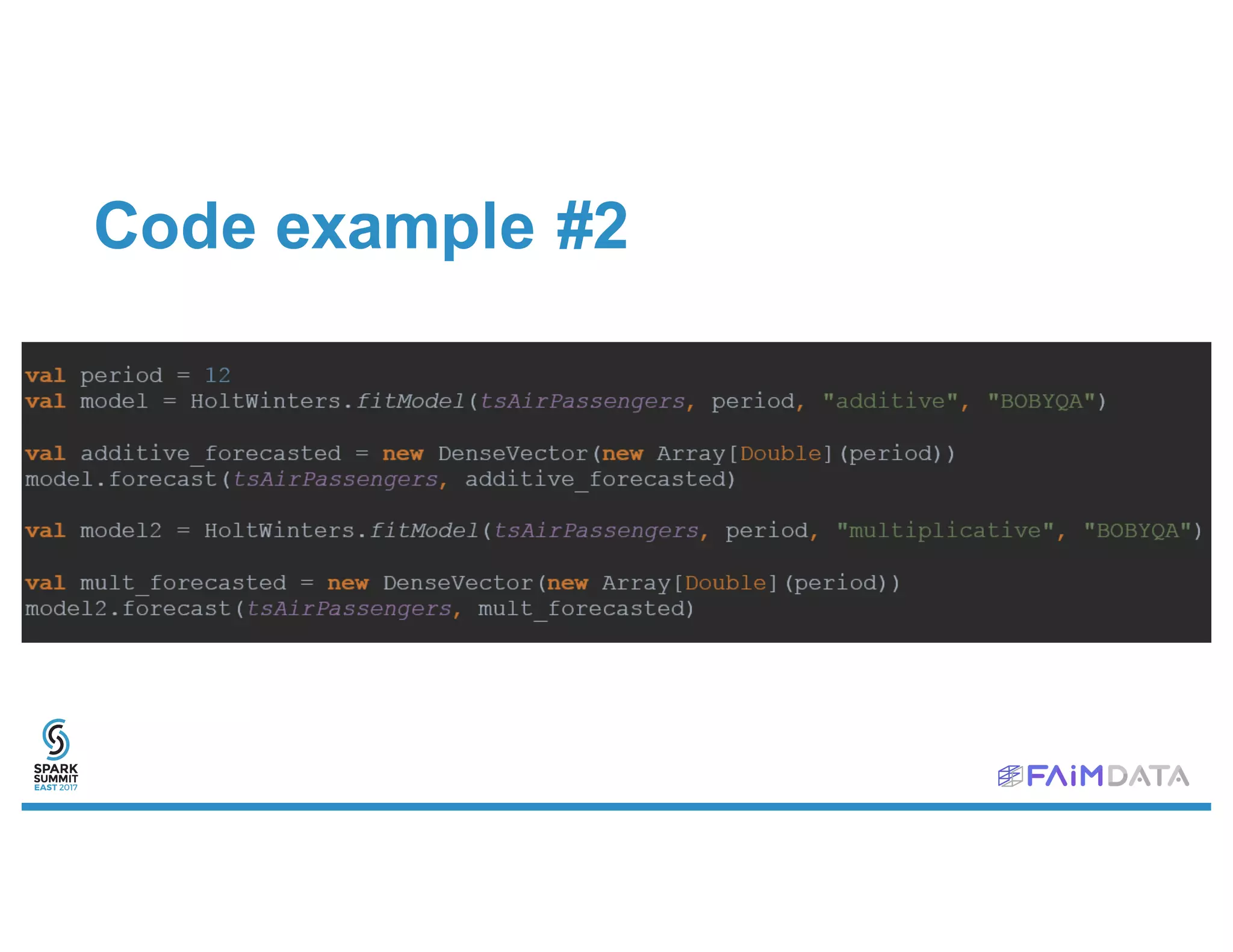
• We will use Holt-Winters to forecast some seasonal data.
• Holt-winters: exponential moving average applied to level, trend and
seasonal component of the time series, then combined into global
forecast.
Code example #2
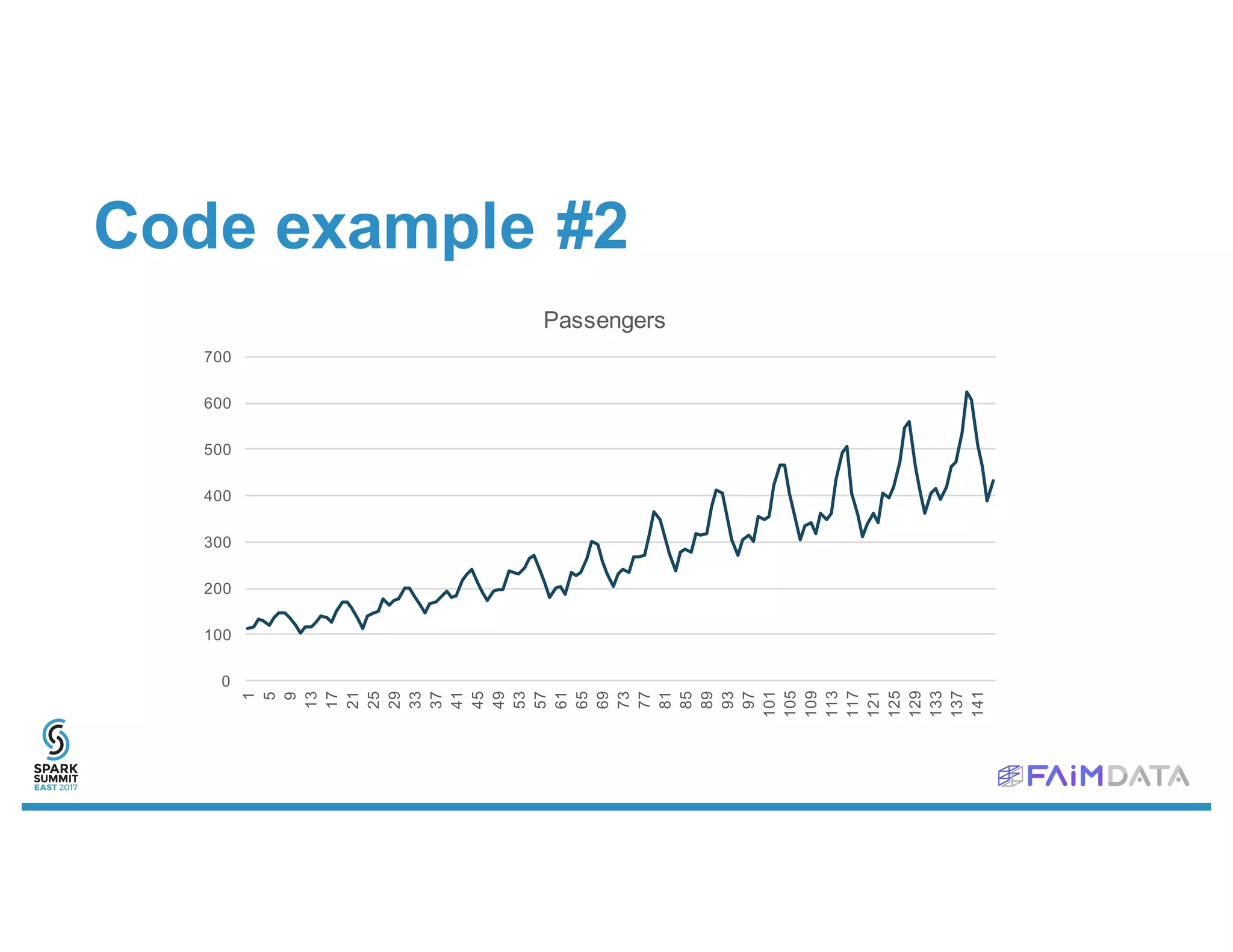
0
100
200
300
400
500
600
700
1
5
9
13
17
21
25
29
33
37
41
45
49
53
57
61
65
69
73
77
81
85
89
93
97
101
105
109
113
117
121
125
129
133
137
141
Passengers
Code example #2
Code example #2
350
400
450
500
550
600
650
1 2 3 4 5 6 7 8 9 10 11 12 13
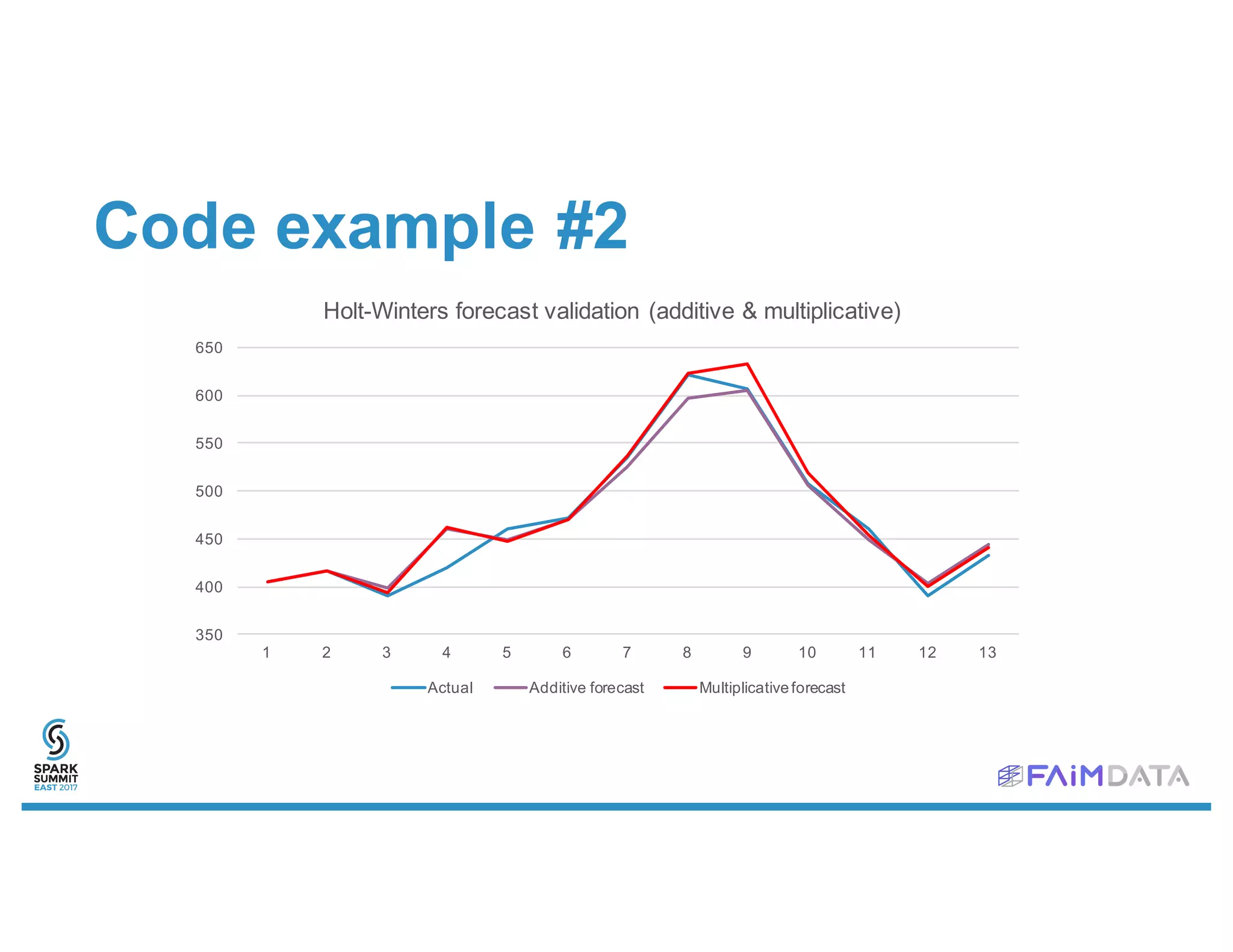
Holt-Winters forecast validation (additive & multiplicative)
Actual Additive forecast Multiplicativeforecast
Thank You.
e-mail: souellette@faimdata.com

Time Series Analytics with Spark: Spark Summit East talk by Simon Ouellette

  • 1.
    Time Series Analytics withSpark Simon Ouellette Faimdata
  • 2.
    What is spark-timeseries? •Open source time series library for Apache Spark 2.0 • Sandy Ryza – Advanced Analytics with Spark: Patterns for Learning from Data at Scale – Senior Data Scientist at Clover Health • Started in February 2015 https://github.com/sryza/spark-timeseries
  • 3.
    Who am I? •Chief Data Science Officer at Faimdata • Contributor to spark-timeseries since September 2015 • Participated in early design discussions (March 2015) • Been an active user for ~2 years http://faimdata.com
  • 4.
    Survey: Who usestime series?
  • 5.
    Design Question #1:How do we structure multivariate time series? Columnar or Row-based?
  • 6.
    Vectors Date/ Time Series 1Series 2 Vector 1 2:30:01 4.56 78.93 Vector 2 2:30:02 4.57 79.92 Vector 3 2:30:03 4.87 79.91 Vector 4 2:30:04 4.48 78.99 RDD[(ZonedDateTime, Vector)] DateTime Index Vector for Series 1 Vector for Series 2 2:30:01 4.56 78.93 2:30:02 4.57 79.92 2:30:03 4.87 79.91 2:30:04 4.48 78.99 TimeSeriesRDD( DateTimeIndex, RDD[Vector] ) Columnar representation Row-based representation
  • 7.
    Columnar vs Row-based •Lagging • Differencing • Rolling operations • Feature generation • Feature selection • Feature transformation • Regression • Clustering • Classification • Etc. More efficient in columnar representation: More efficient in row-based representation:
  • 8.
    Example: lagging operation •Time complexity: O(N) (assumes pre-sorted RDD) • For each row, we need to get values from previous k rows • Time complexity: O(K) • For each column to lag, we truncate most recent k values, and truncate the DateTimeIndex’s oldest k values. Columnar representationRow-based representation
  • 9.
    Example: regression • We’reestimating: • The lagged values are typically part of each row, because they are pre-generated as new features. • Stochastic Gradient Descent: we iterate on examples and estimate error gradient to adjust weights, which means that we care about rows, not columns. • To avoid shuffling, the partitioning must be done such that all elements of a row are together in the same partition (so the gradient can be computed locally).
  • 10.
    Current solution • Corerepresentation is columnar. • Utility functions to go to/from row-based. • Reasoning: spark-timeseries operations are mostly time-related, i.e. columnar. Row-based operations are about relationships between the variables (ML/statistical), thus external to spark- timeseries.
  • 11.
  • 12.
    Survey: Who usesunivariate time series that don’t fit inside a single executor’s memory? (or multivariate of which a single variable’s time series doesn’t fit)
  • 13.
    Design Question #2:How do we partition the multi-variate time series for distributed processing? Across features, or across time?
  • 14.
    Current design Assumption: asingle time series must fit inside executory memory!
  • 15.
    Current design Assumption: asingle time series must fit inside executory memory! TimeSeriesRDD ( DatetimeIndex, RDD[(K, Vector)] ) IrregularDatetimeIndex ( Array[Long], // Other limitation: Scala arrays = 232 elements java.time.ZoneId )
  • 16.
    Future improvements • Creationof a new TimeSeriesRDD-like class that will be longitudinally (i.e. across time) partitioned rather than horizontally (i.e. across features). • Keep both types of partitioning, on a case-by- case basis.
  • 17.
    Design Question #3:How do we lag, difference, etc.? Re-sampling, or index-preserving?
  • 18.
    Option #1: re-sampling Irregular Time yvalue at t x value at t 1:30:05 51.42 4.87 1:30:07.86 52.37 4.99 1:30:07.98 53.22 4.95 1:30:08.04 55.87 4.97 1:30:12 54.84 5.12 1:30:14 49.88 5.10 Uniform Time y value at t x value at (t – 1) 1:30:06 51.42 4.87 1:30:07 51.42 4.87 1:30:08 53.22 4.87 1:30:09 55.87 4.95 1:30:10 55.87 4.97 1:30:11 55.87 4.97 1:30:12 54.84 4.97 1:30:13 54.84 5.12 1:30:14 49.88 5.12 Before After (1 second lag)
  • 19.
    Option #2: indexpreserving Irregular Time y value at t x value at t 1:30:05 51.42 4.87 1:30:07.86 52.37 4.99 1:30:07.98 53.22 4.95 1:30:08.04 55.87 4.97 1:30:12 54.84 5.12 1:30:14 49.88 5.10 Irregular Time y value at t x value at (t – 1) 1:30:05 51.42 N/A 1:30:07.86 52.37 4.87 1:30:07.98 53.22 4.87 1:30:08.04 55.87 4.87 1:30:12 54.84 4.97 1:30:14 49.88 5.12 Before After (1 second lag)
  • 20.
    Current functionality • Option#1: resample() function for lagging/differencing by upsampling/downsampling. – Custom interpolation function (used when downsampling) • Conceptual problems: – Information loss and duplication (downsampling) – Bloating (upsampling)
  • 21.
    Current functionality • Option#2: functions to lag/difference irregular time series based on arbitrary time intervals. (preserves index) • Same thing: custom interpolationfunction can be passed for when downsampling occurs.
  • 22.
  • 23.
    High-level objects • TimeSeriesRDD •TimeSeries • TimeSeriesStatisticalTests • TimeSeriesModel • DatetimeIndex • UnivariateTimeSeries
  • 24.
    TimeSeriesRDD • collectAsTimeSeries • filterStartingBefore,filterStartingAfter, slice • filterByInstant • quotients, differences, lags • fill: fills NaNs by specified interpolation method (linear, nearest, next, previous, spline, zero) • mapSeries • seriesStats: min, max, average, std. deviation • toInstants, toInstantsDataFrame • resample • rollSum, rollMean • saveAsCsv, saveAsParquetDataFrame
  • 25.
    TimeSeriesStatisticalTests • Stationarity tests: –Augmented Dickey-Fuller (adftest) – KPSS (kpsstest) • Serial auto-correlation tests: – Durbin-Watson (dwtest) – Breusch-Godfrey (bgtest) – Ljung-Box (lbtest) • Breusch-Pagan heteroskedasticity test (bptest) • Newey-West variance estimator (neweyWestVarianceEstimator)
  • 26.
    TimeSeriesModel • AR, ARIMA •ARX, ARIMAX (i.e. with exogenous variables) • Exponentially weighted moving average • Holt-winters method (triple exp. smoothing) • GARCH(1,1),ARGARCH(1,1,1)
  • 27.
    Others • Java bindings •Python bindings • YAHOO financial data parser
  • 28.
    Code example #1 TimeY X 12:45:01 3.45 25.0 12:46:02 4.45 30.0 12:46:58 3.45 40.0 12:47:45 3.00 35.0 12:48:05 4.00 45.0 Y is stationary X is integrated of order 1
  • 29.
  • 30.
    Code example #1 Timey d(x) Lag1(y) Lag2(y) Lag1(d(x)) Lag2(d(x)) 12:45:01 3.45 12:46:02 4.45 5.0 3.45 12:46:58 3.45 10.0 4.45 3.45 5.0 12:47:45 3.00 -5.0 3.45 4.45 10.0 5.0 12:48:05 4.00 10.0 3.00 3.45 -5.0 10.0
  • 31.
    Code example #2 •We will use Holt-Winters to forecast some seasonal data. • Holt-winters: exponential moving average applied to level, trend and seasonal component of the time series, then combined into global forecast.
  • 32.
  • 33.
  • 34.
    Code example #2 350 400 450 500 550 600 650 12 3 4 5 6 7 8 9 10 11 12 13 Holt-Winters forecast validation (additive & multiplicative) Actual Additive forecast Multiplicativeforecast
  • 35.