TIME SERIES
PREPARED BY:JAMSHID RAQI
TIME SERIES
Content:
 Introduction
 Objectives of Times Series
 Components of Times Series
 Important of Times Series
 Types of Times Series
 Application of Times Series
What is a Time Series?
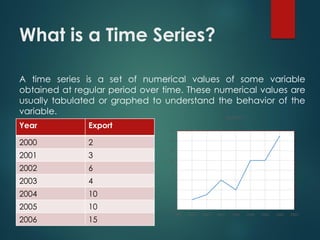
A time series is a set of numerical values of some variable
obtained at regular period over time. These numerical values are
usually tabulated or graphed to understand the behavior of the
variable.
Year Export
2000 2
2001 3
2002 6
2003 4
2004 10
2005 10
2006 15
0
2
4
6
8
10
12
14
16
1999 2000 2001 2002 2003 2004 2005 2006 2007
export
Objectives of Time Series:
 In time series analyses, it is assumes that the
various factors which have already influenced the
patterns of change in the value of the variable
under study will continue to do so almost in the
same manner in future also.
 The review and evaluation of progress in any
phenomenon are made based on time series
data. For example evaluation of the policy of
controlling inflation and price rise is done based
on various price indices that are based on the
analysis of time series.
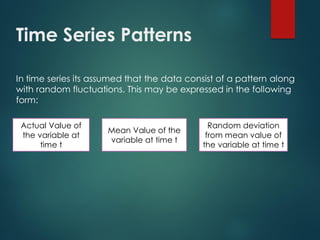
Time Series Patterns
In time series its assumed that the data consist of a pattern along
with random fluctuations. This may be expressed in the following
form:
= +
Actual Value of
the variable at
time t
Mean Value of the
variable at time t
Random deviation
from mean value of
the variable at time t
Components of Time Series:
The time series data contain four components:
Trend, Cyclicality, Seasonality, and Irregularity. Not all
time series have all these components. Figure 1.2
shows the effects of these time series components
over a period of time.
 Trend: Some times a time series displays a steady
tendency of either upward or downward
movement in the average value of the forecast y
over time. Such a tendency is called a trend.
When observations are plotted against time, a
straight line describes the increase or decrease in
the time series over a period of time.
 Cycles: upward and downward movements in
the variable value about the trend time over a
time period are called cycles. A business cycle
may vary in length, usually more than a year but
less than 5 to 7 years.
 Seasonal: It is a special case of a cycle
component of time series in which fluctuations are
repeated usually within a year (Egg. Daily, weakly,
monthly, quarterly) with a high degree of
regularity. For example, average sales for a retail
store may increase greatly during festival
seasons.
 Irregular: Variations are rapid charges or bleeps
in the data caused by short term unanticipated
and non recurring factors. Irregular fluctuations
can happen as often as day to day.
Time Series Decomposition Models
The Analysis of Time Series Consist of two major steps:
 Identifying the various factors or influences which
produce the variations in the time series.
 Isolating, analyzing and measuring the effect of
these factors independently holding other things
constant.
There are two main Model Time Series:
 Multiplicative Model
 Addictive Model
Multiplicative Model :
The actual values of a time series, Y can be found by multiplying
its four components at a particular time period. The effect of four
components on the time series is interdependent. The
multiplicative time series model is defined as:
Y=T*C*S*I ………….. Multiplicative Model
Addictive Model:
In this Model it is assumed that the effect of various components
on a time series can be estimated by adding these components.
The addictive time series model is defined as:
Y=T+C+S+I …………. Addictive Model
.

Time series

  • 1.
  • 2.
    Content:  Introduction  Objectivesof Times Series  Components of Times Series  Important of Times Series  Types of Times Series  Application of Times Series
  • 3.
    What is aTime Series? A time series is a set of numerical values of some variable obtained at regular period over time. These numerical values are usually tabulated or graphed to understand the behavior of the variable. Year Export 2000 2 2001 3 2002 6 2003 4 2004 10 2005 10 2006 15 0 2 4 6 8 10 12 14 16 1999 2000 2001 2002 2003 2004 2005 2006 2007 export
  • 4.
    Objectives of TimeSeries:  In time series analyses, it is assumes that the various factors which have already influenced the patterns of change in the value of the variable under study will continue to do so almost in the same manner in future also.  The review and evaluation of progress in any phenomenon are made based on time series data. For example evaluation of the policy of controlling inflation and price rise is done based on various price indices that are based on the analysis of time series.
  • 5.
    Time Series Patterns Intime series its assumed that the data consist of a pattern along with random fluctuations. This may be expressed in the following form: = + Actual Value of the variable at time t Mean Value of the variable at time t Random deviation from mean value of the variable at time t
  • 6.
    Components of TimeSeries: The time series data contain four components: Trend, Cyclicality, Seasonality, and Irregularity. Not all time series have all these components. Figure 1.2 shows the effects of these time series components over a period of time.
  • 7.
     Trend: Sometimes a time series displays a steady tendency of either upward or downward movement in the average value of the forecast y over time. Such a tendency is called a trend. When observations are plotted against time, a straight line describes the increase or decrease in the time series over a period of time.  Cycles: upward and downward movements in the variable value about the trend time over a time period are called cycles. A business cycle may vary in length, usually more than a year but less than 5 to 7 years.
  • 8.
     Seasonal: Itis a special case of a cycle component of time series in which fluctuations are repeated usually within a year (Egg. Daily, weakly, monthly, quarterly) with a high degree of regularity. For example, average sales for a retail store may increase greatly during festival seasons.  Irregular: Variations are rapid charges or bleeps in the data caused by short term unanticipated and non recurring factors. Irregular fluctuations can happen as often as day to day.
  • 9.
    Time Series DecompositionModels The Analysis of Time Series Consist of two major steps:  Identifying the various factors or influences which produce the variations in the time series.  Isolating, analyzing and measuring the effect of these factors independently holding other things constant. There are two main Model Time Series:  Multiplicative Model  Addictive Model
  • 10.
    Multiplicative Model : Theactual values of a time series, Y can be found by multiplying its four components at a particular time period. The effect of four components on the time series is interdependent. The multiplicative time series model is defined as: Y=T*C*S*I ………….. Multiplicative Model Addictive Model: In this Model it is assumed that the effect of various components on a time series can be estimated by adding these components. The addictive time series model is defined as: Y=T+C+S+I …………. Addictive Model
  • 11.