
Time Series Predictions
using Long Short-Term
Memory
Setu Chokshi
IoT Asia 2017 – 30th March
LSTMs are mainstream
What are Neural Network
Y1
Y2
X1
X2
X3
h1
h2
h3
h4
Information Transfer
Input Values
Calculator – Activations
Output (Activation)
1
2
3
4
Input Hidden Output
X1
X2
X3
W11
W21
W31
 
h1
Example of  = REctified Linear Unit =
max(0,input)
Strengthen weak signals; Leave strong
signals alone
Weight is the strength of the connection
between nodes
1
Challenges
 Only fixed sized inputs & outputs
 Performs mapping of features from input to output
 No memory and hence difficult to model time series
Lets add some memory
Input Hidden Output
Input + prevInput Hidden Output Input+ prevHidden Hidden Output
Input + prevInput Hidden Output
Input + prevHidden Hidden Output
Approach 1: Add previous inputs Approach 2: Add previous hidden
Lets do 4 time series steps Lets do 4 time series steps
Lets add some memory…and color
Input Hidden Output
Input + prevInput Hidden Output Input+ prevHidden Hidden Output
Input + prevInput Hidden Output
Input + prevHidden Hidden Output
Approach 1: Add previous inputs Approach 2: Add previous hidden
Lets do 4 time series steps Lets do 4 time series steps
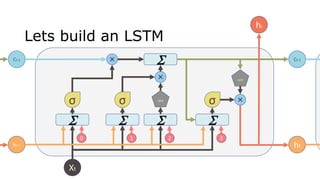
Lets build an LSTM
Xt
   
0 1 2 3
ht-1
Ct-1 Ct✖
✖

✖σ σ σtanh
tanh
ht
ht
Ct-1
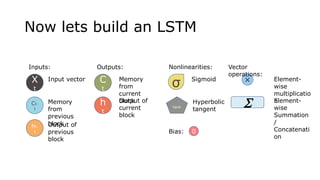
Now lets build an LSTM
Element-
wise
Summation
/
Concatenati
on
Element-
wise
multiplicatio
n
X
t
ht-
1
Ct-
1
h
t
C
t
0
σ

✖
tanh
Inputs: Outputs:
Input vector
Memory
from
previous
blockOutput of
previous
block
Memory
from
current
blockOutput of
current
block
Nonlinearities:
Sigmoid
Hyperbolic
tangent
Vector
operations:
Bias:
Lets skip the math, ok?
Element-
wise
summation
Element-
wise
multiplicatio
n
✖ = =
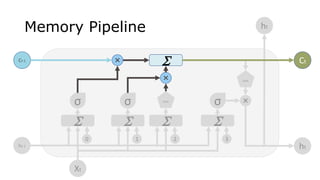
Memory Pipeline
Xt
   
0 1 2 3
ht-1
Ct-1
C
t
ht
✖
✖

✖σ σ σtanh
tanh
ht
✖
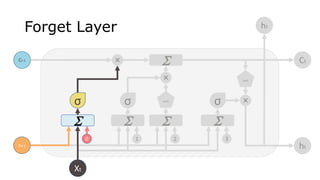
Forget Layer
Xt
   
0 1 2 3
ht-1
Ct-1 Ct
ht
✖
✖

✖σ σ σtanh
tanh
ht
Generate new memories: Input
Xt
  + 
0 1 2 3
ht-1
Ct-1 Ct
ht
✖
✖

✖σ σ σtanh
tanh
ht

2
tanh
Generate new memories: Candidate
Xt
   
0 1 2 3
ht-1
Ct-1 Ct
ht
✖
✖

✖σ σ σtanh
tanh
ht
Memory Pipeline
Xt
   
0 1 2 3
ht-1
Ct-1 Ct
ht
✖
✖

✖σ σ σtanh
tanh
ht
Generate the output
Xt
   
0 1 2 3
ht-1
Ct-1 Ct
ht
✖
✖

✖σ σ σtanh
tanh
ht
EXAMPLES
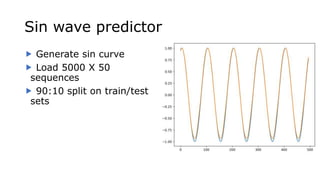
Sin wave predictor
 Generate sin curve
 Load 5000 X 50
sequences
 90:10 split on train/test
sets
Power Consumption Dataset
 Power Consumption
Dataset
 47 Months of data
 2075259 measurements
 Active energy consumed
per min
 Load 4567 X 50
sequences
 90:10 split on train/test
sets
References
 Understanding LSTM Networks
http://colah.github.io/posts/2015-08-Understanding-
LSTMs/
 General Sequence Learning using Recurrent
Neural Networks
https://www.youtube.com/watch?v=VINCQghQRuM
 Recurrent Neural Networks Part 1: Theory
https://www.slideshare.net/gakhov
 Facebook Prophet
https://github.com/facebookincubator/prophet
 Images adapted from Shi Yan
https://medium.com/@shiyan/understanding-lstm-and-its-
diagrams-37e2f46f1714
 Anyone Can Learn To Code
https://iamtrask.github.io/2015/11/15/anyone-can-code-lstm/
THANK YOU
@setuc
www.linkedin.com/in/setuchoks
hi/
github.com/setuc/iotAsia2017

Time series predictions using LSTMs

  • 1.
    Time Series Predictions usingLong Short-Term Memory Setu Chokshi IoT Asia 2017 – 30th March
  • 2.
  • 3.
    What are NeuralNetwork Y1 Y2 X1 X2 X3 h1 h2 h3 h4 Information Transfer Input Values Calculator – Activations Output (Activation) 1 2 3 4 Input Hidden Output X1 X2 X3 W11 W21 W31   h1 Example of  = REctified Linear Unit = max(0,input) Strengthen weak signals; Leave strong signals alone Weight is the strength of the connection between nodes 1
  • 4.
    Challenges  Only fixedsized inputs & outputs  Performs mapping of features from input to output  No memory and hence difficult to model time series
  • 5.
    Lets add somememory Input Hidden Output Input + prevInput Hidden Output Input+ prevHidden Hidden Output Input + prevInput Hidden Output Input + prevInput Hidden Output Input + prevInput Hidden Output Input + prevInput Hidden Output Input + prevHidden Hidden Output Input + prevHidden Hidden Output Input + prevHidden Hidden Output Input + prevHidden Hidden Output Approach 1: Add previous inputs Approach 2: Add previous hidden Lets do 4 time series steps Lets do 4 time series steps
  • 6.
    Lets add somememory…and color Input Hidden Output Input + prevInput Hidden Output Input+ prevHidden Hidden Output Input + prevInput Hidden Output Input + prevInput Hidden Output Input + prevInput Hidden Output Input + prevInput Hidden Output Input + prevHidden Hidden Output Input + prevHidden Hidden Output Input + prevHidden Hidden Output Input + prevHidden Hidden Output Approach 1: Add previous inputs Approach 2: Add previous hidden Lets do 4 time series steps Lets do 4 time series steps
  • 7.
    Lets build anLSTM Xt     0 1 2 3 ht-1 Ct-1 Ct✖ ✖  ✖σ σ σtanh tanh ht ht Ct-1
  • 8.
    Now lets buildan LSTM Element- wise Summation / Concatenati on Element- wise multiplicatio n X t ht- 1 Ct- 1 h t C t 0 σ  ✖ tanh Inputs: Outputs: Input vector Memory from previous blockOutput of previous block Memory from current blockOutput of current block Nonlinearities: Sigmoid Hyperbolic tangent Vector operations: Bias:
  • 9.
    Lets skip themath, ok? Element- wise summation Element- wise multiplicatio n ✖ = =
  • 10.
    Memory Pipeline Xt    0 1 2 3 ht-1 Ct-1 C t ht ✖ ✖  ✖σ σ σtanh tanh ht ✖
  • 11.
    Forget Layer Xt    0 1 2 3 ht-1 Ct-1 Ct ht ✖ ✖  ✖σ σ σtanh tanh ht
  • 12.
    Generate new memories:Input Xt   +  0 1 2 3 ht-1 Ct-1 Ct ht ✖ ✖  ✖σ σ σtanh tanh ht  2 tanh
  • 13.
    Generate new memories:Candidate Xt     0 1 2 3 ht-1 Ct-1 Ct ht ✖ ✖  ✖σ σ σtanh tanh ht
  • 14.
    Memory Pipeline Xt    0 1 2 3 ht-1 Ct-1 Ct ht ✖ ✖  ✖σ σ σtanh tanh ht
  • 15.
    Generate the output Xt    0 1 2 3 ht-1 Ct-1 Ct ht ✖ ✖  ✖σ σ σtanh tanh ht
  • 16.
  • 17.
    Sin wave predictor Generate sin curve  Load 5000 X 50 sequences  90:10 split on train/test sets
  • 18.
    Power Consumption Dataset Power Consumption Dataset  47 Months of data  2075259 measurements  Active energy consumed per min  Load 4567 X 50 sequences  90:10 split on train/test sets
  • 19.
    References  Understanding LSTMNetworks http://colah.github.io/posts/2015-08-Understanding- LSTMs/  General Sequence Learning using Recurrent Neural Networks https://www.youtube.com/watch?v=VINCQghQRuM  Recurrent Neural Networks Part 1: Theory https://www.slideshare.net/gakhov  Facebook Prophet https://github.com/facebookincubator/prophet  Images adapted from Shi Yan https://medium.com/@shiyan/understanding-lstm-and-its- diagrams-37e2f46f1714  Anyone Can Learn To Code https://iamtrask.github.io/2015/11/15/anyone-can-code-lstm/
  • 20.

Editor's Notes

  • #4 Unlike all hidden layers in a neural network, the output layer units most commonly have as activation function: 1. Linear identity function (for regression problems) 2. Softmax (for classification problems).
  • #11 If you multiply the old memory C_t-1 with a vector that is close to 0, that means you want to forget most of the old memory. You let the old memory goes through, if your forget valve equals 1. Then the second operation the memory flow will go through is this + operator. New memory and the old memory will merge by this operation. How much new memory should be added to the old memory is controlled by another valve, the ✖ below the + sign.
  • #12 Sometimes it’s good to forget. If you’re analyzing a text corpus and come to the end of a document you may have no reason to believe that the next document has any relationship to it whatsoever, and therefore the memory cell should be reset before the network gets the first element of the next document. In many cases by reset we don’t only mean immediate set it to 0, but also gradual resets corresponding to slowly fading cell states