CVXOPT:
A Python Based Convex
Optimization Suite

11 May 2012
Industrial Engineering Seminar
Andrew B. Martin
Easy and Hard
• Easy Problems - efficient and reliable
solution algorithms exist
• Once distinction was between
Linear/Nonlinear, now
Convex/Nonconvex

2
Outline
• What is CVXOPT?
• How does CVXOPT solve problems?
• What are some interesting applications
of CVXOPT?
3
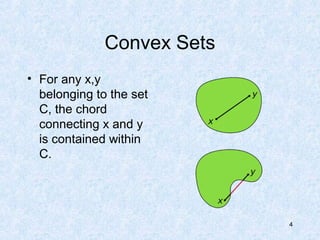
Convex Sets
• For any x,y
belonging to the set
C, the chord
connecting x and y
is contained within
C.

4
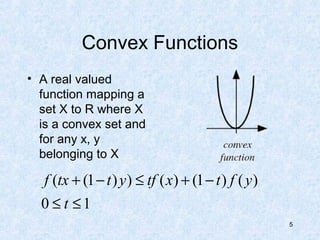
Convex Functions
• A real valued
function mapping a
set X to R where X
is a convex set and
for any x, y
belonging to X

f (tx + (1 − t ) y ) ≤ tf ( x) + (1 − t ) f ( y )
0 ≤ t ≤1
5
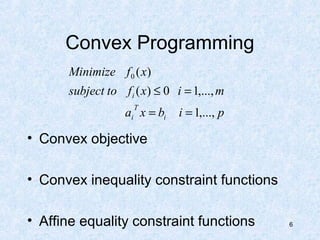
Convex Programming
Minimize f 0 ( x)
subject to f i ( x) ≤ 0 i = 1,..., m
T

ai x = bi

i = 1,..., p

• Convex objective
• Convex inequality constraint functions
• Affine equality constraint functions

6
Linear Programming

• Supply Chain Modeling (Forestry)

7
Quadratic Programming

• Least Squares and Constrained Least
Squares
• Quantitative Finance
8
Second Order Cone
Programming

• Robust Linear Programming
• Truss design, robotic grasping force, antenna
design
9
Example: Robust LP
Minimize cT x
subject to aiT x ≤ bi ∀ai ∈ Ε i i = 1,..., m
_

Ei = {a i + Pi u | u 2 ≤ 1} Pi ∈ ℜ nxn
sup{aiT x | ai ∈ Ε i } ≤ bi
_T

sup{aiT x | ai ∈ Ε i } = a i x + Pi T x

2

Minimize cT x
_T

subject to a x + Pi T x ≤ bi i = 1,..., m
2

10
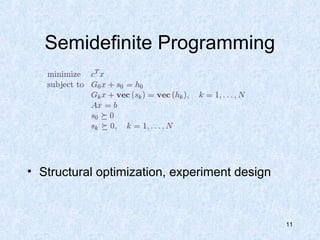
Semidefinite Programming

• Structural optimization, experiment design

11
Geometric Programming
Minimize

f 0 ( x)

Subject to

f i ( x) ≤ 1 i = 1,..., n
h j ( x) = 1 j = 1,..., m

• Posynomial objective and inequality
constraint functions.
• Monomial equality constraint functions
12
Globally Optimal Points
• Any locally optimal point is globally
optimal!
• No concern of getting stuck at
suboptimal minimums.
Overview CVXOPT
• Created by L. Vandenberghe and
J. Dahl of UCLA
• Extends pythons standard libraries
– Objects matrix and spmatrix

• Defines new modules e.g. BLAS,
LAPACK, modeling and solvers
14
cvxopt.solvers
•
•
•
•

Cone solvers: conelp, coneqp
Smooth nonlinear solvers: cp, cpl
Geometric Program solver: gp
Customizable: kktsolver

15
Cone Programs

• s belongs to C, the Cartesian product of a
nonnegative orthant, a number of second
order cones and a number of positive
semidefinite cones
16
Cone Solvers
• Apply Primal-Dual Path following
Interior Point algorithms with NesterovTodd Scaling to the previous problem
• Specify cone dimension with variable
dims
• Separate QP and LP solvers

17
solvers.coneqp
• coneqp(P, q, G, h, A, b, dims, kktsolver)
• Linearize Central Path Equations
(Newton Equations)
• Solving these is the most expensive step

• Transform N.E. into KKT system
18
solvers.coneqp
Central Path Equations
0   P
0  +  A
  
 s  G
  

G T   x  − c 
   
0   y  =  b , ( s, z )  0, z = − µg ( s )
0  z   h 
   

AT
0
0

Newton Equations

P

A
G


AT
0
0

  x  a 
   
0   y  = b 
− W TW   z   c 
   
GT

19
solvers.coneqp
KKT System

 P

 A
W −T G


T

A
0
0

T

G W
0
−I

−1

 x   a 
  
y = b 


 Wz  W −T c 

  

20
Constrained Regression

21
>> from cvxopt import matrix, solvers
>> A = matrix([ [ .3, -.4, -.2, -.4, 1.3 ], [ .6, 1.2, -1.7, .3, -.3 ], /

-.3, .0, .6, -1.2, -2.0 ] ])
>> b = matrix([ 1.5, .0, -1.2, -.7, .0])
>> m, n = A.size

>>> I = matrix(0.0, (n,n))
>> I[::n+1] = 1.0
>> G = matrix([-I, matrix(0.0, (1,n)), I])
>> h = matrix(n*[0.0] + [1.0] + n*[0.0])
>> dims = {'l': n, 'q': [n+1], 's': []}
>> x = solvers.coneqp(A.T*A, -A.T*b, G, h, dims)['x']
>> print(x)
7.26e-01]
6.18e-01]
3.03e-01]

22
solvers.conelp
• Coneqp demands strict primal-dual
feasibility. Conelp can detect
infeasibility.
• Embeds primal and dual LPs into one
LP
• Algorithm similar to coneqp except two
QR factorizations used to solve KKT
System
23
solvers.conelp
Self-dual Cone LP
Minimize 0
0  0
0 
  = − A
s −G
   T
κ  − c


AT
0
0
− bT

GT
0
0
− hT

C x
 
b  y
, ( s, κ , z ,τ )  0
h  z 
 
0  τ 


24
dims = {'l': 2, 'q': [4, 4], 's': [3]}
25
Nonlinear Solvers

• Solvers.cpl for linear objective problems
• User specifies F function to evaluate
gradients and hessian of constraints
• Solvers.cpl(F, G, h, A, b, kktsolver)
26
solvers.cpl
KKT System


H
A
~
G


T

A
0
0
m


G  u x  bx 
0  u y  = by ,
   
− W T W  u z  bz 
   

~
T

~

H = ∑ z k ∇ f k ( x), G = [∇f1 ( x) ... ∇f m ( x) G T ]T
2

k =0

27
solvers.cp

• For problems with a nonlinear objective
function
• Problem transformed into epigraph form and
solvers.cpl algorithm applied
28
solvers.cp
Robust Least Squares
from cvxopt import solvers, matrix, spdiag, sqrt, div
def robls(A, b, rho) :
m, n = A.size
def F(x = None, z = None) :
if x is None : return 0, matrix(0.0, (n,1))
y = A*x -b
w = sqrt(rho + y * *2)
f = sum(w)
Df = div(y, w).T * A
if z is None : return f, Df
H = A.T * spdiag(z[0] * rho * (w * * - 3)) * A
return f, Df, H

Minimize

m

∑ φ((Ax-b) )
k =1

k

where φ (u ) = ρ + u 2

return solvers.cp(F)[' x' ]

29
Geometric Solver

• GP transformed to equivalent convex form
and solvers.cp is applied
• Solvers.gp(F, G, h, A, b)
30
Exploiting Structure
• None of the previously mentioned
solvers take advantage of problem
structure
• User specified kktsolvers and python
functions allow for customization
• Potential for better than commercial
software performance
31
Exploiting Structure
M

N

CVXOPT

CVXOPT/BLAS

MOSEK 1.15

MOSEK 1.17

500

100

0.12

0.06

0.75

0.40

1000 100

0.22

0.11

1.53

0.81

1000 200

0.52

0.25

1.95

1.06

2000 200

1.23

0.60

3.87

2.19

1000 500

2.44

1.32

3.63

2.38

2000 500

5.00

2.68

7.44

5.11

2000 1000

17.1

9.52

32.4

12.8

•

L1-norm approximation solution times for six randomly
generated problems of dimension mxn (ref)
32
Interlude: iPython
• Interactive Programming Environment
• explore algorithms, and perform data
analysis and visualization.
• It facilitates experimentation - new ideas
can be tested on the fly
33
iPython - Features
• Magic Commands - e.g. %run
• Detailed Exception Traceback
• OS Shell Commands
• Extensive GUI support
34
Facility Layout Problem
• As Nonlinearly Constrained Program
• As Geometric Program
• As Quadratic Program

35
Nonlinearly Constrained
Facility Layout Problem
Minimize W + H
Subject to wk hk ≤ Areamin
x k + wk ≤ x j
x k + wk ≤ W
yk + hk ≤ y j
yk + hk ≤ H
1 / α ≤ wk / hk ≤ α
36
200 Modules
Geometric Program
Minimize W * H
Subject to x j * xi−1 + w j * xi−1 ≤ 1
x j *W −1 + w j *W −1 ≤ 1
y j * yi−1 + h j * yi−1 ≤ 1
y j * H −1 + h j * H −1 ≤ 1
Areamin * w−1 * h −1 ≤ 1
j
j
1 / α ≤ w j * h −1 ≤ α
j
38
Quadratic Program
Minimize

∑∑
i

j

xi − x j
flowi , j *
yi − y j

2

+ β (W + H )
2

subject to x j + w j ≤ xi
x j + wj ≤ W
y j + h j ≤ yi
y j + hj ≤ H
− w j ≤ − Areamin
− h j ≤ − Areamin
1/ α ≤ wj / hj ≤ α

39
65 Modules
Closing
• CVXOPT: Software for Convex
Optimization
• How will you use it?
• andrew.b.martin@dal.ca
41
References

42

Convex Optimization Modelling with CVXOPT

  • 1.
    CVXOPT: A Python BasedConvex Optimization Suite 11 May 2012 Industrial Engineering Seminar Andrew B. Martin
  • 2.
    Easy and Hard •Easy Problems - efficient and reliable solution algorithms exist • Once distinction was between Linear/Nonlinear, now Convex/Nonconvex 2
  • 3.
    Outline • What isCVXOPT? • How does CVXOPT solve problems? • What are some interesting applications of CVXOPT? 3
  • 4.
    Convex Sets • Forany x,y belonging to the set C, the chord connecting x and y is contained within C. 4
  • 5.
    Convex Functions • Areal valued function mapping a set X to R where X is a convex set and for any x, y belonging to X f (tx + (1 − t ) y ) ≤ tf ( x) + (1 − t ) f ( y ) 0 ≤ t ≤1 5
  • 6.
    Convex Programming Minimize f0 ( x) subject to f i ( x) ≤ 0 i = 1,..., m T ai x = bi i = 1,..., p • Convex objective • Convex inequality constraint functions • Affine equality constraint functions 6
  • 7.
    Linear Programming • SupplyChain Modeling (Forestry) 7
  • 8.
    Quadratic Programming • LeastSquares and Constrained Least Squares • Quantitative Finance 8
  • 9.
    Second Order Cone Programming •Robust Linear Programming • Truss design, robotic grasping force, antenna design 9
  • 10.
    Example: Robust LP MinimizecT x subject to aiT x ≤ bi ∀ai ∈ Ε i i = 1,..., m _ Ei = {a i + Pi u | u 2 ≤ 1} Pi ∈ ℜ nxn sup{aiT x | ai ∈ Ε i } ≤ bi _T sup{aiT x | ai ∈ Ε i } = a i x + Pi T x 2 Minimize cT x _T subject to a x + Pi T x ≤ bi i = 1,..., m 2 10
  • 11.
    Semidefinite Programming • Structuraloptimization, experiment design 11
  • 12.
    Geometric Programming Minimize f 0( x) Subject to f i ( x) ≤ 1 i = 1,..., n h j ( x) = 1 j = 1,..., m • Posynomial objective and inequality constraint functions. • Monomial equality constraint functions 12
  • 13.
    Globally Optimal Points •Any locally optimal point is globally optimal! • No concern of getting stuck at suboptimal minimums.
  • 14.
    Overview CVXOPT • Createdby L. Vandenberghe and J. Dahl of UCLA • Extends pythons standard libraries – Objects matrix and spmatrix • Defines new modules e.g. BLAS, LAPACK, modeling and solvers 14
  • 15.
    cvxopt.solvers • • • • Cone solvers: conelp,coneqp Smooth nonlinear solvers: cp, cpl Geometric Program solver: gp Customizable: kktsolver 15
  • 16.
    Cone Programs • sbelongs to C, the Cartesian product of a nonnegative orthant, a number of second order cones and a number of positive semidefinite cones 16
  • 17.
    Cone Solvers • ApplyPrimal-Dual Path following Interior Point algorithms with NesterovTodd Scaling to the previous problem • Specify cone dimension with variable dims • Separate QP and LP solvers 17
  • 18.
    solvers.coneqp • coneqp(P, q,G, h, A, b, dims, kktsolver) • Linearize Central Path Equations (Newton Equations) • Solving these is the most expensive step • Transform N.E. into KKT system 18
  • 19.
    solvers.coneqp Central Path Equations 0  P 0  +  A     s  G    G T   x  − c      0   y  =  b , ( s, z )  0, z = − µg ( s ) 0  z   h      AT 0 0 Newton Equations P  A G  AT 0 0   x  a      0   y  = b  − W TW   z   c      GT 19
  • 20.
    solvers.coneqp KKT System  P  A W −T G  T A 0 0 T G W 0 −I −1  x   a     y = b     Wz  W −T c      20
  • 21.
  • 22.
    >> from cvxoptimport matrix, solvers >> A = matrix([ [ .3, -.4, -.2, -.4, 1.3 ], [ .6, 1.2, -1.7, .3, -.3 ], / -.3, .0, .6, -1.2, -2.0 ] ]) >> b = matrix([ 1.5, .0, -1.2, -.7, .0]) >> m, n = A.size >>> I = matrix(0.0, (n,n)) >> I[::n+1] = 1.0 >> G = matrix([-I, matrix(0.0, (1,n)), I]) >> h = matrix(n*[0.0] + [1.0] + n*[0.0]) >> dims = {'l': n, 'q': [n+1], 's': []} >> x = solvers.coneqp(A.T*A, -A.T*b, G, h, dims)['x'] >> print(x) 7.26e-01] 6.18e-01] 3.03e-01] 22
  • 23.
    solvers.conelp • Coneqp demandsstrict primal-dual feasibility. Conelp can detect infeasibility. • Embeds primal and dual LPs into one LP • Algorithm similar to coneqp except two QR factorizations used to solve KKT System 23
  • 24.
    solvers.conelp Self-dual Cone LP Minimize0 0  0 0    = − A s −G    T κ  − c  AT 0 0 − bT GT 0 0 − hT C x   b  y , ( s, κ , z ,τ )  0 h  z    0  τ   24
  • 25.
    dims = {'l':2, 'q': [4, 4], 's': [3]} 25
  • 26.
    Nonlinear Solvers • Solvers.cplfor linear objective problems • User specifies F function to evaluate gradients and hessian of constraints • Solvers.cpl(F, G, h, A, b, kktsolver) 26
  • 27.
    solvers.cpl KKT System  H A ~ G  T A 0 0 m  G u x  bx  0  u y  = by ,     − W T W  u z  bz       ~ T ~ H = ∑ z k ∇ f k ( x), G = [∇f1 ( x) ... ∇f m ( x) G T ]T 2 k =0 27
  • 28.
    solvers.cp • For problemswith a nonlinear objective function • Problem transformed into epigraph form and solvers.cpl algorithm applied 28
  • 29.
    solvers.cp Robust Least Squares fromcvxopt import solvers, matrix, spdiag, sqrt, div def robls(A, b, rho) : m, n = A.size def F(x = None, z = None) : if x is None : return 0, matrix(0.0, (n,1)) y = A*x -b w = sqrt(rho + y * *2) f = sum(w) Df = div(y, w).T * A if z is None : return f, Df H = A.T * spdiag(z[0] * rho * (w * * - 3)) * A return f, Df, H Minimize m ∑ φ((Ax-b) ) k =1 k where φ (u ) = ρ + u 2 return solvers.cp(F)[' x' ] 29
  • 30.
    Geometric Solver • GPtransformed to equivalent convex form and solvers.cp is applied • Solvers.gp(F, G, h, A, b) 30
  • 31.
    Exploiting Structure • Noneof the previously mentioned solvers take advantage of problem structure • User specified kktsolvers and python functions allow for customization • Potential for better than commercial software performance 31
  • 32.
    Exploiting Structure M N CVXOPT CVXOPT/BLAS MOSEK 1.15 MOSEK1.17 500 100 0.12 0.06 0.75 0.40 1000 100 0.22 0.11 1.53 0.81 1000 200 0.52 0.25 1.95 1.06 2000 200 1.23 0.60 3.87 2.19 1000 500 2.44 1.32 3.63 2.38 2000 500 5.00 2.68 7.44 5.11 2000 1000 17.1 9.52 32.4 12.8 • L1-norm approximation solution times for six randomly generated problems of dimension mxn (ref) 32
  • 33.
    Interlude: iPython • InteractiveProgramming Environment • explore algorithms, and perform data analysis and visualization. • It facilitates experimentation - new ideas can be tested on the fly 33
  • 34.
    iPython - Features •Magic Commands - e.g. %run • Detailed Exception Traceback • OS Shell Commands • Extensive GUI support 34
  • 35.
    Facility Layout Problem •As Nonlinearly Constrained Program • As Geometric Program • As Quadratic Program 35
  • 36.
    Nonlinearly Constrained Facility LayoutProblem Minimize W + H Subject to wk hk ≤ Areamin x k + wk ≤ x j x k + wk ≤ W yk + hk ≤ y j yk + hk ≤ H 1 / α ≤ wk / hk ≤ α 36
  • 37.
  • 38.
    Geometric Program Minimize W* H Subject to x j * xi−1 + w j * xi−1 ≤ 1 x j *W −1 + w j *W −1 ≤ 1 y j * yi−1 + h j * yi−1 ≤ 1 y j * H −1 + h j * H −1 ≤ 1 Areamin * w−1 * h −1 ≤ 1 j j 1 / α ≤ w j * h −1 ≤ α j 38
  • 39.
    Quadratic Program Minimize ∑∑ i j xi −x j flowi , j * yi − y j 2 + β (W + H ) 2 subject to x j + w j ≤ xi x j + wj ≤ W y j + h j ≤ yi y j + hj ≤ H − w j ≤ − Areamin − h j ≤ − Areamin 1/ α ≤ wj / hj ≤ α 39
  • 40.
  • 41.
    Closing • CVXOPT: Softwarefor Convex Optimization • How will you use it? • andrew.b.martin@dal.ca 41
  • 42.