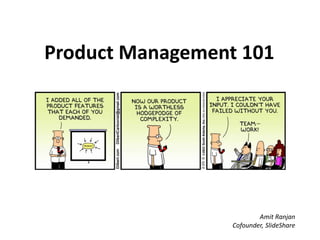
Product Management 101
Amit Ranjan
Cofounder, SlideShare
Presentation Flow
• Product Management
‐ what, why, who
• Product Manager skillsets
• Difference between Consumer & Enterprise
products
• Strategies for Hacking Growth
• Product Management is the function that
manages the product life cycle through
activities like planning, forecasting,
production, marketing.
• The Product Management role can have
different flavours
‐ engineering, design, sales, user acquisition,
marketing, data etc
• Product Managers have responsibility but no
authority
• They own the product, but don’t manage the
people building the product
The Product Management Dilemma
“A great product manager has the brain
of an engineer, the heart of a designer,
and the speech of a diplomat…”
“The best Product Managers become
CEOs of their products (minus P&L
responsibilities)…”
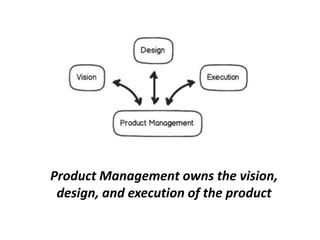
Product Management owns the vision,
design, and execution of the product
• Vision
‐ align org goals with market conditions & user needs
‐ ‘get’ the pulse of the product (think movie directors)
• Design
‐ give shape to the product: feature mix, user
experience
• Execution
‐ work with engineering, quality, marketing to deliver
Identifying a Good Product Manager
• Strong product sense/instinct
• Carries multiple points of views
• Communicates clearly
• Simplifies & prioritizes
• Measures & iterates
• Understands good design
• Writes effective copy
“Product Managers are God’s gift to
mankind…. against feature bloat”
"Every failed product had an awesome
spreadsheet…"
Product Managers: “The Art of Saying No”
• So many reasons to say yes
‐ “But the data looks good…”
‐ “But it’ll only take a few minutes….”
‐ “But this customer is about to quit…”
‐ “But we can just make it optional…”
‐ “But my cousin’s neighbour said…”
‐ “But we’re allowed to work on whatever we want…”
‐ “But 713,000 people said they want it…”
‐ “But we’ll achieve our monthly target…”
How to tackle casual product feedback
• One person's opinion (OPO)
‐ what if the one-person is Steve Jobs
• Strong suggestion
• Vocal minority phenomenon
• Mandate
https://www.linkedin.com/pulse/20140602024642-22330283-avoiding-the-unintended-
consequences-of-casual-feedback
3 point thumb rule for product prioritization
• Product features (prioritizing for a product)
‐ Metrics movers
‐ Satisfiers
‐ Delighters
• Product Roadmap (prioritizing overall product plan)
‐ Core
‐ Strategic
‐ Venture
Both consumer & enterprise products
deliver user values & functionality but…
- Consumer: you build for end-users
Enterprise: you build for end-users & buyers
- Consumer: satisfies the user’s emotional need
Enterprise: workflow efficiency is focus
- Consumer: build what users love (partners: Eng/Design/Pdt.)
Enterprise: revenue driven (partners: Sales/Marketing)
- Consumer: often requires an artistic mindset
Enterprise: requires a business mindset
Early Stage Startups - Growth Strategies
“A startup is a temporary organization
which is searching for a repeatable and
scalable business model…”
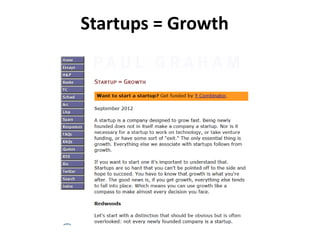
Startups = Growth
Three stages of startup growth….
• Initial period of slow or no growth
‐ startup tries to figure out what it's doing
• After product market fit
‐ rapid growth, reach as many people as possible
• Startup grows into a big company
‐ growth slows due limits of market size &
organizational bloat
Growth Strategies
• Consumer Products case study
• Enterprise Products case study
References
• http://crankypm.com/2006/11/08/that-all-the-responsibility-and-no-authority-saying/
• http://steveblank.com/2010/01/25/whats-a-startup-first-principles/
• http://www.paulgraham.com/growth.html
• http://blog.intercom.io/product-strategy-means-saying-no/
• https://www.linkedin.com/pulse/20140602024642-22330283-avoiding-the-unintended-
consequences-of-casual-feedback
• https://www.pinterest.com/pin/47850814762416434/
• http://www.sachinrekhi.com/blog/2013/01/28/what-is-product-management
• http://www.quora.com/What-distinguishes-the-Top-1-of-Product-Managers-from-the-Top-
10/answer/Ian-McAllister
• https://www.linkedin.com/pulse/how-enterprise-products-differ-from-consumer-angela-
yoonjeong-yang
• www.dilbert.com
• http://www.quora.com/What-are-the-best-ways-to-prioritize-a-list-of-product-features
• http://www.instigatorblog.com/the-role-of-product-managers/2012/06/08/
• https://medium.com/design-of-a-technology-business/ultimate-guide-to-product-prioritization-
b08c18d5c00f
https://twitter.com/amitranjan
https://www.facebook.com/amitranjan
http://in.linkedin.com/in/amitranjanprofile

Product Management 101

  • 1.
    Product Management 101 AmitRanjan Cofounder, SlideShare
  • 2.
    Presentation Flow • ProductManagement ‐ what, why, who • Product Manager skillsets • Difference between Consumer & Enterprise products • Strategies for Hacking Growth
  • 3.
    • Product Managementis the function that manages the product life cycle through activities like planning, forecasting, production, marketing. • The Product Management role can have different flavours ‐ engineering, design, sales, user acquisition, marketing, data etc
  • 4.
    • Product Managershave responsibility but no authority • They own the product, but don’t manage the people building the product The Product Management Dilemma
  • 5.
    “A great productmanager has the brain of an engineer, the heart of a designer, and the speech of a diplomat…”
  • 6.
    “The best ProductManagers become CEOs of their products (minus P&L responsibilities)…”
  • 7.
    Product Management ownsthe vision, design, and execution of the product
  • 8.
    • Vision ‐ alignorg goals with market conditions & user needs ‐ ‘get’ the pulse of the product (think movie directors) • Design ‐ give shape to the product: feature mix, user experience • Execution ‐ work with engineering, quality, marketing to deliver
  • 9.
    Identifying a GoodProduct Manager • Strong product sense/instinct • Carries multiple points of views • Communicates clearly • Simplifies & prioritizes • Measures & iterates • Understands good design • Writes effective copy
  • 10.
    “Product Managers areGod’s gift to mankind…. against feature bloat”
  • 11.
    "Every failed producthad an awesome spreadsheet…"
  • 12.
    Product Managers: “TheArt of Saying No” • So many reasons to say yes ‐ “But the data looks good…” ‐ “But it’ll only take a few minutes….” ‐ “But this customer is about to quit…” ‐ “But we can just make it optional…” ‐ “But my cousin’s neighbour said…” ‐ “But we’re allowed to work on whatever we want…” ‐ “But 713,000 people said they want it…” ‐ “But we’ll achieve our monthly target…”
  • 13.
    How to tacklecasual product feedback • One person's opinion (OPO) ‐ what if the one-person is Steve Jobs • Strong suggestion • Vocal minority phenomenon • Mandate https://www.linkedin.com/pulse/20140602024642-22330283-avoiding-the-unintended- consequences-of-casual-feedback
  • 14.
    3 point thumbrule for product prioritization • Product features (prioritizing for a product) ‐ Metrics movers ‐ Satisfiers ‐ Delighters • Product Roadmap (prioritizing overall product plan) ‐ Core ‐ Strategic ‐ Venture
  • 15.
    Both consumer &enterprise products deliver user values & functionality but… - Consumer: you build for end-users Enterprise: you build for end-users & buyers - Consumer: satisfies the user’s emotional need Enterprise: workflow efficiency is focus - Consumer: build what users love (partners: Eng/Design/Pdt.) Enterprise: revenue driven (partners: Sales/Marketing) - Consumer: often requires an artistic mindset Enterprise: requires a business mindset
  • 16.
    Early Stage Startups- Growth Strategies
  • 17.
    “A startup isa temporary organization which is searching for a repeatable and scalable business model…”
  • 18.
  • 19.
    Three stages ofstartup growth…. • Initial period of slow or no growth ‐ startup tries to figure out what it's doing • After product market fit ‐ rapid growth, reach as many people as possible • Startup grows into a big company ‐ growth slows due limits of market size & organizational bloat
  • 20.
    Growth Strategies • ConsumerProducts case study • Enterprise Products case study
  • 21.
    References • http://crankypm.com/2006/11/08/that-all-the-responsibility-and-no-authority-saying/ • http://steveblank.com/2010/01/25/whats-a-startup-first-principles/ •http://www.paulgraham.com/growth.html • http://blog.intercom.io/product-strategy-means-saying-no/ • https://www.linkedin.com/pulse/20140602024642-22330283-avoiding-the-unintended- consequences-of-casual-feedback • https://www.pinterest.com/pin/47850814762416434/ • http://www.sachinrekhi.com/blog/2013/01/28/what-is-product-management • http://www.quora.com/What-distinguishes-the-Top-1-of-Product-Managers-from-the-Top- 10/answer/Ian-McAllister • https://www.linkedin.com/pulse/how-enterprise-products-differ-from-consumer-angela- yoonjeong-yang • www.dilbert.com • http://www.quora.com/What-are-the-best-ways-to-prioritize-a-list-of-product-features • http://www.instigatorblog.com/the-role-of-product-managers/2012/06/08/ • https://medium.com/design-of-a-technology-business/ultimate-guide-to-product-prioritization- b08c18d5c00f
  • 22.