Dr. Renju Joseph
TOTS 20 Batch
Vision: Adolescent Transformation Mentor
Mission: Educate, Empower, Enlighten
TIME MANAGEMENT
Introduction
David, a Project Manager.
Let us look at what is going on in
David’s mind on a typical workday.
Introduction
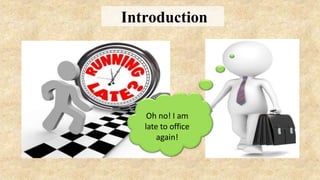
Oh no! I am
late to office
again!
Introduction
So many emails to check!
I don’t even have time left for
morning tea now.
Where did I put the file for the Maxwell
Project?
Introduction
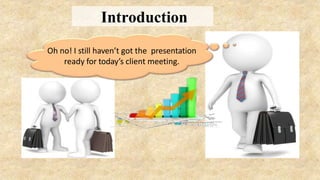
Oh no! I still haven’t got the presentation
ready for today’s client meeting.
Introduction
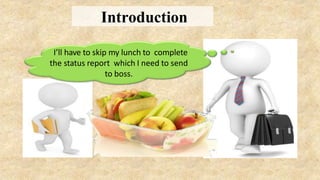
I’ll have to skip my lunch to complete
the status report which I need to send
to boss.
Introduction
Oh! I forgot I also
have to attend
the Parent-
Teacher meeting
of my kid today!
Introduction
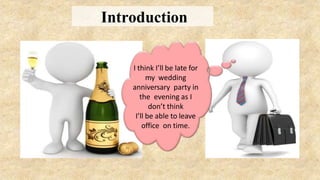
I think I’ll be late for
my wedding
anniversary party in
the evening as I
don’t think
I’ll be able to leave
office on time.
Introduction
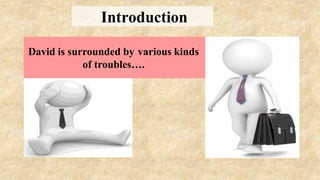
David is surrounded by various kinds
of troubles….
Introduction
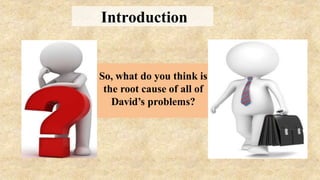
So, what do you think is
the root cause of all of
David’s problems?
Introduction
• Yes, all of David’s problems
arise due to lack of proper time
/ self management.
Introduction
Let us see how David suffers
from poor time management.
Introduction
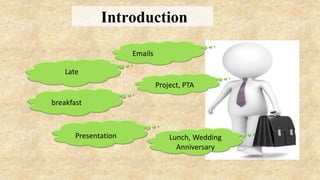
Late
Emails
breakfast
Project, PTA
Presentation Lunch, Wedding
Anniversary
Introduction
We suffer not only
on the professional
but also on the
personal front.
Introduction
So, it is crucial that whether you are a student, a working
professional or a homemaker, you should learn to manage
your time effectively.
Introduction
What is Time Management?
The art of arranging, organizing, scheduling, and
budgeting one’s time for the purpose of generating
more effective work and productivity is known as Time
Management.
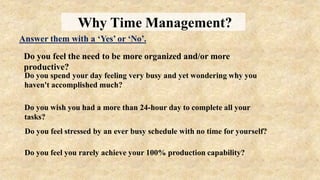
Why Time Management?
Do you feel the need to be more organized and/or more
productive?
Answer them with a ‘Yes’ or ‘No’.
Do you spend your day feeling very busy and yet wondering why you
haven't accomplished much?
Do you wish you had a more than 24-hour day to complete all your
tasks?
Do you feel stressed by an ever busy schedule with no time for yourself?
Do you feel you rarely achieve your 100% production capability?
If you have answered ‘Yes’ to
any of the earlier questions,
then the solution to your
dilemma lies in ‘time
management’.
Why Time Management?
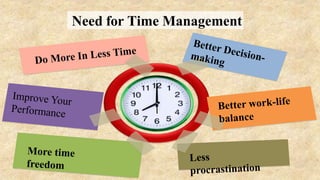
Need for Time Management
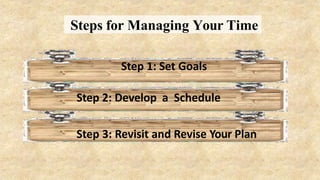
Steps for Managing Your Time
Step 1: Set Goals
Step 2: Develop a Schedule
Step 3: Revisit and Revise Your Plan
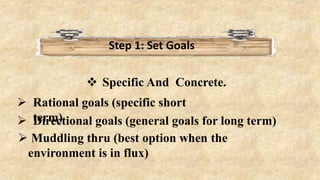
Step 1: Set Goals
 Specific And Concrete.
 Rational goals (specific short
term)
 Directional goals (general goals for long term)
 Muddling thru (best option when the
environment is in flux)
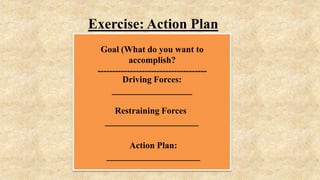
Exercise: Action Plan
Goal (What do you want to
accomplish?
-------------------------------------
Driving Forces:
__________________
Restraining Forces
_____________________
Action Plan:
_____________________
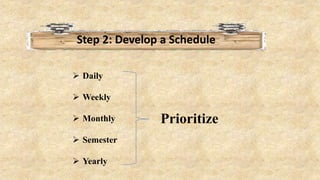
Step 2: Develop a Schedule
 Daily
 Weekly
 Monthly
 Semester
 Yearly
Prioritize
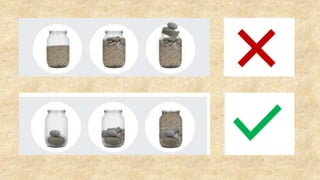
Is the Jar Full?
"Okay. Let's find out."
Seems like
Gravel can
make it space in
that Full Jar…
Is the Jar Full?
"Okay. Let's find out."
Is it Full Now?
Seems like Sand
can make it
space in that
Full Jar…
Is the Jar Full?
"Okay. Let's find out."
Is it Full Now?
Seems like
Water can make
it space in that
Full Jar…
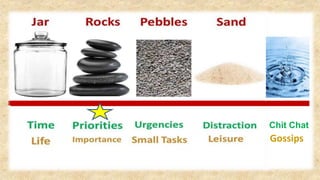
What's The Point?
Is the Jar Full?
Gossips
Chit Chat
The Action Priority Matrix
1. Tasks to focus on, and
2. In which order.
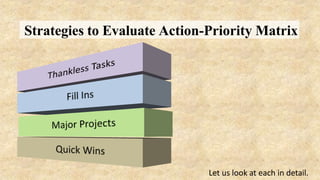
Strategies to Evaluate Action-Priority Matrix
Let us look at each in detail.
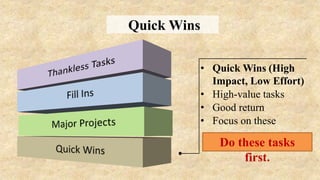
Quick Wins
• Quick Wins (High
Impact, Low Effort)
• High-value tasks
• Good return
• Focus on these
Do these tasks
first.
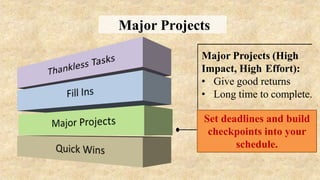
Major Projects
Major Projects (High
Impact, High Effort):
• Give good returns
• Long time to complete.
Set deadlines and build
checkpoints into your
schedule.
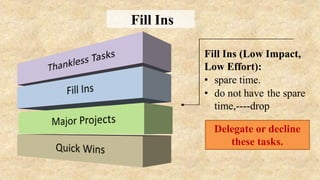
Fill Ins
Fill Ins (Low Impact,
Low Effort):
• spare time.
• do not have the spare
time,----drop
Delegate or decline
these tasks.
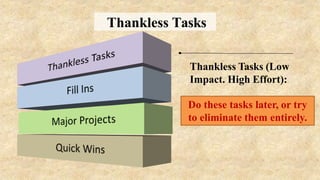
Thankless Tasks
Thankless Tasks (Low
Impact. High Effort):
Do these tasks later, or try
to eliminate them entirely.
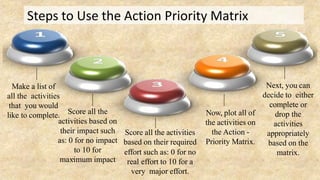
Steps to Use the Action Priority Matrix
Make a list of
all the activities
that you would
like to complete. Score all the
activities based on
their impact such
as: 0 for no impact
to 10 for
maximum impact
.
Score all the activities
based on their required
effort such as: 0 for no
real effort to 10 for a
very major effort.
Now, plot all of
the activities on
the Action -
Priority Matrix.
Next, you can
decide to either
complete or
drop the
activities
appropriately
based on the
matrix.
Step 3: Revisit and Revise Your Plan
 Check whether the plan is working
 Identify the deviance between your planned schedule and
your actual followed schedule
Alter your schedule and revise your plan.
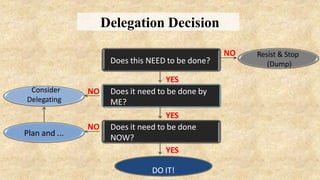
Delegation Decision
Does this NEED to be done?
Resist & Stop
(Dump)
YES
YES
YES
DO IT!
Consider
Delegating
Plan and ...
NO Does it need to be done by
ME?
NO Does it need to be done
NOW?
NO
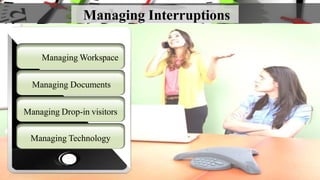
Managing Interruptions
Managing Workspace
Managing Documents
Managing Drop-in visitors
Managing Technology
Telephone
1
Email
2
Unsubscribe
Important
Chat
3
Web Meeting
4
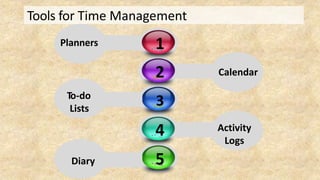
Tools for Time Management
Planners 1
2
3
4
5
To-do
Lists
Diary
Calendar
Activity
Logs
Let us now look at a real
life example to
understand the methods
of time management.
Real Life Example
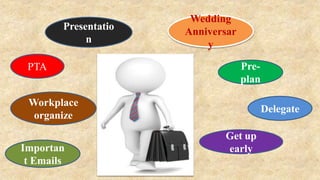
PTA
Wedding
Anniversar
y
Presentatio
n
Workplace
organize
Importan
t Emails
Get up
early
Delegate
Pre-
plan
• At what time of the day do you
feel most energetic?
Use Your Energy
Efficiently
 Morning Person
 Night Person
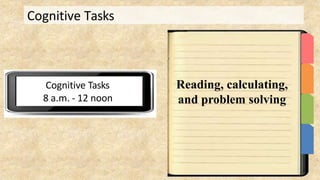
Cognitive Tasks
Cognitive Tasks
8 a.m. - 12 noon
Reading, calculating,
and problem solving
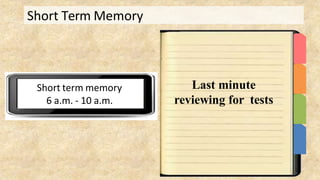
Short Term Memory
Short term memory
6 a.m. - 10 a.m.
Last minute
reviewing for tests
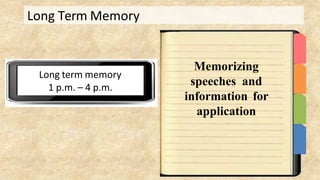
Long Term Memory
Long term memory
1 p.m. – 4 p.m.
Memorizing
speeches and
information for
application
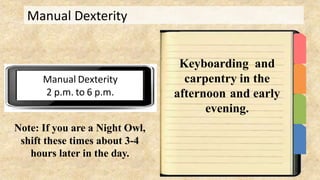
Manual Dexterity
Manual Dexterity
2 p.m. to 6 p.m.
Keyboarding and
carpentry in the
afternoon and early
evening.
Note: If you are a Night Owl,
shift these times about 3-4
hours later in the day.
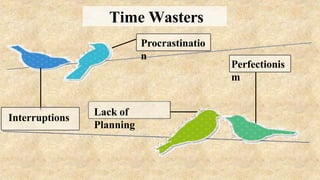
Time Wasters
Interruptions
Procrastinatio
n
Perfectionis
m
Lack of
Planning
Common Time
Management Pitfalls
Not
Keeping a
To-Do List
Absence
of Goals
Not
Prioritizing
Getting
Distracted
Procrastinating
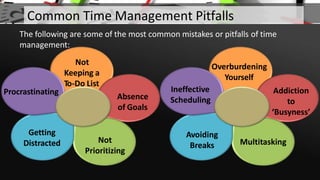
Common Time Management Pitfalls
The following are some of the most common mistakes or pitfalls of time
management:
Overburdening
Yourself
Addiction
to
‘Busyness’
Multitasking
Avoiding
Breaks
Ineffective
Scheduling
Practice
Let us now practice
all that you have
learned about Time
Management.
Practice
• What is the one major important
activity that you need to perform
daily?
• What are your biggest and most
frequent time wasters?
• Which time management tool is
most useful to you in managing
time?
• How can you improve your time
management skills?
Summary
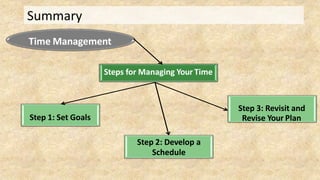
Steps for Managing Your Time
Time Management
Step 1: Set Goals
Step 2: Develop a
Schedule
Step 3: Revisit and
Revise Your Plan
Summary
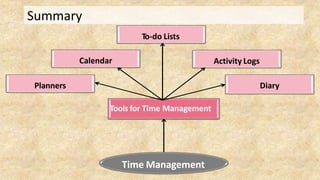
Time Management
Tools for Time Management
Planners
Calendar
To-do Lists
Diary
Activity Logs
Summary
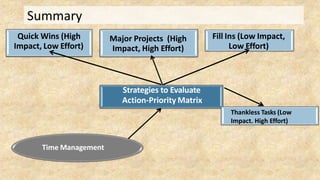
Major Projects (High
Impact, High Effort)
Quick Wins (High
Impact, Low Effort)
Fill Ins (Low Impact,
Low Effort)
Strategies to Evaluate
Action-Priority Matrix
Thankless Tasks (Low
Impact. High Effort)
Time Management
Summary
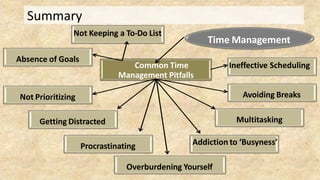
Common Time
Management Pitfalls
Time Management
Not Keeping a To-Do List
Not Prioritizing
Getting Distracted
Procrastinating Addiction to ‘Busyness’
Multitasking
Avoiding Breaks
Ineffective Scheduling
Absence of Goals
Overburdening Yourself
If you fail to Plan
You are Planning to Fail
Time management

Time management

  • 1.
    Dr. Renju Joseph TOTS20 Batch Vision: Adolescent Transformation Mentor Mission: Educate, Empower, Enlighten TIME MANAGEMENT
  • 2.
    Introduction David, a ProjectManager. Let us look at what is going on in David’s mind on a typical workday.
  • 3.
    Introduction Oh no! Iam late to office again!
  • 4.
    Introduction So many emailsto check! I don’t even have time left for morning tea now.
  • 5.
    Where did Iput the file for the Maxwell Project? Introduction
  • 6.
    Oh no! Istill haven’t got the presentation ready for today’s client meeting. Introduction
  • 7.
    I’ll have toskip my lunch to complete the status report which I need to send to boss. Introduction
  • 8.
    Oh! I forgotI also have to attend the Parent- Teacher meeting of my kid today! Introduction
  • 9.
    I think I’llbe late for my wedding anniversary party in the evening as I don’t think I’ll be able to leave office on time. Introduction
  • 10.
    David is surroundedby various kinds of troubles…. Introduction
  • 11.
    So, what doyou think is the root cause of all of David’s problems? Introduction
  • 12.
    • Yes, allof David’s problems arise due to lack of proper time / self management. Introduction
  • 13.
    Let us seehow David suffers from poor time management. Introduction
  • 14.
  • 15.
    We suffer notonly on the professional but also on the personal front. Introduction
  • 16.
    So, it iscrucial that whether you are a student, a working professional or a homemaker, you should learn to manage your time effectively. Introduction
  • 17.
    What is TimeManagement? The art of arranging, organizing, scheduling, and budgeting one’s time for the purpose of generating more effective work and productivity is known as Time Management.
  • 18.
    Why Time Management? Doyou feel the need to be more organized and/or more productive? Answer them with a ‘Yes’ or ‘No’. Do you spend your day feeling very busy and yet wondering why you haven't accomplished much? Do you wish you had a more than 24-hour day to complete all your tasks? Do you feel stressed by an ever busy schedule with no time for yourself? Do you feel you rarely achieve your 100% production capability?
  • 19.
    If you haveanswered ‘Yes’ to any of the earlier questions, then the solution to your dilemma lies in ‘time management’. Why Time Management?
  • 20.
    Need for TimeManagement
  • 21.
    Steps for ManagingYour Time Step 1: Set Goals Step 2: Develop a Schedule Step 3: Revisit and Revise Your Plan
  • 22.
    Step 1: SetGoals  Specific And Concrete.  Rational goals (specific short term)  Directional goals (general goals for long term)  Muddling thru (best option when the environment is in flux)
  • 23.
    Exercise: Action Plan Goal(What do you want to accomplish? ------------------------------------- Driving Forces: __________________ Restraining Forces _____________________ Action Plan: _____________________
  • 24.
    Step 2: Developa Schedule  Daily  Weekly  Monthly  Semester  Yearly Prioritize
  • 25.
    Is the JarFull? "Okay. Let's find out."
  • 26.
    Seems like Gravel can makeit space in that Full Jar… Is the Jar Full?
  • 27.
    "Okay. Let's findout." Is it Full Now?
  • 28.
    Seems like Sand canmake it space in that Full Jar… Is the Jar Full?
  • 29.
    "Okay. Let's findout." Is it Full Now?
  • 30.
    Seems like Water canmake it space in that Full Jar… What's The Point? Is the Jar Full?
  • 32.
  • 33.
    The Action PriorityMatrix 1. Tasks to focus on, and 2. In which order.
  • 34.
    Strategies to EvaluateAction-Priority Matrix Let us look at each in detail.
  • 35.
    Quick Wins • QuickWins (High Impact, Low Effort) • High-value tasks • Good return • Focus on these Do these tasks first.
  • 36.
    Major Projects Major Projects(High Impact, High Effort): • Give good returns • Long time to complete. Set deadlines and build checkpoints into your schedule.
  • 37.
    Fill Ins Fill Ins(Low Impact, Low Effort): • spare time. • do not have the spare time,----drop Delegate or decline these tasks.
  • 38.
    Thankless Tasks Thankless Tasks(Low Impact. High Effort): Do these tasks later, or try to eliminate them entirely.
  • 39.
    Steps to Usethe Action Priority Matrix Make a list of all the activities that you would like to complete. Score all the activities based on their impact such as: 0 for no impact to 10 for maximum impact . Score all the activities based on their required effort such as: 0 for no real effort to 10 for a very major effort. Now, plot all of the activities on the Action - Priority Matrix. Next, you can decide to either complete or drop the activities appropriately based on the matrix.
  • 40.
    Step 3: Revisitand Revise Your Plan  Check whether the plan is working  Identify the deviance between your planned schedule and your actual followed schedule Alter your schedule and revise your plan.
  • 41.
    Delegation Decision Does thisNEED to be done? Resist & Stop (Dump) YES YES YES DO IT! Consider Delegating Plan and ... NO Does it need to be done by ME? NO Does it need to be done NOW? NO
  • 42.
    Managing Interruptions Managing Workspace ManagingDocuments Managing Drop-in visitors Managing Technology
  • 43.
  • 44.
  • 45.
  • 46.
  • 47.
    Tools for TimeManagement Planners 1 2 3 4 5 To-do Lists Diary Calendar Activity Logs
  • 48.
    Let us nowlook at a real life example to understand the methods of time management. Real Life Example
  • 49.
  • 50.
    • At whattime of the day do you feel most energetic? Use Your Energy Efficiently  Morning Person  Night Person
  • 51.
    Cognitive Tasks Cognitive Tasks 8a.m. - 12 noon Reading, calculating, and problem solving
  • 52.
    Short Term Memory Shortterm memory 6 a.m. - 10 a.m. Last minute reviewing for tests
  • 53.
    Long Term Memory Longterm memory 1 p.m. – 4 p.m. Memorizing speeches and information for application
  • 54.
    Manual Dexterity Manual Dexterity 2p.m. to 6 p.m. Keyboarding and carpentry in the afternoon and early evening. Note: If you are a Night Owl, shift these times about 3-4 hours later in the day.
  • 55.
  • 56.
  • 57.
    Not Keeping a To-Do List Absence ofGoals Not Prioritizing Getting Distracted Procrastinating Common Time Management Pitfalls The following are some of the most common mistakes or pitfalls of time management: Overburdening Yourself Addiction to ‘Busyness’ Multitasking Avoiding Breaks Ineffective Scheduling
  • 58.
    Practice Let us nowpractice all that you have learned about Time Management.
  • 59.
    Practice • What isthe one major important activity that you need to perform daily? • What are your biggest and most frequent time wasters? • Which time management tool is most useful to you in managing time? • How can you improve your time management skills?
  • 61.
    Summary Steps for ManagingYour Time Time Management Step 1: Set Goals Step 2: Develop a Schedule Step 3: Revisit and Revise Your Plan
  • 62.
    Summary Time Management Tools forTime Management Planners Calendar To-do Lists Diary Activity Logs
  • 63.
    Summary Major Projects (High Impact,High Effort) Quick Wins (High Impact, Low Effort) Fill Ins (Low Impact, Low Effort) Strategies to Evaluate Action-Priority Matrix Thankless Tasks (Low Impact. High Effort) Time Management
  • 64.
    Summary Common Time Management Pitfalls TimeManagement Not Keeping a To-Do List Not Prioritizing Getting Distracted Procrastinating Addiction to ‘Busyness’ Multitasking Avoiding Breaks Ineffective Scheduling Absence of Goals Overburdening Yourself
  • 65.
    If you failto Plan You are Planning to Fail