Submitted by
G. Ponsutha
II MSc Microbiology
REG :20201232516113
Submitted to,
G. Ramanathan
Assistant professor
Department of microbiology
SEMESTER – IV
BIOINFORMATICS
SEMINAR TOPIC : TI PLASMID DERIVED VECTOR
 1907 smith &Townsend postulated that a bacterium was the causative agent of
Crown gall tumor
 A tumifaciens infects wounded or damaged plant tissues, it induces the formation of
a plant tumor called crown gall.
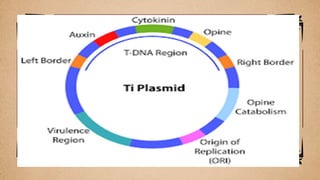
 Ti plasmid is a tumor-inducing or tumor induction plasmid
 It is plasmid of agrobacterium tumifaciens bacteria, the cells of virulent strains of A.
tumifaciens contain, besides the chrismal DNA, a small circular non-chromosomal
DNA called Ti-plasmid, which carries ancillary genes such as those affecting
pathogenicity and metabolism of opines.
Introduction
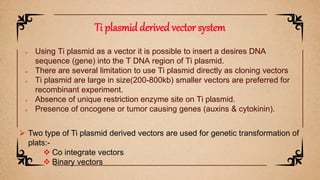
 Using Ti plasmid as a vector it is possible to insert a desires DNA
sequence (gene) into the T DNA region of Ti plasmid.
 There are several limitation to use Ti plasmid directly as cloning vectors
 Ti plasmid are large in size(200-800kb) smaller vectors are preferred for
recombinant experiment.
 Absence of unique restriction enzyme site on Ti plasmid.
 Presence of oncogene or tumor causing genes (auxins & cytokinin).
Ti plasmid derived vector system
 Two type of Ti plasmid derived vectors are used for genetic transformation of
plats:-
 Co integrate vectors
 Binary vectors
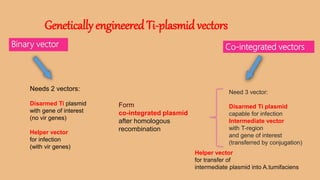
Need 3 vector:
Disarmed Ti plasmid
capable for infection
Intermediate vector
with T-region
and gene of interest
(transferred by conjugation)
Needs 2 vectors:
Disarmed Ti plasmid
with gene of interest
(no vir genes)
Helper vector
for infection
(with vir genes)
Genetically engineered Ti-plasmid vectors
Form
co-integrated plasmid
after homologous
recombination
Helper vector
for transfer of
intermediate plasmid into A.tumifaciens
Binary vector Co-integrated vectors
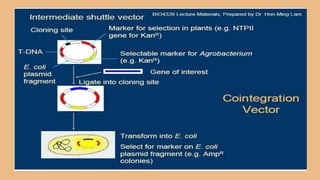
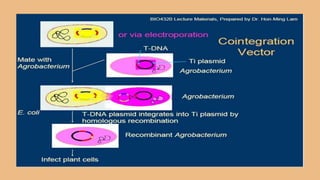
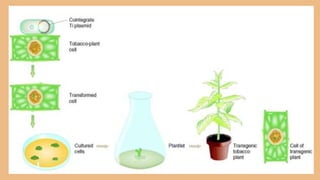
 In the cointegrate vector system, the disarmed and modified Ti
plasmid combines with an intermediate cloning vectors to produce a
recombinant Ti plasmid.
 Production of disarmed Ti plasmid:-
 The T-DNA genes for hormone biosynthesis are removed.
In place of the deleted DNA, a bacterial plasmid(pBR322)
DNA sequence is incorporated. This disarmed plasmid, also
referred to as receptor plasmid , has basic structure of T-
DNA (right &left borders, virulence genes etc.)
COINTEGATRE VECTOR
Construction of intermediate vector:-
1. The intermediate vector is constructed with the following components.
An intermediate vector is made using E.coli plasmid, vir region, T-DNA, origin of
replication, pBR322sequence
A plant transformation marker(PTM)
A gene coding for neomycin phosphotransferase 2 (npt2), These gene confer
resistance to kanamycin in the plant cells and this permits their isolation.
A bacterial resistance marker:-
A gene coding for spectinomycin resistance. This gene confers
spectinomycin resistance to recipient bacterial cells and thus permits
their selective isolation.
A multiple cloning site(MCS)Where foreign genes can be
inserted.
i. A co-E1 origin of replication which allows the replication of
plasmid in E.coli but not in agrobacterium.
ii. An oriT sequence with basis of ,mobilization (bom)site for the
transfer of intermediate vector form E.coli to Agrobacterium
1. Target genes can be easily cloned.
2. The plasmid is relatively small with a number of restriction sites.
3. Intermediate plasmid is conveniently cloned in E.coli and transferred
to Agrobacterium.
Advantages
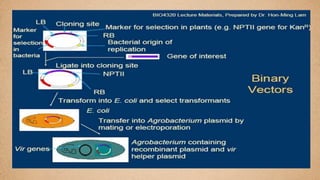
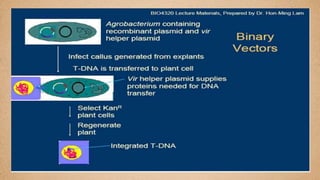
1. A binary vector system consists of an agrobacterium strain along with
disarmed Ti plasmid called vir helper plasmid (the entire T-DNA
region including borders deleted while vir gene is retained.) It may be
noted that both of them are not physically linked (or integrated.) A
binary vector with T-DNA can replicate in E.coli and agrobacterium.
binary vector is consist of a pair vector.
2. The binary vector has following component:-
The disarmed ti plasmid: this plasmid has T-DNA with gene
of interest and ori for both E.coli and agrobacterium. Also called
as mini-Ti plasmid or micro plasmid eg.Bin 19
Helper Ti plasmid has virulence region that mediates transfer of
T-DNA in micro Ti plasmid to the plant.
BINERY VECTORS
1. A bacterial resistant marker e.g. tetracycline resistant gene for
selecting binary vector colonies in E.coli and agrobacterium.
2. oriT sequence for conjugal mobilization of the binary vector from
E.coli agrobacterium.
3. A broad host-range origin of replication such as RK2 that allows the
replication of binary vector in agrobacterium.
1. The binary vector system involve only the transfer of a binary plasmid
to agrobacterium without any integration.
2. This is in contrast to cointegrate vector system. where in the
intermediate vector is transferred and integrated with disarmed Ti
plasmid.
3. Due to convenience, binary vectors are more frequently used than
cointegrate vectors
Advantages of binary vectors
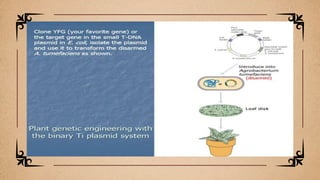
1. The target(foreign) gene of interest is inserted into the multiple
cloning site of the binary vector.
2. In this way, the target gene is placed between the right and left border
repeats and left border repeats and cloned in E.coli.
3. By a mating process, the binary vector is mobilized from E.coli to
Agrobacterium.
4. Now, the virulence gene proteins of T-DNA of the vectors into plant
cells.
Uses of binary vectors
CRÉDITOS: Esta plantilla de presentación fue
creada por Slidesgo, que incluye iconos de Flaticon,
infografías e imágenes de Freepik e ilustraciones de
Storyset
ti plasmid derived vector.pptx

ti plasmid derived vector.pptx

  • 1.
    Submitted by G. Ponsutha IIMSc Microbiology REG :20201232516113 Submitted to, G. Ramanathan Assistant professor Department of microbiology SEMESTER – IV BIOINFORMATICS SEMINAR TOPIC : TI PLASMID DERIVED VECTOR
  • 2.
     1907 smith&Townsend postulated that a bacterium was the causative agent of Crown gall tumor  A tumifaciens infects wounded or damaged plant tissues, it induces the formation of a plant tumor called crown gall.  Ti plasmid is a tumor-inducing or tumor induction plasmid  It is plasmid of agrobacterium tumifaciens bacteria, the cells of virulent strains of A. tumifaciens contain, besides the chrismal DNA, a small circular non-chromosomal DNA called Ti-plasmid, which carries ancillary genes such as those affecting pathogenicity and metabolism of opines. Introduction
  • 4.
     Using Tiplasmid as a vector it is possible to insert a desires DNA sequence (gene) into the T DNA region of Ti plasmid.  There are several limitation to use Ti plasmid directly as cloning vectors  Ti plasmid are large in size(200-800kb) smaller vectors are preferred for recombinant experiment.  Absence of unique restriction enzyme site on Ti plasmid.  Presence of oncogene or tumor causing genes (auxins & cytokinin). Ti plasmid derived vector system  Two type of Ti plasmid derived vectors are used for genetic transformation of plats:-  Co integrate vectors  Binary vectors
  • 5.
    Need 3 vector: DisarmedTi plasmid capable for infection Intermediate vector with T-region and gene of interest (transferred by conjugation) Needs 2 vectors: Disarmed Ti plasmid with gene of interest (no vir genes) Helper vector for infection (with vir genes) Genetically engineered Ti-plasmid vectors Form co-integrated plasmid after homologous recombination Helper vector for transfer of intermediate plasmid into A.tumifaciens Binary vector Co-integrated vectors
  • 6.
     In thecointegrate vector system, the disarmed and modified Ti plasmid combines with an intermediate cloning vectors to produce a recombinant Ti plasmid.  Production of disarmed Ti plasmid:-  The T-DNA genes for hormone biosynthesis are removed. In place of the deleted DNA, a bacterial plasmid(pBR322) DNA sequence is incorporated. This disarmed plasmid, also referred to as receptor plasmid , has basic structure of T- DNA (right &left borders, virulence genes etc.) COINTEGATRE VECTOR
  • 7.
    Construction of intermediatevector:- 1. The intermediate vector is constructed with the following components. An intermediate vector is made using E.coli plasmid, vir region, T-DNA, origin of replication, pBR322sequence A plant transformation marker(PTM) A gene coding for neomycin phosphotransferase 2 (npt2), These gene confer resistance to kanamycin in the plant cells and this permits their isolation.
  • 8.
    A bacterial resistancemarker:- A gene coding for spectinomycin resistance. This gene confers spectinomycin resistance to recipient bacterial cells and thus permits their selective isolation. A multiple cloning site(MCS)Where foreign genes can be inserted. i. A co-E1 origin of replication which allows the replication of plasmid in E.coli but not in agrobacterium. ii. An oriT sequence with basis of ,mobilization (bom)site for the transfer of intermediate vector form E.coli to Agrobacterium
  • 12.
    1. Target genescan be easily cloned. 2. The plasmid is relatively small with a number of restriction sites. 3. Intermediate plasmid is conveniently cloned in E.coli and transferred to Agrobacterium. Advantages
  • 13.
    1. A binaryvector system consists of an agrobacterium strain along with disarmed Ti plasmid called vir helper plasmid (the entire T-DNA region including borders deleted while vir gene is retained.) It may be noted that both of them are not physically linked (or integrated.) A binary vector with T-DNA can replicate in E.coli and agrobacterium. binary vector is consist of a pair vector. 2. The binary vector has following component:- The disarmed ti plasmid: this plasmid has T-DNA with gene of interest and ori for both E.coli and agrobacterium. Also called as mini-Ti plasmid or micro plasmid eg.Bin 19 Helper Ti plasmid has virulence region that mediates transfer of T-DNA in micro Ti plasmid to the plant. BINERY VECTORS
  • 14.
    1. A bacterialresistant marker e.g. tetracycline resistant gene for selecting binary vector colonies in E.coli and agrobacterium. 2. oriT sequence for conjugal mobilization of the binary vector from E.coli agrobacterium. 3. A broad host-range origin of replication such as RK2 that allows the replication of binary vector in agrobacterium.
  • 17.
    1. The binaryvector system involve only the transfer of a binary plasmid to agrobacterium without any integration. 2. This is in contrast to cointegrate vector system. where in the intermediate vector is transferred and integrated with disarmed Ti plasmid. 3. Due to convenience, binary vectors are more frequently used than cointegrate vectors Advantages of binary vectors
  • 18.
    1. The target(foreign)gene of interest is inserted into the multiple cloning site of the binary vector. 2. In this way, the target gene is placed between the right and left border repeats and left border repeats and cloned in E.coli. 3. By a mating process, the binary vector is mobilized from E.coli to Agrobacterium. 4. Now, the virulence gene proteins of T-DNA of the vectors into plant cells. Uses of binary vectors
  • 19.
    CRÉDITOS: Esta plantillade presentación fue creada por Slidesgo, que incluye iconos de Flaticon, infografías e imágenes de Freepik e ilustraciones de Storyset