Air and Media Sterilization
Yogesh Bhandari
 Sterilization -
• It is a process of destruction or removing of all
forms of living micro organisms from a
substance or surface by treating it with
chemicals, radiations or by steam.
 Air Sterilization -
• Methods of air sterilization –
i. Sterilization by heating
ii. Radiations
iii. Use of chemicals
iv. Sterilization by filtration
• Filtration sterilization method is commonly
used.
 Filtration -
• Two types of filtration –
i. Depth Filter
ii. Absolute Filter
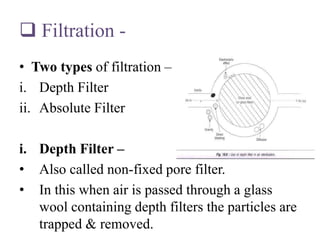
i. Depth Filter –
• Also called non-fixed pore filter.
• In this when air is passed through a glass
wool containing depth filters the particles are
trapped & removed.
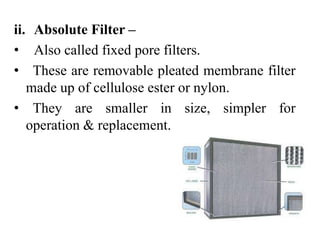
ii. Absolute Filter –
• Also called fixed pore filters.
• These are removable pleated membrane filter
made up of cellulose ester or nylon.
• They are smaller in size, simpler for
operation & replacement.
 Media Sterilization -
• In- situ – fermentor vessel & fermentation
medium is sterilize at a time.
• Ex- situ – fermentor vessel & fermentation
medium is sterilize separately & then add.
 Methods of Media Sterilization -
i. Heat sterilization
ii. Sterilization by filtration
iii. Radiations
iv. Use of Chemicals
i. Heat sterilization –
Most widely used sterilization technique.
a) Direct Heating –
• Boiling
b) Steam –
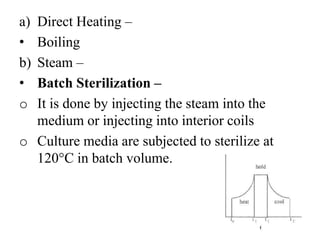
• Batch Sterilization –
o It is done by injecting the steam into the
medium or injecting into interior coils
o Culture media are subjected to sterilize at
120°C in batch volume.
• Continuous Sterilization -
o It is done by directly injecting the steam or by
means of heat exchangers.
o It is carried out at 140°C for 30- 120 seconds.
o Three types of heat exchangers -
I. 1st at 90-120°C within 20-30 seconds
II. 2nd at 140°C maintains 30-120 seconds
III. 3rd bring down temperature by cooling into
20-30 seconds
• Autoclave -
o The process is carried out at a temperature of
121°C for 20 minutes at 15psi pressure.
ii. Filtration -
• It is the quickest way of sterilization without
heating.
• Membrane filters are more commonly used.
• It may be noted that viruses & phage are
much smaller than bacteria so the filtration
method is not applicable.
iii. Radiations -
• This method involves exposing the packed
materials to radiations for sterilization.
• Two types of Radiations –
I. Non- ionic Radiation-
• UV rays have low penetration & thus are less
effective.
• But it is relatively safe & can be used for
small area sterilization.
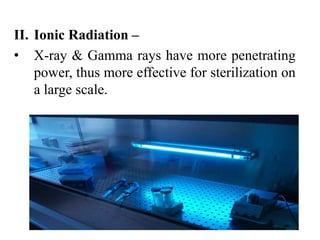
II. Ionic Radiation –
• X-ray & Gamma rays have more penetrating
power, thus more effective for sterilization on
a large scale.
iv. Chemical Agents -
• This is done by using toxic gasses.
• Gasses used for sterilization are very
poisonous.
• The commonly used gas is Ethylene oxide
with a combination of carbon dioxide.
• Other gasses like hydrogen peroxide, ozone
also used.
Thank You

Sterilization

  • 1.
    Air and MediaSterilization Yogesh Bhandari
  • 2.
     Sterilization - •It is a process of destruction or removing of all forms of living micro organisms from a substance or surface by treating it with chemicals, radiations or by steam.
  • 3.
     Air Sterilization- • Methods of air sterilization – i. Sterilization by heating ii. Radiations iii. Use of chemicals iv. Sterilization by filtration • Filtration sterilization method is commonly used.
  • 4.
     Filtration - •Two types of filtration – i. Depth Filter ii. Absolute Filter i. Depth Filter – • Also called non-fixed pore filter. • In this when air is passed through a glass wool containing depth filters the particles are trapped & removed.
  • 5.
    ii. Absolute Filter– • Also called fixed pore filters. • These are removable pleated membrane filter made up of cellulose ester or nylon. • They are smaller in size, simpler for operation & replacement.
  • 6.
     Media Sterilization- • In- situ – fermentor vessel & fermentation medium is sterilize at a time. • Ex- situ – fermentor vessel & fermentation medium is sterilize separately & then add.
  • 7.
     Methods ofMedia Sterilization - i. Heat sterilization ii. Sterilization by filtration iii. Radiations iv. Use of Chemicals i. Heat sterilization – Most widely used sterilization technique.
  • 8.
    a) Direct Heating– • Boiling b) Steam – • Batch Sterilization – o It is done by injecting the steam into the medium or injecting into interior coils o Culture media are subjected to sterilize at 120°C in batch volume.
  • 9.
    • Continuous Sterilization- o It is done by directly injecting the steam or by means of heat exchangers. o It is carried out at 140°C for 30- 120 seconds. o Three types of heat exchangers - I. 1st at 90-120°C within 20-30 seconds II. 2nd at 140°C maintains 30-120 seconds III. 3rd bring down temperature by cooling into 20-30 seconds
  • 10.
    • Autoclave - oThe process is carried out at a temperature of 121°C for 20 minutes at 15psi pressure.
  • 11.
    ii. Filtration - •It is the quickest way of sterilization without heating. • Membrane filters are more commonly used. • It may be noted that viruses & phage are much smaller than bacteria so the filtration method is not applicable.
  • 12.
    iii. Radiations - •This method involves exposing the packed materials to radiations for sterilization. • Two types of Radiations – I. Non- ionic Radiation- • UV rays have low penetration & thus are less effective. • But it is relatively safe & can be used for small area sterilization.
  • 13.
    II. Ionic Radiation– • X-ray & Gamma rays have more penetrating power, thus more effective for sterilization on a large scale.
  • 14.
    iv. Chemical Agents- • This is done by using toxic gasses. • Gasses used for sterilization are very poisonous. • The commonly used gas is Ethylene oxide with a combination of carbon dioxide. • Other gasses like hydrogen peroxide, ozone also used.
  • 15.