Newborn examination
Presenter: intern. Kamal Ghimire
Moderator : Dr. Binod Sah
History
• Gestational history
• Age of mother
• Natural pregnancy or IVF
• Outcome of previous pregnancies
• Maternal health status in current pregnancy, including drug history
• Delivery history
• Gestational age
• Mode of delivery
• Duration of membrane rupture
• Pyrexia in labor
• Meconium staining of amniotic fluid
• Non-reassuring fetal status during labour
• Neonatal history
• Baby cried immediately after birth
• Passage of meconium and urine since birth
• Feeding satisfactorily
• Family history of illness
General examination
• Conducted in a warm and comfortable room with baby completely
undressed and placed on a flat surface at height convenient for
physician
• A good source of light
• Clean and warm examiner’s hand
Done routinely at birth, within 24 hours or next day and at time of
discharge.
Examination at birth
Vitals
1. Temperature : Normal axillary temperature is between 36.5° and 37.4°C (97.7° and
99.3°F)
2. Heart rate : Normal heart rate in a newborn is between 95 and 160 bpm.
persistenly > 200 suggest paraoxysmal atrial tachycardia and bradycardia in newborn is a
feature of asphyxia, hypothyroidism, hypothermia, raised icp, hypertension and
hyperkalemia
3. Respiratory rate: Normal respiratory rate in a newborn is between 30 and 60 breaths
per minute.
4. Blood pressure : Normal systolic BP is 60-90 mm hg
Apgar Score
0 1 2
Heart rate No heart beat <100 >100
Respiratory
effort
Apnoea Irregular, shallow or
gasping
Vigorous and
crying
Color Pale, blue Pale or blue
extremities
Pink
Muscle tone absent Weak, passive tone Active
movement
Reflex
response
Absent Grimace Active
avoidance
Normal : 7-10 moderately depressed: 4-6 severely depressed: 0-3
Helps to predict future neurological outcome
• Weight, length and head circumference : compare against population
parameter.
• Cord vessels
Head to toe examinations
• Skin
• Vernix, lanugo, petechiae, milia, erythema toxicum (Flesh-colored papules with
erythematous base, contains eosinophils, resolves in first week), vesicles,
pustules, salmon patch/naevus simplex/stork bite- superficial vascular naevi,
port wine stain, strawberry naevus, Mongolian spot- pigmented naevus,
jaundice and cyanosis
Erythema toxicum
Erythema toxicum
Port wine stain
• Head
• Size-
• microcephalous (isolated small head, less than the second percentile or two standard
deviations below the mean for age and sex)
• Macrocephaly (isolated head enlargement, greater than the 98th percentile or greater
than two standard deviations above the mean)
• Shapes (dolicocephaly, brachycephaly, oxycephaly, plagiocephaly,
scaphocephaly.
• Fontanelles (AF – 3 to 6cm and PF – 1-1.5 cm in diameter)
• Sutures- A prematurely fused suture indicates craniosynostosis
• Caput succedaneum is scalp edema that is not limited by suture lines, is often
pitting, and decreases over time. Most caputs resolve within 48 hours.
• Cephalhematoma is subperiosteal hematoma limited by suture line.
Cephalohematoma is a risk factor for jaundice and sepsis and may worsen
over 48 hours, potentially taking up to three to four months to fully reabsorb
• Eyes
• scleral hemorrhages, icterus, conjunctival exudate, iris
coloring, extraocular muscle movement, and pupillary size, equality,
reactivity, centering, hypertelorism (downs, apert syndrome, thalassemia)
• Red reflex
• Ears
• Hearing assessment
• Size, shape , position of ear (low set in trisomy
21, 13 and 18)
• Pre auricular skin tags and pits
Note: Recent data indicate that renal ultrasonography should be
performed in patients with isolated ear anomalies, such as
preauricular pits or cup ears, only when they are associated with
one or more of the following characteristics
: other malformations or dysmorphic features, teratogenic
exposures, a family history of deafness, or a maternal history of
gestational diabetes
• Nose
• Patency of nostrils, asymmetry of nasal septum
• Mouth
• Cleft lips and palates, ankyloglossia
• Neck
• Range of motion, goiter, clavicle(for fracture), mass in the neck
(cystic hygroma in posterior triangle).
Cardiovascular system
• Color
• Reddish pink hue normally or sometimes acrocyanosis
• Cyanosis suggest cyanotic heart diseases
• Excessive paleness or ruddiness should prompt hematocrit measurement to
detect relative anemia (hematocrit <42%) or polycythemia (hematocrit >65%)
• Apex beat : in the midclavicular line in 4th or 5th ICS
• Heart rate
• Femoral pulses: weak or absent suggest COA
• Auscultation: Murmurs are heard in up to 2% of neonates but only
a minority have a structural heart problem. Murmurs are pathological if:
• Holosystolic continuous, harsh murmur,
• Grade 3 or higher systolic
• diastolic
Respiratory examination
• Chest shape and symmetry of movement
• Respiratory rate and additional noises
• Signs of respiratory distress: tachypnea, suprasternal, intercostal or
subcostal retractions, nasal flaring, grunting and cyanosis
• Auscultation: anteriorly, laterally and posteriorly
• Note crackles and wheeze
• Bilateral equal air entry or not: Unequal breath sounds may indicate a
pneumothorax and should prompt imaging.
Abdomen examination
• Inspection of abdomen:
• distention from feed or swallowed air is common. Scaphoid in congenital
diaphragmatic hernia.
• The presence of a gastroschisis (intestines protrude through the abdominal wall
without a sac, usually to the right of the umbilicus) or omphalocele (abdominal
contents protrude within a sac at the midline) is usually known before delivery
and warrants emergent surgical consultation
• Umbilicus:
• Infection (spreading erythema, pus) and bleeding
• It should contain two arteries and one vein. A single umbilical artery may be
associated with another congenital abnormality, especially renal anomalies,
esophageal atresia and imperforate anus.
• Umbilical hernias (mostly resolve by 3 yrs of age)
• Palpation
• Gentle palpation moving from lower to upper to reveal edges of liver and
spleen. Normally liver palpable about 2.5 cm below costal margin but spleen
usually not palpable.
• Deep palpation of mass and kidneys. Low yield in the age of USG
• Anus: patency.( meconium in nappy doesnot guarantee patency
because meconium can be passed through rectovaginal fistula)
gastroschisis
perineum
• Female
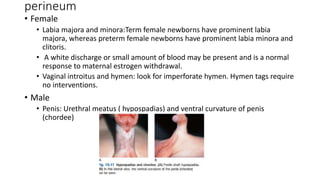
• Labia majora and minora:Term female newborns have prominent labia
majora, whereas preterm female newborns have prominent labia minora and
clitoris.
• A white discharge or small amount of blood may be present and is a normal
response to maternal estrogen withdrawal.
• Vaginal introitus and hymen: look for imperforate hymen. Hymen tags require
no interventions.
• Male
• Penis: Urethral meatus ( hypospadias) and ventral curvature of penis
(chordee)
• Scrotum:
• Inguinal hernia and hydrocele ( due to patent processus vaginalis).
• Palpate testes: if not palpable look for undescended, ectopic or retractile
testes. Palpate the abdomen for smooth lumps moving fingers down over the
inguinal canal to the scrotum and perineum. Undescended testes should be
followed in 1st month of life for descent.
• Rectractile testes can be milked into the scrotum.
Extremities , joints and spine
• Extremities
• Polydactyly, syndactyly
• Clinodactyly (curvature of the fifth digit) may be hereditary or a sign of a
variety of syndromes, including Turner syndrome and trisomy 21 syndrome.
• Single palmer crease- in trisomy 21 but can be normal.
• Palsies :
• An Erb palsy results from a traction injury to the C5 to C7 spinal nerve roots and may
cause the newborn to hold his or her arm medially rotated to the side with the hand
pronated (“waiter's tip”)
• A Klumpke palsy involving lower segments of C8 and T1 results in paralysis of the entire
arm with absent reflexes.
• Talipes equinovarus, or clubfoot
• Spine
• Turn the baby and inspect from neck to sacrum and then palpate
• Look for pigmented patches/tuft of hair(spina bifida occulta), soft midline swellings
(meningocele, meningomyelocele)
• Hip
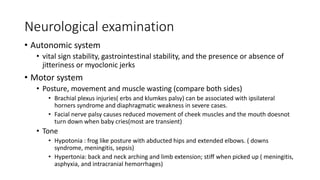
Neurological examination
• Autonomic system
• vital sign stability, gastrointestinal stability, and the presence or absence of
jitteriness or myoclonic jerks
• Motor system
• Posture, movement and muscle wasting (compare both sides)
• Brachial plexus injuries( erbs and klumkes palsy) can be associated with ipsilateral
horners syndrome and diaphragmatic weakness in severe cases.
• Facial nerve palsy causes reduced movement of cheek muscles and the mouth doesnot
turn down when baby cries(most are transient)
• Tone
• Hypotonia : frog like posture with abducted hips and extended elbows. ( downs
syndrome, meningitis, sepsis)
• Hypertonia: back and neck arching and limb extension; stiff when picked up ( meningitis,
asphyxia, and intracranial hemorrhages)
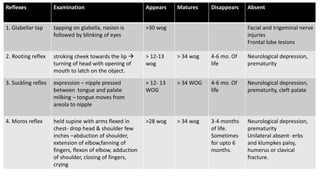
• Primitive reflexes
• Are LMN responses, present at birth but disappears by 4-6 months as theey
become suppressed by higher centres, so persistence indicates
neurodevelopmental abnormality.
• Absent in infants with neurological depression (birth asphyxia, sepsis,
intracranial hemorrhage) and preterm ; assymetrical in infants with nerve
injuries and muscle weakness
Reflexes Examination Appears Matures Disappears Absent
1. Glabellar tap tapping on glabella, nasion is
followed by blinking of eyes
>30 wog Facial and trigeminal nerve
injuries
Frontal lobe lesions
2. Rooting reflex stroking cheek towards the lip 
turning of head with opening of
mouth to latch on the object.
> 12-13
wog
> 34 wog 4-6 mo. Of
life
Neurological depression,
prematurity
3. Suckling refles expression – nipple pressed
between tongue and palate
milking – tongue moves from
areola to nipple
> 12- 13
WOG
> 34 WOG 4-6 mo. Of
life
Neurological depression,
prematurity, cleft palate
4. Moros reflex held supine with arms flexed in
chest- drop head & shoulder few
inches –abduction of shoulder,
extension of elbow,fanning of
fingers, flexon of elbow, adduction
of shoulder, closing of fingers,
crying
>28 wog > 34 wog 3-4 months
of life.
Sometimes
for upto 6
months.
Neurological depression,
prematurity
Unilateral absent- erbs
and klumpkes palsy,
humerus or clavical
fracture.
Reflex Examination Appears Disappears Absent / notes
Tonic neck reflex supine position – head turned to one
side – arm on same side straighten &
opposite arm flex
35 wog 2- 3 months. Normally, prematurity
Galant reflex held prone – stroke along paravertebral
line from shoulder to hip level shoulder
& pelvis moves to same side & same
distance
> 32 wog 4-6 months absence indicates spinal
cord lesions.
(meningomyelocele)
Stepping reflex held vertical position – soles touching
hard surface, – alternate rhythmical
stepping, premature toe-heel, term
heel-toe fashion
> 37 wog 1.5 to 2 months
Reappears at
8mo – 1 yr as
voluntary
behavior.
Palmer grasp stroke the palm – fingers flexed and
fisting to hold object. Stroking dorsum
of hand – extension of fingers and
release of object
>10 wog Repalced by
voluntary grasp
at 2 months.
Persistence interferes
with hand movement
Plantar grasp firm pressure on sole – plantar flexion
of all toes
> 28 wog 9 months Persistence interferes
with walking
Reflexes Examination appears disappears
Parachut reflex turned face down – dropped short
distance towards the surface – arms,
hands & fingers extend
8-9 months when
baby starts walking
Persists life long
Landau reflex supported in air prone – head extend to
above horizontal plane, back & hip extend
“superman appearance. Head pushed to
flexion – legs drops to flexion & re
extends when head released
3-4 months 12- 24 months
• Newborn's responsiveness to the outside world
• Check eyesight by carrying the alert baby to a dark corner
where baby may open her eyes wide. If moved to a bright area
baby will then screw up her eyes
• Test hearing by noting the startle response to a sound. Ideally
electronic audiological screening should be performed
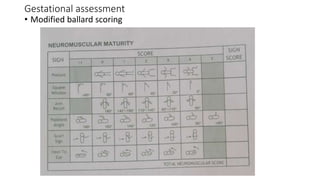
Gestational assessment
• Modified ballard scoring
Arm recoil Popliteal angle
Scarf sign
Heel to ear sign
skin
lanugo Plantar surface
Male genitals Female genitals
Daily clinical screening
• Detailed examination is unnecessary
• Enquire about feeding problems, vomiting and bowel disorders
• Examine for jaundice
• Any evidences of infection such as conjunctivitis, pyoderma, umbilical
sepsis, and oral thrush
Examination at discharge
• Detailed examination to make sure no anamolies and birth injuries
are missed.
• Auscultation of heart
• Measure oxygen saturation
• Advice mother about feeding, vitamins and iron supplements, general
cleanliness, immunization and follow up.
Reference :
• Cloherty and Stark's Manual of Neonatal Care Eighth Edition
• Pediatric clinical methods by Meherban singh
• Macleod’s clinical examination 13th edition
• Lewis ML. A comprehensive newborn examination
Newborn examination

Newborn examination

  • 1.
    Newborn examination Presenter: intern.Kamal Ghimire Moderator : Dr. Binod Sah
  • 2.
    History • Gestational history •Age of mother • Natural pregnancy or IVF • Outcome of previous pregnancies • Maternal health status in current pregnancy, including drug history • Delivery history • Gestational age • Mode of delivery • Duration of membrane rupture • Pyrexia in labor • Meconium staining of amniotic fluid • Non-reassuring fetal status during labour • Neonatal history • Baby cried immediately after birth • Passage of meconium and urine since birth • Feeding satisfactorily • Family history of illness
  • 3.
    General examination • Conductedin a warm and comfortable room with baby completely undressed and placed on a flat surface at height convenient for physician • A good source of light • Clean and warm examiner’s hand Done routinely at birth, within 24 hours or next day and at time of discharge.
  • 4.
    Examination at birth Vitals 1.Temperature : Normal axillary temperature is between 36.5° and 37.4°C (97.7° and 99.3°F) 2. Heart rate : Normal heart rate in a newborn is between 95 and 160 bpm. persistenly > 200 suggest paraoxysmal atrial tachycardia and bradycardia in newborn is a feature of asphyxia, hypothyroidism, hypothermia, raised icp, hypertension and hyperkalemia 3. Respiratory rate: Normal respiratory rate in a newborn is between 30 and 60 breaths per minute. 4. Blood pressure : Normal systolic BP is 60-90 mm hg
  • 5.
    Apgar Score 0 12 Heart rate No heart beat <100 >100 Respiratory effort Apnoea Irregular, shallow or gasping Vigorous and crying Color Pale, blue Pale or blue extremities Pink Muscle tone absent Weak, passive tone Active movement Reflex response Absent Grimace Active avoidance Normal : 7-10 moderately depressed: 4-6 severely depressed: 0-3 Helps to predict future neurological outcome
  • 6.
    • Weight, lengthand head circumference : compare against population parameter. • Cord vessels
  • 7.
    Head to toeexaminations • Skin • Vernix, lanugo, petechiae, milia, erythema toxicum (Flesh-colored papules with erythematous base, contains eosinophils, resolves in first week), vesicles, pustules, salmon patch/naevus simplex/stork bite- superficial vascular naevi, port wine stain, strawberry naevus, Mongolian spot- pigmented naevus, jaundice and cyanosis Erythema toxicum Erythema toxicum Port wine stain
  • 8.
    • Head • Size- •microcephalous (isolated small head, less than the second percentile or two standard deviations below the mean for age and sex) • Macrocephaly (isolated head enlargement, greater than the 98th percentile or greater than two standard deviations above the mean) • Shapes (dolicocephaly, brachycephaly, oxycephaly, plagiocephaly, scaphocephaly. • Fontanelles (AF – 3 to 6cm and PF – 1-1.5 cm in diameter) • Sutures- A prematurely fused suture indicates craniosynostosis • Caput succedaneum is scalp edema that is not limited by suture lines, is often pitting, and decreases over time. Most caputs resolve within 48 hours. • Cephalhematoma is subperiosteal hematoma limited by suture line. Cephalohematoma is a risk factor for jaundice and sepsis and may worsen over 48 hours, potentially taking up to three to four months to fully reabsorb
  • 10.
    • Eyes • scleralhemorrhages, icterus, conjunctival exudate, iris coloring, extraocular muscle movement, and pupillary size, equality, reactivity, centering, hypertelorism (downs, apert syndrome, thalassemia) • Red reflex
  • 11.
    • Ears • Hearingassessment • Size, shape , position of ear (low set in trisomy 21, 13 and 18) • Pre auricular skin tags and pits Note: Recent data indicate that renal ultrasonography should be performed in patients with isolated ear anomalies, such as preauricular pits or cup ears, only when they are associated with one or more of the following characteristics : other malformations or dysmorphic features, teratogenic exposures, a family history of deafness, or a maternal history of gestational diabetes
  • 12.
    • Nose • Patencyof nostrils, asymmetry of nasal septum • Mouth • Cleft lips and palates, ankyloglossia • Neck • Range of motion, goiter, clavicle(for fracture), mass in the neck (cystic hygroma in posterior triangle).
  • 13.
    Cardiovascular system • Color •Reddish pink hue normally or sometimes acrocyanosis • Cyanosis suggest cyanotic heart diseases • Excessive paleness or ruddiness should prompt hematocrit measurement to detect relative anemia (hematocrit <42%) or polycythemia (hematocrit >65%) • Apex beat : in the midclavicular line in 4th or 5th ICS • Heart rate • Femoral pulses: weak or absent suggest COA • Auscultation: Murmurs are heard in up to 2% of neonates but only a minority have a structural heart problem. Murmurs are pathological if: • Holosystolic continuous, harsh murmur, • Grade 3 or higher systolic • diastolic
  • 15.
    Respiratory examination • Chestshape and symmetry of movement • Respiratory rate and additional noises • Signs of respiratory distress: tachypnea, suprasternal, intercostal or subcostal retractions, nasal flaring, grunting and cyanosis • Auscultation: anteriorly, laterally and posteriorly • Note crackles and wheeze • Bilateral equal air entry or not: Unequal breath sounds may indicate a pneumothorax and should prompt imaging.
  • 17.
    Abdomen examination • Inspectionof abdomen: • distention from feed or swallowed air is common. Scaphoid in congenital diaphragmatic hernia. • The presence of a gastroschisis (intestines protrude through the abdominal wall without a sac, usually to the right of the umbilicus) or omphalocele (abdominal contents protrude within a sac at the midline) is usually known before delivery and warrants emergent surgical consultation • Umbilicus: • Infection (spreading erythema, pus) and bleeding • It should contain two arteries and one vein. A single umbilical artery may be associated with another congenital abnormality, especially renal anomalies, esophageal atresia and imperforate anus. • Umbilical hernias (mostly resolve by 3 yrs of age)
  • 18.
    • Palpation • Gentlepalpation moving from lower to upper to reveal edges of liver and spleen. Normally liver palpable about 2.5 cm below costal margin but spleen usually not palpable. • Deep palpation of mass and kidneys. Low yield in the age of USG • Anus: patency.( meconium in nappy doesnot guarantee patency because meconium can be passed through rectovaginal fistula) gastroschisis
  • 19.
    perineum • Female • Labiamajora and minora:Term female newborns have prominent labia majora, whereas preterm female newborns have prominent labia minora and clitoris. • A white discharge or small amount of blood may be present and is a normal response to maternal estrogen withdrawal. • Vaginal introitus and hymen: look for imperforate hymen. Hymen tags require no interventions. • Male • Penis: Urethral meatus ( hypospadias) and ventral curvature of penis (chordee)
  • 20.
    • Scrotum: • Inguinalhernia and hydrocele ( due to patent processus vaginalis). • Palpate testes: if not palpable look for undescended, ectopic or retractile testes. Palpate the abdomen for smooth lumps moving fingers down over the inguinal canal to the scrotum and perineum. Undescended testes should be followed in 1st month of life for descent. • Rectractile testes can be milked into the scrotum.
  • 21.
    Extremities , jointsand spine • Extremities • Polydactyly, syndactyly • Clinodactyly (curvature of the fifth digit) may be hereditary or a sign of a variety of syndromes, including Turner syndrome and trisomy 21 syndrome. • Single palmer crease- in trisomy 21 but can be normal. • Palsies : • An Erb palsy results from a traction injury to the C5 to C7 spinal nerve roots and may cause the newborn to hold his or her arm medially rotated to the side with the hand pronated (“waiter's tip”) • A Klumpke palsy involving lower segments of C8 and T1 results in paralysis of the entire arm with absent reflexes. • Talipes equinovarus, or clubfoot • Spine • Turn the baby and inspect from neck to sacrum and then palpate • Look for pigmented patches/tuft of hair(spina bifida occulta), soft midline swellings (meningocele, meningomyelocele)
  • 22.
  • 23.
    Neurological examination • Autonomicsystem • vital sign stability, gastrointestinal stability, and the presence or absence of jitteriness or myoclonic jerks • Motor system • Posture, movement and muscle wasting (compare both sides) • Brachial plexus injuries( erbs and klumkes palsy) can be associated with ipsilateral horners syndrome and diaphragmatic weakness in severe cases. • Facial nerve palsy causes reduced movement of cheek muscles and the mouth doesnot turn down when baby cries(most are transient) • Tone • Hypotonia : frog like posture with abducted hips and extended elbows. ( downs syndrome, meningitis, sepsis) • Hypertonia: back and neck arching and limb extension; stiff when picked up ( meningitis, asphyxia, and intracranial hemorrhages)
  • 24.
    • Primitive reflexes •Are LMN responses, present at birth but disappears by 4-6 months as theey become suppressed by higher centres, so persistence indicates neurodevelopmental abnormality. • Absent in infants with neurological depression (birth asphyxia, sepsis, intracranial hemorrhage) and preterm ; assymetrical in infants with nerve injuries and muscle weakness
  • 25.
    Reflexes Examination AppearsMatures Disappears Absent 1. Glabellar tap tapping on glabella, nasion is followed by blinking of eyes >30 wog Facial and trigeminal nerve injuries Frontal lobe lesions 2. Rooting reflex stroking cheek towards the lip  turning of head with opening of mouth to latch on the object. > 12-13 wog > 34 wog 4-6 mo. Of life Neurological depression, prematurity 3. Suckling refles expression – nipple pressed between tongue and palate milking – tongue moves from areola to nipple > 12- 13 WOG > 34 WOG 4-6 mo. Of life Neurological depression, prematurity, cleft palate 4. Moros reflex held supine with arms flexed in chest- drop head & shoulder few inches –abduction of shoulder, extension of elbow,fanning of fingers, flexon of elbow, adduction of shoulder, closing of fingers, crying >28 wog > 34 wog 3-4 months of life. Sometimes for upto 6 months. Neurological depression, prematurity Unilateral absent- erbs and klumpkes palsy, humerus or clavical fracture.
  • 26.
    Reflex Examination AppearsDisappears Absent / notes Tonic neck reflex supine position – head turned to one side – arm on same side straighten & opposite arm flex 35 wog 2- 3 months. Normally, prematurity Galant reflex held prone – stroke along paravertebral line from shoulder to hip level shoulder & pelvis moves to same side & same distance > 32 wog 4-6 months absence indicates spinal cord lesions. (meningomyelocele) Stepping reflex held vertical position – soles touching hard surface, – alternate rhythmical stepping, premature toe-heel, term heel-toe fashion > 37 wog 1.5 to 2 months Reappears at 8mo – 1 yr as voluntary behavior. Palmer grasp stroke the palm – fingers flexed and fisting to hold object. Stroking dorsum of hand – extension of fingers and release of object >10 wog Repalced by voluntary grasp at 2 months. Persistence interferes with hand movement Plantar grasp firm pressure on sole – plantar flexion of all toes > 28 wog 9 months Persistence interferes with walking
  • 27.
    Reflexes Examination appearsdisappears Parachut reflex turned face down – dropped short distance towards the surface – arms, hands & fingers extend 8-9 months when baby starts walking Persists life long Landau reflex supported in air prone – head extend to above horizontal plane, back & hip extend “superman appearance. Head pushed to flexion – legs drops to flexion & re extends when head released 3-4 months 12- 24 months • Newborn's responsiveness to the outside world • Check eyesight by carrying the alert baby to a dark corner where baby may open her eyes wide. If moved to a bright area baby will then screw up her eyes • Test hearing by noting the startle response to a sound. Ideally electronic audiological screening should be performed
  • 28.
  • 29.
    Arm recoil Poplitealangle Scarf sign Heel to ear sign
  • 31.
    skin lanugo Plantar surface Malegenitals Female genitals
  • 34.
    Daily clinical screening •Detailed examination is unnecessary • Enquire about feeding problems, vomiting and bowel disorders • Examine for jaundice • Any evidences of infection such as conjunctivitis, pyoderma, umbilical sepsis, and oral thrush Examination at discharge • Detailed examination to make sure no anamolies and birth injuries are missed. • Auscultation of heart • Measure oxygen saturation • Advice mother about feeding, vitamins and iron supplements, general cleanliness, immunization and follow up.
  • 35.
    Reference : • Clohertyand Stark's Manual of Neonatal Care Eighth Edition • Pediatric clinical methods by Meherban singh • Macleod’s clinical examination 13th edition • Lewis ML. A comprehensive newborn examination