THYROID CANCERS
By :Darayus P. Gazder
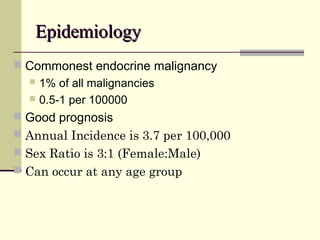
EpidemiologyEpidemiology
 Commonest endocrine malignancy
 1% of all malignancies
 0.5-1 per 100000
 Good prognosis
 Annual Incidence is 3.7 per 100,000
 Sex Ratio is 3:1 (Female:Male)
 Can occur at any age group
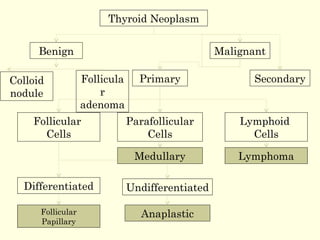
Thyroid Neoplasm
Benign Malignant
SecondaryPrimary
Follicular
Cells
Parafollicular
Cells
Lymphoid
Cells
LymphomaMedullary
Differentiated Undifferentiated
AnaplasticFollicular
Papillary
Colloid
nodule
Follicula
r
adenoma
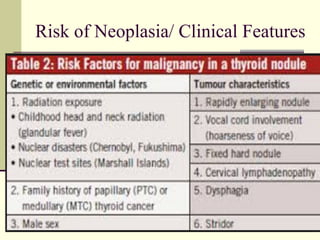
Risk of Neoplasia/ Clinical Features
Investigations:
Radioactive iodine scan
Ultrasound
FNA
CT scan- detects metastases
Serum calcitonin & CEA in Medullary cancer
MRI and PET scans- distant metastases
Papillary Adenocarcinoma
 It is 60% common.
 Common in females and younger age group.
1. Popular (most common)
2. Psammoma bodies
3. Palpable lymph nodes (spreads most commonly by lymphatics, seen
in 33% of patients)
4. Positive 131I uptake
5. Positive prognosis
6. Postoperative 131I scan to diagnose/ treat metastases
7. Pulmonary metastases
 Gross
It can be soft, firm, hard, cystic. It can be solitary or
multinodular. It contains brownish black fluid.
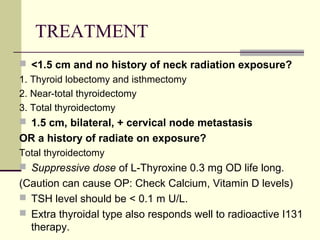
TREATMENT
 <1.5 cm and no history of neck radiation exposure?
1. Thyroid lobectomy and isthmectomy
2. Near-total thyroidectomy
3. Total thyroidectomy
 1.5 cm, bilateral, + cervical node metastasis
OR a history of radiate on exposure?
Total thyroidectomy
 Suppressive dose of L-Thyroxine 0.3 mg OD life long.
(Caution can cause OP: Check Calcium, Vitamin D levels)
 TSH level should be < 0.1 m U/L.
 Extra thyroidal type also responds well to radioactive I131
therapy.
PROGNOSIS
Follicular CarcinomaFollicular Carcinoma
 Account for 10% of all thyroid cancers.
 More common in I-deficient areas.
 Female:male ratio is 3:1
 Mean age at presentation is 50 yrs.
 Solitary thyroid nodule, rapid increase in size and long-
standing goiter.
 Hyperfunctioning < 1%. (S&S of Thyrotoxicosis)
 Far-away metastasis (spreads hematogenously)
 Female (3 to 1 ratio)
 Favorable prognosis
Follicular CarcinomaFollicular Carcinoma
 FNA biopsy cannot differentiate between
benign and malignant follicular tumors.
 Pre-operative diagnosis of malignancy is difficult
unless there is distant metastasis.
 Large follicular tumor > 4 cm in old individual  CA.
 Treatment:
 Thyroid Lobectomy (at least 80% are benign
adenomas)
 Total-Thyroidectomy in older individual with tumor >
4cm (50% chance of malignancy).
 Prophylactic nodal dissection is unnecessary.
MEDULLARY CARCINOMA
 It is uncommon (5%) type of thyroid malignancy.
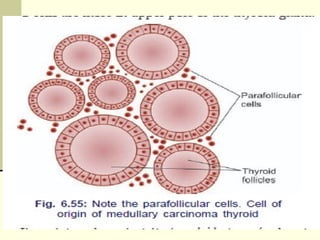
 It arises from the parafollicular ‘C’ cells/ AD
 Associated with MEN-II
 Tumour also secretes 5-H.T. (serotonin), Prostaglandin,
ACTH and vasoactive intestinal polypeptide (VIP).
CLINICAL FEATURES:
 Thyroid swelling often with enlargement of neck lymph node.
 Diarrhea, flushing (30%), Hypertension.
 TREATMENT
 Total thyroidectomy and median lymph node
dissection
 Modified neck dissection, if lateral cervical nodes
are positive
 Prophylactic Thyroidectomy in RET mutation
detection
 Before age of 6 yrs for MEN2A
 Before age of 1 yr for MEN2B
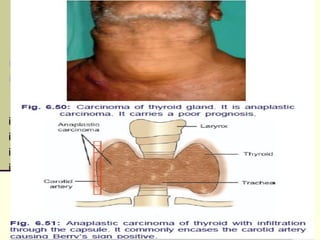
Anaplastic Cancer
 It occurs in elderly.
 It is a very aggressive tumor of short duration, presents with a
swelling in thyroid region which is rapidly progressive causing
—
i. Stridor and hoarseness of voice due to tracheal obstruction.
ii. Dysphagia.
iii. Fixity to the skin.
iv. Positive Berry’s sign—involvement of carotid sheath leads to
absence of carotid pulsation.
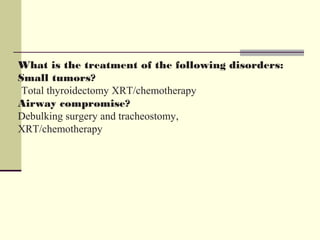
What is the treatment of the following disorders:
Small tumors?
Total thyroidectomy XRT/chemotherapy
Airway compromise?
Debulking surgery and tracheostomy,
XRT/chemotherapy
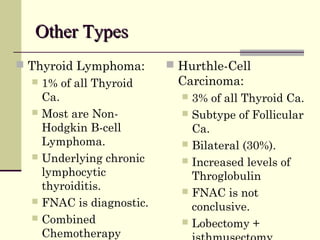
Other TypesOther Types
 Thyroid Lymphoma:
 1% of all Thyroid
Ca.
 Most are Non-
Hodgkin B-cell
Lymphoma.
 Underlying chronic
lymphocytic
thyroiditis.
 FNAC is diagnostic.
 Combined
Chemotherapy
 Hurthle-Cell
Carcinoma:
 3% of all Thyroid Ca.
 Subtype of Follicular
Ca.
 Bilateral (30%).
 Increased levels of
Throglobulin
 FNAC is not
conclusive.
 Lobectomy +
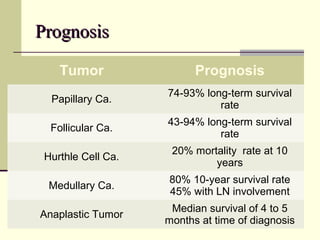
PrognosisPrognosis
Tumor Prognosis
Papillary Ca.
74-93% long-term survival
rate
Follicular Ca.
43-94% long-term survival
rate
Hurthle Cell Ca.
20% mortality rate at 10
years
Medullary Ca.
80% 10-year survival rate
45% with LN involvement
Anaplastic Tumor
Median survival of 4 to 5
months at time of diagnosis
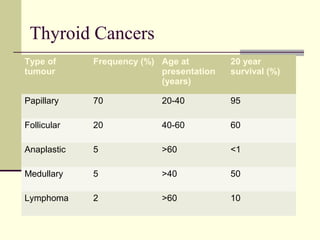
Thyroid Cancers
Type of
tumour
Frequency (%) Age at
presentation
(years)
20 year
survival (%)
Papillary 70 20-40 95
Follicular 20 40-60 60
Anaplastic 5 >60 <1
Medullary 5 >40 50
Lymphoma 2 >60 10

Thyroid cancer

  • 1.
  • 5.
    EpidemiologyEpidemiology  Commonest endocrinemalignancy  1% of all malignancies  0.5-1 per 100000  Good prognosis  Annual Incidence is 3.7 per 100,000  Sex Ratio is 3:1 (Female:Male)  Can occur at any age group
  • 6.
  • 7.
    Risk of Neoplasia/Clinical Features
  • 9.
    Investigations: Radioactive iodine scan Ultrasound FNA CTscan- detects metastases Serum calcitonin & CEA in Medullary cancer MRI and PET scans- distant metastases
  • 10.
    Papillary Adenocarcinoma  Itis 60% common.  Common in females and younger age group. 1. Popular (most common) 2. Psammoma bodies 3. Palpable lymph nodes (spreads most commonly by lymphatics, seen in 33% of patients) 4. Positive 131I uptake 5. Positive prognosis 6. Postoperative 131I scan to diagnose/ treat metastases 7. Pulmonary metastases  Gross It can be soft, firm, hard, cystic. It can be solitary or multinodular. It contains brownish black fluid.
  • 11.
    TREATMENT  <1.5 cmand no history of neck radiation exposure? 1. Thyroid lobectomy and isthmectomy 2. Near-total thyroidectomy 3. Total thyroidectomy  1.5 cm, bilateral, + cervical node metastasis OR a history of radiate on exposure? Total thyroidectomy  Suppressive dose of L-Thyroxine 0.3 mg OD life long. (Caution can cause OP: Check Calcium, Vitamin D levels)  TSH level should be < 0.1 m U/L.  Extra thyroidal type also responds well to radioactive I131 therapy.
  • 12.
  • 13.
    Follicular CarcinomaFollicular Carcinoma Account for 10% of all thyroid cancers.  More common in I-deficient areas.  Female:male ratio is 3:1  Mean age at presentation is 50 yrs.  Solitary thyroid nodule, rapid increase in size and long- standing goiter.  Hyperfunctioning < 1%. (S&S of Thyrotoxicosis)  Far-away metastasis (spreads hematogenously)  Female (3 to 1 ratio)  Favorable prognosis
  • 14.
    Follicular CarcinomaFollicular Carcinoma FNA biopsy cannot differentiate between benign and malignant follicular tumors.  Pre-operative diagnosis of malignancy is difficult unless there is distant metastasis.  Large follicular tumor > 4 cm in old individual  CA.  Treatment:  Thyroid Lobectomy (at least 80% are benign adenomas)  Total-Thyroidectomy in older individual with tumor > 4cm (50% chance of malignancy).  Prophylactic nodal dissection is unnecessary.
  • 15.
    MEDULLARY CARCINOMA  Itis uncommon (5%) type of thyroid malignancy.  It arises from the parafollicular ‘C’ cells/ AD  Associated with MEN-II  Tumour also secretes 5-H.T. (serotonin), Prostaglandin, ACTH and vasoactive intestinal polypeptide (VIP). CLINICAL FEATURES:  Thyroid swelling often with enlargement of neck lymph node.  Diarrhea, flushing (30%), Hypertension.
  • 16.
     TREATMENT  Totalthyroidectomy and median lymph node dissection  Modified neck dissection, if lateral cervical nodes are positive  Prophylactic Thyroidectomy in RET mutation detection  Before age of 6 yrs for MEN2A  Before age of 1 yr for MEN2B
  • 17.
    Anaplastic Cancer  Itoccurs in elderly.  It is a very aggressive tumor of short duration, presents with a swelling in thyroid region which is rapidly progressive causing — i. Stridor and hoarseness of voice due to tracheal obstruction. ii. Dysphagia. iii. Fixity to the skin. iv. Positive Berry’s sign—involvement of carotid sheath leads to absence of carotid pulsation.
  • 18.
    What is thetreatment of the following disorders: Small tumors? Total thyroidectomy XRT/chemotherapy Airway compromise? Debulking surgery and tracheostomy, XRT/chemotherapy
  • 19.
    Other TypesOther Types Thyroid Lymphoma:  1% of all Thyroid Ca.  Most are Non- Hodgkin B-cell Lymphoma.  Underlying chronic lymphocytic thyroiditis.  FNAC is diagnostic.  Combined Chemotherapy  Hurthle-Cell Carcinoma:  3% of all Thyroid Ca.  Subtype of Follicular Ca.  Bilateral (30%).  Increased levels of Throglobulin  FNAC is not conclusive.  Lobectomy +
  • 20.
    PrognosisPrognosis Tumor Prognosis Papillary Ca. 74-93%long-term survival rate Follicular Ca. 43-94% long-term survival rate Hurthle Cell Ca. 20% mortality rate at 10 years Medullary Ca. 80% 10-year survival rate 45% with LN involvement Anaplastic Tumor Median survival of 4 to 5 months at time of diagnosis
  • 21.
    Thyroid Cancers Type of tumour Frequency(%) Age at presentation (years) 20 year survival (%) Papillary 70 20-40 95 Follicular 20 40-60 60 Anaplastic 5 >60 <1 Medullary 5 >40 50 Lymphoma 2 >60 10