TESTICULAR CANCERS 
Presented By: Dr Isha Jaiswal 
Moderator: Dr Madhup Rastogi 
Date:10th September 2014
Overview 
Cancers of testis are relatively rare cancer accounting for approx. 1 % cancer in 
males. However it is important in field of oncology as it represents a highly curable 
neoplasm & the incidence is focused on young patients at their peak of 
productivity
Anatomy 
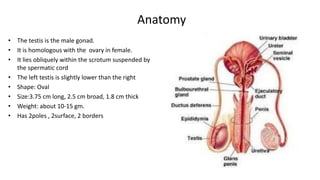
• The testis is the male gonad. 
• It is homologous with the ovary in female. 
• It lies obliquely within the scrotum suspended by 
the spermatic cord 
• The left testis is slightly lower than the right 
• Shape: Oval 
• Size:3.75 cm long, 2.5 cm broad, 1.8 cm thick 
• Weight: about 10-15 gm. 
• Has 2poles , 2surface, 2 borders
Descent of testis 
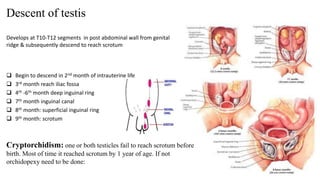
Develops at T10-T12 segments in post abdominal wall from genital 
ridge & subsequently descend to reach scrotum 
 Begin to descend in 2nd month of intrauterine life 
 3rd month reach iliac fossa 
 4th -6th month deep inguinal ring 
 7th month inguinal canal 
 8th month: superficial inguinal ring 
 9th month: scrotum 
Cryptorchidism: one or both testicles fail to reach scrotum before 
birth. Most of time it reached scrotum by 1 year of age. If not 
orchidopexy need to be done:
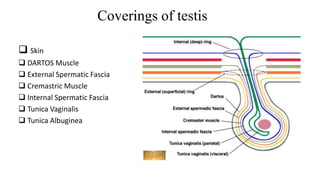
Coverings of testis 
 Skin 
 DARTOS Muscle 
 External Spermatic Fascia 
 Cremastric Muscle 
 Internal Spermatic Fascia 
 Tunica Vaginalis 
 Tunica Albuginea
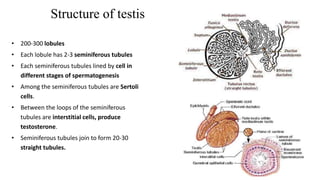
Structure of testis 
• 200-300 lobules 
• Each lobule has 2-3 seminiferous tubules 
• Each seminiferous tubules lined by cell in 
different stages of spermatogenesis 
• Among the seminiferous tubules are Sertoli 
cells. 
• Between the loops of the seminiferous 
tubules are interstitial cells, produce 
testosterone. 
• Seminiferous tubules join to form 20-30 
straight tubules.
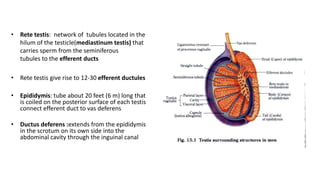
• Rete testis: network of tubules located in the 
hilum of the testicle(mediastinum testis) that 
carries sperm from the seminiferous 
tubules to the efferent ducts 
• Rete testis give rise to 12-30 efferent ductules 
• Epididymis: tube about 20 feet (6 m) long that 
is coiled on the posterior surface of each testis 
connect efferent duct to vas deferens 
• Ductus deferens :extends from the epididymis 
in the scrotum on its own side into the 
abdominal cavity through the inguinal canal
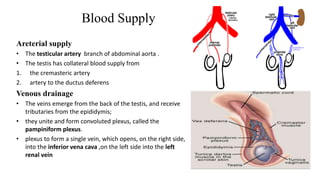
Blood Supply 
Areterial supply 
• The testicular artery branch of abdominal aorta . 
• The testis has collateral blood supply from 
1. the cremasteric artery 
2. artery to the ductus deferens 
Venous drainage 
• The veins emerge from the back of the testis, and receive 
tributaries from the epididymis; 
• they unite and form convoluted plexus, called the 
pampiniform plexus. 
• plexus to form a single vein, which opens, on the right side, 
into the inferior vena cava ,on the left side into the left 
renal vein
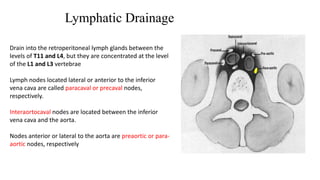
Lymphatic Drainage 
Drain into the retroperitoneal lymph glands between the 
levels of T11 and L4, but they are concentrated at the level 
of the L1 and L3 vertebrae 
Lymph nodes located lateral or anterior to the inferior 
vena cava are called paracaval or precaval nodes, 
respectively. 
Interaortocaval nodes are located between the inferior 
vena cava and the aorta. 
Nodes anterior or lateral to the aorta are preaortic or para-aortic 
nodes, respectively
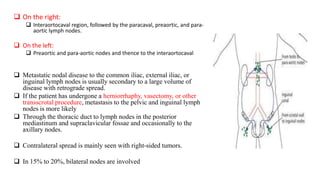
 On the right: 
 Interaortocaval region, followed by the paracaval, preaortic, and para-aortic 
lymph nodes. 
 On the left: 
 Preaortic and para-aortic nodes and thence to the interaortocaval 
 Metastatic nodal disease to the common iliac, external iliac, or 
inguinal lymph nodes is usually secondary to a large volume of 
disease with retrograde spread. 
 If the patient has undergone a herniorrhaphy, vasectomy, or other 
transscrotal procedure, metastasis to the pelvic and inguinal lymph 
nodes is more likely 
 Through the thoracic duct to lymph nodes in the posterior 
mediastinum and supraclavicular fossae and occasionally to the 
axillary nodes. 
 Contralateral spread is mainly seen with right-sided tumors. 
 In 15% to 20%, bilateral nodes are involved
Nerve Supply 
• Sympathetic nerves arising from segment T10 of the spinal cord. 
• Both afferent for testicular sensation and efferent to the blood vessels(vasomotor).
Epidemiology of testicular cancer
INTRODUCTION 
 Comprise a morphologically and clinically diverse group of tumors 
 Predominantly affects young males 
 1 -2 % of all cancers in USA 
 Testicular cancer forms about 1% of all malignancies in males in India. 
 Incidence (ASR)– 0.6 per 100000 
 Mortality (ASR)– 0.3 per 100000 
 95% are Germ Cell Tumours (GCTs) 
 90% GCT are in testes,2-10% in extra gonadal (eg retropreitoneum, mediastinal) 
 Cure rate increased with introduction of platinum based chemotherapy from 10 to 80%
EPIDEMOLOGY OF TESTICULAR CANCER 
• Age: for GCT: median age at diagnosis is 34 years, with 50% of incident 
cases between 20 and 34 years. 
• In a man age: 50 years or older solid testicular mass is usually lymphoma 
• Age - 3 peaks 
2 – 4 yrs 
20 – 40 yrs 
above 50 yrs 
• Geographic: Highest incidence in Denmark, Norway, and Switzerland 
and the lowest in eastern Europe and Asia. 
• Race: more common in young white men ,less in African Americans
Predisposing Factors 
1. Cryptorchidism 
2. Klinefelter syndrome 
3. Positive family history 
4. Positive personal history 
5. Intratubular germ cell neoplasia 
6. Trauma 
7. Viral infection 
8. Hormonal factors 
9. Exposure to environmental oestrogen
Predisposing Factors 
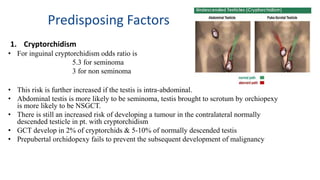
1. Cryptorchidism 
• For inguinal cryptorchidism odds ratio is 
5.3 for seminoma 
3 for non seminoma 
• This risk is further increased if the testis is intra-abdominal. 
• Abdominal testis is more likely to be seminoma, testis brought to scrotum by orchiopexy 
is more likely to be NSGCT. 
• There is still an increased risk of developing a tumour in the contralateral normally 
descended testicle in pt. with cryptorchidism 
• GCT develop in 2% of cryptorchids & 5-10% of normally descended testis 
• Prepubertal orchidopexy fails to prevent the subsequent development of malignancy
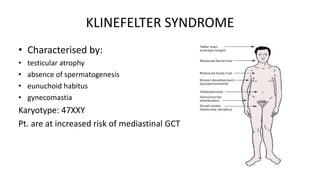
KLINEFELTER SYNDROME 
• Characterised by: 
• testicular atrophy 
• absence of spermatogenesis 
• eunuchoid habitus 
• gynecomastia 
Karyotype: 47XXY 
Pt. are at increased risk of mediastinal GCT
Predisposing Factors 
2. Positive family history 
Men with first degree relative with testicular cancer 
Median age being less by 2-3 yrs 
 brother of men with testicular tumor: 8-10 times more risk of 
developing TGCT 
Relative risk to father and sons: 2-4 times
Predisposing Factors 
3. Positive personal history 
12 folds increased risk of developing GCT in the contralateral testis 
Higher risk for contralateral tumor if 
• Younger age 
• Seminoma
Predisposing Factors 
4. Intratubular Germ Cell Neoplasia (ITGCN) 
• Precursor lesion of all types of germ-cell tumors except spermatocytic seminoma 
• Originate from primordial germ cells early during embryogenesis, possibly due to an excess 
of estrogens. 
 No spermatogenesis 
 PLAP positive 
 Present in adjacent testicular parenchyma in 80% of pt with GCT 
 5-9% in unaffected contralateral testis; increases to 36% in atrophy or 
cryptorchidism 
 50% risk of GCT in 5 yrs, 70% in 7yrs
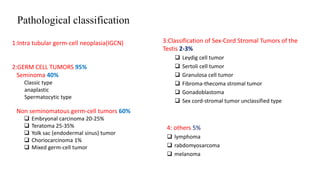
Pathological classification 
3:Classification of Sex-Cord Stromal Tumors of the 
Testis 2-3% 
 Leydig cell tumor 
 Sertoli cell tumor 
 Granulosa cell tumor 
 Fibroma-thecoma stromal tumor 
 Gonadoblastoma 
 Sex cord-stromal tumor unclassified type 
1:Intra tubular germ-cell neoplasia(IGCN) 
2:GERM CELL TUMORS 95% 
Seminoma 40% 
Classic type 
anaplastic 
Spermatocytic type 
Non seminomatous germ-cell tumors 60% 
 Embryonal carcinoma 20-25% 
 Teratoma 25-35% 
 Yolk sac (endodermal sinus) tumor 
 Choriocarcinoma 1% 
 Mixed germ-cell tumor 
4: others 5% 
 lymphoma 
 rabdomyosarcoma 
 melanoma
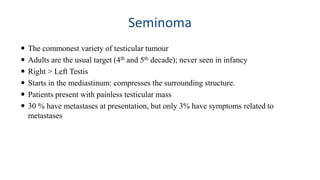
Seminoma 
 The commonest variety of testicular tumour 
 Adults are the usual target (4th and 5th decade); never seen in infancy 
 Right > Left Testis 
 Starts in the mediastinum: compresses the surrounding structure. 
 Patients present with painless testicular mass 
 30 % have metastases at presentation, but only 3% have symptoms related to 
metastases
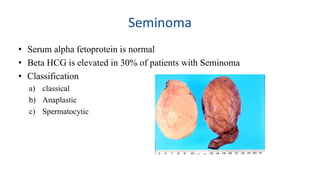
Seminoma 
• Serum alpha fetoprotein is normal 
• Beta HCG is elevated in 30% of patients with Seminoma 
• Classification 
a) classical 
b) Anaplastic 
c) Spermatocytic
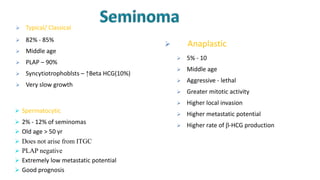
 Anaplastic 
 5% - 10 
 Middle age 
 Aggressive - lethal 
 Greater mitotic activity 
 Higher local invasion 
 Higher metastatic potential 
 Higher rate of β-HCG production 
 Typical/ Classical 
 82% - 85% 
 Middle age 
 PLAP – 90% 
 Syncytiotrophoblsts – ↑Beta HCG(10%) 
 Very slow growth 
 Spermatocytic 
 2% - 12% of seminomas 
 Old age > 50 yr 
 Does not arise from ITGC 
 PLAP negative 
 Extremely low metastatic potential 
 Good prognosis
Embryonal Carcinoma 
 2nd most common germ cell tumor 90% of NSGCT 
 Present in majority of mixed germ cell tu mors 
 Most men present in their 20s to 30s with a testicular mass 
 Highly malignant tumours; may invade the cord stuctures.epidydymis 
 High degree of metastasis 
 Serum AFP is positive in 33 5, & beta HCG is elevated in 20% of cases
Yolk Sac Tumour 
 Most common germ cell tumor ( & most common testicular tumor ) in children, where 
it occurs in its pure form. 
– 60% of GCT in children. First 2 years of life. 
– Pure yolk sac tumor <2% of testicular tumors in adults 
– 40% of mixed germ-cell tumors. 
– Elevated serum levels of alpha-fetoprotein. 
– Microscopically, Schiller-Duval bodies are a characteristic feature 
 Testicular mass the most usual presentation.
Choriocarcinoma 
 A rare and aggressive tumour (5yrs survival is 5%) 
 Typically elevated hCG 
 Presents with disseminated disease 
 Metastasis to lungs and brain 
 Primary is very small and often exhibit NO TESTICULAR 
ENLARGEMENT 
 Small palpable nodule may be present. 
 Prone to hemorrhage, sometimes spontaneous (lungs and brain)
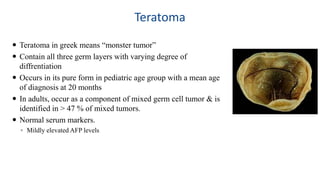
Teratoma 
 Teratoma in greek means “monster tumor” 
 Contain all three germ layers with varying degree of 
diffrentiation 
 Occurs in its pure form in pediatric age group with a mean age 
of diagnosis at 20 months 
 In adults, occur as a component of mixed germ cell tumor & is 
identified in > 47 % of mixed tumors. 
 Normal serum markers. 
◦ Mildly elevated AFP levels
Interstitial cell tumors 
1. Leydig cell tumors 
May affect 20-60yrs of age 
A masculinising tumor, produces androgens 
No association with crytochordism 
Presents with painless testicular mass 
Precocious puberty 
 Prominent external genitalia 
 Deep masculinised voice 
 Pubic hair 
Gynacomastia and decreased libodo due to oestrogen production by 
increased peripheral conversion
Interstitial cell tumors 
2. Sertoli Cell Tumor 
 can occur in any age group including infants 
 No association with crytochordism 
 Excess estrogen production 
 Gynacomastia in 1/3rd of cases 
 10 % are malignant
Interstitial cell tumors 
3. Gonadoblastoma 
 Mixed germ cell/sex cord/stromal tumor 
 Composed of seminoma like germ cells and Sertoli differentiation 
 Exclusively in patients with dysgenic gonads and intersex syndromes 
 80% are phenotype females with primary amenorrhoea 
 20% are males with crytochordism and dysgenic gonads and 
hypospadias 
 Considered in-situ malignant form of GCT 
 Bilateral orchidectomy because of risk of bilateral tumours
Secondary Tumors of Testis 
• Lymphoma – most common secondary tumor 
- most common testicular tumor in patients above 50 years 
- most common variety is histiocytic 
• Leukamic Infilteration of testis 
-primary site of relapse after ALL remission 
-occurs mainly in the interstitial space 
-Metastases to testis 
- rare
Spread 
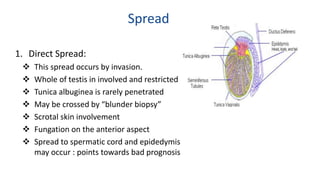
1. Direct Spread: 
 This spread occurs by invasion. 
 Whole of testis in involved and restricted 
 Tunica albuginea is rarely penetrated 
 May be crossed by “blunder biopsy” 
 Scrotal skin involvement 
 Fungation on the anterior aspect 
 Spread to spermatic cord and epidedymis 
may occur : points towards bad prognosis
Spread 
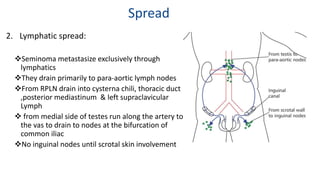
2. Lymphatic spread: 
Seminoma metastasize exclusively through 
lymphatics 
They drain primarily to para-aortic lymph nodes 
From RPLN drain into cysterna chili, thoracic duct 
,posterior mediastinum & left supraclavicular 
Lymph 
 from medial side of testes run along the artery to 
the vas to drain to nodes at the bifurcation of 
common iliac 
No inguinal nodes until scrotal skin involvement
Spread 
3. Blood Spread 
 NSGCT spread through blood route 
 Lungs, liver, bones and brain are the usual sites usually involved
Clinical Features 
1. Due to primary tumor 
a) Painless testicular lump 
b) Sensation of heaviness if size > than 2-3 times 
c) Rarely dragging pain is complained of (1/3rd cases) 
d) May mimic epidedymo-orchitis 
e) Sudden pain and enlargement due to hemorrhage mimicking torsion 
f) History of trauma (co-incidental)
DICTUM FOR ANY SOLID SCROTAL SWELLINGS 
• All patients with a solid, Firm Intratesticular Mass that 
cannot be Trans illuminated should be regarded as 
Malignant unless otherwise proved.
Clinical Features 
2. Due to metastasis 
 Abdominal or lumbar pain (lymphatic spread) 
 Dyspnoea, hemoptysis and chest pain with lung mets 
 Jaundice with liver mets 
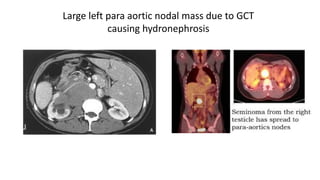
 Hydronephrosis by para-aortic lymph nodes enlargement 
 Pedal oedema by IVC obstruction 
 Troiser’s sign
Clinical Features 
3. Clinical examination: 
a) Enlarged testis (except choriocarcinoma) 
b) Nodular testis 
c) Firm to hard in consistency 
d) Loss of testicular sensation 
e) Secondary hydrocele 
f) Flat and difficult to feel epididymis 
g) General examination for metastasis
Tumor markers 
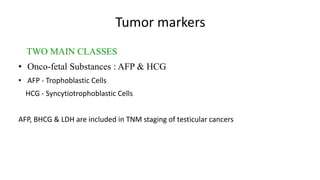
TWO MAIN CLASSES 
• Onco-fetal Substances : AFP & HCG 
• AFP - Trophoblastic Cells 
HCG - Syncytiotrophoblastic Cells 
AFP, BHCG & LDH are included in TNM staging of testicular cancers
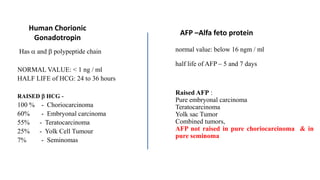
Human Chorionic 
Gonadotropin 
Has  and  polypeptide chain 
NORMAL VALUE: < 1 ng / ml 
HALF LIFE of HCG: 24 to 36 hours 
RAISED  HCG - 
100 % - Choriocarcinoma 
60% - Embryonal carcinoma 
55% - Teratocarcinoma 
25% - Yolk Cell Tumour 
7% - Seminomas 
AFP –Alfa feto protein 
normal value: below 16 ngm / ml 
half life of AFP – 5 and 7 days 
Raised AFP : 
Pure embryonal carcinoma 
Teratocarcinoma 
Yolk sac Tumor 
Combined tumors, 
AFP not raised in pure choriocarcinoma & in 
pure seminoma
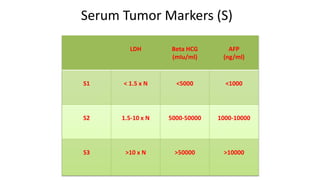
Serum Tumor Markers (S) 
LDH Beta HCG 
(mIu/ml) 
AFP 
(ng/ml) 
S1 < 1.5 x N <5000 <1000 
S2 1.5-10 x N 5000-50000 1000-10000 
S3 >10 x N >50000 >10000
ROLE OF TUMOUR MARKERS 
• Helps in Diagnosis - 80 to 85% of Testicular Tumors have Positive Markers 
• Most of Non-Seminomas have raised markers. 
• Indicate Histology of Tumor: 
If AFP elevated in Seminoma - Means Tumour has Non-Seminomatous elements 
• Degree of Marker Elevation Appears to be Directly Proportional to Tumor Burden
ROLE OF TUMOUR MARKERS 
• may predict the responsiveness of nonseminomas to treatment 
• The level of beta-HCG should decrease by 90% or more every 21 days with each successful 
treatment cycle of chemotherapy. 
• The decline of AFP is less predictable 
• Normalization of tumor marker after high inguinal orchidectomy does not ensure complete 
disease removal however after Orchiectomy if Markers Elevated means Residual Disease 
• Negative Tumor Markers becoming positive on follow up usually indicates -Recurrence of 
Tumor 
• Markers become Positive earlier than radiological studies
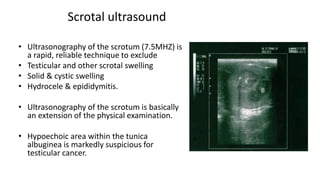
Scrotal ultrasound 
• Ultrasonography of the scrotum (7.5MHZ) is 
a rapid, reliable technique to exclude 
• Testicular and other scrotal swelling 
• Solid & cystic swelling 
• Hydrocele & epididymitis. 
• Ultrasonography of the scrotum is basically 
an extension of the physical examination. 
• Hypoechoic area within the tunica 
albuginea is markedly suspicious for 
testicular cancer.
Staging Work Up 
• General 
History (document cryptorchidism and previous inguinal or scrotal 
surgery) 
Physical examination 
• Laboratory Studies 
CBC, LFT, RFT, LDH 
• Serum assays 
Alpha fetoprotein (AFP) 
Beta human chorionic gonadotropin
• Diagnostic Radiology 
– Chest x-ray films, posterior/anterior and lateral views 
– Computed tomography (CT) scan of abdomen and 
pelvis 
– CT scan of chest for non seminomas and stage II 
seminomas 
– Ultrasound of contralateral testis
Large left para aortic nodal mass due to GCT 
causing hydronephrosis
“I always had the size difference there, but I didn’t 
know…I would’ve still been waiting if it hadn’t started 
hurting, it just got so painful I couldn’t sit on my bike 
“I always had the size difference 
there, but I didn’t know…I would’ve 
still been waiting if it hadn’t started 
hurting, it just got so painful I couldn’t 
sit on my bike anymore.” 
-Lance Armstrong 
anymore.” 
-Lance Armstrong 
“I always had the size difference there, but I didn’t 
know…I would’ve still been waiting if it hadn’t started 
hurting, it just got so painful I couldn’t sit on my bike 
anymore.” 
-Lance Armstrong

TESTICULAR CANCERS

  • 1.
    TESTICULAR CANCERS PresentedBy: Dr Isha Jaiswal Moderator: Dr Madhup Rastogi Date:10th September 2014
  • 2.
    Overview Cancers oftestis are relatively rare cancer accounting for approx. 1 % cancer in males. However it is important in field of oncology as it represents a highly curable neoplasm & the incidence is focused on young patients at their peak of productivity
  • 3.
    Anatomy • Thetestis is the male gonad. • It is homologous with the ovary in female. • It lies obliquely within the scrotum suspended by the spermatic cord • The left testis is slightly lower than the right • Shape: Oval • Size:3.75 cm long, 2.5 cm broad, 1.8 cm thick • Weight: about 10-15 gm. • Has 2poles , 2surface, 2 borders
  • 4.
    Descent of testis Develops at T10-T12 segments in post abdominal wall from genital ridge & subsequently descend to reach scrotum  Begin to descend in 2nd month of intrauterine life  3rd month reach iliac fossa  4th -6th month deep inguinal ring  7th month inguinal canal  8th month: superficial inguinal ring  9th month: scrotum Cryptorchidism: one or both testicles fail to reach scrotum before birth. Most of time it reached scrotum by 1 year of age. If not orchidopexy need to be done:
  • 5.
    Coverings of testis  Skin  DARTOS Muscle  External Spermatic Fascia  Cremastric Muscle  Internal Spermatic Fascia  Tunica Vaginalis  Tunica Albuginea
  • 6.
    Structure of testis • 200-300 lobules • Each lobule has 2-3 seminiferous tubules • Each seminiferous tubules lined by cell in different stages of spermatogenesis • Among the seminiferous tubules are Sertoli cells. • Between the loops of the seminiferous tubules are interstitial cells, produce testosterone. • Seminiferous tubules join to form 20-30 straight tubules.
  • 7.
    • Rete testis:network of tubules located in the hilum of the testicle(mediastinum testis) that carries sperm from the seminiferous tubules to the efferent ducts • Rete testis give rise to 12-30 efferent ductules • Epididymis: tube about 20 feet (6 m) long that is coiled on the posterior surface of each testis connect efferent duct to vas deferens • Ductus deferens :extends from the epididymis in the scrotum on its own side into the abdominal cavity through the inguinal canal
  • 8.
    Blood Supply Areterialsupply • The testicular artery branch of abdominal aorta . • The testis has collateral blood supply from 1. the cremasteric artery 2. artery to the ductus deferens Venous drainage • The veins emerge from the back of the testis, and receive tributaries from the epididymis; • they unite and form convoluted plexus, called the pampiniform plexus. • plexus to form a single vein, which opens, on the right side, into the inferior vena cava ,on the left side into the left renal vein
  • 9.
    Lymphatic Drainage Draininto the retroperitoneal lymph glands between the levels of T11 and L4, but they are concentrated at the level of the L1 and L3 vertebrae Lymph nodes located lateral or anterior to the inferior vena cava are called paracaval or precaval nodes, respectively. Interaortocaval nodes are located between the inferior vena cava and the aorta. Nodes anterior or lateral to the aorta are preaortic or para-aortic nodes, respectively
  • 10.
     On theright:  Interaortocaval region, followed by the paracaval, preaortic, and para-aortic lymph nodes.  On the left:  Preaortic and para-aortic nodes and thence to the interaortocaval  Metastatic nodal disease to the common iliac, external iliac, or inguinal lymph nodes is usually secondary to a large volume of disease with retrograde spread.  If the patient has undergone a herniorrhaphy, vasectomy, or other transscrotal procedure, metastasis to the pelvic and inguinal lymph nodes is more likely  Through the thoracic duct to lymph nodes in the posterior mediastinum and supraclavicular fossae and occasionally to the axillary nodes.  Contralateral spread is mainly seen with right-sided tumors.  In 15% to 20%, bilateral nodes are involved
  • 11.
    Nerve Supply •Sympathetic nerves arising from segment T10 of the spinal cord. • Both afferent for testicular sensation and efferent to the blood vessels(vasomotor).
  • 12.
  • 13.
    INTRODUCTION  Comprisea morphologically and clinically diverse group of tumors  Predominantly affects young males  1 -2 % of all cancers in USA  Testicular cancer forms about 1% of all malignancies in males in India.  Incidence (ASR)– 0.6 per 100000  Mortality (ASR)– 0.3 per 100000  95% are Germ Cell Tumours (GCTs)  90% GCT are in testes,2-10% in extra gonadal (eg retropreitoneum, mediastinal)  Cure rate increased with introduction of platinum based chemotherapy from 10 to 80%
  • 14.
    EPIDEMOLOGY OF TESTICULARCANCER • Age: for GCT: median age at diagnosis is 34 years, with 50% of incident cases between 20 and 34 years. • In a man age: 50 years or older solid testicular mass is usually lymphoma • Age - 3 peaks 2 – 4 yrs 20 – 40 yrs above 50 yrs • Geographic: Highest incidence in Denmark, Norway, and Switzerland and the lowest in eastern Europe and Asia. • Race: more common in young white men ,less in African Americans
  • 15.
    Predisposing Factors 1.Cryptorchidism 2. Klinefelter syndrome 3. Positive family history 4. Positive personal history 5. Intratubular germ cell neoplasia 6. Trauma 7. Viral infection 8. Hormonal factors 9. Exposure to environmental oestrogen
  • 16.
    Predisposing Factors 1.Cryptorchidism • For inguinal cryptorchidism odds ratio is 5.3 for seminoma 3 for non seminoma • This risk is further increased if the testis is intra-abdominal. • Abdominal testis is more likely to be seminoma, testis brought to scrotum by orchiopexy is more likely to be NSGCT. • There is still an increased risk of developing a tumour in the contralateral normally descended testicle in pt. with cryptorchidism • GCT develop in 2% of cryptorchids & 5-10% of normally descended testis • Prepubertal orchidopexy fails to prevent the subsequent development of malignancy
  • 17.
    KLINEFELTER SYNDROME •Characterised by: • testicular atrophy • absence of spermatogenesis • eunuchoid habitus • gynecomastia Karyotype: 47XXY Pt. are at increased risk of mediastinal GCT
  • 18.
    Predisposing Factors 2.Positive family history Men with first degree relative with testicular cancer Median age being less by 2-3 yrs  brother of men with testicular tumor: 8-10 times more risk of developing TGCT Relative risk to father and sons: 2-4 times
  • 19.
    Predisposing Factors 3.Positive personal history 12 folds increased risk of developing GCT in the contralateral testis Higher risk for contralateral tumor if • Younger age • Seminoma
  • 20.
    Predisposing Factors 4.Intratubular Germ Cell Neoplasia (ITGCN) • Precursor lesion of all types of germ-cell tumors except spermatocytic seminoma • Originate from primordial germ cells early during embryogenesis, possibly due to an excess of estrogens.  No spermatogenesis  PLAP positive  Present in adjacent testicular parenchyma in 80% of pt with GCT  5-9% in unaffected contralateral testis; increases to 36% in atrophy or cryptorchidism  50% risk of GCT in 5 yrs, 70% in 7yrs
  • 21.
    Pathological classification 3:Classificationof Sex-Cord Stromal Tumors of the Testis 2-3%  Leydig cell tumor  Sertoli cell tumor  Granulosa cell tumor  Fibroma-thecoma stromal tumor  Gonadoblastoma  Sex cord-stromal tumor unclassified type 1:Intra tubular germ-cell neoplasia(IGCN) 2:GERM CELL TUMORS 95% Seminoma 40% Classic type anaplastic Spermatocytic type Non seminomatous germ-cell tumors 60%  Embryonal carcinoma 20-25%  Teratoma 25-35%  Yolk sac (endodermal sinus) tumor  Choriocarcinoma 1%  Mixed germ-cell tumor 4: others 5%  lymphoma  rabdomyosarcoma  melanoma
  • 22.
    Seminoma  Thecommonest variety of testicular tumour  Adults are the usual target (4th and 5th decade); never seen in infancy  Right > Left Testis  Starts in the mediastinum: compresses the surrounding structure.  Patients present with painless testicular mass  30 % have metastases at presentation, but only 3% have symptoms related to metastases
  • 23.
    Seminoma • Serumalpha fetoprotein is normal • Beta HCG is elevated in 30% of patients with Seminoma • Classification a) classical b) Anaplastic c) Spermatocytic
  • 24.
     Anaplastic 5% - 10  Middle age  Aggressive - lethal  Greater mitotic activity  Higher local invasion  Higher metastatic potential  Higher rate of β-HCG production  Typical/ Classical  82% - 85%  Middle age  PLAP – 90%  Syncytiotrophoblsts – ↑Beta HCG(10%)  Very slow growth  Spermatocytic  2% - 12% of seminomas  Old age > 50 yr  Does not arise from ITGC  PLAP negative  Extremely low metastatic potential  Good prognosis
  • 25.
    Embryonal Carcinoma 2nd most common germ cell tumor 90% of NSGCT  Present in majority of mixed germ cell tu mors  Most men present in their 20s to 30s with a testicular mass  Highly malignant tumours; may invade the cord stuctures.epidydymis  High degree of metastasis  Serum AFP is positive in 33 5, & beta HCG is elevated in 20% of cases
  • 26.
    Yolk Sac Tumour  Most common germ cell tumor ( & most common testicular tumor ) in children, where it occurs in its pure form. – 60% of GCT in children. First 2 years of life. – Pure yolk sac tumor <2% of testicular tumors in adults – 40% of mixed germ-cell tumors. – Elevated serum levels of alpha-fetoprotein. – Microscopically, Schiller-Duval bodies are a characteristic feature  Testicular mass the most usual presentation.
  • 27.
    Choriocarcinoma  Arare and aggressive tumour (5yrs survival is 5%)  Typically elevated hCG  Presents with disseminated disease  Metastasis to lungs and brain  Primary is very small and often exhibit NO TESTICULAR ENLARGEMENT  Small palpable nodule may be present.  Prone to hemorrhage, sometimes spontaneous (lungs and brain)
  • 28.
    Teratoma  Teratomain greek means “monster tumor”  Contain all three germ layers with varying degree of diffrentiation  Occurs in its pure form in pediatric age group with a mean age of diagnosis at 20 months  In adults, occur as a component of mixed germ cell tumor & is identified in > 47 % of mixed tumors.  Normal serum markers. ◦ Mildly elevated AFP levels
  • 29.
    Interstitial cell tumors 1. Leydig cell tumors May affect 20-60yrs of age A masculinising tumor, produces androgens No association with crytochordism Presents with painless testicular mass Precocious puberty  Prominent external genitalia  Deep masculinised voice  Pubic hair Gynacomastia and decreased libodo due to oestrogen production by increased peripheral conversion
  • 30.
    Interstitial cell tumors 2. Sertoli Cell Tumor  can occur in any age group including infants  No association with crytochordism  Excess estrogen production  Gynacomastia in 1/3rd of cases  10 % are malignant
  • 31.
    Interstitial cell tumors 3. Gonadoblastoma  Mixed germ cell/sex cord/stromal tumor  Composed of seminoma like germ cells and Sertoli differentiation  Exclusively in patients with dysgenic gonads and intersex syndromes  80% are phenotype females with primary amenorrhoea  20% are males with crytochordism and dysgenic gonads and hypospadias  Considered in-situ malignant form of GCT  Bilateral orchidectomy because of risk of bilateral tumours
  • 32.
    Secondary Tumors ofTestis • Lymphoma – most common secondary tumor - most common testicular tumor in patients above 50 years - most common variety is histiocytic • Leukamic Infilteration of testis -primary site of relapse after ALL remission -occurs mainly in the interstitial space -Metastases to testis - rare
  • 33.
    Spread 1. DirectSpread:  This spread occurs by invasion.  Whole of testis in involved and restricted  Tunica albuginea is rarely penetrated  May be crossed by “blunder biopsy”  Scrotal skin involvement  Fungation on the anterior aspect  Spread to spermatic cord and epidedymis may occur : points towards bad prognosis
  • 34.
    Spread 2. Lymphaticspread: Seminoma metastasize exclusively through lymphatics They drain primarily to para-aortic lymph nodes From RPLN drain into cysterna chili, thoracic duct ,posterior mediastinum & left supraclavicular Lymph  from medial side of testes run along the artery to the vas to drain to nodes at the bifurcation of common iliac No inguinal nodes until scrotal skin involvement
  • 35.
    Spread 3. BloodSpread  NSGCT spread through blood route  Lungs, liver, bones and brain are the usual sites usually involved
  • 36.
    Clinical Features 1.Due to primary tumor a) Painless testicular lump b) Sensation of heaviness if size > than 2-3 times c) Rarely dragging pain is complained of (1/3rd cases) d) May mimic epidedymo-orchitis e) Sudden pain and enlargement due to hemorrhage mimicking torsion f) History of trauma (co-incidental)
  • 37.
    DICTUM FOR ANYSOLID SCROTAL SWELLINGS • All patients with a solid, Firm Intratesticular Mass that cannot be Trans illuminated should be regarded as Malignant unless otherwise proved.
  • 38.
    Clinical Features 2.Due to metastasis  Abdominal or lumbar pain (lymphatic spread)  Dyspnoea, hemoptysis and chest pain with lung mets  Jaundice with liver mets  Hydronephrosis by para-aortic lymph nodes enlargement  Pedal oedema by IVC obstruction  Troiser’s sign
  • 39.
    Clinical Features 3.Clinical examination: a) Enlarged testis (except choriocarcinoma) b) Nodular testis c) Firm to hard in consistency d) Loss of testicular sensation e) Secondary hydrocele f) Flat and difficult to feel epididymis g) General examination for metastasis
  • 40.
    Tumor markers TWOMAIN CLASSES • Onco-fetal Substances : AFP & HCG • AFP - Trophoblastic Cells HCG - Syncytiotrophoblastic Cells AFP, BHCG & LDH are included in TNM staging of testicular cancers
  • 41.
    Human Chorionic Gonadotropin Has  and  polypeptide chain NORMAL VALUE: < 1 ng / ml HALF LIFE of HCG: 24 to 36 hours RAISED  HCG - 100 % - Choriocarcinoma 60% - Embryonal carcinoma 55% - Teratocarcinoma 25% - Yolk Cell Tumour 7% - Seminomas AFP –Alfa feto protein normal value: below 16 ngm / ml half life of AFP – 5 and 7 days Raised AFP : Pure embryonal carcinoma Teratocarcinoma Yolk sac Tumor Combined tumors, AFP not raised in pure choriocarcinoma & in pure seminoma
  • 42.
    Serum Tumor Markers(S) LDH Beta HCG (mIu/ml) AFP (ng/ml) S1 < 1.5 x N <5000 <1000 S2 1.5-10 x N 5000-50000 1000-10000 S3 >10 x N >50000 >10000
  • 43.
    ROLE OF TUMOURMARKERS • Helps in Diagnosis - 80 to 85% of Testicular Tumors have Positive Markers • Most of Non-Seminomas have raised markers. • Indicate Histology of Tumor: If AFP elevated in Seminoma - Means Tumour has Non-Seminomatous elements • Degree of Marker Elevation Appears to be Directly Proportional to Tumor Burden
  • 44.
    ROLE OF TUMOURMARKERS • may predict the responsiveness of nonseminomas to treatment • The level of beta-HCG should decrease by 90% or more every 21 days with each successful treatment cycle of chemotherapy. • The decline of AFP is less predictable • Normalization of tumor marker after high inguinal orchidectomy does not ensure complete disease removal however after Orchiectomy if Markers Elevated means Residual Disease • Negative Tumor Markers becoming positive on follow up usually indicates -Recurrence of Tumor • Markers become Positive earlier than radiological studies
  • 45.
    Scrotal ultrasound •Ultrasonography of the scrotum (7.5MHZ) is a rapid, reliable technique to exclude • Testicular and other scrotal swelling • Solid & cystic swelling • Hydrocele & epididymitis. • Ultrasonography of the scrotum is basically an extension of the physical examination. • Hypoechoic area within the tunica albuginea is markedly suspicious for testicular cancer.
  • 46.
    Staging Work Up • General History (document cryptorchidism and previous inguinal or scrotal surgery) Physical examination • Laboratory Studies CBC, LFT, RFT, LDH • Serum assays Alpha fetoprotein (AFP) Beta human chorionic gonadotropin
  • 47.
    • Diagnostic Radiology – Chest x-ray films, posterior/anterior and lateral views – Computed tomography (CT) scan of abdomen and pelvis – CT scan of chest for non seminomas and stage II seminomas – Ultrasound of contralateral testis
  • 48.
    Large left paraaortic nodal mass due to GCT causing hydronephrosis
  • 49.
    “I always hadthe size difference there, but I didn’t know…I would’ve still been waiting if it hadn’t started hurting, it just got so painful I couldn’t sit on my bike “I always had the size difference there, but I didn’t know…I would’ve still been waiting if it hadn’t started hurting, it just got so painful I couldn’t sit on my bike anymore.” -Lance Armstrong anymore.” -Lance Armstrong “I always had the size difference there, but I didn’t know…I would’ve still been waiting if it hadn’t started hurting, it just got so painful I couldn’t sit on my bike anymore.” -Lance Armstrong

Editor's Notes

  • #17 1. Changes start to develop at the age of 2 yrs
  • #20 1.