DIABETIC KETOACIDOSIS–
MANAGEMENT EMERGENCY
MEDICINE
.
BY DR DARAYUS P. GADER
Diabetes Ketoacidosis (DKA)Definition
All the major definitions by various authorities are rather subjective but
emphasize on the following points :
 1 Acute life threatening metabolic complication of diabetes
 2 Characterized by absolute insulin deficiency and hyperglycemia
A Life-threatening medical emergency with a Mortality rate:
 Under 5% in individuals under 40 years of age
 With a serious prognosis in older adults, who have mortality rates over
20%.
Savage MW, Dhatariya KK, Kilvert A, Rayman G, Rees JA, Courtney CH, Hilton L, Dyer
PH, Hamersley MS, Joint British Diabetes Societies. Joint British Diabetes Societies
guideline for the management of diabetic ketoacidosis. Diabetic Medicine. 2011
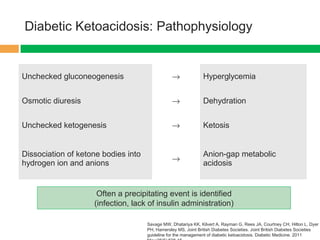
Diabetic Ketoacidosis: Pathophysiology
Unchecked gluconeogenesis → Hyperglycemia
Osmotic diuresis → Dehydration
Unchecked ketogenesis → Ketosis
Dissociation of ketone bodies into
hydrogen ion and anions
→
Anion-gap metabolic
acidosis
Often a precipitating event is identified
(infection, lack of insulin administration)
Savage MW, Dhatariya KK, Kilvert A, Rayman G, Rees JA, Courtney CH, Hilton L, Dyer
PH, Hamersley MS, Joint British Diabetes Societies. Joint British Diabetes Societies
guideline for the management of diabetic ketoacidosis. Diabetic Medicine. 2011
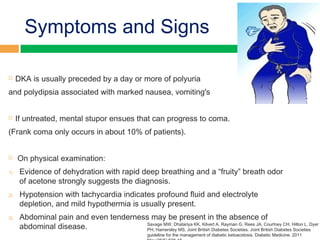
Symptoms and Signs
 DKA is usually preceded by a day or more of polyuria
and polydipsia associated with marked nausea, vomiting's
 If untreated, mental stupor ensues that can progress to coma.
(Frank coma only occurs in about 10% of patients).
 On physical examination:
1) Evidence of dehydration with rapid deep breathing and a “fruity” breath odor
of acetone strongly suggests the diagnosis.
2) Hypotension with tachycardia indicates profound fluid and electrolyte
depletion, and mild hypothermia is usually present.
3) Abdominal pain and even tenderness may be present in the absence of
abdominal disease. Savage MW, Dhatariya KK, Kilvert A, Rayman G, Rees JA, Courtney CH, Hilton L, Dyer
PH, Hamersley MS, Joint British Diabetes Societies. Joint British Diabetes Societies
guideline for the management of diabetic ketoacidosis. Diabetic Medicine. 2011
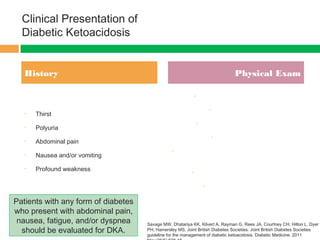
Clinical Presentation of
Diabetic Ketoacidosis
History
• Thirst
• Polyuria
• Abdominal pain
• Nausea and/or vomiting
• Profound weakness
Physical Exam
• Kussmaul respirations
• Fruity breath
• Relative hypothermia
• Tachycardia
• Supine hypotension, orthostatic drop
of blood pressure
• Dry mucous membranes
• Poor skin turgor
Handelsman Y, et al. Endocr Pract. 2016;22:753-762.
Patients with any form of diabetes
who present with abdominal pain,
nausea, fatigue, and/or dyspnea
should be evaluated for DKA.
Savage MW, Dhatariya KK, Kilvert A, Rayman G, Rees JA, Courtney CH, Hilton L, Dyer
PH, Hamersley MS, Joint British Diabetes Societies. Joint British Diabetes Societies
guideline for the management of diabetic ketoacidosis. Diabetic Medicine. 2011
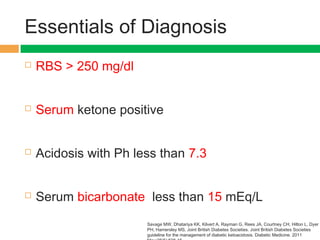
Essentials of Diagnosis
 RBS > 250 mg/dl
 Serum ketone positive
 Acidosis with Ph less than 7.3
 Serum bicarbonate less than 15 mEq/L
Savage MW, Dhatariya KK, Kilvert A, Rayman G, Rees JA, Courtney CH, Hilton L, Dyer
PH, Hamersley MS, Joint British Diabetes Societies. Joint British Diabetes Societies
guideline for the management of diabetic ketoacidosis. Diabetic Medicine. 2011
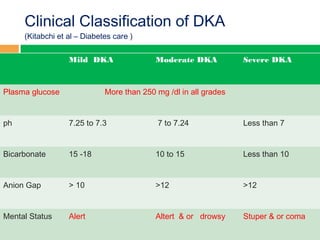
Clinical Classification of DKA
(Kitabchi et al – Diabetes care )
Mild DKA Moderate DKA Severe DKA
Plasma glucose More than 250 mg /dl in all grades
ph 7.25 to 7.3 7 to 7.24 Less than 7
Bicarbonate 15 -18 10 to 15 Less than 10
Anion Gap > 10 >12 >12
Mental Status Alert Altert & or drowsy Stuper & or coma
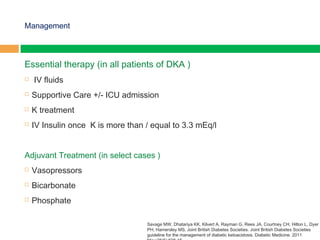
Management
Essential therapy (in all patients of DKA )
 IV fluids
 Supportive Care +/- ICU admission
 K treatment
 IV Insulin once K is more than / equal to 3.3 mEq/l
Adjuvant Treatment (in select cases )
 Vasopressors
 Bicarbonate
 Phosphate
Savage MW, Dhatariya KK, Kilvert A, Rayman G, Rees JA, Courtney CH, Hilton L, Dyer
PH, Hamersley MS, Joint British Diabetes Societies. Joint British Diabetes Societies
guideline for the management of diabetic ketoacidosis. Diabetic Medicine. 2011
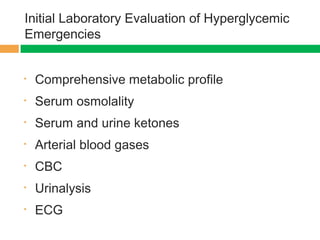
Initial Laboratory Evaluation of Hyperglycemic
Emergencies
• Comprehensive metabolic profile
• Serum osmolality
• Serum and urine ketones
• Arterial blood gases
• CBC
• Urinalysis
• ECG
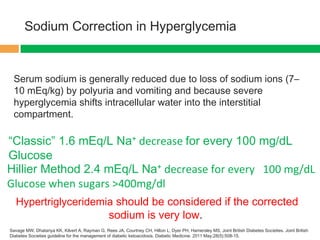
Sodium Correction in Hyperglycemia
“Classic” 1.6 mEq/L Na⁺ decrease for every 100 mg/dL
Glucose
Hillier Method 2.4 mEq/L Na⁺ decrease for every 100 mg/dL
Glucose when sugars >400mg/dl
Serum sodium is generally reduced due to loss of sodium ions (7–
10 mEq/kg) by polyuria and vomiting and because severe
hyperglycemia shifts intracellular water into the interstitial
compartment.
Hypertriglyceridemia should be considered if the corrected
sodium is very low.
Savage MW, Dhatariya KK, Kilvert A, Rayman G, Rees JA, Courtney CH, Hilton L, Dyer PH, Hamersley MS, Joint British Diabetes Societies. Joint British
Diabetes Societies guideline for the management of diabetic ketoacidosis. Diabetic Medicine. 2011 May;28(5):508-15.
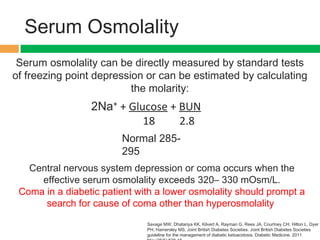
Serum Osmolality
2Na⁺ + Glucose + BUN
18 2.8
Normal 285-
295
Serum osmolality can be directly measured by standard tests
of freezing point depression or can be estimated by calculating
the molarity:
Central nervous system depression or coma occurs when the
effective serum osmolality exceeds 320– 330 mOsm/L.
Coma in a diabetic patient with a lower osmolality should prompt a
search for cause of coma other than hyperosmolality
Savage MW, Dhatariya KK, Kilvert A, Rayman G, Rees JA, Courtney CH, Hilton L, Dyer
PH, Hamersley MS, Joint British Diabetes Societies. Joint British Diabetes Societies
guideline for the management of diabetic ketoacidosis. Diabetic Medicine. 2011
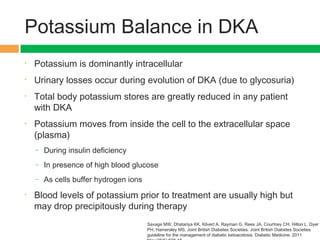
Potassium Balance in DKA
• Potassium is dominantly intracellular
• Urinary losses occur during evolution of DKA (due to glycosuria)
• Total body potassium stores are greatly reduced in any patient
with DKA
• Potassium moves from inside the cell to the extracellular space
(plasma)
– During insulin deficiency
– In presence of high blood glucose
– As cells buffer hydrogen ions
• Blood levels of potassium prior to treatment are usually high but
may drop precipitously during therapy
Savage MW, Dhatariya KK, Kilvert A, Rayman G, Rees JA, Courtney CH, Hilton L, Dyer
PH, Hamersley MS, Joint British Diabetes Societies. Joint British Diabetes Societies
guideline for the management of diabetic ketoacidosis. Diabetic Medicine. 2011
ABG vs VBG
 The difference between venous and arterial
pH is 0.02 to 0.15 pH units and venous and
arterial bicarbonate is 1.88 mEq/L. These
small differences will not affect either the
diagnosis or the management of DKA, and
there is no need to collect arterial blood for
measuring the acid-base status.
Savage MW, Dhatariya KK, Kilvert A, Rayman G, Rees JA, Courtney CH, Hilton L, Dyer
PH, Hamersley MS, Joint British Diabetes Societies. Joint British Diabetes Societies
guideline for the management of diabetic ketoacidosis. Diabetic Medicine. 2011
IV fluids
(Initial fluid & maintenance fluid)
 Initial Fluid (first one Hour )
Isotonic saline (0.9 NaCl ) is the initial fluid of choice in all
cases irrespective of volume status and sodium status
Goal : Restoration of Tissue Perfusion
Dose 15 to 20 ml / Kg in 1 hour
This translates to 1 - 1.5 l in first one hour in normal
adults .
Savage MW, Dhatariya KK, Kilvert A, Rayman G, Rees JA, Courtney CH, Hilton L, Dyer
PH, Hamersley MS, Joint British Diabetes Societies. Joint British Diabetes Societies
guideline for the management of diabetic ketoacidosis. Diabetic Medicine. 2011
IV fluid- Maintenance fluid(after first 1 hour)
 If Severely volume Depleted :
Signs
Orthostatic/ Supine hypotension
Dry mucus membrane
Poor skin turgor
Recommendation is to continue fluid resuscitation
with frequent monitoring and rate adjustments as
required until the patient becomes stable
Fluid of choice : 0.9 % NS
Savage MW, Dhatariya KK, Kilvert A, Rayman G, Rees JA, Courtney CH, Hilton L, Dyer
PH, Hamersley MS, Joint British Diabetes Societies. Joint British Diabetes Societies
guideline for the management of diabetic ketoacidosis. Diabetic Medicine. 2011
Maintenance fluid(after 1 hour)- if not severely
volume depleted.
 For Moderate to mildly hypovolumic patients :After first 1 hour fluid
resuscitation with NS measure Corrected Serum sodium
 Recommended Rate of infusion : 250 to 500 ml /hr
 Goal :To replenish half of fluid deficit gradually in 12 to 24hrs
 Once RBS is below 250mg /dl shift to
Fluids should be changed to a 5% glucose-containing solution to maintain
serum glucose in the range of 250–300 mg/dL. Preventing hypoglycemia
and reduce the chance of cerebral edema,due to rapid correction
Corrected Na = Measured Na + 0.016 x
(glucose -100)
If Hyponatremic If Normo/Hyperntremic
0.9 % NS 0.45 NaCl
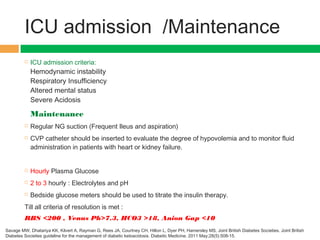
ICU admission /Maintenance
 ICU admission criteria:
Hemodynamic instability
Respiratory Insufficiency
Altered mental status
Severe Acidosis
Maintenance
 Regular NG suction (Frequent Ileus and aspiration)
 CVP catheter should be inserted to evaluate the degree of hypovolemia and to monitor fluid
administration in patients with heart or kidney failure.
 Hourly Plasma Glucose
 2 to 3 hourly : Electrolytes and pH
 Bedside glucose meters should be used to titrate the insulin therapy.
Till all criteria of resolution is met :
RBS <200 , Venus Ph>7.3, HCO3 >18, Anion Gap <10
Savage MW, Dhatariya KK, Kilvert A, Rayman G, Rees JA, Courtney CH, Hilton L, Dyer PH, Hamersley MS, Joint British Diabetes Societies. Joint British
Diabetes Societies guideline for the management of diabetic ketoacidosis. Diabetic Medicine. 2011 May;28(5):508-15.
Potassium Therapy
 Serum K may be high, low or normal at various stages of DKA but
DKA is always a state of Total K depletion irrespective of serum K
levels (due to osmotic Diuresis)
 If the patient is not uremic or has an adequate urinary output, Start
K therapy @ 10-30 mEq /hr infused in IV FLUID as soon as
initial K levels are available (hold if K >5.3) to maintain K between
3.3 and 5.3
 Insulin should be stopped if K falls below 3.3
 ECG can be of help in monitoring the patient’s potassium status
Savage MW, Dhatariya KK, Kilvert A, Rayman G, Rees JA, Courtney CH, Hilton L, Dyer
PH, Hamersley MS, Joint British Diabetes Societies. Joint British Diabetes Societies
guideline for the management of diabetic ketoacidosis. Diabetic Medicine. 2011
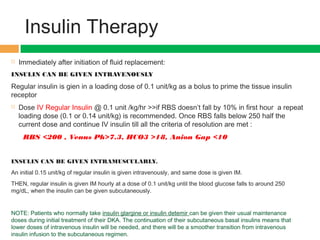
Insulin Therapy
 Immediately after initiation of fluid replacement:
INSULIN CAN BE GIVEN INTRAVENOUSLY
Regular insulin is gien in a loading dose of 0.1 unit/kg as a bolus to prime the tissue insulin
receptor
 Dose IV Regular Insulin @ 0.1 unit /kg/hr >>if RBS doesn’t fall by 10% in first hour a repeat
loading dose (0.1 or 0.14 unit/kg) is recommended. Once RBS falls below 250 half the
current dose and continue IV insulin till all the criteria of resolution are met :
RBS <200 , Venus Ph>7.3, HCO3 >18, Anion Gap <10
INSULIN CAN BE GIVEN INTRAMUSCULARLY.
An initial 0.15 unit/kg of regular insulin is given intravenously, and same dose is given IM.
THEN, regular insulin is given IM hourly at a dose of 0.1 unit/kg until the blood glucose falls to around 250
mg/dL, when the insulin can be given subcutaneously.
NOTE: Patients who normally take insulin glargine or insulin detemir can be given their usual maintenance
doses during initial treatment of their DKA. The continuation of their subcutaneous basal insulins means that
lower doses of intravenous insulin will be needed, and there will be a smoother transition from intravenous
insulin infusion to the subcutaneous regimen.
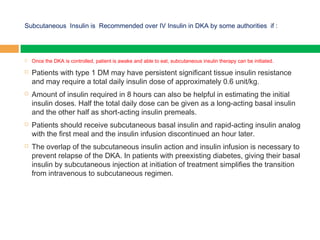
Subcutaneous Insulin is Recommended over IV Insulin in DKA by some authorities if :
 Once the DKA is controlled, patient is awake and able to eat, subcutaneous insulin therapy can be initiated.
 Patients with type 1 DM may have persistent significant tissue insulin resistance
and may require a total daily insulin dose of approximately 0.6 unit/kg.
 Amount of insulin required in 8 hours can also be helpful in estimating the initial
insulin doses. Half the total daily dose can be given as a long-acting basal insulin
and the other half as short-acting insulin premeals.
 Patients should receive subcutaneous basal insulin and rapid-acting insulin analog
with the first meal and the insulin infusion discontinued an hour later.
 The overlap of the subcutaneous insulin action and insulin infusion is necessary to
prevent relapse of the DKA. In patients with preexisting diabetes, giving their basal
insulin by subcutaneous injection at initiation of treatment simplifies the transition
from intravenous to subcutaneous regimen.
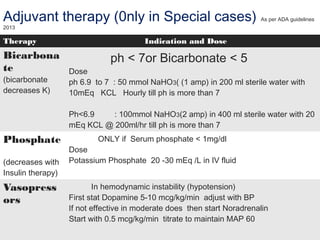
Adjuvant therapy (0nly in Special cases) As per ADA guidelines
2013
Therapy Indication and Dose
Bicarbona
te
(bicarbonate
decreases K)
ph < 7or Bicarbonate < 5
Dose
ph 6.9 to 7 : 50 mmol NaHO3( (1 amp) in 200 ml sterile water with
10mEq KCL Hourly till ph is more than 7
Ph<6.9 : 100mmol NaHO3(2 amp) in 400 ml sterile water with 20
mEq KCL @ 200ml/hr till ph is more than 7
Phosphate
(decreases with
Insulin therapy)
ONLY if Serum phosphate < 1mg/dl
Dose
Potassium Phosphate 20 -30 mEq /L in IV fluid
Vasopress
ors
In hemodynamic instability (hypotension)
First stat Dopamine 5-10 mcg/kg/min adjust with BP
If not effective in moderate does then start Noradrenalin
Start with 0.5 mcg/kg/min titrate to maintain MAP 60
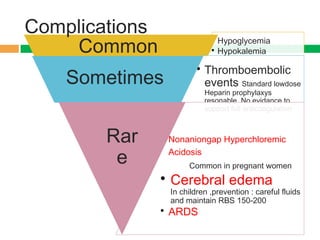
• Hypoglycemia
• HypokalemiaCommon
• Thromboembolic
events Standard lowdose
Heparin prophylaxys
resonable .No evidance to
support full anticoagulation
Sometimes
• Nonaniongap Hyperchloremic
Acidosis
Common in pregnant women
• Cerebral edema
In children ,prevention : careful fluids
and maintain RBS 150-200
• ARDS
Rar
e
Complications
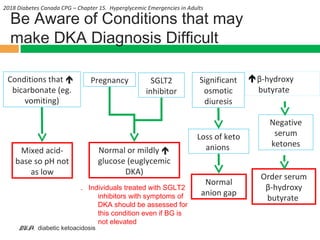
Be Aware of Conditions that may
make DKA Diagnosis Difficult
2018 Diabetes Canada CPG – Chapter 15. Hyperglycemic Emergencies in Adults
Conditions that 
bicarbonate (eg.
vomiting)
Pregnancy SGLT2
inhibitor
Significant
osmotic
diuresis
β-hydroxy
butyrate
Mixed acid-
base so pH not
as low
Normal or mildly 
glucose (euglycemic
DKA)
Loss of keto
anions
Normal
anion gap
Negative
serum
ketones
Order serum
β-hydroxy
butyrate
DKA, diabetic ketoacidosis
. Individuals treated with SGLT2
inhibitors with symptoms of
DKA should be assessed for
this condition even if BG is
not elevated  
THANK YOU!!

DIABETIC KETOACIDOSIS GUIDELINES

  • 1.
  • 2.
    Diabetes Ketoacidosis (DKA)Definition Allthe major definitions by various authorities are rather subjective but emphasize on the following points :  1 Acute life threatening metabolic complication of diabetes  2 Characterized by absolute insulin deficiency and hyperglycemia A Life-threatening medical emergency with a Mortality rate:  Under 5% in individuals under 40 years of age  With a serious prognosis in older adults, who have mortality rates over 20%. Savage MW, Dhatariya KK, Kilvert A, Rayman G, Rees JA, Courtney CH, Hilton L, Dyer PH, Hamersley MS, Joint British Diabetes Societies. Joint British Diabetes Societies guideline for the management of diabetic ketoacidosis. Diabetic Medicine. 2011
  • 3.
    Diabetic Ketoacidosis: Pathophysiology Uncheckedgluconeogenesis → Hyperglycemia Osmotic diuresis → Dehydration Unchecked ketogenesis → Ketosis Dissociation of ketone bodies into hydrogen ion and anions → Anion-gap metabolic acidosis Often a precipitating event is identified (infection, lack of insulin administration) Savage MW, Dhatariya KK, Kilvert A, Rayman G, Rees JA, Courtney CH, Hilton L, Dyer PH, Hamersley MS, Joint British Diabetes Societies. Joint British Diabetes Societies guideline for the management of diabetic ketoacidosis. Diabetic Medicine. 2011
  • 4.
    Symptoms and Signs DKA is usually preceded by a day or more of polyuria and polydipsia associated with marked nausea, vomiting's  If untreated, mental stupor ensues that can progress to coma. (Frank coma only occurs in about 10% of patients).  On physical examination: 1) Evidence of dehydration with rapid deep breathing and a “fruity” breath odor of acetone strongly suggests the diagnosis. 2) Hypotension with tachycardia indicates profound fluid and electrolyte depletion, and mild hypothermia is usually present. 3) Abdominal pain and even tenderness may be present in the absence of abdominal disease. Savage MW, Dhatariya KK, Kilvert A, Rayman G, Rees JA, Courtney CH, Hilton L, Dyer PH, Hamersley MS, Joint British Diabetes Societies. Joint British Diabetes Societies guideline for the management of diabetic ketoacidosis. Diabetic Medicine. 2011
  • 5.
    Clinical Presentation of DiabeticKetoacidosis History • Thirst • Polyuria • Abdominal pain • Nausea and/or vomiting • Profound weakness Physical Exam • Kussmaul respirations • Fruity breath • Relative hypothermia • Tachycardia • Supine hypotension, orthostatic drop of blood pressure • Dry mucous membranes • Poor skin turgor Handelsman Y, et al. Endocr Pract. 2016;22:753-762. Patients with any form of diabetes who present with abdominal pain, nausea, fatigue, and/or dyspnea should be evaluated for DKA. Savage MW, Dhatariya KK, Kilvert A, Rayman G, Rees JA, Courtney CH, Hilton L, Dyer PH, Hamersley MS, Joint British Diabetes Societies. Joint British Diabetes Societies guideline for the management of diabetic ketoacidosis. Diabetic Medicine. 2011
  • 6.
    Essentials of Diagnosis RBS > 250 mg/dl  Serum ketone positive  Acidosis with Ph less than 7.3  Serum bicarbonate less than 15 mEq/L Savage MW, Dhatariya KK, Kilvert A, Rayman G, Rees JA, Courtney CH, Hilton L, Dyer PH, Hamersley MS, Joint British Diabetes Societies. Joint British Diabetes Societies guideline for the management of diabetic ketoacidosis. Diabetic Medicine. 2011
  • 7.
    Clinical Classification ofDKA (Kitabchi et al – Diabetes care ) Mild DKA Moderate DKA Severe DKA Plasma glucose More than 250 mg /dl in all grades ph 7.25 to 7.3 7 to 7.24 Less than 7 Bicarbonate 15 -18 10 to 15 Less than 10 Anion Gap > 10 >12 >12 Mental Status Alert Altert & or drowsy Stuper & or coma
  • 8.
    Management Essential therapy (inall patients of DKA )  IV fluids  Supportive Care +/- ICU admission  K treatment  IV Insulin once K is more than / equal to 3.3 mEq/l Adjuvant Treatment (in select cases )  Vasopressors  Bicarbonate  Phosphate Savage MW, Dhatariya KK, Kilvert A, Rayman G, Rees JA, Courtney CH, Hilton L, Dyer PH, Hamersley MS, Joint British Diabetes Societies. Joint British Diabetes Societies guideline for the management of diabetic ketoacidosis. Diabetic Medicine. 2011
  • 9.
    Initial Laboratory Evaluationof Hyperglycemic Emergencies • Comprehensive metabolic profile • Serum osmolality • Serum and urine ketones • Arterial blood gases • CBC • Urinalysis • ECG
  • 10.
    Sodium Correction inHyperglycemia “Classic” 1.6 mEq/L Na⁺ decrease for every 100 mg/dL Glucose Hillier Method 2.4 mEq/L Na⁺ decrease for every 100 mg/dL Glucose when sugars >400mg/dl Serum sodium is generally reduced due to loss of sodium ions (7– 10 mEq/kg) by polyuria and vomiting and because severe hyperglycemia shifts intracellular water into the interstitial compartment. Hypertriglyceridemia should be considered if the corrected sodium is very low. Savage MW, Dhatariya KK, Kilvert A, Rayman G, Rees JA, Courtney CH, Hilton L, Dyer PH, Hamersley MS, Joint British Diabetes Societies. Joint British Diabetes Societies guideline for the management of diabetic ketoacidosis. Diabetic Medicine. 2011 May;28(5):508-15.
  • 11.
    Serum Osmolality 2Na⁺ +Glucose + BUN 18 2.8 Normal 285- 295 Serum osmolality can be directly measured by standard tests of freezing point depression or can be estimated by calculating the molarity: Central nervous system depression or coma occurs when the effective serum osmolality exceeds 320– 330 mOsm/L. Coma in a diabetic patient with a lower osmolality should prompt a search for cause of coma other than hyperosmolality Savage MW, Dhatariya KK, Kilvert A, Rayman G, Rees JA, Courtney CH, Hilton L, Dyer PH, Hamersley MS, Joint British Diabetes Societies. Joint British Diabetes Societies guideline for the management of diabetic ketoacidosis. Diabetic Medicine. 2011
  • 12.
    Potassium Balance inDKA • Potassium is dominantly intracellular • Urinary losses occur during evolution of DKA (due to glycosuria) • Total body potassium stores are greatly reduced in any patient with DKA • Potassium moves from inside the cell to the extracellular space (plasma) – During insulin deficiency – In presence of high blood glucose – As cells buffer hydrogen ions • Blood levels of potassium prior to treatment are usually high but may drop precipitously during therapy Savage MW, Dhatariya KK, Kilvert A, Rayman G, Rees JA, Courtney CH, Hilton L, Dyer PH, Hamersley MS, Joint British Diabetes Societies. Joint British Diabetes Societies guideline for the management of diabetic ketoacidosis. Diabetic Medicine. 2011
  • 13.
    ABG vs VBG The difference between venous and arterial pH is 0.02 to 0.15 pH units and venous and arterial bicarbonate is 1.88 mEq/L. These small differences will not affect either the diagnosis or the management of DKA, and there is no need to collect arterial blood for measuring the acid-base status. Savage MW, Dhatariya KK, Kilvert A, Rayman G, Rees JA, Courtney CH, Hilton L, Dyer PH, Hamersley MS, Joint British Diabetes Societies. Joint British Diabetes Societies guideline for the management of diabetic ketoacidosis. Diabetic Medicine. 2011
  • 14.
    IV fluids (Initial fluid& maintenance fluid)  Initial Fluid (first one Hour ) Isotonic saline (0.9 NaCl ) is the initial fluid of choice in all cases irrespective of volume status and sodium status Goal : Restoration of Tissue Perfusion Dose 15 to 20 ml / Kg in 1 hour This translates to 1 - 1.5 l in first one hour in normal adults . Savage MW, Dhatariya KK, Kilvert A, Rayman G, Rees JA, Courtney CH, Hilton L, Dyer PH, Hamersley MS, Joint British Diabetes Societies. Joint British Diabetes Societies guideline for the management of diabetic ketoacidosis. Diabetic Medicine. 2011
  • 15.
    IV fluid- Maintenancefluid(after first 1 hour)  If Severely volume Depleted : Signs Orthostatic/ Supine hypotension Dry mucus membrane Poor skin turgor Recommendation is to continue fluid resuscitation with frequent monitoring and rate adjustments as required until the patient becomes stable Fluid of choice : 0.9 % NS Savage MW, Dhatariya KK, Kilvert A, Rayman G, Rees JA, Courtney CH, Hilton L, Dyer PH, Hamersley MS, Joint British Diabetes Societies. Joint British Diabetes Societies guideline for the management of diabetic ketoacidosis. Diabetic Medicine. 2011
  • 16.
    Maintenance fluid(after 1hour)- if not severely volume depleted.  For Moderate to mildly hypovolumic patients :After first 1 hour fluid resuscitation with NS measure Corrected Serum sodium  Recommended Rate of infusion : 250 to 500 ml /hr  Goal :To replenish half of fluid deficit gradually in 12 to 24hrs  Once RBS is below 250mg /dl shift to Fluids should be changed to a 5% glucose-containing solution to maintain serum glucose in the range of 250–300 mg/dL. Preventing hypoglycemia and reduce the chance of cerebral edema,due to rapid correction Corrected Na = Measured Na + 0.016 x (glucose -100) If Hyponatremic If Normo/Hyperntremic 0.9 % NS 0.45 NaCl
  • 17.
    ICU admission /Maintenance ICU admission criteria: Hemodynamic instability Respiratory Insufficiency Altered mental status Severe Acidosis Maintenance  Regular NG suction (Frequent Ileus and aspiration)  CVP catheter should be inserted to evaluate the degree of hypovolemia and to monitor fluid administration in patients with heart or kidney failure.  Hourly Plasma Glucose  2 to 3 hourly : Electrolytes and pH  Bedside glucose meters should be used to titrate the insulin therapy. Till all criteria of resolution is met : RBS <200 , Venus Ph>7.3, HCO3 >18, Anion Gap <10 Savage MW, Dhatariya KK, Kilvert A, Rayman G, Rees JA, Courtney CH, Hilton L, Dyer PH, Hamersley MS, Joint British Diabetes Societies. Joint British Diabetes Societies guideline for the management of diabetic ketoacidosis. Diabetic Medicine. 2011 May;28(5):508-15.
  • 18.
    Potassium Therapy  SerumK may be high, low or normal at various stages of DKA but DKA is always a state of Total K depletion irrespective of serum K levels (due to osmotic Diuresis)  If the patient is not uremic or has an adequate urinary output, Start K therapy @ 10-30 mEq /hr infused in IV FLUID as soon as initial K levels are available (hold if K >5.3) to maintain K between 3.3 and 5.3  Insulin should be stopped if K falls below 3.3  ECG can be of help in monitoring the patient’s potassium status Savage MW, Dhatariya KK, Kilvert A, Rayman G, Rees JA, Courtney CH, Hilton L, Dyer PH, Hamersley MS, Joint British Diabetes Societies. Joint British Diabetes Societies guideline for the management of diabetic ketoacidosis. Diabetic Medicine. 2011
  • 19.
    Insulin Therapy  Immediatelyafter initiation of fluid replacement: INSULIN CAN BE GIVEN INTRAVENOUSLY Regular insulin is gien in a loading dose of 0.1 unit/kg as a bolus to prime the tissue insulin receptor  Dose IV Regular Insulin @ 0.1 unit /kg/hr >>if RBS doesn’t fall by 10% in first hour a repeat loading dose (0.1 or 0.14 unit/kg) is recommended. Once RBS falls below 250 half the current dose and continue IV insulin till all the criteria of resolution are met : RBS <200 , Venus Ph>7.3, HCO3 >18, Anion Gap <10 INSULIN CAN BE GIVEN INTRAMUSCULARLY. An initial 0.15 unit/kg of regular insulin is given intravenously, and same dose is given IM. THEN, regular insulin is given IM hourly at a dose of 0.1 unit/kg until the blood glucose falls to around 250 mg/dL, when the insulin can be given subcutaneously. NOTE: Patients who normally take insulin glargine or insulin detemir can be given their usual maintenance doses during initial treatment of their DKA. The continuation of their subcutaneous basal insulins means that lower doses of intravenous insulin will be needed, and there will be a smoother transition from intravenous insulin infusion to the subcutaneous regimen.
  • 20.
    Subcutaneous Insulin isRecommended over IV Insulin in DKA by some authorities if :  Once the DKA is controlled, patient is awake and able to eat, subcutaneous insulin therapy can be initiated.  Patients with type 1 DM may have persistent significant tissue insulin resistance and may require a total daily insulin dose of approximately 0.6 unit/kg.  Amount of insulin required in 8 hours can also be helpful in estimating the initial insulin doses. Half the total daily dose can be given as a long-acting basal insulin and the other half as short-acting insulin premeals.  Patients should receive subcutaneous basal insulin and rapid-acting insulin analog with the first meal and the insulin infusion discontinued an hour later.  The overlap of the subcutaneous insulin action and insulin infusion is necessary to prevent relapse of the DKA. In patients with preexisting diabetes, giving their basal insulin by subcutaneous injection at initiation of treatment simplifies the transition from intravenous to subcutaneous regimen.
  • 21.
    Adjuvant therapy (0nlyin Special cases) As per ADA guidelines 2013 Therapy Indication and Dose Bicarbona te (bicarbonate decreases K) ph < 7or Bicarbonate < 5 Dose ph 6.9 to 7 : 50 mmol NaHO3( (1 amp) in 200 ml sterile water with 10mEq KCL Hourly till ph is more than 7 Ph<6.9 : 100mmol NaHO3(2 amp) in 400 ml sterile water with 20 mEq KCL @ 200ml/hr till ph is more than 7 Phosphate (decreases with Insulin therapy) ONLY if Serum phosphate < 1mg/dl Dose Potassium Phosphate 20 -30 mEq /L in IV fluid Vasopress ors In hemodynamic instability (hypotension) First stat Dopamine 5-10 mcg/kg/min adjust with BP If not effective in moderate does then start Noradrenalin Start with 0.5 mcg/kg/min titrate to maintain MAP 60
  • 22.
    • Hypoglycemia • HypokalemiaCommon •Thromboembolic events Standard lowdose Heparin prophylaxys resonable .No evidance to support full anticoagulation Sometimes • Nonaniongap Hyperchloremic Acidosis Common in pregnant women • Cerebral edema In children ,prevention : careful fluids and maintain RBS 150-200 • ARDS Rar e Complications
  • 23.
    Be Aware ofConditions that may make DKA Diagnosis Difficult 2018 Diabetes Canada CPG – Chapter 15. Hyperglycemic Emergencies in Adults Conditions that  bicarbonate (eg. vomiting) Pregnancy SGLT2 inhibitor Significant osmotic diuresis β-hydroxy butyrate Mixed acid- base so pH not as low Normal or mildly  glucose (euglycemic DKA) Loss of keto anions Normal anion gap Negative serum ketones Order serum β-hydroxy butyrate DKA, diabetic ketoacidosis . Individuals treated with SGLT2 inhibitors with symptoms of DKA should be assessed for this condition even if BG is not elevated  
  • 24.

Editor's Notes

  • #4 &amp;lt;number&amp;gt;
  • #5 Conversely, cholecystitis or pancreatitis may occur with minimal symptoms and signs &amp;lt;number&amp;gt;
  • #6 &amp;lt;number&amp;gt;
  • #8 Note serum and urine ketones are positive in all stages , Effective plasma osmolarity is variable in al groups &amp;lt;number&amp;gt;
  • #10 &amp;lt;number&amp;gt;
  • #11 Serum sodium is generally reduced due to loss of sodium ions (7–10 mEq/kg) by polyuria and vomiting and because severe hyperglycemia shifts intracellular water into the interstitial compartment. For every 100 mg/dL of plasma glucose, serum sodium decreases by 1.6 mEq/L (5.56 mmol/L). The decrease in serum sodium may be greater when patients have more severe hyperglycemia (greater than 400 mg/dL, 22.2 mmol/L) and a correction factor of 2.4 mEq/L may be used. Hypertriglyceridemia should be considered if the corrected sodium is very low. Serum osmolality can be directly measured by standard tests of freezing point depression or can be estimated by calculating the molarity of sodium, chloride, and glucose in the serum. A convenient method of estimating effective serum osmolality is as follows (normal values in humans are 280–300 mOsm/kg): &amp;lt;number&amp;gt;
  • #13 &amp;lt;number&amp;gt;
  • #16 Source Kitabchi et al &amp;lt;number&amp;gt;
  • #19 However, because of shifts of potassium from cells into the extracellular space as a consequence of acidosis, serum potassium is usually normal to slightly elevated prior to institution of treatment. As the acidosis is corrected, potassium flows back into the cells, and hypokalemia can develop if potassium replacement is not instituted. I &amp;lt;number&amp;gt;
  • #20 INSULIN CAN BE GIVEN INTRAMUSCULARLY. An initial 0.15 unit/kg of regular insulin is given intravenously, and same dose is given IM. THEN, regular insulin is given IM hourly at a dose of 0.1 unit/kg until the blood glucose falls to around 250 mg/dL, when the insulin can be given subcutaneously. Patients who normally take insulin glargine or insulin detemir can be given their usual maintenance doses during initial treatment of their DKA. The continuation of their subcutaneous basal insulins means that lower doses of intravenous insulin will be needed, and there will be a smoother transition from intravenous insulin infusion to the subcutaneous regimen. &amp;lt;number&amp;gt;