RENAL CELL CANCER
By :Darayus P. Gazder
Case Presentation
By :Darayus P. Gazder
CASE REPORT
 46 YEAR OLD FEMALE, WITH NKCM
 C/O PAIN IN THE LEFT LUMBAR REGION SINCE 1
MONTH
 She was having difficulty in changes of posture
 Pain was radiating to the left leg
 PMH: Not significant
 PSH: C-section 8 years ago
 DH: NKDA
 FH: +ve H/O HTN, IHD. No H/O DM, Asthma or Cancers
 PH: Having difficulty in sleeping, normal micturition, bowel
movements
 SH: Housewife. No addictions.
 ROS: H/O weight loss and decreased appetite since 3
months
 O/E
A 46 year old female lying on the bed comfortably
well oriented in time, place, person.
 Patient was vitally stable
A+, J-, C-,K-,L-,E-,D-
ABDOMINAL EXAMINATION----
Soft, tenderness in the Left lumbar region.
Hard mass felt in the region on abdominal
ballottement
CT SCAN WHOLE ABDOMEN WITH NON IONIC CONTRAST
(April 4th
2016)
A large sharply marginated well circumscribed mass lesion seen arising
from posterior aspect of the upper and mid pole of left kidney.
Its centrally necrotic and demonstrates enhancement in the arteroportal
phase of circulation with washout on delayed imaging, the enhanced
vascular channels are seen predominantly encircling the mass
peripherally where few collateral channels are also seen along its
posterior aspect. It measure 15.4 x 4.8 x 12 cms in (CC, AP, TS)
dimensions.
Anteriorly: Forward displacement of the renal parenchyma with
anterosuperior displacement of pancreatic body and tail.
Posteromedially: the posterior abdominal wall
Medially: Its abutting the psoas and Quadratus muscles
All surrounding fat interfaces are well preserved around this mass with
no evidence of any infiltration or invasion
Overall findings are suggestive of neoplastic Left renal mass.
INVESTIGATIONS:
 Blood: (April 9th
2016)
 CBC: Hb:9, PCV: 29, TLC: 5.6, PLT:468
 UCE: Normal
 LFT: Normal
 PT, INR: Normal
 Hep Profile: Negative
 URINE D/R: Normal (No blood)
 CXR: Normal
Hospital Course:
TREATMENT
AND
COURSE
Renal Tumor Embolization
(April 11th
2016)
 1 PCV was transfused before the embolization
procedure/ Consent was taken, procedure was
explained
 Right femoral artery approach was used.
 Initial angiogram showed a large tumor in left renal
region. It showed AV shunting with venous
aneurysms.
 Subsequently multiple vessels were selectively
cannulated and embolization was performed using
gelfoam.
 Major vascularity was occluded
 No complication was seen.
INVESTIGATIONS:
 Patient remained vitally stable. There was no active
issues. She was counselled about surgery and consent
was taken.
 PRE-OPS: were done
 Anesthesia review: ASA GRADE 2
(Patients with mild systemic disease, No functional limitations)
4 PCV’s were arranged
SURGERY: Left Radical Nephrectomy
 Left subcoastal incision was given
 Peritoneum was opened
 Splenic Flexure of Colon was mobilized
 Left renal pedicle was tied
 Radical nephrectomy was done
 Omentum was packed in the remaining space
 Drain was inserted in the renal bed
 Patient was transfused with 1 PCV
 POST OP ORDERS:
- Shift patient to SICU for further workup and management
- NPO TFO
- Strict I/O charting
- Apply TED stockings
- Inj R/L @ 125 ml/hr
- Inj Cefuroxime 750 mg TDS
- Inj Nalbuphine, Metoclopramide
- Spirometry 4 hourly
- Nebulize with steam and Iprtropium
SICU Course (April 12th
)
 Patient was received from the OT
 She remained vitally stable
 Systemic examination was unremarkable
 NG by gravity drain
 Urine was adequate but was reddish
 Was started on Pethidine infusion 50mg in 50mL
@5mg/hr
SICU Day 1 (April 13th
)
 She remained vitally stable
CBC: Hb: 8.8, PCV: 27, TLC: 14.5, PLT: 375
UCE: N:138, K:4.8, CL:103, HC:25.8, U:37, Cr:1.15
Ca: 8.96 PT: 13.9 INR: 0.8
 NG with gravity drain
 Drain: Intact, No output
 Dressing was intact, clean
 I/O charting was adequate, Urine appeared reddish
dark
SICU Day 2 (April 14th
)
 She developed a temperature spike in the morning and
was given Paracetamol 1gm stat.
 She developed pain at the site and infusion was increased
to 8ml/hr
 Drain: Intact, No output
 I/O charting was adequate, Urine appeared reddish dark
 Later, her NG tube was removed, sips were allowed R/L
and Cefuroxime, steam inhalation were continued.
Pethidine infusion was stopped, she was started on:
- Inj Nalbupheine 10mg TDS
- Inj Enoxaparin 60mg OD
- Inj Paracetamol 1gm SOS
 1 PCV was transfused
 Patient was mobilized out of bed
 She remained stable and was shifted to the ward
Ward Course (14th
April-12PM onward)
 Patient remained stable
 Foleys and drain were removed
 Patient was mobilized
 Dressing was changed
 IV fluids were reduced to 75ml/hr and later stopped as
patient was orally tolerating
- Inj Nalbuphine was tapered to SOS
- Inj Paracetamol every 6H
- Niflam mouth wash was added
SURGERY (T)/
POST OP
9-Apr T 12-Apr 13-Apr T 14-Apr 15-Apr
Hb 9 T 8.8 8.3 T 9
Hct 29 T 28 27 T 28
TLC 5.6 T 14.5 12.4 T 11.4
PLT 468 T 375 338 T 309
Urea 24 T 34 T 34 24
Cr 0.86 T 1.18 T 1.11 9.7
Discharge (April 15th
)
 Patient was discharged after getting a shower/ COD
D/C meds:
- Tab Cefuroxime 250 mg 2 Tabs BD
- Tab Nuberol forte TDS
- Cap Tramadol 50mg SOS (In case of severe pain)
- Cap Fefol Vit OD for 1 month
 Take daily shower, allowed regular diet
 Mobilization, activity as tolerated
 Follow up on April 22th with Biopsy report with
Urologist.
Biopsy Report
 Chromophobe renal cell cancer
 3% of all adult malignancies
 M>F, ratio 2:1
 50 – 80 years
 It is an adenocarcinoma arising from renal tubular
cells, most common site is proximal renal tubule.
 This noncapsulated tumour is very vascular.
 30% presenting with metastatic disease
BHD=Birt-Hogg-Dubé; FH=fumarate hydratase; VHL=von Hippel-Lindau.
Modified from Linehan WM et al. J Urol. 2003;170:2163-2172.
Clear cell
75%
Type
Incidence (%)
Associated
mutations
VHL
Papillary type 1
5%
c-Met
10%
Chromophobe
5%
BHD
5%
D
*2004 WHO lists over 50 different types of kidney
cancer
(Sarcomatoid variant can occur with any subtype)
Renal Cell Carcinoma (RCC) – Risk
Factors
 Smoking
Obesity (especially in women)
Use of phenacetin analgesics
Patients on dialysis, who acquire cystic kidney
disease
Occupational risk factors
 Leather tanning (TCC – dye and textile industry)
 Asbestos exposure
Genetic risk factors
 Von Hippel Lindau disease
 Adult polycystic disease
Renal Cell Carcinoma – Clinical
Presentation
 Most are asymptomatic until development of metastasis
 Classical triad (19% of cases):
 LOIN PAIN
 FLANK MASS
 HAEMATURIA
 Fever and sweats /Weight loss / Malaise
 Varicocele in 2% of males (due to compression of left renal vein)
 Paraneoplastic syndrome
 Polycythaemia due to EPO-like molecules
 Hypertension due to renin
 Hypercalcaemia due to PTH-related peptide
 Stauffer syndrome
Renal Cell Carcinoma - Spread
 Local
 Adrenal Glands
 Renal Veins
 Inferior Vena Cava
 Gerota’s fascia (anterior to
perinephric space)
 Perinephric Tissue
 Lymphatics
 Lymph nodes at renal hilum
 Abdominal para-aortic nodes
 Paracaval nodes
 Blood
 Lung
 Bone
 Soft tissue
 Central nervous system
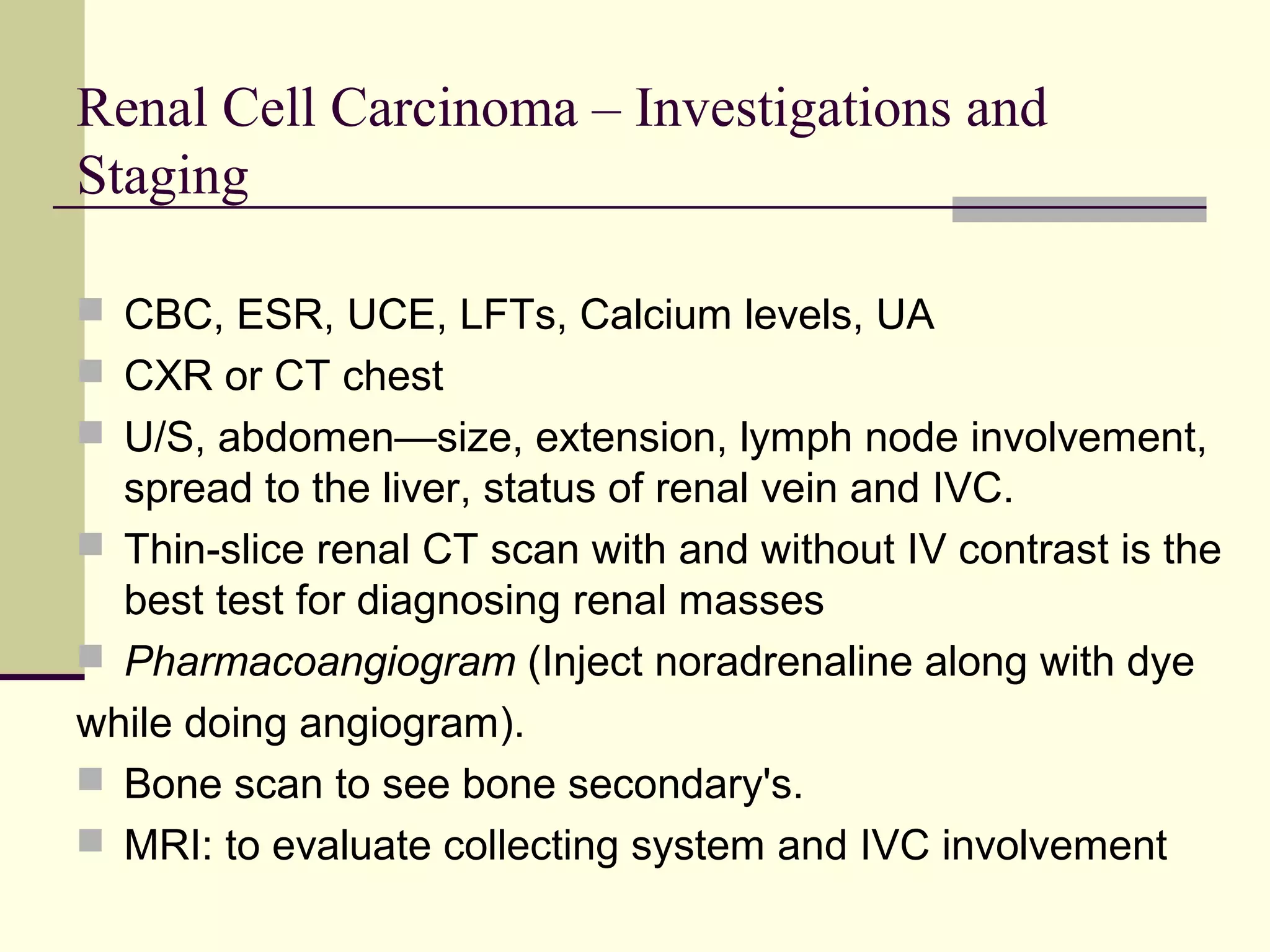
Renal Cell Carcinoma – Investigations and
Staging
 CBC, ESR, UCE, LFTs, Calcium levels, UA
 CXR or CT chest
 U/S, abdomen—size, extension, lymph node involvement,
spread to the liver, status of renal vein and IVC.
 Thin-slice renal CT scan with and without IV contrast is the
best test for diagnosing renal masses
 Pharmacoangiogram (Inject noradrenaline along with dye
while doing angiogram).
 Bone scan to see bone secondary's.
 MRI: to evaluate collecting system and IVC involvement
Robson’s staging
 Surgery
 Radiotherapy (used in Palliative setting)
 Biological treatment (used in Palliative setting)
 (Chemotherapy unhelpful)
Surgical
modalities
Rad.Neph
Open
Lap
N.S.S
Open
Lap
Minimally
invasive
approach
Cryoablation
open
P.C
LapR.F.A open
P.C
LAP
Noninvasive HIFU
ablation
Removal of kidney, adrenal gland, perirenal fat within gerota’s fascia +/- LN
dissection
Treatment
Disseminated disease:
 Nephrectomy--- reducing tumor burden
 Radiation--- radioresistant tumor, metastases
2/3 effective
 Chemotherapy--- <10% effective
 Immunotherapy--- IL-2/interferon-alpha, 30%
response rate
 Molecular therapy---eg. sorafenib
Renal Cell Carcinoma – Biological Treatment
 Cytokine therapy
 Interferon α
 Interleukin 2
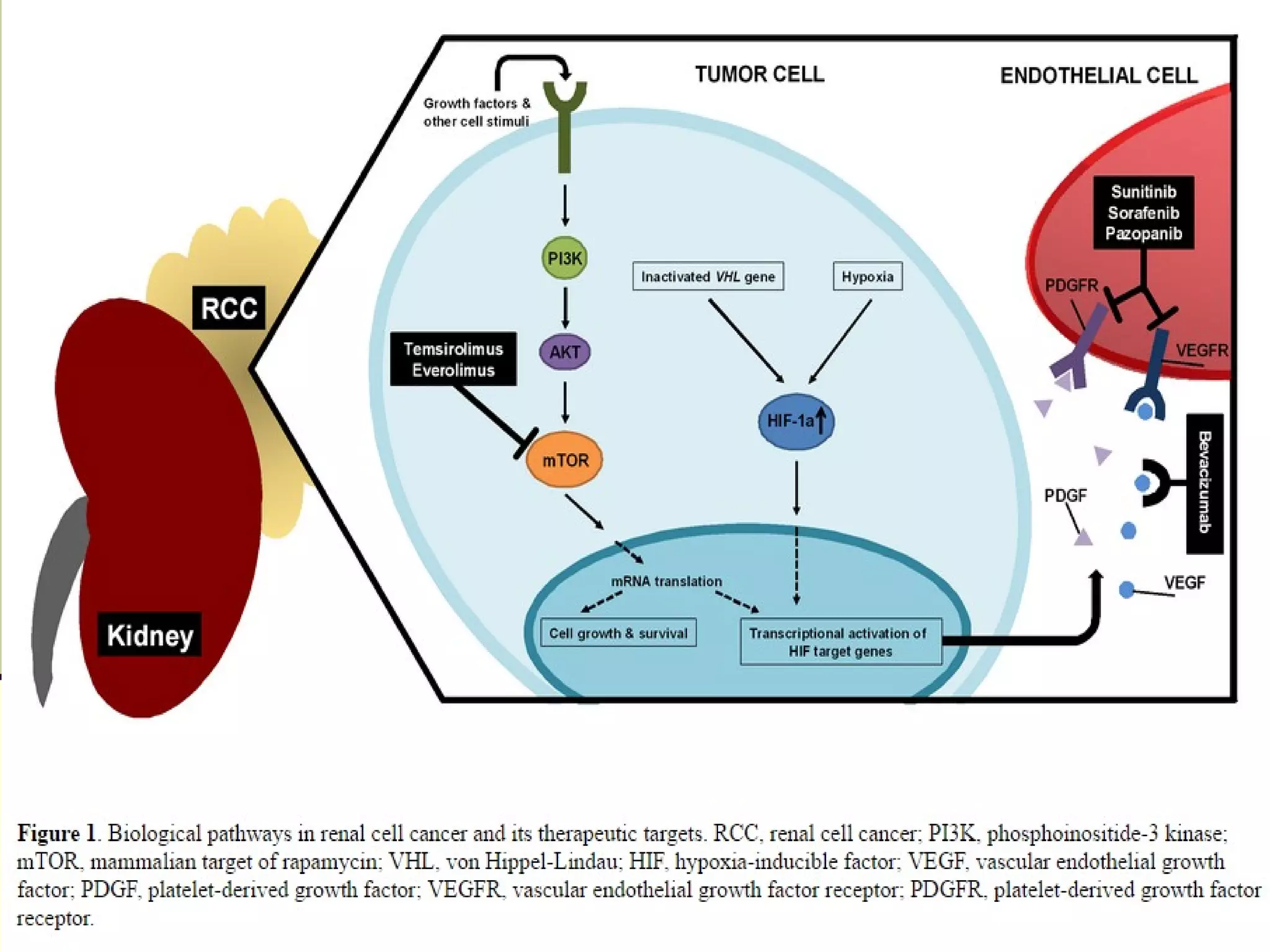
 Signal transduction inhibitors that regulate cell growth, cell
proliferation, protein synthesis, and transcription
 Tyrosine kinase inhibitors
 Sunitinib
 Sorafenib
 Serine/threonine protein kinase inhibitors - MTOR
(mammalian target of rapamycin)
 Temsirolimus
 Everolimus
Renal Cell Carcinoma - Sunitinib
 Oral small molecule TK Inhibitor of Vascular endothelial
growth factor (VEGF) and Platelet derived growth factor
(PDGF)
 First-line for advanced and/or metastatic renal cell carcinoma
 Presented at ASCO in 2006: In a phase 3 study -
 Median progression-free survival: Sunitinib (11 months) vs
Interferon α (5 months)
 Secondary endpoints: 28% of patients had significant
tumor shrinkage with Sunitinib compared to 5% with
Interferon α.
 Patients receiving Sunitinib had a better quality of life than
interferon α.
(N Engl J Med 356 (2): 115–124)
Prognosis  Stage 5-year survival rate
 I 88~100%
 II 60%
 III 15~20%
 IV 0~20%

Renal cell carcinoma

  • 1.
    RENAL CELL CANCER By:Darayus P. Gazder
  • 2.
  • 3.
    CASE REPORT  46YEAR OLD FEMALE, WITH NKCM  C/O PAIN IN THE LEFT LUMBAR REGION SINCE 1 MONTH  She was having difficulty in changes of posture  Pain was radiating to the left leg  PMH: Not significant  PSH: C-section 8 years ago  DH: NKDA  FH: +ve H/O HTN, IHD. No H/O DM, Asthma or Cancers  PH: Having difficulty in sleeping, normal micturition, bowel movements  SH: Housewife. No addictions.  ROS: H/O weight loss and decreased appetite since 3 months
  • 4.
     O/E A 46year old female lying on the bed comfortably well oriented in time, place, person.  Patient was vitally stable A+, J-, C-,K-,L-,E-,D- ABDOMINAL EXAMINATION---- Soft, tenderness in the Left lumbar region. Hard mass felt in the region on abdominal ballottement
  • 5.
    CT SCAN WHOLEABDOMEN WITH NON IONIC CONTRAST (April 4th 2016) A large sharply marginated well circumscribed mass lesion seen arising from posterior aspect of the upper and mid pole of left kidney. Its centrally necrotic and demonstrates enhancement in the arteroportal phase of circulation with washout on delayed imaging, the enhanced vascular channels are seen predominantly encircling the mass peripherally where few collateral channels are also seen along its posterior aspect. It measure 15.4 x 4.8 x 12 cms in (CC, AP, TS) dimensions. Anteriorly: Forward displacement of the renal parenchyma with anterosuperior displacement of pancreatic body and tail. Posteromedially: the posterior abdominal wall Medially: Its abutting the psoas and Quadratus muscles All surrounding fat interfaces are well preserved around this mass with no evidence of any infiltration or invasion Overall findings are suggestive of neoplastic Left renal mass.
  • 6.
    INVESTIGATIONS:  Blood: (April9th 2016)  CBC: Hb:9, PCV: 29, TLC: 5.6, PLT:468  UCE: Normal  LFT: Normal  PT, INR: Normal  Hep Profile: Negative  URINE D/R: Normal (No blood)  CXR: Normal
  • 7.
  • 8.
    Renal Tumor Embolization (April11th 2016)  1 PCV was transfused before the embolization procedure/ Consent was taken, procedure was explained  Right femoral artery approach was used.  Initial angiogram showed a large tumor in left renal region. It showed AV shunting with venous aneurysms.  Subsequently multiple vessels were selectively cannulated and embolization was performed using gelfoam.  Major vascularity was occluded  No complication was seen.
  • 9.
    INVESTIGATIONS:  Patient remainedvitally stable. There was no active issues. She was counselled about surgery and consent was taken.  PRE-OPS: were done  Anesthesia review: ASA GRADE 2 (Patients with mild systemic disease, No functional limitations) 4 PCV’s were arranged
  • 10.
    SURGERY: Left RadicalNephrectomy  Left subcoastal incision was given  Peritoneum was opened  Splenic Flexure of Colon was mobilized  Left renal pedicle was tied  Radical nephrectomy was done  Omentum was packed in the remaining space  Drain was inserted in the renal bed  Patient was transfused with 1 PCV  POST OP ORDERS: - Shift patient to SICU for further workup and management - NPO TFO - Strict I/O charting - Apply TED stockings - Inj R/L @ 125 ml/hr - Inj Cefuroxime 750 mg TDS - Inj Nalbuphine, Metoclopramide - Spirometry 4 hourly - Nebulize with steam and Iprtropium
  • 11.
    SICU Course (April12th )  Patient was received from the OT  She remained vitally stable  Systemic examination was unremarkable  NG by gravity drain  Urine was adequate but was reddish  Was started on Pethidine infusion 50mg in 50mL @5mg/hr
  • 12.
    SICU Day 1(April 13th )  She remained vitally stable CBC: Hb: 8.8, PCV: 27, TLC: 14.5, PLT: 375 UCE: N:138, K:4.8, CL:103, HC:25.8, U:37, Cr:1.15 Ca: 8.96 PT: 13.9 INR: 0.8  NG with gravity drain  Drain: Intact, No output  Dressing was intact, clean  I/O charting was adequate, Urine appeared reddish dark
  • 13.
    SICU Day 2(April 14th )  She developed a temperature spike in the morning and was given Paracetamol 1gm stat.  She developed pain at the site and infusion was increased to 8ml/hr  Drain: Intact, No output  I/O charting was adequate, Urine appeared reddish dark  Later, her NG tube was removed, sips were allowed R/L and Cefuroxime, steam inhalation were continued. Pethidine infusion was stopped, she was started on: - Inj Nalbupheine 10mg TDS - Inj Enoxaparin 60mg OD - Inj Paracetamol 1gm SOS  1 PCV was transfused  Patient was mobilized out of bed  She remained stable and was shifted to the ward
  • 14.
    Ward Course (14th April-12PMonward)  Patient remained stable  Foleys and drain were removed  Patient was mobilized  Dressing was changed  IV fluids were reduced to 75ml/hr and later stopped as patient was orally tolerating - Inj Nalbuphine was tapered to SOS - Inj Paracetamol every 6H - Niflam mouth wash was added SURGERY (T)/ POST OP 9-Apr T 12-Apr 13-Apr T 14-Apr 15-Apr Hb 9 T 8.8 8.3 T 9 Hct 29 T 28 27 T 28 TLC 5.6 T 14.5 12.4 T 11.4 PLT 468 T 375 338 T 309 Urea 24 T 34 T 34 24 Cr 0.86 T 1.18 T 1.11 9.7
  • 15.
    Discharge (April 15th ) Patient was discharged after getting a shower/ COD D/C meds: - Tab Cefuroxime 250 mg 2 Tabs BD - Tab Nuberol forte TDS - Cap Tramadol 50mg SOS (In case of severe pain) - Cap Fefol Vit OD for 1 month  Take daily shower, allowed regular diet  Mobilization, activity as tolerated  Follow up on April 22th with Biopsy report with Urologist.
  • 16.
  • 17.
     3% ofall adult malignancies  M>F, ratio 2:1  50 – 80 years  It is an adenocarcinoma arising from renal tubular cells, most common site is proximal renal tubule.  This noncapsulated tumour is very vascular.  30% presenting with metastatic disease
  • 19.
    BHD=Birt-Hogg-Dubé; FH=fumarate hydratase;VHL=von Hippel-Lindau. Modified from Linehan WM et al. J Urol. 2003;170:2163-2172. Clear cell 75% Type Incidence (%) Associated mutations VHL Papillary type 1 5% c-Met 10% Chromophobe 5% BHD 5% D *2004 WHO lists over 50 different types of kidney cancer (Sarcomatoid variant can occur with any subtype)
  • 20.
    Renal Cell Carcinoma(RCC) – Risk Factors  Smoking Obesity (especially in women) Use of phenacetin analgesics Patients on dialysis, who acquire cystic kidney disease Occupational risk factors  Leather tanning (TCC – dye and textile industry)  Asbestos exposure Genetic risk factors  Von Hippel Lindau disease  Adult polycystic disease
  • 21.
    Renal Cell Carcinoma– Clinical Presentation  Most are asymptomatic until development of metastasis  Classical triad (19% of cases):  LOIN PAIN  FLANK MASS  HAEMATURIA  Fever and sweats /Weight loss / Malaise  Varicocele in 2% of males (due to compression of left renal vein)  Paraneoplastic syndrome  Polycythaemia due to EPO-like molecules  Hypertension due to renin  Hypercalcaemia due to PTH-related peptide  Stauffer syndrome
  • 22.
    Renal Cell Carcinoma- Spread  Local  Adrenal Glands  Renal Veins  Inferior Vena Cava  Gerota’s fascia (anterior to perinephric space)  Perinephric Tissue  Lymphatics  Lymph nodes at renal hilum  Abdominal para-aortic nodes  Paracaval nodes  Blood  Lung  Bone  Soft tissue  Central nervous system
  • 23.
    Renal Cell Carcinoma– Investigations and Staging  CBC, ESR, UCE, LFTs, Calcium levels, UA  CXR or CT chest  U/S, abdomen—size, extension, lymph node involvement, spread to the liver, status of renal vein and IVC.  Thin-slice renal CT scan with and without IV contrast is the best test for diagnosing renal masses  Pharmacoangiogram (Inject noradrenaline along with dye while doing angiogram).  Bone scan to see bone secondary's.  MRI: to evaluate collecting system and IVC involvement
  • 26.
  • 27.
     Surgery  Radiotherapy(used in Palliative setting)  Biological treatment (used in Palliative setting)  (Chemotherapy unhelpful)
  • 28.
  • 29.
    Treatment Disseminated disease:  Nephrectomy---reducing tumor burden  Radiation--- radioresistant tumor, metastases 2/3 effective  Chemotherapy--- <10% effective  Immunotherapy--- IL-2/interferon-alpha, 30% response rate  Molecular therapy---eg. sorafenib
  • 30.
    Renal Cell Carcinoma– Biological Treatment  Cytokine therapy  Interferon α  Interleukin 2  Signal transduction inhibitors that regulate cell growth, cell proliferation, protein synthesis, and transcription  Tyrosine kinase inhibitors  Sunitinib  Sorafenib  Serine/threonine protein kinase inhibitors - MTOR (mammalian target of rapamycin)  Temsirolimus  Everolimus
  • 32.
    Renal Cell Carcinoma- Sunitinib  Oral small molecule TK Inhibitor of Vascular endothelial growth factor (VEGF) and Platelet derived growth factor (PDGF)  First-line for advanced and/or metastatic renal cell carcinoma  Presented at ASCO in 2006: In a phase 3 study -  Median progression-free survival: Sunitinib (11 months) vs Interferon α (5 months)  Secondary endpoints: 28% of patients had significant tumor shrinkage with Sunitinib compared to 5% with Interferon α.  Patients receiving Sunitinib had a better quality of life than interferon α. (N Engl J Med 356 (2): 115–124)
  • 33.
    Prognosis  Stage5-year survival rate  I 88~100%  II 60%  III 15~20%  IV 0~20%

Editor's Notes

  • #7 7-6…….10-11
  • #11 Left subcoastal incision was given Peritoneum was opened Splenic Flexure of Colon was mobilized Left renal pedicle was tied Radical nephrectomy was done Omentum was packed in the remaining space Drain was inserted in the renal bed POST OP ORDERS: -Prop patient up at 45 degrees -Oxygen inhalation -Daily Chest X-ray Treatment: IV Tazocin, Amikacin, Omeprazole.
  • #14 She developed a temperature spike in the morning and was given Falgan 1gm stat. She developed pain at the site and infusion was increased to 8ml/hr Later, her NG tube was removed, sips were allowed R/L and Cefuroxime, steam inhalation were continued. Pethidine infusion was stopped, she was started on: Inj Nalbupheine 10mg TDS Inj Enoxaparin 60mg OD Inj Paracetamol 1gm SOS 1 PCV was transfused Patient was mobilized out of bed and was shifted to the ward
  • #20 Common epithelial neoplasms of the kidney can be either familial or sporadic Mutations in the gene for VHL, c-Met, FH, or BHD are common in both the familial and sporadic forms of kidney neoplasms.1,2 Cases of familial neoplasm arise from inherited germline mutations earlier than cases of sporadic neoplasm. Familial neoplasm requires only one additional mutation to inactivate the gene while sporadic neoplasm requires multiple subsequent mutations in order to inactivate the gene.1 Clear-cell RCC is the predominant histological type (75%).1,2 There are two types of papillary renal cell cancer: Type II is very aggressive; Type I less so. Oncocytoma is no longer considered to be malignant tumor, it is a benign neoplasm.3
  • #24 Ultrasonography Intravenous Urography (IVU): CT scanning: more sensitive, mass+renal hilum, perinephric space and vena cava, adrenals, regional LN and adjacent organs Renal Angiography MRI: to evaluate collecting system and IVC involvement Pharmacoangiogram (Inject noradrenaline along with dye while doing angiogram). As tumour vessels are autonomous they will not constrict whereas adjacent normal vessels will constrict, so tumour blush is visualised.
  • #26 T3: Tumor extends into major veins or directly invades adrenal gland or perinephric tissues but not beyond Gerota&amp;apos;s fascia.   T3a: Tumor directly invades adrenal gland or perinephric tissues (including renal sinus) but not beyond the renal fascia.  T1: Tumor 7 cm or less, limited to the kidney. T1a: Tumor less than 4 cm and limited to the kidney. T1b: Tumor greater than 4 cm and limited to the kidney.  T2: Tumor greater than 7 cm and limited to the kidney. T2 a: Tumor greater than 7 cm and less than 10 cm and limited to the kidney. T2 b: Tumor greater than 10 cm and limited to the kidney. T3: Tumor extends into major veins or directly invades adrenal gland or perinephric tissues but not beyond Gerota&amp;apos;s fascia.   T3a: Tumor directly invades adrenal gland or perinephric tissues (including renal sinus) but not beyond the renal fascia.  T3b: Tumor grossly extends into renal vein(s) or caval vein below diaphragm.  T3c: Tumor grossly extends into caval vein or wall of vena cava above diaphragm.  T4: Tumor directly invades beyond the renal fascia.
  • #29 Radical nephrectomy – removal of kidney, adrenal gland, perirenal fat within gerota’s fascia +/- LN dissection Partial nephrectomy -(NSS) Tumor &amp;lt; 4cm / Bilateral RCCa Solitary kidney / Polar tumor Patients being considered for immunotherapy Arterial embolization Radiofrequency ablation Removal of solitary metastasis