Dr. Darayus P.Gazder
PG R-1
Diabetic ketoacidosis (DKA).
Hyperosmolar hyperglycemic State.
Hypoglycemia.
Diabetic ketoacidosis (DKA) and hyperosmolar hyperglycemic
state (HHS)are two of the most serious acute complications of
diabetes.
DKA=hyperglycemia ,ketosis ,acidosis.
HHS= hyperosmolarity ,hyperglycemia ,altered mental
status.
DKA = 3 letters= triad of D K A
Diabetic
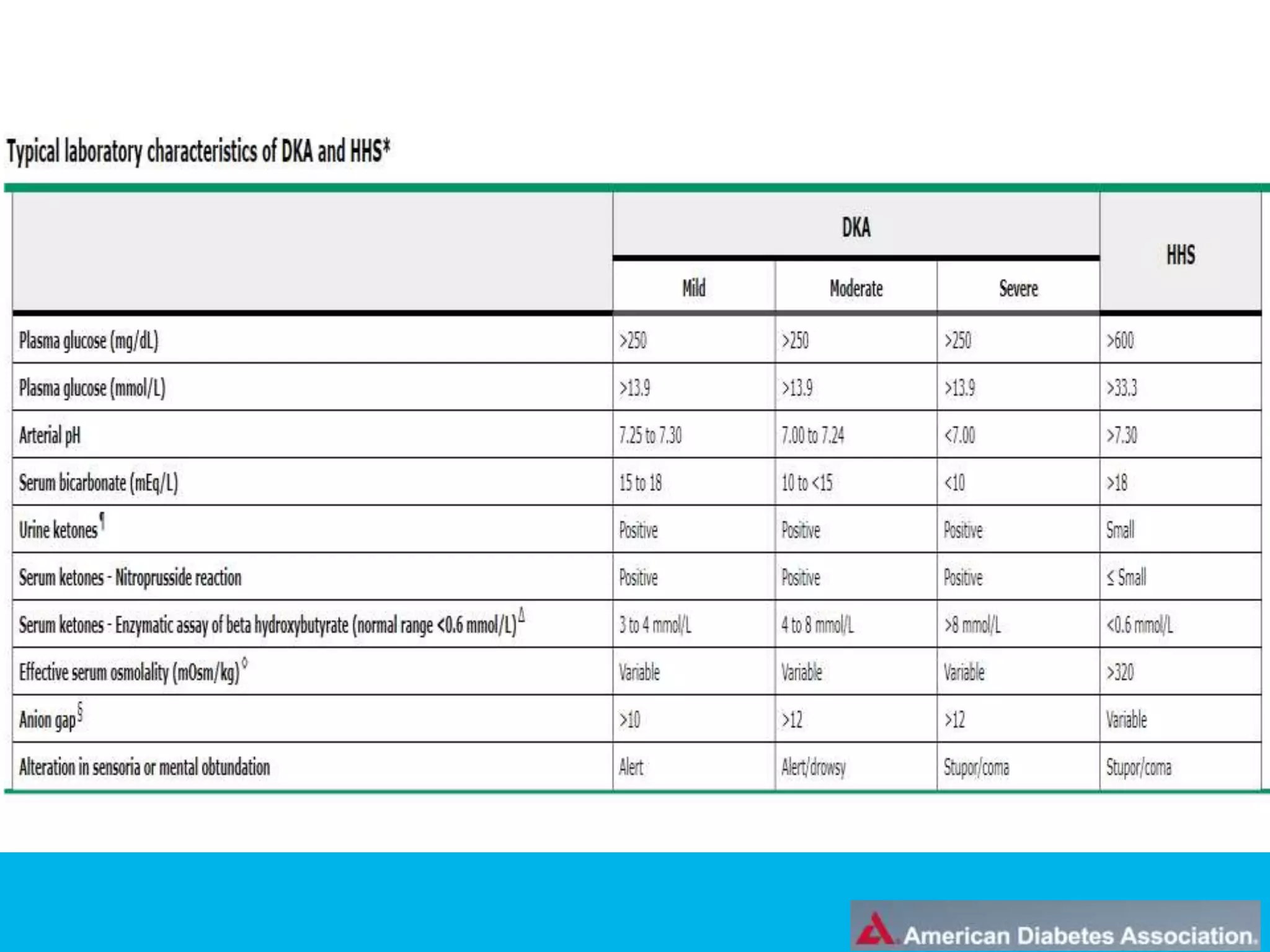
glucose >250 mg/dL
Keto
ketones – both in urine and in serum
acetoacetate, acetone, betahydroxybutyrate
fruity smell.
 If the Ketone level is below 0.6 mmol/L is normal.
The person with a reading above 1.5 mmol/L indicate a greater
risk for developing Ketoacidosis (DKA).
Acidosis
Increased anion gap AG=[(Na)-(Hco3+CL)],metabolic acidosis;
HCO3-
<15, pH<7.30
The normal blood pH is tightly regulated between 7.35 and 7.45.
PATHOLOGY
 Infection i.e. (Pneumonia,
sepsis,UTI)
 Inadequate insulin
 Inadequate water intake
 Infarction (myocardial)
 Intoxication(cocaine)Recurrent DKA
I
 Ischaemic(Stroke)
 injury
 Insult (Emotional)
 Infant(Pregnancy)
 New onset type 1
(20 to 25 %)
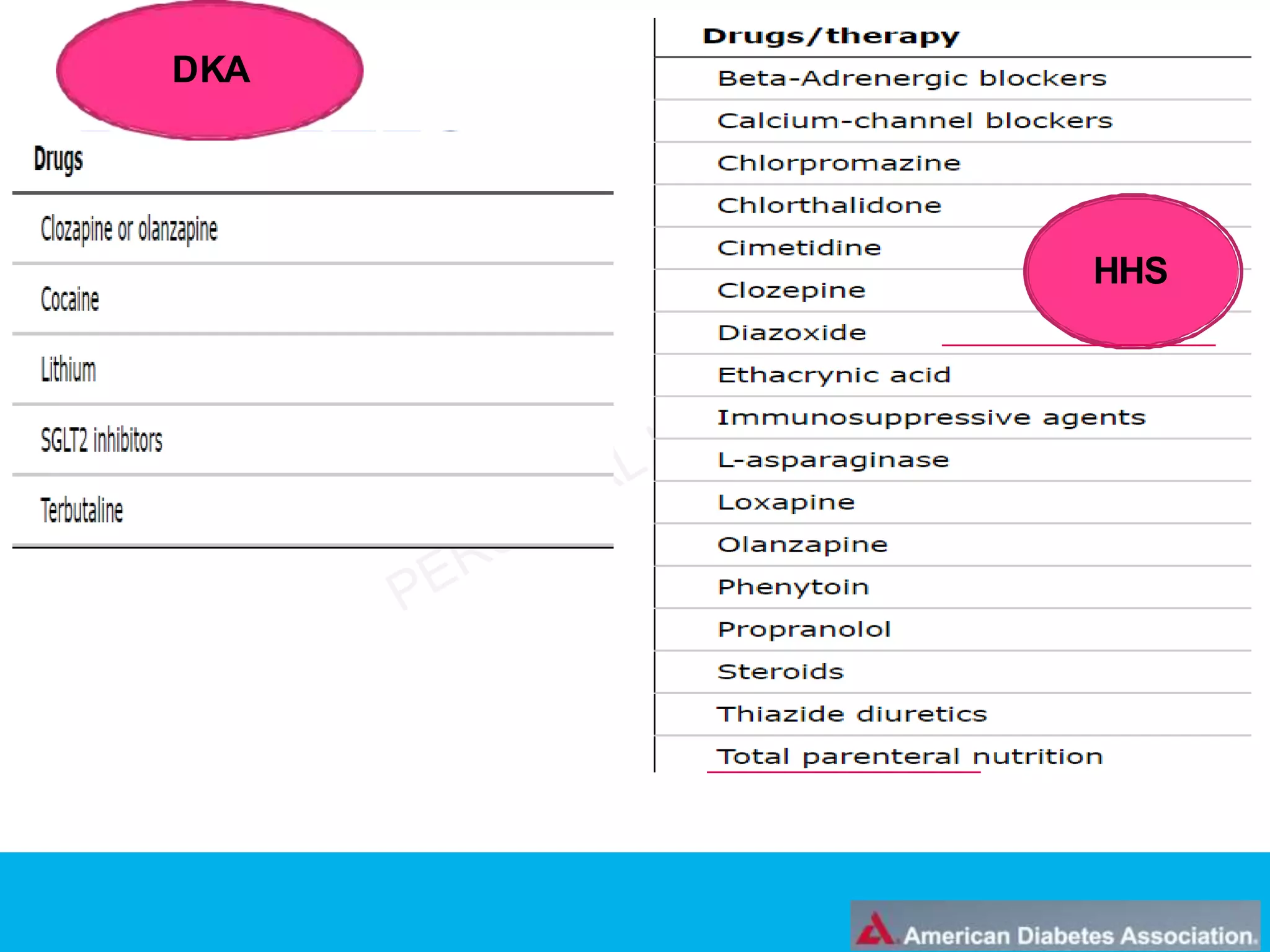
 Drugs.
HHS
DKA
DKA HHS
Age More in children More in elderly
DM type More in type I More in type II
Glucose > 250 > 600
Ketonuria/emia +++++ + or -
pH <7.3 >7.3
HCO3 <15 >15
S osmolarity Variable Hyperosmolarity
Sensitivity to insulin Variable Sensitive to small dose
DKA Hypoglycemia
Etiology Insulin deficiency or
increased counter-reg
hormones
Insulin overdose or
hyperinsulinemia
Onset Gradual Acute
Symptoms and
signs
Sof hyperglycemia
Sof dehydration S
of acidosis
-S of Brain glucopenia
- S ofsympathetic
overactivity
RBS hyperglycemia hypoglycemia
Ketonuria Yes No
Ketonemia Yes No
DIAGNOSTIC EVALUATION
●Airway, breathing, and circulation (ABC) status
●Mental status
●Possible precipitating events (eg, source of infection, myocardial infarction)
●Volume status
Laboratory evaluation :
●Serum glucose
●Serum electrolytes (with calculation of the anion gap), blood urea nitrogen (BUN), and plasma
creatinine
●Complete blood count (CBC) with differential
●Urinalysis and urine ketones by dipstick
●Plasma osmolality
●Serum ketones (if urine ketones are present)
●Arterial blood gas if the serum bicarbonate is substantially reduced or hypoxia is suspected
●Electrocardiogram
For monitoring
RBS :Every 1 hour till RBS reaches 200 mg/dl or less, then
every 6 hours
• Venous ph (for DKA) every two to four hours.
• Direct measurement of beta-
hydroxybutyrate(not urine ketones)
• Electrolytes serum level every 4 hours till
correction
 Fluid deficit 3-6 liters for DKA and 8-10liters in HHS.
Over 24 hours.
 Patients with hypovolemic shock. Isotonic saline as
quickly as possible.
 Patients without shock (and without heart failure),
isotonic saline 15 to 20 ml/kg for the first 2 hours.
TREATMENT:
 Then according to state of hydration, serum
electrolyte levels, and the urine output.
 Measure “corrected” sodium .
 Add dextrose to the saline solution when the
serum glucose reaches
200 mg/dl (11.1 mmol/L) in DKA or
250 to 300 mg/dl (13.9 to 16.7 mmol/L) in HHS
TREATMENT:
P
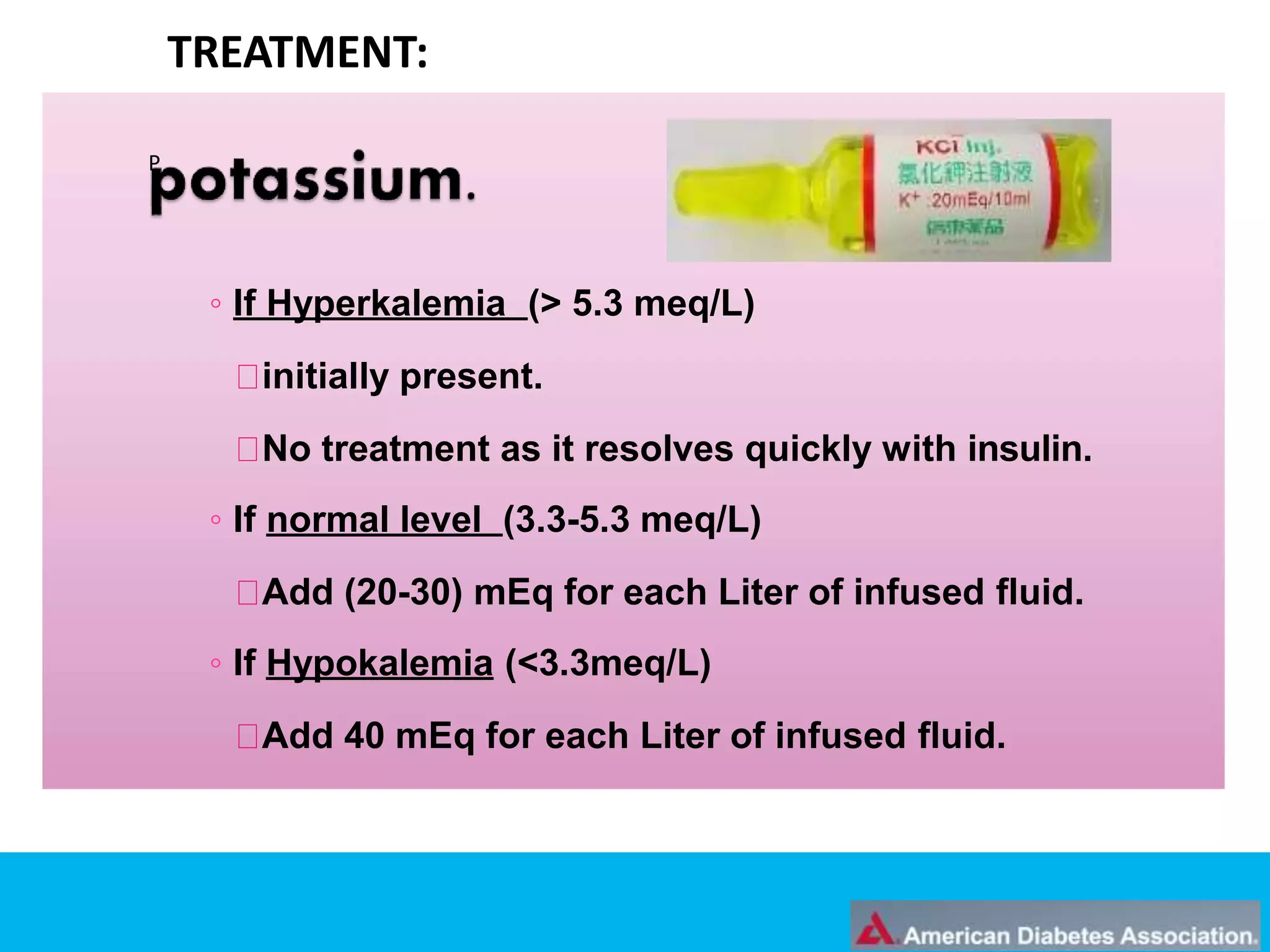
◦ If Hyperkalemia (> 5.3 meq/L)
initially present.
No treatment as it resolves quickly with insulin.
◦ If normal level (3.3-5.3 meq/L)
Add (20-30) mEq for each Liter of infused fluid.
◦ If Hypokalemia (<3.3meq/L)
Add 40 mEq for each Liter of infused fluid.
TREATMENT:
 Bicarbonate given if the arterial PH is less
than 6.90.
 We give 100 meq of sodium
bicarbonate in 400 ml sterile water with
20 meq
of potassium chloride, if the serum
potassium is less than
5.3 meq/L, administered over two
hours.
TREATMENT:
• IV bolus of 0.1 units/kg regular insulin.
• Infusion insulin at 0.1 units/kg/hr
• (Check BG every 1hour.
• ( goal of reduction is 50-80 mg/dl/hr)
When reaches
◦ 200 mg/dL in DKA or 250 to 300 mg/dL in HHS, the
IV saline solution is switched to dextrose in
saline, and decrease the insulin infusion rate to 0.02
to 0.05 U/kg per hour.
TREATMENT:
Plasma glucose is usually high but not
always.
◦ DKA can be present with RBS < 300 dueto
Impaired gluconeogenesis
Liver disease
Acute alcohol ingestion
Prolonged fasting.
Pregnancy.
Ketone (acetoacetic acid by nitroprusside tablets (Acetest)or
reagent sticks (Ketostix) in urine may be –ve in DKA, but
always +ve in blood(betahydroxybuteric acid which is the
predominant ketone)
PERSONAL USE ONLY
Be Aware of Conditions that may
make DKA Diagnosis Difficult
2018 Diabetes Canada CPG – Chapter 15. Hyperglycemic Emergencies in Adults
Conditions that 
bicarbonate (eg.
vomiting)
Pregnancy SGLT2
inhibitor
Significant
osmotic
diuresis
 β-hydroxy
butyrate
Mixed acid-
base so pH
not as low
Normal or mildly 
glucose (euglycemic
DKA)
Loss of keto
anions
Normal
anion gap
Negative
serum
ketones
Order serum
β-hydroxy
butyrate
DKA, diabetic ketoacidosis
. Individuals treated with SGLT2
inhibitors with symptoms of
DKA should be assessed for this
condition even if BG is not
elevated
High WBC may be present without infection.>>>Bandaemia
High creatinine may be present without true renal function(it
may cross react with ketone bodies).
Blood urea may be elevated with prerenal azotemia
secondary to dehydration.
Serum amylase is often raised even in the absence of
pancreatitis.
Creatine kinase and troponin levels mildly increase in
the absence of myocardial damage
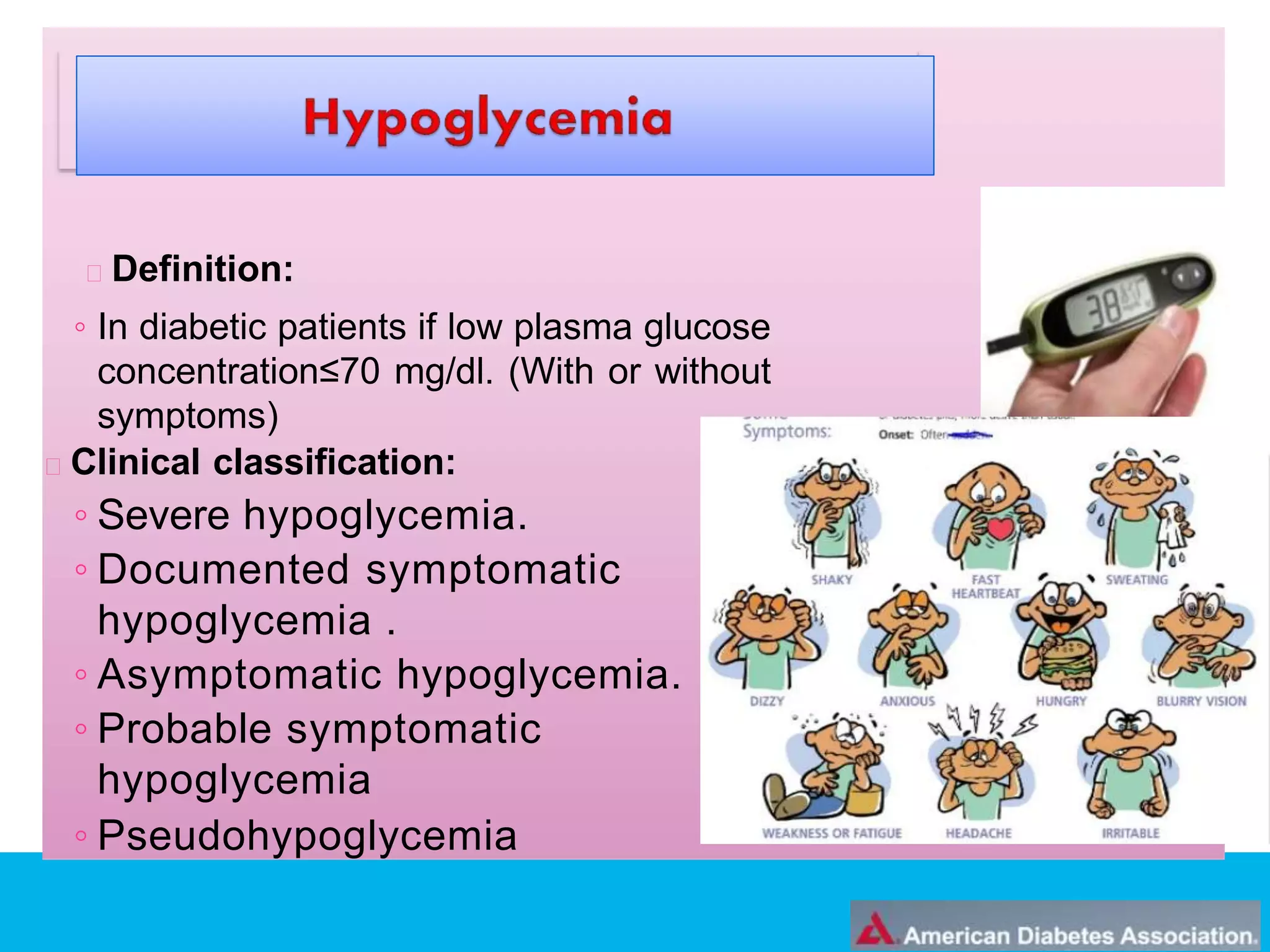
Definition:
◦ In diabetic patients if low plasma glucose
concentration≤70 mg/dl. (With or without
symptoms)
Clinical classification:
◦ Severe hypoglycemia.
◦ Documented symptomatic
hypoglycemia .
◦ Asymptomatic hypoglycemia.
◦ Probable symptomatic
hypoglycemia
◦ Pseudohypoglycemia
Treatment
For asymptomatic or symptomatic hypoglycemia ,ingest
carbohydrates. 15 to 20 grams of oral glucose is
typically sufficient. Glucose may be ingested in the form
of tablets, juice, milk,
glucagon(0.5 to 1.0) mg given as a subcutaneous or
intramuscular injection. If difficult IV access .(or at
home)
EDUCATION .
IV dextrose (25 g of 50 percent glucose [dextrose]) can
be administered to treat hypoglycemia in patients with
impaired consciousness and established IV access
(typically in hospital).
THANK YOU!!

DIABETIC EMERGENCIES- DKA / HONK / HYPOGLYCEMIA

  • 1.
  • 2.
    Diabetic ketoacidosis (DKA). Hyperosmolarhyperglycemic State. Hypoglycemia.
  • 3.
    Diabetic ketoacidosis (DKA)and hyperosmolar hyperglycemic state (HHS)are two of the most serious acute complications of diabetes. DKA=hyperglycemia ,ketosis ,acidosis. HHS= hyperosmolarity ,hyperglycemia ,altered mental status.
  • 5.
    DKA = 3letters= triad of D K A Diabetic glucose >250 mg/dL Keto ketones – both in urine and in serum acetoacetate, acetone, betahydroxybutyrate fruity smell.  If the Ketone level is below 0.6 mmol/L is normal. The person with a reading above 1.5 mmol/L indicate a greater risk for developing Ketoacidosis (DKA). Acidosis Increased anion gap AG=[(Na)-(Hco3+CL)],metabolic acidosis; HCO3- <15, pH<7.30 The normal blood pH is tightly regulated between 7.35 and 7.45.
  • 6.
  • 7.
     Infection i.e.(Pneumonia, sepsis,UTI)  Inadequate insulin  Inadequate water intake  Infarction (myocardial)  Intoxication(cocaine)Recurrent DKA I  Ischaemic(Stroke)  injury  Insult (Emotional)  Infant(Pregnancy)  New onset type 1 (20 to 25 %)  Drugs.
  • 8.
  • 11.
    DKA HHS Age Morein children More in elderly DM type More in type I More in type II Glucose > 250 > 600 Ketonuria/emia +++++ + or - pH <7.3 >7.3 HCO3 <15 >15 S osmolarity Variable Hyperosmolarity Sensitivity to insulin Variable Sensitive to small dose
  • 12.
    DKA Hypoglycemia Etiology Insulindeficiency or increased counter-reg hormones Insulin overdose or hyperinsulinemia Onset Gradual Acute Symptoms and signs Sof hyperglycemia Sof dehydration S of acidosis -S of Brain glucopenia - S ofsympathetic overactivity RBS hyperglycemia hypoglycemia Ketonuria Yes No Ketonemia Yes No
  • 13.
    DIAGNOSTIC EVALUATION ●Airway, breathing,and circulation (ABC) status ●Mental status ●Possible precipitating events (eg, source of infection, myocardial infarction) ●Volume status Laboratory evaluation : ●Serum glucose ●Serum electrolytes (with calculation of the anion gap), blood urea nitrogen (BUN), and plasma creatinine ●Complete blood count (CBC) with differential ●Urinalysis and urine ketones by dipstick ●Plasma osmolality ●Serum ketones (if urine ketones are present) ●Arterial blood gas if the serum bicarbonate is substantially reduced or hypoxia is suspected ●Electrocardiogram
  • 14.
    For monitoring RBS :Every1 hour till RBS reaches 200 mg/dl or less, then every 6 hours • Venous ph (for DKA) every two to four hours. • Direct measurement of beta- hydroxybutyrate(not urine ketones) • Electrolytes serum level every 4 hours till correction
  • 15.
     Fluid deficit3-6 liters for DKA and 8-10liters in HHS. Over 24 hours.  Patients with hypovolemic shock. Isotonic saline as quickly as possible.  Patients without shock (and without heart failure), isotonic saline 15 to 20 ml/kg for the first 2 hours. TREATMENT:
  • 16.
     Then accordingto state of hydration, serum electrolyte levels, and the urine output.  Measure “corrected” sodium .  Add dextrose to the saline solution when the serum glucose reaches 200 mg/dl (11.1 mmol/L) in DKA or 250 to 300 mg/dl (13.9 to 16.7 mmol/L) in HHS TREATMENT:
  • 17.
    P ◦ If Hyperkalemia(> 5.3 meq/L) initially present. No treatment as it resolves quickly with insulin. ◦ If normal level (3.3-5.3 meq/L) Add (20-30) mEq for each Liter of infused fluid. ◦ If Hypokalemia (<3.3meq/L) Add 40 mEq for each Liter of infused fluid. TREATMENT:
  • 18.
     Bicarbonate givenif the arterial PH is less than 6.90.  We give 100 meq of sodium bicarbonate in 400 ml sterile water with 20 meq of potassium chloride, if the serum potassium is less than 5.3 meq/L, administered over two hours. TREATMENT:
  • 19.
    • IV bolusof 0.1 units/kg regular insulin. • Infusion insulin at 0.1 units/kg/hr • (Check BG every 1hour. • ( goal of reduction is 50-80 mg/dl/hr) When reaches ◦ 200 mg/dL in DKA or 250 to 300 mg/dL in HHS, the IV saline solution is switched to dextrose in saline, and decrease the insulin infusion rate to 0.02 to 0.05 U/kg per hour. TREATMENT:
  • 21.
    Plasma glucose isusually high but not always. ◦ DKA can be present with RBS < 300 dueto Impaired gluconeogenesis Liver disease Acute alcohol ingestion Prolonged fasting. Pregnancy. Ketone (acetoacetic acid by nitroprusside tablets (Acetest)or reagent sticks (Ketostix) in urine may be –ve in DKA, but always +ve in blood(betahydroxybuteric acid which is the predominant ketone)
  • 22.
    PERSONAL USE ONLY BeAware of Conditions that may make DKA Diagnosis Difficult 2018 Diabetes Canada CPG – Chapter 15. Hyperglycemic Emergencies in Adults Conditions that  bicarbonate (eg. vomiting) Pregnancy SGLT2 inhibitor Significant osmotic diuresis  β-hydroxy butyrate Mixed acid- base so pH not as low Normal or mildly  glucose (euglycemic DKA) Loss of keto anions Normal anion gap Negative serum ketones Order serum β-hydroxy butyrate DKA, diabetic ketoacidosis . Individuals treated with SGLT2 inhibitors with symptoms of DKA should be assessed for this condition even if BG is not elevated
  • 23.
    High WBC maybe present without infection.>>>Bandaemia High creatinine may be present without true renal function(it may cross react with ketone bodies). Blood urea may be elevated with prerenal azotemia secondary to dehydration. Serum amylase is often raised even in the absence of pancreatitis. Creatine kinase and troponin levels mildly increase in the absence of myocardial damage
  • 24.
    Definition: ◦ In diabeticpatients if low plasma glucose concentration≤70 mg/dl. (With or without symptoms) Clinical classification: ◦ Severe hypoglycemia. ◦ Documented symptomatic hypoglycemia . ◦ Asymptomatic hypoglycemia. ◦ Probable symptomatic hypoglycemia ◦ Pseudohypoglycemia
  • 25.
    Treatment For asymptomatic orsymptomatic hypoglycemia ,ingest carbohydrates. 15 to 20 grams of oral glucose is typically sufficient. Glucose may be ingested in the form of tablets, juice, milk, glucagon(0.5 to 1.0) mg given as a subcutaneous or intramuscular injection. If difficult IV access .(or at home) EDUCATION . IV dextrose (25 g of 50 percent glucose [dextrose]) can be administered to treat hypoglycemia in patients with impaired consciousness and established IV access (typically in hospital).
  • 26.

Editor's Notes

  • #10 Abdominal pain It is more common in children, unusual in HHS It is multifactorial Metabolic acidosis. Not hyperglycamiea.?pancreatitis Delayed gastric emptying. Ileus from electrolyte disturbances It sometimes mimicks acute abdomen.
  • #12 DKA usually evolves rapidly over a 24-hour period.Common, early signs of ketoacidosis include nausea, vomiting, abdominal pain, and hyperventilation. The earliest symptoms of marked hyperglycemia are polyuria, polydipsia, and weight loss.As hyperglycemia worsens, neurologic symptoms appear and may progress to include lethargy, focal deficits, obtundation, seizure, and coma.