DR NILESH KATE
MBBS,MD
ASSOCIATE PROF
ESIC MEDICAL COLLEGE, GULBARGA.
DEPT. OF PHYSIOLOGY
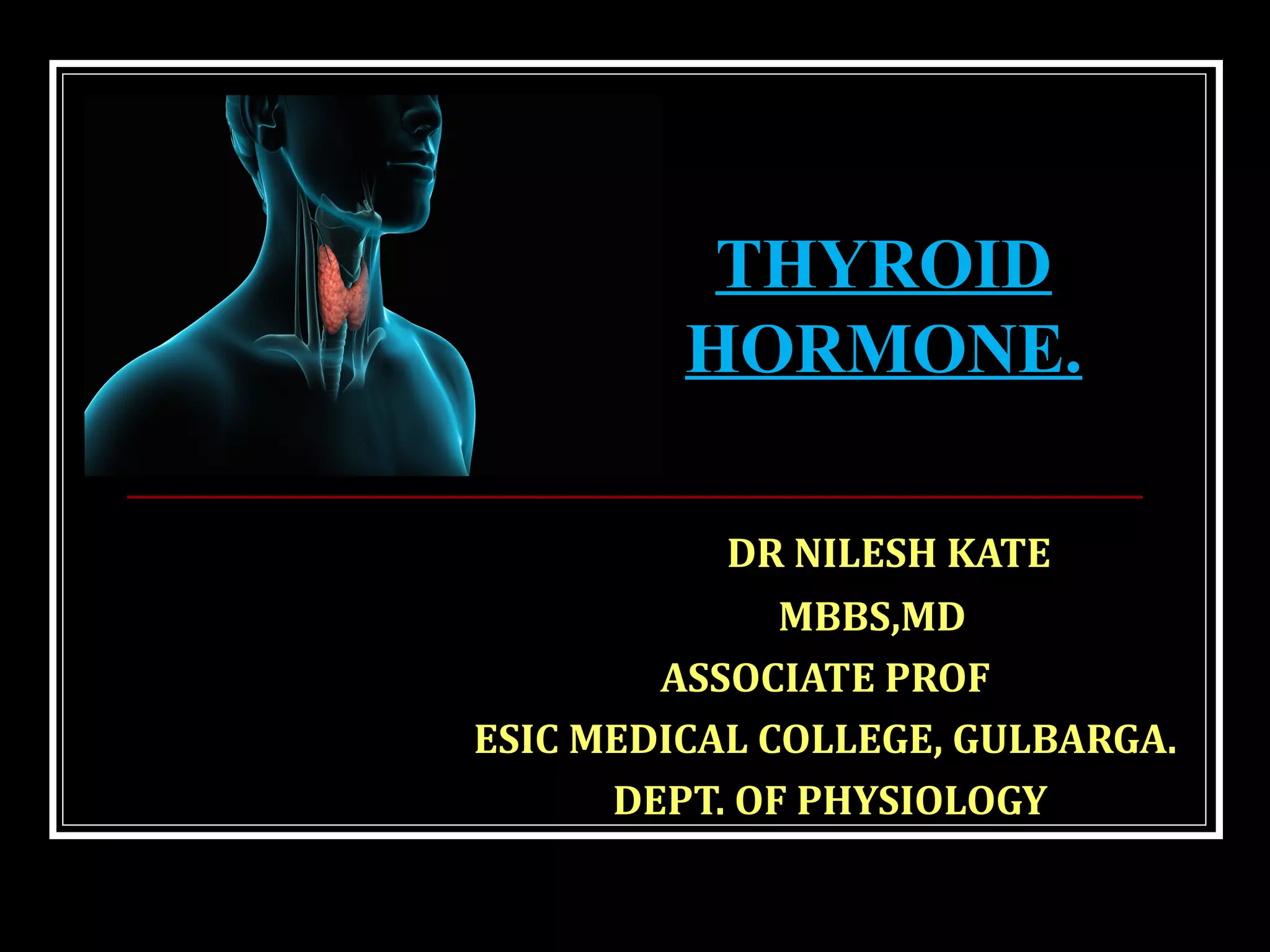
THYROID
HORMONE.
OBJECTIVES.
 Functional Anatomy.
 Gross anatomy
 Histological structure
 Thyroid hormones
 Biosynthesis & Storage
 Secretion, transport & Metabolism.
 Regulation of thyroid hormone secretion.
 Applied aspects
 Hyperthyroidism
 Hypothyroidism.
FUNCTIONAL ANATOMY.
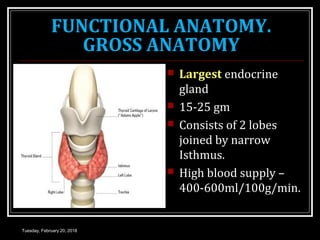
GROSS ANATOMY
 Largest endocrine
gland
 15-25 gm
 Consists of 2 lobes
joined by narrow
Isthmus.
 High blood supply –
400-600ml/100g/min.
Tuesday, February 20, 2018
HISTOLOGICAL STRUCTURE
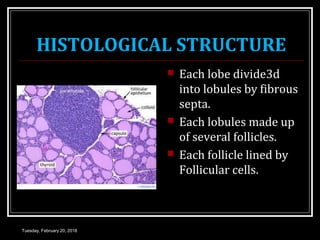
 Each lobe divide3d
into lobules by fibrous
septa.
 Each lobules made up
of several follicles.
 Each follicle lined by
Follicular cells.
Tuesday, February 20, 2018
HISTOLOGICAL STRUCTURE
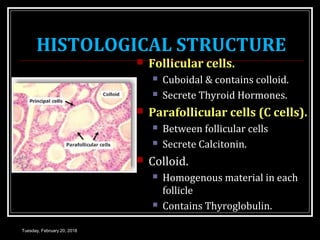
 Follicular cells.
 Cuboidal & contains colloid.
 Secrete Thyroid Hormones.
 Parafollicular cells (C cells).
 Between follicular cells
 Secrete Calcitonin.
 Colloid.
 Homogenous material in each
follicle
 Contains Thyroglobulin.
Tuesday, February 20, 2018
THYROID HORMONES
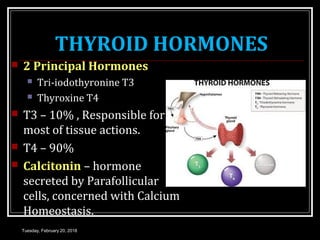
 2 Principal Hormones
 Tri-iodothyronine T3
 Thyroxine T4
 T3 – 10% , Responsible for
most of tissue actions.
 T4 – 90%
 Calcitonin – hormone
secreted by Parafollicular
cells, concerned with Calcium
Homeostasis.
Tuesday, February 20, 2018
IODINE METABOLISM
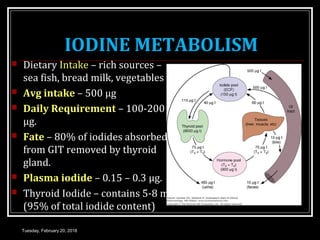
 Dietary Intake – rich sources –
sea fish, bread milk, vegetables
 Avg intake – 500 μg
 Daily Requirement – 100-200
μg.
 Fate – 80% of iodides absorbed
from GIT removed by thyroid
gland.
 Plasma iodide – 0.15 – 0.3 μg.
 Thyroid Iodide – contains 5-8 mg.
(95% of total iodide content)
Tuesday, February 20, 2018
THYROID HORMONES
BIOSYNTHESIS & STORAGE
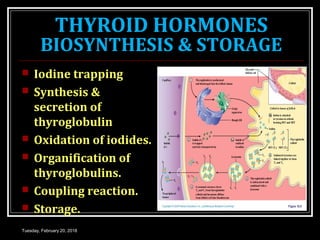
 Iodine trapping
 Synthesis &
secretion of
thyroglobulin
 Oxidation of iodides.
 Organification of
thyroglobulins.
 Coupling reaction.
 Storage.
Tuesday, February 20, 2018
IODINE TRAPPING
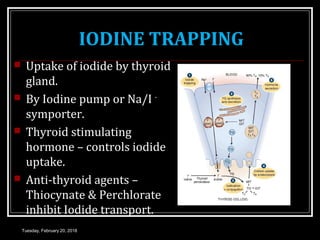
 Uptake of iodide by thyroid
gland.
 By Iodine pump or Na/I –
symporter.
 Thyroid stimulating
hormone – controls iodide
uptake.
 Anti-thyroid agents –
Thiocynate & Perchlorate
inhibit Iodide transport.
Tuesday, February 20, 2018
SYNTHESIS & SECRETION OF
THYROGLOBULIN
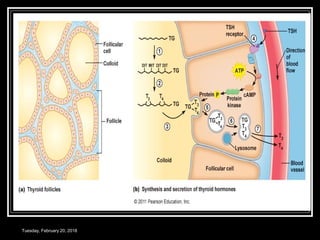
 Thyroglobulin – large Glycoprotein synthesized in
rough endoplasmic reticulum of thyroid epithelial
cells & then released into lumen.
 1 molecule of Thyroglobulin contains – 140
thyrosine residue which is a substrate for iodine for
thyroid hormone synthesis.
Tuesday, February 20, 2018
OXIDATION OF IODIDES.
 Once inside gland iodide is taken into lumen by
transporter – Pendrin.
 Then iodide is oxidised to Iodine by enzyme
Peroxidase.
Tuesday, February 20, 2018
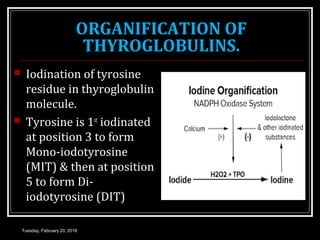
ORGANIFICATION OF
THYROGLOBULINS.
 Iodination of tyrosine
residue in thyroglobulin
molecule.
 Tyrosine is 1st
iodinated
at position 3 to form
Mono-iodotyrosine
(MIT) & then at position
5 to form Di-
iodotyrosine (DIT)
Tuesday, February 20, 2018
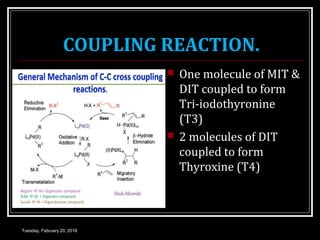
COUPLING REACTION.
 One molecule of MIT &
DIT coupled to form
Tri-iodothyronine
(T3)
 2 molecules of DIT
coupled to form
Thyroxine (T4)
Tuesday, February 20, 2018
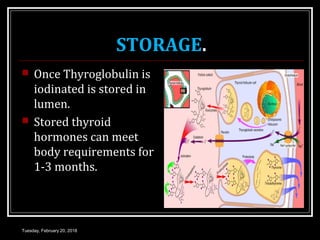
STORAGE.
 Once Thyroglobulin is
iodinated is stored in
lumen.
 Stored thyroid
hormones can meet
body requirements for
1-3 months.
Tuesday, February 20, 2018
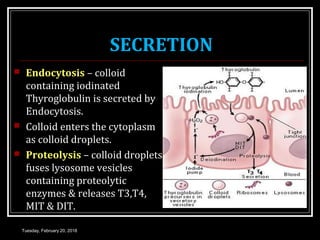
SECRETION
 Endocytosis – colloid
containing iodinated
Thyroglobulin is secreted by
Endocytosis.
 Colloid enters the cytoplasm
as colloid droplets.
 Proteolysis – colloid droplets
fuses lysosome vesicles
containing proteolytic
enzymes & releases T3,T4,
MIT & DIT.
Tuesday, February 20, 2018
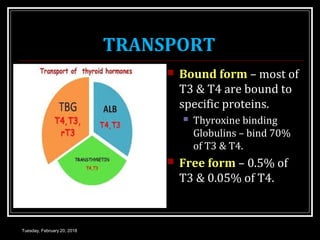
TRANSPORT
 Bound form – most of
T3 & T4 are bound to
specific proteins.
 Thyroxine binding
Globulins – bind 70%
of T3 & T4.
 Free form – 0.5% of
T3 & 0.05% of T4.
Tuesday, February 20, 2018
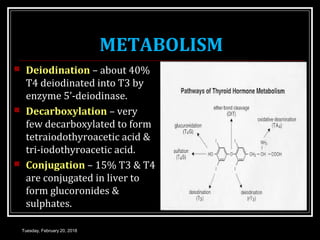
METABOLISM
 Deiodination – about 40%
T4 deiodinated into T3 by
enzyme 5’-deiodinase.
 Decarboxylation – very
few decarboxylated to form
tetraiodothyroacetic acid &
tri-iodothyroacetic acid.
 Conjugation – 15% T3 & T4
are conjugated in liver to
form glucoronides &
sulphates.
Tuesday, February 20, 2018
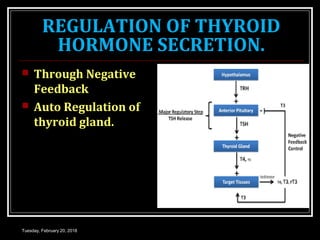
REGULATION OF THYROID
HORMONE SECRETION.
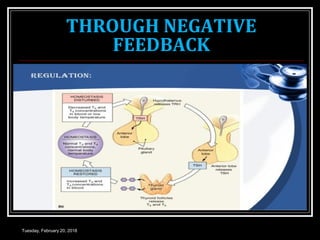
 Through Negative
Feedback
 Auto Regulation of
thyroid gland.
Tuesday, February 20, 2018
THROUGH NEGATIVE
FEEDBACK
Tuesday, February 20, 2018
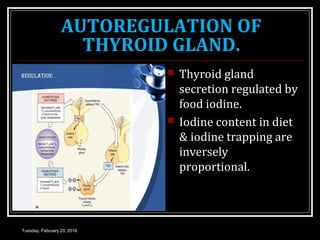
AUTOREGULATION OF
THYROID GLAND.
 Thyroid gland
secretion regulated by
food iodine.
 Iodine content in diet
& iodine trapping are
inversely
proportional.
Tuesday, February 20, 2018
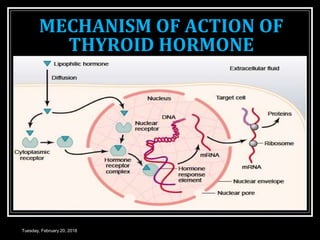
MECHANISM OF ACTION OF
THYROID HORMONE
Tuesday, February 20, 2018
ACTIONS OF THYROID
HORMONE
 Effect on growth & tissue
development.
 Effect on metabolic rate in general.
 Effects on metabolism.
 Carbohydrate
 Fats
 Proteins
 Vitamins
 Respiratory effects.
 Cardiovascular effects.
 Effects on nervous system
 Development
 Functioning of nervous tissue
 Effects on GIT.
 Effects on reproductive system
 Effects on other endocrine
glands.
 Effects on kidney.
Tuesday, February 20, 2018
EFFECT ON GROWTH & TISSUE
DEVELOPMENT.
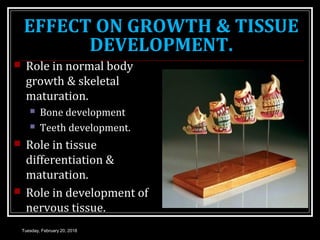
 Role in normal body
growth & skeletal
maturation.
 Bone development
 Teeth development.
 Role in tissue
differentiation &
maturation.
 Role in development of
nervous tissue.
Tuesday, February 20, 2018
EFFECT ON METABOLIC RATE
IN GENERAL.
 Stimulate metabolic
activities
 Increases basal rate of
oxygen consumption
and heat production.
Tuesday, February 20, 2018
EFFECTS ON METABOLISM.
 Carbohydrate – increase glucose absorption & metabolism.
 Fats – Mobilization of fats from adipose tissue 7 decreases
plasma cholesterol levels.
 Proteins – Physiologically anabolic effect & in high conc
catabolic effect.
 Vitamins – increases quantity of enzymes so causes vitamin
deficiency.
Tuesday, February 20, 2018
RESPIRATORY EFFECTS.
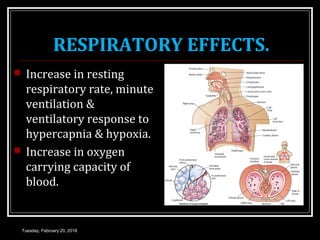
 Increase in resting
respiratory rate, minute
ventilation &
ventilatory response to
hypercapnia & hypoxia.
 Increase in oxygen
carrying capacity of
blood.
Tuesday, February 20, 2018
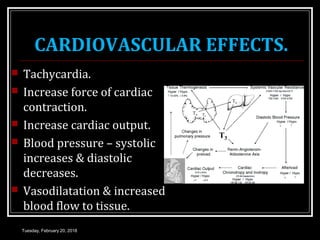
CARDIOVASCULAR EFFECTS.
 Tachycardia.
 Increase force of cardiac
contraction.
 Increase cardiac output.
 Blood pressure – systolic
increases & diastolic
decreases.
 Vasodilatation & increased
blood flow to tissue.
Tuesday, February 20, 2018
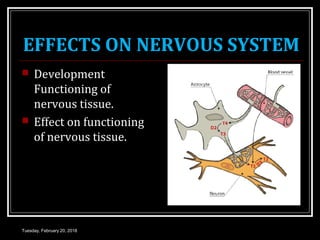
EFFECTS ON NERVOUS SYSTEM
 Development
Functioning of
nervous tissue.
 Effect on functioning
of nervous tissue.
Tuesday, February 20, 2018
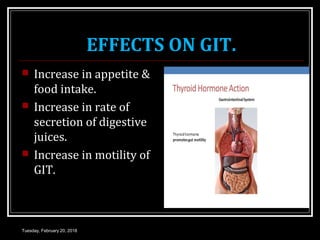
EFFECTS ON GIT.
 Increase in appetite &
food intake.
 Increase in rate of
secretion of digestive
juices.
 Increase in motility of
GIT.
Tuesday, February 20, 2018
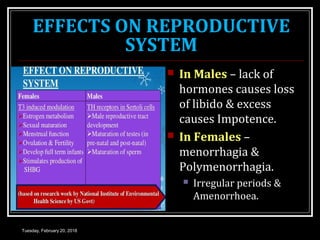
EFFECTS ON REPRODUCTIVE
SYSTEM
 In Males – lack of
hormones causes loss
of libido & excess
causes Impotence.
 In Females –
menorrhagia &
Polymenorrhagia.
 Irregular periods &
Amenorrhoea.
Tuesday, February 20, 2018
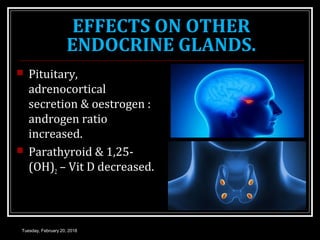
EFFECTS ON OTHER
ENDOCRINE GLANDS.
 Pituitary,
adrenocortical
secretion & oestrogen :
androgen ratio
increased.
 Parathyroid & 1,25-
(OH)2 – Vit D decreased.
Tuesday, February 20, 2018
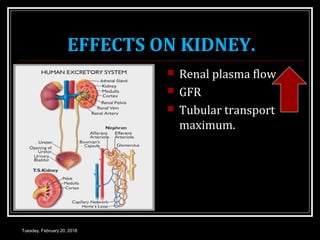
EFFECTS ON KIDNEY.
 Renal plasma flow
 GFR
 Tubular transport
maximum.
Tuesday, February 20, 2018
APPLIED ASPECTS
 Hyperthyroidism
Hypothyroidism.
Tuesday, February 20, 2018
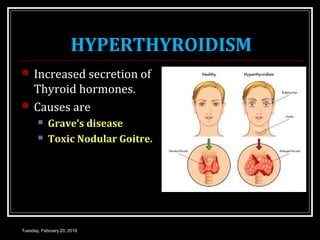
HYPERTHYROIDISM
 Increased secretion of
Thyroid hormones.
 Causes are
 Grave’s disease
 Toxic Nodular Goitre.
Tuesday, February 20, 2018
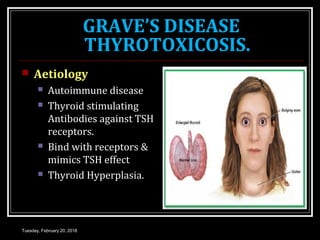
GRAVE’S DISEASE
THYROTOXICOSIS.
 Aetiology
 Autoimmune disease
 Thyroid stimulating
Antibodies against TSH
receptors.
 Bind with receptors &
mimics TSH effect
 Thyroid Hyperplasia.
Tuesday, February 20, 2018
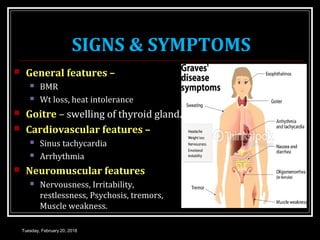
SIGNS & SYMPTOMS
 General features –
 BMR
 Wt loss, heat intolerance
 Goitre – swelling of thyroid gland.
 Cardiovascular features –
 Sinus tachycardia
 Arrhythmia
 Neuromuscular features
 Nervousness, Irritability,
restlessness, Psychosis, tremors,
Muscle weakness.
Tuesday, February 20, 2018
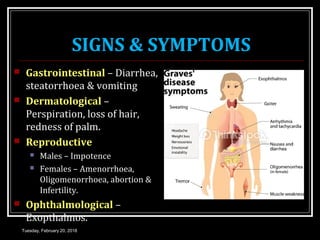
SIGNS & SYMPTOMS
 Gastrointestinal – Diarrhea,
steatorrhoea & vomiting
 Dermatological –
Perspiration, loss of hair,
redness of palm.
 Reproductive
 Males – Impotence
 Females – Amenorrhoea,
Oligomenorrhoea, abortion &
Infertility.
 Ophthalmological –
Exopthalmos.
Tuesday, February 20, 2018
INVESTIGATIONS
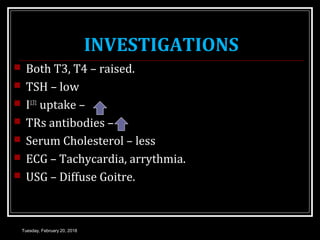
 Both T3, T4 – raised.
 TSH – low
 I131
uptake –
 TRs antibodies –
 Serum Cholesterol – less
 ECG – Tachycardia, arrythmia.
 USG – Diffuse Goitre.
Tuesday, February 20, 2018
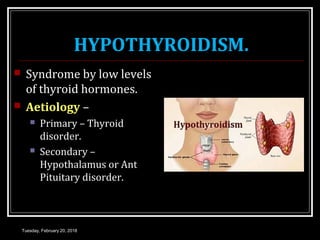
HYPOTHYROIDISM.
 Syndrome by low levels
of thyroid hormones.
 Aetiology –
 Primary – Thyroid
disorder.
 Secondary –
Hypothalamus or Ant
Pituitary disorder.
Tuesday, February 20, 2018
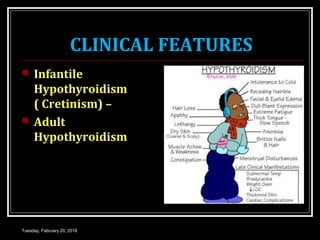
CLINICAL FEATURES
 Infantile
Hypothyroidism
( Cretinism) –
 Adult
Hypothyroidism
Tuesday, February 20, 2018
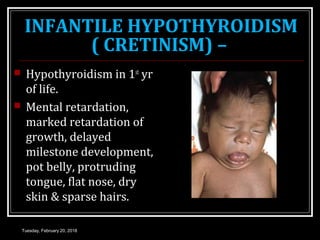
INFANTILE HYPOTHYROIDISM
( CRETINISM) –
 Hypothyroidism in 1st
yr
of life.
 Mental retardation,
marked retardation of
growth, delayed
milestone development,
pot belly, protruding
tongue, flat nose, dry
skin & sparse hairs.
Tuesday, February 20, 2018
ADULT HYPOTHYROIDISM
(MYXODEMA)
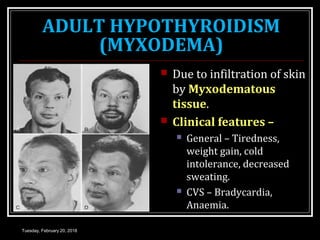
 Due to infiltration of skin
by Myxodematous
tissue.
 Clinical features –
 General – Tiredness,
weight gain, cold
intolerance, decreased
sweating.
 CVS – Bradycardia,
Anaemia.
Tuesday, February 20, 2018
ADULT HYPOTHYROIDISM
(MYXODEMA)
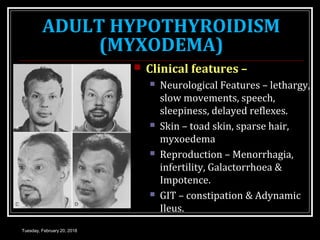
 Clinical features –
 Neurological Features – lethargy,
slow movements, speech,
sleepiness, delayed reflexes.
 Skin – toad skin, sparse hair,
myxoedema
 Reproduction – Menorrhagia,
infertility, Galactorrhoea &
Impotence.
 GIT – constipation & Adynamic
Ileus.
Tuesday, February 20, 2018
GOITRE
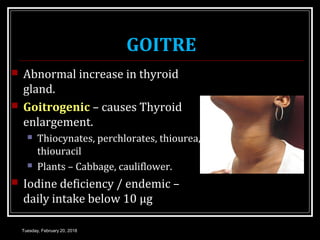
 Abnormal increase in thyroid
gland.
 Goitrogenic – causes Thyroid
enlargement.
 Thiocynates, perchlorates, thiourea,
thiouracil
 Plants – Cabbage, cauliflower.
 Iodine deficiency / endemic –
daily intake below 10 μg
Tuesday, February 20, 2018
THYROID FUNCTION TESTS
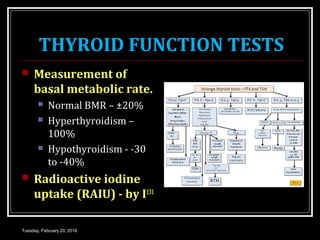
 Measurement of
basal metabolic rate.
 Normal BMR – ±20%
 Hyperthyroidism –
100%
 Hypothyroidism - -30
to -40%
 Radioactive iodine
uptake (RAIU) - by I131
Tuesday, February 20, 2018
THYROID FUNCTION TESTS
 Normal value 20-40%
 Hyperthyroidism –
60%
 Hypothyroidism –
20%
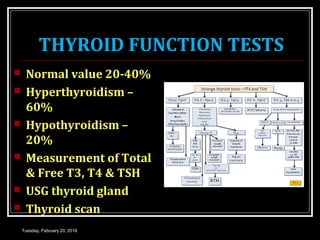
 Measurement of Total
& Free T3, T4 & TSH
 USG thyroid gland
 Thyroid scan
Tuesday, February 20, 2018
THYROID FUNCTION TESTS
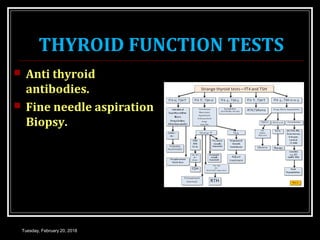
 Anti thyroid
antibodies.
 Fine needle aspiration
Biopsy.
Tuesday, February 20, 2018
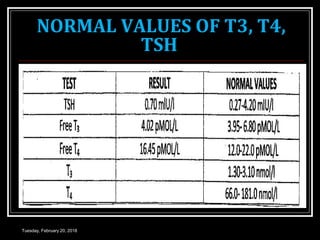
NORMAL VALUES OF T3, T4,
TSH
Tuesday, February 20, 2018
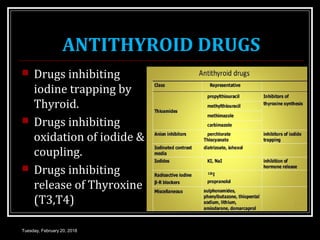
ANTITHYROID DRUGS
 Drugs inhibiting
iodine trapping by
Thyroid.
 Drugs inhibiting
oxidation of iodide &
coupling.
 Drugs inhibiting
release of Thyroxine
(T3,T4)
Tuesday, February 20, 2018
THANK
YOU

THYROID HORMONE

  • 1.
    DR NILESH KATE MBBS,MD ASSOCIATEPROF ESIC MEDICAL COLLEGE, GULBARGA. DEPT. OF PHYSIOLOGY THYROID HORMONE.
  • 2.
    OBJECTIVES.  Functional Anatomy. Gross anatomy  Histological structure  Thyroid hormones  Biosynthesis & Storage  Secretion, transport & Metabolism.  Regulation of thyroid hormone secretion.  Applied aspects  Hyperthyroidism  Hypothyroidism.
  • 3.
    FUNCTIONAL ANATOMY. GROSS ANATOMY Largest endocrine gland  15-25 gm  Consists of 2 lobes joined by narrow Isthmus.  High blood supply – 400-600ml/100g/min. Tuesday, February 20, 2018
  • 4.
    HISTOLOGICAL STRUCTURE  Eachlobe divide3d into lobules by fibrous septa.  Each lobules made up of several follicles.  Each follicle lined by Follicular cells. Tuesday, February 20, 2018
  • 5.
    HISTOLOGICAL STRUCTURE  Follicularcells.  Cuboidal & contains colloid.  Secrete Thyroid Hormones.  Parafollicular cells (C cells).  Between follicular cells  Secrete Calcitonin.  Colloid.  Homogenous material in each follicle  Contains Thyroglobulin. Tuesday, February 20, 2018
  • 6.
    THYROID HORMONES  2Principal Hormones  Tri-iodothyronine T3  Thyroxine T4  T3 – 10% , Responsible for most of tissue actions.  T4 – 90%  Calcitonin – hormone secreted by Parafollicular cells, concerned with Calcium Homeostasis. Tuesday, February 20, 2018
  • 7.
    IODINE METABOLISM  DietaryIntake – rich sources – sea fish, bread milk, vegetables  Avg intake – 500 μg  Daily Requirement – 100-200 μg.  Fate – 80% of iodides absorbed from GIT removed by thyroid gland.  Plasma iodide – 0.15 – 0.3 μg.  Thyroid Iodide – contains 5-8 mg. (95% of total iodide content) Tuesday, February 20, 2018
  • 8.
    THYROID HORMONES BIOSYNTHESIS &STORAGE  Iodine trapping  Synthesis & secretion of thyroglobulin  Oxidation of iodides.  Organification of thyroglobulins.  Coupling reaction.  Storage. Tuesday, February 20, 2018
  • 9.
    IODINE TRAPPING  Uptakeof iodide by thyroid gland.  By Iodine pump or Na/I – symporter.  Thyroid stimulating hormone – controls iodide uptake.  Anti-thyroid agents – Thiocynate & Perchlorate inhibit Iodide transport. Tuesday, February 20, 2018
  • 10.
    SYNTHESIS & SECRETIONOF THYROGLOBULIN  Thyroglobulin – large Glycoprotein synthesized in rough endoplasmic reticulum of thyroid epithelial cells & then released into lumen.  1 molecule of Thyroglobulin contains – 140 thyrosine residue which is a substrate for iodine for thyroid hormone synthesis. Tuesday, February 20, 2018
  • 11.
  • 12.
    OXIDATION OF IODIDES. Once inside gland iodide is taken into lumen by transporter – Pendrin.  Then iodide is oxidised to Iodine by enzyme Peroxidase. Tuesday, February 20, 2018
  • 13.
    ORGANIFICATION OF THYROGLOBULINS.  Iodinationof tyrosine residue in thyroglobulin molecule.  Tyrosine is 1st iodinated at position 3 to form Mono-iodotyrosine (MIT) & then at position 5 to form Di- iodotyrosine (DIT) Tuesday, February 20, 2018
  • 14.
    COUPLING REACTION.  Onemolecule of MIT & DIT coupled to form Tri-iodothyronine (T3)  2 molecules of DIT coupled to form Thyroxine (T4) Tuesday, February 20, 2018
  • 15.
    STORAGE.  Once Thyroglobulinis iodinated is stored in lumen.  Stored thyroid hormones can meet body requirements for 1-3 months. Tuesday, February 20, 2018
  • 16.
    SECRETION  Endocytosis –colloid containing iodinated Thyroglobulin is secreted by Endocytosis.  Colloid enters the cytoplasm as colloid droplets.  Proteolysis – colloid droplets fuses lysosome vesicles containing proteolytic enzymes & releases T3,T4, MIT & DIT. Tuesday, February 20, 2018
  • 17.
    TRANSPORT  Bound form– most of T3 & T4 are bound to specific proteins.  Thyroxine binding Globulins – bind 70% of T3 & T4.  Free form – 0.5% of T3 & 0.05% of T4. Tuesday, February 20, 2018
  • 18.
    METABOLISM  Deiodination –about 40% T4 deiodinated into T3 by enzyme 5’-deiodinase.  Decarboxylation – very few decarboxylated to form tetraiodothyroacetic acid & tri-iodothyroacetic acid.  Conjugation – 15% T3 & T4 are conjugated in liver to form glucoronides & sulphates. Tuesday, February 20, 2018
  • 19.
    REGULATION OF THYROID HORMONESECRETION.  Through Negative Feedback  Auto Regulation of thyroid gland. Tuesday, February 20, 2018
  • 20.
  • 21.
    AUTOREGULATION OF THYROID GLAND. Thyroid gland secretion regulated by food iodine.  Iodine content in diet & iodine trapping are inversely proportional. Tuesday, February 20, 2018
  • 22.
    MECHANISM OF ACTIONOF THYROID HORMONE Tuesday, February 20, 2018
  • 23.
    ACTIONS OF THYROID HORMONE Effect on growth & tissue development.  Effect on metabolic rate in general.  Effects on metabolism.  Carbohydrate  Fats  Proteins  Vitamins  Respiratory effects.  Cardiovascular effects.  Effects on nervous system  Development  Functioning of nervous tissue  Effects on GIT.  Effects on reproductive system  Effects on other endocrine glands.  Effects on kidney. Tuesday, February 20, 2018
  • 24.
    EFFECT ON GROWTH& TISSUE DEVELOPMENT.  Role in normal body growth & skeletal maturation.  Bone development  Teeth development.  Role in tissue differentiation & maturation.  Role in development of nervous tissue. Tuesday, February 20, 2018
  • 25.
    EFFECT ON METABOLICRATE IN GENERAL.  Stimulate metabolic activities  Increases basal rate of oxygen consumption and heat production. Tuesday, February 20, 2018
  • 26.
    EFFECTS ON METABOLISM. Carbohydrate – increase glucose absorption & metabolism.  Fats – Mobilization of fats from adipose tissue 7 decreases plasma cholesterol levels.  Proteins – Physiologically anabolic effect & in high conc catabolic effect.  Vitamins – increases quantity of enzymes so causes vitamin deficiency. Tuesday, February 20, 2018
  • 27.
    RESPIRATORY EFFECTS.  Increasein resting respiratory rate, minute ventilation & ventilatory response to hypercapnia & hypoxia.  Increase in oxygen carrying capacity of blood. Tuesday, February 20, 2018
  • 28.
    CARDIOVASCULAR EFFECTS.  Tachycardia. Increase force of cardiac contraction.  Increase cardiac output.  Blood pressure – systolic increases & diastolic decreases.  Vasodilatation & increased blood flow to tissue. Tuesday, February 20, 2018
  • 29.
    EFFECTS ON NERVOUSSYSTEM  Development Functioning of nervous tissue.  Effect on functioning of nervous tissue. Tuesday, February 20, 2018
  • 30.
    EFFECTS ON GIT. Increase in appetite & food intake.  Increase in rate of secretion of digestive juices.  Increase in motility of GIT. Tuesday, February 20, 2018
  • 31.
    EFFECTS ON REPRODUCTIVE SYSTEM In Males – lack of hormones causes loss of libido & excess causes Impotence.  In Females – menorrhagia & Polymenorrhagia.  Irregular periods & Amenorrhoea. Tuesday, February 20, 2018
  • 32.
    EFFECTS ON OTHER ENDOCRINEGLANDS.  Pituitary, adrenocortical secretion & oestrogen : androgen ratio increased.  Parathyroid & 1,25- (OH)2 – Vit D decreased. Tuesday, February 20, 2018
  • 33.
    EFFECTS ON KIDNEY. Renal plasma flow  GFR  Tubular transport maximum. Tuesday, February 20, 2018
  • 34.
  • 35.
    HYPERTHYROIDISM  Increased secretionof Thyroid hormones.  Causes are  Grave’s disease  Toxic Nodular Goitre. Tuesday, February 20, 2018
  • 36.
    GRAVE’S DISEASE THYROTOXICOSIS.  Aetiology Autoimmune disease  Thyroid stimulating Antibodies against TSH receptors.  Bind with receptors & mimics TSH effect  Thyroid Hyperplasia. Tuesday, February 20, 2018
  • 37.
    SIGNS & SYMPTOMS General features –  BMR  Wt loss, heat intolerance  Goitre – swelling of thyroid gland.  Cardiovascular features –  Sinus tachycardia  Arrhythmia  Neuromuscular features  Nervousness, Irritability, restlessness, Psychosis, tremors, Muscle weakness. Tuesday, February 20, 2018
  • 38.
    SIGNS & SYMPTOMS Gastrointestinal – Diarrhea, steatorrhoea & vomiting  Dermatological – Perspiration, loss of hair, redness of palm.  Reproductive  Males – Impotence  Females – Amenorrhoea, Oligomenorrhoea, abortion & Infertility.  Ophthalmological – Exopthalmos. Tuesday, February 20, 2018
  • 39.
    INVESTIGATIONS  Both T3,T4 – raised.  TSH – low  I131 uptake –  TRs antibodies –  Serum Cholesterol – less  ECG – Tachycardia, arrythmia.  USG – Diffuse Goitre. Tuesday, February 20, 2018
  • 40.
    HYPOTHYROIDISM.  Syndrome bylow levels of thyroid hormones.  Aetiology –  Primary – Thyroid disorder.  Secondary – Hypothalamus or Ant Pituitary disorder. Tuesday, February 20, 2018
  • 41.
    CLINICAL FEATURES  Infantile Hypothyroidism (Cretinism) –  Adult Hypothyroidism Tuesday, February 20, 2018
  • 42.
    INFANTILE HYPOTHYROIDISM ( CRETINISM)–  Hypothyroidism in 1st yr of life.  Mental retardation, marked retardation of growth, delayed milestone development, pot belly, protruding tongue, flat nose, dry skin & sparse hairs. Tuesday, February 20, 2018
  • 43.
    ADULT HYPOTHYROIDISM (MYXODEMA)  Dueto infiltration of skin by Myxodematous tissue.  Clinical features –  General – Tiredness, weight gain, cold intolerance, decreased sweating.  CVS – Bradycardia, Anaemia. Tuesday, February 20, 2018
  • 44.
    ADULT HYPOTHYROIDISM (MYXODEMA)  Clinicalfeatures –  Neurological Features – lethargy, slow movements, speech, sleepiness, delayed reflexes.  Skin – toad skin, sparse hair, myxoedema  Reproduction – Menorrhagia, infertility, Galactorrhoea & Impotence.  GIT – constipation & Adynamic Ileus. Tuesday, February 20, 2018
  • 45.
    GOITRE  Abnormal increasein thyroid gland.  Goitrogenic – causes Thyroid enlargement.  Thiocynates, perchlorates, thiourea, thiouracil  Plants – Cabbage, cauliflower.  Iodine deficiency / endemic – daily intake below 10 μg Tuesday, February 20, 2018
  • 46.
    THYROID FUNCTION TESTS Measurement of basal metabolic rate.  Normal BMR – ±20%  Hyperthyroidism – 100%  Hypothyroidism - -30 to -40%  Radioactive iodine uptake (RAIU) - by I131 Tuesday, February 20, 2018
  • 47.
    THYROID FUNCTION TESTS Normal value 20-40%  Hyperthyroidism – 60%  Hypothyroidism – 20%  Measurement of Total & Free T3, T4 & TSH  USG thyroid gland  Thyroid scan Tuesday, February 20, 2018
  • 48.
    THYROID FUNCTION TESTS Anti thyroid antibodies.  Fine needle aspiration Biopsy. Tuesday, February 20, 2018
  • 49.
    NORMAL VALUES OFT3, T4, TSH Tuesday, February 20, 2018
  • 50.
    ANTITHYROID DRUGS  Drugsinhibiting iodine trapping by Thyroid.  Drugs inhibiting oxidation of iodide & coupling.  Drugs inhibiting release of Thyroxine (T3,T4) Tuesday, February 20, 2018
  • 51.

Editor's Notes