Dr. Dinesh. M.G
Professor of Surgery
J.J.M.M.C.
Davangere
Pituitary gland
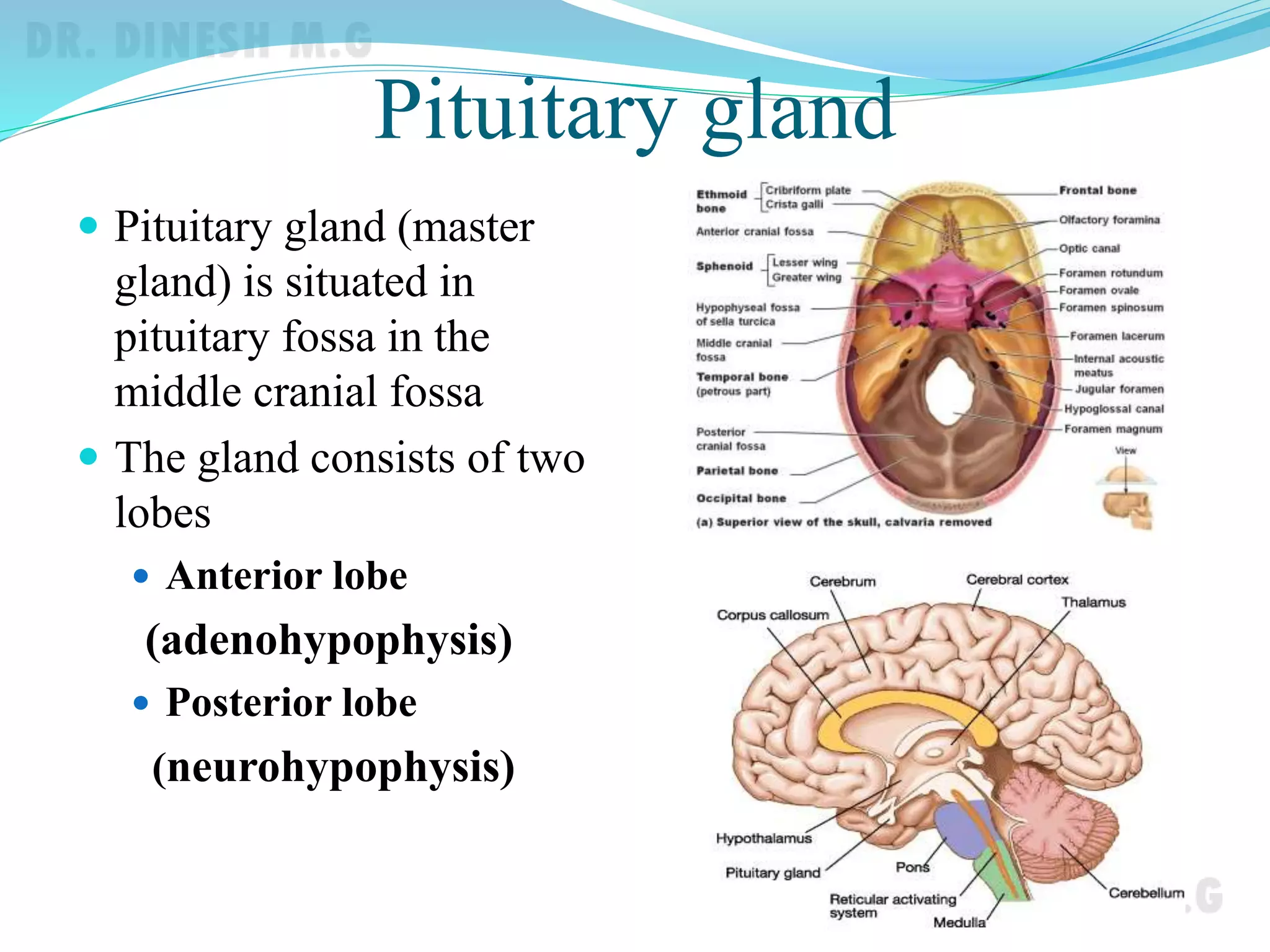
 Pituitary gland (master
gland) is situated in
pituitary fossa in the
middle cranial fossa
 The gland consists of two
lobes
 Anterior lobe
(adenohypophysis)
 Posterior lobe
(neurohypophysis)
Pituitary-anterior lobe
 It is an ectodermal derivative
formed from Rathke’s pouch
 The cells of anterior pituitary
secrete
 Growth hormone(GH)
 Prolactin
 ACTH & MSH(melanocyte
stimulating hormone)
 Thyroid stimulating
hormone(TSH)
 Follicle stimulating
hormone(FSH) & Leutinising
hormone(LH)
These functions are under the
indirect control of hypothalamus
through stimulatory & inhibitory
factors which reach the anterior
lobe through capillary flow
Pituitary-posterior lobe
 Develops as a diverticulum
from the floor of diencephalon
 Made of mainly interlacing
nerve fibres
 The nerve fibres contain
granules of neuro-secretory
material which secrete
 Vasopressin or antidiuretic
hormone(ADH)
 Oxytocin
Both these hormones are
produced by neuro-secretary
cells of hypothalamus but are
stored in cells of posterior
pituitary
Hormones of anterior pituitary
 Growth Hormone(GH)
 Regulation of body growth via liver by secreting growth factors
which help in chondrogenesis, skeletal growth, protein synthesis
& cell proliferation
 Prolactin
 Helps in milk production during lactation
 ACTH
 Regulates secretion from adrenal cortex of its corticosteroids
 TSH(Thyroid Stimulating Hormone)
 Regulates secretion of thyroid hormones from thyroid
 FSH & LH(ICSH)
 Also known as gonadotropic hormones
 Regulate production of estrogens and progesterone & induce
ovulation from ovaries
 Regulate production of testosterone from testis by acting on
interstitial cells of Leydig and help in maturation of sperms
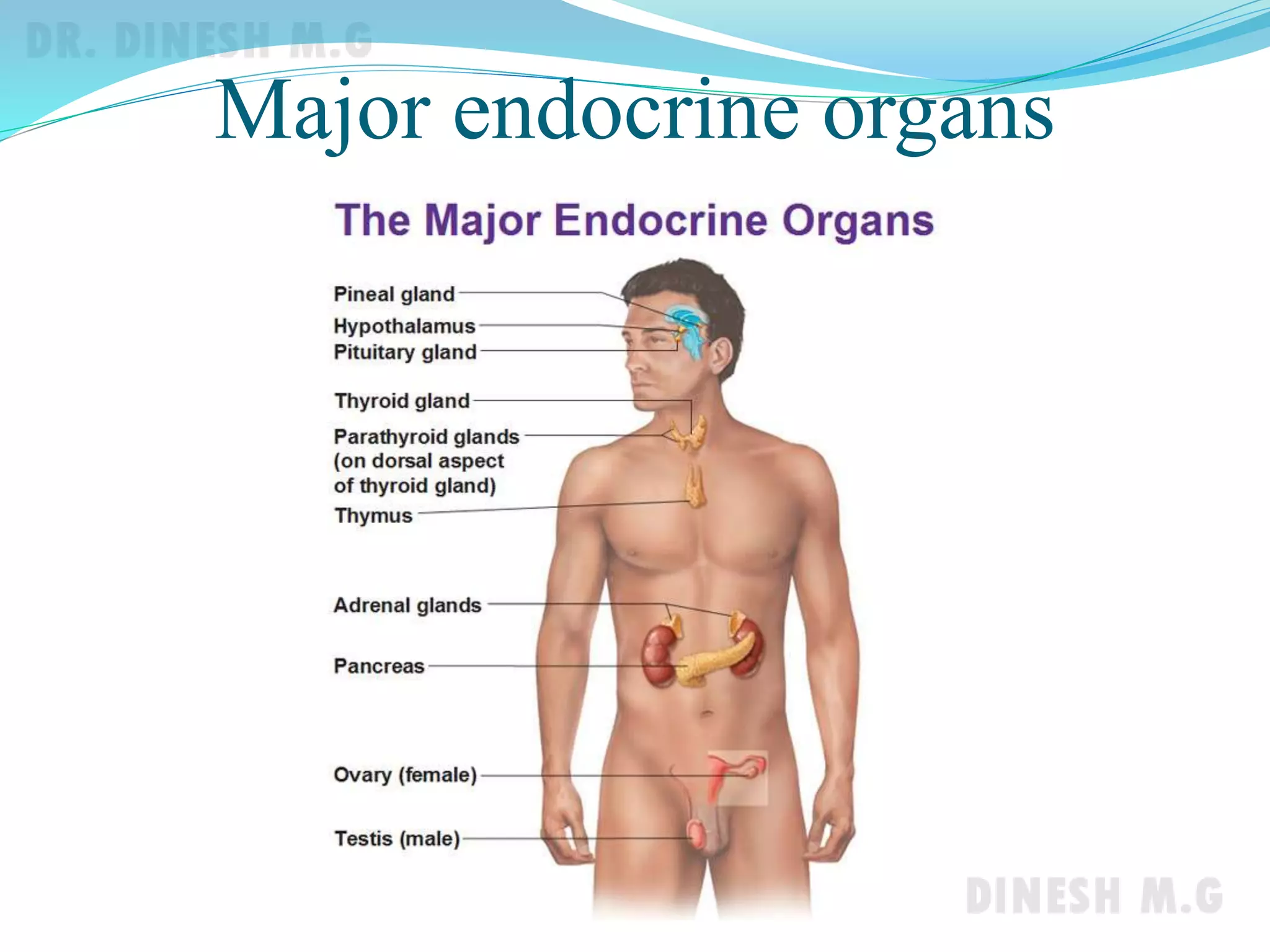
Major endocrine organs
Hormones of posterior pituitary
 ADH(Anti diuretic hormone)
 Causes reabsorption of water from the renal tubules &
maintains the osmolality of plasma
 Oxytocin
 Acts on myoepithelial cells of breast helping propulsion of
milk during lactation
 Contraction of uterine muscles during delivery
Diseases of pituitary
 Hyperpituitarism
 Over secretion of one or more pituitary hormones
 A disease of anterior or posterior pituitary/ hypothalamus
 Hypopituitarism
 Decreased secretion of one or more pituitary hormones
 A disease of anterior or posterior pituitary/ hypothalamus
 Pituitary tumours
Hyperpituitarism
 For all practical purposes, hyper function of anterior
pituitary is due to a hormone secreting adenoma or rarely
a carcinoma
 Heperfunction of anterior pituitary
 Gigantism and Acromegaly
 Hyperprolactinemia
 Cushing’s syndrome
Gigantism and Acromegaly
 Occur because of sustained
excess of growth hormone
Gigantism occurs prior to
closure of epiphysis in pre-
pubertal boys and girls
 Excessive and proportionate
growth of child
 Considerable increase in height
and thickening of bone
Acromegaly occurs in adults
following cessation of bone
growth
 Enlargement of hands and feet
 Coarseness of facial features
 Prominent supraorbital ridges
 Prominent lower jaw producing
prognathism
Hyperpituitarism
Hyperprolactinaemia
 Excess production of prolactin
 In females it produces amenorrhea-
galactorrhea syndrome
 Infertility
 Milk secretion not related to pregnancy or
puerperium
 In males it may cause impotence
Cushing’s syndrome
 Excess secretion of ACTH
 Central or trunkal obesity with thin arms
and legs, moon face
 Wasting & thinning of skeletal muscle,
atrophy of skin and subcutaneous tissue
 Osteoporosis
 Hypertension . Diabetes mellitus
 Amenorrhoea, hirsuitism and infertility
 Insomnia, depression, confusion and
psychosis
Hyperpituitarism
 Hyperfunctioning of posterior pituitary
 Inappropriate release of ADH
Hypopituitarism
Hypofunction of anterior pituitary
 Occurs when more than 75% destruction of anterior lobe by
pituitary lesion or adjacent lesion
Two important syndromes in this are
 Panhypopituitarism
 Pituitary dwarfism: Severe deficiency of growth hormone
in children before growth is completed
 Pituitary adenoma, craniopharyngioma, infarction of pituitary
 Clinical features
 Normal mental age but proportionate retardation of bone growth
 Poorly developed genitalia
 Delayed puberty
Hypopituitarism
Hypofunction of posterior pituitary and hypothalamus
 Diabetes insipidus due to deficiency of ADH
 Polyuria(large volume with low specific gravity)
 Polydypsia
Pituitary tumours
 Account for 10-15% of all intra-
cranial tumours
 Majority are benign adenomas
 Carcinomas, primary or metastatic
are rare
 Clinical features are produced by
pressure effects or endocrine
dysfunction
 Pressure effects on optic
chiasma(bitemporal hemianopia)
 Dysfunction of cranial nerves
III, IV & VI
 Endocrine dysfunction
 Prolactinoma
 Corticotroph adenoma causing
Cushing’s syndrome
 Somatotroph adenoma causing
acromegaly or gigantism
Pituitary tumours
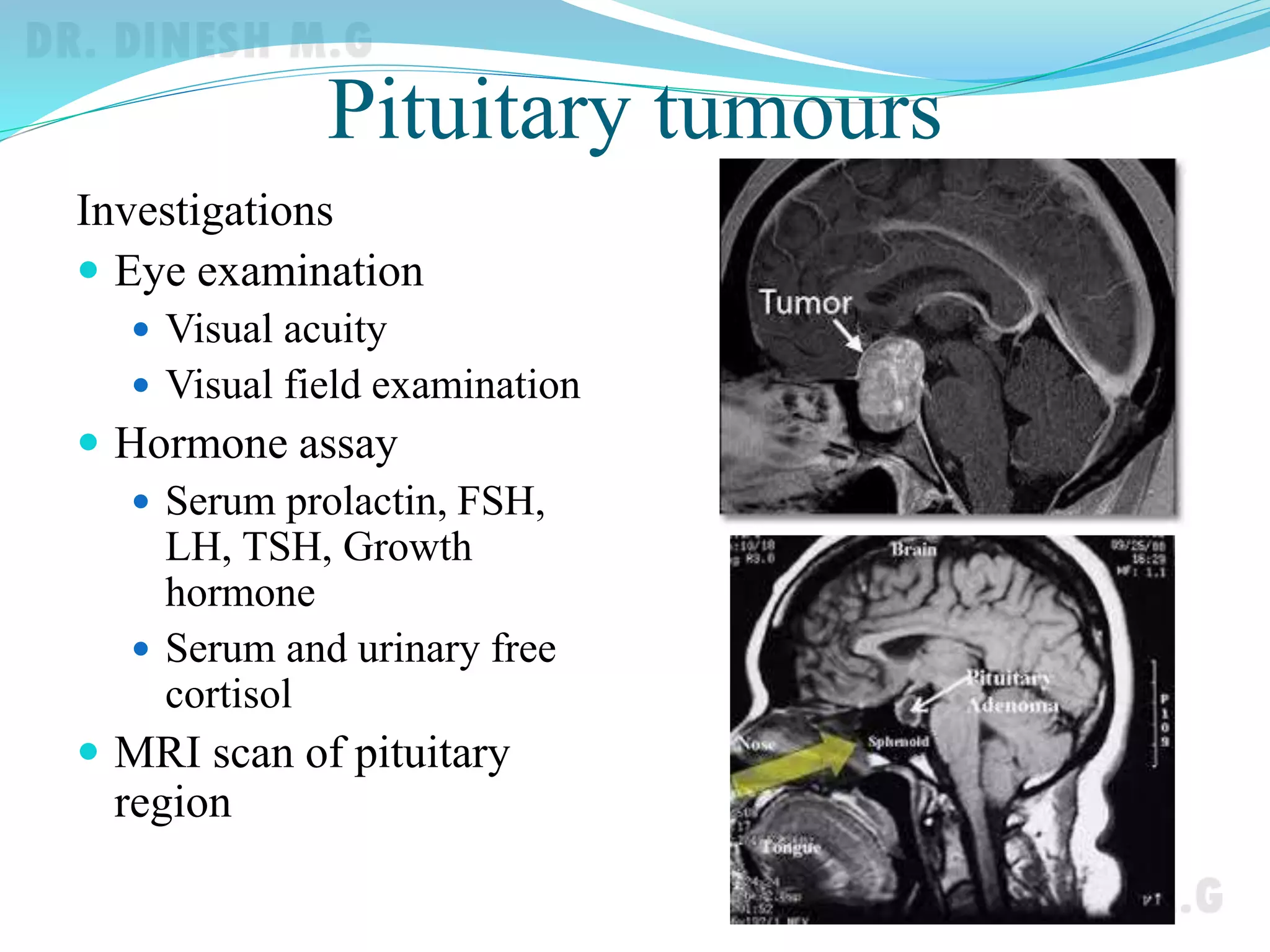
Investigations
 Eye examination
 Visual acuity
 Visual field examination
 Hormone assay
 Serum prolactin, FSH,
LH, TSH, Growth
hormone
 Serum and urinary free
cortisol
 MRI scan of pituitary
region
Pituitary tumours
Treatment
 Medical
 Prolactinoma is treated by bromocriptine
 Growth hormone secreting tumour is treated by octreotide
or dopamine agonist
 Surgical
 First line of treatment in corticotroph & thyrotroph adenoma
 For prolactinoma and growth hormone secreting adenomas
not responding to medical treatment
Pituitary tumours
 Trans-sphenoidal surgery
using operating
microscope.
 Nowadays endoscope is
being used instead of
operating microscope. The
approach is through nostril
and it cause minimal
lateral damage
 Radiotherapy is given in
case surgery is not
possible or for recurrence
after surgery
Thank you

Pituitary gland

  • 1.
    Dr. Dinesh. M.G Professorof Surgery J.J.M.M.C. Davangere
  • 2.
    Pituitary gland  Pituitarygland (master gland) is situated in pituitary fossa in the middle cranial fossa  The gland consists of two lobes  Anterior lobe (adenohypophysis)  Posterior lobe (neurohypophysis)
  • 3.
    Pituitary-anterior lobe  Itis an ectodermal derivative formed from Rathke’s pouch  The cells of anterior pituitary secrete  Growth hormone(GH)  Prolactin  ACTH & MSH(melanocyte stimulating hormone)  Thyroid stimulating hormone(TSH)  Follicle stimulating hormone(FSH) & Leutinising hormone(LH) These functions are under the indirect control of hypothalamus through stimulatory & inhibitory factors which reach the anterior lobe through capillary flow
  • 4.
    Pituitary-posterior lobe  Developsas a diverticulum from the floor of diencephalon  Made of mainly interlacing nerve fibres  The nerve fibres contain granules of neuro-secretory material which secrete  Vasopressin or antidiuretic hormone(ADH)  Oxytocin Both these hormones are produced by neuro-secretary cells of hypothalamus but are stored in cells of posterior pituitary
  • 5.
    Hormones of anteriorpituitary  Growth Hormone(GH)  Regulation of body growth via liver by secreting growth factors which help in chondrogenesis, skeletal growth, protein synthesis & cell proliferation  Prolactin  Helps in milk production during lactation  ACTH  Regulates secretion from adrenal cortex of its corticosteroids  TSH(Thyroid Stimulating Hormone)  Regulates secretion of thyroid hormones from thyroid  FSH & LH(ICSH)  Also known as gonadotropic hormones  Regulate production of estrogens and progesterone & induce ovulation from ovaries  Regulate production of testosterone from testis by acting on interstitial cells of Leydig and help in maturation of sperms
  • 6.
  • 7.
    Hormones of posteriorpituitary  ADH(Anti diuretic hormone)  Causes reabsorption of water from the renal tubules & maintains the osmolality of plasma  Oxytocin  Acts on myoepithelial cells of breast helping propulsion of milk during lactation  Contraction of uterine muscles during delivery
  • 8.
    Diseases of pituitary Hyperpituitarism  Over secretion of one or more pituitary hormones  A disease of anterior or posterior pituitary/ hypothalamus  Hypopituitarism  Decreased secretion of one or more pituitary hormones  A disease of anterior or posterior pituitary/ hypothalamus  Pituitary tumours
  • 9.
    Hyperpituitarism  For allpractical purposes, hyper function of anterior pituitary is due to a hormone secreting adenoma or rarely a carcinoma  Heperfunction of anterior pituitary  Gigantism and Acromegaly  Hyperprolactinemia  Cushing’s syndrome
  • 10.
    Gigantism and Acromegaly Occur because of sustained excess of growth hormone Gigantism occurs prior to closure of epiphysis in pre- pubertal boys and girls  Excessive and proportionate growth of child  Considerable increase in height and thickening of bone Acromegaly occurs in adults following cessation of bone growth  Enlargement of hands and feet  Coarseness of facial features  Prominent supraorbital ridges  Prominent lower jaw producing prognathism
  • 11.
    Hyperpituitarism Hyperprolactinaemia  Excess productionof prolactin  In females it produces amenorrhea- galactorrhea syndrome  Infertility  Milk secretion not related to pregnancy or puerperium  In males it may cause impotence Cushing’s syndrome  Excess secretion of ACTH  Central or trunkal obesity with thin arms and legs, moon face  Wasting & thinning of skeletal muscle, atrophy of skin and subcutaneous tissue  Osteoporosis  Hypertension . Diabetes mellitus  Amenorrhoea, hirsuitism and infertility  Insomnia, depression, confusion and psychosis
  • 12.
    Hyperpituitarism  Hyperfunctioning ofposterior pituitary  Inappropriate release of ADH
  • 13.
    Hypopituitarism Hypofunction of anteriorpituitary  Occurs when more than 75% destruction of anterior lobe by pituitary lesion or adjacent lesion Two important syndromes in this are  Panhypopituitarism  Pituitary dwarfism: Severe deficiency of growth hormone in children before growth is completed  Pituitary adenoma, craniopharyngioma, infarction of pituitary  Clinical features  Normal mental age but proportionate retardation of bone growth  Poorly developed genitalia  Delayed puberty
  • 14.
    Hypopituitarism Hypofunction of posteriorpituitary and hypothalamus  Diabetes insipidus due to deficiency of ADH  Polyuria(large volume with low specific gravity)  Polydypsia
  • 15.
    Pituitary tumours  Accountfor 10-15% of all intra- cranial tumours  Majority are benign adenomas  Carcinomas, primary or metastatic are rare  Clinical features are produced by pressure effects or endocrine dysfunction  Pressure effects on optic chiasma(bitemporal hemianopia)  Dysfunction of cranial nerves III, IV & VI  Endocrine dysfunction  Prolactinoma  Corticotroph adenoma causing Cushing’s syndrome  Somatotroph adenoma causing acromegaly or gigantism
  • 16.
    Pituitary tumours Investigations  Eyeexamination  Visual acuity  Visual field examination  Hormone assay  Serum prolactin, FSH, LH, TSH, Growth hormone  Serum and urinary free cortisol  MRI scan of pituitary region
  • 17.
    Pituitary tumours Treatment  Medical Prolactinoma is treated by bromocriptine  Growth hormone secreting tumour is treated by octreotide or dopamine agonist  Surgical  First line of treatment in corticotroph & thyrotroph adenoma  For prolactinoma and growth hormone secreting adenomas not responding to medical treatment
  • 18.
    Pituitary tumours  Trans-sphenoidalsurgery using operating microscope.  Nowadays endoscope is being used instead of operating microscope. The approach is through nostril and it cause minimal lateral damage  Radiotherapy is given in case surgery is not possible or for recurrence after surgery
  • 19.