


IQ Test:
Thurstone Test of
Mental Alertness
Joshua J. Batalla
MP-IOP
The Testing Environment
• “Quiet”
• Adequate lighting and Ventilation
• Provide an enclosed, professional environment that is
clean, comfortable, smoke-free and conducive to testing.
• Only one workstation should be placed on each four feet
(1.2 meter) of space
Source : Pearson Quality Testing Centers
Exam Directions
• This test consists of four kinds of questions.
• For each of the four pages of test questions you
are to mark your answers in the appropriate box
in the answer column down the right hand side
of each page
• You should make a Heavy X for each answer
Key Proponent
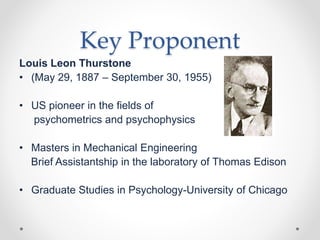
Louis Leon Thurstone
• (May 29, 1887 – September 30, 1955)
• US pioneer in the fields of
psychometrics and psychophysics
• Masters in Mechanical Engineering
Brief Assistantship in the laboratory of Thomas Edison
• Graduate Studies in Psychology-University of Chicago
Four Job-Related Tasks
assessed by the TMA Test
• Adjusting to New Situations
• Learning New skills Quickly
• Understanding Complex or
Subtle Relationships
• Thinking Flexibly
Raven’s Progressive Matrices
Wechsler Adult Intelligence Scale
Otis-Lennon School Ability Test
Stanford-Binet Intelligence Scales
IPAT Culture Fair
“Alternative Tests”
“Answers”
Three Scores are derived from the test items
• L Score of Linguistic or Verbal Ability
• Q Score of Quantitative Ability
• Total Score is the sum of L Score and the
Q Score
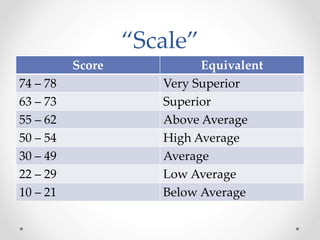
“Scale”
Score Equivalent
74 – 78 Very Superior
63 – 73 Superior
55 – 62 Above Average
50 – 54 High Average
30 – 49 Average
22 – 29 Low Average
10 – 21 Below Average
“Criticisms”
• Western Subjects
• Cultural Differences
• Discrimination on previously acquired
knowledge
Thank you!

Thurstone test ppt

  • 1.
    IQ Test: Thurstone Testof Mental Alertness Joshua J. Batalla MP-IOP
  • 2.
  • 3.
    The Testing Environment •“Quiet” • Adequate lighting and Ventilation • Provide an enclosed, professional environment that is clean, comfortable, smoke-free and conducive to testing. • Only one workstation should be placed on each four feet (1.2 meter) of space Source : Pearson Quality Testing Centers
  • 4.
    Exam Directions • Thistest consists of four kinds of questions. • For each of the four pages of test questions you are to mark your answers in the appropriate box in the answer column down the right hand side of each page • You should make a Heavy X for each answer
  • 5.
    Key Proponent Louis LeonThurstone • (May 29, 1887 – September 30, 1955) • US pioneer in the fields of psychometrics and psychophysics • Masters in Mechanical Engineering Brief Assistantship in the laboratory of Thomas Edison • Graduate Studies in Psychology-University of Chicago
  • 6.
    Four Job-Related Tasks assessedby the TMA Test • Adjusting to New Situations • Learning New skills Quickly • Understanding Complex or Subtle Relationships • Thinking Flexibly
  • 7.
    Raven’s Progressive Matrices WechslerAdult Intelligence Scale Otis-Lennon School Ability Test Stanford-Binet Intelligence Scales IPAT Culture Fair “Alternative Tests”
  • 8.
    “Answers” Three Scores arederived from the test items • L Score of Linguistic or Verbal Ability • Q Score of Quantitative Ability • Total Score is the sum of L Score and the Q Score
  • 9.
    “Scale” Score Equivalent 74 –78 Very Superior 63 – 73 Superior 55 – 62 Above Average 50 – 54 High Average 30 – 49 Average 22 – 29 Low Average 10 – 21 Below Average
  • 10.
    “Criticisms” • Western Subjects •Cultural Differences • Discrimination on previously acquired knowledge
  • 11.

Editor's Notes

  • #8 Raven’s Progressive Matrices Ipat Culture Fair Research shows a strong relationship between general mental ability and various work related outcomes. In addition to often being the strongest predictor of individual job performance, the TMA can help reduce overall turnover by helping to improve the effectiveness of hiring and placement decisions. The test can also help reduce supervisory and training time for employees in new positions and help increase overall profitability as a workforce with higher levels of cognitive ability acquires new information more easily and more quickly and is able to use information more effectively. Features _ The TMA assessment’s scores were correlated with job performance in various organizations for 10 functions, including management and non-management positions _ The test offers two comparable versions (A and B), which can be used to test applicants _ Easy to administer, the test requires only 20 minutes to complete Administration and Scoring Options
  • #9 Scores Three scores are derived from the test items:  The Same-Opposite and Definition items produce an L score of Linguistic or Verbal ability.  The Arithmetic and Number Series items produce a Q score of Quantitative Ability.  The Total Score is the sum of the L score and the Q score.  A high Total Score reflects the ability to respond correctly and quickly to the two types of items - verbal items and quantitative items. Alternating verbal items with quantitative items requires a mental shift. The rapidity with which an individual can respond to a series of alternating L and Q items can indicate how rapidly s/he is able to adapt to different situations. Scales and Norms Three scores are derived from four types of test items. There are scores for quantitative (Q) and linguistic (L) ability and a total score. The total score is the sum of the Q score and the L score. _ Quantitative: measured by Arithmetic and Number Series problems _ Linguistic: measured by Same-Opposite word meanings and Definitions items Percentile norms are listed for both subscores and the total score for the total sample.
  • #10 Use of Norms Scores on the TMA test can be interpreted by converting them to percentiles using norm tables. These tables are generated from scores of North American test takers and are intended to serve as a general guides until The JobBank develops local norms. The effectiveness of tests may vary from situation to situation. Factors such as talent available in the local labour market, job requirements within a specific company, etc. may affect score ranges. Other factors such as education, experience and motivation are also important determinants of job success. No standard score can accurately predict job performance in every situation and so it is recommended that these norms not be accepted as specific test score limits that positively designate individuals who will succeed in a given job. The JobBank will assist employers who use the TMA test to determine their own approximate score levels that can help identify effective job performance based on the cumulative experience with the test.   Percentile norms are listed by the two sub scores (quantitative and linguistic) and the total score for the following job classifications: • Manager  • Bank and insurance manager  • Human resource manager  • Sales manager  • Supervisor  • Computer programmer  • Sales representative  • General clerical  • College student  • Unskilled/skilled  • Cosmetology student  • Accounting  • Customer service  • Chief financial officer  • Marketing  • Company president  Validation studies have been conducted and scores were correlated with job performance in various companies for the following jobs: • Assistant manager  • Bank teller  • Clerical worker  • Computer operator  • Computer programmer  • Manager (retail store)  • Salesperson (retail store)  • Sales representative  • Sales supervisor  • Supervisor (insurance) 
  • #11 ** Criticisms Western Subjects - Subjects were white north American men Culture Differences - Discrimination on acquired knowledge