Iqra Shahzad 
Roll no. 72
Purpose 
 
Designed to identify individuals with brain 
dysfunction or perceptual disorders 
involving hand and eye coordination.
 
Population: Children and Adults 
Scores: Raw scores, Accuracy Score 
Time: (10-15) minutes 
Author: Richard L. Slosson 
Publisher: Slosson Educational 
Publications
Description 
 
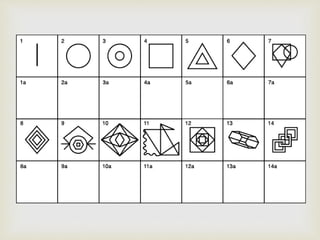
The Slosson Drawing Coordination Test 
(SDCT) is a supplement to the Slosson 
Intelligence Test (SIT). It can be given 
individually or in groups.
Scoring 
 
Each drawing is scored either “plus” when 
all lines are contained in the drawing, and or 
“minus” when the elements are 
distorted. The raw score is the total number 
of “minus” drawings. The Accuracy score is 
a percentage score for errors at a certain age, 
and is obtained from a table in the manual.

Reliability 
 
The reliability coefficient was .96 for test-retest 
reliability on a sample ranging from 4 
to 52 years, tested at the beginning and the 
end of the same session. Inter-scorer 
reliability is high, as scoring rules have been 
simplified.
Validity 
 
The goal of this test is to screen our individuals 
with serious forms of brain 
damage. Individuals with emotional or mental 
disturbances, those lacking motivation, or those 
with vision impairments may also show an 
abnormal degree of distortion on this test.
 
There are also brain dysfunctions that do not 
involve eye-hand coordination, so this SDCT 
should be used in coordination with the SIT 
to strengths and weaknesses may be 
determined from the analysis of scatter. 
Qualitative validation research involved 
testing individuals who were known to be 
brain damaged.
Norms 
 
Norms have been established for each age 
level and for each figure. Norms have been 
established for groups reflecting the 
individual’s gender, age, dexterity, artistic 
ability, vision defects and disorganizing 
emotional or mental illness.
Suggested use 
 
The SCDT can be used in conjunction with 
the Slosson Intelligence Test. It can be used to 
identify individuals with various forms of 
brain dysfunction of perceptual disorders 
where eye-hand coordination is involved.

Slosson drawing coordination test

  • 1.
  • 2.
    Purpose  Designedto identify individuals with brain dysfunction or perceptual disorders involving hand and eye coordination.
  • 3.
     Population: Childrenand Adults Scores: Raw scores, Accuracy Score Time: (10-15) minutes Author: Richard L. Slosson Publisher: Slosson Educational Publications
  • 4.
    Description  TheSlosson Drawing Coordination Test (SDCT) is a supplement to the Slosson Intelligence Test (SIT). It can be given individually or in groups.
  • 5.
    Scoring  Eachdrawing is scored either “plus” when all lines are contained in the drawing, and or “minus” when the elements are distorted. The raw score is the total number of “minus” drawings. The Accuracy score is a percentage score for errors at a certain age, and is obtained from a table in the manual.
  • 6.
  • 7.
    Reliability  Thereliability coefficient was .96 for test-retest reliability on a sample ranging from 4 to 52 years, tested at the beginning and the end of the same session. Inter-scorer reliability is high, as scoring rules have been simplified.
  • 8.
    Validity  Thegoal of this test is to screen our individuals with serious forms of brain damage. Individuals with emotional or mental disturbances, those lacking motivation, or those with vision impairments may also show an abnormal degree of distortion on this test.
  • 9.
     There arealso brain dysfunctions that do not involve eye-hand coordination, so this SDCT should be used in coordination with the SIT to strengths and weaknesses may be determined from the analysis of scatter. Qualitative validation research involved testing individuals who were known to be brain damaged.
  • 10.
    Norms  Normshave been established for each age level and for each figure. Norms have been established for groups reflecting the individual’s gender, age, dexterity, artistic ability, vision defects and disorganizing emotional or mental illness.
  • 11.
    Suggested use  The SCDT can be used in conjunction with the Slosson Intelligence Test. It can be used to identify individuals with various forms of brain dysfunction of perceptual disorders where eye-hand coordination is involved.